Showing posts with label IRTSA. Show all posts

Wednesday, 2 December 2020

Railway Employees under the Medical Insurance Scheme for obtaining treatment in private hospitals - IRMS

Railway Employees under the Medical Insurance Scheme for obtaining treatment in private hospitals - IRMS

Medical Insurance Scheme for Railway Employees

INDIAN RAILWAYS TECHNICAL SUPERVISORS ASSOCIATION
(Estd. 1965, Regd. No.1329, Website http://irtsa.net)

M. Shanmugam,
Central President, IRTSA
# 4, Sixth Street, TVS Nagar, Padi,
Chennai – 600050.
Email-  cpirtsa@yahoo.com
Mob:09443140817

Harchandan Singh,
General Secretary, IRTSA,
C.Hq. 32, Phase 6, Mohali,
Chandigarh-160055.
Email gsirtsa@ yahoo.com
(Ph: 0172-2228306, 9316131598)

No: IRTSA/CHQ/Memo .2020-13

Date: 27.11.2020

DIRECTOR GENERAL (HR)
Railway Board
New Delhi

Sub: PROPOSAL OF MEDICAL INSURANCE SCHEME FOR RAILWAY EMPLOYEES.

Ref: 1) Railway Board letter No.E(W)2020/Misc/ Dashboard- GIS, dated 27.10.2020
2) Railway Board order No.ERB-1I/2020/23/30, dated 20.10.2020.

1) Ministry of Railways constituted a committee to examine and tender their recommendations to bring all Railway Employees under the Medical Insurance Scheme for obtaining treatment in private hospitals. IRTSA submits the following for the kind consideration of Railway Board.


2) Indian Railways Medical Service (IRMS) is spread across the length and breadth of the country. IRMS is having 125 hospitals and 586 dispensaries, manned by 33,300 medical staff catering to approximately 66 lakh beneficiaries including 12.27 lakh serving employees. In the year 2018-19 Railway Hospitals treated 2.01 crore OPD patients, 5.08 lakh in-patients and performed 1.02 lakh major and specialty surgeries.

7th CPC Transport Allowance and DA granted for Indian Railway Medical Service (IRMS) officers drawing Grade Pay of Rs.10,000/- under DACP Scheme

3) Railway Hospitals performed pre-placement medical examination for 38,000 candidates and carried out periodical medical examination for 1.14 lakh employees. They also examined 12.51 lakh food and water samples.

4) Indian Railways total medical services expenses for the year 2018-19 including cost of medical staff is Rs. 6888.34 crore. That makes average medical expense per beneficiary as Rs.10,500.

5) No medical insurance company in India handles 66 lakh beneficiaries. Medical Insurance doesn’t cover OPD. Since Railway is catering 2.01 crore OPD patients in a year, it may not be possible to include huge OPD beneficiaries in private managed medical insurance.

6) In existing Railway medical system all medical services like OPD, diagnosing, medicines, Surgeries, in-patient care, major treatment/surgeries carried out in referral private/ CGHS hospitals and follow-up checking are part of employees’ welfare scheme offered to employees and their dependents. It is a part of service condition. For retired employees and their dependents who opted for RELHS on onetime payment, same medical services are extended.

7) In the Railway Medical system, no cost ceiling is fixed for entitlement of any required treatment. On the other hand, medical insurance cover is basically extended to in-patient treatments and for surgeries with a ceiling based on the premium paid.

8) For example, United India Insurance Company Limited offers Rs.10 lakh sum insured at premium rate per member Rs.12,386 in age group 41-45. If all 66 lakh Railway beneficiaries are covered under above premium Rs.8370.78 crore will be paid as total premium. Whereas total medical expense of Indian Railways for the year 2018-19 is Rs. 6888.34 crore which is for diverse services given in the Annexure.

9) In the same time there is a need for addition of more private empanelled hospitals in Indian Railways Medical Services with seamless cashless treatment, since large number of serving and retired health care beneficiaries live in the newly developed suburbs of various cities throughout India. It is pertinent to note that in case of emergency, beneficiaries first require to approach Railway Hospital, then they are referred to private hospitals and in many cases precious golden hours are lost in mere formalities endangering the life.

10) Beneficiaries living in faraway places from Railway Hospitals also find it difficult to get their regular treatments and minor treatments occasionally, since they are required to travel long distance to reach Railway Hospitals. These beneficiaries will be benefited if cashless treatment is extended to them in the hospitals available near their living place.

11) Hence it is requested that,

a. Existing Indian Railways Medical Service facilities may please be continued.

b. The proposal for Medical Insurance Scheme for Railway employees / Pensioners and their depended may please be made as additionally facility to the beneficiaries to get their regular treatments including OPD & IPD in empaneled private hospitals, premium thereof may please be borne by Railways.

Thanking You

Yours faithfully,
(Harchandan Singh),
General Secretary, IRTSA

Annexure

List of diverse services performed by Indian Railways Medical Service (IRMS)

1) Attending Railway accidents and similar incidents;
2) Emergency medical treatment for sick passengers;
3) Pre-employment medical examination for prospective employees;
4) Periodical medical examination for employees;
5) Medical boards and other medical certification for employees;
6) Safe water supply at Railway stations;
7) Safe food supply at Railway stations;
8) Running medical first-aid posts for IR factories under the Factories Act;
9) Certification of dead bodies;
10) Certification of perishable goods;
11) Curative healthcare; and
12) Preventive healthcare.

Monday, 30 July 2018

NFIR: Pay Matrix Level 8 to JE


Pay Matrix Level 8 to JE

NFIR

Pay Matrix Level 8 to JE/CMA/DMS/JE(IT) in Railways

No. IV/NFIR/ 7 CPC (Imp)/2017/R.B. Part II
Dated: 23/07/2018
Shri Piyush Goyal,
Hon'ble Minister of Railways,
Rail Mantralaya,
New Delhi.

Dear Shri Goyal Sahib,

Sub: Grave injustice done by successive Pay Commission to the category of Junior Engineers and Senior Engineers in Railways-growing dissatisfaction, discontentment and frustration among Technical Supervisors - kind intervention requested.

Ref: (i) Hon'ble MR's D.O. letter No. PC-VII/2015/R-U/9 dated 20/04/2017 to Hon'ble Finance Minister.
(ii) NFIR's letter No. IV/NFIR/7 CPC (Imp) /2017/R.B.- Part II dated 19/02/2018 to CRB and copy endorsed to MS. MF, FC, DG(P) etc.
(iii) NFIR's PNM File No. 03/2018 and 10/2018.

NFIR has been pursuing the case of Graduate Engineers/Diploma Engineers and Supervisory Officials working in different Departments since several years at the level of Railway Ministry for rectifying the imbalances in their pay structure to ensure justice to these Supervisory Officials who have been let down not only by the previous Pay Commissions but also by the Railway Board.

Pursuant to NFIR's follow up action through PNM fora (Agenda Item No. 03/2018 & 10/2018), the Railway Board through Action Taken Statement dated 10th May, 2018 has conveyed that the proposal regarding upgradation of 75% of Senior Supervisors from Level 7 (erstwhile GP 4600) to Level-8 (erstwhile GP 4800), to bring parity has already been sent to the Ministry of Finance and Hon’ble MR has also sent D.O. letter dated 20th April, 2017 to the Hon'ble Finance Minister seeking approval. The Railway Board has also informed the Federation that a meeting also been held with the Officials of Finance Ministry on 21st February, 2018 and action on hand for obtaining clearance.

NFIR brings to the kind notice of the Hon'ble MR that despite D.O letter of Hon'ble MR vide letter dated 20th April, 2017and discussions held by the Railway Ministry with Ministry of Finance on 21/02/2018, approval of Ministry of Finance has not yet been received. Hon'ble MR may kindly appreciate that in this case the Railway Ministry conceded that grave injustice has been meted out to Graduate Engineers, Diploma Engineers and Supervisory Officials in the Railway resultantly approached the Ministry of Finance to approve for upgradation of 75% posts of erstwhile GP 4600/Level-7 to erstwhile GP 4800/Pay Level-8.

Hon'ble MR may kindly appreciate that on this issue, there was an agreement between the full Board and the Federations for total replacement of GP 4600 (6th CPC)/Pay Level-7 of 7th CPC with GP 4800 (6th CPC)/Pay Level-8 of 7th CPC but sadly, the agreement has not been implemented till date.

NFIR, therefore seeks your kind intervention for the purpose of obtaining approval of the Ministry of Finance for upgradation of posts to GP 4800/- (Pay Level-8) without further delay.
With regards,

Yours sincerely,
sd/-
(Dr. M. Raghavaiah)
General Secretary
Source: NFIR

Tuesday, 1 May 2018

Post Retirement Complimentary Passes (PRCP) admissible to Ex-servicemen or CG employees - Railway Board's clarification

Post Retirement Complimentary Passes (PRCP) admissible to Ex-servicemen or CG employees - Railway Board's clarification
Government of India
Ministry of Railways
(Railway Board)
No. E(W)2016/PS5-8/2
New Delhi, dated 19.04.2018
The General Managers (P)
All Zonal Railways &
Production Units.

Sub: Clarification regarding entitled number of sets of "Post Retirement Complimentary Passes" (PRCP) admissible to lateral entrants in Railways Service.
Ref: (i) Board's letter No.E(W)2006/PS5-1/28 dated 18.04.2007.
(ii) Board's letter No.E(W)2006/PS5-1/28 dated 08.05.2008.
(iii) Board's letter No.E(W)2013/PS5-1/7 dated 16.12.2013.
(iv) Board's letter No.E(W)2013/PS5-1/28 dated 12.03.2014.

In the PNM/NFIR meeting with Board, the Federation have raised an issue that lateral entrants in Railways Service, especially ex-servicemen, who have retired or ceased to be a railway servant, after having rendered more than 20 years of qualifying service (i.e. after addition of admissible past non-railway service) are not being issued entitled number of PRCPs.

2. In this context, your attention is drawn to the amendment made vide Advance Correction Slip (ACS) No.53 to Railway Servants (Pass) Rules, 1986 (Second Edition - 1993), circulated vide Board's letter cited under Ref.(i) which provided for giving weightage only to the extent of half of the period of past non-railway service rendered by "Ex-servicemen or Central Government employees" for determining their eligibility to PRCP. The said provision was further amended vide ACS No.56, circulated vide Board's letter cited under Ref.(ii). It provided for counting of half of the period of past non-railway service rendered by the lateral entrants in non-railway departments or establishments to determine their eligibility ot PRCP subject to the condition that the said period of past non-railway service has been counted along with the railway service for pensionary benefits. It was also made clear that the number of PRCPs of such lateral entrants shall be at par with those railway servants who have retired with minimum 20 years of qualifying railway service.

3. Furthermore, in terms of ACS No. 74, circulated vide Board's letter cited under Ref.(iii), read with Board's letter cited under Ref.(iv), railway employees who retired on or after 01.01.2006 were made entitled to the following PRCP facility:-

CategoryNo. of PRCPs admissible in one year
Group A & BWith railway service of 20 years or more3 Sets
Group C2 Sets
Group D1 Set

4. Accordingly, it is clarified that the lateral entrants who have retired or ceased to be a railway servant w.e.f. 01.01.2006 after having rendered 20 years or more of qualifying service (i.e. either railway service plus half of the period of past non- railway service counted along with railway service for pensionary benefits or railway service exclusively), are entitled to the number of PRCPs as stipulated in preceding para 3.

5. The Railways are advised to follow the extant provisions of statutory rules scrupulously and issue passes accordingly.
(V. Muralidharan)
Dy. Director Estt. (Welfare)-I
Railway Board
Source: IRTSA

Tuesday, 13 June 2017

Railway Holiday Homes locations across the Country and the group wise availability of suites

Railway Holiday Homes locations across the Country and the group wise availability of suites

IRTSA has published Indian Railways Holiday Homes across the Country

 List of Holiday Homes on Indian Railways
LocationNo. of suites
Address to whom applications
should be addressed
Group
A & B
Group   C
& D
Central Railway
1Matheran
4
-
Sr.DE  , CST Mumbai
-
9
DRM(W), CST Mumbai
2Lonavala
-
3
DRM(W), CST Mumbai
-
4
PA/DRM, CST Mumbai
3Igatpuri
-
2
DRM(W), CST Mumbai
4Mahabaleshwar
4
-
DGM (G).
-
16
PA/DRM.
5Pandharpur
-
2
DRM (P), Solapur.
6Dadar
-
6
DRM (W), CST Mumbai
7Baidyanath Dham
-
6
CPO, E.Rly, Kolkatta
8Puri
2
10
-do-
9Darjeeling
3
4
-do-
10Nainital
4
7
-do-
11Haridwar
3
6
-do-
Northern Railway
12Shimla
7
13 (C)2 (D)AE  / R/Ambala
2 (A)
1 (B)
4 (C)
1 (D)
Secretary,
Railway Board.
13Barog
2 (B)
2 (C)AE  / .Rly./Ambala
14Baijnath Paprola
2 (B)
2 (C)IOW/Palampur
15Manali
3 (A)
2 (B)
-
DRM/Firozpur Cant. Jn
1 (B)
-
Secretar Sy, Rly. Board
16Haridwar
-
2
DRM/  R/Moradabad
17Nainital
2
2 (C)
1 (D)
Secretary,
Railway Board
18Mussoorie
2
2 four
bedded dormi- tories
DSE (C), Moradabad
19Badrinath
2
2
DSE (C), Moradabad
North Eastern Railway
20Nainital14
10
DRM/G, APO(W) &
Sr.DE  /Izzatnagar
21Ranikhet
2
2
Sr.DE  / Izzatnagar
22Varanasi
-
3
Sr.DE  /  ER/Varanasi
23Allahabad City
-
3
AE   or APO(W)/
E Rly., Varanasi
Northeast Frontier Railway
24Shillong
3
4
Sr.DE  /  F Rly./Pandu
25Kurseong
3
10 bedded
dormi- tory
AE  /  F Rly.,
Siliguri Jn.
26Craigment atDarjeeling
2
-
Secy. to GM,   F Rly, Maligaon.
27Darjeeling (Subordinate)
-
4
-do-
28Nainital
1
1
-do-
Southern Railway
29Madurai
-
5
DPO/S.Rly./Madurai
30Courtallam
2
6
-do-
31Rameswaram
-
2
-do-
32Palani
-
2
-do-
33Kanniyakumari
6
4
Sr.DPO/S.Rly./
Trivandrum
34Coonoor
-
4
DPO/S.Rly./Palakkad
35Udagamandalam
(Ooty)
-
8
-do-
South Central Railway
36Kolva Beach
(Vascodagama)
2
2
Sr.DPO/SCR/Hubli
37Tirupathi(Rly. Station)
6
9
Sr.DPO/SCR,
Guntakal
38Aurangabad
(Rly. Station)
2
2
Sr. DPO/ SCR,
Hyderabad.
South Eastern Railway
39Pur
i
-
8
Dy.CPO(W)/Garden Reach, Kolkatta.
40
Darjeeling
-
4
-do-
41
Ranchi
-
4
-do-
42
Digha
4
-
DGM (G)
-
2 Suites +
4 bedded dormi- tory
DPO (I)/Kharagpur Jn.
43
Araku
2
-
Sr.DE  /Coord/Waltair


-
6 bedded
dormi - tory
Sr.DPO /Waltair
Western Railway
44
Agra (Idgha)
-
4
DRM (E), Kota
45
Pali Hill, Bandra (Mumbai
-
8 (C)
2 (D)
DRM (E),Mumbai Central
46
Lonavala
-
2
-do-
47
Udaipur
-
14
DRM (E), Ajmer
-
2
SPO (W), Churchgate
48
Mount Abu
4
-
3 under PA/CE
1 under DRM/Ajmer
-
13
DRM(E), Ajmer

2
SPO (W), Church Gate.
49
Verawal (Gujarat)
-
4
DRM (E), Bhavnagar
50
Dwarka (Gujarat)
-
3
DRM (E), Rajkot


-
1
SPO (W), Churchgate
51
Gholva d
3
-
DRM/ Mumbai Central
52
Convalscent Home:
Bandra
-
2 (C)
1 (D)
/SPO W/Church Gate.
North Western Railway
53
Jaipur
-
4
DRM (E), Jaipur
West Central Railway
54
Pachmarhi
-
3
Sr.DPO, Jabalpur
South Western Railway
55
Mysore (Rly.Stn.)
-
5
DPO, Mysore.
Integral Coach Factory, Chennai
56
Udagamandalam
(Ooty)
-
4
Welfare Officer/ICF.
Rail Coach Factory, Kapurthala.
57
Patni
2
4
Dy.GM/G/RCF
Chittaranjan Locomotive Works, Chittaranjan
58
Pur
i
-
2
CPO/CLW, Chittaranjan
Diesel Locomotive Works, Varanasi
59
Nainital
1
-
Secy. to GM/DLW
60
Puri
1
1
Secy. to GM/DLW
Note:  1.        (C) means Group-C (D) means Group-D.
2.        Unless specified, the Suites under Column-2 are both for Group-A and B and under
Column-3 for both Group-C and D.


Source : Irtsa

Monday, 19 September 2016

Minimum Pay & Multiple factor after 7th CPC Memorandum submitted by IRTSA

Minimum Pay & Multiple factor after 7th CPC - Memorandum submitted by IRTSA

INDIAN RAILWAYS TECHNICAL SUPERVISORS ASSOCIATION
(Estd. 1965, Regd. No.1329, Website http://www.irtsa.net)

M.Shanmugam,
Central President, IRTSA
#4, Sixth Street, TVS Nagar, Padi,
Chennai-600050
Email-cpirtsa@yahoo.com
Mob: 09443140817

Harchandan Singh
General Secretary, IRTSA,
C.Haq.32, Phase 6, Mohali,
Chandigarh -160055,
Email-gsirtsa@yahoo.com
(Ph:0172-2228306, 9316131598)

No:IRTSA/CHQ/Memo CPC MF/2016-16
Date: 14-9-2016

Additional Secretary (Expenditure),
Government Of India
North Block
New Delhi - 110 001


For kind consideration of the Committee of Secretaries - On Minimum Pay & Fitment Facotr of 7th CPC
Subject: Minimum Pay & Multiple factor after 7th CPC
Reference: i) Para 10.1.67 Of Report of 7th Pay Commission

ii) Para 3 & 4 of Resolution No.1-2/2016-IC dated 25-07-2016 of Govt of India on 7th CPC Report

We have to make the following submissions for the kind consideration of the Committee for regarding Minimum Pay and Fitment/Multiplication Factor:

1. MODIFICATIONS ACCEPTED BY SUPREME COURT & PRESENT DAY REQUIREMENTS IGNORED BY 7TH CPC FOR DECIDING MINIMUM PAY BY Dr.W.AYKROYED FORMULA

a) The Minimum Pay Fixed at Rs.18000 by the 7th CPC is very much unjust and meager and ignores the accepted norms in this regard.

b) The Minimum wage of Rs.18000 proposed by 7th Pay Commission is based on Dr Aykroyed formula for Minimum Need Based Wage which was adopted by 15th Indian Labour Conference held in 1957. This needed to be updated as per present day requirements. As per law of natural justice and as per directions of the Supreme Court of India issued as long back as in 1991 in the case of Reputekos Brett & Co. Vs Workers & others.

c) Prescribed provision of 25% to cover education, recreation, festivals & medical expenses has been reduced to 15% by 7th CPC. Similarly provision for housing has been reduced from prescribed 7.5% to 3% which are totally inadequate, unjust and unrealistic.

d) In para 4.2.8, Step-1, 7th CPC indicated that a family is comprising of three consumption units, as per norms set by 15th Indian Labour Conference (ILC) in 1957.

e) Computing husband as one unit, wife as 0.8 unit and two children each below the age of 14 as 0.6 unit is very much inadequate and 15th ILC had not considered maintenance of aged parents.

f) Maintenance and Welfare of Parents and Senior Citizens Act, 2007 make it a legal obligation for children and heirs to provide maintenance to senior citizens and parents, by monthly allowance.

g) It is therefore, necessary that while calculating cost for maintenance household the aged parents should also be considered as 2 Units besdes the husband, wife, two Children as consumption units per family and the same should be taken at least as four (if not five) instead of three.

h) Dr. W. Aykroyd formula on food & other requirements and associated requirements specified by 15th ILC shall be applied for 4 consumptio units per family.

i) Minimum Pay works out to be Rs.24,000 (instead of Rs.18000 recommended by the 7th CPC) and the multiple factor 3.43 (instead of 2.57 recommended by the 7th CPC)

j) Table-1 of 7th CPC for calculation of minimum pay needs to be redrawn as under by keeping 4 consumption unit per family:

IRTSA-Memo-1


2. MINIMUM PLUS DA WITH 40% FIXATION BENEFIT

a) 40% fixation benefit was given over 4th CPC scale to 5th CPC scale in general to all the scales.

b) 40% of maximum of 5th CPC scale was given over 5th CPC scale as fixation benefit in general in 6th CPC scales.

c) But, only 14.29% (i.e even less than 15%) of basic pay has been given as fixation benefit is after the 7th CPC over 6th CPC pay, which is grievously inadequate.

d) Table-2 given below gives the comparison on fixation benefit given after 6th CPC & after 7th CPC.

IRTSA-Memo-2


e) The Multiple Factor of 2.57 proposed by the Pay Commission for Pay Fixation is totally unjust, inadequate and arbitrary especially keeping in view the high inflation (in real terms and wage rise in the organized sector including the PSUs after two revisions in PSUs since the Sixth CPC. The Fixation Benefit needs to be at least 40% - as after the last two Pay Commissions and the Common Multiple Factor may please be fixed at least (Pay+DA) + 40% of Pay + DA, ie. 3.15 times of 6th CPC basic pay.

Table -3 showing calculation of new pay which will be equal to Pay + Pay fixation benefit equal to 40% of 6th CPC Pay + DA

IRTSA-Memo-3


k) Minimum Pay works out to be Rs.22,100 (instead of Rs.18000 recommended by the 7th CPC) and the multiple factor 3.15 (instead of 2.57 recommended by the 7th CPC)

3. MINIMUM PAY BY MERGER OF DA EVERY TIME THE DA RISES BY 50%

a) Merger of DA with Pay & Pension was always done every time the DA crossed 50%, except after the Sixth Pay Commission and that norm justifiably needs to be restored.

b) Minimum Pay as on 1-1-2016 would be Rs.19,687 if DA was merged with Pay when the DA crossed 50% (from 1-1-2011) and when it crossed 100% even without any relief or fixation benefit of 7th CPC and the Minimum Pay would bebRs. 22,483 or say 22,500 with 14.29% of total emoluments Fixation benefit given by the 7th CPC (which itself was the lowest ever after any CPC) - as per detailed calculations submitted below:

4. a) Minimum Pay after DA Merger at 50% & 100% and with 14.29% rise.

7000×1.5 = 10500 x 1.5 = 15750×1.25 = Rs.19687×1.1429 = 22500.272 or say Rs.22000

b) Fitment Factor after DA Merger at 50% & 100% and with 14.29% rise

= 22500 / 7000 = 3.21 times of BP

c) Even if the Merger of DA was done only once after it crossed 50% (on 1-1-2011), Minimum Pay as on 1-1-2016 would have been Rs.18375 (without any relief or fixation benefit of CPC) and Rs.20984 or say Rs.21000 with 14.2% Fixation benefit given by the 7th CPC as per details below:

d) Minimum Pay after DA Merger at 50% & 100% and 14.2% rise:

= 7000 x 1.5 = 10500 x 1.75 = 18375 x 1.1429 = Rs.21000.7875 or say Rs.21000.

e) Fitment Factor after DA Merger at 50% and 14.2% rise

21000 / 7000 = 3 times of BP

f) All the foregoing calculations of Minimum Pay and Fitment Factor are linked to only 14.2% rise of wages as inherent in the recommendations of 7th CPC - which is the lowest ever rise after a Pay Commission in recent years.

g) The minimum Pay may please be fixed as Rs.22500 and the multiple factor for revision of Pay and Pension may please be fixed as 3.21.

4. It is, therefore, requested that, in view of above submissions:

a) Minimum Pay may please be fixed as Rs.24,000 and the multiple factor 3.43, by modifying Dr. W.Aykroyed Formula & 15th ILC norms by duly taking into account Maintenance and Welfare of Parents and Senior Citizens Act, 2007. (or)

b) Minimum Pay be fixed as Rs.22,100 and the multiple factor 3.15 by giving 40% fixation benefit for the 6th CPC Pay & DA. (or)

c) Minimum Pay may please be fixed as Rs.22500 and the multiple factor for revision of Pay and Pension may please be fixed as 3.21, by merging the DA with Pay whenever it crossed 50% with fixation benefit of 14.2% equitant to the rise recommended by 7th CPC.

Thanking you in anticipation,


Yours faithfully,
sd/-
Harchandan Singh
General Secretary, IRTSA


Source: IRTSA

Friday, 16 September 2016

Memorandum Reg Minimum Pay & Multiplying Factor of 7th CPC - submitted by IRTSA

Memorandum Reg Minimum Pay & Multiplying Factor of 7th CPC - submitted by IRTSA

INDIAN RAILWAYS TECHNICAL SUPERVISORS ASSOCIATION
(Estd. 1965, Regd. No.1329, Website http://www.irtsa.net )
M. Shanmugam,
Central President, IRTSA
# 4, Sixth Street, TVS Nagar, Padi, Chennai - 600050.
Email- cpirtsa@yahoo.com
Mob: 09443140817
Harchandan Singh,
General Secretary, IRTSA,
C.Hq. 32, Phase 6, Mohali, Chandigarh-160055.
Email-gsirtsa@yahoo.com
(Ph:0172-2228306, 9316131598)
No:IRTSA/CHQ / Memo CPC MF / 2016-16
Date: 14-9-2016

Additional Secretary (Expenditure),
Government of India,
North Block,
New Delhi-110001

For kind consideration of the Committee of Secretaries - On Minimum Pay & Fitment Factor of 7th CPC

Subject: MINIMUM PAY & MULTIPLE FACTOR AFTER 7TH CPC
Reference: i) Para 10.1.67 of Report of 7th Pay Commission
ii) Para 3 & 4 of Resolution No. 1-2/2016-IC dated 25-7-2016 of Govt of India on 7th CPC Report
We have to make the following submissions for the kind consideration of the Committee for regarding Minimum Pay and Fitment / Multiplication Factor:

1. MODIFICATIONS ACCEPTED BY SUPREME COURT & PRESENT DAY REQUIREMENTS IGNORED BY 7TH CPC FOR DECIDING MINIMUM PAY BY Dr. W. AYKROYED FORMULA

a) The Minimum Pay Fixed at Rs.18000 by the 7th CPC is very much unjust and meager and ignores the accepted norms in this regard.

b) The Minimum wage of Rs.18000 proposed by 7th Pay Commission is based on Dr Aykroyed
formula for Minimum Need Based Wage which was adopted by 15th Indian Labour Conference held in 1957. This needed to be updated as per present day requirements. As per law of natural justice and as per directions of the Supreme Court of India issued as long back as in 1991 in the case of Reputekos Brett & Co. Vs  Workers & others.

c) Prescribed provision of 25% to cover education, recreation, festivals & medical expenses has been reduced to 15% by 7th CPC. Similarly provision for housing has been reduced from prescribed 7.5% to 3% which are totally inadequate, unjust and unrealistic..

d) In para 4.2.8, Step-1, 7th CPC indicated that a family is comprising of three consumption units, as per norms set by 15th Indian Labour Conference (ILC) in 1957.

e) Computing husband as one unit, wife as 0.8 unit and two children each below the age of 14 as 0.6 unit is very much inadequate and 15th ILC had not considered maintenance of aged parents.

f) Maintenance and Welfare of Parents and Senior Citizens Act, 2007 make it a legal obligation for children and heirs to provide maintenance to senior citizens and parents, by monthly allowance.

g) It is therefore, necessary that while calculating cost for maintenance household the aged parents should also be considered as 2 Units besdes the husband, wife,  two Children as consumption units per family and the same should be taken at least as four (if not five) instead of three.

h) Dr. W. Aykroyd formula on food & other requirements and associated requirements specified by 15th ILC shall be applied for 4 consumptio units per family.

i) Minimum Pay works out to be Rs.24,000 (instead of Rs.18000 recommended by the 7th CPC) and the multiple factor 3.43 (instead of 2.57 recommended by the 7th CPC)

j) Table-1 of 7th CPC for calculation of minimum pay needs to be redrawn as under by keeping 4 consumption unit per family:
Calculation of Minimum Pay as on 01.01.2016 for four consumption unit per family
Per dayPCUUnitPer month4 PCUUnitPrice/ UnitRs.ExpensesRs.
1Rice/Wheat475gm57.00kg25.931478.01
2Dal (Toor/Urad/Moong)80gm9.60kg97.84939.26
3Raw Vegetables100gm12.00kg58.48701.76
4Green Vegetables125gm15.00kg38.12571.80
5Other Vegetables75gm9.00kg32.80295.20
6Fruits120gm14.40kg64.16923.90
7Milk200ml24.00litre37.74905.76
8Sugar/Jaggery56gm6.72kg37.40251.33
9Edible Oil40gm4.80kg114.02547.30
10Fish3.33kg268.38894.60
11Meat6.67kg400.902672.67
12Egg120no.4.27512.40
13Detergents etcRs/month388.41388.41
14Clothing7.33meter164.881208.57
15Total (1-14)12290.97
16Fuel, Electricity, Water Charges3072.74
17Total-(15) divided by 0.815363.71
18Marriage, Recreation, Festivals, etc.2711.24
19Total-(17) divided by 0.8518074.95
20Provide for Skill by adding 25% to (19)4518.74
21Sum (19+20)22593.69
22Housing @698.77
23Total-Divide no.21 by 0.9723292.47
24Step up of 3% on No.23 as DA is projected at 125% on 01.01.2016698.77
25Final Minimum Pay as on 01.01.2016 (23+24)23991.24
26Rounding off24000
2. MINIMUM PLUS DA WITH 40% FIXATION BENEFIT

a) 40% fixation benefit was given over 4th CPC scale to 5th CPC scale in general to all the scales.

b) 40% of maximum of 5th CPC scale was given over 5th CPC scale as fixation benefit in general in 6th CPC scales.

c) But, only 14.29% (i.e even less than 15%) of basic pay has been given as fixation benefit is after the 7th CPC over 6th CPC pay, which is grievously inadequate.

d) Table-2 given below gives the comparison on fixation benefit given after 6th CPC & after 7th CPC.

Table-2
5th CPC6th CPC%increase from 5th CPC Pay+ DA to
6th CPC Pay
6th CPC Pay +125% DA7th CPC Pay% increase from 6th CPC Pay+ DA to7th CPC
5th CPC Pay5th CPC Pay + DA86%PBGP6th CPC Basic Pay
27505115PB-11800700036.85%1800014.29%
30505673PB-11900773036.26%220501990013.68%
32005952PB-12000846042.14%245072170019.66%
40007440PB-12400991033.20%253892550015.18%
45008370PB-128001136035.72%309962920016.18%
50009300PB-242001350045.16%351863540016.54%
745013857PB-246001714023.69%425254490022.50%
750013950PB-248001815030.11%513144760012.83%
800014880PB-254002100041.13%590635310016.37%
800014880PB-354002100041.13%638825610018.73%
1032519205PB-366002535032.00%661506770016.58%
1200022320PB-376002950032.17%813027880017.05%
1430026598PB-487004610073.32%9424811850014.24%
1540028644PB-489004910071.41%14521513110019.91%
1430026598PB-4100005300099.26%15305914420035.21%

e) The Multiple Factor of 2.57 proposed by the Pay Commission for Pay Fixation is totally unjust, inadequate and arbitrary especially keeping in view the high  inflation (in real terms and wage rise in the organized sector including the PSUs after two revisions in PSUs since the Sixth CPC. The Fixation Benefit needs to  be at least 40% - as after the last two Pay Commissions and the Common Multiple Factor may please be fixed at least (Pay+DA) + 40% of Pay + DA, ie. 3.15  times of 6th CPC basic pay.
Table -3 showing calculation of new pay which will be equal to Pay + Pay fixation benefit equal to 40% of 6th CPC Pay + DA

1Minimum Pay (6th CPC)7000
2DA @ 125%8750
3Pay + DA15750
4Fixation benefit (40% of Pay + DA) & Proposed increase in real wage6300
5New Pay (3+4)22050
6Increase in basic pay (in Rs.) (5 - 1)15050
7No. of times increase in basic pay3.15
8Real wage no. of times increase1.40
k) Minimum Pay works out to be Rs.22,100 (instead of Rs.18000 recommended by the 7th CPC) and the multiple factor 3.15 (instead of 2.57 recommended by the 7th CPC)

3. MINIMUM PAY BY MERGER OF DA EVERY TIME THE DA RISES BY 50%

a) Merger of DA with Pay & Pension was always done every time the DA crossed 50%, except after the Sixth Pay Commission and that norm justifiably needs to be
restored.

b) Minimum Pay as on 1-1-2016 would be Rs.19,687 if DA was merged with Pay when the DA crossed 50% (from 1-1-2011) and when it crossed 100% even without any relief  or fixation benefit of 7th CPC and the Minimum Pay would bebRs. 22,483 or say 22,500 with 14.29% of total emoluments Fixation benefit given by the 7th CPC (which  itself was the lowest ever after any CPC) - as per detailed calculations submitted below:

4. a) Minimum Pay after DA Merger at 50% & 100% and with 14.29% rise.

7000×1.5 = 10500 x 1.5 = 15750×1.25 = Rs.19687×1.1429 = 22500.272 or say Rs.22000

b) Fitment Factor after DA Merger at 50% & 100% and with 14.29% rise

= 22500 / 7000 = 3.21 times of BP
c) Even if the Merger of DA was done only once after it crossed 50% (on 1-1-2011), Minimum Pay as on 1-1-2016 would have been Rs.18375 (without any relief or
fixation benefit of CPC) and Rs.20984 or say Rs.21000 with 14.2% Fixation benefit given by the 7th CPC as per details below:

d) Minimum Pay after DA Merger at 50% & 100% and 14.2% rise:

= 7000 x 1.5 = 10500 x 1.75 = 18375 x 1.1429 = Rs.21000.7875 or say Rs.21000.
e) Fitment Factor after DA Merger at 50% and 14.2% rise
21000 / 7000 = 3 times of BP

f) All the foregoing calculations of Minimum Pay and Fitment Factor are linked to only 14.2% rise of wages as inherent in the recommendations of 7th CPC - which is  the lowest ever rise after a Pay Commission in recent years.

g) The minimum Pay may please be fixed as Rs.22500 and the multiple factor for revision of Pay and Pension may please be fixed as 3.21.

4. It is, therefore, requested that, in view of above submissions:

a) Minimum Pay may please be fixed as Rs.24,000 and the multiple factor 3.43, by modifying Dr.W.Aykroyed Formula & 15th ILC norms by duly taking into account Maintenance and Welfare of Parents and Senior Citizens Act, 2007. (or)

b) Minimum Pay be fixed as Rs.22,100 and the multiple factor 3.15 by giving 40% fixation benefit for the 6th CPC Pay & DA. (or)

c) Minimum Pay may please be fixed as Rs.22500 and the multiple factor for revision of Pay and Pension may please be fixed as 3.21, by merging the DA with Pay whenever it crossed 50% with fixation benefit of 14.2% equitant to the rise recommended by 7th CPC.

Thanking you in anticipation,
Yours faithfully,
sd/-
Harchandan Singh,
General Secretary, IRTSA
Source : IRTSA
========================= CPC, Income Declaration Scheme, PIB, central government employee news
Government reiterates that information contained in a valid declaration under the Income Declaration Scheme, 2016 is confidential and shall not be shared with any authority.

The Income Declaration Scheme, 2016 (the Scheme) provides an opportunity to persons who have not paid full taxes in the past to come forward and declare their undisclosed income and assets. The Scheme is open for declarations up to 30.9.2016.

As regards, concerns regarding confidentiality of the information filed under the Scheme, it is reiterated that information contained in a valid declaration is confidential and shall not be shared. In respect of declarations filed with the Commissioner of Income-tax, Centralised Processing Centre, Bengaluru [CIT (CPC)], the declaration shall not be shared even with the jurisdictional Principal Commissioner / Commissioner and payments made under the Scheme shall not be visible to the jurisdictional officers. Form-2 and Form-4 required to be issued in such cases shall be system generated by the CPC.

Similarly, the declaration filed with jurisdictional Principal Commissioner/Commissioner shall not be shared with any authority within or outside the department including the jurisdictional Assessing Officer. Further, the payments under the Scheme shall neither be reflected in 26AS statement nor can be viewed by the Assessing Officer in the Online Tax Accounting System (OLTAS) of the Department in the interest of confidentiality.

PIB
========================= 7th CPC, 7th Pay Commission, Air Chief Marshal, Armed Forces, CoSC, Defence Minister, Manohar Parrikar, Parrikar, Pay Commission, central government employee news
Satisfied with Parrikar’s response on pay commission: Air Chief Marshal Arup Raha

New Delhi: The armed forces today said they have raised “anomalies” in the 7th Pay Commission with Defence Minister Manohar Parrikar and were satisfied with his response that the issue will be resolved at the earliest.

The statement by the Chairman of the Chiefs of Staff Committee (CoSC) Air Chief Marshal Arup Raha comes just days after the three services issued letters to their formations, saying they have asked the government to hold “in abeyance” the implementation of the CPC in view of the “unresolved anomalies”.
The forces argue that the anomalies lower the status and pay parity of forces vis-a-vis their counterparts in the police and civilian administration.

Raha and Navy Admiral Sunil Lanba had also met with Parrikar on Monday over the issue.
The 7th Pay Commission anomalies in respect of the armed forces were discussed with the Defence Minister in detail by the Service Chiefs and the members of the Armed Forces Pay Commission Cell, a statement by Raha’s office said.

The Defence Ministry is “seized of all the issues and has assured to resolve them at the earliest. The Services are satisfied with the response,” it said.

The statement came amid reports that the forces were not happy with Parrikar’s reply.

PTI

INDIAN RAILWAYS TECHNICAL SUPERVISORS ASSOCIATION

INDIAN RAILWAYS TECHNICAL SUPERVISORS ASSOCIATION
(Estd. 1965, Regd. No.1329, Website http://www.irtsa.net )

M. Shanmugam,
Central President, IRTSA
# 4, Sixth Street, TVS Nagar, Padi, Chennai  600050.
Email: cpirtsa@yahoo.com
Mob: 09443140817
Harchandan Singh,
General Secretary, IRTSA,
C.Hq. 32, Phase 6, Mohali, Chandigarh-160055.
Email-gsirtsa@yahoo.com
(Ph:0172-2228306, 9316131598)
No: IRTSA/CHQ/Memo/CPC-All-2016-15
Date: 12-09-2016

1. Finance Secretary & Secretary (Expenditure), North Block, New Delhi- 110001. Email: secy-exp@nic.in
2. Secretaries of Home Affairs, North Block, New Delhi - 110001 Email: hshso@nic.in
3. Secretary Defence, 101 South Block, New Delhi - 110001 Email: defsecy@nic.in
4. Secretary Post, Deptt. of Post, Sanchar Bhawan, Sansad Marg, New Delhi 110001 Email: secy-posts@nic.in
5. Secretary Health & Family Welfare, Nirman Bhawan, New Delhi - 110001 Email: secyhfw@gmail.com
6. Secretary Personnel & Training, North Block, New Delhi - 110001 Email: secy_mop@nic.in
7. Chairman, Railway Board, Rail Bhawan, New Delhi - 110001. Email: crb@rb.rail.net.gov.in

For kind consideration of the Committee of Secretaries on Allowances

Respected Sir,

Subject: 7th CPC Report - Reg. Allowances

Reference: Para 7 of Resolution of MOF GOI Notification No. 1-2/2016-IC Dated 25-7-2016
We have to submit as under for the kind consideration of the Committee on Allowances:

1. Seventh CPC in its report has categorized 196 allowances under 15 categories. Common allowances viz., Dearness Allowance, House Rent Allowance, Transport Allowance, Tour Travelling Allowance and Children Education Allowance, which fall under 3 categories i.e. Common Allowances, Department Specific Allowances and Category Specific Allowances.

Allowances are administered in broadly four ways
i. Indexed fully DA
ii. Indexed partially DA
iii. No DA indexation
iv. Percentage of Basic Pay

2. UNJUST AND ARBITRARY RECOMMENDATIONS:

a) It is regretted that none of the Allowances were dealt in detail and the Commission had recommended for abolition of 52 allowances without even going into the merit or justification of either of them.

b) Recommendations made by 7th CPC on allowances were not based on a just approach and there is need to review & revise the recommendations of 7th CPC on all allowances.

3. None of the previous Pay Commissions had ever dealt with the issue in such a ruthless, arbitrary and unjust manner, without even applying its mind to such a vital issue which affected lakhs of employees. All these Allowances had been granted as per statutory provisions of law and specific justifications and on the recommendations of the previous Pay Commissions or High Powered Committees on the specific issues.

As such, no allowances should be abolished and it should be left to the respective departments for the continuance of allowances as per nature of duties & job requirements.

4. CLASSIFICATION OF EXISTING ALLOWANCES:

As mentioned by the Pay Commission, the existing Allowances can be broadly classified as under:
SlNo.CategoryNumber of Allowances
1Allowances payable for Additional/Extra Duty14
2Allowances related to Knowledge Updates3
3Allowances related to Deputation3
4Allowances related to Working on Holidays3
5Allowances related to Housing7
6Allowances related to Good Service4
7Qualification Allowances15
8Allowances related to Risk and Hardship51
9Allowances for Running Staff of Indian Railways13
10Allowances related to Sports2
11Sumptuary Allowances5
12Allowances related to Training2
13Allowances related to Travel13
14Allowances related to Uniform9
15Other Allowances52
Total196

5. UNJUST FACTOR OF 2 ADOPTED BY 7TH CPC TO CALCULATE ALLOWANCES IN 7TH CPC SCALE (Para 4 of Chapter 8.2.5)

a. 7th CPC has used unjust factors to arrive at quantum of allowances in new pay.
b. Multiple Factor (of 2.57 recommended by 7th CPC - as may be revised by the Govt.) for revision of pay by 7th CPC be used for revision of allowances paid in fixed amount.
c. Factor of 80% of MF be used for allowances that are indexed partially with DA.
d. Factor of 40% of MF be used for allowances that are indexed fully with DA.
e. Factor of 1 be used for allowances that are paid on percentage of Basic Pay.

SNNature of AllowanceFactor recommended by 7th   CPCFactor proposed   *
1Allowances that are paid in fixed amount not indexed with DA2.252.57
2Allowances that are paid in fixed amount indexed partially with DA1.52
3Allowances that are paid in fixed amount indexed fully with DANo change1.4
4Allowances that are paid in percentage of Basic Pay0.81
* Multiple factor recommended by 7th CPC (or) as may be revised by the Govt.

6. ALLOWANCES APPLICABLE TO RAILWAYS

1. Sub: PCO ALLOWANCE (para 8.17.101) - Reduction recommended by 7th CPC is unjust and should not be implemented:

a. Incentive system followed in Indian Railways is unique for its system & within Railway Budget. The system is cost effective since it improved the productivity by better utilization of men, machine & infrastructure. By introducing incentive system in the Production Units & Workshops, Indian Railways improved its efficiency.

b. Technicians, Junior Engineers, Senior Section Engineers & helpers working in shop / section are included in the incentive system. Direct Incentive (at piece rate) is being paid to Technicians working in four grades. Average incentive based on the performance of individual shop / section is being paid to helpers & Junior Engineers. Technicians, helpers and Junior Engineers are paid at hourly rates as per RBE No.194/2009. Senior Section Engineers working in shop floor are paid 15% of their basic pay as incentive.

c. Junior Engineers & Technicians who are posted in production control organization on tenure basis in the same grade are eligible for PCO allowance in lieu of incentive at the rate of 15% of their basic pay. Likewise Senior Section Engineers who are posted in production control organization on tenure basis are eligible for PCO allowance in lieu of incentive at the rate of 7.5% of their basic pay.

d. Revision of incentive rates along with productivity improvement by reducing allowed time is being done in Railways after the implementation of every Pay Commission recommendations in a holistic manner.

e. In the year 1999 while revising the incentive rates 12.5% fatigue & contingency allowances were reduced from the allowed time. In the year 2009 while revising the incentive rates 5% allowed time had been reduced across the board. Effectively 17.5% of additional man power and corresponding additional infrastructure were made available to improve the productivity.

f. Incentive rates & PCO allowance are integral part of Incentive system being followed in Railways. Revision of incentive rates & PCO allowance have to done at same time by taking all factors including productivity improvement into consideration.

g. Hence 7th CPC’s recommendations on PCO Allowance may please be ignored and the same be continued to be paid at the existing rates of 15% & 7.5% of new basic pay respectively.

2. BREAKDOWN ALLOWANCE (para 8.10.8 & 8.10.80) Recommended for abolition needs to be continued:

a. 7th CPC has recommended for abolition of Breakdown allowance stating that it is part of Government employees’ duty to respond to emergencies.

b. Breakdown Allowance is being paid to the employees who constitute breakdown squad. Work down during breakdown is not of routine nature and it requires special skill to restore railway operation in case of emergency.

c. It also fixes responsibility to breakdown squad to respond immediately to any emergencies as per laid down procedures.

d. It is therefore requested to continue Breakdown allowance atleast equal to one day basic pay rounded off to next hundreds as per the table given below.

Proposed Rates of Break Down Allowance:
S.No.CategoryRevised Pay StructureAmount of Break down Allowance/monthProposed
BD Allowance
Pay
Band
Grade
Pay
1Helper & Gr ‘D’ staffPB-11800Rs.80 p.m.Rs.600
2.Technician Gr.IIIPB-11900Rs.120 p.m.Rs.700
3Technician Gr.II Technician Gr.IPB-1PB-12400 & 2800Rs.160 p.m.Rs.900
4.Sr. Technicians  Junior Engineers and Senior Section EngineersPB-24200 & 4600Rs.200 p.m.Rs.1200

3. NATIONAL HOLIDAY ALLOWANCE (para 8.6.11):

a. National Holiday Allowance (NHA) is paid to the Group ‘C’ Staff - when they are required to work on National Holiday. Rate of NHA is already very marginal, 7th CPC has further reduced it in terms of percentage to entry basic pay.

b. It is requested that
i. National Holiday Allowance be paid at least equal to one day wage including DA (or)
ii. Percentage to entry basic pay applied in 6th CPC shall be applied for 7th CPC basic pay as given in the table. It should be paid for working on holidays including Sundays if the employees are not given compensatory rest, and NDA may please be raised further by 25% each time DA increases by 50%.
Desg
6th CPC7th CPC
Proposed
Entry BPNH% to BPPay LevelEntry  BPNH
Recommended
by 7th CPC
%to BPApplying 6th CPC%One Day
Pay 7th CPC
BP+DA
Helper70002563.7L1180003842.1658600+DA
TechGr
-III
77302563.3L2199003841.9659663+DA
TechGr
-II
99103183.2L4255004771.9818850+DA
TechGr
-I
113604203.7L5262004771.8969873+DA
Sr.Tech135004203.1L6354006301.811011180+DA
JE135004203.1L6354006301.811011180+DA
SSE171404202.5L7449006301.411001497+DA

4. TEACHING ALLOWANCE - be paid 30% of Basic pay (para 8.14.8 & 8.14.9):

a. Given to all non-permanent faculty members joining training institutions on deputation.

b. In 1986 when this allowance was introduced 30% of total emoluments were granted. Fourth CPC reduced it to 30% of basic pay. In the year 1991-92 due to the resource crunch, the allowance was reduced to 15 % of basic pay.

c. Training allowance is granted to non-faculty members, to attract more intelligent and knowledgeable persons to the training institutes. Due the availability of incentive schemes and other benefits the present rate of Training allowance does not motivate intelligent and knowledgeable persons to join Training institutions.

d. Even though Sixth Pay Commission had not recommended for any change in % of basic pay paid as Training Allowance, Railways / Government have made principle decision to increase the Training Allowance from 15% to 30% keeping in view the necessity to attract more talent & expertise faculty to the Training Institutions, but still the decision has not been implemented.

e. But, 7th CPC has proposed to reduce the teaching allowance for existing 15% to 12% for non permanent training faculties’ working in various training institutes for non Gazteed staff.

f. In the present fast technological improvement scenario to attract intelligent and knowledgeable persons to the training institutions, the Training allowance should be restored to 30 % of basic pay and Eligibility for maximum period of five years recommended by 7th CPC should be ignored since many of Railway training institutes are having eight year tenure for teaching faculties.

5. RISK & HARDSHIP ALLOWANCE (para 8.10.64):

Recommendations on Risk Allowance by previous Pay Commission a narration
SecondCPCRecommended Rs.3 to unskilled staff working in Defense and Railways whose work was exceptionally heavy or whose normal duty involved special risks such as those of chemical process or those who handled explosives. Also extended to sweepers working in underground sewers.
Third CPCRecommended Rs.10. Included semi skilled workers worked in boiler plants and cold storage plants.
Committee on Risk allowanceClassified   the   beneficiaries   into   four   categories,   namely,   Semi-skilled,   skilled, supervisors and Certain gazetted and non-gazetted officers. The rate ranged from Rs.15 to Rs.100 per month.
Fourth CPCRecommended 100% increase in the existing rates.
Fifth CPCa)   Contingent Risk Relate to one-time events where the event is uncertain.b)   Continuous  Risk  Situation  where  the  risk  is  inherent  and  continuous  in  the occupational itself with adverse effects on health.
c)   Fifth  CPC  recommended  Risk  allowance  for  those  categories  which  fall  under sl.no.2.
d)   It also de-notified some of categories.
e)   Recommended Risk allowance ranged from Rs.40 to Rs.300.
Sixth CPC6th  CPC opinioned that risk factors in any job should be removed instead of making  allowance for them and all other conditions of work should be taken care in the pay scale itself.
But Sixth CPC didn’t followed its own recommendations and granted common pay scales for all non technical, technical and staff who works in open to sky areas.
a. On the Railways, especially in open line depots and yards, exposure to hot sun, heavy rain, cold climate and unhygienic open to sky work areas particularly, presence of human excreta are having continues inherent health risks as part of their occupation itself, that cannot be eliminated.

b. There are other areas which are having continuous inherent risk in their occupation - for example:

i. In Welding shops, Paint shops, Forge & Smith shop, Electroplating shops in Workshops and Production Units of Indian Railways having adverse effects of health.

ii. In Diesel Shed exposure to high noise to the decibel level of 180, working temperature around 50 degree centigrade and air pollution beyond permissible levels.

iii. In Track maintenance exposure to hot sun, heavy rain, cold climate and unhygienic open to sky working, presence of human excreta and other non-biodegradable wastes having inherent health risks.

iv. C&M Staff exposed to radiations like X-ray and many Chemicals.

c. It is therefore requested to extend Risk & hardship allowance to sheds & depots and open line Technical staff &Technical Supervisors as per medium & low risk factors of Risk & hardship Matrix recommended by 7th CPC.

6. Internet Allowance, Mobile Phone Allowance (para 8.17.61):

a. 7th CPC left it to individual departments / ministries to deal with internet, mobile & newspaper allowance. Indian Most Railways employees are using their individual mobile and / or internet to perform the official duty.

b. It is therefore requested that all the non-supervisory employees may please be granted with Rs.500 and Technical Supervisors may please be granted Rs.1000 as communication allowance. Or all supervisors may please be provided with CUG connections with free talk time of Rs.1000 per month.

7. Night Duty Allowance (para 8.17.77):

a. 7th CPC recommended for continuing the present formulation of weightage of 10 minutes for every hour of duty performed between the hours of 22.00 and 06.00. Hourly rate of equal to (BP+DA)/200 also continued.

b. It is requested that Formulation of weightage of 10 minutes for every hour of duty performed between 22.00 and 6.00 hours may please be changed to 20 minutes for every hour of duty performed between 18.00 and 6.00 hours in view of hazards of work during Night Shift.

7. GENERAL ALLOWANCES APPLICABLE TO ALL CENTRAL GOVERNMENT EMPLOYEES

1. DEARNESS ALLOWANCE (para 8.17.37)

a. The existing formula for DA is weighed heavily against the employees in view of following reasons:

b. All India Consumer Price Index (Industrial Workers) on which the presently based, is itself defective in so far as the weightage give to various items is arbitrary and not based on present day requirement.

c. By changing the base year to 2016 whatever advantage that had emerge out of the 7th Pay commission will be neutralized. for example the DA as on 1-7-2016 works out to be 7% on previous base year which would have been Rs.490 on the old Basic Pay of Rs. 7000 but it would now be only Rs. 360 i.e. 2% of new Basic Pay of Rs.18000.

d. Most importantly, the fraction of %age rise is totally ignored while declaring the revised DA. This considerably erodes the real wage every time the DA is revised. (For example the %age rise of Price Index from 1-1-2016 works out to be 2.92 but the DA as per existing system would be only 2% thus resulting in 0.92% erosion of Pay & Pension in the very first year of 7th CPC)
e. This is against the Law of Averages which lays down the principle that for rounding off the fraction below half may be ignored and the fraction more than half should be rounded off to the next higher point.

f. In any case, the fraction ignored in previous half year should be added in the next half year (for example the Average Price Index was 125.83 at the end of December, 2016. But the fraction of 0.83 was ignored and Pay rise was given only on 125%. The balance of 0.83% should be added to 2.92 for calculation the DA from July, 2016 thus DA @ 3% instead of 2% fro 1-7-2016).
It is, therefore, requested as under)

a) Weight-age given to various items in the All India Consumer Price Index, may please be modified as per present day requirements.

2. HOUSE RENT ALLOWANCE (para 8.7.3 to 8.7.16)

House rent allowance recommended by 7th CPC is inadequate
Sl.No.Classof
City
Existing
Population criteria
Existing rates as percentage of BPProposed
Population criteria
Proposed
Ratesof H.R.A.
a“x” Class50 Lakhs & above30%“A1” 25 Lakhs &
above
40%ofPay
+D.A.
b‘y” Class50 -5 Lakhs20%“A” 5 to 25 Lakhs30%ofPay+
D.A.
c“Z”ClassBelow 5 lakhs10%“C” & UnclassifiedBelow 5 Lakhs20%ofPay
+D.A.

3. TRANSPORT ALLOWANCE (8.15.44 to 8.15.54)

10% of Pay + DA be granted as Transport Allowance uniformly for all cities in India since the cost of fuel is almost equal in all cities and other areas.
Transport Allowance may please be revised as under:
Pay LevelHigher TPTA CitiesOther PlacesProposed Rate  of Transport
Allowance per month
9 and above7200 + DA3600 + DA10%ofPay+DA
3 to 83600 + DA1800 + DA
1 and 21350 + DA900 + DA

4. CHILDREN EDUCATION ALLOWANCE SCHEME & HOSTEL SUBSIDY (para 8.17.11 to 8.17.17)

Grant of Children Education Assistance and Reimbursement of actual Tuition Fee or 2.57 times of existing rates & Extension of the scheme.

a. Under the Scheme of Children Education Allowance reimbursement is granted to Government Servants upto a maximum of two children and for children from classes nursery to twelve, including classes eleventh and twelfth held by junior colleges or schools affiliated to Universities or Boards of Education. Annual ceiling of Rs.12,000 per child has been increased to Rs.18,000 per child when the DA crossed 100% in 6th CPC scale.

b. Limiting the scheme only upto 12th standard is also graciously inadequate, since expenses for higher education & professional education are (even in Government institutions) very high and getting out of reach of salaried people.

c. It therefore requested that
i. Actual expenses incurred towards Children Education shall be reimbursed or the existing CEA Rs.18000 shall be indexed by 2.57 to Rs.46,260.
ii. The scheme may please be extended to college education also.
iii. Children Education Allowance & Hostel Subsidy shall be allowed to avail concurrently.

5. Fixed Medical Allowance (para 8.17.52):

Considering the high cost of medical treatment in old age FMA should be raised from the present level of Rs.500 to Rs.2000 and it should be paid to all the retired employees without any restriction.

6. Family Planning Allowance (para 8.17.50 ) Recommended for abolition needs to be continued

a. Family planning allowance initially granted the amount equal to one increment of the pay scale the employee belongs, but subsequently it has been reduced considerably and the rate granted after Sixth Pay Commission is very meagre as given below,

b. It requested to grant Family Planning Allowance at least equal to one increment in the revised scale, or it should be indexed by the factor of 2.57 and rounded off to next hundred as given in table below.

Sl.
No.
NameofPay
Band/Scale
PayBandsGrade
Pay
Existing rates of family planning allowanceProposed rate of family planning allowance
1-1S4440-74401300210600
2-1S4440-74401400
3-1S4440-74401600
4-1S4440-74401650
5PB-15200-202001800
6PB-15200-202001900
7PB-15200-202002000
8PB-15200-202002400
9PB-15200-202002800250700
10PB-29300-3480042004001100
11PB-29300-348004200
12PB-29300-348004200
13PB-29300-348004200
14PB-29300-348004200
15PB-29300-3480046004501200
16PB-29300-3480048005001300
17PB-29300-3480054005501500
18PB-315600-391005400
19PB-315600-391005400
20PB-315600-391005400
21PB-315600-3910066006501700
22PB-315600-391006600
23PB-315600-391006600
24PB-315600-3910076007502000
25PB-315600-391007600
26PB-315600-391007600
27PB-437400-6700087008002100
28PB-437400-670008700
29PB-437400-6700089009002400
30PB-437400-670008900
31PB-437400-670001000010002600
32PB-437400-6700010000

IV. ALLOWANCES WHICH ARE NOT CONSIDERED BY 7TH CPC.

1. Sub: Grant of PCO Allowance / Incentive Bonus to Technical Staff Supporting Shops / Sections (including  CMT / (C & M Lab), Drawing / Design, IT Power Supply & Stores etc)  in Railway Workshops & Production Units  Treating them as part of Inspection, Planning & Progress wings of PCO.

a. Technical Staff in Drawing / Design Office, CMT/ (M & C Lab), IT, Stores, Maintenance & Power Supply etc., in Railway Workshops & Production Units play important roles in improving the production & productivity through upkeep & maintenance of machinery, plants & equipments; improved Tools, Templates, Jigs & Fixtures & designing of components & prototypes of Rolling Stocks; ensuring uninterrupted supply of Power and requisite Stores; and effective quality control through intensive inspection & Testing (including 100% Testing in many areas of in house production) to ensure correct chemical composition & metallurgical qualities as per specifications etc.

b. But all these staffs are not paid either any Incentive Bonus or the PCO Allowance like the other Technical Supervisors & Staff in the PCO (Production Control Organisation). Thus they get less take home pay than the rest of the technical staff in the Workshops & Production Units, inspite of substantial contribution & technological inputs to the productivity. This is against the principle of “equal work equal pay” and discriminatory.

c. It is, therefore, requested that the Technical Staff in Supporting Shops / Sections (including CMT / (C & M Lab), Drawing / Design, IT, Maintenance, Power Supply & Stores etc) - in Workshops & Production Units be treated as part of Inspection Planning & Progress wings of PCO & paid either the PCO Allowance or Incentive Bonus as EIW Staff - at par with their counterparts working in PCO / Shop floor.

2. DESIGN ALLOWANCE

a. Fifth Pay Commission ( vide Para 50.19 ) had recommended for grant of Design Allowance of Rs.300 for Junior Engineers and Rs.600 for Assistant Engineers and the Recommendation was accepted by the Government and implemented in the CPWD ( vide their letter No. 15/4/98-DW(S&D)547-1000 dated 9.6.2000), but the same was not implemented by the Railways although the JEs & SSEs in the Drawing & Design Offices on the Railways do a lot of designing work as mentioned in details in annexure of this report. This is very unjust and discriminatory.
b. It is therefore requested to kindly recommend for grant of Design Allowance to the JEs & SSEs in the Drawing & Design Office on the Railways - at par with their counterparts in the CPWD.

3. GRANT OF SPECIAL PAY or IT ALLOWANCE

a. To get the maximum advantage from the latest Information Technology the Railways had to induct talented IT Engineers who are in possession of not only the domain knowledge of the functioning of the day to day working of the Zone, Division & workshop; but also additionally the skill and aptitude for and possessing I.T Skills for manning and administering the Computer Centres started in different Workshops and Divisions.

b. The different Zonal Railway Administrations have formed IT Centres by inducting good number of Technical Supervisors / Supervising Engineers and other Technical Personnel (in addition to staff from other categories) from the Workshops / Divisions - (preferably) possessing higher qualifications like B.E. / AMIE etc. Computer Aptitude Test and gave them specialized training in various computer aspects for efficient maintenance of EDP Centres as well as different M.I.S Application Packages. There is also element of Direct Recruit in the Grade Of Junior Engineer/IT & Senior Engineer/IT.

c. These IT Engineers have been performing the sophisticated jobs without any Special Pay which is in vogue for other categories of staff for performing special types of jobs like imparting training in the Training Organisation on Railways.
d. It is therefore requested that to grant Special Pay or IT Allowance to Junior Engineers/IT & Senior Engineer/IT to attract and retain talented personnel in this new horizon of Information Technology.

4. CCA - CITY COMPENSATORY ALLOWANCE

a. CCA - City Compensatory Allowance should be restored to meet the peculiar needs especially of the big cities and Metros, towards payment of Professional Taxes to the Local Governments/Local Authorities, Miscellaneous expenses, higher expenses of children for attending to distant schools and colleges, etc

b. CCA be linked to the Consumer Price Index or D.A. The rates of CCA be automatically increase by 25% whenever the Dearness Allowance goes up by 25%.
PROPOSED RATES OF C.C.A.

Sl.No.Class of CityProposed Rates of  C.C.A.
a“x” Class15%ofPay+D.A
b“y” Class10%ofPay+D.A
c“Z” Class8%ofPay+D.A
Thanking You
Yours faithfully,
sd/-
Harchandan Singh,
General Secretary, IRTSA
Source : IRTSA

Flash News

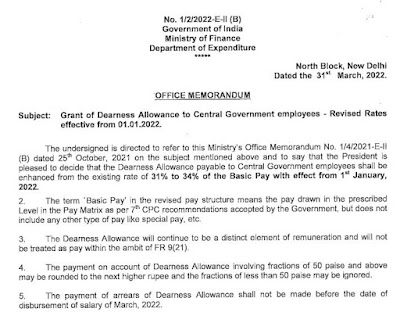
DA Jan 2022 - Grant of Dearness Allowance to Central Government employees - Revised Rates effective from 01.01.2022

 3% DA Hike - Revised Rates effective from 01.01.2022: DoE OM dated 31.03.2022 No. 1/2/2022-E-II (B) Government of India Ministry of Finance...