Saturday, 28 January 2017

7th Pay Commission: In 70 years, senior government officials salary hiked from Rs 2,000 to Rs 2.50 lakh


7th Pay Commission: In 70 years, senior government officials salary hiked from Rs 2,000 to Rs 2.50 lakh


7th CPC salary hike


The 7th pay commission has recommended a 14.27% increase in the basic pay of government employees.
1. In the last 70 years, the government has announced 7 pay commissions.
2. In 1947, govt officials lowest salary was Rs 55 per month.
3. The 7th pay commission has recommended a hike of 14.27 pc in govt employees salary.
In the last 70 years, the Central government has announced seven central pay commissions. The 7th pay commission has recommended a 14.27 per cent increase in the basic pay of govt employees.

In 1947, after India's Independence, the lowest salary of a central government employee was Rs 55 per month while the senior most officials took home a salary of Rs 2000 per month. After the 6th pay commission, the monthly salary of senior government officials rose to Rs 90,000 with the lowest salary being Rs 7000 per month.

Central Pay Commission's previous recommendations:
Central Pay Commission's previous recommendations

Following was the salary slabs of government employees in different pay commissions:

 salary slabs of government employees

 The government employees' salaries saw a significant rise with the 7th pay commission. Now, after the 14.27 per cent increase in basic salary, the lowest salary has been increased to Rs 18,000 from Rs 7,000 while the salary of senior government officials has gone up to Rs 2.50 lakh from Rs 90,000.

In the last 70 years, the Centre has increased the minimum salary of its employees from Rs 55 to Rs 18,000 per month - a hike of 32,727 per cent.

Whereas the salary of senior officials has seen a quantum jump of 12,500 per cent in the same period, from Rs 2,000 per month to Rs 2.50 lakh.

Source: Indiatoday

Revision of rates of subscription under Central Government Health Scheme as per 7th CPC


Revision of rates of subscription under Central Government Health Scheme as per 7th CPC

No.S.11011/11/2016-CGHS(P)/EHS
Government of India
Ministry of Health and Family Welfare
EHS Section
Nirman Bhawan, New Delhi
Dated the 13th January, 2017
OFFICE MEMORANDUM

Sub: Revision of rates of subscription under Central Government Health Scheme due to revision of pay and allowances of Central Government employees and revision of pension/ family pension on account of implementation of recommendations of the Seventh Central Pay Commission.

In partial modification to this Ministry’s OM of even No. dated 9th January, 2017 on the subject mentioned above, the undersigned is directed to say that the revised rates will be effective from 1st February 2017 instead of 1st January, 2017.

2. Other contents of the above said OM will remain unchanged.
sd/-
(Sunil Kumar Gupta)
Under Secretary to the Government of India
Tel. 23061986
No. S.11011/11/2016 CGHS(P)/EHS
Government of India
Ministry of Health and Family Welfare
EHS Section
Nirman Bhawan, New Delhi
Dated the 9th January, 2017
OFFICE MEMORANDUM

Sub: Revision of rates of subscription under Central Government Health Scheme due to revision of pay and allowances of Central Government employees and revision of-pension/ family pension on account of implementation of recommendations of the Seventh Central Pay Commission.

The undersigned is directed to refer to this Ministry’s OM No. S.11011/2/2008-CGHS(P) dated 20th May, 2009 vide which orders were issued revising the rates of monthly subscription for availing CGHS facility, as also the entitlement for free diet, entitlement of accommodation in private empanelled hospitals under CGHS, etc.

2. Consequent upon revision of pay on the basis of the implementation of the recommendations of the 7th Central Pay Commission, it has been decided to revise the rates of subscriptions, to be made by employees / pensioners, for availing benefits under the CGHS, with effect from 1st January, 2017. It has also been decided to revise the monetary ceiling limits for various entitlements of the beneficiaries for availing CGHS facilities.

3. In supersession of all earlier instructions, the following revisions are being made, in so far as it relates to the facilities mentioned below:

(A) Monthly Contributions for availing CGHS facility:

Sl. No. Corresponding   levels in the  Pay Matrix  as per 7th CPC     Contribution (Rs. Per month)
1 Level: 1 to 5  250
2 Level: 6   450
3 Level: 7 to 11  650
4 Level: 12 & above   1000

(B)       Entitlement    of wards in private hospitals empanelled   under CGHS:
Sl. No. Corresponding   Basic Pay drawn  by the officer  in 7th CPC per month       Ward  entitlement
1 Up to  Rs. 47,600/-  General
2 Rs. 47,601/-  to Rs. 63,100/- Semi-Private
3 Rs. 63,101/-  and above     Private

(e) Monetary Ceiling for Free Diet:
The monetary ceiling for free diet for CGHS beneficiaries is revised to pay/ pension / family pension of Rs. 44,900/- per month.

(D) Monetary ceiling for free diet for beneficiaries suffering from TB or mental disease):
The monetary ceiling for free diet in case of beneficiary suffering from TB or Mental disease is revised to pay / pension / family pension of Rs. 69,700/- per month.

(E) Pay slab for determining the entitlement of Nursing Home facilities in Government / State Government / Municipal Hospitals:
The monetary ceiling for determining the entitlement of nursing home facilities in Central Government / State Government / Municipals Hospitals is revised to pay / pension / family pension Rs. 47,600/- per month and above.

(F) Monetary Ceiling for direct consultation with Specialists in Central Government /State Government /Municipal Hospitals:
The monetary ceiling for determining the entitlement for direct consultation with Specialists in Central Government / State Government / Municipal Hospitals will continue at the existing rates until revision of the same after consultation with Ministry of Finance.

(G) Pay slab for determining the entitlement of accommodation in AIIMS, New Delhi.

The revised entitlement, as per the pay drawn by the officials, is as follows:
Sl . No. Corresponding   Basic Pay drawn  by the  officer  in 7th   CPC per month   Ward  entitlement
1 Up to Rs. 63,100/-       General
2 Rs. 63,101/-  to Rs. 80,900/- Private
3 Rs. 80,901/-  and above  Deluxe/Private

4. It is clarified that the reference to pay in this order relates to the pay drawn in the level of pay.

5. Pensioners have an option to get their CGHS pensioner card made by either making CGHS contribution on an annual basis (twelve months) or by making contribution for 10 (ten) years {120 (one hundred and twenty) months} for getting a pensioner CGHS card with life-time validity. It is clarified that:
(i) Contribution to be made by pensioners / family pensioners would be the amount that they were subscribing at the time of their retirement or at the time of death of the Government servant;

(ii) Pensioner beneficiaries, who have already obtained CGHS card with life time validity by paying a lump sum amount equivalent to 10 years’ contribution, will not be required to pay any additional amount as a result of the revision in the rates of contribution for availing CGHS facility;

(iii) Entitlement of pensioners / family pensioners, who have already deposited their contribution for life time CGHS facility, will not be changed.

(iv) Pensioners / family pensioners who are contributing to the CGHS on an annual basis and wish to continue to avail CGHS benefits will have to contribute at the revised rates up to the time of contribution needed to cover a period of a total of ten years from the time pensioner CGHS card was issued for the first time to them. The revised rate of contribution for the remaining period would be with reference to the level of pay that he / she would have drawn in the post held by him / her (at the time of his / her retirement / death) had he / she continued to be in service now but for his / her retirement/ death; and

(v) Any pensioner / family pensioner who is entitled to avail CGHS facility has not so far got his / her pensioner CGHS card made, the rate of contribution in such cases will be with reference to the level of pay that he / she would have drawn in the post held by him / her (at the time of his / her retirement / death) had he / she continued to be in service now but for his/ her retirement / death.
6. This issues with the concurrence of the Department of Expenditure vide their I.D. Note No. 18(1)/EV/2016, dated 24/11/2016.

7. Hindi version will follow.
sd/-
(Sunil Kumar Gupta)
Under Secretary to the Government of India
Authority: http://cghs.gov.in/

TDS on approved Provident and Superannuation Funds as per Income-Tax Act

TDS on approved Provident and Superannuation Funds as per Income-Tax Act

income-tax-deduction-2017


TDS on payment of accumulated balance under recognised provident fund and contribution from approved superannuation fund

Ministry of Finance has issued a circular about details of TDS on approved Provident and Superannuation Funds as per Income-Tax Act

TDS ON PAYMENT OF ACCUMULATED BALANCE UNDER RECOGNISED PROVIDENT FUND AND CONTRIBUTION FROM APPROVED SUPERANNUATION FUND:

    The   trustees of a Recognized Provident Fund, or any person   authorized   by the regulations of the Fund   to  make payment of  accumulated   balances due   to  employees, shall   in   cases where sub-rule(1) of Rule 9 of Part A of the Fourth Schedule   to the Act applies, at the time   when the accumulated   balance due to an employee is paid, make therefrom   the deduction specified in Rule 10 of Part A of the Fourth Schedule to the Act.

The accumulated balance is treated as income chargeable under the head “Salaries”.

Where any contribution   made by an  employer,  including   interest on  such  contributions,  if any, in  an approved Superannuation Fund is paid to the employee,  tax on the  amount so paid shall be deducted by the trustees of the Fund  to the extent provided in Rule 6 of Part B of the Fourth Schedule to the Act. TDS should be at the average rate of tax at which, the employee was liable to be taxed during the preceding three years or during the period, if that period is less than three years, when he was member of the fund.

The deductor shall remain liable to deduct tax on any sum paid on account of returned contributions (including interest, if any)  even if a fund or part of a fund ceases to be an approved Superannuation fund.

As per section 192A of the Act, w. e. f. 01.06.2015 the trustees of the EPF Scheme 1952 framed under section 5 of the EPF & Misc. Provisions Act, 1952 or any person authorized under the scheme to make payment of accumulated balance due to employees, shall, in a case where the accumulated balance due to an employee participating in a recognized provident fund is includible in his total income owing to the provisions of Rule 8  of Part A of Fourth Schedule not being applicable at the time of payment of accumulated balance due to the employee, deduct income tax thereon @ 10% if the amount of such payment or aggregate of such payment exceeds Rs 50,000/-. In case the employee does not provide his/her PAN No., then the deduction will have to be made at maximum marginal rate.

Check the Circular

GST will not lead to job losses at central excise dept, assures Jaitley


GST will not lead to job losses at central excise dept, assures Jaitley

New Delhi: Ahead of the rollout of GST, Finance Minister Arun Jaitley today sought to address concerns of job loss from reduced work of central excise and service tax officials, saying they should have no insecurity as enough work and opportunities will be available to them in the new indirect tax regime.

"I see no reason really for disquiet for the simple reason (that) opportunities which are available to people in service and the matter of policy and constitutional guarantee are all protected," he said at the Investiture Ceremony 2017 and International Customs Day 2017 organised by CBEC here.

Only the nature of activity will change because there will be one national sales tax replacing an array of central and state levies like excise duty, service tax and VAT.

"Important changes and evolutions which take place are never put on the back burner" just because the people who conduct the activity would now have to work in an altered form and environment, he said.

"The number of people required, the kind of opportunity will remain unchanged except that the nature of activity itself changes," he said.

GST, he said, has for last several yeas been considered as a larger part of policy consensus in India and an important taxation reform that will lead to the economic integration of the country.

"Once it takes place you have a situation where taxes (that) are levied by the state (and) by Centre (will) all be integrated into one and therefore resulting in one assessment.

"Multiple systems on assessment which is there at present will evolve into a newer kind of system," he said.

He was responding to Central Board of Excise and Customs (CBEC) Chairman Najib Shah’s remarks drawing his attention to "the rising disquiet in the cadre", saying there were human resource issues in the service.

Jaitley said the revenue to be collected is going to expand and there will be expansion of economic activity as well.

"Therefore even though you have two parallel machineries which could now be converging into similar kind of activities and shared responsibility, I think the future will stand witness to the fact that there will be adequate amount of opportunities to be created and therefore the kind of disquiet in service, the kind of personal pressure I see on you should reduce as there is no real occasion for a fear of this kind or a sense of insecurity for anyone in this service," he said.

The Finance Minister said change and evolution are an integral part of any economic order, and they are never held back because the nature of responsibility is going to change.

"This is an ongoing process it will continue and we will all have to adjust ourselves with this particular change. I can only assure you that there is no reason for disquiet, you can go and have a comfortable sleep tonight,” he told the revenue officials.

Revenue Secretary Hasmukh Adhia told the officers that they will have enough work to do under GST.

The Indian Revenue Service (Customs and Central Excise) Officers Association has asked the government to protect the sanctity of their service amid attempts by officers of state government VAT departments to equate themselves with IRS (Customs and Central Excise) officers.

PTI

Friday, 27 January 2017

Budget may bring good news for salaried people

Budget may bring good news for salaried people
Budget 2017 Good News


New Delhi: Every year when the Union finance minister presents the Budget speech, the ‘salaried people’ looks to him with expectations for reducing their tax liability.

It is possible that there would be some moves in this regard in the coming one.

The salaried people could get some relief as finance minister Arun Jaitley is likely to raise the minimum income threshold for paying personal income tax for those below 60 years of age to Rs 3 lakh a year from Rs 2.5 lakh at present and the deduction limit under Section 80C to Rs 2 lakh in the Union Budget for 2017-18, multiple sources told The Sen Times.

Currently the tax exemption slab is at Rs 2.5 lakh for individuals below 60 years, while deduction under Section 80C is Rs 1.5 lakh.

Union Finance Minister Arun Jaitley raised the personal income tax exemption limit from Rs 2 lakh to Rs 2.50 lakh on July 11, 2014 in the Union Budget for 2014-15.

Jaitley may also raise section 80C deductions limit to Rs 2.0 lakh, the sources said.

This move aimed at boosting household savings. The hike in deductions limit for investments by individuals in financial instruments to Rs 2.0 lakh would come as a sigh of relief for the salaried people blatting high inflation.

Investments under Section 80C up in popular tax saving instruments such as the general provident Fund, public provident fund, NPS, national savings scheme, unit-linked insurance plans and equity-linked savings schemes are not taxed up to the allowed threshold.

Section 80C was introduced by the UPA government in 2005-06 with a limit of Rs 1 lakh but UPA government did not revised it since then. Jaitley raised it up to Rs 1.5 lakh in the Union Budget for 2014-15.
Deduction on payment of income tax on interest paid on loans for self occupied houses may be also raised to Rs 2.5 lakh from Rs 2.0 lakh, the sources added.

Union Finance Minister will present the Union Budget on Wednesday.

TST

Clarifications on implementation of GAAR provisions under the Income Tax Act, 1961


Clarifications on implementation of GAAR provisions under the Income Tax Act, 1961

The General Anti Avoidance Rule (GAAR) provisions shall be effective from the Assessment Year 2018-19 onwards, i.e. Financial Year 2017-18 onwards. The necessary procedures for application of GAAR and conditions under which it shall not apply, have been enumerated in Rules 10U to 10UC of the Income-tax Rules, 1962.The provisions of General Anti Avoidance Rule (GAAR) are contained in Chapter X-A of the Income Tax Act, 1961.

Stakeholders and industry associations had requested for clarifications on implementation of GAAR provisions and a Working Group was constituted by Central Board of Direct Taxes (CBDT) to examine the issues raised. Accordingly, CBDT has issued the clarifications on implementation of GAAR provisions today.

Amongst others, it has been clarified that if the jurisdiction of FPI is finalized based on non-tax commercial considerations and the main purpose of the arrangement is not to obtain tax benefit, GAAR will not apply. GAAR will not interplay with the right of the taxpayer to select or choose method of implementing a transaction. Further, grandfathering as per IT Rules will be available to compulsorily convertible instruments, bonus issuances or split / consolidation of holdings in respect of investments made prior to 1st April 2017 in the hands of same investor. It has also been clarified that adoption of anti-abuse rules in tax treaties may not be sufficient to address all tax avoidance strategies and the same are required to be tackled through domestic anti-avoidance rules. However, if a case of avoidance is sufficiently addressed by Limitation of Benefits (LoB) provisions in the tax treaty, there shall not be an occasion to invoke GAAR.

It has been clarified that if at the time of sanctioning an arrangement, the Court has explicitly and adequately considered the tax implications, GAAR will not apply to such an arrangement. It has also been clarified that GAAR will not apply if an arrangement is held as permissible by the Authority for Advance Rulings.

Further, it has been clarified that if an arrangement has been held to be permissible in one year by the PCIT/CIT/Approving Panel and the facts and circumstances remain the same, GAAR will not be invoked for that arrangement in a subsequent year.

The proposal to apply GAAR will be vetted first by the Principal Commissioner of Income Tax / Commissioner of Income Tax and at the second stage by an Approving Panel headed by a judge of High Court. The stakeholders have been assured that adequate procedural safeguards are in place to ensure that GAAR is invoked in a uniform, fair and rational manner.

Government is committed to provide certainty and clarity in tax rules. Further clarifications, if any, on doubts of stakeholders regarding GAAR implementation, will also be provided.

PIB

Review of CSSS officers in the Grade of Personal Assistant under FR 56 (j) and Rule 48 of CCS(Pension) Rules, 1972


Review of CSSS officers in the Grade of Personal Assistant under FR 56 (j) and Rule 48 of CCS(Pension) Rules, 1972
Reminder
No. 25/9/2016-CS-II(C)
Government of India
Ministry of Personnel, Public Grievances and Pensions
Department of Personnel & Training

3rd Floor, Lok Nayak Bhawan,
Khan Market, New Delhi-11 0003
Dated: 25th Jan, 2017
OFFICE MEMORANDUM

Subject: Review of CSSS officers in the Grade of Personal Assistant under FR 56 (j) and Rule 48 of CCS(Pension) Rules, 1972-reg.

The undersigned is directed to refer to this Department's D.O. letter No. 3/8/2015-CS.1 (D) dated 26.02.2016 and subsequent reminders dated 08.11.2016, 29.11.2016 and 23.12.2016 vide which all the cadre units of CSSS were requested to furnish the inputs in the format annexed therewith with respect to the officers who in the opinion of Ministry/Department, are covered under extant provisions of FR 56 (j)/Rule 48 of CCS(Pension) Rule, 1972. However, the inputs sought in respect of PA Grade are still awaited from several Ministries/Departments.

2. It is, therefore, once again requested to all the defaulting cadre units to furnish the requisite information in respect of PA Grade who are due to review under the provisions of FR 56U) to this Department within a week positively.
(Pradeep A)
Under Secretary to the Government of India
Tel: 24623157
To
Under Secretaries of all defaulting Cadre units of CSSS
Read More

GST - 70,000 Tax Officials warn of non-cooperation movement


GST - 70,000 Tax Officials warn of non-cooperation movement

Opposing some recent decisions taken by GST Council, various indirect tax officials' associations today decided to start non-cooperation movement.

To start with, the employees associations will not celebrate international customs day on Friday. Besides, they will observe 'black day' by wearing black badges on Martyrs' Day, i.E. January 30, as per minutes of meeting held among their representatives here.

The associations said that their members are "highly disappointed" and feel "cheated" over the decisions taken by Finance Minister Arun Jaitley-led GST Council in its meeting on January 16.

The Council had agreed to give states the powers to levy tax on economic activity within 12 nautical miles of territorial waters and to administer 90 per cent of the tax payers under Rs 1.5 crore annual turnover.

"We feel that the biggest tax reform of the century should have been in conformity with the principles of responsibility and authority going together and also in conformity with the Constitutional design. We feel that the decision shall weaken the Centre's ability to ensure its revenues.

"The decision will not only adversely affect the career of revenue officers but it is not in national interest. We oppose the decisions taken by GST Council and requests for deferment and review of above inappropriate and incorrect decisions," as per the minutes of meeting of steering committee of associations representing Group A, B and C employees of Central Board of Excise and Customs (CBEC).

The decision came after a meeting of representatives of Indian Revenue Service (Customs and Central Excise), All India Association of Central Excise Gazetted Executive Officers, All India Central Excise Inspectors' Association and All India Central Excise and Service Tax Ministerial Officers Association, comprising 70,000 personnel, here, office bearers said.
According to them, the decision taken by GST Council in its January 16, meeting will not only weaken the Centre but also adversely affect the Indian economy and revenue collection but also national security.

They have decided to request authorities concerned to take immediate necessary action to resolve the issues and to defer the unjustified decision of GST Council taken under pressure of state VAT officers.

"We feel that if the above genuine demands in national and revenue interest are not considered then this disciplined service will be forced to initiate non-cooperation movement following Gandhian methods of Satyagraha," the associations said.

The Goods and Services Tax (GST) is likely to be rolled out from July 1, as against April 1 decided earlier by the government.

PTI

Representation of Defence Civilian Employees Federations regarding misinterpretation of RPR 2016 leading to incorrect pay fixation of employees

MoD once again issued a clarification orders with three illustrations of an employee shall be fixed who has been granted financial upgradation in MACP on 15.3.2016 in the grade pay of Rs.4200.

MoD action on BPMS's representation on Seeking of Clarification regarding Option & Pay Fixation in 7th CPC
Office of the Controller General of Defence Accounts
Ulan Batar Road, Palam, Delhi Cantt - 110010
No.AT/II/2701/Orders
Dated: 05 Jan 2017
To
All PCsDA/CsDA
PCA(Fys)/All CsFA(Fys)
(Through NIC mail server

Subject: Representation of Defence Civilian Employees Federations regarding misinterpretation of RPR 2016 leading to incorrect pay fixation of employees.

A copy of MoD/D (Civ-I) ID No 11 (6)/2016-D(Civ-I) dated 07.12.2016 along with all its enclosures on the above subject is forwarded herewith. It is seen that MoD/D(Civ-I) has requested that the clarification on the subject from MoF/MoD(Fin) may be awaited. Accordingly, the instructions issued by MoD in para 2 of the MoD ID dated 7.12.2016 may be adhered to avoid any inconsistencies in the matter of pay fixation.
Jt CGDA (P&W) has seen.
(Vinod Anand)
Sr ACGDA (P&W)
The employee has exercised option 2 to fix the pay in the Pay Matrix after availing the increment dated 1.7.2016, in the old pay structure scale.


Option 2 is exercised by the employee to fix the pay in the new pay matrix after availing promotional upgradation under MACP Scheme that look place on 1.1.2016.


Option 2 is exercised by the employee to fix the pay in the pay matrix after availing promotion/MACP upgradation as on 15.3.2016


Click to view the order
Authority: http://pcafys.nic.in/

General Budget 2017-18 - NFIRs proposals for consideration


General Budget 2017-18 - NFIR's proposals for consideration
NFIR
National Federation of Indian Railwaymen
3, Chemlmsford Road, New Delhi - 110 055
Affiliated to:
Indian National Trade Union Congress (INTUC)
International Transport Workers’ Federation (ITF)
No.IV/Budget/Part III
23.01.2017
Shri Arun Jaitley,
Hon'ble Minister of Finance,
North Block, New Delhi.

Dear Sir,

Sub: General Budget 2017-18 - NFIR's proposals for consideration

The National Federation of Indian Railwaymen (NFIR) requests the Hon'ble Finance Minister to consider its proposals listed below for inclusion in the General Budget 2017-18 to be presented in Parliament in February, 2017.
1. The Income Tax exemption limit for Central Government Employees may be raised to atleast Rupees Six Lakhs
2. The Income Tax exemption limit for senior citizens may be raised to Rs.7.5 lakhs and for those Senior Citizens above 75 years age, the exemption be allowed up to Rs.10 lakhs.
3. Transport Allowance presently paid to the Central Government Employees may be exempted from the purview of Income Tax.
4. Fixed Medical Allowance to the retired Central Government Employees may be revised to not less than Rs.2,000/- Per month.
5. Grant House Rent Allowance at the rate of 30%, 20% & 10% of 7th CPC Pay to the Central Government Employees working at Cities/Towns classified as 'X' 'Y' & 'Z' respectively with back date.
6. Contract Labour performing jobs of perennial nature be granted wages at par with the regular employees performing similar jobs.
7. Child Care Leave for women employees be revised upwardly.
8. Pension parity be granted all those pre 1.1.2016 Pensioners of Central Government.

Proposals - Railway Specific

9. Additional funds be allocated for augmenting Railway Training Institutes and Railway Community Halls, Recreation Clubs etc'.
10. More funds may be provided for construction of new quarters in the Railways and for maintenance of Railway colonies.
11. Training Allowance for Trainers in Railways Training Institules may be enhanced to 30% of pay in lieu of the existing 15%.
12. Separate Rest Rooms for Women Railway Employees at different locations be sanctioned to enable them to stay when they visit on railway duties.
13. Additional Road Mobile Medical Vans may be approved for providing medical treatment to the railway employees and their families living at remote places and jungle stations.
sd/-
(Dr. M.Raghavaiah)
General Secretary
Source: NFIR

Flash News

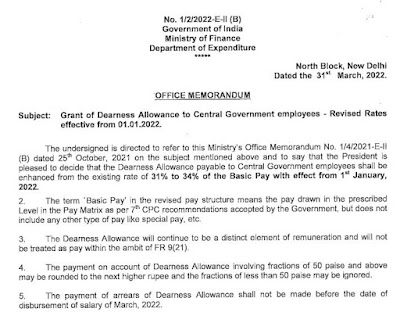
DA Jan 2022 - Grant of Dearness Allowance to Central Government employees - Revised Rates effective from 01.01.2022

 3% DA Hike - Revised Rates effective from 01.01.2022: DoE OM dated 31.03.2022 No. 1/2/2022-E-II (B) Government of India Ministry of Finance...