Saturday, 13 February 2016

Draft Memorandum of NFPE to be submitted on GDS Issue to the Chairman, GDS Committee

Draft Memorandum of NFPE to be submitted on GDS Issue to the Chairman, GDS Committee

GDS-Commitee-NFPE

From: – …………………………………………
…………………………………………
…………………………………………
…………………………………………
To Shri Kamlesh Chandra
Chairman,
Gramin Dak Sevak Committee
Ministry of Communication & IT
Government of India
Malcha Marg Post office Building
New Delhi – 110021
Sub: – Memorandum on GDS issues,

With due respects and regards, we submit the following for your kind consideration and favourable recommendations to the Government.
  1. Departmentalization of GDS by declaring them as Civil Servants and grant all benefits of regular employees on pro rata basis.
  1. Change the nomenclature of GDS as “Gramin Dak Karmachari” or “Rural Postal Employees”
  1. Considering the need and requirement of Rural Post Offices after modernization viz., Core Banking Solutions (CBS), Core Insurance Solution (CIS) and introduction of handheld computers at BOs and additional responsibilities, the working hours of all BOs may be extended to 8 hours and all GDS may be granted full time Civil Servant status. There should no combination of duties. The illegal condition that GDS shall not on duty for more than five hours should be removed.
  1. Minimum five hour wages should be paid even if the work load is less than 5 hours and if work load is more than five hours wages for full time (8hours) should be paid. Nomenclature of TRCA should be changed and it should be called as ‘Pay’. There should not be any reduction in wages under any circumstances.
  1. The Branch Postmaster shall be paid at the pro rata wages of Postal Assistants; GDSMD/GDSSV shall be paid equal to Postmen; and all other categories with the comparison of MTS. GDS shall be appointed and not engaged and the word ‘engagement’ shall be deleted in the existing rules.
  1. Time bound promotion (ACP) to higher pay scale on completion of 10 years, 20 years and 30 years may be granted to GDS. Point to Point fixation is requested for senior GDS. The pay shall be fixed to the seniors in the revised pay based on the number of years of service rendered to that extent by granting notional annual increments. The percentage of annual increment shall be at par with regular employees to whom the comparison is being made. The nomenclature of increment shall be introduced in the place of ‘future entitlement’.
  1. The GDS may be considered for grant of HRA, Transport Allowance, Split duty Allowance on pro rata basis at par with regular departmental employees whom we are comparing for wage fixation. The rent of the building in which BO is housed may be paid by the department.
  1. TA/DA may be granted to GDS if ordered in the interest of service and all other Allowance like Boat Allowance, SDA, may be extended to GDS.
  1. The GDS shall be covered with the Children Education Allowance and hostel subsidy at par with regular employees.
  1. The GDS shall be covered under the CS (MA) Rules or a new set of rules equal to that which provide full reimbursement of medical expenses to the GDS and their families.
  1. The GDS may be granted leave on the following norms.
(i)           E.L – One Day for each completed calendar month with accumulation.
(ii)          HPL – 20 days per year, with accumulation facility.
(iii)        Commuted leave may be introduced.
(iv)         Maternity leave – 180 days at par with regular employees with full pay & allowances. Pay shall be made from salary head and not from the welfare fund of GDS.
(v)          Child care leave shall be granted at par with regular employees.
(vi)         Special Disability Leave – As applicable to regular employees.
  1. Notwithstanding our claim of introduction of pension scheme at par with regular employees prior to 01-01-2004, we request to modify the S.D.B.S scheme to the extent of 10% recovery from the officials; 20% from the department. Ex-gratia gratuity shall be granted on completion 10 years service. Family pension shall also be introduced.
  1. All vacancies in the departmental posts viz. MTS, Postmen, shall be filled only by GDS and there shall be no other open market direct recruitment. In respect of PA cadre, the GDS possessing Qualifications and computer knowledge shall be permitted to write the competitive exam along with postman & MTS for the Departmental Quota vacancies.
  1. The GDS Conduct & Engagement rules 2011 shall be scrapped and CCS (Conduct) Rules 1964 may be made applicable to GDS also. It shall be covered under Article 309 of the Union Constitution.
  1. 50% of the past services of GDS shall be counted as regular service on promotion for pensionary benefits including gratuity.
  1. GDS shall also be covered under LTC Scheme to have recreation in life.
  1. GDS may be provided with uniforms and also grant of Washing Allowance.
  1. All advances like festival, medical, LTC, Tour TA, scooter, HBA, Motor Cycle Advance shall be extended to the GDS. All incentives, honorariums shall be introduced for the excess work performed by GDS.
  1. Furnishing of security band shall be dropped. Similarly the residential condition may also be dropped in the recruitment rules.
  1. Transfer facilities may further be liberalized; there shall be no loss of service or pay on transfer. Identity cards to GDSs are a must and that shall be supplied to GDS free of cost of the Department.
  1. Compassionate appointment may be granted to the dependents of deceased GDS, removing the existing conditions.
  1. GDS may be granted all Trade Union rights at par with regular employees.
  1. The amount payable under Group Insurance Scheme may be enhanced to five lakhs.
  1. The 50 years age limit for appearing for departmental examination may be removed.
  1. One point may be granted for Rs.4000- of cash handling in BOs.
We submit that these poor and down trodden 2.76 lakhs of Gramin Dak Sevaks should not be neglected and shall be extended with all benefits applicable to departmental employees. As Justice Talwar Quoted that ‘the weak and downtrodden need protection’. We hope that the respected Chairman, GDS Committee will look in to the prayers made by the All India Postal employees Union GDS (NFPE) also we made in the pre paras and render justice to this down-trodden section of the Postal employees.

With profound regards,
Yours sincerely,
Place: -
Date:-
(Name of the GDS with Designation)

OROP Pension Discrepancies : Details of Nodal Officers of respective PSA

OROP Pension Discrepancies : Details of Nodal Officers of respective PSA

Nodal Officers : In case of any doubt relating to revision of pension in terms of these orders, PDAs may immediately take up the matter with Nodal Officers of the respective PSAs by name as under:-

For commissioned officers

Army: Shri. R.B.Sharma, Sr. AO(P)
O/o the PCDA (P) Allahabad- 211014
Phone – 0532-2421877 Extn. 144
Email – cda-albd@nic.in

Navy: Smt Vandana Shetty, Sr. AO
O/o the PCDA (NAVY), Mumbai- 400039
Phone – 022-22696139
Email – pcdanavy@nic.in

Air Force: – Shri Ravinder Grover, Sr. AO
O/o the JCDA (Air Force) New Delhi- 110066
Phone – 011-25695012
E-mail- dcdaaf-delh.cgda@nic.in

For JCOs/ORs
Army: – Shri S.C. Saroj, Sr. A.O(P)
O/o the PCDA (P) Allahabad- 211014
Phone – 0532-2421877 Ext. 206
Email – cda-albd@nic.in

Navy: Smt Vandana Shetty, Sr. AO
O/o the PCDA (NAVY), Mumbai- 400039
Phone – 022-22696139
Email – pcdanavy@nic.in

Air Force: – Shri Amar Singh, Sr. A.O
O/o the Jt. CDA (Air Force) New Delhi
Phone – 011-25695012
Email – dcdaaf_delh.cgda@nic.in

Note- Pension cases to be referred in respect of Commissioned Officer and JCOs/ORs, pensioners and family pensioners of Air Force and Navy retired/discharged/invalided out up to 31.10.1985 shall be forwarded to the PCDA (P) Allahabad, and the cases pertaining to retirement/ discharge/invalidment after 31.10.1985 shall be forwarded to the office of the Jt. CDA (Air Force), Subroto Park, New Delhi and PCDA (Navy), Mumbai as the case may be, as indicated above.

Authority: pcda circular 555

OROP Pension Calculation – Rounding of Qualifying Service

OROP Pension Calculation – Rounding of Qualifying Service

Rounding of Qualifying Service : While calculating the length of qualifying service for the pensionary benefits, a fraction of a year equal to 3 months and above but less than 9 months is treated as one half (1/2) year period, and nine months or more but less than a year is treated as a completed one year for determining the amount of pension w.e.f. 28/06/1983. Prior to 28/06/1983, the broken period of service of 180 days or more is to be treated as 1⁄2 years w.e.f. 22/04/1960. In view of above, if qualifying service has been mentioned as 17 years 10 months in PPO/Corr PPO, it should be rounded upto 18 years for post 28.06.1983 retirees, 17.5 years for pre-28.6.1983 but post 22.04.1960 and 17 years for pre-22.04.1960 retirees.

The provisions of this circular shall be applicable to all Pre-01.07.2014 pensioners/family pensioners and their pension/family pension shall be stepped up with reference to rank, group and qualifying service in which they were pensioned. Note: -a) The officers retired on or after 1.1.1996 in the rank of Major and who have completed 21 years of service have been allowed the pay of Lt.Col. Accordingly, pension of these officers have been revised by issue of Corr. PPOs.

It is therefore, requested to revise the pension of post-96 Army Officer with rank Major and its equivalent in the Air Force and Navy who have completed 21 years. b) In case of pre-1.1.2006 retirees, rank for pension and rank last held may be different. While revising the Pension/Family Pension under these orders, rank for pension, which is shown in the PPOs, may be considered for pre 1-1-2006 retires. c) A JCOs/ORs pensioner, who had retired with a particular rank and granted ACP-I will be eligible for revision of pension of next higher rank; if ACP-II has been granted, he will be eligible for revision of pension of next higher rank of ACP-I; and if ACP-III has been granted, he will be eligible for revision of pension of next higher rank of ACP-II w.e.f. 01.07.2014.

For example- a Sepoy granted ACP-I will be eligible for revision of pension of Naik rank, sepoy granted ACP-II will be eligible for revision of pension of Havildar rank and sepoy granted ACP-III will be eligible for revision of pension of Naib Subedar rank.

Full pension of PSU absorbees, who had opted for 100% commutation of pension, shall be revised by concerned PSAs under these orders with reference to revised pension of the rank determined for regular category of pensioners. However, there shall be no change in restored amount of pension already notified by respective PSAs in their cases.

Friday, 12 February 2016

Schedule of Inter Ministry Music, Dance & Short Play Competition 2015-16

Schedule of Inter Ministry Music, Dance & Short Play Competition 2015-16

MUSIC & DANCE AND SHORT PLAY COMPETITION 2015-16
(15th TO 18th FEBRUARY, 2016)

S.No Event Time Duration
15th February, 2016
1. Inaugural Function As & when Chief Guest arrives
  • Welcome of Chief Guest
  • Lighting of lamp by Hon’bleChief Guest
  • Presentation of Bouquet toChief Guests & Guest of Honor
  • Welcome Speech by Sh. Pradeep KumarKharma, Convenor
  • Cultural Programme
  • March past by participants ofdifferent Ministries
2. Instrumental Music (Light) 10 a.m. onward 5 Min for each Participant

Instrumental Music (Western)

Vocal Music (Classical)

Vocal Music (Light Classical)

Western Music
16th February, 2016
3. Inter-Ministry Short Play Competition Whole Day 0930 A.M. – 0530 P.M. (60 Minutes- including set up)
17th February, 2016
4. Classical Dance (Solo) Whole Day 10A.M. – 6 P.M.

Folk Dance (Solo)

Western Dance (solo)

Group Dance( Folk)
18th February, 2016
5. Carnatic Music (Light)
10 A.M. onwards

Camatic Vocal (Classical)

Folk Music (Solo)

Folk Music (Group)

Closing Ceremony
  • Welcome of Chief Guest
  • Cultural Programme
  • Closing Speech by Convener,Sh. Pradeep Kumar Khanna
  • Prize Distribution

(I.P.S. Bawa)
PS, CCSCSB
February 11,2016

Appointment of the Secretaries to the Government of India.

Appointment of the Secretaries to the Government of India.
No. 36/1/2016-EO(SM-I)
Government of India
Secretariat of the
Appointments Committee of the Cabinet
Ministry of Personnel, Public Grievances and Pensions
Department of Personnel and Training
New Delhi, the 11th February, 2016

The Appointments Committee of the Cabinet has approved the following:


1. Appointment of Shri Girish Shankar, lAS (SH:1982), Secretary, Department of Official Language, Ministry of Home Affairs as Secretary, Department of Heavy Industry, Ministry of Heavy Industries and Public Enterprises vice Shri Rajan S Katoch, lAS (MP:1979) on his superannuation on 29.02.2016.

2. (i) Creation of a post of Officer on Special Duty (Secretary level) in the Department of Industrial Policy and Promotion by upgrading the vacant post of Additional Secretary in that Department for the period till 29.02.2016.

(ii) Appointment of Shri Ramesh Abhishek, lAS (SH: 1982), Secretary (Performance Management), Cabinet Secretariat as Officer on Special Duty in the Department of Industrial Policy and Promotion with immediate effect in the rank and pay of Secretary.

(iii) Appointment of Shri Ramesh Abhishek, lAS (SH: 1982) as Secretary, Department of Industrial Policy and Promotion, Ministry of Commerce and Industry vice Shri Amitabh Kant, lAS (KL:1980) on his superannuation on 29.02.2016.

3. Extension in service to Shri Ratan P Watal, lAS (AP:1978), Finance Secretary and Secretary, Department of Expenditure, Ministry of Finance for a period of two months i.e., upto 30.04.2016
(Rajiv Kumar)
Secretary
Appointments Committee of the Cabinet
& Establishment Officer
Source: ccis.nic.in

Memorandum of Understanding (MoU) signed between Ministry of Railways and Governments of Telangana

Memorandum of Understanding (MoU) signed between Ministry of Railways and Governments of Telangana for “Formation of Joint Venture Companies for Development of Railway Infrastructure in Telangana State.

In the august presence of Chairman, Railway Board Shri A.K. Mital an Memorandum of Understanding  (MoU) between Ministry of Railways and State Government of Telangana for “Formation of Joint Venture Companies for Development of Railway Infrastructure in the State of Telangana” was signed today i.e. on 11.02.2016.   On the event of Signing Ceremony, Chairman Railway Board Shri A. K. Mital, Member Engineering Shri V. K. Gupta, Member Staff Shri Pradip Kumar, Secretary Railway Board Shri R. K. Verma and other Board Members and Senior Officials were present. On behalf of the Railway Ministry Shri Ved Prakash Dudeja, Executive Director/Works signed the MoU whereas on behalf of Government of Telangana, Shri Sunil Sharma, Principal Secretary, Department of Transport, Roads & Buildings, Govt. of Telangana signed the MoU. Dr. Shashank Goel, Resident Commissioner, Govt. of Telangana was present among others. The MoU was signed in the backdrop of Railway Minister’s Budget announcement regarding setting up of Joint Ventures with States for focused project development, resource mobilization, land acquisition, project implementation and monitoring of critical rail projects.

Speaking on the occasion, Chairman Railway Board stated that Railways has a big shelf of projects valuing about 3.5 lakh crore. Last year, Railways had sanctioned additional lines of nine thousand kilometres. There have always been lot of expectations from various States for new railway lines/lands. Thus,  to meet the demands of the States, a Cabinet note was got approved for formation of JV Companies. He stated that 17 States have already consented for formation of JV Companies in their respective States and 5 States have already signed MoUs with Railway Ministry in this regard which are Andhra Pradesh, Kerala, Maharashtra, Chhattisgarh, Odisha. He stated that today’s MoU will help in putting the execution of railways projects on fast track.  He stated that this will also help to take into account the priorities of the States because these projects will be finalised in consultation with the States as there would be offices from State Governments as well as Railways in the new Company which will be formed.  He stated that this is very welcome step which takes the partnership of State and Centre together to take railway projects on very fast pace.

Salient Features of the MoU:-
  • In view of the growing demands for railway lines in various states and huge requirement of funds to execute them, Minister for Railways announced in his budget speech regarding setting up of Joint Ventures with states for focused project development, resource mobilization, land acquisition, project implementation and monitoring of critical rail projects.
  • 17 State Governments consented for formation of Joint Venture Companies in collaboration with the Ministry of Railways for development of rail infrastructure in their respective States. Draft MoU  were sent to these State Governments and discussions were also held with them to clarify various provisions of the MoU.
  • MoUs have already been signed by the Ministry of Railways with the State Governments of Odisha, Maharashtra, Andhra Pradesh, Kerala and Chhattisgarh.
  • Today, MoUs are being signed with the State Governments of Telangana. This signing of MOU is going to be a stepping stone for formation of JV companies.
  • The MoU envisages formation of a Joint Venture companies having 51% stakes of the respective State Government and 49% stakes of Ministry of Railways. Thus, the JV companies shall be fully owned by the Government. The companies will primarily identify projects and possible financing avenues in addition to Govt of India and the State Governments. After finances for a project are tied up, project specific SPVs or special purpose vehicles shall be formed. These SPVs can have other stake holders from Industries, Central PSUs, State PSUs etc. However, the JV companies shall be  mandatory stake holders with minimum 26% shares in the SPVs.
  • The ministry of Railways will sign a concession agreement of 30 years with the project SPV for safe and sound operation, revenue sharing and providing technical & marketing logistics to the SPV. The revenue sharing shall be based on already established formula being used for inter zonal apportionment of revenue.
  • The most important aspect of this MoU is that the ownership of the land shall vest with the SPVs which is a departure from previous practice. This will give financial leverage to the company to exploit commercial potential of the land. This is likely to result in making project viable which are otherwise not viable.
  • At the end of concession period, the railways will have option to take over the assets at a nominal price. This is largely in line with average codal life of the assets as most of the assets will need large scale replacement after 30 years.
  • Indian Railways has been playing a major role in national integration by connecting the remotest places and bringing people closer to each other. Railways receive a large number of demands for network expansion as a railway line acts as an engine of growth for the area it serves.
  • However, Railways have a large shelf of ongoing New Line, Gauge Conversion and Doubling projects needing about Rs 3.5 lakh crores to complete. We have been trying to meet the aspirations of public within limited availability of funds.
  • To expedite the projects, Railways have been trying to mobilize resources through other than Gross Budgetary Support. However, on the initiative of Minister for Railways Sh. Suresh Prabhu, Indian Railways have tied up funds for critical capacity enhancement project of doubling, third line , electrification etc. An MoU was signed with LIC of India and we have already taken first tranche of Rs 2000 Cr for these projects. This tied up loan will ensure dedicated and assured funding for such critical projects.
  • Indian Railways have targeted to commission 2000 Km New Lines, 4000 Km Gauge Conversion and 11000 Km Doubling/Tripling/ Quadrupling projects over 5 years i.e. from 2015-16 to 2019-20. In 2015-16, we had kept quite ambitious target of commissioning 2500 Km Broad Gauge track. It is a matter of great satisfaction that we are poised to not only achieve these targets but to surpass them. We have already commissioned about 1300 Km Broad Gauge track till December, 2015 against 800 Km track commissioned in the corresponding period of the previous year (Due to monsoons, major commissioning takes place in the last quarter of the financial year).
  • Formation of Joint Venture Companies with the State Governments will go a long way in faster commissioning of critical rail infrastructure projects as it will not only help in mobilization of funds but also in facilitating various clearances and land acquisition.
PIB

7th Pay Commission: Nurses to go on relay hunger strike from tomorrow

7th Pay Commission: Nurses to go on relay hunger strike from tomorrow

7th-Pay-Commission-strike-nurse-7thCPC


Members of All India Government Nurses Federation will go on a relay hunger strike from February 12-27 against the Seventh Pay Commission report.

Nurses across the country are also expected to go on a mass casual leave on February 26.

“We will protest against retrograde recommendations of the Seventh Pay Commission. We demand that the entry pay grade for staff nurses should be enhanced to Rs 5,400 from the existing Rs 4,600. Also the nursing allowance should be enhanced by Rs 7,800 in the 7th Central Pay Commission. Risk allowance and night duty allowances should be given to all nurses as it is given to all other government employees.

“Operation theatre or intensive care unit allowance should continue as earlier,” Federation’s Secretary General G K Khurana said.

The members have also demanded that railway nurses be given eight days of off in a month like all other nurses along with full pay during child care leave.

“We deal with the deadly infections daily but we are not provided enough risk allowances. If the demands are not met, we will go on an indefinite strike from March 15,” Khurana said.

Inputs with PTI

Family Identity Cards for retired railway employees

Family Identity Cards for retired railway employees

family-identity-card-retired-railway-employees


The Family Identity Cards for Retiring / Retired Railway Employees will be issued by the office from where the employees retired. The identity card should be carried by the spouse/dependent children during journey and produced on demand by the Ticket Checking Staff

Railway Board Order on issue of Family Identity Cards for retiring / retired railway employees with – life time validity – ID Cards with 7 years validity already issued can be replaced with this new ID Card

RBE No.12/2016
GOVERNMENT OF INDIA
MINISTRY OF RAILWAYS
(RAILWAY BOARD)

No.E(W)2003/PS 5-8/1

New Delhi, Dated 29.01.2016
The General Managers(P)
The General Managers(Commercial),
All Indian Railways.

Sub: Family Identity Cards to retiring/retired railway employees.
Ref: Board’s letter of even No.dated 16.03.2015.

In terms of Board’s letter cited under reference, Family Identity Cards (FICs) are to be issued to retiring/retired railway employees and the Widows of railway employees with life time validity.

2. The issue of simplification of FICs, presently in the form of a booklet, was considered and with the approval of Board, it has been decided that individual FICs should be issued to the retiring/retired railway officials and the Widows of railway employees in the form of computer printed and laminated cards on the model enclosed as Annexure-I. As it is stipulated in the Pass Rules that the Railway Administration should issue FIC, for the first time simplified FICs may be issued free of cost. However, issue of duplicate FICs should be on receipt of a written request, accompanied by a copy of FIR filed on loss of the card and payment @ Rs.25/- per card.

3. The Railways should commence issue of individual FICs within 2 months from the date of issue of these instructions. It has also been decided that in order to avoid any rush, FICs in the booklet form issued till March 2015 with 7 years validity may be replaced free of cost with individual FICs as and when they become due for renewal. However, if any retired official requests for individual FICs in lieu of old FTC before the expiry of validity, such requests may not be denied and individual FICs should be issued free of cost treating it as renewal. In case of officials who retired after April 2015 and got an FIC with life time validity, they may be allowed to get it replaced with individual FICs, free of cost, as per their convenience. FICs in the booklet form will, however, continue as a valid identity proof for travel on PRCP till its replacement with individual FICs in due course so that pensioners do not face any problem while travelling. Individual FICs for travel on Widow Passes may also be issued on the same model.


4. The following instructions issued vide Board’s letter of even no. dated 04.06.2003 would continue to be in force:-
(i) The identity card should be carried by the spouse/dependent children during journey and produced on demand by the Ticket Checking Staff.

(ii) The FICs, will be issued by the office from where the employees retired.

(iii) In case of retired employees/Widows drawing Post-retirement Complimentary Pass/Widow Pass from an office other than the office where the original FIC was issued, the renewal of the FIC shall be done by the authority who is issuing the pass to the applicant. For the purpose of renewal, the applicant shall submit the old FIC based on which renewal will be done.

(iv) Any addition in the FIC shall be done only by the office who issued the FIC for the first time. Renewing authorities shall have no power to carry out any addition in FIC. However, deletion of eligible member in FIC on account of death. marriage of daughter, etc. may be allowed on request.

5. Aadhaar No., if available may be incorporated in the FICs an indicated in the format. Necessary action may be taken by the Railways accordingly.

6. This issues with the concurrence of the Finance Directorate of the Ministry of Railways.

(Sunil Kumar)
Director Establishment (welfare)
Railway Board
Download Railway Board Circular RBE No.12/2016 No.E(W)2003/PS 5-8/1, Dated 29.01.2016

Budget 2016 – High Chances of Boost in Take Home Salary

“We are in favour of waiving the employees’ contribution altogether up to a certain level of income. This will boost the take-home salary of such employees rather than force them to park so much of their monthly income into their EPF account for retirement,” said the official.

Budget 2016 – High Chances of Boost in Take Home Salary – An analyst said this could also help arrest the trend of higher job creation in the informal sector and jobs of informal nature in the formal sector.

The Union Budget 2016-17 is likely to announce measures to put more money into the hands of employees with a monthly income up to a certain threshold, like Rs.10,000, for instance, by doing away with their mandatory 12 per cent contribution for Provident Fund (PF) savings, a government official said on condition of anonymity.

“We are in favour of waiving the employees’ contribution altogether up to a certain level of income. This will boost the take-home salary of such employees rather than force them to park so much of their monthly income into their EPF account for retirement,” said the official, who had participated in the deliberations of a Committee of Secretaries, set up by Prime Minister Narendra Modi, that has endorsed the idea.

Presently, 24 per cent of salaries of all employees in the formal sector earning up to Rs.15,000 a month, are deducted towards the employees’ PF account — with 12 per cent counted as employer’s share and 12 per cent as employee’s contribution.

Employers would continue to pay their 12 per cent share towards employees’ retirement savings account and other administrative charges, including those related to the employees’ deposit-linked insurance scheme that EPF account holders are automatically enrolled into. EPF contributions are mandatory for all firms employing twenty persons or more.

If the employees’ contribution is waived for those earning up to Rs.15,000 a month or Rs.1.8 lakh a year, the current ceiling for statutory EPF contributions, it would increase take home salaries for such employees by Rs.1,800 a month or Rs.21,600 a year. Officials said this would be the equivalent of a tax break to such beneficiaries as they are anyway not liable to pay any income tax. Personal income upto Rs.2.5 lakh a year is exempt from income tax.

While the government hopes this could spur domestic consumption and demand and play a part in reviving the investment cycle, it is also keen on doing away with the system of imposing high forced savings on low income workers through the statutory EPF contributions. The labour ministry as well as the Employees’ Provident Fund Organisation that administers the scheme have been consulted over the proposal and have concurred with it.

An analyst said this could also help arrest the trend of higher job creation in the informal sector and jobs of informal nature in the formal sector.

“In a formal sector job, if you earn Rs.15,000 a month, 44.3 per cent of your salary is deducted towards statutory benefits like EPF and employees’ State insurance. For someone earning Rs.55,000 a month, the same number is just 8 per cent,” said Rituparna Chakraborty, Senior Vice-President at Teamlease.

A lot of young entrants into the workforce prefer to opt for informal work contracts with no benefits in order to ensure that their take-home salaries remain high.

“Employers can’t raise their cost to company for employees, while the young workers starting their careers want more money in hand to take care of rent, commuting costs and daily meals. And once they start their career informally, it is difficult to change track,” said Ms. Chakraborty, adding that the reduction in statutory contributions for EPF would incentivise the creation of more formal jobs.

Source: The Hindu

Double MPs’ salary, allowances soon: Parliamentary panel members to government

Double MPs’ salary, allowances soon: Parliamentary panel members to government

Several members in a parliamentary panel have pitched for quick implementation of the Centre’s proposed move to double salary and allowances of MPs and insisted that report of any government-constituted committee on the matter must be channelled through it.

At a meeting of the Joint Committee on Salaries and Allowances of Members of Parliament on Wednesday, a number of MPs favoured routing of report of any independent mechanism, being set up to review salary and allowances of MPs, through the panel, which draws its power from Parliament, sources said.

They said before the report is handed over to the government it should be vetted by the committee. The members also insisted their pay and perks should be equal to that of the Cabinet Secretary, they said.

The Centre had in September last proposed to constitute a three-member Emoluments Commission to determine salary and allowances of Members of Parliament and it was endorsed at the two-day All India Whips Conference on September 29 and 30.

The proposal had come in the backdrop of a controversy over a parliamentary panel’s recommendations in June last to double the pay and perks of lawmakers. The Joint Committee, headed by BJP MP Yogi Adityanath, in its meetings in May and July last year had opined that there was need for an independent system/mechanism for review of salary and allowances of MPs.

The committee suggested that while considering enhancement of salary, parameters like inflation and hike in the salary of government officials should be taken into consideration. The panel also asked the Parliamentary Affairs Ministry to place before it the proposal.

The Ministry representatives on Wednesday told the panel that a cabinet note has been prepared for doubling salary and allowances of MPs.

To this, the panel members asked them to place the note before the Union Cabinet soon for its early approval so the proposals become a reality in this Union Budget. The Budget session of Parliament begins on February 23 and the Union Budget will be presented on February 29.

An MP gets a salary of Rs 50,000 per month. In addition, Rs 2,000 per day is paid as daily allowance when an MP signs the register while attending Parliament sessions or House committee meetings.

An MP is also entitled to Rs 45,000 constituency allowance every month — Rs 15,000 for stationery and Rs 30,000 to employ secretarial assistance staff.

In their sitting on October 20 last year, the committee decided to enhance the amount of Constituency Allowance from the present Rs 45,000 to Rs 75,000, which required an amendment in rules.

MPs are also entitled for government accommodation, air travel and train travel facilities, besides three landline telephone connections and two mobile phones. They also get a loan of Rs 4 lakh to buy a vehicle.

PTI

Flash News

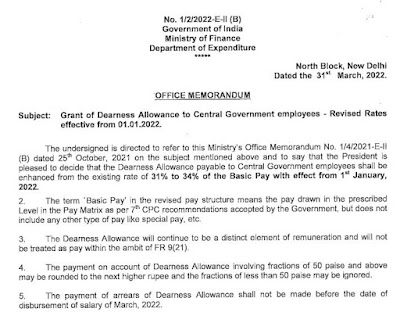
DA Jan 2022 - Grant of Dearness Allowance to Central Government employees - Revised Rates effective from 01.01.2022

 3% DA Hike - Revised Rates effective from 01.01.2022: DoE OM dated 31.03.2022 No. 1/2/2022-E-II (B) Government of India Ministry of Finance...