Monday, 18 September 2017

Procedure for empanelment of retired officers as the Inquiry Officers for conducting Departmental Inquiries


Procedure for empanelment of retired officers as the Inquiry Officers for conducting Departmental Inquiries - reg.

F.No.142/40/2015-AVD.I
Government of India Ministry of Personnel,
Public Grievances and Pensions
Department of Personnel and Training
New Delhi
Dated, the 15th September, 2017
OFFICE MEMORANDUM
Subject: Procedure for empanelment of retired officers as the Inquiry Officers for conducting Departmental Inquiries- reg.

The undersigned is directed to state that the issue of utilizing the services of retired officers for conducting departmental inquiries had been under consideration of the Department. It has now been decided that panels of retired officers from the Ministries/Departments under Government of India and PSUs would be created and maintained by the respective Cadre Controlling Authorities for conducting Departmental Inquiries against the delinquent officials.

2. Procedure for empanelment of retired officers as the Inquiry Officers - Panels of retired officers not below the rank of Deputy Secretary in Central Government and equivalent officer in the State Governments/PSUs to be appointed as the Inquiry Officer for the purpose of conducting departmental inquiries would be maintained level/rank wise and place-specific by each cadre controlling authority where its offices are located.

3. Validity of the panel - The panel of the retired officers created for the purpose of appointing Inquiry Officers for conducting departmental inquiry will be valid for a period of three years. The respective Cadre Controlling Authority will ensure that a panel of retired Inquiry Officers is available with them.
4. Following are the eligibility conditions for appointment of willing retired officers as the Inquiry Officers to conduct departmental inquiries:-
(i) Retired officers who are willing to serve as Inquiry Officer.
(ii) He/she should not have been penalized in a Disciplinary Proceeding case (no penalty in DP or prosecution in criminal case)
5. The respective Cadre Controlling Authority will immediately take necessary action for inviting applications from willing and eligible retired officers to serve as the Inquiry Officer for conducting departmental inquiry. In this regard, a format for inviting applications is annexed.

6. A three-member committee consisting of Joint Secretary level officers including CVO of the concerned Ministry/Departments/PSUs would be constituted by the respective cadre controlling authority. The other two members can be from the same Ministry/Department or from the attached or subordinate office. After receipt of willingness of the retired officers, names of the officers will be screened by the committee so constituted. The formation of panel will be a continuous and ongoing process. The DA will decide on the appointment of the JO based on willingness for a case, experience in the sector and status of residence. Committee constituted for making panels of retired officers as the Inquiry Officer has to keep in mind that applications of retired officers willing to serve as an Inquiry Officer should be scrutinized carefully to ensure that the applicant meets the eligibility criteria.

7. The number of disciplinary cases assigned to an Inquiry Officer may be restricted to 8 cases in a year, with not more than 4 cases at a time.

8. Terms and conditions for appointment of retired officers as the Inquiry Officer.
The designated Inquiry Officer shall require to give an undertaking as follows:-
(i) that he/she is not a witness or a complainant in the matter to be inquired into or a close relative or a known friend of the delinquent Government officer. A certificate to this effect will be obtained from the Inquiry Officer with respect to every inquiry and placed on record
(ii) shall maintain strict secrecy in relation to the documents he/she receives or information/data collected by him/her in connection with the inquiry and utilize the same only for the purpose of inquiry in the case entrusted to him/her.
9. No such documents/information or data shall be divulged to anyone during the Inquiry or after presentation of the Inquiry Report. All the records, reports etc. available with the Inquiry Officer shall be duly returned to the authority which appointed him/her as such, at the time of presentation of the Inquiry Report.

10. The Inquiry Officer shall conduct the inquiry proceedings at a location taking into account the availability of records, station/place where the misconduct occurred as well as the convenience of the witnesses/ PO etc. Video Conferencing should be utilized to the maximum extent possible to minimize travel undertaken by the IO/PO/CO. The cadre controlling authorities will facilitate necessary arrangements for the Video Conferencing.

11.The Inquiry Officer shall undertake travel for conducting inquiry (in unavoidable circumstances) with the approval of an authority as may be nominated by the concerned Ministry/Department.

12.The Inquiry Officer shall submit the inquiry report after completing the inquiry within 180 days from the date of his/her appointment as the Inquiry Officer. Extension of time beyond 180 days can be granted only by the Authority as may be prescribed.

13. The rates of honorarium and other allowances payable to the Inquiry Officer will be as under:-

retired-officers-dopt


50% will be paid on submission of the Inquiry Report. Remaining amount will be paid within 45 days. In case it is not possible to proceed with the matter due to stay by courts etc., the Inquiry Officer may be discharged from his/her duties and payment of honorarium and other allowances will be made on pro rata basis.
14. Before the payment is received by the Inquiry Officer, it will be his/her responsibility to ensure that:-
(a)All case records and inquiry report (two ink signed copies) properly documented and arranged is handed over to the office of Disciplinary Authority.

(b)The report returns findings on each of the Articles of Charge which has been enquired into should specifically deal and address each of the procedural objections, if any, raised by the charged officers as per the extant rules and instructions.

(c)There should not be any ambiguity in the inquiry report and therefore every care should be taken to ensure that all procedures for conducting departmental inquiries have been followed in accordance with the relevant rules/instructions of disciplinary and appeal Rules to which the delinquent Government officials are governed.
15. Letter regarding engaging a retired officer as the Inquiry Officer will only be issued with the approval of the Disciplinary Authority of the Ministry/Department/ Office concerned.

16. A review of every empanelled Inquiry Officer will be done after receipt of 2 inquiry reports where adherence to time lines and the procedure and quality of work will be assessed by the concerned Ministry. Subsequent allocation of work may be done only after such evaluation. The services of Inquiry Officers whose performance is not upto the mark will be terminated with the approval of appointing authority.

17.Any issue arising out of this O.M. between the Inquiring Officer and the Disciplinary Authority will be decided by the Secretary , DoPT whose decision shall be final and binding on both parties.

18.These guidelines are issued for internal use of DoPT and other Cadre controlling authorities may adopt the same with suitable amendments.
(K. Srinivasan)
Under Secretary to the Govt. of India
Te1:23092957
Source: Dowmload PDF -DOPT ORDER

Agitation programmes of NFPE & Confederation : AIPEU-GDS

Agitation programmes of NFPE & Confederation : AIPEU-GDS
NFPE-CONFEDERATION-AIPEU-GDS


Dear Comrades,
The Confederation of Central Govt Employees & Workers decided to conduct series of agitation programmes on the issues of working class & Central Govt. Employees as scheduled below.

NFPE is the major organization in the CCGEW and endorsed the agitation programmes announced on the charter of demands.

The members of AIPEU-GDS is also should participate in all the agitation programmes given by NFPE. The GDS demands are also placed in the Charter for the cause of GDS along with the demands of postal working class and Central Govt Employees.

It is requesting all the members of AIPEU-GDS in the divisions of all Circles to participate in all agitation programmes along with NFPE unions and make it grand success.

The CHQ office bearers, Circle Secretaries, Division/Branch Secretaries and active comrades are requested to mobilize the GDS comrades and participate in a large number to make all the agitation programmes successful.

Phased Programmes

1. Mass Dharna at all District Head Quarter on 19th Sept 2017
2. Mass Dharna at all State Capitals on 17th October 2017
3. Maha Dharna at New Delhi with Central Trade Unions other independent federation on 9th, 10th& 11th Nov 2017.

12 points charter of Demands of all workers

1. Urgent measures for containing price rise through universalization of public distribution system and banning speculative trade in commodity market.
2. Containing unemployment through concrete measures for employment generation.
3. Strict enforcement of all basic labour laws without any exception or exemption and stringent punitive measures for violation of Labour laws.
4. Universal social security cover for all workers.
5. Minimum wages of not less than 18000/- per month with provisions of indexation.
6. Assured enhanced pension not less than Rs.3000/- per month for the entire working population.
7. Stoppage of disinvestment and strategic sale in Central/State Public Sector Undertakings.
8. Stoppage of Contractorisation in permanent periennial work and payment of same wage and benefits for contract workers as regular workers for same and similar work.
9. Removal of all ceilings on payment and eligibility of bonus, provident fund; increase the quantum of gratuity.
10. Compulsory registration of Trade Unions within a period of 45 days from the date of submitting application and immediate ratification of ILO Conventions C-87 and C-98.
11. Against Labour law amendments.
12. Against FDI in Railways, Insurance and Defence.

21 points charter of Demands of Confederation

1. Honour the assurance given by the Group of Ministers to NJCA on 30th June 2016 and 6th July 2016, especially increase in minimum wage and fitment factor. Grant revised HRA at the rate of 30%, 20% and 10% with effect from 01-01-2016. Settle all anomalies arising out of implementation of 7th CPC recommendations, in a time bound manner.

2. Implement option-I recommended by 7th CPC regarding parity in pension of pre-2016 pensioners.

3.  Scrap PFRDA Act and Contributory Pension Scheme and grant pension and Family Pension to all Central Government employees recruited after 01.01.2004, under CCS (Pension) Rules 1972.

4. Treat GraminDakSewaks of Postal department as Civil Servants, and extend all benefits like pay, pension, allowances etc. of departmental employees to GDS.

5. Regularise all casual, contract, part-time, contingent and Daily rated mazdoors and grant equal pay and other benefits.

6. No Downsizing, Privatisation, outsourcing and contractorisation of Government functions.

7. Withdraw the arbitrary decision of the Government to enhance the bench mark for performance appraisal for promotion and financial upgradations under MACP from "GOOD” to VERY GOOD" and also decision to withhold annual increments in the case of those employees who are not able to meet the bench march either for MACP or for regular promotion within the first 20 years of service. Grant MACP pay fixation benefits on promotional hierarchy and not on pay-level hierarchy. Personnel promoted on the basis of examination should be treated as fresh entrants to the cadre for grant of MACP.

8. Withdraw the draconian FR 56 (J) and Rule 48 of CCs (Pension) Rules 1972 which is being misused as a short cut as purity measure to punish and victimize the employees.

9. Fill up all vacant posts including promotional posts in a time bound manner. Lift ban on creation of posts. Undertake cadre Review to assess the requirement of employees and their cadre prospects. Modify recruitment rules of Group-'C' cadre and make recruitment on Reginal basis.

10. Remove 5% ceiling on compassionate appointments and grant appointment in all deserving cases.

11. Grant five promotions in the service carreer to all Central Govt. employees.

12. Abolish and upgrade all Lower Division Clerks to Upper Division Clerks.

13. Ensure parity in pay for all stenographers, Assistants, Ministerial Staff in subordinate offices and in all organized Accounts cadres with Central Secretariat staff by upgrading their pay scales. Grant pay scale of Drivers in LokSabha Secretariat to Drivers working in all other Central Government Departments.

14. Reject the stipulation of 7th CPC to reduce the salary to 80% for the second year of Child Care leave and retain the existing provision.

15. Introduce Productivity Linked bonus in all department and continue the existing bi-lateral agreement on PLB wherever it exists.

16. Ensure cashless, hassle free medical treatment to all Central Government employees & Pensioners in all recognized Government and Private hospitals.

17. Revision of Overtime Allowance (OTA) and Night Duty Allowance (NDA) w.e.f 01.01.2016 based on 7th CPC pay scale.

18. Revision of wages of Central Government employees in every five years.

19. Revive JCM functioning at all levels. Grant recognition to the unions/Associations under CCS (RSA) Rules 1993 within a time frame to facilitate effective JCM functioning.

20. Implementation of the Revised Pay structure in respect of employees and pensioners of autonomous bodies consequent on implementation of CCS (Revised Pay) Rules 2016 and Revised Pension Rules in respect of Central Government employees and pensioners.

21. Implementation of the "equal pay for equal work" judgment of the Supreme Court in all departments of the Central Government.
P.Pandurangarao
General Secretary
Source : http://aipeugdsnfpe.blogspot.in/

Sunday, 17 September 2017

Grant of Educational Concession to the Children of Armed Forces Officers/Personnel Below Officer Ranks (PBORs) missing/disabled/killed in action


Grant of Educational Concession to the Children of Armed Forces Officers/Personnel Below Officer Ranks (PBORs) missing/disabled/killed in action

EDUCATIONAL-CONCESSION-ARMED-FORCES-CHILDREN

No.6(I)/2009/Edu. Concession/ D(Res.-II)
Government of India
Ministry of Defence
Department of Ex-Servicemen Welfare
Room No. 231, 'B' Wing
Sena Bhawan, New Delhi
Dated: 13th Sept, 2017
To,

The Chief of the Army Staff
The Chief of the Naval Staff
The Chief of the Air Staff
The Director General Indian Coast Guard.

Subject : Grant of Educational Concession to the Children of Armed Forces Officers/Personnel Below Officer Ranks (PBORs) missing/disabled/killed in action

Consequent upon the decision taken by the Government on the recommendations made by the Seventh Central Pay Commission (7th CPC) in Para 8.17.42 regarding enhancement of Educational Concessions to the Children of Armed Forces Officers/Personnel Below Officer Ranks (PBORS) Missing/Disabled/Killed in action and in supersession of earlier order No 6(1)/2009/Edu. Concession/II D(Res) dated 25th Oct 2010 on the subject, the President is pleased to issue the following instructions:
(i) Tuition Fees: Full reimbursement of tuition fee (Capitation fee and caution money not included) levied by the educational institutions concerned (including charges levied for the school bus maintained by the school or actual fares paid for railway pass for students or bus fare certified by the Head of Institutes).

(ii) Hostel Charges: Full reimbursement of Hostel charges for those studying in boarding schools and colleges.

(iii) Cost of books/stationery: Rs. 2000/- (Rupees two thousand only) per annum per student or the amount claimed by the student, whichever is less.

(iv) Cost of Uniform where this is Compulsory: Rs. 2000/- (Rupees two thousand only) or the amount claimed‘by the student, whichever is less.

(v) Clothing: Rs. 700/- (Rupees seven hundred only) per annum per student or the amount claimed by the student, whichever is less.
2. The education concessions referred to above will be admissible only for undertaking studies in Govt/Govt. aided schools/educational institutes, Military/Sainik Schools and other schools or colleges recognised by the Central or State Governments including the autonomous organisations financed entirely by the Central/State Governments.

3. The above educational concessions will be available for school going children from 2 classes prior to lSt class up to and inclusive of the First Degree Course.

4. Re-imbursement of Educational Concession shall have no nexus with the performance of the child in his/her class. In other words, even if a child fails in a particulars class, the re-imbursement of CEA shall not be stopped.

5. The combined amount of Tuition Fees and Hostel Charges shall not exceed Rs. 10,000/-pm.

6. The concession shall go up by 25 percent each time DA rises by 50 percent.

7. These orders shall be effective from 1st July, 2017.

8. The Educational concession referred to in this order will be debit able from Major Head 2076 and Minor Head 800 B(a)2 of the Defence services Estimates (Army) and relevant Heads of Navy, Air Force and Coast Guard.

9. This issues with the concurrence of Ministry of Defence (Finance Pension) vide their U.O. No.IO (23)/O9/Fin/Pen dated 1 1.09.2017.
Yours faithfully,
sd/-
(Santosh)
Joint Secretary to the Government of India
Source: http://desw.gov.in/

7th CPC Pay Matrix IOR Revision: Example of Increase/Decrease in Basic Pay - MoD message for recovery thereon


7th CPC Pay Matrix IOR Revision: Example of Increase/Decrease in Basic Pay - MoD message for recovery thereon
Message Regarding 7 CPC

1. --text not reproduced---

2. "Govt orders have been received vide SRO No 17(E) dated 06/07/2017 notified in Gazette of India No 14 dated 07/07/2017 and acted upon in Aug 2017. As per the orders, index of rationalization (IOR) of level 12A & 13 of the Defence Pay Matrix has been enhanced from 2.57 to 2.67 for the entry level Pay but the multiplication factor is retained as 2.57. In some cases pay fixed on 01/01/2016 as per revised Pay matrix would be less than that fixed earlier as per SRO 12(E) dated 03/05/2017, leading to recovery in August 2017 pay account. A few examples are cited at Annexure A"

Pay as On
31/ 12/ 2015
Grade Pay as on
31/ 12/ 2015
Multiplication Factor 2.57 Pay as per SRO dated
03/ 05 /2017
Pay as per SRO dated
06 /07 /2017
Pay Increase / Decrease
37,4008,0001,16,6781,16,7001,21,200Increase
38,7708,0001,20,1991,20,2001,21,200Increase
40,1808,0001,23,8231,27,5001,24,800Decrease
41,6308,0001,27,5491,31,3001,28,500Decrease
58,9808,7001,73,9381,74,0001,75,500Increase
61,5908,7001,80,6451,84,6001,80,800Decrease
63,3408,7001,85,1431,90,1001,86,200Decrease
65,2708,7001,90,1031,95,8001,91,800Decrease

Revision of commission payable to SAS agents on Kisan Vikas Patra (KVP)


Revision of commission payable to SAS agents on Kisan Vikas Patra (KVP)

F.No.2/4/2014-NS.II
Ministry of Finance
Department of Economic Affairs
(Budget Division)
North Block, New Delhi
Dated: 15.09.2017

Subject: Revision of commission payable to SAS agents on Kisan Vikas Patra (KVP).

In partial modification of the instructions issued vide this Department's O.M. of even no. dated 01.07.2015, the undersigned is directed to convey that the rate of commission payable to the authorised agents under the Standardised Agency System (SAS) for securing investment in Kisan Vikas Patra is revised from 1.0% to 0.5% with immediate effect.

2. This has the approval of Finance Minister.
Sd/-
(Padam Singh)
Regional Director (Sr.)

Re-engagement of retired staff on daily remuneration basis in exigencies of services: Railway Board Order


Re-engagement of retired staff on daily remuneration basis in exigencies of services: Railway Board Order
RBE No 128 /2017
GOVERNMENT OF INDIA
MINISTRY OF RAILWAYS
(RAILWAY BOARD)
No. E(NG)II/2010/RC-4/6
New Delhi, dated 14 09.2017
The General Manager (P)
All Indian Railways/PUs

Sub: Re-engagement of retired staff on daily remuneration basis in exigencies of services.

Attention is invited to this Ministry's letter of even number dated 07.10.2016 (RBE No 119/2016) on the above subject. Keeping in view the acute shortage of staff in various categories of posts and consequent hampering of the Railway's services, Ministry of Railway (Railway Board) have decided to extend the said scheme, in exigencies of services, for a further period of one year, i.e. up to 14.09.2018, in the same terms & conditions a mentioned in Board's letter of even number dated 27.09.2012. While implementing the scheme, General Managers may keep in view the fresh recruitment made in the vacant posts.

This issues with the concurrence of the Finance Directorate of Ministry of Railway (Railway Board).
Sd/-
(Neeraj Kumar)
Director Estt. (N)
Railway Board

Central Government Employees Group Insurance Scheme 1980 - Tables of Benefits for the savings fund for the period from 01.07.2017 to 30.09.2017


Central Government Employees Group Insurance Scheme 1980 - Tables of Benefits for the savings fund for the period from 01.07.2017 to 30.09.2017.
central-government-employees-group-insurance-scheme

No.7(2)/EV/2016
Government of India
Ministry of Finance
Department of Expenditure
New Delhi, the September 6,2017
Office Memorandum

Sub: Central Government Employees Group Insurance Scheme 1980 - Tables of Benefits for the savings fund for the period from 01.07.2017 to 30.09.2017.

The Tables of Benefits for Savings Fund to the beneficiaries under the Central Government Employees Group Insurance Scheme-1980, which are being issued on a quarterly basis from l.1.20 17 onwards, as brought out in ' this Ministry's OM of even number dated 17.3 .2017, for the quarter from l.7.2017 to 30.9.2017, as worked out by IRDA based on the interest rate of 7 .8% per annum (compounded quarterly) as notified by the Department of Economic Affairs as per their Resolution No. 5(1)-B(PD)/2017 dated 17.7.2017, are enclosed.

2. The Tables enclosed are of two categories as per the existing practice. As hitherto, the first Table of Benefits for the savings fund of the scheme is based on the subscription of Rs. 10 p.m. froml.1.1982 to 31.12.1989 and Rs. 15 p.m. w.e.f. 1.1.1990 onwards. The second Table of Benefits for savings fund is based on a subscription of Rs. 10 p .m. for those employees who had opted out of the
revised rate of subscription w.e.f. 1.1.1990.

3. While these orders are in respect of Table of Benefits for the period from l.7.2017 to 30.9.2017, the Tables already issued for the quarters from 1.1.2017 to 31.3.2017 and from 1.4.2017 to 30.6.2017 are also reproduced for the sake of convenience and consolidation.

4. In their application to the employees of Indian Audit and Accounts Department, these orders are issued after consultation with the Comptroller & Auditor General of India.

5. Hindi version of these orders is attached.
(Amar Nath Singh)
Director
To
1. All Ministries / Department of the Central Government as per standard list.
2. Copy with spare copies for information and necessary action to C&AG, UPSC, all State Government etc. as per standard list.
3. NIC, Department of Expenditure - for uploading the same on the website of Ministry of Finance, Department of Expenditure.

Source: doe.gov.in - DOWNLOAD PDF

7th CPC Special Pay/Special Allowance admissible to officers of the Organized Group 'A' services - Dopt Ordres


7th CPC Special Pay/Special Allowance admissible to officers of the Organized Group 'A' services - Dopt Ordres

No.2/12/2017-Estt.(Pay-II)
Government of India
Ministry of Personnel, Public Grievances & Pensions
Department of Personnel & Training
North Block, New Delhi
Dated 14th September, 2017
OFFICE MEMORANDUM

Subject:- Implementation of the recommendations of Seventh Central Pay Commission relating to Headquarters Special Pay/Special Allowance admissible to officers of the Organized Group 'A' services on their posting in their respective Headquarters - reg.

This Department's OM No.2/22(A)/2008-Estt(Pay-ll) dated 3rd September, 2008 provided for rates of Headquarters Special pay/ Special Allowance admissible to officers of the Organized Group 'A' services on their posting in their respective headquarters.

2. As provided in para 7 of Ministry of Finance (Department of Expenditure)'s Resolution No.1-2/2016-IC dated 25th July, 2016, the matter regarding allowances (except Dearness Allowance) based on the recommendations of the 7th Central Pay Commission (CPC) was referred to a Committee under the Chairmanship of Finance Secretary and until a final decision thereon, all allowances have been paid at the existing rates in the existing pay structure.

3. The decision of the Government on various allowances based on the recommendations of the 7th CPC and in the light of the recommendations of the Committee under the Chairmanship of the Finance Secretary has since been issued as per the Resolution No.11-1/2016-IC dated 6th July, 2017 of Department of Expenditure.

4. As mentioned at SI.No. 76 of the Appendix-II of the said Resolution dated 6th July, 2017, the recommendation of the 7th CPC for abolition of Headquarters Allowance has been accepted by the Government and this decision is effective from 1st July, 2017. Accordingly, the President is pleased to abolish the Headquarters Special Pay/ Special Allowance in respect of officers of the Organized Group 'A' services on their posting in their respective Headquarters.

5. Accordingly, the entitlement and payment of Headquarters Allowance is discontinued from the salary of the month of July, 2017. A copy of Department of Expenditure's OM No.29/1/2017-E.II (B) dated 11th July, 2017 on Payment on account of discontinued allowances is enclosed for reference.
6. In so far as persons serving in the Indian Audit & Accounts Department are concerned, these orders issue after consultation with the Comptroller & Auditor General of India.
sd/-
(Pushpender Kumar)
Under Secretary to the Government of India
Authority: www.dopt.gov.in

Click to view the order

Maximum Governance Minimum Government is the government's motto: Dr. Jitendra Singh


Maximum Governance Minimum Government is the government's motto: Dr. Jitendra Singh
Swachh Bharat Mission Manual launched
Two Day Regional Conference on Good Governance and Replication of Best Practices concludes in Goa
'Maximum Governance, Minimum Government' is the motto of the Central Government. To achieve this motto Government is concentrated on "Citizen-First" mantra, said Dr. Jitendra Singh, Union Minister of State for Development of North Eastern Region (Independent Charge), MoS for PMO, Personnel, Public Grievances and Pensions, Atomic Energy and Space. He was speaking at the valedictory session of the two-day regional conference on 'Good Governance and Replication of Best Practices' which concluded in Goa today.

"Our dream is to bring Government closer to citizens so that they become active participants in the governance process. An important step for Good Governance is the simplification of procedures and processes in the Government so as to make the entire system transparent and faster. To this end Government has taken the decision to scrap 1,500 obsolete rules, started the self-certification process etc. To achieve this, the Department of Administrative Reforms & Public Grievances has a key role to play," said Dr. Jitendra Singh.

Dr. Jitendra Singh said the Prime Minister's Awards for Excellence in Public Administration were instituted 10 years back and first awards were presented on the 2nd Civil Services Day on April 21, 2007 to the Civil Servants for their innovative ideas and efforts in addressing the problems locally. This motivation is required for improving governance and delivery of services. He said the Priority Programmes for PM’s Award to be presented next year are (i) Pradhan Pradhan Mantri Fasal Bima Yojana (PMFBY); (ii) Deen Dayal Upadhyaya Grameen Kaushalya Yojana (DDU-GKY); (iii) Promoting Digital Payments; and (iv) Pradhan Mantri Awas Yojana (Rural &Urban).

Talking about Grievance cell, he informed that Department of Administrative Reforms and Public Grievances (DARPG) enabled a quantum shift in Online Government Service delivery across the country. This aims to further Government’s efforts at revamping of Public Administration system, Public Grievance Redress Mechanism, ushering in e-Governance, Digital India, more so in the context of the goal of ‘Minimum Government with Maximum Governance’ through e-Governance based Citizen Centric End-to-End Online Services. Compared to 2.70 lakh grievances in 2014, 11.94 lakh grievances were received on CPGRAMS (Central Public Grievance Redress and Monitoring System) in 2016. In 2017, 9.32 lakhs grievances have already been received till 25.8.17. Due to higher expectations, the grievances have increased more than 4 times in 2016, compared to 2014. However, due to intensive monitoring, the disposal rate has also increased significantly and is presently more than the rate of receipt of grievances. Action on grievances can be tracked with the help of unique grievance registration number. A timeline of two months has been prescribed for disposal of grievances. In case it is not possible, an interim reply with reasons for delay has to be provided.
Right to Information Act (RTI) is now online and from last six months it is available on mobile also, he informed.

Development Manual for District level functionaries by DARPG Swachh Bharat Mission [Gramin] was also launched during the Valedictory function. The purpose of the Development Role manual is to create an enabling mechanism for improved implementation of the Centrally sponsored schemes at the cutting edge, leading to enhanced outcomes in nature and extent. The manual is prepared with inputs from a combination of sources, including interaction with the Ministry of Drinking Water and Sanitation (MDWS), review of extant scheme guidelines and circulars issued by MDWS and discussions with the key personnel involved in the implementation of the scheme.

Chief Minister of Goa, Shri Manohar Parrikar also shared his thoughts on Good Governance, Swachh Bharat, and Grievance redressal mechanisms during the valedictory session.

Shri C. Viswanath, Secretary DARPG in his address said that conferences like these are useful for promoting meaningful confluence of interactions and insights, cross-fertilization of ideas and exchange of constructive views among the policy makers, public figures, peers, practitioners and professionals who may have championed and facilitated the successful implementation of innovations in government processes, administrative reforms, and public service delivery.

With this, the two-day Regional Conference on 'Good Governance and Replication of Best Practices' concluded. The DARPG has so far organized 26 such regional conferences to share experiences in the formulation and successful implementation of good governance practices and to facilitate speedy and efficient delivery of public services

PIB

Conference on Portability from Superannuation and Recognized Provident Funds to National Pension System (NPS); NPS has more than 1.71 crore subscribers with total Asset under Management (AUM) of more than Rs. 2.04 lakh crores


Conference on Portability from Superannuation and Recognized Provident Funds to National Pension System (NPS); NPS has more than 1.71 crore subscribers with total Asset under Management (AUM) of more than Rs. 2.04 lakh crores.

A Conference on Portability from Superannuation and recognized Provident Funds to National Pension System (NPS) was organized by the Pension Fund Regulatory and Development Authority (PFRDA) in coordination with Willis Towers Watson in national capital. The Prime objective of the Conference was to provide a knowledge base platform to the Corporate by providing solutions to address the issues / challenges of portability of superannuation funds to NPS.

160 participants comprising Corporate, Points of Presence (POPs), Pension Funds, Central Record Keeping Agencies (CRAs) participated in the Conference.

Dr. B. S. Bhandari, Whole Time Member (Economics), PFRDA, highlighted the need to expand the coverage of NPS in an efficient and sustainable way. He asserted the fact that there are more employees in the Corporate - Private sector than in the government sector and hence there is a great potential for NPS in the corporate sector. PFRDA has been constantly engaging with its stake holders in the NPS and has been working with industry associations for promotion of NPS in the Corporate - Private sector. To make NPS entry easy and the interface user friendly, various modifications have been carried out in the product.
Shri Rohit Jain, Head, Willis Towers Watson (India), speaking on the occasion, told that the average life expectancy of persons in India has risen and hence there is a greater need for a retirement / pension product for all. Traditional pension products cover only 30% of the population. In this changing scenario there is a latent demand for product like NPS as there is no universal pension product.

Shri Hemant Contractor, Chairman, PFRDA in his key note address, informed that, earlier, people used to retire from the same job not only in the government sector but also in private sector. With opening up of economy people started getting more job opportunities switching jobs suitable to their skills and talents. Job switching has become more frequent and people seek more controls on their finances, when they start moving jobs and place from one to another. The concept of portability came in and people started thinking about having better control on their retirement savings.

Defined Benefit Pension schemes, which were predominant, became unsustainable not only for the government sector but also for the private sector because of various factors. A Defined Contribution scheme was therefore launched in 2004 which was initially only for Central Government employees, but which was later extended to State Government employees and later to the private sector. This scheme is the National Pension System (NPS), which is regulated by PFRDA.

NPS addressed the concerns of subscribers relating to portability and freedom of choice, and gradually started to pick up momentum in the private sector. The other features of NPS, namely, low cost, attractive returns, transparency, flexibility and domain expertise in each area of pension activity were the other factors which appealed to the private sector. Innovations and changes are made from time to time in the NPS product and processes, some recent examples being, introduction of two new life cycle funds, inclusion of alternative assets in investment portfolio, online entry and exit etc.

The entry age to NPS is now proposed to be increased to 65 years from 60 years and there is an option to continue up to age of 70 years.

The Chairman also mentioned that NPS should also be explored, as an additional retirement benefit, for corporates where superannuation funds are not available and employees are covered only under the mandatory EPFO schemes.

He highlighted the growth of 47% in AUM and 26% in number of subscribers in the last financial year (2016-17). He also made a reference to Atal Pension Yojana, the pension platform available for unorganized segment through Government of India / PFRDA and its year on year growth indicating the underlying demand for pension products in India.

During the conference, a panel discussion comprising industry experts such as Willis Towers Watson, HDFC Pension Funds, Siemens Limited, Vedanta Group and NSDL e-Governance Infrastructure Limited eyeing the opportunities, addressing the challenges / issues and preparation of necessary guidelines on superannuation funds and NPS portability was conducted.

In the second half, a Conference for Point of Presence (PoPs), the distribution channel for NPS, was conducted.

Shri Hemant Contractor, Chairman, PFRDA, in his keynote address stressed on the need for robust distribution of the NPS through the current distribution network being managed by POPs which are Banks and other financial institutions. He also laid emphasis on the fact that, the key to last mile connectivity is increased distribution network by the POPs by registration and activation of more branches and through awareness campaigns. He informed that PFRDA has empanelled IL&FS Skill Development Corporation Limited as its training agency to impart training on NPS to POPs and Corporate and urged the POPs to utilise the services of the Training Agency for training of their staff member on NPS.
During this conference, awards were distributed to the POPs, for their performance in FY 2016-17 under various categories.

Currently, NPS has more than 1.71 crore subscribers with total Asset under Management (AUM) of more than Rs. 2.04 lakh crores.

PIB

Flash News

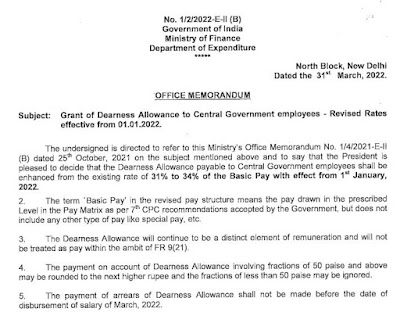
DA Jan 2022 - Grant of Dearness Allowance to Central Government employees - Revised Rates effective from 01.01.2022

 3% DA Hike - Revised Rates effective from 01.01.2022: DoE OM dated 31.03.2022 No. 1/2/2022-E-II (B) Government of India Ministry of Finance...