Sunday, 25 December 2016

Revision of Pension and grant of DR to the pensioners of Autonomous Bodies


Revision of Pension and grant of DR to the pensioners of Autonomous Bodies
CONFEDERATION OF CENTRAL GOVT. EMPLOYEES & WORKERS
1st Floor, North Avenue PO Building, New Delhi- 110001

Ref: Confdn/Pen/2016-19
Dated - 19.12.2016
To
The Secretary
Department of Pension & Pensioners Welfare
Government of India
Sardar Patel Bhawan,
New Delhi - 110001

Sub :- Revision of Pension and grant of Dearness Relief to the pensioners of Statutory/Autonomous Bodies.

The Government of India - vide the resolution dated 4th August 2016, accepted the recommendations of the 7th Central Pay Commission on pensionery benefits and have granted the benefits of revised pension with retrospective effect from 01.01.2016 to all the Central Government Pensioners.
Accordingly, in terms of OM dated 04.08.2016, Central Government pensioners have been paid arrears of pension due to them on 31.08.2016 along with their revised pension for the month of August 2016. Recently they have been granted the Dearness Relief with effect from 01.07.2016. Similarly, the employees of Autonomous Bodies have been granted Dearness Allowance with effect from 01.07.2016 based on the orders issued by the Finance Ministry.

It has been brought to our notice by the pensioners/family pensioners of Statutory/Autonomous Bodies that they have neither been granted revised pension in terms of 7th CPC orders contained in OM dated 04.08.2016 nor the Dearness Relief, though the Central Government pensioners have already got their revised pension and dearness relief. We wish to bring to your kind information that, hither to, pensioners/family pensioners of Statutory/Autonomous Bodies were getting revised pension as per the CPCs recommendations, as and when accepted by the Government, and Dearness Relief, as and when sanctioned, simultaneously along with the Central Government pensioners. This time, unfortunately, both these revised pension, in term of 7th CPC orders, and Dearness Relief have not been sanctioned to the pensioners of autonomous/statutory bodies. We fail to understand why such discrimination is meted out in respect of pensioners of Autonomous/Statutory Bodies.

We also wish to bring to your kind information that, immediately on issue of orders by the Finance Ministry granting Dearness Allowance to the staff of Central Government/Autonomous Bodies, the Department of pension was issuing orders granting Dearness Relief to pensioners of Central Government and Autonomous Bodes. While the DOPT has already issued the orders granting Dearness Relief to the pensioners of Central Government w.e.f. 01.07.2016, similar orders have not been issued in respect of pensioners of Autonomous/Statutory Bodes.

While the pensioners/family pensioners of Statutory/Autonomous Bodes, most of whom are in the evening of their lives yearning for betterment of their finances for a peaceful retired life, have been disappointed/frustrated, on the one hand, by the inordinate delay in the extension of 7th CPC orders to them, they have been further disappointed by the Government in not granting the Dearness Relief due to them with effect from 01.07.2016.

We, therefore, request you to issue the orders granting the 7th CPC benefits as also Dearness Relief due to the pensioners of Autonomous/Statutory Bodies, without any further delay, thereby facilitating the pensioners to lead their retired life, peacefully.

Thanking you,
Yours faithfully,
(M. Krishnan)
Secretary General
Confederation
Source : Conferderation

State Bank to grant two-day special leave to employees

State Bank to grant two-day special leave to employees

State Bank of India will grant special leave of two days to its employees as reward for having taken additional stress since November 8 when demonetisation was announced.

Employees would be able to avail this leave any time until March 2018, said SBI Chairman Arundhati Bhattacharya in Mumbai on Wednesday.

"Our employees will get rewarded, I am sure. We are looking into what can be done. We have already given overtime wherever it is due."

On the issue of new currency notes being diverted by some bank employees, Bhattacharya clarified that in any system there would be a few bad examples.

She observed that such incidents of Rs.100-200 crore being diverted to a select few had created doubts in the minds of people. The banking sector had dispensed Rs.7 lakh crore worth of money in the system during this period. But those who are guilty of such malpractices will be dealt in accordance with law, she said.

Bankers have been going about their job silently and without being given credit for implementing such a challenging task, she said.

They had been putting in late hours and many could not go home in the initial few days, she said.
The SBI chief said that there were checks and balances in place but if checks were tightened further, banks would not be able to serve their customers.

SBI was using analytics to ascertain the number of notes received by the bank versus the number issued to customers, besides reporting suspicious transactions on a daily basis, Bhattacharya said.

Source : The Hindu

Announcement of new Passport Rules

Announcement of new Passport Rules

1. In order to streamline, liberalize and ease the process of issue of passport, the Ministry of External Affairs has taken a number of steps in the realm of passport policy which is expected to benefit the citizens of India applying for a passport. The details of these steps are given below:

PROOF OF DATE OF BIRTH

2. As per the extant statutory provisions of the Passport Rules, 1980, all the applicants born on or after 26/01/1989, in order to get a passport, had to, hitherto, mandatorily submit the Birth Certificate as the proof of Date of Birth (DOB). It has now been decided that all applicants of passports can submit any one of the following documents as the proof of DOB while submitting the passport application:
(i) Birth Certificate (BC) issued by the Registrar of Births & Deaths or the Municipal Corporation or any other prescribed authority whosoever has been empowered under the Registration of Birth & Deaths Act, 1969 to register the birth of a child born in India;

(ii) Transfer/School leaving/Matriculation Certificate issued by the school last attended/recognized educational board containing the DOB of the applicant;

(iii) PAN Card issued by the Income Tax Department with the DOB of applicant;

(iv) Aadhar Card/E-Aadhar having the DOB of applicant;

(v) Copy of the extract of the service record of the applicant (only in respect of Government servants) or the Pay Pension Order (in respect of retired Government Servants), duly attested/certified by the officer/in-charge of the Administration of the concerned Ministry/Department of the applicant, having his DOB;

(vi) Driving licence issued by the Transport Department of concerned State Government, having the DOB of applicant;

(vii) Election Photo Identity Card (EPIC) issued by the Election Commission of India having the DOB of applicant;

(viii) Policy Bond issued by the Public Life Insurance Corporations/Companies having the DOB of the holder of the insurance policy.
Report of the Inter Ministerial Committee

3. A three-member Committee comprising of the officials of the Ministry of External Affairs and the Ministry of Women and Child Development was constituted to examine various issues pertaining to passport applications where mother/child has insisted that the name of the father should not be mentioned in the passport and also relating to passport issues to children with single parent and to adopted children. The Report of the Committee has been accepted by the Minister of External Affairs.
The following policy changes have been made inter-alia on the basis of the recommendations of this Committee:
(i) The online passport application form now requires the applicant to provide the name of father or mother or legal guardian, i.e., only one parent and not both. This would enable single parents to apply for passports for their children and to also issue passports where the name of either the father or the mother is not required to be printed at the request of the applicant.

(ii) The total number of Annexes prescribed in the Passport Rule, 1980, has been brought down to 9 from the present 15. Annexes A, C, D, E, J, and K have been removed and certain Annexes have been merged.

(iii) All the annexes that are required to be given by the applicants would be in the form of a self declaration on a plain paper. No attestation/swearing by/before any Notary/Executive Magistrate/First Class Judicial Magistrate would be henceforth necessary.

(iv) Married applicants would not be required to provide Annexure K or any marriage certificate.

(v) The Passport application form does not require the applicant to provide the name of her/his spouse in case of separated or divorced persons. Such applicants for passports would not be required to provide even the Divorce Decree.

(vi) Orphaned children who do not have any proof of DOB such as Birth Certificate or the Matriculation Certificate or the declaratory Court order, may now submit a declaration given by the Head of the Orphanage/Child Care Home on their official letter head of the organization confirming the DOB of the applicant.

(vii) In case of children not born out of wedlock, the applicant for the passport of such children should submit only Annexure G while submitting the passport application.

(viii) In case of issue of passport to in-country domestically adopted children, submission of the registered adoption deed would no longer be required. In the absence of any deed to this effect, the passport applicant may give a declaration on a plain paper confirming the adoption.

(ix) Government servants, who are not able to obtain the Identity Certificate (Annexure-B)/ No-Objection Certificate (Annexure-M) from their concerned employer and intend to get the passport on urgent basis can now get the passport by submitting a self-declaration in Annexure-‘N’ that he/she has given prior Intimation letter to his/her employer informing that he/she was applying for an ordinary passport to a Passport Issuing Authority.

(x) Sadhus/ Sanyasis can apply for a passport with the name of their spiritual Guru mentioned in the passport application in lieu of their biological parent(s) name(s) subject to their providing of at least one public document such as Election Photo Identity Card (EPIC) issued by the Election Commission of India, PAN card, Adhar Card, etc wherein the name of the Guru has been recorded against the column(s) for parent(s) name(s).
4. Necessary notifications would be soon published in the Official Gazette to give effect to these changes. Instructions are also being issued to the Passport Issuing Authorities in India and abroad on these revised regulations.

5. The Ministry of External Affairs expects that the above changes in the Passport Rules would further ease the process for passport applicants in getting their Passport. At the same time, it would enable this Ministry to continue to deliver passport related services to the citizens in a timely, transparent, more accessible, reliable manner and in a comfortable environment through streamlined processes and committed, trained and motivated workforce.

PIB

Reporting Cash Transactions under Rule 114E of Income Tax Rules, 1962

Reporting Cash Transactions under Rule 114E of Income Tax Rules, 1962

Rule 114E of Income-Tax Rules, 1962, for furnishing Statement of Financial Transactions (SFT) came into force with effect from 1st April, 2016. Any person who is liable for audit under section 44AB of the Income-Tax Act, 1961 is required to furnish a statement in respect of transaction at serial no. 11 of Rule 114E(2) relating to receipt of cash payment exceeding Rupees 2,00,000/- (Rupees Two Lakh) for sale of goods or service. Doubts were raised if such transactions are required to be aggregated for reporting.

The norms of aggregation contained in sub-rule 3 of Rule 114E have been amended vide CBDT’s Notification No. 91/2016 dated 6th October, 2016; clearly indicating that the said transactions did not require aggregation and the reporting requirement under SFT for this purpose is on receipt of cash payment exceeding Rupees Two Lakh for sale of goods or services per transaction.

PIB

Thursday, 22 December 2016

Updation of web-based data of PA Grade of CSSS in CSCMS

No. 5/4/2016 CS.II(C)
Government of India
Ministry of Personnel, Public Grievances and Pensions
Department of Personnel and Training
3rd Floor, Lok Nayak Bhawan,
Khan Market, New Delhi -110 003
Dated: 22nd Dec., 2016
OFFICE MEMORANDUM

Subject: Updation of web-based data of PA Grade of CSSS in CSCMS-reg.

The undersigned is directed to say that the information in respect of Personal Assistants of CSSS who are posted in all the Ministries/Departments is essentially required to be updated for several purposes ego filling of Immovable Property Return (IPR), updation of web-based data of PAs and filling up of unfilled vacancies etc. It will also serve other purposes- record maintenance, preparation of CSL etc.

2. All Ministries/Departments are, therefore, requested to furnish the requisite information of PA Grade as oh 31.12.2016 in the proforma attached by 15.01.2017 positively to enable this Department to update the records of PA Grade.
Encls:- As above
(Umesh Kumar Bhatia)
Under Secretary to the Govt. of India
Get the Annexure here

Amendment in Recruitment Rules for the post of Multi Tasking Staff (MTS) in the Institute of Secretariat Training & Management


No.A-12034/13/2016-ISTM
Government of India
Ministry of Personnel, Public Grievances and Pension
Department of Personnel & Training
Training Division
Old JNU Campus, Block IV, 4th Floor,
New Mehrauli Road, New Delhi-110067
Dated: 21st December, 2016
OFFICE MEMORANDUM

Subject: Amendment in Recruitment Rules for the post of Multi Tasking Staff (MTS) in the Institute of Secretariat Training & Management - regarding

The undersigned is directed to upload the draft recruitment rules for the post of Multi Tasking Staff in the Institute of Secretariat Training & Management, New Delhi and to request for comments, if any, from all the stakeholders on the draft RRs. The comments may kindly be sent to the undersigned on e-mail id: 'op.chawla@nic.in' latest by 20.01.2017.

Encl: As above.
(O P Chawla)
Under Secretary to the Government of India

Notification

New Delhi the December, 2016
G.S.R ...- In exercise of the powers conferred by the proviso to article 309 of the Constitution, and in supersession of the Institute of Secretariat Training and Management (Multi Tasking Staff) Recruitment Rules, 2013, except as respects things done or omitted to have been done, before such supersession, the President hereby makes the following rules regulating the method of recruitment to the post of Multi Tasking Staff in the Institute of Secretariat Training and Management, Ministry of Personnel, Public Grievances and Pensions, Department of Personnel and Training, namely:-

1. Short title and commencement:-
(1) These rules may be called the Ministry of Personnel, Public Grievances and Pensions, Department of Personnel and Training, Institute of Secretariat Training and Management (Multi Tasking Staff) Recruitment Rules, 2016.

(2) They shall come into force on the date of their publication in the Official Gazette.

2. Number of post, classification and Level in the pay matrix:- The number of the said post, its classification and Level in the pay matrix shall be as specified in columns (2) to (4) of the schedule annexed to these rules.

3. Method of recruitment, age limit, qualifications, etc.:- The method of recruitment, age limit, qualifications and other matters relating thereto shall be as specified in columns (5) to (13) of the said Schedule.

4. Disqualification:- No person,

(a) who has entered into or contracted a marriage with a person having a spouse living; or
(b) who, having a spouse living, has entered into or contracted a marriage with any person, shall be eligible for appointment to the said post:

Provided that the Central Government may, if satisfied that such marriage is permissible under the personal law applicable to such person and the other party to the marriage and that there are other grounds for so doing, exempt any person from the operation of this rule.

5. Power to relax:- Where the Central Government is of the opinion that it is necessary or expedient so to do, it may, by order, for reasons to be recorded in writing, relax any of the provisions of these rules with respect to any class or category of persons.

6. Saving:- Nothing in these rules shall affect reservations, relaxation of age limit and other concessions required to be provided for the Scheduled Castes, the Scheduled Tribes, Other Backward Classes, Ex-servicemen and other special category of person's in accordance with the orders issued by the Central Government from time to time in this regard.

Get the full circular

Digitalisation of fee payment system in CCSCSB

Digitalisation of fee payment system in CCSCSB

Department of Personnel and Training
Ministry of Personnel,
Public Grievances and Pensions
GOVERNMENT OF INDIA
361 , B-Wing, 3rd Floor
Lok Nayak Bhawan
New Delhi- 110003
No. 170/1/20 16-1 7/CCSCSB
21st December, 2016
Notice

To foster Digital India, the Central Civil Services Cultural & Sports Board (CCSCSB) has decided to accept all types of fee/charges through digital mode only and any payment through Cash/Cheque will not be accepted at all.

2 All Central Govt. employees and other stake holders are therefore requested to make payment of fee and other charges to the CCSCSB through digital mode only directly into CCSCSB's saving bank account NO.904320 1 0052140 with Syndicate Bank having IFSC code SYNV009043.

3 After making payment, a copy of the remittance advice received from the Bank/online receipt must be made available to CCSCSB. The CCSCSB will issue the official receipt after submitting application form and online generated payment receipt /Proof.

4. Towards achieving the objective of cashless transactions, various digital options are available which can be adopted for making digital payments, such as:
i). UPI (Unified Payments Interface)
For smart phone holders, Unified Payment Inteface (UPI)facilities transactions through bank accounts.
ii). AEPS (Aadhaar Enabled Payment System)
For people who do not have mobile phones, Aadhaar Enabled payment (AEPS) makes it possible to transact with Aadhaar based authentication.
Prepaid/Debit cards and Banking correspondents also provide the required services.
iii). USSD (Unstructured Supplementary Service Data)
For people having generic phones, USSD (*99#) facilitates digital transactions on mobile phones through SMS.
iv). PoS Machines
Basic Payments can be made with debit or credit card usmg PoS machines.
v). NET BANKING
For computer literate population, Net Banking is available.
Detailed information regarding digital payments (in English/Hindi) is available on NIT! Aayog's website at http://niti.gov.in/contentldigitalpayments.
5 All are requested to cooperate in our endeavor to introduce cashless transactions in line with Digital India initiative and to serve you better.

6 The above mentioned procedure would be effective from 1st January, 2017 onwards.
(Md.Nadeem.)
Secretary, CCSCSB
Get the Government Notice

7th pay commission: Government mulling over higher allowances without arrears


7th pay commission: Government mulling over higher allowances without arrears

7th-Pay-Commission


New Delhi: The government is considering to give relief to central government employees amid cash crunch, which refusing to ease on even after six weeks of the demonetisation announcement, official sources today said.

“We can expect the higher allowances without arrears under 7th pay commission recommendations in the coming days as the PMO thinks payment of the higher allowances with salaries on salary day cannot be “chaotic”, a close aide of the Finance Minister told The Sen Times.

“The PMO might ask the Finance Ministry to ready the higher allowances proposal without arrears before the budget. The Finance Minister Arun Jaitley can also take some time to formalise this announcement. The issue of arrears of higher allowances may not be reconsidered”, he said.
Another official said the government is considering to make only allowances hike for its employees. “The financial advisors of the government believe it could be tough to give arrears of the higher allowances as millions will queue outside the money dispensers to get higher allowances as the cash crunch may be normalised in three to four months.”, the official revealed.

In the current financial year, the government has given higher basic pay with arrears, effective from January 1, 2016 to its employees on the recommendations of the 7th pay commission but the hike in allowances other than dearness allowance referred to the ‘Committee on Allowances’ headed by the Finance Secretary Ashok Lavasa for examination as the pay commission had recommended of abolishing 51 allowances and subsuming 37 others out of 196 allowances.

Existing allowances are now paid to the central government employees according to the 6th Pay Commission recommendations until issuing of higher allowances notification.

Earlier, Finance Secretary Ashok Lavasa said, “We are ready to submit our report, when the Finance Minister Arun Jaitley calls up.”

But the government gave extension to the committee up to February 22, 2017 to take cash crunch turn for better.

“The government would comply with the cash crunch to give higher allowances without arrears. The government wishes to give the higher allowances with arrears from August to its employees”, said the sources.

They said the PMO still wants to somehow bring out the higher allowances without arrears for the central government employees now, “but the Finance Ministry cannot take emotional decisions. We hope the announcement for the higher allowances will come with arrears soon after the budget.”
“The committee on allowances proposed higher allowances from August 2016 but the central government employees unions demanded for implementation of the allowances with retrospective effect from January 2016,” the sources also said.

TST

Centre okays ordinance for wage payment via e-mode, cheques

Centre okays ordinance for wage payment via e-mode, cheques

New Delhi: Promoting less-cash economy, the government today brought in an ordinance to enable industries covered under the Payment of Wages Act to pay workers through cheques or crediting money into their bank accounts, although employers will have the option to pay in cash.

Labour Minister Bandaru Dattatreya had introduced The Payment of Wages (Amendment) Bill, 2016 in Lok Sabha on December 15 but it could not be passed because of continued disruption of the Winter Session of Parliament due to ruckus over demonetisation.

The decision to adopt ordinance route to amend the Act was taken by the Union Cabinet.

Trying to clear the air, Dattatreya told reporters at a press conference after the Cabinet meeting that employers will have the option of paying wages in cash after notification of industries by Centre and states.

Confusion prevailed earlier in the day whether it would be mandatory for employers of the industries notified by the Centre and states, to pay wages through cheques or by crediting the same into employees bank account.

The bill however clearly states that "appropriate Government may, by notification in the Official Gazette, specify the industrial or other establishment, the employer of which shall pay to every person employed in such industrial or other establishment, the wages only by cheque or by crediting the wages in his bank account”.

The amendment enables the Centre as well as state governments to notify industries where employers shall have pay wages either through cheque or crediting that into workers’ bank account.

Despite repeated queries the minister maintained that employers will have the option to pay wages in cash after the amendment in the Act through ordinance as well as the bill.

Dattatreya said however that the government has adopted the ordinance route because it was long pending demand of the trade unions.

Centre of Indian Trade Unions (CITU) General Secretary Tapen Kumar Sen said: “They are lying. The bill introduced in the Parliament clearly bars payment of wages in cash by industries notified by Centre and States. They just want to please Prime Minister Narendra Modi.”

He also said, “It is not correct to take away workers’ right to demand wages in cash amid currency crunch when the entire banking service in the country is in disorder facing an abnormal situation.

“This is not the right time for bringing this ordinance as workers are already going through tough times due to currency crunch following demonetisation.
In a statement, CITU said: “This right to consent is

important for workers since at least 35 per cent of the habitations in the country are still out of the coverage of bank branches in the vicinity and also a big majority of workers including those in urban areas, particularly those in low-paid unorganised sector, do not have bank accounts. And in case of compulsory bank payment of wages, the migrant workers will be put in serious difficulty.”

As per the Bill, the new procedure will serve the objective of “digital and less-cash economy”.

The Act had come into force on April 23, 1936, providing for payment of wages in coin or currency notes, or in both. The provision for payment of wages by cheque or crediting it into bank account after obtaining the requisite authorisation of employee was inserted in 1975.

At present, the Act covers all those employees in certain categories of establishments whose wage does not exceed Rs 18,000 per month.

The Centre can make rules regarding payment of wages in relation to railways, air transport services, mines, oil fields and its establishments while states take a call on all other cases.

By making state-level amendments to the Act, Andhra Pradesh, Uttarakhand, Punjab, Kerala and Haryana have already made provisions for payment of wages through cheque and electronic transfer.

At present, with the written authorisation of an employee, wages can be given through cheque or transferred to his or her bank account.

PTI

Delinking of revised pension from qualifying service of 33 years

Delinking of revised pension from qualifying service of 33 years

F. No. CPAO/Co-ord/(107)/2016-17/542
Government Of India
Ministry Of finance, Department of Expenditure,
central Pension Accounting Office,
Trikoot-II, Bhikaji Cama Place, New Delhi - 110066
Phone:011-26178990 e-mail: sraocord-cpao@nic.in


Dated: 20th Dec, 2016

OFFICE MEMORANDUM

Sub: OM No.38/37/08-P&PW (A) dated 6th April, 2016 of DP&PW: Delinking of revised pension from qualifying service of 33 years.

Attention is invited to previously issued OMs to Ministries/Departments/ AGs/UTs by CPAO on the subject mentioned obove. It is observed thot progress in disposal of such coses hos declined in spite of repeated requests for early settlement of pending coses and out of 89,481 cases,25,692 cases are still pending for revision. To avoid delay in payment of revised pension and arrear to the pensioners, special drive is required to clear these cases

It is requested to clear all the pending revision cases by 31st December, 2016.PAOs may be instructed to revise the remaining pending cases and send the revision authorities to CPAO for further authorization. It is also requested that in case some pending revisions are not covered under this OM, a certificate may be sent to CPAO in this regard so that these cases may be removed from the pendency list.

Sd/-
(Subhash Chandra)
Controller of Accounts
Source : http://cpao.nic.in/

Flash News

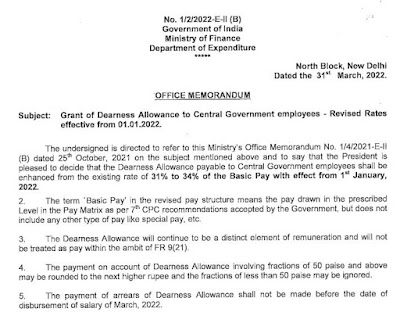
DA Jan 2022 - Grant of Dearness Allowance to Central Government employees - Revised Rates effective from 01.01.2022

 3% DA Hike - Revised Rates effective from 01.01.2022: DoE OM dated 31.03.2022 No. 1/2/2022-E-II (B) Government of India Ministry of Finance...