Wednesday, 4 November 2015

7th Pay Commission: IPS, IRS officers up in arms against IAS supremacy

7th Pay Commission: IPS, IRS officers up in arms against ‘IAS supremacy’

Sanjay R Bhoosreddy, Secretary of Central IAS Officers Association
New Delhi: About 20 central civil services, including IPS and IRS, have decided to petition Seventh Central Pay Commission (CPC) to seek job parity and career progression enjoyed by IAS officers.

A meeting of representatives of central civil services was held here recently and it was unanimously decided to petition the CPC to inform it about job-related anomaly, official sources said.

The petition, citing in detail the discrepancy, will soon be sent to the seventh Central Pay Commission. The purpose behind sending such a request is to have parity and to end IAS supremacy, they said.

The move assumes significance as a war of words is going on between officers of Indian Administrative Service (IAS) and those belonging to other central government services over the issue.

Officers belonging to Indian Revenue Service (IRS), Railways and other such central services have been seeking pay parity and career benefits enjoyed by those in IAS.

Opposing this, about 200 IAS officers have written to Department of Personnel and Training, cadre controlling authority for their service, requesting it to stonewall any move that seeks to bring down the edge given to them over other services due to various reasons.

IAS officers get empanelled to a Joint Secretary-level post in 11 years while those belonging to IRS and other services get it after putting in at least 13 years of service.

The early empanelment gives an upper hand to IAS officer, in terms of higher pay and other pecuniary benefits, as compared to their batchmate of other services.

“There is a lot of frustration and resentment among the young officers. They have taken a conscious decision of joining IAS after viewing their career options.

“Some of them have left very good private sector jobs abroad and joined the civil services. Most of them were selected in other services but they chose to sit in exam again to become an IAS officer. The merit of these boys should not be ignored,” said Sanjay R Bhoosreddy, Secretary of central IAS officers’ association here.

“If there is no place for merit, then many meritorious aspirants may opt out of civil services,” Bhoosreddy said.

IPS officers’ association Secretary P V Ramasashtry said a service can plead for how much pay it should get but not what others should not get.

“When the pay commission is yet to finalise their recommendations, the move triggered by some IAS officers was premature and avoidable.

“A service can plead for how much pay it should get but not what others should not get. One cannot understand how extra two increments can be the sole motivation factor and removal of the same thoroughly demoralises an officer who claims himself superior to others?,” he asked.

Many comments are pouring on social networking sites likeFacebook and micro-blogging portal Twitter by various officers of different services serving across the country on the issue.
PTI

No problem with OROP to paramilitary, raise retirement age to 60

No problem with OROP to paramilitary, raise retirement age to 60

Ex-servicemen demanding the for One Rank One Pension (OROP) scheme here on Monday said they have no problem with the paramilitary forces also asking for it, but then they would also demand that the retirement age of soldiers be raised to 60.

“As far as we are concerned, all have the right and will be rather happy. But we would then demand government to permit us to serve till 60 years of age,” Group Captain (retd.) VK Gandhi, general secretary of the Indian Ex-Servicemen Movement told IANS at Jantar Mantar here.

“Soldiers are forced to retire at 40 (years)… A person who retires at 40 years, gets Rs 8 crore less than one who retires at 60 years,” he said.

While the retirement age for civil servants is 60 years, 85 percent of the soldiers are compulsorily retired aged between 35 to 37. Another 12 percent to 13 percent soldiers aged between 40 to 54, as per estimates.
Monday was the 141st day of the agitation at Jantar Mantar by the veterans, when Over 200 retired paramilitary personnel on Monday launched a three-day protest here demanding ‘One Rank One Pension’ (OROP) for around 13 lakh retired and serving personnel of the Central Armed Police Forces (CAPF).
The retired paramilitary personnel have gathered under the banner of Delhi-based All India Central Paramilitary Forces Ex-servicemen Welfare Association.

Tuesday, 3 November 2015

Removal of Grade Pay System in 7th Pay Commission – A detailed report

Removal of Grade Pay System in 7th Pay Commission – A detailed report

Will the removal of Grade Pay System by the 7th Pay Commission help Central Government employees? – This is the topic of this article.

“Unconfirmed reports say that the 7th Pay Commission is very likely to recommend the abolishing of the Grade Pay System introduced by the 6th Pay Commission.”

Not only the Government, but the Central Government employees too are hoping and wishing that the 7th Pay Commission functions independently, free from interventions. The report of the previous Pay Commissions will guide for determining the revision of pay scale and pay bands, allowances, retirement benefits and other facilities/benefits of more than 50 lakh employees. The Pay Commission also considers the recommendations, suggestions and inputs gathered from employees all over the country and presented as memorandums by federations like the NC JCM and the Confederation.

There is no rule that the new Pay Commission has to follow the same methodology and determination followed by the previous Pay Commissions. Therefore, one cannot state for sure that the 7th Pay Commission will tow the guidelines issued by the 6th or the 5th Pay Commission while deciding the new pay scale and pay bands.

One has to keep in mind the fact that the 6th Pay Commission was radically different from the recommendations and guidelines issued by the 5th Pay Commission. One has to also remember that a number of industry experts, who predicted the recommendations of the 6th Pay Commission based on the trends of the previous Pay Commission, were proved completely wrong.

If one Pay Commission has the right to recommend the splitting of the Pay Scale into two, the next Pay Commission has all the powers to completely abolish the system. But, this is not the issue!

Will the Central Government employees benefit by the removal of the Grade Pay system? This is the question now.

It will definitely be beneficial. Here are the reasons why.

It is unacceptable that a promotion, which comes after waiting for many years, brings with it an increment of just Rs.100.

None has until now accepted the splitting of the promotional hierarchy, which had been followed for years, into two.

The anomalies that prevailed due to the ‘Grade Pay Hierarchy’ which was introduced under the MACP promotional system, still remain unresolved.

When the discussions and debates on MACP system continued to grow unabated during the NC JCM Anomaly Committee meeting, it was decided that a separate meeting ought to be held to analyze this issue.
Most of the individual requests from the Central Government employees this time are about the MACP promotional system. The reason is the Grade Pay structure introduced by the 6th Pay Commission.
And also can list out many reasons to abolish the Grade Pay System.

Source: www.90paisa.org

Payment of revised rate of Composite Personal Maintenance Allowance (CPMA) as per 6th CPC Orders

Payment of revised rate of Composite Personal Maintenance Allowance (CPMA) as per 6th CPC Orders
Ministry Of Defence
D(pay/Services)

Subject: Payment of revised rate of Composite Personal Maintenance Allowance (CPMA) as per 6th CPC Orders.

Reference CGDA UO No.AT/I/3510/6th CPC/Vol. IX dated 21.01.2015 on the above subject.

2. The matter has been examined in consultation with Defence (finance). It is clarified that composite personal Maintenance Allowance (CPMA) is admissible at single rate w.e.f. 01.09.2008 as per MoD letter No.1/54/2008/D(Pay/Services) dated 4.11.2008 irrespective whether service in kind has been provided or not. It is also clarified that MoD letter No.90099/AG/PS3(b)/1541/D(Pay/Services) dated 13.7.1998 stands obsolete after implementation of VI CPC recommendations.
(Prashant Rastogi)
Under Secretary
Ph: 23012739
Signed Copy Click here

Bank Employees DA increased to 39.80% for Nov 2015 to Jan 2016

DA for Bank Employees : IBA issued orders for next quarter from Nov to Dec 2015

Indian Banks’ Association
HR & Industrial Relations
No.CIR/HR&IR/76/D/2015-16/1572
October 31, 2015
All Members of the Association
(Designated Officers)

Dear Sirs,
Dearness Allowance for Workmen and Officer Employees in banks for the months of November, December and January 2016 under X BPS/ Joint Note dated 25.5.2015

The confirmed All India Average Consumer Price Index Numbers for Industrial Workers (Base 1960=100) for the quarter ended June 2015 are as follows:-
July, 2015 – 6003.21
August, 2015 – 6026.04
September, 2015 – 6071.69
The average CPI of the above is 6033. Consequently, Dearness Allowance payable to employees is for 398 slabs for the period November, December 2015 and January 2016 i.e. an increase of 34 slabs over the current level.

In terms of clause 7 of the 10th Bipartite Settlement dated 25.05.2015 and clause 3 of the Joint Note dated 25.05.2015, the rate of Dearness Allowance payable to workmen and officer employees for the months of November, December 2015 and January 2016 shall be 39.80% of ‘pay’. While arriving at dearness allowance payable, decimals from third place may please be ignored.

We advise banks to pay the difference between the old and revised salary and allowance to officers on an ad hoc basis, pending amendments to Officers’ Service Regulations.
Yours faithfully,
sd/-
K.S.Chauhan
Senior Vice President
PS : The DA Payable under IXth Bipartite Settlement/Joint Note dated 27.04.2010, is @ [119.85% (6033-2836)=3197/4] i.e 799 slabs @ 0.15% per slab).

Authority : www.iba.org.in

Recovery of NPS subscription fee/charge – NC JCM writes to DoPT

Recovery of NPS subscription fee/charge – NC JCM writes to DoPT
Ph: 23382286
National Council (Staff Side)
Joint Consultative Machinery for Central Government Employees
13-C, Ferozshah Road, New Delhi – 110001
E-Mail: nc.jcm.ni@gmail.com
No.NC/JCM/2015
Dated: October 31, 2015
Shri Sanjay Kothari,
Secretary,
Ministry of Personnel, Public Grievances & Pensions,
(Government of India)
North Block,
New Delhi – 110001

Dear Sir,
Sub: Recovery of NPS subscription fee/charge
Ref : Dy. General Manager, NPS Trust, New Delhi’s notice dated 19.10.2015

It has come to our notice that, @0.01% of the AUM on daily accrual basis is proposed to be imposed on the NPS Subscribers.

In this connection, it is worth-mentioning that, in the past, it was assured to the Central Government Employees that, no Administrative Charge/Fee would be imposed on any of the Government employees.
Orders to this effect, if so issued, should immediately be withdrawn.
Comradely yours,
sd/-
(Shiva Gopal Mishra)
Secretary(Staff Side) NC/JCM & Convener
Authority: www.ncjcmstaffside.com
Click to view the letter

7th Pay Commission – ‘An unjustified pay hike’ - The Hindu

7th Pay Commission – ‘An unjustified pay hike’ - The Hindu


As we brace for another series of Pay Commission-mandated salary hikes, the question is if it is the best use of government resources.

As public servants get ready to enjoy the New Year’s blessing that the Seventh Pay Commission is expected to bestow, it may be a time for the rest of us to look this gift horse in the mouth. The Fourteenth Finance Commission estimates the cost of the Sixth Pay Commission at over Rs. 90,000 crore annually, since pay and allowances of Union government employees more than doubled between 2007-08 and 2011-12.

Compare this to the estimates in the economic survey for the year 2011-12, about Rs. 70,000 crore each for food subsidy, fertilizer and petroleum subsidy and less than Rs. 40,000 crore for the Mahatma Gandhi National Rural Employment Guarantee Act. Simply put, the additional Central government expenditure due to the implementation of the Sixth Pay Commission was over 40 per cent of the major subsidies. If we take into account the costs to the State governments, the tab for Sixth Pay Commission largesse is probably equivalent to all the subsidies provided by the Central government. 

As we brace for another Pay Commission-mandated salary hike, the question to ask is not whether the government can afford it but if it is the best use of government resources. Government employees receive Dearness Allowance (DA) annually to compensate for inflation; they also receive an annual performance appraisal for promotions, which brings with it salary increases. So the decadal salary increases under the Central Pay Commission (CPC) are meant to address inequities in salaries across different parts of the government, across ranks as well as between the public sector and private sector. It is the latter that has provided the greatest justification for salary increases granted under CPC in the past.  

False premise

Dizzying salary packages reported for new Indian Institute of Management graduates or Indian Institute of Technology graduates funnel a sense of discontent among public sector employees since it is hard to imagine any 25-year-old government servant receiving a package of Rs. 40 lakh per annum. This smoke and mirrors strategy masks several observations made by the Sixth Pay Commission. First, it noted that the contention of vast disparities between private sector and government employees was not borne out by data. The CPC found that compensation to Group C and D employees in government was higher than that in the private sector; for Group B it was similar and only for Group A was it lower. Group A employees form less than 5 per cent of the total Central government workforce; Group C and D are about 90 per cent. Second, it noted that a government job offers many other benefits not available in the private sector and the fear of flight away from public service towards the private sector is overblown. 

The Fourteenth Finance Commission estimates the cost of the Sixth Pay Commission at over Rs. 90,000 crore annually.
In spite of these observations, the ultimate recommendations of the Sixth CPC led to substantial increases in the salary and allowance of all public servants, first in the Central service and later on in State governments. A comparison of incomes between private sector employees and government employees using data from India Human Development Surveys (IHDS) of 2004-05 and 2011-12 is instructive in understanding the consequences of the last CPC. These surveys of over 40,000 households were jointly organised by the National Council of Applied Economic Research and the University of Maryland. The graphic shows monthly salaries for men aged 25-59 in 2011-12. Many women work part time as anganwadi workers and ASHA workers and hence are excluded from this comparison, but their inclusion will not change the fundamental results.


The results show that at every single level of education, government workers are paid more than private sector workers and more importantly, the public service advantage has increased rather than decreased after the implementation of the Sixth Pay Commission recommendations. A driver in government service earns far more than one in private service, but so does an engineer. This comparison does not include the other benefits government service provides including PF contributions, housing benefits, health insurance and, frequently, admission of children to coveted Kendriya Vidyalayas. 

One might say that the problem is not global but is concentrated in highly skilled positions. Individuals who are highly skilled may be more likely to choose the private sector. Here only the Union Public Service Commission can tell us if the qualification of the entering cohort of the Indian Administrative Service officers is declining, but at a slightly lower stratospheric level, we see no such evidence. The IHDS shows that among college graduates with a first class degree, government service still seems to be preferred. In 2004-05, among the male college graduates employed in public service, 37 per cent had a first division; this proportion had increased to 39 per cent by 2011-12. This is not to say that skill upgradation is not taking place in the private sector, where the proportion of first class degree holders among graduates has increased from 28 per cent to 35 per cent, but these figures do not suggest that government services are suffering on an average; just that the more qualified individuals are seeking salaried work and moving away from farming and small businesses benefitting both government service and the private sector. 

One might say that the problem is not global but is concentrated in highly skilled positions.
That salary increases will be bestowed by the Seventh CPC is a given. Whether it will address the real challenge, lower wages for Group A officers compared to the private sector, and recognise the public service advantage for the rest of the employees remains questionable. Let us hope that the Seventh CPC will address the challenge of government salaries with a scalpel rather than an axe.

(Sonalde Desai is senior fellow at the National Council of Applied Economic Research and Professor of Sociology at the University of Maryland. Views are personal.)

Source: TheHindu

Grant of Hospital Patient Care Allowance

Grant of Hospital Patient Care Allowance

hospital patient care allowance

GOVERNMENT OF INDIA
MINISTRY OF RAILWAYS
RAILWAY BOARD
No.2013/H-1/10/8
New Delhi,dated 26.10.2015
The Chief Medical Directors/Officers,
All Indian Railways/Production Units.

Sub: Grant of Hospital Patient Care Allowance.

Ref: NFIR’s letter no. 1/5(g)/Part V dated 19.10.2015.

National Federation of Indian Railwaymen in its letter has contentded that there is no designation or post of “Store Pharmacist” on Indian Railways and all the Pharmacists have been working in the Health Care delivery institutions/establishments whose duties involve dispensing medicines and maintaining records of medicines. In the railways there is no category exclusively designed as “Store Pharmacist” not involved in dispensing of medicines.

It is desired to furnish the facts on the matter alongwith details within 7 days by FAX. The same may be uploaded on Smdms.
(Dr. P.Pant)
Director/IH
Railway Board
Source: nfirindia

Bank Employees to Get 34 Slabs Increase in DA for the Next Quarter

Bank Employees to Get 34 Slabs Increase in DA for the Next Quarter

Bank Employees to Get 34 Slabs Increase in DA for the Next Quarter – Accordingly Bank workmen/Officers will have 34 slabs increase in DA payable for next quarter Nov to Jan’16 at 39.80%.(3.40% increase from Existing 36.40%)

With the two point increase of All India Consumer Price Index Numbers (AICPIN) for the month of SEPTEMBER ’15, which stood at 266 points , Bank employees will get hefty increase of 34 slabs of D.A. for Nov’15 to Jan’16 quarter.

Accordingly Bank workmen/Officers will have 34 slabs increase in DA payable for next quarter Nov to Jan’16 at 39.80%.(3.40% increase from Existing 36.40%)

“DA for Nov 2015 increase of 3.4% means increase of 34 Slabs. Now Total DA will be 39.80 %” the Vice President of NOBW Mr.Ashwani Rana said.

Index numbers are yet to be updated in official website of labour ministry.

we have three months data
  • July 2015 263 (6003.21)
  • August 2015 264 (6026.04)
  • September 266 (6071.69)
As of now based on the above data 30 slabs or 3.00% is sure.

Source: NOBW

DoPT to Department: Complete Recruitment Process Within 6 Months

DoPT to Department: Complete Recruitment Process Within 6 Months

NEW DELHI: All government departments need to complete direct recruitment process within six months of the closing date of receipt of applications mentioned in the advertisements, according to draft guidelines formed by the Centre.

The draft prepared by the Department of Personnel and Training (DOPT) says there was “unduly large” delay in recruitment process undertaken by many central government departments.

“All ministries or departments are, therefore, requested that while initiating the recruitment process to fill vacant posts by the method of direct recruitment in their ministries or departments, they may ensure that the recruitment process i.e., conducting written examination or holding of interviews is completed within six months from the closing date of receipt of applications mentioned in the advertisement,” the Department of Personnel and Training (DoPT) has said in draft instructions.

It has come to notice of DoPT that ministries which undertake direct recruitment for various posts in the Government of India by conducting competitive examinations or interviews, are not adhering to the time frame for that purpose.

“It is seen that in many cases the time gap between the date of advertisement for the vacancy and date of examination or interview is unduly large and defeats the object of early recruitment process.

“Further, delay of recruitment process by more than a year will deny the opportunity to fresh candidates who become eligible during that year,” it said in a note to all central government ministries seeking comments. The DoPT has asked all ministries to send their views on the draft by November 16.

PTI via newindianexpress

Flash News

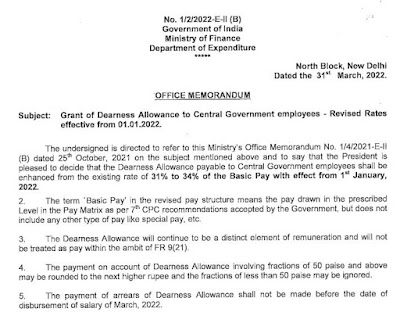
DA Jan 2022 - Grant of Dearness Allowance to Central Government employees - Revised Rates effective from 01.01.2022

 3% DA Hike - Revised Rates effective from 01.01.2022: DoE OM dated 31.03.2022 No. 1/2/2022-E-II (B) Government of India Ministry of Finance...