Showing posts with label 7th CPC Pay Scales. Show all posts

Sunday, 20 October 2019

7th CPC DA to the CDA pattern employees of CPSEs


7th CPC DA to the CDA pattern employees of CPSEs

Payment of DA to the CDA pattern employees of CPSEs, drawing pay in 7th CPC pay scales

CDA pattern pay scales


F. No. W-02/0038/2017- DPE (WC)-GL- XXIV/19
Government of India
Ministry of Heavy Industries & Public Enterprises
Department of Public Enterprises
Public Enterprises Bhawan,
Block 14, CGO Complex, Lodi Road,
New Delhi-110003, the 18th October,2019

OFFICE MEMORANDUM

Subject: Payment of DA to the CDA pattern employees of CPSEs, drawing pay in 7th CPC pay scales.
The undersigned is directed to refer to Para No. 3 and Annexure-II(a) and 11(b) to this Department’s O.M. No. W-02/0058/2016-DPE(WC) dated 17.08.2017 wherein the rates of DA payable to the employees who are following CDA pattern pay scales have been indicated.

2. The DA payable to the employees may be enhanced from the existing rate of 12% to 17% with effect from 01.07.2019.

Also check: DA to the CDA pattern employees of CPSEs, drawing pay in 7th CPC pay scales

3. The payment of Dearness Allowance involving fractions of 50 paise and above may be rounded off to the next higher rupee and the fractions of less than 50 paise may be ignored.

4. These rates are applicable in the case of CDA employees whose pay have been revised with effect from 01.01.2016 as per DPE’s G.M. dated 17.08.2017.

5. All administrative Ministries / Departments of Government of India are requested to bring this to the notice of Central Public Sector Enterprises under their administrative control for action at their end
Naresh Kumar
Under Secretary

Tuesday, 3 September 2019

Granting of one more option to switch over to 7th CPC from a date subsequent to 25th of July 2016


7th Pay Commission

Granting of one more option to switch over to 7th CPC from a date subsequent to 25th of July 2016

Shiva Gopal Mishra
Secretary
National Council (Staff Side)
Joint Consultative Machinery
13-C, Ferozshah Road, New Delhi - 110001
Ref.No.NC-JCM-2017/fin
August 29, 2019
To
The Additional Secretary (Pers)
Government of India,
Ministry of finance,
Department of Expenditure,
North Block, New Delhi.

Sub: Granting of one more option to switch over to 7th CPC from a date subsequent to 25th of July 2016.

Ref: 1) Minutes of National anomaly Committee Meeting held on Tuesday 17th of July 2018, circulated Vide DOP&T OM No. 11/2/2016-JCA-I (Pt.), dated 31st Jan. 2019.

2) This office Lt. No.C-JCM-2017/fin., dt: 5th March 2019.

The Staff Side of the National Council (JCM) is repeatedly representing to consider the demand for granting of one more option to switch over to the 7th CPC pay scales on a date which is beneficial to the employees. Vide our letter referred at (2) above, the reference of the Judgment of CAT Bombay Bench in OA No.45/12 pronounced on 29/06/2017 was also referred. In this Judgment the CAT has directed to grant him option to switch over to 6th CPC from a date which is beneficial to the employee, since he has agreed to surrender the arrears already drawn. This Judgment was also implemented by CGDA.

In the meantime, the aggrieved employees of Ordnance Factory Ambajhari under the Department of Defence production, Min. Of Defence approached the CAT Bombay Bench claiming for grant of one more option to switch over to 7th CPC pay scale. After 25/07/2016/ option to switch over to 7th CPC as on date on increment on 01/07/2016. The CAT after hearing the parties have given a direction to the respondents to consider the representation of the applicants keeping in view the aforesaid DOPT OM dated 08/07/2019, through which the minutes of the Standing committee National Council (JCM) was circulated and has directed the DOP&T to take a decision on the subject matter within a period of 6 weeks from the date of receipt of the copy of the Judgement.

Since the matter is getting unduly delayed the affected employees have started approaching to Court of law to get their grievance settled. This defeats the spirit of the JCM scheme. I therefore request you to kindly arrange to issue Govt. orders for revising the option to switch over to 7th CPC pay scale on the following two situations:
1) Option to switch over to 7th CPC to those employees who are promoted/granted MACP after 25/07/2016.
2) Option to switch over to 7th CPC as on date of increment on 01/07/2016.
‘In this regard kindly refer to ‘the illustration given in our letter dated 22nd March 2018. (copy enclosed for ready reference). We request you to kindly arrange to issue necessary instruction in this regard without further delay.
Thanking you,
Yours faithfully,
(Siva Gopal Mishra)
General Secretary
Source: Confederation

Friday, 15 March 2019

7th CPC: Bunching of stages of pay in the pre-7th CPC pay scales consequent upon fixation of pay in the revised pay scales based on 7th CPC - Railway Order

7th CPC: Bunching of stages of pay in the pre-7th CPC pay scales consequent upon fixation of pay in the revised pay scales based on 7th CPC - Railway Order

7th CPC: Bunching of stages of pay in the pre-7th CPC pay scales consequent upon fixation of pay in the revised pay scales based on 7th CPC


GOVERNMENT OF INDIA (BHARAT SARKAR)
Ministry of Railways (Rail Mantralaya)
(Railway Board)
PC-VII No. 134
File No. PC-VII/2016/RSRP/3
RBE No. 50/2019
New Delhi, dated: 13.03.2019
The General Managers/CAOs(R),
All Indian Railways & Production Units,
(As per mailing list)

Sub: Bunching of stages of pay in the pre-7th CPC pay scales consequent upon fixation of pay in the revised pay scales based on 7th CPC - regarding.

Please refer to Board’s letter of even no. dated 27.09.2017 forwarding therewith a copy of Ministry of Finance, Department of Expenditure’s OM No. 1-6/2016-IC dated 03.08.2017 regarding clarification on bunching of stages in the revised pay structure under CCS(RP) Rules, 2016 for adoption of the same in Railways with respect to RS(RP) Rules, 2016.

Now, Ministry of Finance, Department of Expenditure vide their O.M. No. 1-6/2016-IC/E-IIIA dated 07.02.2019 (copy enclosed) have issued further clarifications on the subject matter. The clarifications issued by Ministry of Finance, Department of Expenditure shall be applicable mutatis mutandis in Railways with respect to RS(RP) Rules, 2016.

Encl. As above.
(Jaya Kumar G)
Deputy Director, Pay Commission–VII
Railway Board

Thursday, 7 March 2019

DA is paid in 7th CPC pay scales to CDA patterns for CPSE employees


DA is paid in 7th CPC pay scales to CDA patterns for CPSE employees.

F. No. W-02/0038/2017-DPE (WC)-GL-V/19
Government of India
Ministry of Heavy Industries & Public Enterprises
Department of Public Enterprises
Public Enterprises Bhawan,
Block 14, CGO Comply, Lodi Road,
New Delhi-110003, the Ist March, 201.9

OFFICE MEMORANDUM

Subject: Payment of DA to the CDA pattern employees of CPSEs, drawing pay in 7th CPC pay scales.

The undersigned is directed to refer to Para No. 3 and Annexure-II(a) and II(b) to this Department’s O.M. No. W-02/0058/2016-DPE(WC) dated. 17.08.2017 wherein the rates of DA payable to the employees who are following CDA pattern pay scales have been indicated.
  1. The DA payable to the employees may be enhanced from the existing rate of 9% to 12% with effect from 01.01.2019.
  2. The payment of Dearness Allowance involving fractions of 50 paise and above may be rounded off to the next higher rupee and the fractions of less than 50 paise may be ignored.
  3. These rates are applicable in the case of CDA employees whose pay have been revised. with effect from 01.01.2016 as per DPE's O.M. dated 17.08.2017.
  4. The payment of arrears of Dearness Allowance (from January to March) shall not be made before the date of disbursement of salary of March, 2019.
  5. All. administrative Ministries/Departments of Government of India are requested to bring this to the notice of Central Public Sector Enterprises under their administrative Control for action at their end.
(A K Khurana)
Director

Friday, 8 February 2019

7th CPC Pay Fixation on Bunching - Clarification Orders issued by Finmin

7th CPC Pay Fixation on Bunching - Clarification Orders issued by Finmin
Bunching of stages of pay in the pre-7th CPC pay scales consequent upon fixation of pay in the revised pay scales based on 7th CPC­ Regarding
No.1-6/2016-IC/E-IIIA
Govt. of India
Ministry of Finance
Department of Expenditure
North Block, New Delhi
Dated the 07th February, 2019
OFFICE MEMORANDUM

Subject: Bunching of stages of pay in the pre-7th CPC pay scales consequent upon fixation of pay in the revised pay scales based on 7th CPC­ Regarding

The undersigned is directed to invite attention to this Departments OM No. 1-6/2016-IC dated 3rd August, 2017, explaining in detail the methodology for applying the principle of “bunching” consequent upon pay fixation in the revised pay scales (applicable Levels of the Pay Matrix) effective from 1.1.2016 based on implementation of the recommendations of the 7th Pay Commission.

2. Notwithstanding the fact that the said OM dated 3.8.2017 has elaborately explained the issue of bunching in the context of the revised pay scales based on 7th Central Pay Commission, references are being received in this Ministry seeking clarification as to the methodology to carry out the principle of bunching. It is seen that some of the clarifications received seem to arise out of the position on bunching as obtaining during the pay structure in vogue based on 6th Pay Commission before 1.1.2016 vis-a-vis the position explained in terms of this Ministry’s aforesaid OM dt. 3.8.2017 in the context of pay structure currently in vogue from 1.1.2016 based on the recommendations of the 7th Pay Commission.

3. Therefore, the matter has been considered keeping in view the clarifications sought and the issue is clarified heretofore. At the very outset, bunching as a sequel to pay fixation based on the formula for such pay fixation on the date of effect of revised pay scales based on the recommendations of the 7th Pay Commission, is to be considered strictly as per the recommendations of the 7th Pay Commission, as illustrated in para 5.1.37 of its report. The principle of bunching as recommended by the 7th Pay Commission, as accepted by the Government in terms of the erstwhile Implementation Cell’s OM dt. 7.9.2016 and 3.8.2017, is different from the principle recommended by the 6th Pay Commission and as accepted by the Government based thereon. Therefore,the principle of bunching in the revised pay structure based on the recommendations of the 7th Pay Commission is independent of the principle followed earlier and has no link thereto.

4. The 6th Central Pay Commission in para 2.2.21 of its Report recommended - “To alleviate the problem of bunching in these cases,the Commission has allowed the benefit of one extro increment wherever two or stages in any of the pre-revised pay scales were getting bunched together at one level in the revised pay bands…. The Commission has prepared a detailed fixation chart which gives the fitment in the revised running pay bands in every stage”. However . in the fitment charts prepared by the 6th Pay Commission, the Commission illustrated the bunching meant by it. The examples from the fitment tables prepared by the 6th Pay Commission are given in Annexure I 

5. The same principle of bunching was adopted in terms of the fitment table prescribed by the Ministry of Finance, Department of Expenditure, as per the OM No.1-1/2008-IC dated 30.8.2008. The examples of which are given in Annexure II.

6. The 7th Pay Commission has dealt with the issue of bunching in paras 5.1.36 and 5.1.37, which are reproduced below.

“5.1.36 Although the rationalisation has been done with utmost care to ensure minimum bunching at most levels, however if situation does arise whenever more than two stages are bunched together ,one additional increment equal to 3 percent may be given for every two stages bunched, and pay fixed in the subsequent cell in the pay matrix.

5.1.37 For instance , if two persons drawing pay of Rs. 53 ,000 and Rs. 54,590 in the GP 10000 are to be fitted in the new pay matrix , the person drawing pay of Rs. 53.000 on multiplication by a factor of 2.57 will expect a pay corresponding to Rs. 1,36,210 and the person drawing pay of Rs. 54,590 on multiplication by a factor of 2.57 will expect a pay corresponding to Rs. 1,40 .296 . Revised pay of both should ideally be fixed in the first cell of level 15 in the pay of Rs.1.44,200 but to avoid bunching the person drawing pay of Rs. 54.590 will get fixed in second cell of level 15 in the pay of Rs.1.48,500.”

7. Accordingly, the essence of the recommendations of the 7th Pay Commission is contained in the above illustration given by the 7th Pay Commission. As per this illustration, the pay of Rs. 53,000 and Rs. 54,590 were the pay applicable in PB-4 plus Grade Pay of Rs. 10.000 as applicable prior to 1.1.2016, which corresponds to Level-14 of the Pay Matrix applicable from 1.1.2016. The pay of Rs. 54,590 was 3% more than the pay of Rs. 53,000. That is, these two Pays were separated by a difference of 3% of Rs. 53 ,000. Thus, the pay of Rs. 54,590 was the stage next to the pay of Rs. 53 ,000. Considering that the 7th Pay Commission allowed the benefit of bunching at the level of the pay of Rs. 54,590 itself , it materially departed from the principle followed at the time of 6th Pay Commission because in the 6th Pay Commission regime the benefit was allowed at the 3rd consecutive stage and not at the 2nd stage itself (next stage) for the purpose of bunching. 

8. Furthermore. in the illustration given in para 5.1.37 of its report, the 7th Pay Commission has not mentioned about the pay in respect of pre-revised pay of Rs. 56,230 , which is 3% more than the pay of Rs. 54,590. The revised pay fixed in the Level 14 with reference to the pre-revised pay of Rs. 56 ,230 will be Rs. 1.48,500. This will be the same as the pay to be given with reference to the pre-revised pay of Rs. 54,590 after allowing bunching. However , the 7th Pay Commission did not recommend any additional benefit in such cases, as it did not include in its illustration for any benefit in case of the further stages of pre-revised pay, consequent upon bunching at the lower stage.

9. In view of the above, the benefit of bunching consequent upon fixation of pay in the revised pay structure effective from 1.1.2016 based on the recommendation of the 7th Pay Commission is to be considered in the light of the above and the clarifications already issued in terms of the aforesaid letter dated 3.8.2017. Accordingly: 

(i) Where consequent upon fixation of pay in terms of Rule 7 (1) (A)(i) of the CCS (RP) Rules, 2016, two different pay drawn in the pay structure obtaining immediately before 1.1.2016, which were separated by one another by 3% of the previous stage, are fixed at the same cell of the applicable Level of the Pay Matrix effective from 1.1.2016, then the benefit of bunching by way of one additional increment as on 1.1.2016 shall be admissible in respect of the pay which is more than 3% of the previous pay, as per the illustration given by the 7th Pay Commission in para 5.1.37, as mentioned above. This is further illustrated as below: 

6th CPC Pay scale : PB-4 (37.400-67,000) + Grade Pay Rs.8,700/- 7th CPC Pay Scale – Level-13 (1,23,100-2,15,900)
6th CPC Pay Structure (PB-4 and GP of Rs. 8,700) Pay fixation in 7th CPC Pay Matrix (Level – 13)
Pay Consolidation based on 2.57 multiple Pay fixed as on 1.1.2016 Pay after bunching
46 ,100 Rs.1,18,477 Rs.1,23,100/- Rs.1,23 ,100/-
47,490
(46 ,100+3%)
Rs.1,22,049 Rs.1,23,100/- Rs.1,26,800/-
(ii) In view of the position explained in para 8 above and the specific recommendation of the 7th Pay Commission as per its illustration given in para 5.1.37 of its report, no further action is to be taken after the benefit of bunching as a result of application of Rule 7(1)(A)(i), as indicated above. This is as illustrated below:
6th CPC Pay Structure (PB-4 and GP of Rs. 8,700) Pay fixation in 7th CPC Pay Matrix (Level – 13)
Pay Consolidation based on 2.57 multiple Pay fixed as on 1.1.2016 Pay after bunching Remarks
46 ,100 Rs.1,18,477 Rs.1,23,100/- Rs.1,23,100/-
47,490
(46 ,100+3%)
Rs.1,22,049 Rs.1,23,100/- Rs.1,26,800/- Pay raised because of bunching
48,920
(47,490+3%)
Rs. 1,25,724 Rs.1,26,800 Rs.1,26,800 No change

10. In the light of the above, the points of clarification as referred to this Ministry are explained in the Annexure III.

11. These orders are issued after consultation with the Comptroller and Auditor General of India in their application to the employees belonging to the Indian Audit and Accounts Department.

12. Hindi version of these orders is attached.

sd/-
(Amar Nath Singh)
Director

Sunday, 25 November 2018

7th CPC Pay Scales for DCSEM Scientific Staff, Technical Staff and Administrative Staff


7th CPC Pay Scales for DCSEM Scientific Staff, Technical Staff and Administrative Staff

Directorate of Construction, Services & Estate Management (DCSEM)

7th Pay Commission Pay Scales for DCSEM Scientific Staff, DCSEM Technical Staff, DCSEM Administrative Staff and DCSEM Auxiliary Staff

Pay Scales for Scientific Staff
PostLevel in Pay Matrix as per 7th CPCGrade Pay as per 6th CPCPay Band as per 6th CPCG/NGGroup
Outstanding Scientist15-HAG (67,000-79,000)GA
SO/H+/SO/H1410000PB-4 (37400-67000)G
SO/G13A8900G
SO/F138700G
SO/E, TO/E127600PB-3 (15,600-39100)G
SO/D, TO/D116600G
SO/C, TO/C105400G

Pay Scales for Technical Staff
PostLevel in Pay Matrix as per 7th CPCGrade Pay as per 6th CPCPay Band as per 6th CPCG/NGGroup
SA/G127600PB-3 (15600-39100)NGA
SA/F116600NG
Tech.Sup A (Drg)116600NG
SA/E105400NG
Sr.Tech/J105400NG
D/E105400NG
FM/C105400NG
SA/D84800PB-2 (9300-34800)NGB
D/D84800NG
Sr.Tech/H84800NG
SA/C74600NG
D/C74600NG
Tech/G74600NG
SA/B64200NG
Tech/F/FI64200NG
D/BI64200NG
Tech/D52800NGC
Tech/C42400NG
Tech/B32000NG

Pay Scales for Administrative Staff
PostLevel in Pay Matrix as per 7th CPCGrade Pay as per 6th CPCPay Band as per 6th CPCG/NGGroup
Chief Admn. Officer127600PB-3 (15600-39100)GA
JC (F&A)127600G
Administrative Officer-III116600G
DCA116600G
DD (Official Language)116600G
Sr. Accounts Officer105400G
Accounts Officer95400PB-2 (9300-34800)GB
Asstt. Accounts Officer84800G
Asstt. Personnel Officer84800G
Sr. Private Secretary84800G
Sr. Hindi Translator74600NG
PS (NS)74600G
Assistant74600NG
Assistant Accountant74600NG
Steno Gr-I64200NG
Steno Gr-II64200NG
Senior Clerk64200NG
Steno Gr-III42400PB-1 (5200-20200)NGC
Upper Division Clerk42400NG
Lower Division Clerk21900NG

Pay Scales for Auxiliary Staff
PostLevel in Pay Matrix as per 7th CPCGrade Pay as per 6th CPCPay Band as per 6th CPCG/NGGroup
Chief Security Officer127600PB-3 (15600-39100)GA
Dy. Chief Security Officer116600G
Security Officer84800PB-2 (9300-34800)GB
ASO (B)64200NG
ASO (A)64200NG
Driver Spl Gr64200NG
Supr B1 (CM)64200NG
Driver Gr I52800PB-1 (5200-20200)NGC
Sr. Work Assistant/B52800NG
Driver Gr.II42400NG
Caretaker42400NG
Surveyor42400NG
Sr. Work Assistant/A42400NG
Work Asstt/C32000NG
Asst Halwai cum Cook (Auxillary)21900NG
Clerk (Canteen)21900NG
Assist Halwai cum Cook (Canteen)21900NG
Driver OG21900NG
Hd. Security Guard21900NG
Work Asstt/B21900NG
Sr. Security Guard11800NG
Security Guard11800NG
Work Asst / A11800NG
Canteen Attendant11800NG

Tuesday, 20 February 2018

7th Central Pay Commission - Applicability to the pay scales of Casual Labourers with Temporary status


Recommendations of 7th Central Pay Commission - Applicability to the pay scales of Casual Labourers with Temporary status.
7th CPC Pay Scale

No.49011/2/2017-Estt(C)
Government of India
Ministry of Personnel, PG and Pensions
Department of Personnel & Training
North Block, New Delhi
Dated: 19th Feb, 2018
OFFICE MEMORANDUM

Subject: Recommendations of 7th Central Pay Commission - Applicability to the pay scales of Casual Labourers with Temporary status.

The undersigned is directed to say that on the implementation of the recommendations of the 7th Central Pay Commission as per Government of India Notification dated 25th July, 2016, the Casual Labourers with Temporary Status will continue to receive their wages with effect from 01.01.2016 as per provisions of the Casual Labours (Grant of Temporary Status & Regularisation) Scheme, worked out on the basis of the pay scales of Group 'C' as per Level 1 of the Pay Matrix recommended by the 7th Central Pay Commission and approved by the Government provided they are matriculate. In case of the similarly placed non- matriculate Casual Labourers with Temporary Status the above benefit of wages w.e.f. 01.01.2016 may he extended only after imparting the requisite trainin2, by the respective administrative Ministries/ Departments on the lines indicated in the MOF O.M. No. 1/1/2008-IC dated 24.12.2008.

2. This issues with concurrence of M.O.F. I.D. No. 4-17/2017-IC/E.IIIA dated 07.02.2018.
(Sanjiv Kumar)
Deputy Secretary (Estt)
Telefax: 23093176

Copy to:
All Ministries/ Departments of Government of India.
Copy to:
(I) The President's Secretariat, New Delhi
(II) The Vice- President's Secretariat, New Delhi
(III) The Prime Minister's Office, New Delhi
(IV) The Cabinet Secretariat, New Delhi
(V) The Rajya Sabha Secretariat, New Delhi
(VI) The Lok Sabha Secretariat, New Delhi
(VII) The Controller and Auditor General of India, New Delhi
(VIII) The Secretary, Union Public Service Commission
(IX) The Secretary, Staff Selection Commission
(X) All Attached offices under the Ministry of Personnel, Public Grievances and Pensions
(XI) All Officers and Section in the Department of Personnel & Training
(XII) NIC for uploading on the website under OM's / Orders - *Establishment *Daily Wage Casual labour; and 'What's New'

Source : DoPT

Monday, 28 August 2017

Revision of the 6th CPC Pay Scale of Rs. 4440-7440 (-1S)

Revision of the 6th CPC Pay Scale of Rs. 4440-7440 (-1S)

JCM requests to Ministry of Finance that kindly consider the issue of pay revision of non-matric employees appointed on compassionate ground in 6th CPC pay scale -1S(4440-7440) w.e.f. 1/1/2016 on the basis of 7th CPC.

Shiva Gopal Mishra
Secretary
National Council (Staff Side)
Joint Consultative Machinery
for Central Government Employees
13-C. Ferozshah Road, New Delhi - 110001
No.NC-JCM-2017/Fin.
August 24, 2017
The Secretary,
Ministry of Finance,
Department of Expenditure,
North Block,
New Delhi.

Sub: Revision of the 6th CPC Pay Scale of Rs. 4440-7440 (-1S)

Dear Sir,

Alter the implementation of 6th CPC recommendations the minimum entry qualification for Central Government job is kept as Matriculation or ITI. However candidates who are not Matric/ITI qualified are recruited in the -1S pay scale of Rs. 4440-7440 and kept in the same pay scale till they acquire the Matriculation qualification. However the pay scale is not yet revised even after the implementation of the 7th CPC pay scales w.e.f. 1/1/2016.  This is causing undue financial hardship to the concerned employees.  It is therefore requested that you may kindly consider the above issue and necessary instructions may please be issued revising the above pay scale w.e.f. 1/1/2016 on the basis of 7th CPC

Thanking you,
Yours faithfully,

(Shiva Gopal Mishra)
Secretary

revision-of-6CPC-1S-Scale-jcm-letter


Sunday, 20 August 2017

7th CPC Matrix Level MACP Anomaly - Detail Illustration


7th CPC Matrix Level MACP Anomaly - Detail Illustration

Recently NFIR writes letter to Railway board with the subject "MACPS anomaly as a result of implementation of 7th CPC Pay Matrix levels"

NFIR given illustration relating to no benefit in certain situations where the employee is granted MACP, also NFIR requested rectification from the Railway Board.

In the existing pay matrix the stages of pay are same in most of the levels such as level 2 & 3, 6 & 7 , 7 & 8 etc.

In case an employee is upgraded under MACP from one level to another level, his pay will be exactly same as he/she may have drawn even without receiving the benefit under MACP. He/She get only one increment, no benefit in promotion.

Here is the detail Illustration for all pay scales in the level 2 & 3, 6 & 7 , 7 & 8

Same Value in Next Pay Level, during MACP / Promotion upgrade
7th CPC Matrix Level MACP Anomaly

Thursday, 28 July 2016

Recommendations of the Seventh Central Pay Commission – DOPT

Recommendations of the Seventh Central Pay Commission – DOPT

DEPARTMENT OF PERSONNEL & TRAINING
MINISTRY OF PERSONNEL, PUBLIC GRIEVANCES AND PENSIONS
NORTH BLOCK NEW DELHI-110001
D.O.No.14021/1/2016-AIS.II

Dear Sir,
As you are aware, the Central Government has accepted the recommendations of the Seventh Central Pay Commission. The Notification dated 25.7.2016 has since been issued by the Department of Expenditure, Ministry of Finance a copy of which is enclosed.

2. You are requested to furnish the comments of the State Government on the proposed recommendations immediately and positively by 3rd August, 2016 through Fax. If no reply is received by this time, it would be presumed that the State Government concurs with the said proposals relating to the revision of pay scales of AIS Officers.
Yours sincerely,
sd/-
(Jishnu Barua)
Source : DOPT

Friday, 18 December 2015

7th Pay Commission Report : Employees Expectations versus Disappointments

7th Pay Commission Report – From the perspectives of various employees and employees’ unions”

7th-CPC-Report-Employees-Expectations-Disappointments

On November 19, the 7th Central Pay Commission submitted its report on the salaries, pensions, and benefits for more than 50 lakh Central Government employees.

Within hours, the websites and news media began to give their elaborate interpretations and opinions about the recommendations. Mr. Krishnan, the secretary of Confederation of Central Government Employees & Workers, on his website, gave a scathing review of the report, listing out all the drawbacks and disappointments. This was followed by similar opinions from almost all the other employees associations.


Employees’ expectations versus disappointments

Minimum wages : NCJCM demanded that the minimum wages be raised to Rs.26,000. Reports said earlier that the numbers range from Rs.24,000 to 21,000. But, the Pay Commission had fixed it as Rs.18,000. Criticism about the minimum wages that are going to be enforced for the next ten years is the great disappointment.

House Rent Allowance : House Rent Allowances have been brought down from the current 10, 20 and 30 percent to eight, 16, and 24 percent. NC JCM had asked for an increase to 20, 40, and 60 percent. Popular opinion says that even if the idea of increasing HRA was unacceptable, the commission didn’t have to reduce it.

Date of increment : There was disappointment because the report didn’t say anything about adding the date of increments, such as January 1 and July 1.

Date of implementation : NC JCM demanded that the new recommendations be implemented with effect from 01.01.2014, but the commission has prescribed 01.01.2016 as the date of implementation.

Multiplication Factor : The 6th Pay Commission recommended that the Grade Pay be calculated at 40 percent from the higher pay band and a Multiplication Factor of 1.86 be used on it. The 7th Pay Commission had recommended only 2.57 and has completely removed the Grade Pay structure. The NC JCM had insisted that it be fixed at 3.7.

Promotion and Increment : The Pay Matrix table was prepared only with 3 percent increment. Everybody expected in the benefit of promotion, there will be two increments or a 5 percent hike. The 7th Pay Commission instead made no changes to this. The employees are also disappointed that promotions are not likely to bring in a noticeable financial improvement. The Grade Pay hike, which was implemented in the 6th Pay Commission, has now been removed.

MACP Promotion Scheme : Four or five promotions were expected under the much-awaited MACP scheme. But the new report recommends the same 10, 20, and 30 years routine, with stricter guidelines for promotions. This could lead to complications for those who weren’t given any promotions for more than 10 years, to get one through the MACP upgradation.

Allowances and Advances : The Pay Commission has recommended the abolishing of about 52 allowances, including the “Family Planning Allowances.” It has also recommended the abolishing of all kinds of advances, including the LTC advance.

And also disappointed in the topics of New Pension Scheme, LTC, Transport Allowance, Children Education Allowance, CGEGIS, Fixed Medical Allowance and GDS Issues.

Monday, 7 December 2015

Standard Pay Scales of 7th Pay Commission

Standard Pay Scales of 7th Pay Commission

On the recommendations of the 7th Central Pay Commission, the Scales of Pay (Table 1) existing from 1.1.2006 may be replaced by the Scales of pay (Table 2) with effect from 1.1.2016.

Table-1
Pay Band Corresponding Pay Bands Grade Pay
PB – 1 5200 – 20200 1800
PB – 1 5200 – 20200 1900
PB – 1 5200 – 20200 2000
PB – 1 5200 – 20200 2400
PB – 1 5200 – 20200 2800
PB – 2 9300 – 34800 4200
PB – 2 9301 – 34800 4200
PB – 2 9302 – 34800 4200
PB – 2 9303 – 34800 4200
PB – 2 9304 – 34800 4600
PB – 2 9305 – 34800 4800
PB – 2 9306 – 34800 5400
PB – 3 15600 – 39100 5400
PB – 3 15601 – 39100 5400
PB – 3 15602 – 39100 6600
PB – 3 15603 – 39100 6600
PB – 3 15604 – 39100 6600
PB – 3 15605 – 39100 7600
PB – 3 15606 – 39100 7600
PB – 3 15607 – 39100 7600
PB – 4 37400 – 67000 8700
PB – 4 37401 – 67000 8700
PB – 4 37402 – 67000 8900
PB – 4 37403 – 67000 8900
PB – 4 37404 – 67000 10000
PB – 4 37405 – 67000 10000
HAG 67000
(3% Increment – 79000)
HAG + Scale 75500
(3% Increment – 80000)
75500
(3% Increment – 80000)
Apex Scale 80000
Cab. Sec 90000

Table-2

Pay Band Grade Pay Entry Pay (EP) Level 1
5200 – 20200 1800 7000 1
1900 7730 2
2000 8460 3
2400 9910 4
2800 11360 5
9300 – 34800 4200 13500 6
4600 17140 7
4800 18150 8
5400 20280 9
15600 – 39100 5400 21000 10
6600 25350 11
7600 29500 12
37400 – 67000 8700 46100 13
8900 49100 13A
10000 53000 14
67000 – 79000
67000 15
75500 – 80000
75500 16
80000
80000 17
90000
90000 18

Source: 7thpaycommissionnews.in

Wednesday, 11 November 2015

7th Pay Commission report – estimated pay scales and multiplication factor

7th Pay Commission Pay Scales and 7th CPC Pay Calculator – Revisit by GConnect

After taking in to account the expected DA of 125% from January 2016,  estimated 7th Pay Commission Pay Scales, 7th CPC pay and 7CPC Grade Pay as follows:
7th Pay Commission Pay Scales, and 7th CPC pay Using the multiplication factor of 2.25
7th Pay Commission Grade Pay By Providing 40% fitment Benefit

7th Pay Commission Pay Scales and Fitment Benefit (7th CPC Grade Pay Structure)

PB 6 CPCPay bands 7th CPC Pay Band 6th CPC GradePay 7th CPCGradePay 6CPC Minimum Basic pay 7CPC Minimum Basic pay
1 5200-20200 13880-47480 1800 7380 7000 21240
1 5200-20200 14010-47610 1900 7540 7100 21520
1 5200-20200 14130-47730 2000 7680 7200 21790
1 5200-20200 14630-48230 2400 8280 7600 22890
1 5200-20200 15120-48720 2800 8880 8000 23970
2 9300-34800 26040-83160 4200 14680 13500 40660
2 9300-34800 26540-83660 4600 15280 13900 41760
2 9300-34800 26790-83910 4800 15580 14100 42310
2 9300-34800 27530-84650 5400 16480 14700 43950
3 15600-39100 41640-94250 5400 22140 21000 63700
3 15600-39100 43130-95770 6600 23940 22200 66990
3 15600-39100 44370-97010 7600 25440 23200 69720
4 37400-67000 94570-160870 8700 46720 46100 141100
4 37400-67000 94820-161120 8900 47020 46300 141650
4 37400-67000 96180-162480 10000 48660 47400 144660
4 37400-67000 98660-164960 12000 51660 49400 150130

Meanwhile, we have also made a comparison of 7th Pay Commission Pay estimated by GConnect by adopting 6th CPC methods and 7CPC Pay proposed by National Council, Staff Side JCM and Confederation of Central Government Employees and Workers.
In this comparison, we have arrived at the Net increase in pay out of 7CPC Pay for employees in each grade pay which is calculated on the basis of present 6CPC pay along with DA as on January 2016 (125%).
This increase in Percentage has been calculated for 7th Pay Commission Pay estimated by GConnect and also for 7th CPC Pay proposed by JCM Seperately.
Present PB and GP 6CPC Minimum Basic pay 7th PayCommissionPay estimated by GConnect JCM / Confederation proposed 7CPC Basic Pay % increase in 7cpc pay estimated by GConnect % increase in 7cpc pay as proposed by JCM
PB-1 GP 1800 7000 21240 26000 35% 65%
PB-1 GP 1900 7100 21520 31000 35% 94%
PB-1 GP 2000 7200 21790 33000 35% 104%
PB-1 GP 2400 7600 22890 41000 34% 140%
PB-1 GP 2800 8000 23970 46000 33% 156%
PB-2 GP 4200 13500 40660 56000 34% 84%
PB-2 GP 4600 13900 41760 66000 34% 111%
PB-2 GP 4800 14100 42310 74000 33% 133%
PB-2 GP 5400 14700 43950 78000 33% 136%
PB-3 GP 5400 21000 63700 88000 35% 86%
PB-3 GP 6600 22200 66990 102000 34% 104%
PB-3 GP 7600 23200 69720 120000 34% 130%
PB-4 GP 8700 46100 141100 139000 36% 34%
PB-4 GP 8900 46300 141650 148000 36% 42%
PB-4 GP 10000 47400 144660 162000 36% 52%
PB-4 GP 12000 49400 150130 193000 35% 74%

Originally published by GConnect

Tuesday, 3 November 2015

Removal of Grade Pay System in 7th Pay Commission – A detailed report

Removal of Grade Pay System in 7th Pay Commission – A detailed report

Will the removal of Grade Pay System by the 7th Pay Commission help Central Government employees? – This is the topic of this article.

“Unconfirmed reports say that the 7th Pay Commission is very likely to recommend the abolishing of the Grade Pay System introduced by the 6th Pay Commission.”

Not only the Government, but the Central Government employees too are hoping and wishing that the 7th Pay Commission functions independently, free from interventions. The report of the previous Pay Commissions will guide for determining the revision of pay scale and pay bands, allowances, retirement benefits and other facilities/benefits of more than 50 lakh employees. The Pay Commission also considers the recommendations, suggestions and inputs gathered from employees all over the country and presented as memorandums by federations like the NC JCM and the Confederation.

There is no rule that the new Pay Commission has to follow the same methodology and determination followed by the previous Pay Commissions. Therefore, one cannot state for sure that the 7th Pay Commission will tow the guidelines issued by the 6th or the 5th Pay Commission while deciding the new pay scale and pay bands.

One has to keep in mind the fact that the 6th Pay Commission was radically different from the recommendations and guidelines issued by the 5th Pay Commission. One has to also remember that a number of industry experts, who predicted the recommendations of the 6th Pay Commission based on the trends of the previous Pay Commission, were proved completely wrong.

If one Pay Commission has the right to recommend the splitting of the Pay Scale into two, the next Pay Commission has all the powers to completely abolish the system. But, this is not the issue!

Will the Central Government employees benefit by the removal of the Grade Pay system? This is the question now.

It will definitely be beneficial. Here are the reasons why.

It is unacceptable that a promotion, which comes after waiting for many years, brings with it an increment of just Rs.100.

None has until now accepted the splitting of the promotional hierarchy, which had been followed for years, into two.

The anomalies that prevailed due to the ‘Grade Pay Hierarchy’ which was introduced under the MACP promotional system, still remain unresolved.

When the discussions and debates on MACP system continued to grow unabated during the NC JCM Anomaly Committee meeting, it was decided that a separate meeting ought to be held to analyze this issue.
Most of the individual requests from the Central Government employees this time are about the MACP promotional system. The reason is the Grade Pay structure introduced by the 6th Pay Commission.
And also can list out many reasons to abolish the Grade Pay System.

Source: www.90paisa.org

Tuesday, 18 August 2015

Real wage hike the CG employee is expecting is more than 80% wage hike – Karnataka COC

Real wage hike the CG employee is expecting is more than 80% wage hike – Karnataka COC

The General Secretary of Karnataka COC Shri P.S.Prasad said in the article published in his official blog on 14.8.2015 that the real wage hike the Central Government employee is expecting is more than 80% wage hike. We reproduced full content of the article and given below for your ready reference.

Central Government Employees Salary Expenditurer

Comrades,
There are various reports of wage hike from 15.79 % to 40% in news papers/social media / web sites. It is once again clarified that none of these are correct. If we go through the statement of the Finance Minister in Parliament which says the salary outgo of central government employees will go up by 9.56 per cent to Rs 1,00,619 crore in current fiscal. The pace will increase further in 2016-17 at 15.79 per cent to Rs 1.16 lakh crore with the likely implementation of the 7th Pay Commission award, the outgo towards salary will further rise in 2017-18 to over Rs 1.28 lakh crore.

The budget 2015-2016 : if go through the budget of 2015 -16 http://indiabudget.nic.in/ub2015-16/rec/tr.pdf expected tax revenue is 14,49,490.56 (In crores of rupees).

The Central Government employees wage bill is around Rs 1,00,000 crore . The actual wage bill is now at just 8.5 % of the revenue collection please see . http://finmin.nic.in/pru/BROCHURE/brochure2012-13.pdf.
The budget allocation at just 9.56 % as projected is not the real wage increase by the 7th CPC the Central Government employee is expecting, may be the 7th CPC may give higher wage increase than the budget allocation. If we go through the budget expenditure of 2008-09 when the 6th CPC was implemented the 16% of the total revenue was spent as wages.

The Government being model employer should pay its employees the real wages. The real wage hike the Central Government employee is expecting is more than 80% wage hike. Due to following factors. even the 5th CPC the wage increase was about 40% and 6th CPC recommendations the wage increase was about 40% even after merger of DA in 2004, hence the wage increase during from 2004 & 2006 together was more than 60%. Now we should hope for better wage hike from the 7th CPC.

a) The actual price rise in last decade is more than 250% , DA we got is just 119% as on 1/7/15.

b) The DA merger has not taken place as on 1/1/14 which would have given a wage hike of 25%.

c) All Government agencies such as Banks, Public sector undertakings, LIC, State Governments etc are having wage revision in 5 years, we are having only wage revision of 10 years, the price rise is eroding the wage hike in just a few years.

Let us fight for the real wage hike.
Comradely yours
(P.S.Prasad)
General Secretary
Source: http://karnatakacoc.blogspot.in/

Thursday, 30 July 2015

What are the expectations of the Central Government employees from the 7th Pay Commission?

What are the expectations of the Central Government employees from the 7th Pay Commission?

“It is impossible for the 7th Pay Commission to fulfill all the demands of the Central Government employees. The question is – will it at least address the concerns of majority of them?”

The media is full of unconfirmed reports on the submission of 7th Pay Commission report to Central Government. Recently in an interview with a leading English newspaper, Neelakanth Mishra, India equity strategist of Credit Suisse expressed his strong opinions about the 7th Pay Commission and the implementation of its recommendations.
The big question is – what are the expectations of the Central Government employees from the 7th Pay Commission?
In an exclusive interview to NDTV, Neelkanth Mishra said that there are possibilities of a 40% hike in the salaries of Central Government employees. He believed that the 7th Pay Commission will submit its report to the Government in the month of September and the recommendations will be implemented next year.
The employees are likely to get a hike of 30-40%. This time around, the implementation wouldn’t be like it was previously, during the 6th Pay Commission, due to the amount of arrears (it is worth mentioning that the arrears dues were paid in two installments during the 6th Pay Commission). He said that the economic status of Central Government employees would increase enough to afford a car.

His forecast has to be taken seriously. On August 15, 2008, the then Prime Minister Manmohan Singh had announced that the 6th Pay Commission will come into effect from September onwards. More than the salary hike, the employees were curious to know about the arrears and how they were going to get it, because the sum was huge.

The employees didn’t make such a huge fuss about the increment they had received. Instead of small hike that was added to the salary, they were more interested in the lump sum arrears. Since it was impossible to clear 30-months’ arrears in a single payment, the government was forced to release it in two installments.
But this time, the government is particular about giving an increment in salary and allowances without keeping any pending arrears. Therefore the employees are curious to know about their salary hikes.

Source: www.cgstaffnews.in

Friday, 17 July 2015

Expected Date for Submission of 7th Pay Commission Report and its important recommendations- Sources

Expected Date for Submission of 7th Pay Commission Report and its important recommendations- Sources

As the 7th pay Commission itself declared that the work of compilation and finalization of the report is underway, it is the time for expecting the date on which the report will be submitted after it is finalized. The stipulated time for submitting the report is 18 months from the date of notification issued. In a resolution dated 28th February, 2014, Government of India has appointed the Seventh Central Pay Commission comprising Justice Shri Ashok Kumar Mathur as Chairman, Shri Vivek Rae as full time Member, Dr. Ratin Roy as part time Member and Smt. Meena Agarwal as Secretary

The 7th pay commission has been given 18 months’ time from date of its constitution to make its recommendation. Hence the tentative date for submission of Report will be 30th August 2015.
 
The sources close to the 7th Pay Commission, on the condition of anonymity told that the 7th pay Commission Report is almost finalized and the Report is expected to be submitted on or before 14th August 2015. The Leaders representing one of the railway federations in the staff side also confirmed this news.
 According to the Sources the important Points of the Pay Commission’s Recommendations are ..
 
1. There will be no running Pay band and Grade Pay System
2. The uniform multiplication factor for arriving revised pay will be 2.86
3. The Pay scales will be open ended to avoid stagnation in the scales
4. The Minimum Pay will be Rs. 21000
5. The CCA will be separated into two components as it was in the fifth CPC
6. Percentage of HRA will remain same.
7. The Criteria for retirement age will be either completion of 33 Years of service or at the age of      60  Years whichever is earlier.
8. CGEGIS  Insurance Coverage and Monthly premium  will be increased
9. Classification of Posts will be Modified
10. The 7th Pay Commission recommendation will be implemented with effects from 1.1.2016.
 
   Further ,the sources told that the Committee of Secretaries will be appointed to study the report and analyze the financial implications upon implementation of 7th pay commission recommendation.  An ally of NCJCM Staff Side told that the Staff Side also will be invited by the third week of September 2015 by this Committee before giving its final nod for approval for this Recommendation.
 
          It appears that after  three decades the Pay Commission recommendations will come into force on the first day of its due date. Retrospective effect will not be required for implementation of 7th Pay Commission recommendation, since the notification for implementation of 7th Pay Commission recommendations might be issued on or before 1.1.2016.  So there will be no financial burden for government on spending for payment of Arrears to this effect.
 
        It is indeed very good news for entire central and some State government employees community. There are expectations on its peak over 7th pay commission recommendation. Whether the 7th Pay Commission’s recommendation fulfill their expectations or not?.  Let’s hope, by the time of next month, everything that is concealed will be brought to light and made known to all.
Source: Gservants

Monday, 29 June 2015

A concise introduction of pay commissions for Central Government Employees

A concise introduction of pay commissions for Central Government Employees.
Central Pay Commissions and Central Government Employees…
Generally, Central Government Employees who works in different ministries and departments under the Central Government, play major roles in the smooth functioning of the country. Employees under different departments work so hard to maintain law and order, stabilizing the economy, security to the people and defending our nation from enemies. Even though they are not large in numbers, their work during major crisis like natural calamities, earthquake and floods, stands apart. They are even asked to work 24 hours a day on all working days during emergencies. Our Defence Forces have done breathtaking efforts and marvellous work to evacuate Indian citizens from foreign countries which are under civil wars. They are bold enough to cross the border of our neighbouring country to fight against terrorists who had earlier ambushed and killed our security forces. Everyone must be proud of our defence forces for their bravery and skills.

Students after completing their tough academic career in different streams, keeps their first preference to get a government job. Though the pay packages are lower than multinational companies, they think that government jobs give more security to them.

As everyone knows that the pay and allowances for the central government employees are fixed by the central government as per the recommendations of Central Pay Commissions (CPCs). The central government constitutes Pay Commissions by appointing highly placed personalities as Chairman and Members. The commission then studies the economic conditions, day today difficulties of employees, their ideas etc., and give its recommendations to revise pay packages for the employees in every ten years. The commission submits its recommendations to the central government and the government in turn, takes final decision to implement the Pay Commission. Usually, the commission is given 18 months time to submit its report on the recommendations on pay revision:

PAY COMMISSIONS:

The First Pay Commission was appointed on May 1946, and it submitted its report in May 1947.
The Second CPC was appointed on August 1957, and it submitted its report in August 1959.
The Third CPC was appointed on April 1970, and it submitted its report in March 1973.
The Fourth CPC was appointed on June 1983, and three reports were submitted in June 1986, December 1986 and May 1987 respectively.
The Fifth CPC was appointed on April 1994, and submitted its report in January 1997.
The Sixth CPC was appointed on October 2004, and submitted its report in March 2008.

SEVENTH PAY COMMISSION:

The Seventh Central Pay Commission was constituted on the 28th of February 2014 under the Chairmanship of Justice Shri Ashok Kumar Mathur, Shri Vivek Rae as full time member and Smt. Meena Aggarwal as Secretary. The Commission has been given 18 months from the date of its constitution to make its recommendations.

From the date of its constitution, the commission travelled all over the country meeting different delegates, officers, trade union leaders, associations, employees etc., under different departments to take stock of the economic conditions faced by the employees and the impact of rising prices of essential commodities on them.

Finally, the Chairman of the 7th CPC in their final meeting with the National Council JCM, has said that Commission will submit its report to the central government in September 2015. Points regarding the implementation of the 7th CPC were discussed. The Chairman denied any proposal to implement the recommendations from 01.01.2014 and said that the revised pay structures and recommendations will be implemented from 01.01.2016.

Let us hope for the best!!!

Source: www.govtstaffnewsportal.in

Thursday, 5 February 2015

Highlights of the 7th Central Pay Commission: Central Government Employees

Highlights of the 7th Central Pay Commission: Central Government Employees


1. Pay scales are calculated on the basis of pay drawn pay in pay band + GP + 100% DA by employee as on 01-01-2014.

2. 7th CPC report should be implemented w.e.f. 01-01-2014.

3. Scrap New Pension Scheme and cover all employees under Old Pension and Family Pension Scheme.

4. JCM has proposed minimum wage for MTS (Skilled) Rs.26,000 p.m.

5. Ratio of minimum and maximum wage should be 1:8.

6. General formula for determination of pay scale based on minimum living wage demanded for MTS is pay in PB+GP x 3.7

7. Annual rate of increment @ 5% of the pay.

8. Fixation of pay on promotion = 2 increments and difference of pay between present and promotional posts (minimum Rs.3000).

9. The pay structure demanded is as under:-
Existing Proposed (in Rs.)
PB-1 GP Rs.1800 – 26,000
PB-1 GP Rs.1900  – 33,000
PB-1 GP Rs.2000  – 33,000
PB-1 GP Rs. 2400 – 46,000
PB-1 GP Rs.2800 – 46,000
PB-2 GP Rs.4200  – 56,000
PB-2 GP Rs.4600 – 74,000
PB-2 GP Rs.4800 – 74,000
PB-2 GP Rs.5400  – 78,000
PB-3 GP 5400 – 88,000
PB-3 GP 6600 – 1,02,000
PB-3 GP 7600 – 1,20,000
PB-4 GP 8900 – 1,48,000
P4-4 GP 10000 – 1,62,000
HAG – 1,93,000
Apex Scale – 2,13,000
Cabinet Secretary – 2,40,000

10. Dearness Allowances on the basis of 12 monthly average of CPI, Payment on 1st Jan and 1st July every year.

11. Overtime Allowances on the basis of total Pay+DA+Full TA.

12 Liabilities of all Government dues of persons died in harness be waived.

13. Transfer Policy – Group `C and `D Staff should not be transferred. DoPT should issue clear cut guideline as per 5th CPC recommendation. Govt. should from a Transfer Policy in each department for transferring on mutual basis on promotion. Any order issued in violation of policy framed be cancelled by head of department on representation.

14. Transport Allowance –
X Class Cities Y Class Cities
Pay up to Rs.75,000 Rs.7500 + DA Rs.3750 + DA
Pay above Rs.75,000 Rs.6500 + DA Rs.3500 + DA

13. Deputation Allowance double the rates and should be paid 10% of the pay at same station and 20% of the pay at outside station.

14. Classification of the post should be executive and non-executive instead of present Group A, B, C.

15. Special Pay which was replaced with SPL/Allowance by 4th CPC be bring back to curtail pay scales.

16. Scrap downsizing, outsourcing and contracting of govt. jobs.

17. Regularize all casual labour and count their entire service after first two year, as a regular service for pension and all other benefits. They should not be thrown out by engaging contractors workers.

18. The present MACPs Scheme be replaced by giving five promotion after completion of 8, 15, 21, 26 and 30 year of service with benefits of stepping up of pay with junior.

19. PLB being bilateral agreement, it should be out of 7th CPC perview.

20. Housing facility:-
(a) To achieve 70% houses in Delhi and 40% in all other towns to take lease accommodation and allot to the govt. employees.
(b) Land and building acquired by it department may be used for constructing houses for govt. employees.

21. House Building Allowance :-
(a) Simplify the procedure of HBA
(b) Entitle to purchase second and used houses

22. Common Category – Equal Pay for similar nature of work be provided.

23. CP appointment – remove ceiling of 5% and give appointment within Three months.

24. Traveling Allowance:-
‘A1’ and ‘A’ Class Cities Other Cities
A. Executives Rs.5000+DA per day Rs.3500+DA per day
B. Non-Executives Rs.4000+DA per day Rs.2500+DA per day

25. Composite Transfer Grant :-
Executive Class 6000 kg by Goods Train/ Rate per km by road 8 Wheeler Wagon Rs.50+DA(Rs.1 per kg and single container per km)
Non-Executive Class 3000 kg – do – -do-

26. Children Education Allowance should be allowed up to Graduate, Post Graduate, and all Professional Courses. Allow any two children for Children Education Allowance.

27. Fixation of pay on promotion – two increments in feeder grade with minimum
benefit of Rs.3000.

28. House Rent Allowance
X Class Cities 60%
Other Classified Cities 40%
Unclassified Locations 20%

29. City Allowance
`X’ Class Cities `Y’ Class Cities
A. Pay up to Rs.50,000 10% 5%
B. Pay above Rs.50,000 6% minimum Rs 5000 3% minimum Rs.2500

30. Patient Care Allowance to all para-medical and staff working in hospitals.

31. All allowances to be increased by three times.

32. NE Region benefits – Payment of Special Duty Allowance @ 37.5 of pay.

33. Training:- Sufficient budget for in-service training.

34. Leave Entitlement
(i) Increase Casual Leave 08 to 12 days & 10 days to 15 days.
(ii) Declare May Day as National Holiday
(iii) In case of Hospital Leave, remove the ceiling of maximum 24 months leave and 120 days full payment and remaining half payment.
(iv) Allow accumulation of 400 days Earned Leave
(v) Allow encashment of 50% leave while in service at the credit after 20 years Qualifying Service.
(vi) National Holiday Allowance (NHA) – Minimum one day salary and eligibility criteria to be removed for all Non Executive Staff.
(vii) Permit encashment of Half Pay Leave.
(viii) Increase Maternity Leave to 240 days to female employees & increase 30 days Paternity Leave to male employees.

35. LTC – Leave Travel Concession
(a) Permission to travel by air within and outside the NE Region.
(b) To increase the periodicity once in a two year.
(c) One visit outside country in a lifetime

36. Income Tax:
(i) Allow 30% standard deduction to salaried employees.
(ii) Exempt all allowances.
(iii) Raise the ceiling limit as under:
(a) General – 2 Lakh to 5 Lakh
(b) Sr. Citizen – 2.5 Lakh to 7 Lakh
(c) Sr. Citizen above 80 years of age – 5 Lakh to 10 Lakh
(iv) No Income Tax on pension and family pension and Dearness Relief.

35. (a) Effective grievance handling machinery for all non-executive staff.
(b) Spot settlement
(c) Maintain schedule of three meetings in a year
(d) Department Council be revived at all levels
(e) Arbitration Award be implemented within six month, if not be discussed with Staff Side before rejection for finding out some modified form of agreement.

36. Appoint Arbitrator for shorting all pending anomalies of the 6th CPC.

37. Date of Increment – 1st January and 1st July every year. In case of employees retiring on 31st December and 30th June, they should be given one increment on last day of service, i.e. 31st December and 30th June, and their retirements benefits should be calculated by adding the same.

38. General Insurance: Active Insurance Scheme covering risk upto Rs. 7,50,000/- to Non Executive & Rs. 3,50,000/- to Skilled staff by monthly contribution of Rs. 750/- & Rs. 350/- respectively.

39. Point to point fixation of pay.

40. Extra benefits to Women employees (i) 30% reservation for women.
(ii) Posting of husband and wife at same station.
(iii) One month special rest for chronic disease
(iv) Conversion of Child Care Leave into Family Care Leave
(v) Flexi time

41. Gratuity:
Existing ceiling of 16 ½ months be removed and Gratuity be paid @ half month salary for every year of qualifying service.
Remove ceiling limit of Rs.10 Lakh for Gratuity.

42. Pension:
(i) Pension @ 67% of Last Pay Drawn (LPD) instead of 50% presently.
(ii) Pension after 10 years of qualifying service in case of resignation.
(iii) Increase pension age-based as under:
65 years – 70% of LPD
70 years – 75% of LPD
75 years – 80% of LPD
80 years – 85% of LPD
85 years – 90% of LPD
90 years – 100% of LPD
(iv) Parity of pension to retirees before 1.1.2006.
(v) Enhanced family pension should be same in case of death in harness and normal death.
(vi) After 10 years, family pension should be 50% of LPD.
(vii) Family pension to son upto the age of 28 years looking to the recruitment age.
(viii) Fixed Medical Allowance (FMA) @ Rs.2500/- per month.
(ix) Extend medical facilities to parents also.
(x) HRA to pensioners.
(xi) Improvement in ex-gratia pension to CPF/SRPF retirees up to 1/3rd of full pension.

Source: NC JCM Staff Side

Wednesday, 28 January 2015

Triple time increase in pay of Central government employees according to the estimated pay scales

Triple time increase in pay of Central government employees according to the estimated pay scales

The DA increase in January and July 2015 will play a vital role in the final numbers of the Pay Scale of 7th CPC. The estimated Pay Scales for Central Government Employees that the Seventh Pay commission can recommend for Employees working in Central Government establishments…

The Seventh Pay Commission report is expected to be released by the end of this year, and it seems that there will be no delay for the government to implement the report.

The Modi Government, being a believer in business will never want make arrear payments to the central government employees in the future and impose additional financial burden to the government.
If this is true, the seventh pay commission report will be implemented on 01/01/2016 and this news will be like a sweet melody in the ears of the central government employees.

Central government employees are also expecting the DA to be merged with their Pay. In such, along with the Implementation of the report, there will be growth in House Rent Allowance (HRA) and Educational allowance.

As on today’s date, the DA is at 107% and there arethree more DA instalments remaining before the announcement of the Seventh Pay commission. One instalment in January 2015 and the second in July 2015 and final third one Jan 2016 will be implemented.

The DA calculation will be based on the All India Consumer Price Index. Based on the data available on today’s date, the DA is expected to rise by 6% which increases the DA to 113% in this instalment. If the same trend continues, the DA is expected to have another 6% hike this July and also in Jan 2016.

Hence the pay commission will consider 124% DA before preparing the final report; this will prove to be an important number in the final calculation. If by 01.01.2016 the DA reaches 124%, then just considering the DA alone, the pay of the central government employees will be doubled.

But the pay commission considers various other factors to finalise the Pay scales. While adding those numbers, it is certain that the Pay of the central government employees may have a triple time hike. This is good news for the Central Government employees.

Now we have to see how candid does the government stay on the expectations of the central government employees. Nearly 50 lakh central government employees and Pensioners are eagerly waiting for the implementation of the Seventy Pay commission.

Our numbers state that a triple time rise in pay is sure, now it is to see how much more will the government add to these numbers.

Flash News

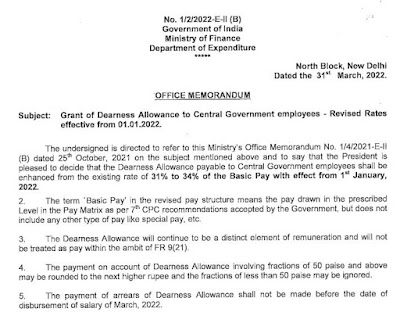
DA Jan 2022 - Grant of Dearness Allowance to Central Government employees - Revised Rates effective from 01.01.2022

 3% DA Hike - Revised Rates effective from 01.01.2022: DoE OM dated 31.03.2022 No. 1/2/2022-E-II (B) Government of India Ministry of Finance...