Showing posts with label 7th CPC Projected Pay Scale. Show all posts

Saturday, 21 November 2015

7th CPC Pay Fixation with examples

7th CPC Pay Fixation with examples

Pay Fixation in the New Pay Structure : The fitment of each employee in the new pay matrix is proposed to be done by multiplying his/her basic pay on the date of implementation by a factor of 2.57. 

The figure so arrived at is to be located in the new pay matrix, in the level that corresponds to the employee’s grade pay on the date of implementation, except in cases where the Commission has recommended a change in the existing grade pay. If the identical figure is not available in the given level, the next higher figure closest to it would be the new pay of the concerned employee. A couple of examples are detailed below to make the process amply clear.

The pay in the new pay matrix is to be fixed in the following manner:

Step 1: Identify Basic Pay (Pay in the pay band plus Grade Pay) drawn by an employee as on the date of implementation. This figure is ‘A’.

Step 2: Multiply ‘A’ with 2.57, round-off to the nearest rupee, and obtain result ‘B’.

Step 3: The figure so arrived at, i.e., ‘B’ or the next higher figure closest to it in the Level assigned to his/her grade pay, will be the new pay in the new pay matrix. In case the value of ‘B’ is less than the starting pay of the Level, then the pay will be equal to the starting pay of that level

Example I

i. For example an employee H is presently drawing Basic Pay of Rs.55,040 (Pay in the Pay Band Rs.46340 + Grade Pay Rs.8700 = Rs.55040). After multiplying Rs.55,040 with 2.57, a figure of Rs.1,41,452.80 is arrived at. This is rounded off to Rs.1,41,453.

ii. The level corresponding to GP 8700 is level 13, as may be seen from Table 4, which gives the full correspondence between existing Grade Pay and the new Levels being proposed.

iii. In the column for level 13, the figure closest to Rs.1,41,453 is Rs.1,41,600.

iv. Hence the pay of employee H will be fixed at Rs.1,41,600 in level 13 in the new pay matrix as shown below:

Pay Matrix


As part of its recommendations if Commission has recommended any upgradation or downgrade in the level of a particular post, the person would be placed in the level corresponding to the newly recommended grade pay.

Example II

i. Take the case of an employee T in GP 4200, drawing pay of Rs.20,000 in PB-2. The Basic Pay is Rs.24,200 (20,000+4200). If there was to be no change in T’s level the pay fixation would have been as explained in Example I above. After multiplying by 2.57, the amount fetched viz., Rs.62,194 would have been located in Level 6 and T’s pay would have been fixed in Level 6 at Rs.62,200.

Pay Matrix 7th CPC


ii. However, assuming that the Commission has recommended that the post occupied by T should be placed one level higher in GP 4600. T’s basic pay would then be Rs.24,600 (20000 + 4600). Multiplying this by 2.57 would fetch Rs.63,222.

iii. This value would have to be located in the matrix in Level 7 (the upgraded level of T).

iv. In the column for Level 7 Rs.63,222 lies between 62200 and 64100. Accordingly, the pay of T will be fixed in Level 7 at Rs.64,100.

7CPC PAY MATRIX

Authority: http://7cpc.india.gov.in/

Sunday, 16 August 2015

Government to incur additional expenses due to 7th Pay Commission

Government to incur additional expenses due to 7th Pay Commission :

Pay and Allowances of Central Government employees will increase one lakh crore in the current financial year and also projected to increase further due to recommendations of 7th Pay Commission.

“Salary is a big question for even profit-minded private concerns. It is therefore not surprising that the employees of service-oriented Central Government departments are so obsessed about their pays and allowances. For a few central and state government organizations that rake in huge profits, salaries and allowances to their employees is no big issue.”

A report on the spending habits of the middle class was presented in the Parliament yesterday. According to the report presented by the Minister of Finance, Arun Jaitley, “the salary given to Central Government employees in the current financial year will exceed Rs.1 lakh crore.” The amount is expected to rise further after the implementation of the recommendations of the 7th Pay Commission. This could lead to a financial crunch.

According to estimates, there could be an increase of 9.56 percent in the salary allocation for Central Government employees, to Rs.1 lakh 619 crores. In the Financial Year 2016-17, after the implementations of the 7th Pay Commission’s recommendations, it is very likely to increase to 15.79 percent and touch Rs.1.16 lakh crores. During the Financial Year 2017-18, it will further rise to Rs.1.28 lakh crores. Funds for pensioners will increase to Rs.88,521 crores this financial year. During the Financial Year 2016-17, it is expected to be 1.02 lakh crores. By the Financial Year 2017-18, it would be Rs.1.12 lakh crores.

7th Pay Commission is expected to submit its final report including the revised pay and pension structure for Central Government employees and pensioners to the Central Government on in the last week of September.
If everything goes as planned, the 7th Pay Commission recommendations will come into effect from 01.01.2016 onwards.

Meanwhile, there is no doubt in the fact that employees are extremely curious to find out how much their salaries would increase if the new Pay Commission recommendations are implemented.

Source: http://www.cgstaffnews.in/

Thursday, 6 August 2015

A Crucial Indicator for determining the Basic Pay of 7th Pay Commission- Multiplication Factor

A Crucial Indicator for determining the Basic Pay of 7th Pay Commission- Multiplication Factor

It is well known that Multiplication Factor 1.86 was being used by the 6th Pay Commission to calculate the new revised basic pay. The 6th Pay Commission had initially suggested 1.74, but it was later modified to 1.86.

The Multiplication Factor was arrived at by adding dearness allowance percentage to the basic pay with a simple methodology. The 6th Pay Commission also brought in a new concept called the Grade Pay. So, the basic pay diveded into two segments, which are called as Band Pay and Grade Pay.

Now that Grade Pay is not going to be included, it remains a mystery as to how the 7th Pay Commission will calculate the new Multiplication Factor.

A lot of speculations are now on about this.

With plenty of rumours afloat that salaries for Central Govt employees could increase twofold, an article was published by 90Paisa Blogrecently, which claimed that only a 30% hike in salary is sure to come. The article had used a Multiplication Factor of 2.68.

Last month, gservants.com claimed that the 7th Pay Commission may recommend a Multiplication Factor of 2.86. The website created waves when it published a projected basic pay structure by using a Multiplication Factor of 3.

The NC JCM Staff Side, in its memorandum to the 7th Pay Commission, suggested that a Multiplication Factor of 3.7 be used for calculation of new basic pay. They had also given a detailed explanation for it.
And one more, the Karnataka COC, which is an organization for Central Government employees, had demanded a Multiplication Factor of 3.85, and gave its own reasons for it.

All these are mere speculations…!

It’s up to the employees to believe what they want to.

Source: www.7thpaycommissionnews.in

Wednesday, 6 May 2015

Depending on the weightage fitment formula may range from 2.72 times to 3.72 in 7th Pay Commission

Depending on the weightage fitment formula may range from 2.72 times to 3.72 in 7th Pay Commission
Depending on the weightage fitment formula may range from 2.72 times to 3.72
“The Sixth Central Pay Commission has recommended a minimum wage of Rs 6600/- per month against the demand of Rs 10,000/- per month as worked out by Staff side of JCM, Today the minimum need based wage works out to Rs 26,000/ per month.”
Minimum Wage of Rs 26,000/- Justified and Fitment formula

Comrade,
The DIRECTORATE OF ECONONMICS & STATISTICS DEPARTMENT OF AGRICULTURE & COOPERATION MINISTRY OF AGRILCULTURE GOVERNMENT OF INDIA NEW DELHI has published the RETAIL PRICES OF FOOD AND NON FOOD ITEMS VIDE http://rpms.dacnet.nic.in/ PLEASE GO THROUGH THIS IMPORTANT LINK . which contains district wise price report.

http://rpms.dacnet.nic.in/Bulletin.aspx
You can get any price of any article using the Query option.
http://rpms.dacnet.nic.in/QueryReport.aspx

The prices of many items provided by the Staff side JCM are lower than the retail prices provided by the Government agency . Hence the Minimum wage of Rs 20,000/- is justified for the erstwhile Group “D” with effect from 1/1/15 using Dr Aykroyd formula . After weightage of 25% for Group “C” it works out to Rs 26,000/- .

Please click here for Prices of Food items as on 1/1/15
Please click here for Prices of Non Food items as on 1/1/15
Please click here for Minimum Wage Caluation Sheet

The fitment formula may range from 2.72 times to 3.72 depending upon the weightage.
The Sixth Central Pay Commission has recommended a minimum wage of Rs 6600/- per month against the demand of Rs 10,000/- per month as worked out by Staff side of JCM, Today the minimum need based wage works out to Rs 26,000/ per month.
Comradely yours
(P.S. Prasad)
General Secretary
Source: www.karnatakacoc.blogspot.in

Wednesday, 28 January 2015

Triple time increase in pay of Central government employees according to the estimated pay scales

Triple time increase in pay of Central government employees according to the estimated pay scales

The DA increase in January and July 2015 will play a vital role in the final numbers of the Pay Scale of 7th CPC. The estimated Pay Scales for Central Government Employees that the Seventh Pay commission can recommend for Employees working in Central Government establishments…

The Seventh Pay Commission report is expected to be released by the end of this year, and it seems that there will be no delay for the government to implement the report.

The Modi Government, being a believer in business will never want make arrear payments to the central government employees in the future and impose additional financial burden to the government.
If this is true, the seventh pay commission report will be implemented on 01/01/2016 and this news will be like a sweet melody in the ears of the central government employees.

Central government employees are also expecting the DA to be merged with their Pay. In such, along with the Implementation of the report, there will be growth in House Rent Allowance (HRA) and Educational allowance.

As on today’s date, the DA is at 107% and there arethree more DA instalments remaining before the announcement of the Seventh Pay commission. One instalment in January 2015 and the second in July 2015 and final third one Jan 2016 will be implemented.

The DA calculation will be based on the All India Consumer Price Index. Based on the data available on today’s date, the DA is expected to rise by 6% which increases the DA to 113% in this instalment. If the same trend continues, the DA is expected to have another 6% hike this July and also in Jan 2016.

Hence the pay commission will consider 124% DA before preparing the final report; this will prove to be an important number in the final calculation. If by 01.01.2016 the DA reaches 124%, then just considering the DA alone, the pay of the central government employees will be doubled.

But the pay commission considers various other factors to finalise the Pay scales. While adding those numbers, it is certain that the Pay of the central government employees may have a triple time hike. This is good news for the Central Government employees.

Now we have to see how candid does the government stay on the expectations of the central government employees. Nearly 50 lakh central government employees and Pensioners are eagerly waiting for the implementation of the Seventy Pay commission.

Our numbers state that a triple time rise in pay is sure, now it is to see how much more will the government add to these numbers.

Saturday, 25 October 2014

Meetings held by 7th CPC (as on 21.10.2014)

Meetings held by 7th CPC

Meetings held by 7th CPC (as on 21.10.2014)

Date Meeting with
13.10.2014 At Leh: Personnel of Indian Army, Indian Air Force, Defence Institute of High Altitude Research, DRDO, BRO, ITBP, MES, All Ladakh Central Government Employees Association
09.10.2014 At Dehradun: Non-Gazetted Officers’ Association, LBSNAA; National Institute for the Visually Handicapped Employees’ Union; Ministerial Staff Association, Survey of India; Topographical Staff Association, Survey of India; Class III Service Association, Survey of India; Central Government Library Association; Faculty, Indira Gandhi National Forest Academy; Indira Gandhi National Forest Academy Staff Association; Faculty, Indian Council of Forestry Research and Education
08.10.2014 At Dehradun: National Defence Medical Laboratory Technical Staff Association; All India Association of Clerical Employees of Ordnance Factories; Employees Union Ordnance Factory, Dehradun; All India Association of Non-Gazetted Officers of Ordnance & Equipment Factories and Quality Assurance Organization; Staff Association, Rashtriya Indian Military College; All India DGQA Engineers Association; Wildlife Institute of India
24.09.2014 Indian Ex-servicemen Movement
23.09.2014 CRPF Officers
22.09.2014 BSF Officers; Forum of retired CAPF officers
17.09.2014 Aviation Research Centre
16.09.2014 RPF Group ‘A’ Officers, IIM Bangalore
15.09.2014 Disabled War Veterans (DISWAVE) Association, DG Bureau of Police Research and Development
26.08.2014 At Bangalore: IAS Officers’ Association, IPS Officers’ Association, IFS Officers’ Association
25.08.2014 At Bangalore: IIM Bangalore, ISRO
24.08.2014 At Bangalore: Army Base Workshop (EME) Diploma Holders Association, Bangalore, Air Force Store Keepers Association, All India NCC Defence Civilian Employees Association, Confederation of Central Government Employees and Workers – Karnataka State, Atomic Energy Employees Federation, All India Central Excise Inspectors Association, The Indian Hospital Pharmacist Association, The Indian Railway Loco Pilot Association, South Western Railways Engineers Association, Railway Wheel Factory, South Western Railway Employees Sangh, All India DRDO Personal Staff Association, DoS Pensioners Forum, Central Government Pensioners Association, Indian Institute of Horticulture Research Employees’ Association, NIMHANS, Veterans Association
21.08.2014 Physiotherapy Forum; Indian Ordnance Factories Group’B’ Gazetted Officers Association
20.08.2014 Commissioner, Kendriya Vidyalaya Sangathan; Commissioner, Navodaya Vidyalaya Sangathan
24.07.2014 Confederation of Central Government Gazetted Officers Association; National Ex-Servicemen Co-ordination Committee; Indian Ex-Services League
23.07.2014 Bharat Central Pensioners Federation; Bharat Pensioners Samaj; Group ‘B’ Indian Information Service Association; Indian Postal Service Officers Association; DANICS Officers Association; Group ‘B’ Indian Ordnance Gazetted Officers Association
22.07.2014 Police Commissioner, Delhi; DG Coast Guard; IOFS Officers Association
21.07.2014 Director, IB; Director, CBI; Director, RAW
19.06.2014 Indian Economic Service Officers Association; Indian Statistical Service Officers Association; IFS Officers Association; DGs of CAPFs (BSF+ITBP+Assam Rifles+Sashastra Seema Suraksha Bal); DGs of CAPFs (CISF+CRPF+NSC)
18.06.2014 IFS Officers Association; PFRDA; Officers of Department of Financial Services, MOF; Officers of Department of Pension & Pensioners Welfare; P&T Finance Accounts Gr.A Officers Association; IRAS Officers Association; Central Health Service Association
17.06.2014 IAS Officers’ Association; Central Engineering Services Officers’ Association (Water+Power+Architecture); Central Engineering Services Officers’ Association (Civil+Electrical+Mechanical+Road Transport+Telecom); Income Tax Officers’ Association; Custom Officers Association; Central Excise Officers Association
16.06.2014 IPS Officers’ Association; Representative of Pay Commission cells of Army, Navy and Airforce; Indian Audit and Accounts Service Association; Cost Accounts Association; Civil Accounts Association; Federation of Railway Officers

Thursday, 28 August 2014

7th Pay Commission for Karnataka State Employees

7th Pay Commission for Karnataka State Employees

Karnataka govt keen to constitute 7th pay commission for govt employees

Chief minister Siddaramaiah on Friday said that the state government is positively inclined to constitute seventh pay commission for state government employees in addition to providing various facilities to them on the lines of central government.

Addressing state level government employees conference here, he said the employees are demanding the government to constitute new pay commission, but you should know that state government has implemented the recommendations of the sixth pay commission in 2012 and there is time till 2017 for constitution of the new pay commission.

As there is pressure from the experts to prepare from now itself to constitute the new pay commission government is working in that direction, he said adding that soon the state government may come out with a decision on the constitution of new pay commission. “However we are determined to provide facilities to the state employees on the lines of central government,” he said.

Speaking for more than one hour at this state level conference being organized after a gap of six years, that too at CM’s homeground, he said government is timely releasing the allowances and salaries of the employees. Referring to the demands of the government employees, chief minister said at the same time the employees should learn to work sincerely with a service motto. “Government employees should realize their responsibilities and duties” he said urging the workers to discharge their duties properly. “I am not here to give sermons to you, but if you want to command peoples respect you have to work seriously and sincerely,” he added.

Suggesting the employees to hold this conference once in every three years, Siddaramaiah said such conference will instill confidence you and make you to rededicate yourself for a public cause.

Releasing a souvenir on the occasion, housing minister Ambarish said the employees are the link between the government and people and is the responsibility of the workers to make the government programmes reach people. “This will happen only when employees realize that this itself is a great work and needs dedication,” he said.

Source : Times of India

Friday, 8 August 2014

Will the Federations recommended salary hikes materialize in 7th Pay Commission

Will the Federations recommended salary hikes materialize in 7th Pay Commission

‘Expected Pay Scale of 7th CPC’ – This is the hottest topic of discussion among central government employees right now! Hereinafter the topic and article have become the exciting headline of discussion and make countless debates among government employees.

What will the pay scale recommended by the 7th Pay Commission be like..?

Will the 7th Pay Commission recommend the salary hike suggested by the various associations and unions..?

Particularly, Will the 7th CPC take into consideration of the proposed pay structure presented by the (JCM) Staff Side and the Confederation?


For the time being, our only answer is- we’ll have to wait and watch..!

Some of our readers have felt that the suggestions made by the NC (JCM) Staff Side and Confederation are over-ambitious and beyond the realms of imaginations. They feel that such suggestions would be even considered only by the 8th Pay Commission and also hefty hike reflected in pay scale…etc.

The associations and various federations reflect the mindset of their majority employees. Although there is no denying the fact that they have been asking for slightly high, one has to examine the way these demands were made. It is not an easy task to make a sensible memorandum based on acceptable facts. The proposed pay structure suggested by the staff side is designed on visionary thinking. In 6th pay commission also federations were suggested to fix Rs.10000 as minimum pay, but the Government had fixed it as Rs. 7000. Now they are asking to fix Rs.26000 as minimum pay instead of Rs. 7ooo.
Minimum Pay Scale in 4th CPC Rs. 750

Minimum Pay Scale in 5th CPC Rs. 2550

Minimum Pay Scale in 6th CPC Rs. 7000

Minimum Pay Scale in 7th CPC Rs. 26000 (Demanded by NC JCM Staff Side)

The crying baby only gets the milk…Nothing happens by itself.

Source: www.cgstaffnews.in

Monday, 23 June 2014

Principles of Determination of Pay and Minimum & Maximum Wages Submitted to 7th CPC by IRTSA

Presentation on Principle of Pay determination & Minimum and Maximum Pay – Compiled by Er. K.V. Ramesh, Senior JGS/IRTSA
 
Principles of Determination of Pay & Determination of Minimum & Maximum Wages Submitted to 7th CENTRAL PAY COMMISSION
 
Indian Railways Technical Supervisors Association (IRTSA)
M. SHANMUGAM HARCHANDAN SINGH
Central President General Secretary
Compiled by K.V.RAMESH, Senior JGS/IRTSA

Relevant Terms of reference
 
2.a) To examine, review, evolve and recommend changes that are desirable and feasible regarding the principles that should govern the emoluments structure including pay, allowances and other facilities / benefits, in cash or kind, having regard to rationalization and simplification therein as well as the specialized needs of various Departments, agencies and services, in respect of the following categories of employees:-
 
i. Central Government employees-industrial and non- industrial;
 
2.b)To examine, review, evolve and recommend changes that are desirable and feasible regarding principles that should govern the emoluments structure, concessions and facilities/benefits, in cash or kind …….

Article 43. Living wage, etc., for workers
The State shall endeavour to secure, by suitable legislation or economic organisation or in any other way, to all workers, agricultural, industrial or otherwise, work, a living wage, conditions of work ensuring a decent standard of life and full enjoyment of leisure and social and cultural opportunities and …..

Job Evaluation
Scientific job evaluation methods are available for a fair comparison of wages.
Difference in nature of work can well be taken care of in scientific job evaluation.
Recommendation of 3rd CPC for adoption of Job evolution technique on experimental basis is still not tried.
Classification or Grading method is easier method for job evaluation.
 

Proposed method for Job Evaluation
Brief Job descriptions and details of pay scales, emoluments and other particulars be collected for various group of Employees. 
 
Jobs can be broadly grouped like “Industrial”, “Non-Industrial” and “Secretarial” etc.
These groups may be further broken up into various sub-groups like “Artisan”, “Supervisory”, “Administrative”, “Supportive”, etc. 
 
Separate “Grade definitions” shall be finalised for each of these Groups & sub-groups,
Indicating, type of work, level of job difficulty, area & Span of Supervision, etc
Maintaining horizontal parities & vertical relativities. 
 
Will results in better justice, better job satisfaction, greater industrial harmony leading to higher efficiency and productivity and the time, cost and effort would definitely be worth the returns, particularly in the long run

Minimum Wage as per 6th CPC method
Pay in Pay Band + Grade Pay + % DA + Compensation factor based on rise in NNP at factor Cost.
Calculation of compensation factor
Year Per Capita NNP at factor cost At constant price Increase over previous year
2005-06 26015 1872
2006-07 28067 2052
2007-08 30332 2265
2008-09 31754 1422
2009-10 33901 2147
2010-11 36342 2441
2011-12 38037 1695
2012-13 39168 1131
2013-14* 41046 1878
2014-15* 42924 1878
% Increase of NNP at factor cost on Constant Prices for the period of ten years
65%
* Assumed figures as per average increase
 
Proposed Minimum Pay w.e.f. – 1.1.2016
 
Minimum Basic Pay + DA 140%+ Compensationfactor 65% of BP + DA
Minimum Basic pay after VI CPC Rs.7000
Projected DA 140% (as on 1.1.2016) Rs.9800
BP+DA Rs.16800
Compensation factor (65%) Rs.10920
Proposed Minimum Pay Rs.27720 or Rs.28000
Proposed Number of times increase of BP 3.96
 
Proposed Minimum & Maximum Pay based on post 6th CPC formula
 
EXISTING PAY PROPOSED PAY @ 3.96 TIMES (ROUNDED OFF) OF EXISTING PAY
Minimum Maximum Minimum Maximum
Pay in Pay Band Grade Pay
Rs.5200 Rs.1800 Rs.80,000 Rs.20,800 Rs.7200 Rs.3,20,000
 
Minimum Pay shall be increased from Rs.7000 to Rs.28,000. 

Maximum Pay Shall be increased from Rs.80,000 to 3,20,000.
 
Intermediate Pays shall be fixed in the same way.
Upgradation shall be granted to specific categories on functional & other related justification.
 

Determination of Maximum Pay First & then arriving Minimum Pay in the ratio of 9:1
Maximum Pay shall be fixed first as per rise of NNP and then the Minimum pay in the ratio of 9:1thereof and the Intermediate Pays shall be fixed.
Maximum Pay = Rs.80,000 x Compensation factor based on rise in NNP at factor Cost. = 80000 x 3.96 = Rs.316800 or Rs.3,20,000.
Therefore, Minimum Pay works out to be Rs.320000 / 9 = 35555 or Rs.35500.

Rate of Increments
Annual Increment:- Rate of annual increment in each grade may please be granted @ 5 per cent.
Increment on Promotion:- During Promotion minimum 10% increase in Basic Pay has to be granted.
Fixation of Pay on Promotion at par with Entry Pay:- Pay on Promotion should be fixed at least at par with Entry Pay in the Revised Pay Structure.
Thank you
 
Source: IRTSA
[http://www.irtsa.net/pdfdocs/7th_CPC_Principle_of_Pay_Determination.pdf]

Friday, 23 May 2014

When will the 7th CPC submit its recommendations? When will the recommendations of 7th CPC be implemented?

When will the 7th CPC submit its recommendations? When will the recommendations of 7th CPC be implemented?

These questions are now constantly on the minds of Central Government employees!

Although highly placed sources say that the commission will compile its reports and recommendations in 18 months and that these recommendations will be implemented on 01.01.2016, there are also many who wonder aloud because there are no official confirmations yet.

This is not an exaggeration. The proof lies in the fact that two months ago, the question was raised in the Parliament. While the Terms of Reference make it clear that the Panel Committee has given 18 months time for the 7th CPC to submit its recommendations, a question was raised on when the report would be submitted. The concerned minister’s reply was vague. In other words, there was no concrete announcement.
Let us hope that the Commission submits its reports and recommendations on time.

Flash News

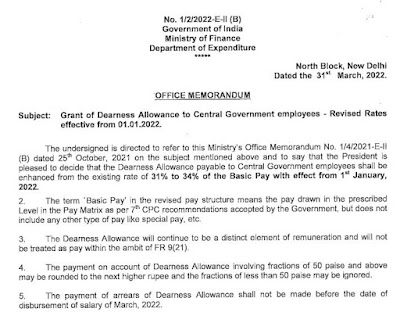
DA Jan 2022 - Grant of Dearness Allowance to Central Government employees - Revised Rates effective from 01.01.2022

 3% DA Hike - Revised Rates effective from 01.01.2022: DoE OM dated 31.03.2022 No. 1/2/2022-E-II (B) Government of India Ministry of Finance...