Showing posts with label 7th CPC Multiplication Factor. Show all posts

Monday, 4 September 2017

Recompute 7th CPC Minimum Pay & Multiplication Factor - Anomaly in computation of Minimum Wage: Agenda Item for NAC Meeting


Recompute 7th CPC Minimum Pay & Multiplication Factor - Anomaly in computation of Minimum Wage: Agenda Item for NAC Meeting

Item No 1

Anomaly in computation of Minimum Wage
In Para 1.29 of Chapter 1 of the 7th CPC report, the learned Chairman of the Commission Justice Shri AK Mathur has approvingly quoted the following observation their Lordship in the Supreme Court in the case of Bhupendranath Hazarika and Another Vs. State of Assam (SC 2013 (2) Sec.516)

"........ It should always be borne in mind that legitimate aspirations of the employees are not guillotined and a situation is not created where hopes end in despair. Hope for everyone is gloriously precious and that a model employer should not convert it to be deceitful and treacherous by playing a game of chess with their seniority. A sense of calm sensibility and concerned sincerity should be reflected in every step. An atmosphere of trust has to prevail and when the employees are absolutely sure that their trust shall not be betrayed and they shall be treated with dignified fairness then only the concept of good governance can be concertized. We say no more."

Naturally the recommendations of the 7th CPC ought to have been in consonance with the spirit of the observations made in Para 1.29, While determining the Minimum Pay (Chapter 4.2). The Commission is on record to state that it shall abide by the formula of Dr WR Aykroyd as amended by Supreme Court in the case of Workmen represented by Secretary Vs. Management of Reptakos Brett and Co. Ltd and Anr. on 31st October, 1991 (Equivalent citations: 1992 AIR 504, 1991 SCR Supl. (2) 129). In its submissions made to the Govt, the Staff Side had pointed out the errors and omissions crept in the computation of Minimum wage and its consequential impact. The Commission’s recommendations in this regard was clearly in violation of what has been stated in para 1.29 (quoted above). We annex for ready reference the extracts from our own submissions pertaining to this issue.

Our submission to Cabinet Secretary on 7th CPC:

"We are not in agreement with the methodology adopted by the 7th CPC in computing the minimum WAGE. We give hereunder briefly the reasons thereof.

The retail prices of the commodities quoted by the Labour bureau is irrational, imaginary and even absurd in respect of certain articles at certain places. The Staff Side had objected to the adoption of those rates in its meeting with the Commission on 9th June, 2015.

The adoption of 12 monthly average of the retail prices is contrary to Dr. Aykroyd formula. Same is the case with the reduction effected by the Commission on housing and social obligation factors. The house rent allowance is not a full compensation of the expenditure incurred by an employee for obtaining an accommodation. Therefore, no reduction on that count in arriving at the minimum wage is permissible. We may cite the minimum wage computation made by the 3rd CPC in this regard. The employees were in receipt of HRA even at that time. But still the 3rd CPC, and rightly so, adopted the 7.5% as the factor for housing. In respect of the addition to be made for children education and social obligation as per the Supreme Court judgement, (25%) the Commission has reduced the percentage to 15% on the specious plea that the employees are separately given children education allowance. The Children education allowance is not a full reimbursement of the expenses one has to incur. After the liberalization of the Education Sector where private parties were allowed to set up universities and colleges, the expenses for education had increased heavily. No concession or allowance is granted to the employees for educating the children beyond the higher secondary levels. The earlier Pay Commission has only tried to compensate a little in the increasing cost of education and that too at the primary level, since even the Governmental institutions had started charging abnormal tuition and other fees.

The website maintained for the Agriculture Ministry depicts the retail prices of commodities which go into the basket of minimum wage computation. Even though the rates quoted by them vary from the real retail prices in the market, it provides a different picture. If one is to take the rates quoted by them for different cities and make an all India average of the prices as on 1.7.2015, it will work out to Rs. 10810. It will result in the computation of the minimum wage of Rs. 19880. Adding 25% for arriving at the MTS scale, it will rise to Rs. 24850. To convert the same as on 1.1.2016, 3% will be added as suggested by the 7th CPC. The final computation will be Rs. 25,596, when rounded off shall be Rs. 26000.

The Andhra Pradesh State Pay Commission in its report has taken the commodity prices at Rs. 9830,- as on 1.7.2013 which works out to a minimum wage of Rs. 18080. The wage of MTS will then be Rs. 22600 as on 1.7.2013. The Corresponding figure for 1.1.2016 shall be Rs. 26758, rounded off to Rs. 27000.
The Staff side had computed the minimum wage as on 1.1.2014 at Rs. 26,000, taking the commodity price at Rs. 11344. The rates were taken on the basis of the actual retail prices in the market as on 1.1.2014 (average prices of 8 Cities in the country) substantiated by the documentary evidence of Cash bill obtained from the concerned vendors. As on 1.12016, the minimum wage work out to Rs. 29339, rounded off to Rs. 30,000.

The 5th CPC adopted the rate of growth in the economy (as reflected in the increase in the per capita net national produce at factor cost) over a period of ten years to arrive at the increase required to be made to arrive at the minimum wage. The per capita NNP at factor cost registered an increase of 65.28% over a period of ten years in 2013-14. If we apply the same percentage to the emoluments (Pay +DA) as on 1.1.2016 (assuming that DA will be 125% as on that date), the minimum wage as on 1.1.2016 for an MTS will have to be Rs. 26030, rounded off to Rs. 27000.

In para 4.2.9 of the report, the Commission has given a table depicting the percentage increase provided by the successive Pay Commissions, according to which the 2nd CPC had made a paltry increase of 14.2%. The 3rd CPC gave a rise of 20.6, 4th 27.6, 5th 31.0 and 6th CPC 54%. While the per centage increase had been in ascending order all along, the 7th CPC has sought to reverse that trend ostensibly for reasons unknown. It was the meager increase of 14% provided for by the 2nd CPC that triggered the volatile situation in the civil service and led to all India strike encompassing all employees which lasted for 5 days in 1960.

In the case of Bank, Insurance and many other Public Sector Undertakings wage revision takes place once in 5 years. In the recently concluded agreement, Bank employees were provided more than 15% increase.
After the implementation of the Pay Commission Report the AP State Employees have been given a wage structure based on a minimum wage for above the level of Central Government employees. In their case also wage revision does take place once in 5 years.

It could be seen from the above that the computation of minimum wage by the 7 CPC is prima facie wrong and computed on untenable premises and incorrect data. The minimum wage therefore requires re-computation and revision. Once the minimum wage gets revised, the fitment formula, the multiplication factor applied for determining the pay levels and the pay matrix itself will have to be consequently revised."

It could be seen from the above extract that the Minimum Wage as on 1.1.2016 could not have been computed at less than Rs 26000/- and consequently the multiplication factor ought to have been at 3.714. It is, therefore, demanded that the Minimum Wage and multiplication factor may be recomputed and Pay Level and Pay matrix changed in accordance with the revised minimum wage.

Tuesday, 31 May 2016

Media reports on 7th CPC are totally wrong and not true – Karnataka COC

Media reports on 7th CPC are totally wrong and not true – Karnataka COC

Prepare for struggle on 7th CPC issues.

Comrades,

The Staff side had demand of minimum wage of Rs 26000/- & fitment formula of 3.71. Against this the 7th CPC had recommended minimum wage of Rs 18000/- & fitment formula of 2.57. The 7th CPC recommendations has provided only at 14% wage hike at Group “C” level it is only ranging from Rs 2240/- to Rs 3500/- increase per month, and at Group “B” level ranging from Rs 4000/- to Rs 6500/- increase per month. This increase is lowest by any pay commission, hence vast changes are required as the prices of essential commodities have gone up and also the inflation rate has gone up.

There are various reports on 7th Central Pay commission on the media reports on minimum wage of Rs 21000/- & fitment formula of 3.00, (which is at 34% wage hike against the 14% wage hike recommended by the 7th CPC). These reports are totally wrong and not true, these reports divert the Central Government Employees from the struggle path. Now it’s clear from the meeting of the staff side leaders with the Cabinet Secretary that there will likely hood of the slight increase in minimum wage, but not be any changes in the fitment formula. This is against the Staff side demand of minimum wage of Rs 26000/- & fitment formula of 3.71.

Secondly there is no change in allowances expect HRA that too its rates are reduced by the 7th CPC and also many allowances have been withdrawn. This is saving for the Government.
Comrades it is the time to struggle, we should educate the members and prepare for struggle, so that we should get at least 50 % wage hike without allowances, as allowances are not taken into pension benefit.

Only struggle will get us benefit. Please don’t believe on rumours. Now it is now or never. Serve strike notice on 9th June 2016.

Comradely yours
(P.S.Prasad)
General Secretary

Source: http://karnatakacoc.blogspot.in/2016/05/prepare-for-struggle-on-7th-cpc-issues.html

Saturday, 21 November 2015

7th CPC Pay Fixation with examples

7th CPC Pay Fixation with examples

Pay Fixation in the New Pay Structure : The fitment of each employee in the new pay matrix is proposed to be done by multiplying his/her basic pay on the date of implementation by a factor of 2.57. 

The figure so arrived at is to be located in the new pay matrix, in the level that corresponds to the employee’s grade pay on the date of implementation, except in cases where the Commission has recommended a change in the existing grade pay. If the identical figure is not available in the given level, the next higher figure closest to it would be the new pay of the concerned employee. A couple of examples are detailed below to make the process amply clear.

The pay in the new pay matrix is to be fixed in the following manner:

Step 1: Identify Basic Pay (Pay in the pay band plus Grade Pay) drawn by an employee as on the date of implementation. This figure is ‘A’.

Step 2: Multiply ‘A’ with 2.57, round-off to the nearest rupee, and obtain result ‘B’.

Step 3: The figure so arrived at, i.e., ‘B’ or the next higher figure closest to it in the Level assigned to his/her grade pay, will be the new pay in the new pay matrix. In case the value of ‘B’ is less than the starting pay of the Level, then the pay will be equal to the starting pay of that level

Example I

i. For example an employee H is presently drawing Basic Pay of Rs.55,040 (Pay in the Pay Band Rs.46340 + Grade Pay Rs.8700 = Rs.55040). After multiplying Rs.55,040 with 2.57, a figure of Rs.1,41,452.80 is arrived at. This is rounded off to Rs.1,41,453.

ii. The level corresponding to GP 8700 is level 13, as may be seen from Table 4, which gives the full correspondence between existing Grade Pay and the new Levels being proposed.

iii. In the column for level 13, the figure closest to Rs.1,41,453 is Rs.1,41,600.

iv. Hence the pay of employee H will be fixed at Rs.1,41,600 in level 13 in the new pay matrix as shown below:

Pay Matrix


As part of its recommendations if Commission has recommended any upgradation or downgrade in the level of a particular post, the person would be placed in the level corresponding to the newly recommended grade pay.

Example II

i. Take the case of an employee T in GP 4200, drawing pay of Rs.20,000 in PB-2. The Basic Pay is Rs.24,200 (20,000+4200). If there was to be no change in T’s level the pay fixation would have been as explained in Example I above. After multiplying by 2.57, the amount fetched viz., Rs.62,194 would have been located in Level 6 and T’s pay would have been fixed in Level 6 at Rs.62,200.

Pay Matrix 7th CPC


ii. However, assuming that the Commission has recommended that the post occupied by T should be placed one level higher in GP 4600. T’s basic pay would then be Rs.24,600 (20000 + 4600). Multiplying this by 2.57 would fetch Rs.63,222.

iii. This value would have to be located in the matrix in Level 7 (the upgraded level of T).

iv. In the column for Level 7 Rs.63,222 lies between 62200 and 64100. Accordingly, the pay of T will be fixed in Level 7 at Rs.64,100.

7CPC PAY MATRIX

Authority: http://7cpc.india.gov.in/

Multiplication Factor / Fitment Formula recommended by 7th Pay Commission

Multiplication Factor / Fitment Formula recommended by 7th Pay Commission

7CPC_fitment-formula-7th-CPC


7th CPC recommended the Multiplication Factor proposed is 2.57

Fitment : The starting point for the first level of the matrix has been set at Rs. 18,000. This corresponds to the starting pay of Rs.7,000, which is the beginning of PB-1 viz., Rs.5,200 + GP 1800, which prevailed on 01.01.2006, the date of implementation of the VI CPC recommendations.

Hence the starting point now proposed is 2.57 times of what was prevailing on 01.01.2006. This fitment factor of 2.57 is being proposed to be applied uniformly for all employees. It includes a factor of 2.25 on account of DA neutralisation, assuming that the rate of Dearness Allowance would be 125 percent at the time of implementation of the new pay. Accordingly, the actual raise/fitment being recommended is 14.29 percent.

Source: 7thpaycommissionnews.in

Thursday, 6 August 2015

A Crucial Indicator for determining the Basic Pay of 7th Pay Commission- Multiplication Factor

A Crucial Indicator for determining the Basic Pay of 7th Pay Commission- Multiplication Factor

It is well known that Multiplication Factor 1.86 was being used by the 6th Pay Commission to calculate the new revised basic pay. The 6th Pay Commission had initially suggested 1.74, but it was later modified to 1.86.

The Multiplication Factor was arrived at by adding dearness allowance percentage to the basic pay with a simple methodology. The 6th Pay Commission also brought in a new concept called the Grade Pay. So, the basic pay diveded into two segments, which are called as Band Pay and Grade Pay.

Now that Grade Pay is not going to be included, it remains a mystery as to how the 7th Pay Commission will calculate the new Multiplication Factor.

A lot of speculations are now on about this.

With plenty of rumours afloat that salaries for Central Govt employees could increase twofold, an article was published by 90Paisa Blogrecently, which claimed that only a 30% hike in salary is sure to come. The article had used a Multiplication Factor of 2.68.

Last month, gservants.com claimed that the 7th Pay Commission may recommend a Multiplication Factor of 2.86. The website created waves when it published a projected basic pay structure by using a Multiplication Factor of 3.

The NC JCM Staff Side, in its memorandum to the 7th Pay Commission, suggested that a Multiplication Factor of 3.7 be used for calculation of new basic pay. They had also given a detailed explanation for it.
And one more, the Karnataka COC, which is an organization for Central Government employees, had demanded a Multiplication Factor of 3.85, and gave its own reasons for it.

All these are mere speculations…!

It’s up to the employees to believe what they want to.

Source: www.7thpaycommissionnews.in

Saturday, 18 July 2015

7th Pay Commission Recommendations has begun to emerge!

(7CPC) 7th Pay Commission Recommendations has begun to emerge!
“It doesn’t come as a surprise that even bits and morsels of information about the recommendations, which is being eagerly expected by nearly 50 lakh employees and pensioners, make headlines.”
The recommendations of the 7th Pay Commission have slowly started to make their way to the media in the form of unconfirmed news. The information that was being extensively discussed by all for more than a week now has finally made it to the websites yesterday.

It has now been confirmed that the 7th Pay Commission will submit is report to the Government next month. With the report being given a final shape, certain pieces of information have already started to hit the media. Some of the workable recommendations of the commission are out.

In 2006, a number of such unconfirmed reports surfaced, when the 6th Pay Commission report was being prepared, because the report was not submitted to the government on time. Due to the delay, there was tremendous curiosity to find out what the report contained. This led to a lot of rumors. Since the internet didn’t become that popular in those days, those rumors were hard to believe. Most of them were circulated by word of mouth.

Now, despite the fact that there are plenty of news sources, since it has become possible to trace the point of origin of the information, such rumors have reduced. This time around, the information was given by the leaders of Federations. Yet, one can neither completely accept them as true, nor dismiss them as entirely false.

Since the government and the major employees federations have their own websites, it has become possible for the information to spread to the corners of the world within minutes. Also, retracts and denials too have become equally fast, thus killing the rumours immediately. With a number of other individual websites and blogs too covering the news about Central Government employees, the readers are now able to differentiate between news and rumours.

There is nothing surprising or shocking in the news reports that have now surfaced. A minimum basic pay of Rs.21,000 is an expected one. The recently released Kerala Pay Commission too has recommended the minimum wage at Rs.17,000 (from 01.01.2014 onwards). The National Council has demanded that it be Rs.26,000 per month.

It is a well known fact that the Grade Pay System had been a source of constant irritation. The dual Hierarchy System (Promotional hierarchy and Grade Pay hierarchy) will come to an end. There will not be any more confusion about the promotions that come through MACP.

The Multiplication Factor of 2.86 does sound very low. NC JCM had pressurized the Pay Commission to fix it at 3.7. The 6th Pay Commission had fixed it at 1.86, and also given Grade Pay. Since the DA now stands at 125% (including July 2015 and January 2016), this could end up being substantial.

Information about retirement is unexpected. Unconfirmed reports claim that the 7th Pay Commission is planning to recommend 33 years in service or the age of 60 (whichever comes early) as the criteria for superannuation. Since the recommendations will be implemented from 01.01.2016 onwards, many are likely to get affected.

And also some key messages revolving about the recommendations are…

There will be no running Pay band and Grade Pay System. The Pay scales will be open ended to avoid stagnation in the scales. The CCA will be separated into two components as it was in the 5th Pay Commission. CGEGIS Insurance Coverage and Monthly premium will be increased. Classification of Posts will be Modified and the 7th Pay Commission recommendation will be implemented with effects from 1.1.2016.

Source: 7thpaycommissionnews.in

Thursday, 18 June 2015

7CPC Fitment Formula and Minimum Wage Calculations – Karnataka COC

7th Pay Commission Fitment Formula and Minimum Wage Calculations – Karnataka COC

Shri.P.S.Prasad General Secretary of COC Karnataka expressed his views about the calculation of fitment formula and computation of minimum wage of 7th CPC on its blog. He hinted in this article that most of the pay commissions have accpeted 70% of the staff side demand. Especially NC JCM Staff Side demands to fix minimum wage at Rs.26000. We reproduced the complete article and given below for your information…

Minimum Wage and Fitment Formula.
The Staff Side (JCM) has calculated minimum wage as on 1st Jan 2014 as per the Dr. Aykroyd formula as Rs 26,000/- taking into following prices.

Minimum Wage 7th CPC

The 7th CPC also would adopt Dr. Aykroyd formula for the computation of the minimum wage and thereafter the fitment formula is calculated.

Fitment formula = Minimum wage / Rs 7000
The Staff Side (JCM) has calculated the fitment formula of 3.72 that is Rs 26000/ Rs 7000 as on 1st Jan 2014.

The 7th CPC has hinted that the date of effect of the 7th CPC shall be from 1st Jan 2016. In this context the minimum wage and fitment formula, should be as follows.
The increase in prices between 1st Jan 2014 to 1st July 2015 is 18% as the DA as on 1st Jan 2014 was 100% and likely DA as on 1st July 2015 is 118%, In actual terms the retail prices have increased by over 25%. Even considering the 18% hike in prices from 1st Jan 2014 to 1st July 2015 and adding 7 % likely hike in prices for the period 1st July 2015 to Jan 2016 it works out to 25% hike in minimum wage.

Minimum wage calculated by the Staff Side (JCM) using Dr. Aykroyd formula as on 1st Jan 2014 was Rs 26,000/-

Adding 25% hike in prices between 1st Jan 2014 to 1st Jan 2016, the minimum wage should be Rs 32,000/- and accordingly the fitment formula should work out to 4.5 times.

If we calculate the minimum wage as on 1/1/2016 using the Dr. Aykroyd formula taking into account the current retail prices in Bangalore. It works out Rs 27,000/- and fitment formula as 3.85.
Minimum Wage 7th CPC
There are many rumors on the fitment formula and minimum wage, actually the 7th CPC has made only a draft and they will calculate the actual fitment formula and minimum wage only next month taking into the account the prices as on 1st July 2015 and adding weight age for the period 1st July 2015 to Jan 2016 and work out the fitment formula and minimum wage.

If any fitment formula less than 3.85 and minimum wage of Rs 27,000/- it will be denial of right wages for CG employees.

During the 6th CPC the Staff Side (JCM) has calculated minimum wage as on 1st Jan 2006 as per the Dr. Aykroyd formula as Rs 10,000/-, where as the 6th CPC had provide the minimum wage as Rs 7000/- and the 6th CPC had fixed fitment formula of 1.86. Most of the pay commissions have accepted 70% of the staff side demand. We sincerely hope this 7th Central Pay Commission will also calculate the right wages and fitment formula for the Central Government Employees.

Source: www.karnatakacoc.blogspot.in

Friday, 23 May 2014

7th CPC Report – When is it going to be submitted?

7th CPC Report – When is it going to be submitted

7th Pay Commission Report and the Need for Timeliness 

Background of the 7th Pay Commission

The 7th pay commission report – when is it going to be submitted?
 
The announcement about the 7th pay commission report came out on September the 25th of 2013. This pay commission unlike the 6th pay commission was set up well in advance. This became possible due to significant efforts of various organisations, union lists and the finance commission report. Announcements say that the 7th pay commission will be implemented from 1.1.2016 and it will take approximately 18 months time for the report to be submitted. 

Recently, the 7th pay commission Chairman and the members gave out a public statement on 4.2.2014 and after that on 22.2.2014 the important 7th cpc terms and references were released. Now, the thought that floats on everyone’s mind is whether the 7th pay commission report will be submitted within the 18 months time period and will the employees be able to get the benefits along with their salary from 1.1.2016.
Recently, in the Lok Shaba during the question and answer session, it was pointed out that no specific time limit can be specified as of now for the implementation of the 7th pay commission. However, the finance ministry is now recruiting people for the 7th pay commission pay cell on deputation basis. This is a good attempt which boosts our confidence in the fact that the 7th pay commission will be put into effect on time. 


Reports of the Earlier Pay Commissions

If the employees get the benefits of the 7th pay commission along with our salary on 1.1.2016, then, this will be the first time we are given the pay commission benefits without arrears. I am providing a link containing reports about when the previous pay commissions were set and when they were implemented.

Pay Commission Date of Appointment Date of submission of report Financial impact (Rs. In crores) Time
First Pay Commission May, 1946 May, 1947 N.A 1 YEAR
Second Pay Commission August, 1957 August, 1959 39.62 2 YEARS
Third Pay Commission April, 1970 March, 1973 144.60 3 YEARS (aprx)
Fourth Pay Commission June, 1983 3 reports submitted in June, 1986; Dec. 1986 and May, 1987 1282 4 YEARS(aprx)
Fifth Pay Commission April, 1994 January, 1997 17,000 3YEARS (aprx)
Sixth pay commission July 2006 March 2008 18 months

Arrears of the 6th Pay Commission :- When you see the timetable above, you can understand that none of the previous pay commissions were implemented on time and without the payment of arrears. When the 6th pay commission was implemented, the government paid a huge amount as arrears in two instalments. This impacted the economy considerably and caused changes in inflation rate and GDP. This shocking fact was revealed by the 13th finance committee report. 

The Benefits of the Timely Implementation of the 7th Pay Commission :- What benefits will the employees get if the 7th pay commission is implemented on 1.1.2016? Let us have a look. 

Firstly, all the allowances and benefits can be got on 1.1.2016. When the benefits are paid as arrears the employees will not get some of the allowances due to exclusion. 

Secondly, the government will not have to pay a huge amount as arrears and thereby can avoid economic burden. 

Thirdly, if a National Anomaly Committee is set up and the shortcomings of the 7th pay commission are corrected immediately, employees can receive the benefits easily. We have to note that several points mentioned the anomaly committee report of the 6th pay commission still remain problematic and uncorrected. 

Fourthly, let us have a look at the elements of ACP and MACP. Like the ACP and MACP, the financial up gradation is going to be introduced in the 7th Pay Commission; the issues that may arise due to this have to be resolved in a timely manner so that everyone may be benefitted by it.   In the 5th pay commission, the time limit for promotion through ACP remained at 12 years, and in the 6th pay commission the time limit for promotions through MACP remained at 10 years. In the 5th pay commission, a new method of promotion through hierarchy was introduced. In the 6th pay commission promotions happened through grade pay structure. 

The main aim of introducing ACP and MACP is to make sure that an employee gets minimal promotion at least thrice in his life time of service. If this is the case, the minimal service period of an employee should be at least 30 years. But presently, employees are appointed even at the age of 37 and so their service period is just 23 years. Such problems have to be carefully considered well in advance and solved before the 7th pay commission is implemented. 

Let us believe that the 7th pay commission will be the first arrears-free pay commission and implemented on time as per the guidelines of the 13th finance commission.
 

Flash News

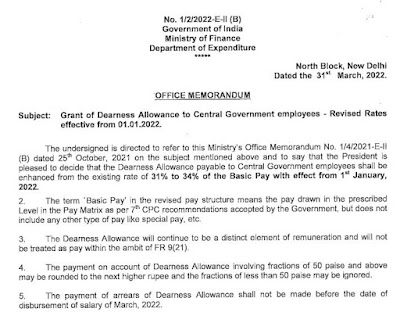
DA Jan 2022 - Grant of Dearness Allowance to Central Government employees - Revised Rates effective from 01.01.2022

 3% DA Hike - Revised Rates effective from 01.01.2022: DoE OM dated 31.03.2022 No. 1/2/2022-E-II (B) Government of India Ministry of Finance...