Wednesday, 7 January 2015

Expected DA for January 2015 – DA Hike Almost Decided..!

Expected DA for January 2015 – DA Hike Almost Decided..!

Until the 6th CPC, the Dearness Allowance didn’t increase by more than 1 or 2%. It was only after the 6th Pay Commission that it began to increase substantially. With the skyrocketing prices of essential commodities, Dearness Allowance too began to rise. Twice, it touched double digits. In July 2013 and Jan 2014, within 12 months the DA has leapt on to the 100%. We cannot forget that the each instalment gave 10%. Then, it slumped.
Dearness Allowance, which is given once every six months, is likely to be 6% hike from January 2015. This is 1% less than the previous hike of additional DA from July 2014. The total DA from Jan 2015 will become 113%.
As soon as the first instalment is confirmed, expectations will start growing about the second instalment, i.e., ‘Expected Da from July 2015‘. The second instalment of the year will cover the months between July and December 2015. This will be the last time that the DA hike will be calculated based on the method recommended by the 6th Pay Commission. DA of 2016 will be calculated based on the recommendations made by the 7th Pay Commission.

7th Pay Commission on DA Calculation..? Is there any possible to change in the method of calculation..?
First, we have to know about the calculation of Dearness Allowance…
How DA is calculated..?
Month Year /  CPI(IW) BY 2001=100 / Total / Average / App. DA / DA%
First is the month and year. Then the CPI (IW) Base Year 2001=100 and the relevant data. In the next column, you have the sum total of all the 12 months, i.e., the total of the declared AIPCIN numbers for the past 12 months. Next comes the division of the sum total by 12.

The next step is the most crucial one. You will have to find out by how much it exceeds 115.76. You will have to calculate the excess as percentage of 115.76.

(12 Monthly Average) – 115.76
————————————————–  X  100 = Percentage increase in prices
115.76

DA Calculation
Source: http://7thpaycommissionnews.in/

The Lokpal and Lokayktas Act, 2013 — Submission of declaration of assets and liabilities by the public servants

Dopt Orders on submission of declaration of assets and liabilities by the public servants

The Lokpal and Lokayuktas Act, 2013 – Submission of declaration of assets and liabilities by the public servants.
IMMEDIATE
F. No. 21/2/2014-CS.I (PR)
Ministry of Personnel, Public Grievances & Pensions
Department of Personnel & Training
CS.I Division
2 Floor, Loknayak Bhawan,
Khan Market, New Delhi
Dated: 7.1.2015
OFFICE MEMORANDUM

Subject: The Lokpal and Lokayktas Act, 2013 — Submission of declaration of assets and liabilities by the public servants

Ministries/ Departments may refer to CS.I Division, DoPTs OM. of even number dated 31st July 2014 and 9th September 2014 on the subject mentioned above.

2. The Government has since amended the Public Servants (Furnishing of Information and Annual Return of Assets and Liabilities and the limits for Exemption of Assets in Filing Returns) Rules, 2014 under the Lokpal and Lokayuktas Act, 2013 vide Notification No G.S.R. 918(E) dated 26th December 2014. in terms of which, the last date of revised returns of assets and liabilities by public servants has been extended to 30th April 2015. The Notification is available on the website of this Department. Further, the Govt. have also modified Form No.11 and Form No.IV for filing of the returns. The  revised formats are attached herewith. Accordingly, all the CSS Officers shall be required to file the revised declarations, information as on the 1.8.2014 by 30.4.2015.

3. The extended date and the modified formats for filing of the returns may be brought to the notice of all CSS Officers. Ministries / Departments are also requested to forward the declarations, information, returns submitted by US and above level officers of CSS to CS.I Division, DoPT for records.
sd/-
(Utraarsh R.Tiwaari)
Director
Click to view the format of revised forms
Source: www.persmin.gov.in

All India Strike by 7 Lakh Coal Mine Workers

All India Strike by 7 Lakh Coal Mine Workers


More than 7 lakh employees across the country have launched a 5-day long strike from yesterday, protesting the Central Government’s decision to sell the company’s shares. This is expected to severely affect the electric power generation for the next few days.

The Central Government has decided to revamp the coal mine companies and sell the shares in the open market. Coal mine workers all over the country had announced a 5-day long strike, claiming that the decision was against the principles of nationalization. The striking workers had also presented their list of demands.
As per their announcement, the strike began with the very first shift in the morning, yesterday. More than 7 lakh coal-mine workers are going to gherao their head-quarters and participate in the strike.

More than 15 lakh tons of coal is dug up everyday at the government-owned mines, and sent to the thermal power stations for generating electricity. The strike is expected to take a severe toll on power generation, and thus, power supply, all over the country. Even otherwise, coal production has been affected due to shortage of power to these mines. With the commencement of strike, the situation is very likely to worsen.

Five important trade unions, including Bharatiya Janata Party’s Bharatiya Mazdoor Sangh (BMS), INTUC, AITUC, CITU and HMS, have declared their support and participation in the strike. The fact that BJP’s own workers’ union is participating in the strike has become a source of embarrassment for the Central Government.

Recognition of Certificate/Qualification of Industrial Training Institute (I.T.I.) upgraded as Centre of Excellence (COE) and its acceptance for the purpose of employment in railways – Railway Board Order

Recognition of Certificate/Qualification of Industrial Training Institute (I.T.I.) upgraded as Centre of Excellence (COE) and its acceptance for the purpose of employment in railways – Railway Board Order

(GOVERNMENT OF INDIA (BHARAT SARKAR)
MINISTRY OF RAILWAYS (RAIL MANTRALAYA)
(RAILWAY BOARD)

RBE NO.147/2014

No, E(NG)-II/2005/RR-1/7

New Delhi. 29-12-2014.

The General Manager (P),
All Zonal Railways/Production Units
Chairmen. Railway Recruitment Boards

Sub: Recognition of Certificate/Qualification of Industrial Training Institute (I.T.I.) upgraded as Centre of Excellence (COE) and its acceptance for the purpose of employment in railways.

Ref: Board’s letter of even number dated 01/12/2012 (RBE No.16/2012).

Pursuant to issue of instructions contained in letter under reference. railway establishments have been seeking a comparative list/mapping of trades awarded by industrial Training institutes (I.T.Is) under the Craftsman Training Scheme (CTS) vis-a-vis courses/trades granted by Centre of Excellence (COE).

2. The matter has been examined in consultation with Directorate General of Employment & Training (DGET), M/o Labour & Employment and a tabulated position of comparative list/mapping of trades supplied is sent herewith for information and compliance:

S. No. Qualification certificate (s) submitted by the candidate obtained from COE
Suggested trade under State Council for Technical Education (SCVT)/ National Council for Technical Education (NCVT)
(i) National Trade Certificate (NTC) of one year- BBBT in sector of Electrical COE plus NTC of any of the following 06 (six) month course advance module in :- Repair & Maintenance of Electrical Machine & Power Supply; OR Repair & Maintenance of Domestic Appliances; OR Operation & Maintenance of Equipments used in HT, LT, Substation Cable Jointing; OR
Non-conventional Power Generation, Battery and inverter; OR Repair and Maintenance of instruments used in Electrical Engineering.
:
Electrician
(ii) National Trade Certificate (NTC) of one year BBBT in sector of Automobile COE plus NTC of any of the following 06 (six) month course advance module in :- Denting Winding and Welding; OR Servicing & Overhauling of Automobiles (Petrol); OR Servicing & Overhauling of Automobiles (Diesel) OR Overhauling of Fuel Injection System & Steering Mechanism; OR Repair & Maintenance of Wheel; Re-trading of Tyres & Wheel Balancing; OR Auto Electrical Electronics & Air-conditioning in Automobiles; :
Mechanic Motor Vehicle
(iii) National Trade Certificate (NTC) of one year BBBT in sector of Fabrication COE plus NTC of any of the following 06 (six) month course advance module in: Structural/Pressure Parts Fitting; OR Structural Welding; OR Pressure Vessel & Pipe Welding; OR Welding Inspection & Testing; OR TIG/MIG Welding. :
Fitter
(iv) National Trade Certificate (NTC) of one year BBBT in sector of Refrigeration & Air Conditioning COE plus NTC of any of the following 06 (six) month course advance module in :- Domestic, Commercial Refrigeration & Air Conditioning; OR Central Air Conditioning Plant, Industrial Cooling & Central Air Conditioning Plant, Industrial Cooling & Package; OR Cold Storage, Ice Plant & Ice-Candy Plant. :
Refrigeration & Air Conditioning
(v) National Trade Certificate (NTC) of one year BBBT in sector of Electronics COE plus NTC of any of the following 06 (six) month course advance module in :- Radio, Audio. Video System and Appliances; OR Inverters, UPS, Voltage Stabilizers and Industrial Drives; OR Repair & Maintenance of Electronic Test Equipment; OR Communication System, Embedded S stern and PLC. :
Electronic Mechanic
(vi) National Trade Certificate (NTC) of one year BBBT in sector of Information Technology (IT) COE plus NTC of any of the following 06 (six) month course advance module in :- Multi Media & Animation; OR Repair & Maintenance of Hardware of Computer & Peripheral Computer Networking ; OR Digital Videography; OR E-Accountancy & Office Management; OR Multi Media & Creative Designing; OR Information System Management. :
Information Communication Technology System Maintenance
(vii) National Trade Certificate (NTC) of one year BBBT in sector of Instrumentation COE plus NTC of any of the following 06 (six) month course advance module in:- Industrial Electronics & Instrumentation; OR Analytical Instrumentation; OR Process Control Instrumentation; OR Medical Instrumentation; OR Optical Instrumentation; OR Electronic Test Measuring Instruments. :
Instrument Mechanic

3. Apart from the above, comparative list/mapping of trades circulated vide letter No. 2012/E(RRB)/3/2 dated l4/9/2012 (copy enclosed) shall also be complied to.

4. Past cases which have been finalized need not be re-opened. Cases where final decision is yet to be taken may be dealt in terms of above instructions.

Please acknowledge receipt.

(Hindi version will follow)
Encls.. As stated.
(Lily Pandeya)
Director Estt. (N)-II
Railway Board.
Source/View/Download: http://www.airfindia.com

For One Rank One Pension, war veterans to march on Delhi

For OROP, war veterans to march on Delhi: Ajay Sura,TNN

CHANDIGARH: More than 10,000 restless ex-servicemen from across the country will hold a massive protest at Jantar Mantar in New Delhi on February 1 to pressurize the Centre into keeping its promise on the one rank one pension (OROP) demand.

During the 2014 Lok Sabha election campaign, both the BJP and Congress had pledged to implement the scheme. But the new government has not implemented it even after completing 200 days in office. Several ex-servicemen welfare organizations have come under the banner of Indian Ex-servicemen Movement (IESM) for the protest.

The veterans are also unhappy over defence minister Manohar Parrikar recent statement that he would try to implement 80% of OROP.

“It has to be implemented 100% as promised by the Prime Minister on a number of occasions. Any dilution will not be OROP,” said Major General Satbir Singh (retd), chairman of IESM. He also wants a white paper from the Centre on OROP, given that Narender Modi had pledged to implement the scheme in his first election rally at Rewari in September 2013 after he was declared BJP’s prime ministerial candidate.

“If it is short of funds, the government should openly say so. We are even ready to accept bonds but give us our 100%,” Gen Satbir said.

Brigadier Harwant Singh (retd), president of the all India Defence Brotherhood, said, “As soldiers, we never thought of performing 80% while guarding the nation. We are feeling dejected and restless because of the delay.”

Brigadier Kiran Krishan (retd) of IESM said OROP was sanctioned on February 17, 2014. “Ten months have passed since. The BJP government enthusiastically promising to implement it had raised our hopes. But the party seems to be dragging its feet.”

In its last budget in February, the UPA government had provisioned for Rs 500 crore for OROP. The BJP government had announced Rs 1,000 crore in its interim budget in July. However, army authorities estimate that Rs 5,000 crore would be required, whereas the accounts department of the defence ministry says Rs 9000 crore would be needed to implement OROP.

Out of 30-lakh ex-servicemen in the country, Punjab alone has around 3 lakh, Haryana has nearly 2.8 lakh, Himachal Pradesh (HP) has around two lakh. Around 10,000 retired ex-servicemen live in Chandigarh.
OROP implies uniform pension to personnel retiring on the same rank with the same length of service irrespective of their date of retirement.

Source: TOI

Exempt Defence Civilian Employees From New Pension Scheme – AIDRDO TOA

Exempt Defence Civilian Employees From New Pension Scheme – AIDRDO TOA

All India DRDO Technical Officers Association have represented both the Central Government and 7th Pay Commission to exempt the Defence civilian employees from New Pension Scheme. The copy of the Representation of AIDRDO TOA is given below..

“……Dear colleagues

We have represented to both previous NDA & UPA Governments to scrap NPS.Now we have requested the present Government to exempt the Defence civilian employees from New Pension Scheme at par with Armed Forces.Let’s be optimistic that present Central Government will exempt us.Let’s build pressure on the Govt. by ensuring that employees/officers who joined after 01/01/2004 send individual representations to the Cabinet Secretary through proper channel.Pl.forward this mail to our younger brothers & sisters who joined after 01/01/2014.

During the meeting with Chairman,7th CPC we have categorically told that New Pension Scheme should be rescinded and scrapped.We requested that the CPC can intervene as 6th CPC had given recommendations that Defined Pension Scheme is better than NPS.We requested that the recommendations of 6th CPC should be applied to all entrants since 01/01/2004.

The extract from our memorandum to 7th CPC on NPS is given below for ready reference.

New Pension Scheme (NPS)

2.1 The contributory pension system brought in by the GOI through their notification dated 22.12.2003, now renamed as National Pension System under PFRDA Act, has been imposed on Government employees who entered service on or after 1.1.2004.

2.2 This is an illegal act in as much as the Supreme Court of India had held Pension as an enforceable inalienable fundamental right. Therefore it should be scrapped or at least not made applicable to Government employees. This has also divided the CG employees into two categories and therefore it is discriminatory in respect of persons who have entered service on or after 1.1.2004 who had been denied the statutory pension. Any discriminatory scheme is illegal and ultravires of Article 14 of the Constitution. On this count also the NPS cannot be made applicable to the Government employees.

2.3 The Centre for Economic Studies and Policy, Institute for Social & Economic Change, Bangalore in a Study of Terminal Benefits of the Central Government Employees sponsored by the VI CPC had also observed that Civil Services Pension is in the nature of a deferred wage. It is well known that the principle guiding the pay package of civil servants is one of intentionally spreading out the compensation over a long period of time, thereby the wages paid out during the course of the work tenure is kept low by design, and the pension payments made during the retirement phase compensate for the low working wages.

2.4 The above mentioned study under the heading “Arguments against pension reforms” states as follows:
“Deferred Wage: In the context of civil servant pension payments, it is argued that, the principle guiding the fixation of pay package is one of intentionally spreading out the compensation over a long period of time, whereby the wages paid out during the course of work tenure is kept low by design, and the pension payments made during the retirement phase compensate for the low working wages. The Supreme Court of India held that pension is neither a bounty nor a matter of grace depending upon the sweet will of the employer. It is not an ex-gratia payment, but a payment for past services rendered. It is a social welfare measure, rendering socio-economic justice to those who in the heyday of their life ceaselessly toiled for the employer on an assurance that in their old age, they would not be left in the lurch.”

“Larry Williams observes “Actually, civil service pensions, because they are not based on contributions, are best described as deferred wages. Civil servants accept a lower current wage in exchange for the promise of a pension in their old age. If this pension were contributory, they would insist on a higher wage and government would have to either increase taxes or borrow (issue debt) to pay it. The real cost of civil servants is thus much higher than recorded under the current system of cash accounting. A good reform would be to move to a system of accrual accounting setting up at least a notional fund to pay these deferred wages” (Larry Wilmore, 2004)” “Public and private sector pay differentials: A comparison of the public and private sector wages reveals that while the public sector wages for the lower grades compares well with that of the private sector, the salaries of the employees belonging to the higher grades are highly unfavourable to the public sector employees. The post-retirement benefits that the government employees are entitled to act as some incentive to retain them in government sector.”

2.5 The above study had submitted the following estimated pensionery outgo which tends to increase during the period from 2014-2038. It is only after 2043 that it starts declining and will be reduced to zero only in 2088. The table is given below:

Table showing estimated pensionery outgo 
 Year                                            Employee Pension Payout (in Rs   Crores) Family Pension    Pay out (in Rs. Crores) Total pension payout (in Rs.Crores)
2004 11300.69 2983.38 14284.07
2008 13532.84 3572.68 17105.52
2013 16549.07 4368.94 20918.02
2018 21862.54 5771.79 27634.33
2023 27723.68 7319.11 35042.80
2028 34076.27 8996.13 43072.41
2033 39321.68 10381.01 49702.69
2038 45164.50 11923.41 57087.90
2043 41747.23 11021.30 52768.53
2048 35011.92 9243.18 44255.10
2053 25405.44 6707.07 32112.51
2058 16303.15 4304.07 20607.22
2063 8179.51 2159.39 10838.90
2068 3159.88 834.19 3994.07
2073 800.68 211.34 1012.02
2078 110.26 29.17 139.43
2083 3.52 0.97 4.49
2088 0.00 0.00 0.00

2.6 The above study had also pointed out that expenditure on pensions of civil servants of high income OECD countries on an average is 2% of GDP (less than 1% in Ireland and more than 3.5% in Austria*)(* Source: OECD Social Expenditure Database). But in the 8 South Asian countries it is less than 1% of GDP (Source: World Bank Data base). However, in India between 1964-65 and 2004-05 on an average pension payments (Civil Service pension paid by Central Government) have constituted 0.51% share of GDP. The Pension liability would continue to increase and reach 0.54% level by 2014-15 and remain at that level till 2024-25 after which they would decline as a percentage of GDP according to the same study conducted by Dr.Gayatri at the instance of VI CPC. These figures argue themselves in favour of continuation of the Defined Benefit Pension Scheme for all Central Government employees instead of throwing a section of them to market based NPS. According to 2011 census 62.8% are in the age group of 15 to 60 and only 8.2% are above the age of 60.

2.7 From the above projection it is very clear that the benefit of NPS will commence only after 30 years i.e. in 2044. And during the period it will increase exponentially as because in addition to the Statutory pension liability the Government will be contributing to the NPS also @ 10% of annual salary bill of the CG Employees who have entered service on or after 1.1.2004.

2.8 The final conclusion of this study team has been as under:
“Mainly given the fact that the future liability although may be large in terms of the absolute size is not likely to last very long and does not constitute an alarmingly big share of the GDP which is also on the decline, it appears that pursuing the existing “Pay As you Go” to meet the liability would be an ideal solution.”

2.9 Applying this conclusion we may suggest that the NPS may not be made applicable to the Government employees and all those who had been covered under NPS may be reverted back to statutory pension scheme. The Government may be asked to study the experiences of this scheme in several other countries in the world. In Chile such a scheme has been reversed as because the return which the low paid employees got out of the annuity purchased was not as good as 50% of LPD but as low as 20% of LPD. The UK Government had to pay out of the exchequer large amount by way of subventions in order to ensure that that annuities purchased yield 50% of LPD as pension. It is well known that in USA where there were similar pension schemes dependent upon the market had collapsed during the financial melt down from 2008 onwards. It is estimated that more than 3.5 trillion $ worth of pension wealth was lost. The workers not only lost their pension but also their jobs. Our respectful submission is that taking into account the demographic considerations of India which is a country of young do not need any such market oriented pension scheme, particularly when the international experience is that such schemes had failed and our country can afford to pay pension to civil servants which stands at level of 1% of the GDP. We conclude by quoting the opinions of experts on the future of market dependent pension Scheme.

Mr Joseph Stiglitz (Chief economic advisor to former president of USA Bill Clinton, former vice-chairman and chief economic advisor, World Bank, Nobel Prize winner, Professor of economics, Columbia university) said that “Stock market does not guarantee returns. It does not even guarantee that the stock values will keep up with inflation. Privatization would not protect retirees against the social security systems insolvency. Argentina’s privatization of its pension system was at the centre of its fiscal woes”.

Mr Dean Baker (Co-director for centre for economic and policy research, Washington) said “Privatisation means that you would not have a guaranteed benefit that you have today. It would depend on how will your investments do or how well they have done at the point you retire. He quoted the collapse of NASDAQ and Enron. In Britain, Insurance companies could not honour their promises and the Government had to compensate with 8 billion pounds”.

We have requested the PFRDA Authority to furnish certain information on their working . On receipt of this information we may make certain further submission for the consideration of the Commission.”

With greetings,
Yours fraternally
V.Krishna Mohan

Tuesday, 6 January 2015

Task Force to give suggestions to improve productivity in Railway Operations, manufacturing and other departments on Indian Railways -reg.

Task Force to give suggestions to improve productivity in Railway Operations, manufacturing and other departments on Indian Railways -reg. 
NFIR
National Federation of Indian Railwaymen

3, CHELMSFORD ROAD, NEWDELHT- 110055
Affiliated to :
lndian National Trade Union Congress (INTUC)
lntemational Transport Workers’ Federation (ITF)

No. IV/NFIR/HLC/FINANCIAL HEALTH/IR
Dated: 05/01/2015
The Secretary (E),
Railway Board,
New Delhi
kind attention: Shri Vijay Kumar, EDME(INFRA).

Dear Sir.
Sub: Task Force to give suggestions to improve productivity in Railway Operations, manufacturing and other departments on Indian Railways -reg.

Ref: Railway Board’s letter No. 2014/INFRA/TF/IPRO dated 24/12/2014 and 31/12/2014.
We convey our suggestions vide Annexure to this letter to enable the Task Force to give serious consideration.
Yours faithfully,
(Dr. M. Raghavaiah)
General Secretary
DA/As above
Copy forwarded to the Executive Director/IR, Railway Board, New Delhi for information and necessary action.
Copy to the General Secretaries of Affiliated Unions of NFIR.
Media Centre/NFIR
Copy to File No. IV/NFIR/SR/2014/HLRRC.
Copy to File No. IV/NFIR/FDI/IR.
“Annexure”
1. Railway Operations

1.1 Special priority should be given for ensuring “throughput” so as to avoid detention to trains, thereby path on Railway tracks will be available for running additional services and at the same time rolling stock could be utilized to optimum level and equally expenditure on fuel can be brought down considerably.

1.2 Almost all passenger carrying trains are presently kept at signals due to non- availability of platforms. Additional platforms should be constructed or new terminals be opened for prompt reception and despatch of trains. Presently due to detention at signals, image of Railways is adversely affected and equally man hours and engine hours are wasted. These are required to be addressed.

1.3 Unnecessary movement of empty wagons be avoided and at the same time empties be supplied promptly for meeting the demands. At present on some Zones, empty wagons are run for hundreds of kilometres for the purpose of loading. A thorough review is needed.

1.4 The existing wagon capacity should be utilised for loading at least up to the extant of 80% against present “loaded to total of 65%”.

1.5 The Zonal Railways which have potential to increase the freight loading, should be provided the required assistance.

1.6 A thorough study needs to be done with regard to Zonal Railways where Operating Ratio is poor and steps taken for improving the efficiency levels.


2. Stores

2.1 Supply of raw materials/spare parts should be ensured in order to prevent cannibalization.

2.2 Quality material, spare parts should procured for quality performance of assets instead of resorting to lowest tender system.

2.3 Procurement of machinery and assets may be resorted to only when the same are really required for the system.


3. Civil Engineering Works

3.1 Priority should be given for doubling and laying of third and fourth lines wherever the Tracks are over saturated. There is no need to have “Bullet Train” as such a project would cost heavily to the Nation and the Railways.

3.2 The funds allotted for construction of new lines may be frozen and study be conducted to assess whether such lines are really required at this juncture.


4. Human Resources Development

4.1 The employees belonging to safety categories (Running etc.,) are to be utilized for the duties of the post they are expected to perform, instead of posting them for performing other miscellaneous duties.

4.2 For maintenance of new services/assets, new posts should be created without delay and without insisting on matching surrender. Whenever new services are introduced, the required number of posts should be created simultaneously for manning these services.

4.3 Staff belonging to Safety and Operational categories should be imparted periodical training/refresher courses for upgrading their skills in the areas of working.

4.4 Adequate resting and Running Room facilities should be ensured for availing adequate rest by the staff so that they could take up duties without wastage of man hours. Outstation detention be minimised so that staff can reach back their Head Quarters, avail rest and get ready for working.

4.5 Disciplined, work oriented and dedicated staff & supervisors should be motivated in the form of incentive for achieving good results.

4.6 Management-staff relations should be ensured through frequent interactions/meetings, sharing each others concern/view points with the aim of building oneness at all levels for achieving extraordinary results.

4.7 Working of RRBs should be reviewed for ensuring that panels are made available for promptly filling vacancies in Running and Safety categories. A mechanism should be evolved for ensuring that these vacancies are filled up atleast within seven days of their occurrence.

4.8 Pursuant to the inputs given by the NFIR to the Railway Board regarding scrapping of New Pension Scheme in Railways, a d.o. letter on 29th March 2014 was sent by the former Railway Minister to the Union Finance Minister seeking exemption of railway employees from the purview of New Pension Scheme and to cover them under Liberalized Pension Scheme. This needs to be pursued further for securing approval. The decision on this would encourage new entrants to work for the system with greater commitment.

4.9 The existing system of obtaining Railway Board’s approval relating to certain staff issues needs to be reviewed for delegating powers to the GMs/DRMs.


5. Medical

5.1 Powers for recognition of Referral Hospitals for referring the cases for specialised medical treatment may be delegated to the GMs of Zones/PUs.

5.2 Contracterization of cleanliness activities in trains and station premises has failed as complaints from rail passengers continue. Earlier CMEs/CMDs were managing these activities with the support of departmental staff. Thorough review of the existing policy is required to be done on priority. Reports also reveal that there are instances of Contractors giving work to sub-contractors and workers deserting the work resulting departmental staff thrusted this additional burden. These are required to be addressed.

5.3 Dual control of Health Inspectors between Medical and Commercial Departments has been a failure.
There is strong justification to create new Department/structure with the nomenclature Public Health Department from the existing strength with proper hierarchy at divisional, Zonal and Railway Board’s levels to oversee and ensure cleanliness and also to fulfil the obligations of Food Safety Act, since adopted by the Railway Ministry.


6. Catering in Railways
Travelling public have been bitterly complaining against the Railways on supply of sub-standard food items by the contractors.


The Departmental Catering should be strengthened and the catering staff (formerly in Railways) presently working under IRCTC should be posted back to the Railways.


7. Bed rolls supply and AC staff escorting trains At first place, the activities of bed rolls supply and AC Staff escorting trains should not have been entrusted to private vendors and the jobs should have been retained with the department as outsourcing these activities is leading to lack of security of travelling public and is giving scope to anti-social elements, unauthorised hawkers to entrain the coaches and helpless Ticket Checking Staff have not been able to control mainly due to unbearable workload being handled by them.


8. Miscellaneous

8.1 The existing defective policies in respect of ticket fare needs to be reviewed. For example a platform ticket costs Rs. 5/- whereas minimum fare for a journey of 20 km has been fixed at Rs. 2/-.

8.2 The Railway projects where the expected rate of return is less than 23% may be shelved in the interest of Railways.

MACP Scheme – CGHS Facility – CPF to GPF to KVS Employees

MACP Scheme – CGHS Facility – CPF to GPF to KVS Employees

A detailed report has been submitted as written reply to a question in Parliament about the employees working under Kendriya Vidyalaya Sangathan by the Minister of Human Resource Development as follows…

MACP Scheme: The Modified Assured Career Progression Scheme for the Central Government civilian employees has been introduced vide Department of Personnel & Training O.M. No.35034/3/ 2008-Estt.(D) dated 19th May, 2009 as amended from time to time. The extension of Modified Assured Career Progression (MACP) to the employees is subject to the conditions that:-

i) The earlier ACP Scheme was also implemented/adopted by the said Autonomous/Statutory Body.
ii) The proposal to adopt MACP Scheme has been approved by the Governing Body/Board of Directors.
iii) The Administrative Ministry/Financial Adviser of the Ministry has concurred with the proposal.
iv) The financial implications of adoption of MACP Scheme has been taken into account by the Organisation / Body and the additional financial implication can be met by it within the existing Budget Grants.

As the teaching staff of KVS, including Principals had not accepted the earlier ACP Scheme introduced in the year 1999, they would not be entitled for the benefits of MACP scheme.

CGHS Facility : Directorate General of Health Services (DGHS) has extended the CGHS facility to the employees of KVS(HQ) and non-teaching staff of KVS Regional Office, Delhi. Besides this, CGHS facilities have also been extended by the DGHS to the teaching staff as well as non-teaching staff of Regional Offices and Kendriya Vidyalayas, Mumbai, Hyderabad, Kolkata, Chennai and Bangalore.

The matter was taken up with Ministry of Health & Family Welfare in October, 2012 to extend the CGHS facility to the employees serving in Kendriya Vidyalayas/KVS in all other stations across the country and to its pensioners wherever CGHS facilities are available. However, DGHS in December, 2012 had conveyed that CGHS is already facing acute shortage of human resources and it would not be possible to extend CGHS coverage to new cities as well as new establishments.

Switch over from CPF to GPF-cum-Pension Scheme: After the implementation of the Fourth Pay Commission Report, the Govt. of India vide O.M. dated 01.05.1987 provided an opportunity to the government employees to switch over from CPF to GPF-cum-Pension Scheme. For the KVS employees this option was available till 31.01.1989.

Amendment to PFRDA (Appointment of Auditors) Guidance Note-2012

Amendment to PFRDA (Appointment of Auditors) Guidance Note-2012

Pension Fund Regulatory
& Development Authority
1st Floor, ICADR Building,
Plot No. 6, Vasant Kunj
Institutional Area, Phase – II,
New Delhi – 110070
Tel : 011-26897948/26897949
Fax : 011-26897938
CIRCULAR
PFRDA/2015/02/PFM/02
Date: 05 Jan. 2015
To,
All Pension Fund Managers
CRA
Custodian Trustee bank NPS Trust Auditors

Subject: Amendment to PFRDA (Appointment of Auditors) Guidance Note-2012

Part B – Clause 2 of the PFRDA (Appointment of Auditors)Guidance Note-2012 -has been amended to –
Appointment of auditors and their fee will have to be approved by the Board of NPS Trust.

The recovery of the audit fee and the appointment of auditor would be applicable as per Clause 6 of ‘PFRDA (Preparation of Financial Statements and Auditor’s Report of Schemes under National Pension System) Guidelines-2012 ’.which is reproduced hereunder for ready reference:

‘Every PF shall have the financial statements of scheme audited by an external auditor who is not in any way associated with the audit of the PF or sponsor of the concerned PF or any other PF or schemes of any other PF. Scheme Auditor will be appointed by the NPS Trust and audit fee will be paid by the Pension Fund after obtaining approval for payment from NPS Trust’.
sd/-
Sumeet Kaur Kapoor
(General Manager)
http://www.pfrda.org.in/MyAuth/Admin/showimg.cshtml?ID=568
Source: http://www.pfrda.org.in/

Leave Travel Concession for Central Government employees is likely to be extended to cover trips to foreign countries

Central Government Employees’ LTC Likely to Cover Foreign Countries

Leave Travel Concession for Central Government employees is likely to be extended to cover trips to foreign countries too. Although these are unconfirmed reports, we are sharing the news reports that have appeared in leading English newspapers recently.

Traveling abroad is a dream for most Indian families. The Centre’s attempts to fulfill this dream are worth appreciating. Although initially the scheme covers only four countries (Bhutan, Nepal, Maldives and Sri Lanka), traveling to a foreign country, with the expenses paid by the Government, is no small accomplishment. Traveling abroad with the entire family is bound to elevate the social status of the employee among his friends and relatives.

Newspapers claim that the decision was influenced by a desire to boost tourism to neighbouring countries after Prime Minister Modi’s trip to the SAARC meeting.

Air travel concession under LTC Scheme to the North East Region was launched by the Centre in 2008 in order to boost tourism to those states. The concession was then extended to cover Jammu and Kashmir.

Now, the concession also covers Andaman and Nicobar Islands. The DoPT issued orders on 26.9.2014 that the relaxation to travel by air to NER, J&K and A&N with effect from September 2014.

In the past, All India LTC was granted once every four years to Central Government employees, to travel by train to a selected place and reimburse the ticket expenses. The fact that, from those humble beginnings, it has come this far, is a welcome development.

From general compartment-travels, the concession was upgraded to the air-conditioned class. Then, it was given for air travels. Now, the scheme is all set to cover trips to foreign countries.

Flash News

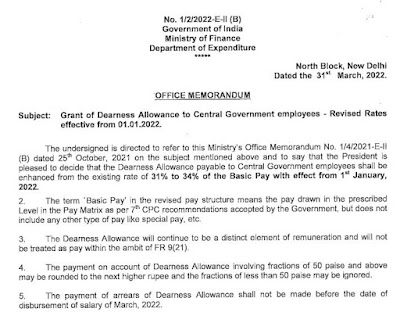
DA Jan 2022 - Grant of Dearness Allowance to Central Government employees - Revised Rates effective from 01.01.2022

 3% DA Hike - Revised Rates effective from 01.01.2022: DoE OM dated 31.03.2022 No. 1/2/2022-E-II (B) Government of India Ministry of Finance...