Showing posts with label New Pension System. Show all posts

Monday, 23 April 2018

Online Submission of FATCA Self-Certification

Online Submission of FATCA Self-Certification

Subscribers registered on or after July 1, 2014 are mandatorily required to submit FATCA Self- certification
Please follow the steps given below for online Self-Certification:
  • Log-in to your NPS account (please visit www.cra- nsdl.com)
  • Click on sub menu "FATCA Self-Certification" under the main menu "Transaction"
  • Submit the required details under "FATCA/CRS Declaration Form"
  • Click on "Submit"
  • You are requested to read and tick "Declaration & Authorization by all customers"
  • Click on "Confirm"
  • Enter OTP received on your registered mobile number.
  • After Authentication through OTP, Acknowledgment for the completion of FATCA Self-certification will be displayed.
You are requested to provide Online Self-certification even if you have submitted /sent the physical Self-Certification form to CRA

Kindly note, you are required to submit physical FATCA Self- certification form to your Nodal Office or CRA if your Birth Place, Citizenship and Residence for the Tax Purposes is other than India or you are an US person. The format of the self-certification is provided in below link.

The form is required to be submitted to Central Recordkeeping Agency (CRA) for NPS at the following address:

NSDL e-Governance Infrastructure Limited,
1st Floor, Times Tower, Kamala Mills Compound, Senapati Bapat Marg,
Lower Parel, Mumbai - 400 013

In case you require any clarification or assistance with respect to the above, please contact Ms. Ranjana Chavan / Ms. Mamta Jadhav at 022-40904242.

Please mention "Self-Certification - FATCA/CRS Declaration Form" on top of the envelope
Self-induced contribution (Voluntary and Tier II) and Withdrawal will not be allowed in the CRA system for FATCA non-compliant Subscribers.

Source: https://www.npscra.nsdl.co.in/

Tuesday, 17 April 2018

Scrapping of New Pension Scheme


Scrapping of New Pension Scheme
Representations have been received regarding the implementation of National Pension System (NPS) which, inter alia, include demand that NPS may be scrapped and the Government may re-introduce old defined benefit pension system.

Government has made a conscious move to shift from the defined benefit pay-as-you-go pension scheme to defined contribution pension scheme, now called as National Pension System (NPS), after considering the rising and unsustainable pension bill. The transition also has the added benefit of freeing the limited resources of the Government for more productive and socio-economic sectoral development.

There is no proposal to replace the NPS with old pension scheme in respect of Central Government employees recruited on or after 01.01.2004.

(e): National Pension System (NPS) had been designed giving utmost importance to the welfare of the subscribers. There are a number of benefits available to the employees under NPS. Some of the benefits are enlisted below:
  • NPS is a well designed pension system managed through an unbundled architecture involving intermediaries appointed by the Pension Fund Regulatory and Development Authority (PFRDA) viz. pension funds, custodian, central record keeping and accounting agency, National Pension System Trust, trustee bank, points of presence and Annuity service providers. It is prudently regulated by PFRDA which is a statutory regulatory body established to promote old age income security and to protect the interest of subscribers of NPS.
  •  Dual benefits of Low Cost and Power of Compounding- The pension wealth which accumulates over a period of time till retirement grows with a compounding effect. The all-in-costs of the institutional architecture of NPS are among the lowest in the world.
  •  Tax Benefits- Contribution made to the NPS Tier-I account is eligible for tax deduction under the Income Tax Act, 1961. An additional tax rebate of Rs.50000 is also allowed for contributions made to NPS Tier-I under Section 80CCD (IB) of the Income Tax Act, 1961.
  •  Transparency and Portability is ensured through online access of the pension account by the NPS subscribers, across all geographical locations and portability of employments.
  • Partial withdrawal- Subscribers can withdraw up to 25% of their own contributions before attaining age of superannuation, subject to certain conditions.
The amount of monthly annuity payable to a Government servant on exit from NPS depends upon various factors such as accumulated pension wealth of the Government servant, portion of accumulated pension wealth utilized for the purchase of annuity and the type of annuity purchased.
Under the defined benefit pension system applicable to Government servants appointed before 01.01.2004, pension is calculated based on qualifying service and the last pay drawn by the Government servant.

Source: Lok Sabha

Saturday, 24 March 2018

Major Changes in NPS including Withdrwal Norms


Major Changes in NPS including Withdrwal Norms

Three major changes in the National Pension Scheme (NPS) including withdrawal norms

Relaxation of Norms for NPS

The Government of India has recently made three changes in the National Pension Scheme (NPS) including withdrawal norms.

The details are as under:

Partial withdrawal during the service: The Pension Fund Regulatory and Development Authority (PFRDA), with an objective to  meet the subscriber's sudden financial requirement enrolled under NPS, has liberalized norms for partial withdrawals which also include reduction of requirement of minimum years of being enrolled under NPS from 10 years to 3 years from the date of joining. Suitable amendments were made through "Pension Fund Regulatory and Development Authority (Exits and Withdrawals under the National Pension System) (First Amendment) Regulations, 2017 and the same has been notified on 10.08.2017.

Increase in the joining age under NPS: With an objective to allow individuals (under NPS-All Citizen Model and Corporate Sector Model) who are in the age bracket between 60 years and 65 years to join NPS system. Suitable amendments were made through Pension Fund Regulatory and Development Authority (Exits and Withdrawals under the National Pension System) (Second Amendment) Regulations, 2017 and the same has been notified on 06.10.2017.

Exit in case of disability and incapacitation of the subscriber: With an objective of facilitating easy exit & withdrawal in case of disability and incapacitation of the subscriber covered under NPS, PFRDA has made suitable amendments through "Pension Fund Regulatory and Development Authority (Exits and Withdrawals under the National Pension System) (Third Amendment) Regulations, 2018 and the same has been notified on 02.02.2018.

This was stated by Shri Ship Pratap Shukla, Minister of State for Finance in a written reply to a question in Lok Sabha today.

Source: PIB

Tuesday, 13 February 2018

Age Limit for National Pension System (NPS)


Age Limit for National Pension System (NPS)

Vide PFRDA (Exits and Withdrawals from National Pension System) Second Amendment Regulations, 2017, dated 6th October, 2017, the Pension Fund Regulatory and Development Authority (PFRDA) has permitted any Indian citizen who is in the age group of 18-65 years to join the National Pension System (NPS) on voluntary basis. As informed by PFRDA, a total of 1056 persons between the ages of 60-65 years have joined up to 31st January, 2018.

Wednesday, 1 November 2017

Maximum age of joining National Pension System (NPS) increased from the existing 60 years to 65 years under NPS - Private Sector


Maximum age of joining National Pension System (NPS) increased from the existing 60 years to 65 years under NPS - Private Sector

In continuance of the several initiatives under taken by Pension Fund Regulatory and Development Authority (PFRDA) during the last few years to increase the pension coverage in the country, PFRDA has now increased the maximum age of joining under NPS-Private Sector (i.e. All Citizen and Corporate Model) from the existing 60 years to 65 years of age.

Now, any Indian Citizen, resident or non-resident, between the age of 60- 65 years, can also join NPS and continue up to the age of 70 years in NPS. With this increase of joining age, the subscribers who are willing to join NPS at the later stage of life will be able to avail the benefits of NPS.

NPS provides a very robust platform to the subscriber to save for his/her old age income security. Due to the better healthcare facilities and increased fitness, along with the opportunities and avenues available in the private sector as well as in the capacity of self-employment, more and more people in their late 50s or 60s are now living an active life allowing them to be employed productively.

The subscriber joining NPS beyond the age of 60 years will have the same choice of the Pension Fund as well as the investment choice as is available under the NPS for subscribers joining NPS before the age of 60 years.

Subscriber joining NPS after the age of 60 years will have an option of normal exit from NPS after completion of 3 years in NPS. In this case, the subscriber will be required to utilize at least 40% of the corpus for purchase of annuity and the remaining amount can be withdrawn in lump-sum.

In case of such subscriber willing to exit from NPS before completion of 3 years in the NPS, he/she will be allowed to do so, but in such case, the subscriber will have to utilize at-least 80% of the corpus for purchase of annuity and the remaining can be withdrawn in lumpsum.

In case of unfortunate death of the subscriber during his stay in NPS, the entire corpus will be paid to the nominee of the subscriber.

The increase in joining age will provide the options to the subscribers who are at the fag-end of the employment and expecting lump-sum amount at the time of retirement, but willing to defer their retirement planning for future, to open the NPS account and contribute the lump-sum corpus to NPS for better fund management by Professional Fund Manager to fetch better returns and plan for the regular income after some time. The Annuity rates available in the older age fetch better annuities than that at the age of 60 or less age.

This initiative will allow a larger segment of the society particularly senior citizens to reap the benefits of NPS and plan for their regular income.

PIB

Thursday, 26 November 2015

New Pension Scheme : Analysis of the Issues by the 7th Pay Commission

New Pension Scheme : Analysis of the Issues by the 7th Pay Commission
New Pension Scheme 7th Pay Commission


10.3.12 The Commission has examined these concerns raised by the stakeholders. The Commission also interacted with Chairman, PFRDA, and representatives of the Department of Pensions and Pensioners Welfare (DPPW), Department of Personnel and Training (DoPT), Department of Expenditure (DoE) and the Department of Financial Services (DFS).

10.3.13 In so far as the future value of pension under NPS is concerned, the Commission notes that this would depend upon a combination of factors:
(i) performance of the invested fund, which in turn would depend on the asset mix of the investment and general economic situation of the country,
(ii) cost of financial intermediation,
(iii) contribution rates,
(iv) period of contribution,
(v) performance of the fund manager and
(vi) development of the annuity market.
Grievances against the NPS

The NPS has now been in effect for over 10 years. During this period, there has been perceptible progress in putting together the architecture and providing information to subscribers. Major concerns, however, remain. Broadly, these are as under:
i. The larger federations and staff associations advocated scrapping the NPS on the ground that it discriminates between two sets of government employees.
ii. Individuals covered under NPS have pleaded for reverting to the OPS on the grounds of uncertainty regarding the actual value of their future pension in the face of market related risks.
iii. Individuals have pointed out that under NPS, the effective salary becomes less since the employee has to mandatorily contribute 10 percent of pay towards the pension fund.
iv. Individuals have stated that grievance redressal facility is not effective and consultation with stakeholders has been non-existent. This communication gap has generated insecurity in the minds of stakeholders including staff and Group ‘A’ officers of Central Government as well as All India Service Officers.
v. Associations have complained that Family Pension after the death of the employee is not ensured in the NPS. Moreover, if an employee dies at an early age, the family would suffer since annuity from the contribution would be grossly inadequate.
vi. Individuals have complained that NPS subscribers have no recourse to GPF for their savings. Their personal savings (10% of salary) are considered part of a larger corpus. It has been pointed out that the justify approach would be to consider only government’s contribution and the returns earned on it as the effective amount available for purchase of annuities.
vii. Associations have pointed out that unlike the facility under GPF, it is not possible to take refundable advances under NPS, even to meet obligatory social expenditure. This forces employees towards increased indebtedness as they have to borrow from elsewhere.

viii. Grievances also relate to tax treatment under NPS. While contributions and accumulations in NPS are exempt, lump sum withdrawals from NPS at any time are taxable at par with any other income. In addition, there is a service tax liability on any amount utilised for purchase of annuity.

ix. It has been pointed out that though NPS became effective from 2004, detailed instructions were issued only in late 2009 and in many cases the credit of contributions began from 2012. In the case of AIS officers in some States, contributions by the concerned State Government are yet to be fully made and deployed. The net result of this has been that contributions for the period 2004-2012 have not been made in full or have earned simple interest and did not get any market linked returns. Because of the prevailing confusion, contributions made by some AIS officer have been returned to them without interest. This will have a huge impact on the eventual corpus as the benefits of compounding were not available for the first 8 -9 years.

x. Individuals, in their presentation before the Commission, stated that annuities under NPS have no compensation for inflation unlike dearness relief under OPS. Further, in the case of OPS there is a revision in basic pension itself after every Pay Commission. This too is not available in respect of annuity of NPS subscribers.

xi. It has been pointed out that government employees are not given freedom of choice in choosing their fund manager based on performance and track record as the contributions are divided in a pre-specified ratio among selected Pension Fund Managers. It has been stated that government employees have no say in asset allocation
of their money.

xii. Concerns were raised that the contribution of 10% + 10% will not be sufficient to create a corpus which provides reasonable assurance that pension will be 50 percent of the last pay drawn.
Authority : http://7cpc.india.gov.in/

Friday, 16 October 2015

Assets under Management (AUM) of National Pension System (NPS) crosses Rs. 1 lac crore: PFRDA Press Release

Assets under Management (AUM) of National Pension System (NPS) crosses Rs. 1 lac crore: PFRDA Press Release
 
PENSION FUND REGULATORY AND DEVELOPMENT  AUTHORITY

PRESS RELEASE
Assets under Management (AUM) of National Pension System (NPS) crosses Rs. 1 lac crore
NPS has been implemented for all Government Employees (except armed forces) joining Central Govt. on or after 01 January 2004. Most of the State/UT Governments have also notified the National Pension System (NPS) for their new employees. NPS has been made available to every Indian Citizen from 01st May 2009 on a voluntary basis.

Further, from 1st June 2015, the Atal Pension Yojana, has been launched which has given the much required impetus to the social security schemes Currently, NPS and APY together have more than One Crore subscribers with total Asset Under Management (AUM) of Rs.1,00,275 crores. The segment wise status of the NPS and APY as on 03.10.2015 is as under:

Segment No. of Subscribers Asset Under Management (Rs. Cr.)
Central Government 15,71,136 32,381
State Governments 27,74,459 49,974
NPS-Private Sector 5,24,143 7,943
NPS-Lite/Swavalamban 44,67,733 1,865
Atal Pension Yojana (APY) 7,94,467 112
Total 1,01,31,938 1,00,275
 
PFRDA has taken various steps at the policy as well as operational level to make NPS more subscriber friendly. In addition to this additional tax benefits made available exclusively to NPS has given a fillip to the scheme. This is further expected to result into a substantial increase in the subscriber base by end March 2016.
 
The following steps have been taken in the recent past for the convenience of the subscriber:
  •  The investment guidelines for NPS have been revised to expand the investment avenues for optimisation of the returns.
  •  Partial withdrawal upto 25% of subscriber’s own contribution for specific purposes like higher education of children, marriage of children, construction of house and specified illness have been allowed to the NPS subscribers after completion of 10 years in NPS.
  • NPS Private Sector subscribers can continue contributing beyond 60 years upto 70 years of age.
  • NPS Subscriber can defer the withdrawal of lumpsum amount upto the age of 70 years and also have the option to defer purchase of annuity upto 3 years from the date of superannuation or 60 years. The funds during this period remain invested in the system.
  • The Statement of Transactions (SOT) being sent by CRA to the existing subscribers has been modified to reflect the returns of the individual subscriber since the date of account opening and also the return generated during the last financial year.
  •  To facilitate and operationalize the deposit of additional contribution of Rs.50,000/- to avail of the additional tax benefit under Section 80 CCD(1B), Government Subscribers already covered under NPS have been provided the facility to deposit voluntary contributions in their Tier I account through any POPSP. Government employee covered under old pension scheme can also avail this tax benefit by opening individual Tier I account through any POP-SP and contributing to the same.
  •  Online reset of password and facility to change mobile no. and email Id have been provided to all the NPS subscribers.
SMS alerts on balances in the NPS account being sent to the subscribers on quarterly basis, in addition to regular monthly alerts on contribution and other changes in the PRAN.
 
APY scheme provides minimum Govt guaranteed monthly pension to subscribers ranging from Rs 1000 to Rs 5000. Further, Govt. of India also co-contributes 50% of the total contribution made by a subscriber during a financial year subject to maximum of Rs 1,000/- per annum for a period of five years, if eligible subscribers open the account by 31st December 2015. All Indian Citizens, in the age group of 18-40 years are eligible to join the scheme through any bank branch. About 8 lakh subscribers have joined APY till date.
 
Source: PFRDA
[http://pfrda.org.in/WriteReadData/Links/Approved%20Press%20Release%20Milestone%20of%201%20lac%20crores%208d3ccf28-4a6e-44e4-91ad-61e1edfa08d8.pdf]

Wednesday, 7 January 2015

Exempt Defence Civilian Employees From New Pension Scheme – AIDRDO TOA

Exempt Defence Civilian Employees From New Pension Scheme – AIDRDO TOA

All India DRDO Technical Officers Association have represented both the Central Government and 7th Pay Commission to exempt the Defence civilian employees from New Pension Scheme. The copy of the Representation of AIDRDO TOA is given below..

“……Dear colleagues

We have represented to both previous NDA & UPA Governments to scrap NPS.Now we have requested the present Government to exempt the Defence civilian employees from New Pension Scheme at par with Armed Forces.Let’s be optimistic that present Central Government will exempt us.Let’s build pressure on the Govt. by ensuring that employees/officers who joined after 01/01/2004 send individual representations to the Cabinet Secretary through proper channel.Pl.forward this mail to our younger brothers & sisters who joined after 01/01/2014.

During the meeting with Chairman,7th CPC we have categorically told that New Pension Scheme should be rescinded and scrapped.We requested that the CPC can intervene as 6th CPC had given recommendations that Defined Pension Scheme is better than NPS.We requested that the recommendations of 6th CPC should be applied to all entrants since 01/01/2004.

The extract from our memorandum to 7th CPC on NPS is given below for ready reference.

New Pension Scheme (NPS)

2.1 The contributory pension system brought in by the GOI through their notification dated 22.12.2003, now renamed as National Pension System under PFRDA Act, has been imposed on Government employees who entered service on or after 1.1.2004.

2.2 This is an illegal act in as much as the Supreme Court of India had held Pension as an enforceable inalienable fundamental right. Therefore it should be scrapped or at least not made applicable to Government employees. This has also divided the CG employees into two categories and therefore it is discriminatory in respect of persons who have entered service on or after 1.1.2004 who had been denied the statutory pension. Any discriminatory scheme is illegal and ultravires of Article 14 of the Constitution. On this count also the NPS cannot be made applicable to the Government employees.

2.3 The Centre for Economic Studies and Policy, Institute for Social & Economic Change, Bangalore in a Study of Terminal Benefits of the Central Government Employees sponsored by the VI CPC had also observed that Civil Services Pension is in the nature of a deferred wage. It is well known that the principle guiding the pay package of civil servants is one of intentionally spreading out the compensation over a long period of time, thereby the wages paid out during the course of the work tenure is kept low by design, and the pension payments made during the retirement phase compensate for the low working wages.

2.4 The above mentioned study under the heading “Arguments against pension reforms” states as follows:
“Deferred Wage: In the context of civil servant pension payments, it is argued that, the principle guiding the fixation of pay package is one of intentionally spreading out the compensation over a long period of time, whereby the wages paid out during the course of work tenure is kept low by design, and the pension payments made during the retirement phase compensate for the low working wages. The Supreme Court of India held that pension is neither a bounty nor a matter of grace depending upon the sweet will of the employer. It is not an ex-gratia payment, but a payment for past services rendered. It is a social welfare measure, rendering socio-economic justice to those who in the heyday of their life ceaselessly toiled for the employer on an assurance that in their old age, they would not be left in the lurch.”

“Larry Williams observes “Actually, civil service pensions, because they are not based on contributions, are best described as deferred wages. Civil servants accept a lower current wage in exchange for the promise of a pension in their old age. If this pension were contributory, they would insist on a higher wage and government would have to either increase taxes or borrow (issue debt) to pay it. The real cost of civil servants is thus much higher than recorded under the current system of cash accounting. A good reform would be to move to a system of accrual accounting setting up at least a notional fund to pay these deferred wages” (Larry Wilmore, 2004)” “Public and private sector pay differentials: A comparison of the public and private sector wages reveals that while the public sector wages for the lower grades compares well with that of the private sector, the salaries of the employees belonging to the higher grades are highly unfavourable to the public sector employees. The post-retirement benefits that the government employees are entitled to act as some incentive to retain them in government sector.”

2.5 The above study had submitted the following estimated pensionery outgo which tends to increase during the period from 2014-2038. It is only after 2043 that it starts declining and will be reduced to zero only in 2088. The table is given below:

Table showing estimated pensionery outgo 
 Year                                            Employee Pension Payout (in Rs   Crores) Family Pension    Pay out (in Rs. Crores) Total pension payout (in Rs.Crores)
2004 11300.69 2983.38 14284.07
2008 13532.84 3572.68 17105.52
2013 16549.07 4368.94 20918.02
2018 21862.54 5771.79 27634.33
2023 27723.68 7319.11 35042.80
2028 34076.27 8996.13 43072.41
2033 39321.68 10381.01 49702.69
2038 45164.50 11923.41 57087.90
2043 41747.23 11021.30 52768.53
2048 35011.92 9243.18 44255.10
2053 25405.44 6707.07 32112.51
2058 16303.15 4304.07 20607.22
2063 8179.51 2159.39 10838.90
2068 3159.88 834.19 3994.07
2073 800.68 211.34 1012.02
2078 110.26 29.17 139.43
2083 3.52 0.97 4.49
2088 0.00 0.00 0.00

2.6 The above study had also pointed out that expenditure on pensions of civil servants of high income OECD countries on an average is 2% of GDP (less than 1% in Ireland and more than 3.5% in Austria*)(* Source: OECD Social Expenditure Database). But in the 8 South Asian countries it is less than 1% of GDP (Source: World Bank Data base). However, in India between 1964-65 and 2004-05 on an average pension payments (Civil Service pension paid by Central Government) have constituted 0.51% share of GDP. The Pension liability would continue to increase and reach 0.54% level by 2014-15 and remain at that level till 2024-25 after which they would decline as a percentage of GDP according to the same study conducted by Dr.Gayatri at the instance of VI CPC. These figures argue themselves in favour of continuation of the Defined Benefit Pension Scheme for all Central Government employees instead of throwing a section of them to market based NPS. According to 2011 census 62.8% are in the age group of 15 to 60 and only 8.2% are above the age of 60.

2.7 From the above projection it is very clear that the benefit of NPS will commence only after 30 years i.e. in 2044. And during the period it will increase exponentially as because in addition to the Statutory pension liability the Government will be contributing to the NPS also @ 10% of annual salary bill of the CG Employees who have entered service on or after 1.1.2004.

2.8 The final conclusion of this study team has been as under:
“Mainly given the fact that the future liability although may be large in terms of the absolute size is not likely to last very long and does not constitute an alarmingly big share of the GDP which is also on the decline, it appears that pursuing the existing “Pay As you Go” to meet the liability would be an ideal solution.”

2.9 Applying this conclusion we may suggest that the NPS may not be made applicable to the Government employees and all those who had been covered under NPS may be reverted back to statutory pension scheme. The Government may be asked to study the experiences of this scheme in several other countries in the world. In Chile such a scheme has been reversed as because the return which the low paid employees got out of the annuity purchased was not as good as 50% of LPD but as low as 20% of LPD. The UK Government had to pay out of the exchequer large amount by way of subventions in order to ensure that that annuities purchased yield 50% of LPD as pension. It is well known that in USA where there were similar pension schemes dependent upon the market had collapsed during the financial melt down from 2008 onwards. It is estimated that more than 3.5 trillion $ worth of pension wealth was lost. The workers not only lost their pension but also their jobs. Our respectful submission is that taking into account the demographic considerations of India which is a country of young do not need any such market oriented pension scheme, particularly when the international experience is that such schemes had failed and our country can afford to pay pension to civil servants which stands at level of 1% of the GDP. We conclude by quoting the opinions of experts on the future of market dependent pension Scheme.

Mr Joseph Stiglitz (Chief economic advisor to former president of USA Bill Clinton, former vice-chairman and chief economic advisor, World Bank, Nobel Prize winner, Professor of economics, Columbia university) said that “Stock market does not guarantee returns. It does not even guarantee that the stock values will keep up with inflation. Privatization would not protect retirees against the social security systems insolvency. Argentina’s privatization of its pension system was at the centre of its fiscal woes”.

Mr Dean Baker (Co-director for centre for economic and policy research, Washington) said “Privatisation means that you would not have a guaranteed benefit that you have today. It would depend on how will your investments do or how well they have done at the point you retire. He quoted the collapse of NASDAQ and Enron. In Britain, Insurance companies could not honour their promises and the Government had to compensate with 8 billion pounds”.

We have requested the PFRDA Authority to furnish certain information on their working . On receipt of this information we may make certain further submission for the consideration of the Commission.”

With greetings,
Yours fraternally
V.Krishna Mohan

Monday, 1 December 2014

What are Government’s Plan about New Pension System

Latest on New Pension System

Q- Of late, there have been lot of changes in the NPS. Are more changes coming?

A- The PFRDA Act was notified in February this year. Now the regulations have to be framed under the Act. As many as 12 regulations have already been framed. They have been put on the PFRDA website for stakeholders’ views. We have received good suggestions. These would be placed before the Pension Advisory Committee. Based on the PAC’s suggestions and views, it will come back to PFRDA Board for finalisation and the entire process will be completed by December 15 this year.

Q- What is the rationale behind such a low fund-management charge (0.01%)?

A- The mandate of the Act is to ensure minimum cost. The new fee is decided based on a transparent bidding process. So, we expect all the pension fund managers (PFMs), who are part of this system to be able manage funds at the cost which they agreed on. As we go along, there would be some learning as to how this is motivating stakeholders and how it is affecting subscribers’ interest. We would see if the fund managers are able to do their business sustainably and profitably.

Q- So, there is a scope of upward revision of PFMs fee…

A- No, I cannot say that; certainly, not in the current scheme of things. But we will assess the impact of different fees on the viability and profitability of the PFMs business.
The monthly accretion in NPS today is about Rs 2,500 crore. That’s the incremental flow every month but we certainly need to increase it. We are expanding the scope of PFMs to increase the return by deploying the money in newer instruments. We do not want fund managers to involve in marketing of the scheme. We want them to focus on maximising returns.

Q- Who will market the NPS then?

A- PFRDA itself is engaged in marketing and selling the scheme. We have our own strategy and it involves publicity, reaching out to corporate, state governments and the unorganised sector. We are doing so through PoPs and aggregators and also reaching out to the corporates. We have tied up with FICCI and CII for marketing of the scheme to their members. Though the present taxation rule, which is EET (exempt, exempt, tax), is proving to be an issue with corporate sector. Most employees there are tax payers, and as per present rule the gain at times of redemption is taxable at the hand of the beneficiaries.

Q- Earlier, it was proposed that with the implementation Direct Tax Code (DTC), NPS would become an EEE instrument. What is the status now?

A- The government wants to promote the scheme as this is a defined contribution scheme (wherein an individual contributes himself towards his pension saving) and it saves a lot of money for the government. The defined benefit (where the employer would bear all the cost of employee’s pension) scheme earlier would result in a lot of expense for the government. To that extent, government would not mind losing some money on the fiscal side by making NPS an EEE scheme.

Q- You said PFRDA is expanding the scope of PFMs to increase the yield by deploying the money in newer instruments. What are these new instruments?

A- It’s an ongoing process. We recently allowed PFMs to invest in additional tier 1 bonds issued by banks. We are on the process of allowing them to invest in asset-backed securities and covered bonds. We are also planning to allow them to invest in Real Estate Investment Trusts (REITs) as and when we get more clarity on it.

Money Today’s Dipak Mondal caught up with R V Verma, member, Pension Fund Regulatory and Development Authority (PFRDA), to know the rationale behind recent changes in the National Pension System (NPS).

Sunday, 16 November 2014

NPS is far beneficial than Government Pension

NPS is far beneficial than Government Pension
GConnect has published an article titled, ‘NPS is far beneficial than Government Pension’

GConnect has published an article titled, ‘NPS is far beneficial than Government Pension’ – Comparison of New Pension Scheme (National Pension Scheme) and Central Government Pension

A very popular website among Central Government employees, GConnect, which began functioning more than 8 years ago, continues to be a strong line of communication between the Central Government and its employees.

The article that was published yesterday seeks to answer critics who claim that the new pension scheme is outright bad. GConnect has made it very clear that the opinions expressed in the article belong to its writer, Mr. Dorai, Deputy Director, ESIC Model Hospital and that the website doesn’t necessarily subscribe to them.

The ‘study report,’ that compares the salient features of the old(Central Government Pension Scheme) and new pension schemes, is bound to create controversies.

While various Central Govt employees associations and federations are putting pressure on the Government to withdraw the new pension scheme and enforce the previous one, we believe that this article is going to make a huge impact.

The writer begins the article by stating that those who are opposing the new pension scheme, with more benefits than the old pension scheme, are doing so due to their ignorance. The article also explains how the new pension scheme could create huge wealth.

The report gives as an example, the case of an employee who joins the Central Government employment as a Upper Division Clerk(UDC) in 2014 and retires after 35 years service, in 2049. The report gives a comparative study of how the pension fund grow each of these 35 years. The study also assumes a regular dearness allowance of 6% every six months, and an annual increment of 3%.

The study also assumes that, at an interval of 10 years, the employee gets 3 promotions during his service tenure. Most importantly, it is assumed that matching the employee’s contribution, the Government’s contribution too would witness an 8.7% increase per annum.

At the time of retirement, the employee is likely to get Rs. 2,87,26,201, which is split into two shares – 40% and 60%, which amounts to Rs. 1,14,90,481, and Rs. 1,72,35,720, respectively. 60% of the lumpsum pension wealth is given at the time of retirement. The remaining 40% is invested in an annuity scheme.

It is stated that the monthly pension will be a minimum Rs. 83,306. In addition to this, at the age of 70, the employee gets the remaining 40% back. The article strongly claims that this money could be the gift that the person leaves behind for his future generation.

The article’s highlight feature is the claim that if the Pay Commission recommendations are taken into account, the amount could be much higher and that the UDC could get as much as Rs. 5 crores at the time of retirement.

According to the old Govt pension scheme, the employee’s monthly pension amount would be Rs. 1,00,934, and after his demise, his spouse would get Rs. 10,317 plus Dearness Allowance. After his/her death, there are no more benefits for the family.

The article is indirectly stating that the absence of gratuity and other such benefits is not a huge issue. According to the old Govt pension scheme, at the time of retirement, the employee would make only Rs. 38,32,550, which is Gratuity (16.5 months) + EL Encashment + Commutation.

While discussing the General Provident Fund (GPF), the article assumes that since nobody leaves anything much in this fund, its overall impact on the total pension fund would be minimal.

The writer concludes his article by declaring that those who oppose the new pension scheme lack intelligence.

Source: 7thpaycommissionnews.in

Thursday, 24 April 2014

PFRDA Circular - Registration of Government employees aged 60 years and above under National Pension System (NPS)

PFRDA Circular - Registration of Government employees aged 60 years and above under National Pension System (NPS) 
CIRCULAR
PENSION FUND REGULATORY AND DEVELOPMENT AUTHORITY 
22 April, 2014 
PFRDA/2014/3/PDEX/12 
Subject: Registration of Government employees aged 60 years and above under National Pension System (NPS) 
The Authority has been receiving several requests from various governments (central & state) to approve the registration of subscribers under National Pension System (NPS) who are aged 60 years and above and which are being approved on case by case basis by PFRDA at present. 
Keeping in view of the difficulties being faced by subscribers, now the Authority has decided to enroll all eligible Government employees (central & state) who are on the rolls of the government in to NPS, irrespective of the age at the time of entry, subject to the condition that the total period of contribution to NPS account shall not be more than 42 years. The NPS applications of such subscribers need to be submitted through the appropriate nodal officer of the Govt/ Deptt, in line with the procedure adopted for NPS registration for Government employees aged below 60 years. Also, the responsibility for ensuring that the employee is eligible for being covered under NPS and that the NPS contribution is not paid beyond 42 years during the entire service period for such an employee, lies with the department submitting the subscriber registration form. 
This is for the information of all concerned. 
Sd/- 
Venkateswarlu Peri 
General Manager 
Source : www.pfrda.org.in
[http://www.pfrda.org.in/writereaddata/linkimages/Registration%20of%20Govt%20employees%20aged%2060%20years%20and%20above763537413.pdf]

Flash News

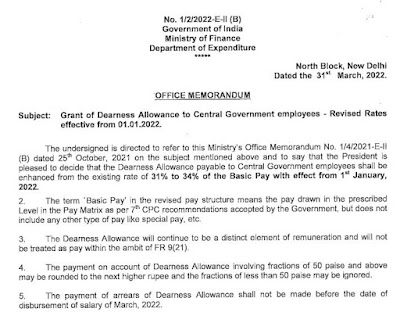
DA Jan 2022 - Grant of Dearness Allowance to Central Government employees - Revised Rates effective from 01.01.2022

 3% DA Hike - Revised Rates effective from 01.01.2022: DoE OM dated 31.03.2022 No. 1/2/2022-E-II (B) Government of India Ministry of Finance...