Saturday, 12 March 2016

Equal Pay for Equal Work – 7th CPC Report

Equal Pay for Equal Work – 7th CPC Report

“Equal Pay for Equal Work  – Pay Matrix addresses these issues as well”
7TH CPC REPORT EQUAL WORK EQUAL PAY

One recurrent theme in the representations of various associations relates to ‘equity’ or ‘Equal Pay for Equal Work.’

Ideally, the remuneration package should establish horizontal equity: employees should feel that their pay is comparable with the remuneration structure of similarly placed positions outside their organization. The employees should also feel that the pay structure shows linear progression pattern and thus the notion of vertical equity is also maintained.

The Pay Matrix addresses these issues as well. The Commission has designed the pay structure in such a manner that the pay progression recognises the importance of vertical relativities and also assigns a reasonable basis to such progression. This has been done by assigning a uniform fitment factor of 2.57.

The Commission feels that there is strong need to create a culture of performance in government – from establishing standards of performance, to measuring, and promoting people based on performance. To emphasize on the culture of performance, the Commission has recommended that all the non-performers in the system should be phased out after 20 years.

The Commission has recommended that Performance Related Pay should be introduced in the government and that all Bonus payments should necessarily be linked with productivity.

The various Central Services have contended that this edge given to the IAS and the IFS is iniquitous and violates the principle of ‘equal pay for equal work.’

They have pointed out that the Civil Services Examination (CSE) conducted by the UPSC is an examination that is common for recruitment to around 18 Group `A’ Services and that the choice of Service exercised by the candidates is based upon very many factors. It is not necessary that only the top-most go to the IAS. It has also been pointed out that officers of most of the Services are, in their early years, posted to small places and are subjected to many transfers. Therefore, the grant of the edge is seen as unfair.

Analysis and Recommendations : This Commission has studied the entire issue and deliberated in detail on the issue in the Chapter 7.2. The Chairman has sought not only to retain the two increment edge within the proposed pay matrix for the IAS and Indian Foreign Service but also extended it to the Indian Police Service and the Indian Forest Service. Shri Vivek Rae, Member, Seventh CPC is not in agreement with extension of the edge in pay to the IPS and IFoS. Dr.Rathin Roy, Member, Seventh CPC is not in agreement with the concept of an edge in pay.

7th Pay Commission Latest News – RTI Reply reveals Pay Parity denial for Defence Personnel at par with IAS

Empowered Committee formed by Government is in the process of examining of 7th Commission Recommendations. After this negative reply by MOD, Defence Personnel might approach the committee to look in to the matter of pay parity

7th Pay Commission Latest News – RTI reply reveals Pay Parity denial for Defence Personnel at par with IAS, IPS and other Group A Civil Services in Central Government

At a time when Central government employees are waiting for the implementation of Seventh pay commission, a new revelation has come to light. According to reports, there is deep distrust between government and armed forces over the pay parity issue.

It is being said that three services had expressed dissatisfaction over some of the recommendations of the Pay commission and had requested Commission to make required changes. Later pay commission approached Defence Ministry with their demands.

Now under RTI query, it has been revealed that the Defence Ministry negated army officers pay parity with civilian counterparts in IAS, IPS and other allied services.

An Army officer was quoted by ET as saying, “We thought it was the pay commission that was selling us short, but this RTI actually revealed it was the Defence Ministry officials”. Ministry also gave reasons why their demands were not approved. “The basis of this demand i.e. merger of rank pay in basic pay was examined in a detailed matter by the Pranab Mukherjee committee report and the same was not accepted hence the case is not supported”, officer further said.

Ministry also not accepted Army men’s argument that civilian bureaucrat mustn’t be paid equal sum of amount in comparison to their defence counterparts. Defence Ministry said that both are different thing as their service conditions and the nature of job is quite different.

What are the grievances of armed forces? Army Officers say that if the Pay Commission is implemented in the present form, it will position them much below their civilian counterparts in terms of salaries, facilities and status.

One of the main grudge that the armed forces have is with regard to risk-hardship matrix. The officers say that a soldier posted in Siachen Glacier, which has the highest degree of both risk and hardship, gets an allowance of Rs 31,500 per month.

In contrast, a civilian bureaucrat from the All India Services draws 30 per cent of his salary as “hardship allowance” when posted anywhere outside the comfort zone.

Under the new scale, a senior IAS official posted in a city in northeast will draw much more as “hardship allowance”, compared to the Rs 31,500 per month drawn by military officers in Siachen.

Source: One India

Madhya Pradesh Government Employees To Strike Over Pay Commission Dispute

Madhya Pradesh Government Employees To Strike Over Pay Commission Dispute

Bhopal: Five lakh Madhya Pradesh government employees across the state will go on strike today against the state government’s grade pay fixation offer, which was recommended by an independent pay review body.
Madhya Pradesh is the first state to revise pay scales of its employees in accordance with the pay commission recommendations asking for rationalization from pay commission, employees are pushing for grade fixation and interim relief instead.

“Talks on grade fixation have failed with principal secretary of GAD (general administration department). So we have decided to strike work today.

However, essential services will not be hampered,” State employees union general secretary Laxmi Narayan Sharma said.

The state has approximately 1.5 lakh employees in Rs 3200-3600 grade pay and employees demand that it should be amended equivalent to grade pay in Chhattisgarh or at the Centre.

“No state or Centre has such a grade pay, which is unacceptable to employees,” Sharma said.
Employees are demanding three scale grade on completion of 10 years, 20 years and 28 years of service, fixing salary hike on January 1 and July 1, regularization of daily wagers and ad hoc employees and simplification of appointments on compassionate grounds.

The state has 19 recognized and 16 non-recognized employee unions with over seven lakh employees as members.

Despite financial burden, the state government had announced recommendations of sixth pay commission, dearness allowance from 7% to 10% during 2012, 2013, 2014 and 2015.

Chief minister Shivraj Singh Chouhan had recently implemented some major recommendations of pay commission, including increase in house rent allowance, daily allowance, conveyance allowance, special allowance for employees posted in tribal scheduled areas, meals allowance, uniform allowance for those in police force, jail and forest departments.

Employees has never had it so good. The chief minister passed the order that A-Grade officers with basic pay of Rs 7,600 will be able to fly for out-of-state for official business. Employees with basic pay scale of Rs 6,600 and above are entitled to fly private operator flights within the state for official work.
Conveyance allowance was increased by 200% to 350% depending on pay scales since 2003. Daily allowance has also been increased between 25% and 208% in the same period, GAD minister Lal Singh Arya.

State revenue minister stated, “The government has already done too much for employees. They should not press for their illegitimate demands now.” With a debt of Rs1.80 lakh crore by the end of 2015-16 and financial burden to cope with farm crisis, drought, insurance, health and education schemes, the government, however, seems to be unwilling to negotiate with employees.

Inputs with TNN

Friday, 11 March 2016

Safety of Women Passengers in Railways

Safety of Women Passengers in Railways

safety-women-passengers-railway


Policing on Railways being a State subject, prevention of crime, registration of cases, their investigation and maintenance of law and order in Railway premises as well as on running trains are the statutory responsibility of the State Governments, which they discharge through Government Railway Police (GRP). However, Railway Protection Force (RPF) supplements the efforts of the GRP to provide security to passengers including women.

The following measures are being taken by Railways for safety and security of passengers including women passengers in trains:
1. On vulnerable and identified routes/ sections, 2300 trains (on an average) are escorted by Railway Protection Force daily, in addition to 2200 trains escorted by Government Railway Police of different States daily.

2. The ladies special trains running in Metropolitan cities are being escorted by lady RPF constables.

3. The ladies compartments in sub-urban trains running in metropolitan cities are being escorted by RPF and GRP. Staff deployment is made during late night and early morning in such trains to ensure proper security to the lady passengers. 4. RPF holds regular coordination meetings with State Police at all levels to ensure proper registration and investigation of crime by GRP.
At present, Close Circuit Television (CCTV) cameras have been provided at about 311 railway stations over Indian Railways. In addition, CCTV cameras have also been installed on trial basis, in a few coaches of some of the trains.

Security has been identified as one of the priority areas for strengthening and upgradation. Measures initiated to strengthen security of women commuters include operationalization of 182 All India Security Helpline, development of security App over some of the zonal Railways, prosecution of offenders under relevant sections of Indian Railways, surveillance in station premises through CCTV etc.

This information was given by the Minister of State for Railways Shri Manoj Sinha in a written reply to a question in Rajya Sabha on 11.03.2016 (Friday).

PIB

CGHS Regional Offices: CITY WISE DETAILS


CGHS Regional Offices

The CGHS does not have regional offices. CGHS Wellness Centres function under the administrative control of the Additional Director, CGHS of the city. Details of the office of Additional Director, CGHS city wise is given below:
CITY WISE DETAILS WHERE THE OFFICE OF ADDITIONAL
DIRECTORS/CGHS IS LOCATED
Sl. No.
CGHS covered City
Allopathic Dispensaries
AYUSH
AD Office to which WCs attached
1. Chandigarh
1
0
AD(Chandigarh)
2. Jammu
2
3. Shimla
1
4. Dehradun
2
0
AD(Dehradun)
5. Delhi/NCR
95
36
AD (HQ)/ AD (Central Zone)/ AD (South Zone)/ AD (North Zone) / AD (East)/ AD (MSD)
6. Jaipur
7
2
AD(Jaipur)
7. Allahabad
7
2
AD(Allahabad)
8. Kanpur
9
3
AD(Kanpur)
9. Lucknow
9
3
AD(Lucknow)
10. Meerut
6
2
AD(Meerut)
11. Patna
5
2
AD(Patna)
12. Shillong
2
0
AD(Shillong)
13. Guwahati
5
1
AD(Guwahati)
14. Kolkata
18
4
AD(Kolkata)
15. Ranchi
3
0
AD(Ranchi)
16. Bhubaneshwar
3
1
AD(Bhubaneshwar)
17. Bhopal
2
0
AD(Bhopal)
18. Jabalpur
4
0
AD(Jabalpur)
19. Ahmedabad
7
2
AD(Ahmedabad)
20. Gandhinagar
1
21. Mumbai
26
5
AD(Mumbai)
22. Nagpur
11
3
AD(Nagpur)
23. Pune
9
3
AD(Pune)
24. Hyderabad
13
6
AD(Hyderabad)
25. Bengaluru
10
4
AD(Bengaluru)
26. Thiruvananthapuram
3
2
AD(Thiruvananthapuram)
27. Chennai
14
4
AD(Chennai)
Total
276
85


The Health Minister, Shri J P Nadda stated this in a written reply in the Lok Sabha here today.

PIB

EPFO settles 104.38 lakh claims in the current fiscal CBT, EPF recommended 8.8% rate of interest for the year 2015-16

EPFO settles 104.38 lakh claims in the current fiscal CBT, EPF recommended 8.8% rate of interest for the year 2015-16

Simplified Pension Claim Form 10D (UAN) and single page Pension Payment Order (PPO) under Employees’ Pension Scheme, 1995 unveiled

New Delhi: While taking stock of the performance of EPFO in the month of February 2016, Dr V.P. Joy, the newly appointed Central P.F. Commissioner, noted that for the period April 2015 to February 2016, EPFO settled 104.38 lakh claims. Out of these 40% were settled within 3 days and 78% within 10 days. 96% of the claims were settled within the stipulated 20 day period.

During the month, 211th meeting of the Central Board of Trustees, EPF was held at Chennai. The Board deliberated on the rate of interest for the financial year 2015-16 and recommended 8.80% interest on the PF balances in members’ accounts. Last year, the rate of interest was 8.75%.

A Simplified Pension Claim Form 10D (UAN) and single page Pension Payment Order (PPO) under the Employees’ Pension Scheme, 1995 was also unveiled by the Union Labour & Employment Minister (Independent charge) at the conclusion of the Board meeting. The single page PPO format is simple and more comprehensible to members / pensioners. This attempt is towards the rationalization and simplification of forms in line with the initiatives of the Government. At present, the simplified 10D-UAN claim form is meant to be used only by a member who has an activated Universal Account Number. Other pre-requisites are filing of details in Form 11(New), Aadhaar Number and Bank Account details in the UAN portal. The nominations with Aadhaar numbers should also be available in the UAN portal. Through this Form, service to a member can be done directly without any requirement of attestation by the employer. Both the simplified PPO format and claim form will be implemented from 01.04.2016.

In order to boost the process of seeding the Universal Account Number (UAN) with KYC (eg. PAN, bank account details, Aadhar) that enables enhanced services from EPFO, an “Incentive Scheme” has been launched for the employers. Under this scheme a claim refund of upto 10% of administrative charges payable to EPFO can be claimed upon completing specified tasks (furnishing member information and digitally authenticated KYC details). The Scheme shall be in operation for one year, beginning 1st January 2016 to 31st December, 2016.

The age of superannuation in EPF Scheme, 1952 was also revised from erstwhile 55 years to 58 years to align it with the age of superannuation in Pension Scheme (EPS 1995).

The month of February 2016 saw EPFO redressing more than 20,000 grievances leaving only 3,083 grievances pending. This translates into 82% of these grievances remaining pending for less than 7 days.

PIB

Availing Benefits of CGHS Wellness Centres

Availing Benefits of CGHS Wellness Centres

CGHS beneficiaries including senior citizens can avail of specialist consultation from any government institution of the Central Government, State Government or local bodies. However, to avail of a procedure/investigation from a private empanelled hospital, a referral from the concerned CGHS Wellness Centre is necessary.

Following efforts have been made to provide better services to the senior citizens/pensioners:
1. There is a separate queue for senior citizens/ pensioners at registration counter and pharmacy counter in the CGHS Wellness Centres.
2. Senior citizens / pensioners can consult CMO i/c without standing in queue.
3. In case of emergency, CGHS beneficiaries including Senior citizens / pensioners can visit any hospital, empanelled or non-empanelled and avail medical treatment without any referral.
The Health Minister, Shri J P Nadda stated this in a written reply in the Lok Sabha here today.

PIB

Women employees demand two year leave for raising newborns

Women employees demand two year leave for raising newborns

Like the central government, the female employees of the Tamil Nadu state government have requested the government to give them two years maternity leave to raise their newborns. The proposal was made during the International Women’s Day celebrations.

The International Women’s Day is celebrated all over the world to ensure the safety of women. Women must be treated as equals of men at workplace and in the society. Also, selective abortions of female foetuses, and killing of female babies must be stopped.

Women take care of the health of their entire family, but often neglect their own health. Due to lack of proper nutrition, many women suffer from malnutrition and anaemia. Women can be healthy only if they eat well-balanced food. Only then will they be able to give birth to healthy children.

The Tamil Nadu government must, like the Central Government, give two years maternity leave to its female employees so they can raise their newborns.

Welfare of Ex-Servicemen State-wise details of ex-servicemen (ESM) in the country as on 31.12.2015 is as under

State-wise details of ex-servicemen (ESM) as on 31.12.2015: Welfare of Ex-Servicemen

Welfare of Ex-Servicemen 
State-wise details of ex-servicemen (ESM) in the country as on 31.12.2015 is as under:
Andaman & Nicobar 25 Maharashtra 172314
Andhra Pradesh 58331 Manipur 7157
Arunachal Pradesh 557 Meghalaya 2423
Assam 34911 Mizoram 5858
Bihar 100437 Nagaland 2462
Chandigarh 10082 Odisha 35500
Chhattisgarh 5412 Puducherry 1706
Delhi 45426 Punjab 284401
Goa 2099 Rajasthan 170109
Gujarat 26299 Sikkim 1078
Haryana 280988 Tamil Nadu 123817
Himachal Pradesh 109697 Telangana 30427
Jammu & Kashmir 73575 Tripura 2573
Jharkhand 22848 Uttar Pradesh 348642
Karnataka 74225 Uttarakhand 122649
Kerala 169563 West Bengal 77835
Madhya Pradesh 44393

TOTAL: 2447819

Details of schemes being implemented for welfare, rehabilitation and resettlement of ESM is as under:

TRAINING PROGRAMMES
Officers’ Training:
  • 24 Weeks Management Courses at IIMs and other reputed B-Schools
  • Modular management courses like Project Finance, Academic Institutions, Supply Chain, Retail, Six Sigma, Seafaring etc.
  • Newly introduced courses for 2015-16 like Strategic Retail Management, Human Resource Management(HRM), Facility, Transition, Export and Import, Event Management etc, Corporate Social Responsibility and Jet Transition.
Junior Commissioned Officers (JCOs)/Other (OR) and Equivalents’ Training at Institutes:
  • Security, Fire & Industrial Safety, Computer & Information Technology including ‘O’ Level, Hospitality, Tourism, Agriculture based, Business Management, Modular Management, Vocational & Technical, Medical & Healthcare, Library & Information Science, Legal Assistant etc
  • Newly introduced courses for 2015-16 like Logistics & Transport Management, Retailing & Showroom, Corporate Office, Material Management, Marine Engineering etc.
Courses at Regimental Centres:
  •  At least two courses are planned every month at all the Regimental Centres to provide variety of courses to the retirees on pension drill.
RE-EMPLOYMENT OPPORTUNITIES

Reservation in Government Jobs:

The Central Government has provided for the following reservation for ESM for vacancies in the posts to be filled by direct recruitment:-
  • 10% in Group ‘C’ posts and 20% in Group ‘D’ posts. In addition 4.5% reservation in each category is meant for Disabled Soldiers and Widows/ Dependents.
  • 14.5% in Group ‘C’ and 24.5% Group ‘D’ posts in Public Sector Undertakings and Nationalized Banks.
  • 10% posts upto Assistant Commandants in Paramilitary Forces.
  • 100 % in Defence Security Corps.
Placement Assistance through DGR:

Directorate General Resettlement (DGR) sponsors Ex-Servicemen (Officers) to various Government organizations, Public Sector Undertakings, Corporate Houses, Private Sector, Central Para Military Forces etc based on their requisition for re-employment of ESM. The DGR sponsored ESM are re-employed by the requisitioning agencies after due process of selection by them.

DGR sponsored security schemes:

SCHEMES OF SELF EMPLOYMENT
Schemes for Officers only:
  • ESM Coal Loading and Transportation Scheme.
  • Allotment of Bharat Petroleum Corporation Limited /Indian Oil Corporation Limited, Company Owned Company Operated Outlets PAN India.
  • Management of CNG Station by Ex-Servicemen (O) in National Capital Region.
Schemes for all:
  • Coal Tipper Attachment Scheme.
  • Allotment of Army Surplus Vehicles
  • Allotment of Regular LPG Distributorship Scheme under ‘Government Personnel’ Category
  • Allotment of Oil Product Agencies Under 8 % Defence Quota
  • Allotment of LPG Agency Under Rajiv Gandhi Gramin LPG Vitran Yojna.
Schemes for JCOs/OR Only:
  • Allotment of Mother Dairy Milk Booths and Fruit & Vegetable (SAFAL) Shops in NCR.
  • Allotment of Milk Shops of Gopaljee Dairy Pvt. Ltd. in Delhi/Noida.
  • Allotment of KIOSKS/Retail outlet of Gopaljee Farm Fresh in Faridabad/NCR.
DETAILS OF BENEFITS GIVEN TO ESM AND THEIR FAMILIES IN THE COUNTRY
  • Financial assistance for treatment of identified serious diseases
  • Prime Minister’s Scholarship Scheme
  • Financial support to institutions involved in rehabilitation of ESM
  • Modified Scooter Grant
  • Tool Kit of Ex-Servicemen Technicians
  • Benefits given from Armed Forces Flag Day
Grants
Amount (in Rs)
Penury Grant (65 Years and above) (Non-Pensioners upto Havaldar Rank)
1,000/-pm (Life time)
Education Grant (upto two children) Boys/Girls upto Graduation
Widows for PG
1,000/-pm
Officer Cadet Grant (for Cadets of NDA only) (Pensioner/Non-Pensioner upto Havaldar Rank)
1,000/-pm
Disabled Children Grant (Pensioner/Non-Pensioner upto Havaldar Rank)
1,000/-pm
House Repair Grant (Pensioner/Non-Pensioner upto Havaldar Rank)
20,000/-
Daughter’s Marriage Grant (upto 2 daughters)
(Pensioner/Non-Pensioner upto Havaldar Rank)
16,000/-
Widow Re-Marriage Grant (Pensioner/Non-Pensioner upto Havaldar Rank)
Funeral Grant (Pensioner/Non-Pensioner upto Havaldar Rank)
5,000/-
Medical Treatment (Non-Pensioner upto Havaldar Rank)
30,000/- (Max)
Orphan Grant (Pensioner/Non-Pensioner all ranks)
Daughters of Ex-Servicemen till she is married.
One Son of Ex-Servicemen upto 21 years of age.
1,000/-pm
Vocational Training Grant for Widows (Pensioner/Non-Pensioner upto Havaldar Rank)
20,000/-
(One Time)

Steps being taken to provide better opportunities to ESM are as under :-
  • dissemination of information on Directorate General Resettlement (DGR) website regarding Open Competitive Examination for various posts, dates and syllabus etc.
  • signing of a Memorandum of Understanding with Confederation of Indian Industries (CII) to conduct job fairs by Corporate Sectors to provide additional employment opportunities to ESM.
  • hosting of job portal by DGR wherein ESM can upload their Bio-data and corporate/other sectors can approach them and pick as per their requirement.
  • organizing ESM Job Fairs Pan India to provide an interface between Corporate & ESM.
  • regular interaction with corporate houses to generate employment opportunities to ESM.
  • Provision of opportunities to ESM through the corporate bodies like TATA Motors, AMAZON.com etc.
This information was given by Minister of State for Defence Rao Inderjit Singh in a written reply to Shri Rajeshbhai Chudasama in Lok Sabha today.

PIB

Suspension of Group ‘A’ Officers of CSS / CSSS – Approval Minister-in-charge of Department of Personnel & Training is required

Suspension of Group ‘A’ Officers of CSS / CSSS – Approval Minister-in-charge of Department of Personnel & Training  is required

Ministry of Personnel, P.G. & Pensions has issued Office Memorandum regarding suspension of Group “A” officers of CSS/CSSS.

F .No.136/1/2016-AVD.l/D
Government of India
Ministry of Personnel, P.G. & Pensions
Department of Personnel & Training
North Block, New Delhi
Dated 8th March, 2016

OFFICE MEMORANDUM

Subject: Suspension of Group ‘A’ Officers of CSS/CSSS- reg.

The undersigned is directed to say that recently it has come to the notice of this Department that Minis tries/Departments have placed Group ‘A’ Officers of Central Secretariat Service and Central Secretariat Stenographer Service under suspension without referring the matter to D/o Personnel & Training.

The powers of Appointing Authority in respect of Group ‘A’ CSS/ CSSS Officers are exercised by Minister-in-charge of Department of Personnel & Training being the Cadre Controlling Authority. Further, for a cadre post of CSS, the power to take disciplinary action including suspension lies with the Cadre Controlling Authority i.e. D/o Personnel & Training. Accordingly attention is drawn to entry no. 41 (e) of Govt. of India (Allocation of Business) Rules, 1961 read with Rule 12 of CCS(CCA) Rules, 1965 whereby the DoP& T was made Disciplinary Authority in respect of the officers belonging to centralised cadres of CSS (Grade ‘A’ and above). Therefore, any Group ‘A’ CSS/ CSSS Officer may be placed under suspension with the approval of the Minister-in-charge of Department of Personnel & Training.

All the Ministries/ Departments are, therefore, requested to forward the proposals, if any, for placing Group ‘A’ Officers of CSS/CSSS under suspension with the approval of their concerned Minister-in-charge to this Department in conformity to the guidelines mentioned in this Department’s OM No. 134/9/93-AVD.I dated 15/11/1993.

(Sher Bahadur)
Under Secretary to Govt. of India
 Telefax: 23094508
Download DoPT OM F.No.136/1/2016-AVD.l/D dated 08.03.2016

Flash News

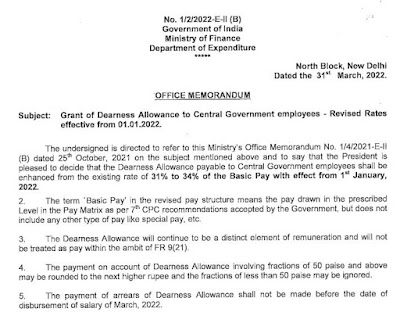
DA Jan 2022 - Grant of Dearness Allowance to Central Government employees - Revised Rates effective from 01.01.2022

 3% DA Hike - Revised Rates effective from 01.01.2022: DoE OM dated 31.03.2022 No. 1/2/2022-E-II (B) Government of India Ministry of Finance...