Friday, 4 December 2015

Railway engineers condemn 7th Pay Commission, present 27 demands – Protest at Jantar Mantar area of central Delhi on 1st and 2nd December 2015

Railway engineers condemn 7th Pay Commission, present 27 demands – Protest at Jantar Mantar area of central Delhi on 1st and 2nd December 2015

7th Pay Commission AIREF


Members from across the Country of All India Railway Engineers Federation (AIREF), gathered at the Jantar Mantar area of central Delhi on 1st and 2nd December 2015 to voice their objections to the recommendations of the Seventh Central Pay Commission.

Mr. Sanjib Kumar, the president of the AIREF, told that , “Due to the faulty policies made by railways and erroneous report given by Seventh Central Pay Commission, the railway engineers have been frustrated seriously for which there will be a tremendous threat to railway safety in the future.”

Mr. Sanjib Kumar, elaborated that the AIREF represents about 80,000 degree and diploma engineers of Indian Railways, all of whom play a crucial role in ensuring the safe and efficient running of trains, construction and production, design, repair and maintenance of tracks, bridges and buildings, rolling stock, locomotives, coaches, electrical services, OHE, signals, telecommunications.

 Mr. Kumar also revealed that the railway engineers also take more responsibility for the safe movement of 23 million passengers daily. The striking railway engineers said that they have submitted a charter of 27 demands for the government to implement, failing which they warned that their strike could turn into an indefinite one.

The demands are as follows:

  1. Group ­B/Gazetted status to all railway engineers (JE, SSE, SE/IT, CMA/CMS & DMS/CDMS) as per DOPT Gazette Notification No­605 dtd. 09.04.2009 as implemented in all other departments of Central Govt
  2. Recognition of All India Railway Engineers Federation (AIREF) and its affiliated Zonal Railway Engineers Associations as per Khanna Committee recommendation.
  3. To remove anomaly of 6th CPC: Grant upgraded Pay matrix equal to Rs. 5400 (PB­3) to JE and Rs. 6600 (PB­3) to SSE with standard designation of Assistant Engineer.
  4. Time bound promotion from JE to Junior Administrative Grade Officer.
  5. Scrap new pension scheme in Railways or make it optional.
  6. Grand Technical Allowance @ 30 percent to all railway engineers.
  7. Inclusion of father and mother in definition of family as per Indian culture.
  8. Remove anomaly of Modified Assured career progression (MACPS)
    a. Counting of apprentice period for MACP for regular service since it is qualifying service for pension and increment.

    b. Financial up­gradation under MACPS to the directly recruited Graduate Engineers (head Draftsman) Considering entry Grade Pay as Rs. 4,600/­ for the purpose of MACP to all the directly recruited Engineering Graduates and treating GP­ 4200 to diploma engineers recruited as Asstt Draftsman in Design/Drawing Cadre and other Cadres, those recruited one stage lower at that time.

    c. Third financial up­gradation under MACPS on completion of 20 years of service from the first promotion or 10 years after second promotion or 30 years after regular appointment whichever is earlier. 03/12/2015
  9. Stop immediately implementation of integrated seniority as per Rly Bd. Letter no. RBE 92/2015 for the purpose of promotion/selection to Group­B posts.
  10. Open a promotional channel to qualified loco pilots to become JE / SSE through LDCE / GDCE.
  11. Provide entitlement in Tatkal ticket through privilege / duty passes/ PTOs.
  12. Provide e­ticket facility to Railway employees on pass/ PTOs / e­pass.
  13. Remove restriction of no. of tickets in Rajdhani/ Shatabdi / Duranto express trains on passes / PTOs.
  14. Provision of accidental insurance of Rs. 20 lakhs to all railway engineers.
  15. Provision of LTC to railway engineers on inland or foreign tours once in two years.
  16. No corporatisation in Indian Railways and its Production Units.
  17. Provision reimbursement of tuition fee of children studying in higher education ( Engg. / Medical / MBA etc)
  18. Provision improved rest house facilities at all major railway stations for Railway Engineers or provide hotel / retiring room facility as admissible to all Central Govt. employees.
  19. Rename the training institutes as Railway Engineers’ Training Institutes instead of Supervisors’ Training Institutes.
  20. Ensure CUG facilities to all Railway Engineers and increase the CUG utility amount to minimum Rs 500/­ for JE and equivalent and Rs 1000/­ for SSE and equivalent.
  21.  Provide brief case to all Railway Engineers irrespective of any condition.
  22. Set up technical library in all divisional / HQ office including workshops, loco sheds under functional management of Engineers Associations of the unit.
  23. Stop unnecessary inspections on Sundays & holidays by higher officers except during unusual incidences like accidents, derailments. etc.
  24. Ensure compulsory weekly rest to field staff and to implement 8 hours duty schedule, sanction additional night duty posts of Engineers where it is not yet exists
  25. Fill up all existing vacant posts to stop short­cut method.
  26. Create new posts as per new assets.
  27. Increase exemption limit Income tax to Rs 8 Lakhs and exemption of all allowances from Income tax.

AIREF expresses that the seventh CPC has ignored all factors i.e. education, duties and responsibilities of the railway engineers, and only concentrated on upgrading the pay structures of non­core, non­technical and non safety categories, Engineer Sanjib warned that it will affect seriously the government’s dream project to run a bullet train in the future.

He said that when several railway safety committees such as the Justice Khanna Committee, the Justice Wanchoo Committee and the Justice Sikiri Committee have categorically recommended giving railway engineers separate recognition in view of their separate nature of duties, responsibilities, mode of recruitment and training etc., why was this government shying away from granting it.

“We have had a good meetings with the commission at several places at different cities of the country. The chairman has assured to give justice by giving Group­B status and good pay structures with perks. But now, we have found that the commission has betrayed us,” Engineer Kumar said.

AIREF Secretary General Engineer Ashok Kumar Tyagi described the lot of railway engineers as disappointing and unfortunate.

“It is the worst ever pay commission report among seven pay commissions,” he maintained.

A.V. Swamy, Member of the Rajya Sabha from Odisha and a member of the Parliament’s Standing Committee on Water Resources, and a former engineer, justified the railway engineers protest.

He said, “When the rights and demands of railway engineers are denied, the chance of technical advancement of the railways is remote.”

Lok Sabha Member B. Majhi and ex­engineer­in­chief of E. Co. Railways, said, “Pay commissions have continuously ignored the just demands of the railway engineers.”

Rajya Sabha Member A.B. Rapolu said, “The Railway Board has denied justice to its technocrats. Junior engineers and SSEs must be granted Group B gazetted status at par with other central government departments

The AIREF said that the railway ministry has been giving only conventional replies and this would eventually affect the safety and economy of the railways seriously.

Source : Indian Railways Technical Supervisors Association

Recommendations of 7th Pay Commission are very disappointing – BPMS

Recommendations of 7th Pay Commission are very disappointing – BPMS

BHARATIYA PRATIRAKSHA MAZDOOR SANGH
(AN ALL INDIA FEDERATION OF DEFENCE WORKERS)

REF: BPMS / OFB / 7th CPC / 251 (8/2/M)
Dated: 01/12/2015
To,
The DGOF & Chairman,
Ordnance Factory Board,
10 A, S K Bose Road,
Kolkata – 700001

Kind Attention : Shri S K Sinha, DDG/IR

Subject : Views / Comments of BPMS on the recommendations of 7th CPC

Reference : OFB letter No. 11/7th CPC/2015, Dated 27.11.2015

Respected Sir,
With due regards, it is submitted that this federation has gone through the recommendations of 7th CPC and found that the recommendations are very disappointing. It appears that the 7th CPC has not considered the genuine demands of the OFB in correct perspective. Hence, OFB is requested to examine the following matters related to the Cadres:-

1. Industrial Cadre :-

(i) BPMS has demanded that the Grade Pay of Skilled employees should be enhanced from Rs. 1900/- to Rs. 2400/-.
(ii) Further, Highly Skilled Gr-II in GP 2400/- and Highly Skilled in GP 2800/-should be merged in a single GP of Rs. 2800/-

(iii) Inter Grade ratio should be same in MOD, Railways & other ministries which is as under in Railways-

Skilled – 20%
Highly Skilled – 64% (HS-II 20%, HS-I 44%)
Master Craftsman – 16%
(iv) To retain the experienced employees in industrial cadre without financial hardships, it has been demanded that Master Craftsman may be promoted to MCM (Selection Grade) in the same GP of Junior Works Manager.

2. Supervisory Staff :-

(i) BPMS has demanded that the Grade Pay of Junior Works Manager should be upgraded from Rs. 4600/- to Rs. 4800/- so that after completion of 04 yrs regular service incumbents may be placed in the GP 5400/-.

(ii) Inter Grade ratio (Chargeman & JWM) should equal for Technical, Non-Technical & Store Cadre.

3. Clerical Cadre :-
(i) BPMS has demanded that the Grade Pay of LDC should be upgraded from Rs. 1900/- to Rs. 2400/- at par with Skilled.
(ii) BPMS has demanded that the Grade Pay of UDC should be upgraded from Rs. 2400/- to Rs. 2800/-.

(iii) BPMS has demanded that the benefit of Non Functional Upgradation to 30% UDC in Secretariat in GP 4200/- on completion of 05 yrs should be extended to the UDCs posted in the Subordinate Offices/Establishments.

4. Store Keeping Cadre :-

(i) BPMS has demanded that the Grade Pay of Store Keeper should be upgraded from Rs. 1900/- to Rs. 2400/- at par with Skilled / LDC.

(ii) BPMS has demanded that the Grade Pay of Supervisor should be upgraded from Rs. 2400/- to Rs. 2800/- at par with UDC / HS.

5. Stenographers Cadre :-

(i) BPMS has demanded that the Grade Pay of Stenographer should be upgraded from Rs. 2400/- to Rs. 2800/- at par with UDC / HS.

(ii) BPMS has demanded that the benefit of Non Functional Upgradation to 30% Steno GM!! in Secretariat in GP 4200/- on completion of 05 yrs should be extended to the Stenographers posted in the Non-Secretariat/Subordinate Offices/Establishments.

6. Fire Fighting Cadre :-

(i) Recommendations of 6th CPC on Fire Fighting Cadre have not been implemented in OFB at par with other Directorates of MOD. 07 CPC has recommended in Para 7.7.24 for drafting of Model Recruitment Rules for the Firefighting Staff of all Central Government Departments and UTs with similar designation and pay structure.

7. Motor Transport Cadre :-
(i) 07th CPC has stated in Para 7.7.16 that Ministry / Departments maycreate supervisory posts as Motor Transport Officer, Transport Supervisor, depending upon the Cadre strength and functional justification. Hence, OFB should create the post of Transport Officer & Motor Transport Officer.

8. Multi Tasking Staff (MTS) :-
(i) Contrary to the recommendations of 07th CPC mentioned in Para 7.7.37,BPMS demands that promotional quota should be enhanced from existing 5% and non-functional upgradation at promotional level should be granted to MTS.

9. Hospital Staff :-

(i) Laboratory Technicians :- As per 07th CPC recommendations, OFB/MOD should take appropriate action for aligning the Laboratory Staff in the line of cadre structure finalized by Ministry of Health & Family Welfare.

The existing incumbents not possessing the revised qualification (BSc plus DMLT) may be granted the Grade Pay of Rs. 4200/- w.e.f. 01.01.2006 if they have completed 05 yrs regular service.

Considering their job requirement, the incumbents should be granted Conveyance Allowance for visiting Pathology Laboratory outside of the normal duty hours.

(ii) Radiographers :- The existing hierarchy of Radiographers in Ministry of Health & Family Welfare (as mentioned in Para 7.6.88 of 07th CPC) should also be implemented in OFB.

(iii) Pharmacist :- 07th CPC has mentioned in Para 7.6.102 that sufficient justification does not exist to upgrade the pay levels scales of Pharmacist.

Considering the proper justification annexed with this letter, the Entry Grade Pay of Pharmacist should be upgraded to Rs. 4200/-. The Existing hierarchy of Pharmacists in Ministry of Railways / Ministry of Health & Family Welfare should also be implemented in OFB.

(iv) Medical Assistant :- Dressers of Ministry of Railways are equivalent to Medical Assistant of OFB. 07th CPC has recommended (in Para 7.6.108) that entry level qualification of Dressers is Class XII with 03 yrs experience of dressing of wounds. Hence, a higher Grade Pay of Rs. 2000/- from Rs. 1800/- would be granted to the incumbents. It further states that the existing incumbents not possessing the revised qualification may be granted the replacement pay level for the time being but on completion of 05 yrs regular service in GP 1800, they may be granted the GP of Rs. 2000/-. This should also be implemented for Medical Assistant in OFB.

(v) Mid Wife :- The entry level qualification of Mid Wife is 10+2 or equivalent with Science and 02 yrs Auxiliary Nursing Mid Wife Course and must have working knowledge of computers as per SRO 88, dated 03.08.2005. The 05th CPC has recommended the pay scale of Rs. (4000-6000) but it has not been granted to the incumbents in OFB. Hence, the existing incumbents not possessing the revised qualification may be granted the Grade Pay of Rs. 2400/- w.e.f. 01.01.2006 if they have completed 05 yrs regular service.

10. Security Staff :-
(i) The existing hierarchy of Security Staff in Department of Atomic Energy (as mentioned in Para 11.2.18 of 07th CPC) or Security Staff in DRDO under Ministry of Defence (as mentioned in Para. 11.12.129 of 07th CPC) should also be implemented in OFB.


11. Rajbhasha Cadre :-

(i) The 07th CPC has mentioned in Para 11.22.126 that the incumbents of Rajbhasha Cadre has demanded for creation of new posts, merger and upgradation of existing posts and re-designation of various posts with upgraded pay scales but the Commission is not dealing with issues relating to cadre restructuring.

(ii) However, considering the stagnation in the Official Language Cadre in OFB, number of posts of Senior Hindi Translators and Assistant Director/Official Language / Hindi Officer should be equated to provide adequate promotional prospects to them.

12. EDP Staff :-

(i) Senior Data Entry Operators may be merged with Chargeman (Tech) and this cadre may be abolished.

13. Canteen Staff :-
(i) Though 07th CPC has not upgraded the Grade Pay of this cadre, however, OFB should prepare a Cadre Review so that Canteen Employees may be promoted and stagnation may be removed.

Further, comments/views on the general recommendations are being offered separately for kind consideration.

Thanking you.
Sincerely yours
(M P SINGH)
General Secretary
Source: BPMS

7th Pay Commission recommendations are far beneficial than all the Pay Commissions so far except few flaws

7th Pay Commission recommendations are far beneficial than all the Pay Commissions so far except few flaws

VII CPC RECOMMENDATIONS ARE FAR BENEFICIAL THAN ALL THE PAY COMMISSIONS SO FAR EXCEPT FEW FLAWS

Financial benefits to be reaped by central government employees through the recommendation of seventh central pay commission are going to be in leaps and bounds : Criticizing the recommendations of the VII Central Pay Commission without fully studying the report and jumping to the conclusion that the pay commission has done injustice to the central government employees is not fair.

The Seventh Central Pay Commission have done an excellent job by presenting the VII CPC Report within the scheduled time and without much anomalies that were vastly found in VI CPC Report. Abolition of Pay Band and Grade Pay System deserve appreciation. Pay matrix have been worked out with brilliance which provide minimum entry scale as well as fitment table for existing employees according to the increments drawn unlike the 3 methods of fixation adopted by VI CPC among new recruits, promotees and existing employees which caused great disparity and anomaly in pay fixation. The hike granted is also quite substantial which in fact is more than what VI CPC had granted.

While the increase granted by VII CPC actually come to 32% of the pre-revised existing Basic pay, the increase is projected as 15% wrongly by the media including the VII CPC in its comparison table which unnecessarily have been paving the way for resentment and unrest among the central government employees who would not have fully studied the report. While projecting the percentage of increase the VI CPC,had taken into account only the basic pay . Whereas the VII CPC had reckoned D.A. element also to project the percentage of increase which gives a wrong picture of around 15% hike.

A clear analysis of the recommendations shall throw insight on the vast financial benefits that the central government servants are going to reap for years to come. Let me analyse the salient features of the recommendations thread bare in an unbiased mind to present a true picture:

1. Basic Pay: The VII CPC has arrived at a factor of 2.57 for multiplication with the pre-revised pay and pay band to arrive at new Basic Pay. While the pre-revised Pay in the pay band and Grade Pay is to be deemed as 100%, the D.A. as on 1/1/2016 constitute 125% totaling to 225% in other words 2.25 factor. This is the actual Pay, Grade Pay and D.A, a government servant would be drawing as on 1/1/2016 under the VI CPC pay pattern. The VII CPC added 32% hike uniformly to all the employees as fitment benefit to the existing pay and grade pay and raised it to 257% or 2.57 factor.

What is to be noted here is although the VI CPC had granted 40% of the maximum of the basic pay scale of the pre-revised V CPC pay as fitment benefit and shown it separately as Grade Pay, yet the present hike of 32% in pay and grade pay is more than that because the existing basic pay containing pay and grade pay already contain 1.86 factor +40% fitment benefit offered by V CPC i.e. 72% D.A as on 1/1/2006, in other words 86% D.A as on 1/1/2006(i.e 50% Dearness Pay and 24% DA and 24% D.A on 50% D.P which come to 12% totaling to 86% plus Grade Pay of 40% totaling to 226 or 2.26 factor Therefore virtually 32% of increase presently granted by VII CPC on the 6th CPC Pay consisting of 1.86 factor plus Grade Pay of 40% totaling to 226 or 2.26 factor actually come to 72.32% hike (226 x 32% = 72.32%) when we have to compare the hike of VII CPC with VI CPC and in terms of the amount.

2. Dearness Allowance: The VII CPC had rightly added 6% D.A. notionally for the period 1/7/2015 to 31/12/2015 to the existing 119% D.A and merged 125% of D.A. on the pre-revised pay and Grade Pay in its revised Basic pay. What is more – the future D.A payable every 6 months as per the All India Consumer Price Index is going to be calculated retaining the same formula of 115.76(Base year 2001=100). Continuance of D.A calculation formula as per the existing rate for the revised Basic Pay which include 125% of D.A as on 1/1/2016 and 32% fitment benefit certainly is going to increase the salary level hugely as the D.A. increase every 6 months may continue to be in the range of 6% to 7%.

3. House Rent Allowance: Although the existing percentage of HRA has been reduced to 0.8 factor i.e. to 80 percent which comes to 24%, 16% and 8% for the X, Y and Z cities respectively, yet there is more than 100% increase in the present HRA rate as a result of payment of HRA on the revised basic pay which include 125% D.A. and 32% fitment benefit totaling to 257 or 2.57 factor. The percentage of increase of HRA come to 61.68% of the existing pre-revised pay and grade pay for X cities which carry only 30% at present(257 x 24%=61.68). The HRA come to 41.12% of the existing pre-revised pay and grade pay for Y cities which carry only 20% at present(257 x 16%=41.12).. Similarly the HRA come to 20. 56% of the existing pre-revised pay and grade pay for Y cities which carry only 10% at present(257 x 8%=20.56).. Thus the present hike in HRA is more than 100% of the existing HRA amount drawn. Further when D.A crosses 50% HRA will be raised to 27%, 18% and 9% and when D.A. crosses 100% HRA will be raised to 30%, 20% and 10%. It must be seen that HRA rate recommended by VII CPC at present itself is very huge.

4. Transport Allowance: 125% of D.A. as on 1/1/2016 have been merged to the existing slab and revised Transport Allowance slabs have been arrived at on exact basis. For example the Transport Allowance after merger of D.A to the existing slab of Rs.3200, 1600 and 600 gets raised to 7200, 3200 and 1350 respectively. Further The D.A gets added once in every 6 months as per the CPI index. Therefore there will be steep increase in Transport Allowance amount every 6 months as the D.A rate enhances.

5. Annual Increment: Retaining 3% increment is quite okay because the 3% increment is granted on revised basic pay which constitute pay, grade pay D.A. at 125% and 32% hike in the existing basic pay as fitment benefit. Of course the benefit is marginal only from the existing monetary benefit that accrue on increment.

6. Children Education Allowance: Hiked by 25% i.e. to Rs.2250 per month with simiar rise in hostel fee.

7. Child Care Leave: Recommended for single male parent also. 80% salary for the next 365 days of the total 730 days is a welcome measure to discourage misuse of Child Care Leave.

8. House Building Advance raised from a meager limit of 7.5 lakhs to 25 lakhs

9. Group Insurance Schme: Increasing Group Insurance limit to such a stupendous level of Rs.50.00 lakhs, 25 lakhs and 15 lakhs shall provide adequate succor to the bereaved family of the government servants who die while in service.

10. Retirement Benefits:

i. Pension: 32% hike in the basic pension(2.57 factor) with one more option for ensuring equal pension for equal number of years of service as in the case of defence which perhaps was not demanded by any central government employees forum is a milestone of the recommendation.

ii. Gratuity: Retention of Gratuity at 16.5 months of revised basic pay and D.A . shall increase the take home gratuity amount. Doubling of Gratuity amount from Rs.10.00 lakhs to Rs.20.00 lakhs with provision for raising the Gratuity limit by 25% when D.A. crosses 50% i.e. to Rs.25 lakhs is a great relief to middle level and higher level employees whose remuneration for 16.5 months are much higher than the existing Rs.10.00 lakhs and who would be saved from losing several lakhs as a result of enhancement of gratuity limit.

iii. Commutation of Pension: Retention of Pension commutation at 40% of the revised basic pension which stands increased by 2.57 times as a result of merger of 125% D.A and 32% fitment benefit shall correspondingly increase the take home pension commutation by 2.57 times. For example, an employee who may be otherwise getting only Rs.5.00 lakhs as pension commutation on the existing Pay+Grade Pay under VI CPC recommendation, may get Rs.12.85 lakhs as pension commutation under VII CPC recommendation.

iv. E.L. encashment: Retention of E.L encashment at the existing 300 days is also a welcome gesture.
Surely there will be 60 to 70 percent increase in the overall take home retirement benefits when compared to the existing retirement benefits

All these monetary benefits recommended by the VII Pay Commission, shall definitely provide an insight about the genuine concern of the Hon’ble Chairman and the Members of the VII Pay Commission to improve the financial situation of the central government employees. The criticisms raised against the Pay Commission’s recommendations are totally unwarranted.

SOME FLAWS OBSERVED IN THE RECOMMENDATIONS WHICH NEED RECTIFICATION BY GOVERNENT:

1. Retention of 3% increment on basic pay in case of promotion leads to lower financial benefits than the existing benefits: In the matter of increment on promotion, the Chairman and the Members of the VII CPC have erred, since the financial benefit would be much lower than what a government servant would have got under VI CPC recommendation on promotion, because the existing benefit on promotion carry change in grade pay apart from 3% increase in Pay+Grade Pay. The following illustration shall show the huge difference:

Suppose an employee whose Pay is Rs.24210/- and the Grade pay is Rs. 5400 totalling to Rs.29610(in the Pay band of 15600-39100), gets his next promotion to the Grade Pay of Rs.6600/- he will be entitled to the following hike in total remuneration under the existing VI CPC recommendation:

Rs.29610 x 3% increment =Rs.890

Difference in Grade Pay from Rs.5400 to Rs.6600= Rs.1200

Total increase of increment in basic pay and Grade Pay= Rs.2090

D.A. at 125% as on 1/1/2016 on Rs.2090 = Rs.2613

HRA at 30%(assuming X city) on Rs.2090 =Rs.627

Total monetary benefit = Rs.5330/-

Whereas the net monetary benefit under VII CPC recommendation, as a result of promotion in the above case will be much lower than the above illustraion as shown under:

Equivalent Basic Pay for Rs.29610 come to Rs77700 as per pay matrix

Rs.77700 x 3% increment =Rs.2331(rounded to 2300)

D.A. at 0% as on 1/1/2016 on Rs.2300 = 0

HRA at 24%(assuming X city) on Rs.2300 =Rs.552

Total monetary benefit = Rs.2852/-only as against the existing Rs.5330/- leading to shortage of Rs. 2478/- This is a big blunder committed by the VII Pay commission.

Therefore the increment on promotion should be atleast 5 to 6% to bring the benefit of increment on promotion to the existing level.

2. Non recommendation for merger of 50% of D.A. with basic pay when D.A. crosses 50% is a great disappointment:

The long standing demand of the central government employees for merger of 50% D.A with basic was not implemented by the government on the excuse that the VI CPC had not made such a proposal. The VII CPC is totally silent about this aspect. It appears no one has demanded the same before the VII CPC for consideration.

It is quite surprising that such a vital issue of non-recommendation of merger of D.A with basic pay when D.A crosses 50% is not being opposed by any central government associations or pointed out by the the media. Had it been recommended by the VII CPC, the government would have implemented the same and the benefit of hike in salary as a result of merger of D.A with basic when it cross 50%, would be so vast that no government servant would crave for a need for timely setting up of next VIII Central Pay commission.

3. Disparity in fitment factor among existing and new recruits at various pay levels: The grant of higher percentage of fitment benefit to new recruits at 2.62 factor(37% increase on Pay+Grade Pay), 2.67) factor(42% increase on Pay+Grade Pay) and 2.72 factor(47% increase on Pay+Grade Pay) etc., is reminiscent of VI Pay Commission’s recommendations which led to disparity among promotees and new recruits. Uniform method should have been adopted. There are chances of persons with more service in a particular pay level getting equal salary with his junior by one or 2 year. This needs rectification.

4. Likely disparities in pension fixation whereby junior may get more pension than the seniors as a result of recommendation under option 2:
The VII CPC has recommended a factor of 2.57 for multiplication of existing basic pension to arrive at revised basic pension. This of course shall not lead to any disparity in pay fixation.
Where as the 2nd option to get the pension fixed as per the number of increments drawn in the particular pay level prior to retirement, may result in great disparities whereby the juniors may get much more than senior pensioners who retired in a higher pay with more basic pension, but with less number of service in the promoted post which he would have held at the time of retirement. Because for arriving at pension under the 2nd option, only the number of years served by a government servant in the particular level of pay at the time of retirement should be taken into consideration as per VII CPC recommendation for exercising the second option.

Therefore in order to arrive at a correct picture to ensure equal pension for civilians for equal number of years, the number of years of service at various level should be taken into account in all the levels from the date of joining the government service till retirement.

5. Suggestion of the Chairman, VII CPC, to do away with setting up of future central pay commissions and give proportionate hike annually to avoid financial burden is a wrong proposal:
The Pay Commissions are set up by the government, to look into the current salary structure and to recommend the hike needed in the pay and other allowances on the basis of the current economic scenario. The Pay Commissions recommendations are not meant for providing financial benefit for the past 10 years, but for future 10 years. The additional financial implication of about Rs.1,02,100 crore i.e. 23.55% in the existing financial liability for implementation of the recommendation is only for one year. i.e.2016-17 which proportionately gets increased every year for the next 10 years. Therefore the suggestion of the Chairman to do away with setting up any more pay commissions and instead to grant proportionate rise in salary every year is a big flaw. It is not clear what the Hon’ble Chairman of the VII CPC really want to suggest. Such a suggestion really shall baffle all the financial experts since the very quantum of additional increase in salary every year comes on the basis of recommendation of the pay commission. Does the Chairman suggest to government to grant further increase in salary every year over and above what the VII CPC have recommended?

6. Questions that need to be answered by the Pay Commission/Government:

a). While adequate amount is provided out of the minimum basic pay of Rs.18,000/-for monthly food items for 3 persons of a family unit which is quite sufficient even for 6 members in a family, but adequate provision is not made towards house rent and educational aspects. The House Rent admissible in X Cities at 24% for Rs.18000/- comes to only Rs.4320/- No family can get a good accommodation for this rate even in Z category cities. There should be a minimum of at least Rs.8000/- as House Rent Allowance in X category cities and a maximum ceiling of Rs.25000/- should be imposed, since persons in higher basic pay stand to get hefty amount as House Rent Allowance which is not advisable.

b). There is no point in granting Children Education Allowance only upto 12th Standard. Any one with 12th Std. qualification can at the most go for a helper job or MTS in government offices. Certainly no welfare government will have such a narrow concept of making the wards of government employees limit their education upto 12th Std. with a view of providing them menial jobs. Therefore government should encourage high level education and pay Children Education Allowance upto Post Graduation level.

CONCLUSION:

Except for the above flaws which need to be rectified, the recommendations of the VII CPC are by and large beneficial and therefore there should be no cause for resentment among the central government employees. They should rejoice over the benefits offered by the VII CPC since the recommendations of the VII Pay Commission are going to yield huge financial benefits in the long run. However, there is a need to take up the matter with the government on the issues which really need intervention by the government to set right the anomalies.

In a nutshell the Chairman and Members of the VII CPC have done a commendable job and fulfilled their mission successfully ensuring justice to all levels of central government employees without any need for worrying about their bread and butter. They really deserve appreciation for presenting an employee friendly report which surely is far beneficial in the history of pay commissions constituted so far.

M.DORAI
Deputy Director
ESIC Model Hospital
(Ministry of Labour, Government of India)
Rajajinagar,
Bangalore

Thursday, 3 December 2015

Deputation of Central Government servants to posts in Central Autonomous Bodies

Deputation of Central Government servants to posts in Central Autonomous Bodies

Central Government servants

 No.2/11/2015-CS.I(U)
Government of India
Ministry of Personnel, Public Grievances & Pension
Department of Personnel & Training
2nd Floor, Lok Nayak Bhavan,
Khan Market, New Delhi.
Dated the 3rd December, 2015.
OFFICE MEMORANDUM

Subject: Deputation of Central Government servants to posts in Central Autonomous Bodies

The undersigned is directed to say that in terms of revised instructions issued by Department of Pension and Pensioners Welfare vide their O.M No. 4/78/2008-P&PW(D) dated 12.10.2015, appointment of Central Govt. employees to posts in Central Autonomous Bodies on deputation basis is allowed without seeking exemption from the Rule of immediate absorption, if the Recruitment Rules for the posts specifically provide for the appointment of Central Government employee on deputation.

2. Accordingly, henceforth, CS.I Division being the cadre controlling authority for CSS Officers will provide cadre clearance to CSS Officers for deputation to Central Autonomous Bodies. However, the Autonomous Bodies and their nodal Ministries concerned should ensure that the provisions of D/o. P & PW’s O.M. dated 12.10.2015 are fulfilled while appointing Government servants on deputation basis.
(V.Srinivasaragavan)
Under Secretary to the Government of India
Tele: 24629412
Encl.: As above

To
All Ministries/Departments (participating in CSS)

Copy to:
1. DS, CS.II, DoPT
2. All USs/SOs, CS.I, DOPT

Source: ccis.nic.in

Indian Air Force Continues Relief and Rescue Operations in rain ravaged areas of Tamil Nadu and Andhra Pradesh

Indian Air Force Continues Relief and Rescue Operations in rain ravaged areas of Tamil Nadu and Andhra Pradesh

Indian_Air_Force_Chennai_Rain


In continuation of rescue & relief operations by the Indian Air Force in flood affected areas of Tamil Nadu and on completion of airlift of 04 National Disaster Relief Force (NDRF) teams from Delhi and 10 NDRF teams from Bhubaneswar to Arakkonam, 04 Indian Army Columns are being airlifted by the transport aircraft of the Indian Air Force today. One C-130J from Tambaram to Delhi and Two C-17s from Arakkonam are expected to get back stranded passengers to Begumpet/Delhi, today.

The helicopter operations are on full swing wherein 04 Medium Lift Helicopter, One Advance Light Helicopter (ALH) and 05 Chetak/Cheetah are involved actively in rescue & relief operations.
One helicopter is positioned in Tirupati to aid the Andhra Pradesh Government.

PIB

Appointment of Joint Secretaries to the Government of India

Appointment of Joint Secretaries to the Government of India

NO.33/12/2015-EO(SM-I)
Government of India
Secretariat of the
Appointments Committee of the Cabinet
Ministry of Personnel, Public Grievances and Pensions
Department of Personnel and Training

New Delhi, the 3rd December, 2015

The Appointments Committee of the Cabinet has approved the following Joint Secretary level appointments in the Pay Band of Rs.37,400-67,000/- (PB-4) with Grade Pay of Rs.10,000/-
(1) Shri Dinesh Kumar, IAS (RJ:1996) as Joint Secretary, Department of Agriculture, Cooperation & Farmers Welfare from the date of assumption of the charge of the post for a period of five years or until further orders, whichever is earlier, vice Shri Sanjeev Chopra, lAS (WB:1985);

(2) Shri Venkata Rama Sastry Pidaparthi, IPS (UP:1989) as Joint Secretary, Department of Consumer Affairs from the date of assumption of the charge of the post for a period of overall seven year central deputation upto 19.03.2019 or until further orders, whichever is earlier, vice Shri Manoj Kumar Parida, IAS (UT:1986);

(3) Shri Rajiv Bansal, IAS (NL:1988) as Joint Secretary, Department of Electronics & Information Technology from the date of assumption of the charge of the post for a period of five years or until further orders, whichever is earlier, against a newly created post;

(4) Shri Amit Yadav, IAS (UT:1991) as Joint Secretary, Department of Telecommunications from the date of assumption of the charge of the post for a period of five years or until further orders, whichever is earlier, vice Shri V. Umashankar, lAS (HY:1993);

(5) Shri B Anand, IAS (TN:1987) as Joint Secretary, Ministry of Urban Development from the date of assumption of the charge of the post for a period of five years or until further orders, whichever is earlier, by temporary upgradation of a newly created post of DSIDirector to JS level for two years in the Ministry of Urban Development;

(6) Shri Shripal, IFS (KL:1986) as Principal Commissioner (JS level), DDA under Ministry of Urban Development from the date of assumption of the charge of the post for a period of five years or until further orders, whichever is earlier, vice Shri Dayanand Kataria, lAS (TN:1989);

(7) Ms. Sonia Sethi, IAS (MH:1994) as Joint Secretary, Ministry of Culture from the date of assumption of the charge of the post for a period of five years or until further orders, whichever is earlier, vice Ms. Arvind M Singh, liS (1984);

(8) Shri Praveen Vashista, IPS (BH:1991) as Joint Secretary, Ministry of Mines from the date of assumption of the charge of the post for a period of five years or until further orders, whichever is earlier, vice Shri Naresh Kumar, lAS (UT:1987);

(9) Ms. Leena Nandan, IAS (UP:1987) as Joint Secretary, Ministry of Road Transport & Highways from the date of assumption of the charge of the post for a period of five years or until further orders, whichever is earlier, vice Shri Alkesh Kumar Sharma, IAS (KL:1990);

(10) Shri Praveen Garg,IAS (MP:1988), Joint Secretary, Department of Justice as Joint Secretary, Department of Economic Affairs on lateral shift basis from the date of assumption of the charge of the post for a period of overall five year central deputation upto 18.07.2018 or until further orders, whichever is earlier, vice Shri Manoj Joshi, lAS (KL:1989);

(11) Shri Anil Kumar Singh, IAS(UT:1995), Joint Secretary, Ministry of Power as Joint Secretary, Department of Justice on lateral shift basis from the date of assumption of the charge of the post for a period of overall five year central deputation upto 07.03.2016 or until further orders, whichever is earlier, against a newly created post.

(12) Shri Rajinder Kumar Kashyap, IPoS (1989) as Joint Secretary, Department of Justice from the date of assumption of the charge of the post for a period of five years or until further orders, whichever is earlier, vice Shri Praveen Garg, lAS (MP:1988);

(13) Ms. Rachna Shah, IAS (KL:1991) as Joint Secretary, Cabinet Secretariat from the date of assumption of the charge of the post for a period of five years or until further orders, whichever is earlier, vice Ms. Deepti Umashankar, lAS (HY:1993) consequent on completion of her tenure on 26.12.2015;

(14) Shri K Gopal, IAS (TN:1992), presently on compulsory wait in the Department of Personnel & Training, as Development Commissioner(Handicrafts) (JS level), Ministry of Textiles on lateral shift basis from the date of assumption of the charge of the post for a period of overall five year central deputation upto 27.02.2018 or until further orders, whichever is earlier, vice Ms. Pushpa Subrahmanyam, IAS (TG:1985);
2. The Competent Authority has approved the proposal for cancellation of appointment of Shri U.K.S. Chauhan, IAS(KL:86), Joint Secretary, Department of Food & Public Distribution as Joint Secretary, Ministry of Home Affairs and that of Ms. Rachna Shah, lAS (KL:1991) as Joint Secretary, Departmentof Food & Public Distribution vice Shri U.K.S. Chauhan, IAS(KL:86),

(Nandini Paliwal)
Deputy Secretary to the Government of India
Tel: 2309 2187
To
All Secretaries to the Government of India concerned.
Copy to: –
1. Principal Secretary to PM
2. Additional Principal Secretary to PM
3. PS to Home Minister/PS to MOS(PP)
4. Cabinet Secretariat (Shri M. Devaraj, Joint Secretary)
5. All Secretaries to the Government of India (as per the standard list).
6. All Chief Secretaries to the States
7. All Officers concerned.
8. PSO to Secretary(P)/PPS to EOI PS to DS(MM)
9. NIC,DOPT
10. Guard File.

Source: Persmin

Scheme for engagement of a dependent of deceased GDS on compassionate grounds

Scheme for engagement of a dependent of deceased GDS on compassionate grounds

No.17-17/2010-GDS
Government of India
Ministry Of communications & IT
Department of Posts
(GDS Section)
Dak Bhawan, Sansad Marg,
New Delhi – 110 001.
Dated: 30 Nov 2015
All Heads of Postal circles

Sub: Scheme for engagement of a dependent of deceased GDS on compassionate grounds – Clarification

Various issues in connection with compassionate engagement scheme were engaging attention of this Directorate for some time past and the same are clarified for the information of all concerned as under:-

S.No. Point raised Clarification
1 Whether cases of married son living with parents and dependent for livelihood on the GDS on the date of death of the deceased GDS considered and rejected for compassionate engagement based on clarification on Point of Doubt No.2 vide Directorate’s letter No.17-17/2010-GDS dated 09.10.2013 can be reconsidered in the light of their consideration as dependent vide Directorate’s letter No.17-39/2012-GDS dated 14.01.2015? Yes, clarification on Point No.2 of Directorate’s letter No.17-17/2010-GDS dated 09.10.2013 is to be treated non-existent/withdrawn ab-initio.
2 Whether or not the educational qualifications prescribed vide Directorate’s letter No.17-39/2012-GDS dated 06.02.2014 & further vide letter No.17-39/6/2012-GDS dated 14.01.2015 would apply to cases of compassionate engagement taking the day of death of the GDS as cutoff date? Being a part of regular mode of engagement to GDS Posts, the education qualification applicable on the date of consideration of cases by CRC would apply.
3 Whether it is permissible to allow compassionate engagement to a dependent of a deceased GDS where the service rendered by him/her was found to be unsatisfactory due to their involvement in serious financial irregularities but expired before award of penalty? Yes, However, this will apply from the date of issue of the order and no rejected past cases would be permissible to be re-opened.
  1. This has the approval of the competent authority.
Sd/-
(Surender Kumar)
Assistant Director General (GDS)
Signed copy Click here

7th Pay Commission Report: Headquarters Organisations in Government of India and Office Staff in Field Offices (CSS Cadre – UDC, SO, NFU, Stenographer CSSS Cadre)

7th Pay Commission Report: Headquarters Organisations in Government of India and Office Staff in Field Offices (CSS Cadre – UDC, SO, NFU, Stenographer CSSS Cadre)

Headquarters Services
Introduction
7.1.1 The headquarters organisation comprises the Secretariats of the ministries and departments of the Government of India. Most of the middle level posts are held by the officers of Central Secretariat Service as also a few administrative posts at the senior level. In the Ministry of Railways, similar positions are held by the Railway Board Secretariat Service, in the Ministry of Defence they are held by the Armed Forces Headquarter Service and in the Ministry of External Affairs the same are held by the Indian Foreign Service (B) officers.
7.1.2 The organisational hierarchy of all the headquarter services by and large includes the following levels with corresponding GP:
Level Grade Pay
Selection Grade 10000
Director 8700
Dy. Secretary 7600
Under Secretary 6600
Section Officer 4800
[after four years GP 5400 (PB-3)]
Assistant 4600
7.1.3 The headquarter services provide a permanent bureaucratic set up which assists in establishment and administration, policy formulation and monitoring and review of the implementation of policies/schemes of various ministries and departments.
Demands
7.1.4 The pay related demands of various headquarter services are as follows:-
a) At least five financial upgradations/promotions in the promotional hierarchy, at regular intervals have been demanded: time bound promotions at 5, 9, 13 years of service to CSS officers after they reach Group ‘A,’ on the same pattern as that given to Officers of the Group `A’ services and in case promotional posts are not available, non-functioning pay upgradation to the next promotional grade. These demands have been made on the grounds that it will attract a talented pool in the CSS at the entry level as well as create motivation for the serving officers.
Analysis and Recommendations

The Commission notes that the MACP scheme by its very nomenclature is intended to provide assured career progression so that government employees do not stagnate. The Commission is recommending continuance of the existing MACP Scheme. As regards the grant of time bound promotions at 5, 9, 13, 17 years to CSS officers on the analogy of Group `A’ Services, this cannot be accepted as the entry level induction of CSS is in Group `B’ and therefore it cannot be compared with Group `A’ Services.
b) Demand has been made for entry Grade Pay of Rs.5400 (PB-3) for Section Officers on the ground that there must be one pay for one post in a cadre and that the minimum residency period of eight years in the grade is very long. Similar demands have been received from the Stenographers cadres too.
Analysis and Recommendations

The post of Section officer (SO) is a promotion post for Assistant (GP 4600). Initially, on promotion, the SO is at GP 4800 and after four years is entitled to a non-functional upgrade to GP 5400 (PB-3), effectively two levels higher. Hence the stipulated residency period of eight years at the level of SO is distributed in two parts, four years in GP 4800 and the balance four in GP 5400 (PB-3). The current position is that the average time spent at the higher level is around 5-6 years.
The Commission observes that the current progression from GP 4600 to GP 4800 on promotion as Section Officer is an appropriate upgrade and does not find any justification for placing the entry level to SO at a higher level. In so far as the non-functional upgrade is concerned, in the newly restructured pay matrix the earlier situation of a common grade pay i.e., 5400 prevailing in PB2 and PB3 has now been rationalised. Accordingly, the non-functional upgrade will henceforth be from level 8 to level 9.In the case of all such cadres/services where nonfunctional upgradation is presently available across two levels, for example, from GP 4800 to GP 5400 (PB-3) the same will now be available across only one level for example, from GP 4800 to GP 5400 (PB-2) or in the new matrix from level 8 to level 9.
c) Various headquarter/stenographer services have demanded placement of GP 7600 in PB-4 for the post of Deputy Secretary or alternatively, grant of GP 8000 in PB-4 as in the case of Lt Colonel in the Indian Army. This demand is based on the ground that in the existing dispensation, there is a considerable gap in pay in between PB-3 and PB-4. Since the Deputy Secretary resides in PB-3 and the Director in PB-4, and the hierarchy does not require Deputy Secretary to report to the Director, this demand has been made.
Analysis and Recommendations
In the newly proposed rationalised pay matrix recommended by this Commission the skewed spacing between pay bands has been moderated and pay levels have been equitably placed. Therefore, there is no need for any other measure in this regard.
d) Demand has been received from various headquarter services for allowing the post of Director be made NFSG as against promotional post. The CSS has argued that the cadre review Committee in the CSS recommended that the residency period for promotion to Director Grade be set at ten years combined approved service as Under Secretary and Deputy Secretary with minimum three years’ regular service as Deputy Secretary. The existing residency period for promotion from Under Secretary to Deputy Secretary is five years and from Deputy Secretary to Director is also five years.
Analysis and Recommendations
The Commission notes that the post of Director in the headquarter services is a promotional one with a higher grade pay. The headquarter services are not comparable with All India Group `A’ service and hence the demand for NFSG for the post of Director is not supported. The Commission recommends no change in the present dispensation.
e) It has been demanded that persons appointed to a particular post either on direct recruitment or on promotion should have their pay fixed at the same level. This has been sought on the ground that no junior should draw more pay than his senior in a cadre. As against this, presently newly recruited Assistants of CSS are getting higher pay than Assistants promoted after implementation of the VI CPC.
Analysis and Recommendations
In so far as one fixation of pay for one post is concerned, it may be mentioned that the VI CPC recommended exclusive pay bands for direct entry into posts with different grade pays attached to them and hence there was a difference of total pay in respect of a direct recruit in comparison to a person promoted to that grade.
In the new pay matrix proposed by this Commission, it has been recommended that the first cell in each level in the matrix would be the entry pay for fresh/ direct recruits. The pay of a person who moves from a lower grade to higher grade is to be fixed with respect to the pay being drawn by him/her at the time of promotion. The details of fixation of pay on promotion has been dealt with in detail in the Chapter 5.1. The proposed system is expected to eliminate the existing anomaly.
f) The AFHQS (LDCE) officers have demanded re-introduction of the scheme of Limited Departmental Competitive Examination in the Section Officer grade. It has been stated that as per the AFHQ Civil Service Rule 2001, the posts of Section Officers used to be filled 20 percent by direct recruitment, 40 percent by seniority and 40 percent through LDCE. The LDCE was introduced in AFHQ Civil Service Rule 2001 on the recommendation of the V CPC, following a similar LDCE pattern in CSS since 1962. Subsequently, a committee of senior officers on cadre review/restructuring recommended abolition of LDCE at the level of Section Officer and stoppage of direct recruitment in the Assistant Grade. This was in view of the fact that the existing 40 percent quota of LDCE which was meant to provide accelerated promotion to direct recruits Assistants was to be abolished and hence there would be no direct recruitment at Assistant level. The above recommendations of the Committee were implemented. Recruitment of Section Officer thereafter has been 50 percent by direct recruitment and 50 percent by promotion, with complete scrapping of the element of LDCE. However, 50 percent direct recruitment quota in the Assistant Grade was retained. It has been demanded that the element of direct recruitment in the Section Officer grade be removed and consequently 50 percent vacancies in the grade be filled up by promotion on seniority and remaining 50 percent through LDCE among the Assistants/Personal Assistants serving in AFHQ.
Analysis and Recommendations
Given the overall parity of posts between the CSS and AFHQS at the level of Assistant and SO, the demand for restoration of the LDCE scheme on the same pattern as available in the CSS seems justified. However, the Commission feels that the issue raised is essentially administrative in nature and hence no specific recommendations can be made in this regard.
g) Demand has been raised regarding extension of Non Functional Upgradation (NFU) to AFHQS officers. It has been stated that although DoPT has clarified that the benefit of NFU will be available to Group `B’ officers inducted into Organised Group `A’ Service, the same has not been extended to AFHQS officers.
Analysis and Recommendations
The Commission feels since the orders on NFU have already been spelt out, no further recommendations on the issue are required.
h) AFHQS has demanded that their officers should be allowed to serve in Ministry of Defence either by earmarking certain percentage of posts up to the grade of Deputy Secretary/Director or by cross posting of CSS officers to posts belonging to Integrated Headquarters of MoD which are currently occupied by AFHQS officers.
Analysis and Recommendations
The issue has been discussed for several years at various fora and as part of the V CPC recommendations. The V CPC did not recommend participation of AFHQS officers in the Central Staffing Scheme however earmarked few posts at the level of Under Secretary and Section Officer in Ministry of Defence for members of this service. Even after several iterations, the recommendations could not be implemented.
Owing to the fact that various headquarter services are performing similar functions in various secretariats, the Commission is of the view that such a vast resource pool of officers should be allowed to move laterally and occupy posts in other secretariats on deputation basis. This will not only enrich the service officers but also bring about harmonisation among services. Later if found feasible these services may also be merged.
i) There has been demand from all headquarter services to extend all recommendations made in respect of CSS to them as well.
Analysis and Recommendations
The Commission recommends parity between comparable posts in the CSS and other headquarter services in the matter of pay structure. The replacement pay available at all levels to CSS officers will be applicable mutatis mutandis to their counterparts in the AFHQS, RBSS, IFS (B) as well those organisations who maintain pay parity with CSS.
j) Issue of parity of field functionaries with the Assistants of the CSS: It has been demanded that CSS be allowed to retain an ‘edge’ over other services or posts which have claimed parity with CSS. It has been argued by the CSS that parity among various posts and services is to be considered on long established principles of classification of posts, duties and responsibilities, their hierarchical structure, historical parity, mode of recruitment as well as minimum qualification for recruitment at entry level as well as level. Historically, various services in the Secretariat have had an edge over analogous posts in the field offices. The CSS has, in its memorandum, demanded that this edge over other services be retained. This has been justified on various grounds, key amongst which is that office staff in the Secretariat perform complex duties and are involved in analysing issues with policy implications whereas their counter parts in field offices perform routine work relating to matters concerning personnel and general administration, and so on. Apart from retention of the edge, the CSS memorandum also seeks a change in the mode of recruitment. It has been argued that up until 1987, directly recruited Assistants of the CSS were selected through an examination conducted by the UPSCand other categories of employees falling under Group `C’were recruited through the Staff Selection Commission [SSC]. In 1987, recruitment of Assistants to the CSS was also brought under the SSC and is now carried out through a common examination called the Combined Graduate Level Exam (CGLE) and an All India Merit List.
Analysis and Recommendations
The VI CPC had gone into this issue in considerable detail. It had noted that while at an earlier point in time it may well have been the case that those in the Secretariat ended up performing more complex duties relating to policy formulation, but over a period of time things had changed. It had noted that there was an increasing emphasis on strengthening the delivery lines and with growing decentralization, the importance of delivery points in the field cannot be understated. Therefore, in its view, the time had come to grant parity between similarly placed personnel employed in field offices and in the Secretariatand that this parity would need to be absolute till the grade of Assistant. The VI CPC had noted that beyond this, it would not be possible or even justified to grant complete parity because the hierarchy and career progression would need to be different. Although the recommendation of the VI CPC was accepted in the first instance, a year down the line the Grade Pay of Assistants was increased from Rs.4200 to Rs.4600, thereby squarely going back to the original position in which the Assistants in the Headquarters resided at one level higher than those in the field. In fact this latest modification follows a consistent pattern seen over the decades. This is elucidated in the table below:
Table 1: Upgradation of Pay of Assistant over Successive Pay Commissions
Post: Assistant
Pay Scale as Initially Recommended
Pay Scale as Revised by Government
Date Scale
Dates (when issued and when effective)
Scale
IV CPC 1.1.1986 1400-2660 31.7.90, but effective from 1.1.86 1640-2900
V CPC 1.1.1996 5500-9000 25.9.2006, effective from 15.9.2006 6500-10500
VI CPC 1.1.2006 GP 4200 August 2008, but effective from 1.1.2006 GP 4600

It may be seen from the above table that the recommendations of successive Pay Commissions with regard to pay of Assistants, even if initially implemented, has invariably been modified at a later point and they have been placed at one higher level. As a corollary to this, the level of Section Officers also is at one level higher than that of SOs in the field.
While notifying the most recent upgrade in August 2008, the order states that the Assistants in Headquarters are required to be at a higher level since “there is an element of direct recruitment in their case and that too, through an all-India Competitive Examination.
The Commission notes that certain inherent contradictions prevail. The first relates to the Common Grade Level Examination (CGLE) through which selections are carried out by the SSC for a range of positions, at varying levels of grade pay. No doubt the examination process is a graded one, with applicants for certain positions having to undergo two written examinations as well as an interview and for certain other positions only two written examinations. But in the case of Assistants for CSS and Assistants for certain other organisations, the examination process is common although the grade pay for the two sets are different. This then brings about a situation where those with lower grade pay continuously demand parity with the others while those with higher grade pay seek to set themselves apart. The categorical observations of the VI CPC that the time had come to grant parity between similarly placed personnel employed in the field offices and in the Secretariat are echoed by this Commission, which sees merit in placing all Assistants recruited through the CGLE, whether working in the field offices or in headquarters, at the same level.
The Commission accordingly strongly recommends parity in pay between the field staff and headquarter staff up to the rank of Assistants on two grounds- firstly the field staff are recruited through the same examination and they follow the same rigour as the Assistants of CSS and secondly there is no difference in the nature of functions discharged by both. Therefore to bring in parity as envisaged by the VI CPC, this Commission recommends bringing the level of Assistants of CSS at par with those in the field offices who are presently drawing GP 4200. Accordingly, in the new pay matrix the Assistants of both Headquarters as well as field will come to lie in Level 6 in the pay matrix corresponding to pre revised GP 4200 and pay fixed accordingly. Similarly the corresponding posts in the Stenographers cadre will also follow similar pay parity between field and headquarter staff. The pay of those Assistants/Stenographer who have in the past, been given higher Grade pay would be protected.
Recently, through a government order similar ‘edge in pay’ has also been extended to the Upper Division Clerks belonging to CSS in the Secretariat by way of grant of non-functional selection grade to GP 4200 (available to 30 percent of UDCs). It is expected to lead to further resentment at the level of UDCs in the field as well as with other non-secretariat posts with which they had parity before. Since as per the recommendation of this Commission, Assistants have now come to lie in Level 6 of the pay matrix which corresponds to pre revised GP 4200, this Commission recommends withdrawal of non-functional selection grade to GP 4200 in respect of Upper Division Clerks belonging to CSS.
Stenographers Services
The Central Secretariat Stenographer Service (CSSS)/ Armed Forces Headquarters Stenographers Service (AFHQSS)
7.1.5 The CSSS/AFHQSS consists of the following grades:
Level Grade Pay
Principal Staff Officer 8700
Sr. PPS 7600
PPS 6600
PS 4800
Stenographer Grade-C 4600
Stenographer Grade-D 2400

7.1.6 The demands of CSSS and AFHQ Stenographers Service are:
a) Merger of headquarters services with their counterparts in the Stenographer cadre with full parity and uniform designation and introduction of Executive Assistant Scheme. In the justification for merger, the recommendation of the VI CPC vide paras 3.1.10 to 3.1.12 have been referred to, where the Commission observed inter-alia, that there is no justification for maintaining a distinct Stenographer cadre in any government office. Instead, emphasis should be on recruiting multi skilled personnel at Assistant level to be designated as Executive Assistants who will discharge the functions of present day Assistant besides performing all the Stenographic functions. The VI CPC had justified the need for a unified cadre and common recruitment on the basis of assumption that secretariat functioning would become more IT oriented in future reducing reliance on personal staff. The CSSS and AFHQSS officers’ Associations have raised demands relating to merger of present incumbents of CSS/AFHQCS and CSSS/AFHQSS with full parity and uniform designation.
The DoPT has referred to propose EA scheme to this Commission.
Analysis and Recommendations
The issue has been deliberated in DoPT several times. Reports of the discussions indicate that although the CSS Associations are strongly opposed to such merger between CSS and CSSS, they are not averse to introduction of the Executive Assistant Scheme. The DoPT itself appears to have not found it feasible in view of the nature of work, duties and responsibilities of the members of CSS and CSSS being different.
In view of the fact that several detailed deliberations have already taken place in DoPT as well as in the meeting of the COS on 1 March, 2013 wherein various aspects of the scheme have been examined threadbare in presence of all the stakeholders, the issue of merger of CSS and CSSS cadre remains an administrative reform issue to be dealt with by the administrative Ministry. The Commission is making no recommendation in this regard.
b) A demand has been received regarding provision of promotional channel to the grade of Joint Secretary in CSSS stating that such creation is essential to bring full parity (in grade) between CSS and CSSS. It has also been argued that this would ensure career progression for PSOs, who have no promotional avenues even after completing five or more years of approved service in the grade.
Analysis and Recommendations
 
As regards demand for in-situ promotion of PSO to the rank of Joint Secretary and demand for creation of the post of JS for removal of stagnation and career progression of CSSS Cadre beyond the level of PSO is concerned, it is stated that these issues are purely administrative in nature and can be dealt with through the process of cadre review. Hence, the Commission is making no recommendation in this regard.
c) A demand for creation of additional posts in the grade of Sr. PPS (GP 7600) and PPS (GP 6600) has been received on the ground that these additional creations will facilitate smooth merger of present incumbents of CSSS and CSS.
Analysis and Recommendations
The demand for creation of additional posts in the grade of Sr. PPS and PPS is linked to the demand of cadre merger, hence it is for the cadre controlling authority i.e., the DoPT to decide the issue in its entirety.
d) The AFHQSS has demanded grant of two increments at par with CSS/CSSS at the time of promotion from GP 6600 to GP 7600 for parity.
Analysis and Recommendations
The Commission finds no merit in continuation of two increments for CSS/CSSS and hence recommends abolition of the same.

One Rank One Pension (OROP): V K Singh to mediate between ex-servicemen & government

One Rank One Pension (OROP): V K Singh to mediate between ex-servicemen & government


New Delhi: Former Army chief and Union Minister Gen (Retd) V K Singh has been appointed as a mediator between government and protesting ex-servicemen over ‘One Rank One Pension’ scheme, the agitators said today as they decided to hold an ‘Aakrosh’ rally at Jantar Mantar on December 13.

As their protest entered 168th today, the war veterans are also contemplating on whether to exercise legal option to fight the government on the OROP issue.

The protesting veterans claimed that they met with Defence Minister Manohar Parrikar last night and together they have decided to appoint Gen (Retd) V K Singh as a mediator.

Singh, the Minister of State for External Affairs, has been involved in back-channel negotiations on the contentious issue earlier also.

“The satyagrah has been confronted with two major challenges. These are in the form of, firstly the government notification of November 8 on OROP, and secondly the effect of the recommendations of the 7CPC (Central Pay Commission) if accepted in toto by the government,” the protesting veterans said in a statement.

Our focus and aim remains on the implementation of the OROP award without dilution and to that extent we will continue to engage with the GoI for justice, they said.

The statement added that while they appreciate the overcoming of the huddle of acceptance of OROP by the government of the day, the final thanksgiving will have to wait till the same hurdle is cleared in a clean jump rather than the “present pitfalls of a combine of created problems -referral to judicial commission – time delays- killing the very soul of OROP”.

It added that a rally would be held on December 13. A press conference is also likely to be held on December 7 which could have former BJP leader and senior lawyer Ram Jethmalani coming out in their support.

PTI

DA from January 2016 may touch 126%

If CPI-IW for November 2015 and December 2015 could touch 271, DA from January 2016 for Central Government Employees will be 126%

CPI-IW for Oct 2015 released – DA from January 2016 may touch 126%

Consumer Price Index (IW) for October 2015 released – DA from January 2016 for Central Government Employees and Pensioners is likely to increase by 6% or 7%

Labour Bureau, Ministry of Labour and Employment has released All India Consumer Price Index for Industrial Workers for the month of October 2015. CPI-IW has increased by 3 points from 266 to 269, the highest increase witnessed this year.

The increase in CPI-IW will be reflected in Dearness Allowance from January 2016 in respect of Central Government Employees including Railway Employees and Defence Personnel.

It was estimated last month that DA from January 2016 for Central Government Employees will be 125%.
However, due to sharp increase in CPI-IW for October 2015, this estimation requires a small correction now.

CPI-IW from January 2015 to October 2015

MonthActual AICPI-IW
Jan-2015254
Feb-2015253
Mar-2015254
Apr-2015256
May-2015258
Jun-2015261
July-2015263
Aug-2015264
Sep-2015266
Oct-2015269
Nov-2015Not released
Dec-2015Not released

If CPI-IW for the month of November 2015 reaches 271 and remains at the same level in December 2015, then DA from January 2016 will be 126%, which is an increase of 7% from the present level. However, increase in DA more than 7% is unlikely as it requires at lease 5 point increase of CPI-IW in each of the coming two months.

DA from Jan 2016=[(254+253+254+256+258+261+263+264+
266+269+271+271)-115.76]*100/115.76
=126 % (7% increase in DA from Jan 2016)

At the same time, if CPI-IW increases by only one point in each of coming two months, DA from January 2016 will be 125%

DA from Jan 2016=[(254+253+254+256+258+261+263+264+
266+269+270+271)-115.76]*100/115.76
=125 % (7% increase in DA from Jan 2016)

Press Release of Labour Bureau for the release of CPI-IW for October 2015

No. 5/1/2015- CPI
GOVERNMENT OF INDIA
MINISTRY OF LABOUR & EMPLOYMENT
LABOUR BUREAU
CLEREMONT’, SHIMLA-171004
DATED : 30th November, 2015
Press Release

Consumer Price Index for Industrial Workers (CPI-IW) – October, 2015

The All-India CPI-IW for October, 2015 increased by 3 points and pegged at 269 (two hundred and sixty nine). On 1-month percentage change, it increased by (+) 1.13 per cent between September and October, 2015 which was static between the same two months a year ago.

The maximum upward pressure to the change in current index came from Food group contributing (+) 2.15 percentage points to the total change. At item level, Rice, Wheat & Wheat Atta, Arhar Dal, Gram Dal, Masur Dal, Moong Dal, Urd Dal, Mustard Oil, Milk, Chillies-Dry, Potato, Tomato, Green Vegetables, Tea (Readymade), Sugar, Cooking Gas, Electricity Charges, Private Tuition Fee, etc. are responsible for the increase in index. However, this increase was restricted by Coconut oil, Fish Fresh, Poultry (Chicken), Onion, Apple, Soft Coke, etc., putting downward pressure on the index.

The year-on-year inflation measured by monthly CPI-IW stood at 6.32 per cent for October, 2015 as compared to 5.14 per cent for the previous month and 4.98 per cent during the corresponding month of the previous year. Similarly, the Food inflation stood at 7.50 per cent against 5.71 per cent of the previous month and 4.48 per cent during the corresponding month of the previous year.

At centre level, Jabalpur reported the highest increase of 10 points followed by Tripura and Ludhiana (9 points each), Ghaziabad, Kodarma and Vadodra (7points each), and Sholapur and Guntur (6 points each). Among others, 5 points rise was observed in 9 centres, 4 points in another 9 centres, 3 points in 10 centres, 2 points in 13 centres and 1 point in 12 centres. On the contrary, Giridih and Chhindwara recorded a maximum decrease of 4 points each followed by Ranchi-Hatia and Haldia (3 points each). Among others, 1 point decrease was observed in 4 centres. Rest of the 9 centres’ indices remained stationary.

The indices of 35 centres are above All India Index and other 42 centres’ indices are below national average. The index of Angul-Talcher centre remained at par with all-India index.

The next issue of CPI-IW for the month of November, 2015 will be released on Thursday, 31st December, 2015. The same will also be available on the office website www.labourbureau.gov. in.
(SHYAM SINGH NEGI)
DEPUTY DIRECTOR GENERAL

Assumption 2: (Assumption of CPI for getting maximum possible DA from January 2016):

DA from January 2016 is calculated to be 126%, only if CPI touches 272 from the present level of 266, at least two times in the coming three months with at least one point increase in the remaining month.  We feel that this scenario is remotely possible considering the trend of CPI, which shows only moderate inflation.

Source: :Labour Bureau via: gconnect

Flash News

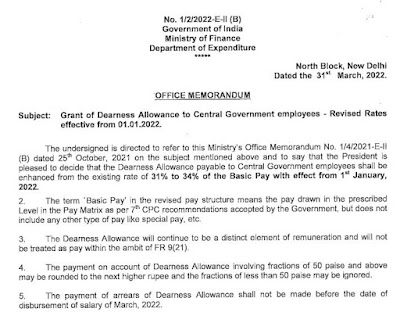
DA Jan 2022 - Grant of Dearness Allowance to Central Government employees - Revised Rates effective from 01.01.2022

 3% DA Hike - Revised Rates effective from 01.01.2022: DoE OM dated 31.03.2022 No. 1/2/2022-E-II (B) Government of India Ministry of Finance...