Showing posts with label Grade pay of SO. Show all posts

Friday, 21 December 2018

7th CPC Pay Fixation on Grant of GP of Rs. 5400 (Level-9) to SPS on completion of 4 years in GP 4800: Clarification by DoE via CGDA


7th CPC Pay Fixation on Grant of GP of Rs. 5400 (Level-9) to SPS on completion of 4 years in GP 4800: Clarification by DoE via CGDA

GOVERNMENT OF INDIA
MINISTRY OF DEFENCE
OFFICE OF THE PRINCIPAL CONTROLLER OF ACCOUNTS (FYS)
PA Y TECH SECTION
10-A, S.K. BOSE ROAD, KOLKATA: 700001
Part. I Office Order No. AT/10
Date: 18/12/2018
To
All CsFA
Subject: Grant of Grade Pay of Rs 5400/-(7th CPC level-9) to Sr. Private Secretary on completion of 4 years of regular service in the Grade Pay of Rs-4800/

A copy of CGDA No-AN/XIV/14164/7th CPC/VoI-I, dated 15/11/2018 received through email on the above subject is forwarded herewith for compliance, please.

Encl: As above.
Sd/-
Asst Controller of Accounts (Fys)

CGDA, Ulan Batar Road, Palam, Delhi Cantt - 110010
No. AN/XIV/14164/7th CPC/Vol-I
Dated: 15/11/2018
To
All PCsDA/CsDA/PCA(Fys)

Subject: Grant of Grade Pay of Rs.5400/- (7th CPC level 9) to Sr. Private Secretary on completion of 4 years of regular service in the Grade Pay of Rs. 4800/-

The matter regarding pay fixation on Grant of Grade Pay of Rs. 5400/- (7th CPC level 9) to Sr. Private Secretary upon completion of 4 years of regular service in the grade pay of Rs. 4800/- was taken up with MoF/DoP&T.

2. In view of the guidelines received from the Ministry, it is clarified that upon completion of four years regular service in Grade pay of 4800 (i.e. Level 8), SPS will be placed in Level 9 corresponding to Grade Pay of Rs.5400 at equal or next available cell. Further, in case the official has been granted Grade Pay of Rs. 5400 between January to June he/she will be granted annual increment of July in that year in the Grade Pay of 4800 and will accordingly be placed under Level 9 at equal or next available cell.

3. An illustration to the above effect is given below for better implementation.

Mr. X promoted to SPS grade in April 2012 is drawing Rs. 53600/- in Level 8 as on 01.01.2016. Upon completion of four years in the Grade Pay of Rs. 4800/-, he becomes eligible for placement in the higher Level 9 corresponding to Grade Pay of Rs.5400/- w.e.f. 04/2016. Since the same cell is not available in level 9, his pay will be fixed at Rs.54700/- i.e. the next available cell under Level 9 and he will continue to draw pay at the same rate upto 30.06.2016. Subsequently, upon pay will be fixed at Rs.55200/- (L-8). However, as he needs to be placed in Level 9 i.e. higher pay level his pay will be fixed at 56300/- with DNI as 01/07/2017.

Necessary action may be taken accordingly.

This has the approval of Sr.Jt. CGDA(AN)
Sd/-
(Vijay Raina)
For CGDA
Source: pcafys.nic.in

Thursday, 21 January 2016

Points to be taken into consideration while finalizing the 7th Pay Commission Report: Demands by MSA, SoI

Points to be taken into consideration while finalizing the 7th Pay Commission Report: Demands by MSA, SoI
SURVEY OF INDIA
MINISTERIAL STAFF ASSOCIATION (CHQs’)
Dehradun
Points to be taken into consideration while finalizing the 7th Pay Commission Report :-
The demand of the Staff Side to fix the minimum pay to that of Rs. 26,000/- has been completely rejected by the 7th CPC and has arbitrarily fixed the minimum pay as Rs. 18000/, The 7th CPC has mutilated the formula for fixing the minimum wage. The minimum wage recommended amounts to a meager increase of Rs. 2250 from the existing minimum pay of Rs. 7000 + 8750 (125 % DA as on 1.1.2016). From this minimum pay of Rs, 18000/-, as per the recommendation of the 7th CPC itself Rs. 1500/- will be recovered for CGEIGS and 10 % i. e Rs.1800/- will be recovered towards New Pension Scheme from the employees recruited after 1.1.2004 and 6% towards GPF contribution from the employees recruited prior to 1.1.2004 resulting in minus or a very meager  benefit for the low paid employees.
While the minimum wage is fixed as Rs. 18000/- the Secretary level officers are given a huge hike of Rs. 2,25,000 and the Cabinet Secretary’s salary is fixed as Rs. 2,50,000. The ratio between minimum pay and the maximum pay should be not more than 1: 8, the 7th CPC has kept the ratio as 1: 13.88.   The public at large is misled by the statement that a hike of Rs 23.5% is granted to Central Government employees where as the actual increase is only  3 to 4 % as per the calculation given below

Calculation of Pay and allowance for the month  of January 2016 as per  Sixth CPC is given below:-

Basic Pay Pay = PB Rs.5200 + GP Rs.1800 = Rs.7000/-
Assuming DA 125% as on 1.1.2016 = Rs. 8750/-
(Since he is staying in Quarter) HRA = Nil
T.A. = 600 + DA = Rs. 1350/-
Total Gross Amount =Rs. 17100/-
Deductions:
NPS 10% of basic Pay + DA =  Rs. 1575/-
CGEGIS = Rs.    30/-
Total Deductions = Rs.  1605/-
Net Pay (6th CPC) =Rs. 15495/-

Calculation of Pay and allowance for the month  of January 2016 as per  Seventh CPC is given below:-

Basic Pay Pay = Rs.18000/-
7th Pay Commission DA as  on 1.1.2016 = Nil
(Since he is staying in Quarter) HRA = Nil
T.A. = 600 + DA = Rs. 1350/-
Total Gross Amount =Rs. 19350/-
Deductions:
NPS 10% of basic Pay =  Rs. 1800/-
CGEGIS (as per 7th CPC recommendation) = Rs.   1500/-
Total Deductions = Rs.  3300/-

Net Pay (7th CPC) =Rs. 16050/-
The Benefit out of 7th Pay commission is (16050 – 15495) only Rs. 555/- which is 3.2 % of the gross pay of 6th CPC.
The minimum wages should be fixed at Rs. 23,100/- as per the calculation given below
Basic Pay Pay = PB Rs.5200 + GP Rs.1800 = Rs.7000/-   (Basic Pay)
100% D.A. which should be merged as per Vth CPC = Rs. 7000/-  (Dearness Pay)
25% DA on the above (total DA 125% - 100%) =Rs.  3500/-  (D.A.)
40% benefit (as given in VIth CPC) on Pay +DP =Rs. 5600/- (Fixation benefit)(*)
(*)(VIth CPC has given fixation benefit of  40% of the maximum of pre-revised scale)
Total Gross Amount =Rs. 23100/-
Hence the minimum benefit should be not less than 23,100/-

House Rent Allowance

The House Rent Allowance has been reduced from the existing 30% to 24%, 20% to 16% and 10% to 8%. More over the 7th CPC has recommended for abolition of various allowances like small family allowance, Cash Handling Allowance and advances like festival advance, Scooter Advance etc. Instead of removing the existing anomalies in the MACP Scheme, the 7th CPC has introduced examination for granting MACP. The 7th CPC has refused to make any recommendations against the New Pension Scheme. For the 2114 spell of 365 days child care leave for women employees the leave wages will be reduced to 80%.
We demand the Allowances like Family Planning Allowance, Cash Handling Allowance, Care Taker Allowance should not be abolished.   The Advances like Scooter Advance, Festival Advance, Flood Advance should not be abolished as these are  the meager amount the low paid employees are getting to celebrate festival and other genuine purposes.  CCL should be granted for 2 years without reducing it to 80% in the 2nd year.
Benefit on promotion before the 7th pay commission is more than the amount of promotion to be given after  implementation of the 7th Central Pay Commission :-
Suppose an UDC get promotion to Assistant before 1.1.2016.
His present Pay :11100 + 2400 Grade Pay
D.A. @ 125 %:16875
On promotion his pay will be : 11510 + 4200
New Pay as per  7th CPC=15710 X 2.57= 40374   Pay metrix : 41100/-
He will get the pay or Rs. 41,100/- in the revised scale  if he  get his promotion before 1.1.2016.
If the same person is getting promotion after 7th C.P.C.
Pay as on 1.1.2016  is    (11100+2400) X 2.57   =  34695   Pay metrix :  35,300/-
On promotion one increment in the same Level should be given   Rs. 36400/- .  As there is no pay near to that  his pay will be upgraded to 36,500/- minimum of the Pay matrix No. 6
His pay will be only Rs. 36,500/- if he get a promotion after 7th Pay Commission.
Hence the loss is    (41100-36500)   =   4600/-
It is one of the example in many cases the loss will be more than this.
Hence it is suggested that the rate of increment should be minimum 5% and on promotion 2 increment should be given otherwise there will be lot of difference in the pay of  employees who got promotion one day before the implementation of 7th Pay commission and those who got promotion after implementation of the 7th pay commission.

Rate of Increment shown in the Pay Matrix  is less than  3%

Please see the Pay Matrix given on page No. 89.
          Level 2,   Index 2,   the pay is shown as 20500,  after giving an increment of 3%  it should be 21,115/-  but the next index is only Rs. 21,100/- (level 2 index 3)    next pay also should be 21115 + 633 =21748 but the next index (level 2 index 4) is only 21700/-   in Level 6 index 14 also it should be 50500 + 1515 = 52015/- whereas it is given only 52000/-.  In many places even though the increment is shown as 3%,  it is rounded off to lesser amount causing  the employees at financial  loss.  In VIth pay, while calculating increment,  commission if the last digit  is 1 or above it used to  round  off to next 10.  So here also if the amount is 10 or above it should be rounded off to the next 100.  Kindly look into the matter.

Cadre Restructuring

As per 7th CPC para No. 1.26 (page No. 6), there is a  mention about Cadre Review.
" A serious grievance has been made by all services that Cadre Reviews have not taken place for years together, which has resulted in great anguish and frustration among the services.  Though it is essentially an administrative matter, it has a serious impact on the status and emoluments of employees.  On account of delay in Cadre Reviews, many Central Services lag behind and that gives rise to frustration and ultimately effects governance.  We have tried to cover this issue in the appropriate chapter in this report.  Therefore, the government should take a call and give them a proper representation in the government.
         6.2.10   (pare No. 106)   The services have contended that there is an urgent requirement for the Defence Forces to undertake periodic cadre reviews to remain current in their manpower structuring, and to enable the forces to adapt to the changing operational scenario at all times, without affecting the pyramidal structure in the services.  The commission recognizes the importance of Cadre Reviews in aligning a service to the ever changing organizational needs and to maintain congruence between functional needs and legitimate aspirations of its officers.
7.3.12 (page No. 170) The various service Associations highlighted that in very many cadres refiews have not been carried out for long.  Extant instructions are that a cadre review should be undertaken at least once in a period of five years.  The fact that these instructions have not been followed in many cases has bred resentment and frustration.
7.3.13.  The process of cadre restructuring and the reported delays affecting the genuine career aspirations of employees at all levels, was discussed with the Department of Personnel and Training (DoPT).  The department acknowledged that while the ideal periodicity is five years, in various cases, reviews are delayed due to many reasons.  Significant amongst these is non submission of proposals by the cadre controlling authorities.  As far as DOPTs concerned, the procedure as well as the templates (for proposal submission) is stated to have been well formulated and disseminated.  It was also informed that meetings of the Cadre Review Committee (CRC) are held regularly.
The maiden cadre review proposal in respect of Ministerial Staff, started in the year 2003 reached nowhere.  Whereas  cadre review of Group A Officers has been processed and implemented during the corresponding period. Thus cadre review procedure for group B & C staff should be implemented at the before the implementation of VIIth Pay Commission, so that our staff will be benefited.  It is therefore, urged upon the respective authority that Cadre Restructuring of Ministerial Staff in particular and Group ‘B’ & ‘C’ Staff in General should be considered before implementation of 7th CPC. Otherwise the same grievances and difficulties regarding continuation of operational scenario of Ministerial job will be existed after this CPC implementation.
The following points may kindly be taken into consideration while finalizing the VIIth Pay Commission proposal:
Sl. No.
Name of the Post
Remarks
01Estt. & Accounts
Officer
The Pay Scale of E & AO as per
4th CPC5th CPC6th CPCNow recommended
2375-75-
3200-100-3500
7450-225-
11500
9300-34800
GP 4600
9300-34800
GP 4800
The Pay Scale of Group 'B' Gazetted Post (Technical)
4th CPC5th CPC6th CPCNow recommended
2000-60-
2300-75-
3200
6500-200-
10500
9300-34800
GP 4200
Later on GP
Increased to
4600/-
9300-34800
GP 4800
There is a huge difference in the pay scales of E& AO as a specialized Gr ‘B’ Officer and other Group B Officers of Survey of India in 4th and 5th CPC.
The Duties of E & AO is much more than that of Group "B" Gazetted Officers (Technical) of Survey of India.
The duties of E & AO are:-
To function as DDO. To supervise both Establish & Accounts Section of the GDC. To Assist the Director in functioning as Administrative Head and Controlling Officer of the GDC/Directorate, etc. The Grade Pay of Section is Rs. 4800/- as per 6th Pay Commission. There are many Section Officers (Office Suptds.) are working under E & AO.
Hence the grade pay recommended by 6th CPC for E & AO is not correct. The Grade Pay of E & AO should be 5400/- considering the duties and responsibilities allotted to him/her.
As per VIIth Pay Commission report Para No. 7.1.4 (Page No. 140), the Grade Pay of Section Officer is a promotion post for Assistant (GP 4600). Initially on promotion, the SO is at GP 4800 and after four years is entitled to a non-functional upgrade to GP 5400 (PB-3), effectively two level higher.
As per VIIth pay commission report Para No. 11.27.19 (ii) page No. 684, the Superintendent of Income Tax are getting the Grade pay of Rs. 4600/-. There are many Office Superintendents working under an E & A.O. Hence it is suggested to consider to upgrade the Grade of Rs. 5400/- to E& AO.
02.Office SuperintendentThe duties of Office Superintendent in Survey of India is one and the same of Section Officers in other Departments. It includes supervising and checking the works of the Ministerial Section and to allot the work to the ministerial staff. Supervision of preparation of reports/returns, seniority lists/gradation list, budget estimates, audit reports, pension cases, work of cashier, internal auditing. Compilation/consolidation/monitoring and disbursement of Budget, Reconciliation, correspondence on audit paras, Data Entry and Respective Correspondence, work related to recruitment. To check the reply of legal cases/RTI caes and to ensure their timely submission. Training and guiding the junior ministerial staff, etc.
The Section Officers of other Departments are getting the Grade pay of Rs. 4800/-. Please refer the letter of 7th CPC regarding recruitment of staff, wherein the pay of Section Officers/equivalent is mentioned as Rs. 4800/-.
The name of Office Superintendent should be changed as Senior Section Officer in the proposed Restructuring proposal and the G.P should be determined accordingly.
03.AssistantsAs per the recommendation of 6th CPC the pay scale of Assistants was upgraded in the pre-revised scale of Rs. 6500-10500 as par with the Central Secretariat Assistants (Grade pay 4200 in the revised scale). In the meantime the grade pay of Central Secretariat Assistants has been raised from Rs. 4200/- to Rs. 4600/- but the same was not done in the case of Assistants of Survey of India. The Assistants were designated as Head Clerk before the creation of the GDCs and they were working as Section Officers in Units/field Parties.
Please refer the letter of 7th CPC regarding recruitment of staff, wherein the pay of Assistants are mentioned as Rs. 4600/- (copy enclosed).
As per VIIth Pay Commission Report page No. 145, the commission has strongly recommended parity in pay between the field staff and headquarter staff upto the rank of Assistants.
" The Commission accordingly strongly recommends parity in pay between the field staff and headquarter staff upto the rank of Assistants on two grounds—firstly the field staff are recruited through the same examination and they follow the same rigour as the Assistants of CSS and secondly there is no difference in the nature of functions discharged by both. Therefore to bring in parity as envisaged by the VI CPC, this Commission recommends bringing the level of Assistants of CSS as per with those in the field offices who are presently drawing GP of 4200. The pay of those Assistants/Stenographer who have in the past, been given higher Grade pay would be protected".
The Assistants of Central Secretariat already got the benefit of fixing their pay with Grade pay of 4600/- and they enjoyed this benefit from 1.1.2006 to 31.12.2015 and their pay will be fixed based on this pay. In order to maintain the parity the same benefit should be extended to the Assistants of Survey of India also.
The name of Assistants should be changes as Junior Section Officer in the proposed Restructuring proposal.
04.U.D.C.The qualification for the post of UDC is fixed as Graduation. Many posts whose educational qualification are graduation are granted with a Grade pay of 4200/- or 2800/-.
The name of UDC should be changed as Administrative Assistant Grade I in the proposed Restructuring proposal.
05.L.D.C.The minimum qualification for the post of LDC has been changed from X to XII but the pay scale of LDC has not changed. The Grade pay for all other posts whose minimum qualification is XII is starting from 2400. For example Hindi Typist, Data Entry Operator, etc. An LDC has to do typing/data entry operation in addition to Preparation of bills, diary and despatch, file management, assistance related to reports/returns/estimates etc. Hence the grade pay of LDC should be Rs. 2400/-.
The name of UDC should be changed as Administrative Assistant Grade II in the proposed Restructuring proposal.

LDC/UDC Issues :-

7th Pay Commission has turned down the genuine issue of LDC & UDC on the ground that the government has stopped direct recruitment for the clerical cadre and gradually phasing out the existing incumbents( Please see Para 11.22.100, Para 11.52.32, Para 11.52.32,. Para 7.7.37 & 11.35.28).  Issuing of such an order without the knowledge of Staff side may not be possible. Thus reason given for rejection of the demand is not convincing.
Besides Confederation/Staff Side JCM, several Departments had recommended upgradation of grade pay of LDC & UDC of Administrative Offices especially the LDC& UDCs of subordinate offices of Government of India.
But the fact is that Staff Selection Commission is frequently conducting recruitment for the post of LDC. Combined higher secondary examination for the selection of LDC also has been conducted recently. Moreover, no alternative recommendation to replace the LDC post is given in the report.  It is to be noted that the normal ratio of LDC and UDC in subordinate offices is 3:1 and thus LDCs have been allocated responsible sections and in many smaller offices LDC alone is handling the work of entire Administration.  The direction set in the recommendation of the Commission is to contractorise all the Administrative posts below the post of Assistants. This should be prevented at any cost and a respectable pay scale for LDC & UDC should be ensured. Without the active support of the Confederation/JCM this cannot be done.

LDC & DATA ENTRY OPERATOR

On the other hand rejecting Central Secretariat Clerical service demand of parity with DEO (Grade Pay 2400), the commission observes “Even though the entry requirements are similar, historically the pay scales of the two posts have been different. Besides, they comprise two distinct cadres with different set of roles and responsibilities. Hence, the demand for parity of pay of LDC with DEOs cannot be acceded to by the Commission.”(Para 11.35.38).
Historically these cadres may be different set of roles but the fact is that functions of LDC are more complex than that of DEO and same was brought before the commission by various Associations/Administrative Authorities. Earlier pay Commissions have fixed Pay Scale to DEO considering their work on computer. But today LDCs are selected on the basis of their expertise in computer operation also.
As you know, in subordinate offices DoPT manual is not followed for allocating work to LDCs there.  In order to bring the reality, some comments among the hundreds of comments posted in our web site/received through e-mail is given in annexure I, II & III. Please go through it.

  Parity of pay of Assistant/Stenographers with Central Secretariat.

Sixth Pay Commission has recommended parity for Assistant of subordinate offices with the Assistants of Central Secretariat and recommended Rs. 4200 grade pay for the genuine reason given in its report. But while implementing the report, grade pay of Assistant of Central Secretariat has been increased to Rs. 4600. All the Associations/Federations including this Association had demanded parity of pay of these cadres with Central Secretariat. JCM Staff Side through its memorandum had demanded parity with the Assistant/Stenographers of Central Secretariat. But in place of increasing the grade pay of Assistants/Stenographers of Subordinate offices, the Pay Commission has reduced the grade pay of Central Secretariat Assistant/Stenographers (Para 7.1.4(J). While implementing 7th Pay Commission Report, Government may not accept the degradation of the grade pay of the cadres of Central Secretariat. Thus necessary action to keep the Grade Pay (4600) of Assistant/stenographers of Subordinate offices including NSSO Offices at par with their counterpart at Central Secretariat is required.
The Assistants of Central Secretariat have  already got the benefit of fixing their pay with Grade pay of 4600/- and they enjoyed this benefit from 1.1.2006 to 31.12.2015 and their pay will be protected as per the recommendations of the 7th Pay Commission Report.  In order to obtain the parity between the Assistants of Central Secretariat and Field offices,  the  benefit of fixing their pay with a Grade pay of Rs. 4600/- from 1.1.2006 to 31.12.2015 should  be extended to the Assistants of Survey of India also.
Similarly, the Non Functional Selection Grade granted to the UDCs of Central Secretariat has also been withdrawn by the 7th CPC in its report (Para 7.1.4(J). Our demand is that the NFSG may be restored and the benefit of the same should be extended to the UDCs of subordinate offices also.

 Grant of MACP on Promotional Hierarchy:

The report of the Commission is confusing and contradictory. Please see Para 5.1.12, 5.1.44, 7.4.8, 74.13, 11.52.45 etc. The Pay Commission has drafted MACP recommendation to fool the employees and giving benefit to Government.  MACP should be granted on hierarchical scale, if both Levels are same it should be given in the immediately next level.

Transport Allowance

In A1 cities the employees crossed the limit of Pay Rs. 7440/ in pay band 5200-200200 was getting transport allowance Rs. 1600+DA. But 7th CPC has recommended only Rs. 1350 for these employees. The disparity is to be removed.

Abolition of interest free advance:

Pay Commission has recommended abolition of 12 advances including, Festival Advance, LTC Advances, Tour/Tr TA Advance Medical Advance etc. This will affect the touring staff and low paid employees. If this recommendation is accepted, no low paid employee can avail LTC.

Abolition/Reduction of Care Taking Allowance

As per recommendation contained in Para 8.3.23 of the 7th CPC report, the present care taking allowance has been abolished and in place Extra Work Allowance at  a  uniform rate of 2  percent  of Basic Pay per month. This will affect detrimentally to the caretaking work in various NSSO Offices especially in FOD Offices where permanent care takers are not appointed and the person assigned the duties of caretaking are doing heavy responsibilities.
On other hand, pay fixation on promotion from UDC to Assistant immediate next pay scale is found more beneficial than the hierarchical promotion. Fixation of a UDC drawing Rs. 10960+2400 promoted to Assistant is given below:
Fixation on Pay scale hierarchy i.e., Rs, 2800 GP
1/1/2016 10960+2400=13360 X 2.57 3433534300
Increment on 1.7.201635300
Increment on Promotion1059
Pay fixed at higher stage in 2800 Grade Pay37000

Fixation on Promotional hierarchy i.e. Rs 4200 GP
1/1/2016 10960+2400=13360 X 2.57 3433534300
Increment on 1.7.201635300
Increment on Promotion1059
Pay fixed at higher stage in 4200 Grade Pay36500

Similar deficiencies may be noticed in other cases also. For similar cases multiplication factor should be increased.  Two  increments should be granted  on promotion.
This may also be looked into.

Kindly consider the above facts while implementing the report of 7th Central Pay Commission.
We oppose Performance based Incentive System because it is not appropriate.   Marks acquired in APAR should not be linked with grant of Increment, promotion  & MACP.
D.A. should be merged with basic pay whenever it crosses  50%.
We oppose plan for Medical Insurance to Central Govt. employees.   CGHS facilities may be improved.
SECRETARY GENERAL,
MINISTERIAL STAFF ASSOCIATION
SURVEY OF INDIA

Thursday, 3 December 2015

7th Pay Commission Report: Headquarters Organisations in Government of India and Office Staff in Field Offices (CSS Cadre – UDC, SO, NFU, Stenographer CSSS Cadre)

7th Pay Commission Report: Headquarters Organisations in Government of India and Office Staff in Field Offices (CSS Cadre – UDC, SO, NFU, Stenographer CSSS Cadre)

Headquarters Services
Introduction
7.1.1 The headquarters organisation comprises the Secretariats of the ministries and departments of the Government of India. Most of the middle level posts are held by the officers of Central Secretariat Service as also a few administrative posts at the senior level. In the Ministry of Railways, similar positions are held by the Railway Board Secretariat Service, in the Ministry of Defence they are held by the Armed Forces Headquarter Service and in the Ministry of External Affairs the same are held by the Indian Foreign Service (B) officers.
7.1.2 The organisational hierarchy of all the headquarter services by and large includes the following levels with corresponding GP:
Level Grade Pay
Selection Grade 10000
Director 8700
Dy. Secretary 7600
Under Secretary 6600
Section Officer 4800
[after four years GP 5400 (PB-3)]
Assistant 4600
7.1.3 The headquarter services provide a permanent bureaucratic set up which assists in establishment and administration, policy formulation and monitoring and review of the implementation of policies/schemes of various ministries and departments.
Demands
7.1.4 The pay related demands of various headquarter services are as follows:-
a) At least five financial upgradations/promotions in the promotional hierarchy, at regular intervals have been demanded: time bound promotions at 5, 9, 13 years of service to CSS officers after they reach Group ‘A,’ on the same pattern as that given to Officers of the Group `A’ services and in case promotional posts are not available, non-functioning pay upgradation to the next promotional grade. These demands have been made on the grounds that it will attract a talented pool in the CSS at the entry level as well as create motivation for the serving officers.
Analysis and Recommendations

The Commission notes that the MACP scheme by its very nomenclature is intended to provide assured career progression so that government employees do not stagnate. The Commission is recommending continuance of the existing MACP Scheme. As regards the grant of time bound promotions at 5, 9, 13, 17 years to CSS officers on the analogy of Group `A’ Services, this cannot be accepted as the entry level induction of CSS is in Group `B’ and therefore it cannot be compared with Group `A’ Services.
b) Demand has been made for entry Grade Pay of Rs.5400 (PB-3) for Section Officers on the ground that there must be one pay for one post in a cadre and that the minimum residency period of eight years in the grade is very long. Similar demands have been received from the Stenographers cadres too.
Analysis and Recommendations

The post of Section officer (SO) is a promotion post for Assistant (GP 4600). Initially, on promotion, the SO is at GP 4800 and after four years is entitled to a non-functional upgrade to GP 5400 (PB-3), effectively two levels higher. Hence the stipulated residency period of eight years at the level of SO is distributed in two parts, four years in GP 4800 and the balance four in GP 5400 (PB-3). The current position is that the average time spent at the higher level is around 5-6 years.
The Commission observes that the current progression from GP 4600 to GP 4800 on promotion as Section Officer is an appropriate upgrade and does not find any justification for placing the entry level to SO at a higher level. In so far as the non-functional upgrade is concerned, in the newly restructured pay matrix the earlier situation of a common grade pay i.e., 5400 prevailing in PB2 and PB3 has now been rationalised. Accordingly, the non-functional upgrade will henceforth be from level 8 to level 9.In the case of all such cadres/services where nonfunctional upgradation is presently available across two levels, for example, from GP 4800 to GP 5400 (PB-3) the same will now be available across only one level for example, from GP 4800 to GP 5400 (PB-2) or in the new matrix from level 8 to level 9.
c) Various headquarter/stenographer services have demanded placement of GP 7600 in PB-4 for the post of Deputy Secretary or alternatively, grant of GP 8000 in PB-4 as in the case of Lt Colonel in the Indian Army. This demand is based on the ground that in the existing dispensation, there is a considerable gap in pay in between PB-3 and PB-4. Since the Deputy Secretary resides in PB-3 and the Director in PB-4, and the hierarchy does not require Deputy Secretary to report to the Director, this demand has been made.
Analysis and Recommendations
In the newly proposed rationalised pay matrix recommended by this Commission the skewed spacing between pay bands has been moderated and pay levels have been equitably placed. Therefore, there is no need for any other measure in this regard.
d) Demand has been received from various headquarter services for allowing the post of Director be made NFSG as against promotional post. The CSS has argued that the cadre review Committee in the CSS recommended that the residency period for promotion to Director Grade be set at ten years combined approved service as Under Secretary and Deputy Secretary with minimum three years’ regular service as Deputy Secretary. The existing residency period for promotion from Under Secretary to Deputy Secretary is five years and from Deputy Secretary to Director is also five years.
Analysis and Recommendations
The Commission notes that the post of Director in the headquarter services is a promotional one with a higher grade pay. The headquarter services are not comparable with All India Group `A’ service and hence the demand for NFSG for the post of Director is not supported. The Commission recommends no change in the present dispensation.
e) It has been demanded that persons appointed to a particular post either on direct recruitment or on promotion should have their pay fixed at the same level. This has been sought on the ground that no junior should draw more pay than his senior in a cadre. As against this, presently newly recruited Assistants of CSS are getting higher pay than Assistants promoted after implementation of the VI CPC.
Analysis and Recommendations
In so far as one fixation of pay for one post is concerned, it may be mentioned that the VI CPC recommended exclusive pay bands for direct entry into posts with different grade pays attached to them and hence there was a difference of total pay in respect of a direct recruit in comparison to a person promoted to that grade.
In the new pay matrix proposed by this Commission, it has been recommended that the first cell in each level in the matrix would be the entry pay for fresh/ direct recruits. The pay of a person who moves from a lower grade to higher grade is to be fixed with respect to the pay being drawn by him/her at the time of promotion. The details of fixation of pay on promotion has been dealt with in detail in the Chapter 5.1. The proposed system is expected to eliminate the existing anomaly.
f) The AFHQS (LDCE) officers have demanded re-introduction of the scheme of Limited Departmental Competitive Examination in the Section Officer grade. It has been stated that as per the AFHQ Civil Service Rule 2001, the posts of Section Officers used to be filled 20 percent by direct recruitment, 40 percent by seniority and 40 percent through LDCE. The LDCE was introduced in AFHQ Civil Service Rule 2001 on the recommendation of the V CPC, following a similar LDCE pattern in CSS since 1962. Subsequently, a committee of senior officers on cadre review/restructuring recommended abolition of LDCE at the level of Section Officer and stoppage of direct recruitment in the Assistant Grade. This was in view of the fact that the existing 40 percent quota of LDCE which was meant to provide accelerated promotion to direct recruits Assistants was to be abolished and hence there would be no direct recruitment at Assistant level. The above recommendations of the Committee were implemented. Recruitment of Section Officer thereafter has been 50 percent by direct recruitment and 50 percent by promotion, with complete scrapping of the element of LDCE. However, 50 percent direct recruitment quota in the Assistant Grade was retained. It has been demanded that the element of direct recruitment in the Section Officer grade be removed and consequently 50 percent vacancies in the grade be filled up by promotion on seniority and remaining 50 percent through LDCE among the Assistants/Personal Assistants serving in AFHQ.
Analysis and Recommendations
Given the overall parity of posts between the CSS and AFHQS at the level of Assistant and SO, the demand for restoration of the LDCE scheme on the same pattern as available in the CSS seems justified. However, the Commission feels that the issue raised is essentially administrative in nature and hence no specific recommendations can be made in this regard.
g) Demand has been raised regarding extension of Non Functional Upgradation (NFU) to AFHQS officers. It has been stated that although DoPT has clarified that the benefit of NFU will be available to Group `B’ officers inducted into Organised Group `A’ Service, the same has not been extended to AFHQS officers.
Analysis and Recommendations
The Commission feels since the orders on NFU have already been spelt out, no further recommendations on the issue are required.
h) AFHQS has demanded that their officers should be allowed to serve in Ministry of Defence either by earmarking certain percentage of posts up to the grade of Deputy Secretary/Director or by cross posting of CSS officers to posts belonging to Integrated Headquarters of MoD which are currently occupied by AFHQS officers.
Analysis and Recommendations
The issue has been discussed for several years at various fora and as part of the V CPC recommendations. The V CPC did not recommend participation of AFHQS officers in the Central Staffing Scheme however earmarked few posts at the level of Under Secretary and Section Officer in Ministry of Defence for members of this service. Even after several iterations, the recommendations could not be implemented.
Owing to the fact that various headquarter services are performing similar functions in various secretariats, the Commission is of the view that such a vast resource pool of officers should be allowed to move laterally and occupy posts in other secretariats on deputation basis. This will not only enrich the service officers but also bring about harmonisation among services. Later if found feasible these services may also be merged.
i) There has been demand from all headquarter services to extend all recommendations made in respect of CSS to them as well.
Analysis and Recommendations
The Commission recommends parity between comparable posts in the CSS and other headquarter services in the matter of pay structure. The replacement pay available at all levels to CSS officers will be applicable mutatis mutandis to their counterparts in the AFHQS, RBSS, IFS (B) as well those organisations who maintain pay parity with CSS.
j) Issue of parity of field functionaries with the Assistants of the CSS: It has been demanded that CSS be allowed to retain an ‘edge’ over other services or posts which have claimed parity with CSS. It has been argued by the CSS that parity among various posts and services is to be considered on long established principles of classification of posts, duties and responsibilities, their hierarchical structure, historical parity, mode of recruitment as well as minimum qualification for recruitment at entry level as well as level. Historically, various services in the Secretariat have had an edge over analogous posts in the field offices. The CSS has, in its memorandum, demanded that this edge over other services be retained. This has been justified on various grounds, key amongst which is that office staff in the Secretariat perform complex duties and are involved in analysing issues with policy implications whereas their counter parts in field offices perform routine work relating to matters concerning personnel and general administration, and so on. Apart from retention of the edge, the CSS memorandum also seeks a change in the mode of recruitment. It has been argued that up until 1987, directly recruited Assistants of the CSS were selected through an examination conducted by the UPSCand other categories of employees falling under Group `C’were recruited through the Staff Selection Commission [SSC]. In 1987, recruitment of Assistants to the CSS was also brought under the SSC and is now carried out through a common examination called the Combined Graduate Level Exam (CGLE) and an All India Merit List.
Analysis and Recommendations
The VI CPC had gone into this issue in considerable detail. It had noted that while at an earlier point in time it may well have been the case that those in the Secretariat ended up performing more complex duties relating to policy formulation, but over a period of time things had changed. It had noted that there was an increasing emphasis on strengthening the delivery lines and with growing decentralization, the importance of delivery points in the field cannot be understated. Therefore, in its view, the time had come to grant parity between similarly placed personnel employed in field offices and in the Secretariatand that this parity would need to be absolute till the grade of Assistant. The VI CPC had noted that beyond this, it would not be possible or even justified to grant complete parity because the hierarchy and career progression would need to be different. Although the recommendation of the VI CPC was accepted in the first instance, a year down the line the Grade Pay of Assistants was increased from Rs.4200 to Rs.4600, thereby squarely going back to the original position in which the Assistants in the Headquarters resided at one level higher than those in the field. In fact this latest modification follows a consistent pattern seen over the decades. This is elucidated in the table below:
Table 1: Upgradation of Pay of Assistant over Successive Pay Commissions
Post: Assistant
Pay Scale as Initially Recommended
Pay Scale as Revised by Government
Date Scale
Dates (when issued and when effective)
Scale
IV CPC 1.1.1986 1400-2660 31.7.90, but effective from 1.1.86 1640-2900
V CPC 1.1.1996 5500-9000 25.9.2006, effective from 15.9.2006 6500-10500
VI CPC 1.1.2006 GP 4200 August 2008, but effective from 1.1.2006 GP 4600

It may be seen from the above table that the recommendations of successive Pay Commissions with regard to pay of Assistants, even if initially implemented, has invariably been modified at a later point and they have been placed at one higher level. As a corollary to this, the level of Section Officers also is at one level higher than that of SOs in the field.
While notifying the most recent upgrade in August 2008, the order states that the Assistants in Headquarters are required to be at a higher level since “there is an element of direct recruitment in their case and that too, through an all-India Competitive Examination.
The Commission notes that certain inherent contradictions prevail. The first relates to the Common Grade Level Examination (CGLE) through which selections are carried out by the SSC for a range of positions, at varying levels of grade pay. No doubt the examination process is a graded one, with applicants for certain positions having to undergo two written examinations as well as an interview and for certain other positions only two written examinations. But in the case of Assistants for CSS and Assistants for certain other organisations, the examination process is common although the grade pay for the two sets are different. This then brings about a situation where those with lower grade pay continuously demand parity with the others while those with higher grade pay seek to set themselves apart. The categorical observations of the VI CPC that the time had come to grant parity between similarly placed personnel employed in the field offices and in the Secretariat are echoed by this Commission, which sees merit in placing all Assistants recruited through the CGLE, whether working in the field offices or in headquarters, at the same level.
The Commission accordingly strongly recommends parity in pay between the field staff and headquarter staff up to the rank of Assistants on two grounds- firstly the field staff are recruited through the same examination and they follow the same rigour as the Assistants of CSS and secondly there is no difference in the nature of functions discharged by both. Therefore to bring in parity as envisaged by the VI CPC, this Commission recommends bringing the level of Assistants of CSS at par with those in the field offices who are presently drawing GP 4200. Accordingly, in the new pay matrix the Assistants of both Headquarters as well as field will come to lie in Level 6 in the pay matrix corresponding to pre revised GP 4200 and pay fixed accordingly. Similarly the corresponding posts in the Stenographers cadre will also follow similar pay parity between field and headquarter staff. The pay of those Assistants/Stenographer who have in the past, been given higher Grade pay would be protected.
Recently, through a government order similar ‘edge in pay’ has also been extended to the Upper Division Clerks belonging to CSS in the Secretariat by way of grant of non-functional selection grade to GP 4200 (available to 30 percent of UDCs). It is expected to lead to further resentment at the level of UDCs in the field as well as with other non-secretariat posts with which they had parity before. Since as per the recommendation of this Commission, Assistants have now come to lie in Level 6 of the pay matrix which corresponds to pre revised GP 4200, this Commission recommends withdrawal of non-functional selection grade to GP 4200 in respect of Upper Division Clerks belonging to CSS.
Stenographers Services
The Central Secretariat Stenographer Service (CSSS)/ Armed Forces Headquarters Stenographers Service (AFHQSS)
7.1.5 The CSSS/AFHQSS consists of the following grades:
Level Grade Pay
Principal Staff Officer 8700
Sr. PPS 7600
PPS 6600
PS 4800
Stenographer Grade-C 4600
Stenographer Grade-D 2400

7.1.6 The demands of CSSS and AFHQ Stenographers Service are:
a) Merger of headquarters services with their counterparts in the Stenographer cadre with full parity and uniform designation and introduction of Executive Assistant Scheme. In the justification for merger, the recommendation of the VI CPC vide paras 3.1.10 to 3.1.12 have been referred to, where the Commission observed inter-alia, that there is no justification for maintaining a distinct Stenographer cadre in any government office. Instead, emphasis should be on recruiting multi skilled personnel at Assistant level to be designated as Executive Assistants who will discharge the functions of present day Assistant besides performing all the Stenographic functions. The VI CPC had justified the need for a unified cadre and common recruitment on the basis of assumption that secretariat functioning would become more IT oriented in future reducing reliance on personal staff. The CSSS and AFHQSS officers’ Associations have raised demands relating to merger of present incumbents of CSS/AFHQCS and CSSS/AFHQSS with full parity and uniform designation.
The DoPT has referred to propose EA scheme to this Commission.
Analysis and Recommendations
The issue has been deliberated in DoPT several times. Reports of the discussions indicate that although the CSS Associations are strongly opposed to such merger between CSS and CSSS, they are not averse to introduction of the Executive Assistant Scheme. The DoPT itself appears to have not found it feasible in view of the nature of work, duties and responsibilities of the members of CSS and CSSS being different.
In view of the fact that several detailed deliberations have already taken place in DoPT as well as in the meeting of the COS on 1 March, 2013 wherein various aspects of the scheme have been examined threadbare in presence of all the stakeholders, the issue of merger of CSS and CSSS cadre remains an administrative reform issue to be dealt with by the administrative Ministry. The Commission is making no recommendation in this regard.
b) A demand has been received regarding provision of promotional channel to the grade of Joint Secretary in CSSS stating that such creation is essential to bring full parity (in grade) between CSS and CSSS. It has also been argued that this would ensure career progression for PSOs, who have no promotional avenues even after completing five or more years of approved service in the grade.
Analysis and Recommendations
 
As regards demand for in-situ promotion of PSO to the rank of Joint Secretary and demand for creation of the post of JS for removal of stagnation and career progression of CSSS Cadre beyond the level of PSO is concerned, it is stated that these issues are purely administrative in nature and can be dealt with through the process of cadre review. Hence, the Commission is making no recommendation in this regard.
c) A demand for creation of additional posts in the grade of Sr. PPS (GP 7600) and PPS (GP 6600) has been received on the ground that these additional creations will facilitate smooth merger of present incumbents of CSSS and CSS.
Analysis and Recommendations
The demand for creation of additional posts in the grade of Sr. PPS and PPS is linked to the demand of cadre merger, hence it is for the cadre controlling authority i.e., the DoPT to decide the issue in its entirety.
d) The AFHQSS has demanded grant of two increments at par with CSS/CSSS at the time of promotion from GP 6600 to GP 7600 for parity.
Analysis and Recommendations
The Commission finds no merit in continuation of two increments for CSS/CSSS and hence recommends abolition of the same.

Wednesday, 12 November 2014

Parity between Assistant, SO of Ordnance Factory and CSS/CSSS Pay Scale: Judgement by HC citing "Equal pay for Equal Work"

Parity between Assistant, SO of Ordnance Factory and CSS/CSSS Pay Scale: Landmark Judgement by HC citing "Equal pay for Equal Work".  Text of Hindustan Times News reproduced below:-
  New pay scale benefits for ordnance staff too: HC

UNIFORMITY Citing ‘equal pay for equal work’ principle, Delhi High Court tells Centre to grant pay parity to ordnance factory employees

Employees at Ordnance Factories (OF) – who have been contesting their omission from the benefits of the sixth pay commission for over seven years have finally more than one reason to rejoice.

Reining in the principle of ‘equal pay for equal work’ at public offices, the Delhi High Court has directed the Centre to grant pay parity to employees in the OF with that of identically ranked official in the Central Secretariat Service (CSS) and Central Secretariat Stenographer’s Service (CSSS).

The direction will be applied retrospectively from 2006 — when the sixth CPC was implemented. Not only this, the HC order will come in handy for the employees of the OF when the seventh central pay commission is implemented.

The HC order came in response to a petition filed by Ordnance Factory Employees Association challenging the decision of the finance ministry declining their request for the assistants working in the OF Board to be given same pay scale as was given to similarly placed officials in CSS, CSSS, Ar my Headquarters, UPSC and other services.

The starting point of discrimination against the employees of the OF Board came soon before the acceptance of recommendation of the sixth CPC when a pay upgradation of employees of CSS and CSSS was made in September 2006.

While the OFs and Armed Forces Head Quarters (AFHQs) — both non-secretariat organization — were excluded from the pay upgradation, the latter took the matter to the Central Administrative Tribunal (CAT) and got an order in its favour.

In the case of OF Board, the central government took the view that since it was a nonattached office working outside the Secretariat, there cannot be parity of pay scales. The OF Board was denied benefit of upgradation and the replacement scales given by the sixth CPC. The CAT, too, took a similar stand and denied any relief to the OF Board.

The matter finally reached the Delhi HC last year and after over a year of deliberation a bench of Justice S Ravindra Bhat and Justice Vipin Sanghi termed the discrimination meted out to the OF Board as “over-classification.”

The HC said the discrimination was illogical and artificial. It also took note that the cadre structure of CSS and CSSS is identical to that of the OF. In all the above organisations, the cadre of upper divisional clerks (UDCs) is filled by the feeder of the cadre of the lower divisional clerks (LDCs).

The cadre of assistants on the OF Board is filled by promotion from the feeder cadre of UDCs with at least five years of experience on regular basis.

“The OF Board was treated historically as equals to CSS/CSSS employees and enjoyed equal pay and all benefits flowing from equal pay,” the high court noted adding, “This was based on the previous four instances of determinations by successive pay commissions that they performed equal work.”

Source Image provided by http://aiamshq.blogspot.in/2014/11/blog-post.html

Source: http://lobis.nic.in/dhc/SRB/judgement/14-10-2014/SRB14102014CW46062013.pdf

Flash News

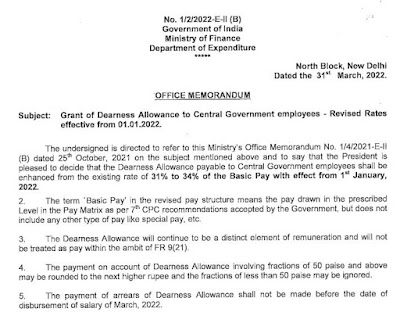
DA Jan 2022 - Grant of Dearness Allowance to Central Government employees - Revised Rates effective from 01.01.2022

 3% DA Hike - Revised Rates effective from 01.01.2022: DoE OM dated 31.03.2022 No. 1/2/2022-E-II (B) Government of India Ministry of Finance...