Showing posts with label UDC. Show all posts

Sunday, 7 January 2018

DELHI HIGH COURT JUDGEMENT ON MACP IN THE HIGH COURT OF DELHI AT NEW DELHI


Delhi HC Judgement on MACP
 
IMPORTANT - DELHI HIGH COURT JUDGEMENT ON MACP IN THE HIGH COURT OF DELHI AT NEW DELHI

Reserved on: 06.07.2017
Pronounced on: 20.12.2017
W.P.(C) 9357/2016 HARI RAM & ANR ..... Petitioners

Through : Ms. Jyoti Singh, Sr. Advocate with
Sh. Padma Kumar S., Sh. Amandeep Joshi and Sh. Himanshu Gautam, Advocates.

versus

REGISTRAR GENERAL, DELHI HIGH COURT..... Respondent
Through : Sh. Sanjoy Ghose, Sh. Rhishabh
Jetley, Ms. Pratishtha Vij and Sh. Urvi Mohan,
Advocates

CORAM:
HON'BLE MR. JUSTICE S. RAVINDRA BHAT
HON'BLE MR. JUSTICE S.P.GARG

S. RAVINDRA BHAT, J.
1. Complaining of unjustified denial of third financial upgradation under the Modified Assured Career Progression Scheme (hereafter called "MACPS", for convenience), the writ petitioners approach this Court under Article 226 of the Constitution for appropriate directions.

2. Both the petitioners joined the establishment of the High Court initially in the cadre of Upper Division Clerk [UDC] (the first petitioner on 05.09.1998 and the second petitioner on 22.10.1984) from which they were promoted to the cadre of UDC (again on 05.09.1998 and 13.05.1999 respectively) and finally to the cadre of Reader (first petitioner on 09.10.2007 and second petitioner on 18.07.2008). The action impugned is the denial of their claim for a third financial upgradation. The petitioners challenge an order of the Screening Committee of the High Court which rejected their claim for third financial upgradation. In terms of the MACPS, an employee is entitled to assured career progression at 10 years' intervals - thus, the first financial up-gradation is after 10 years of service; the second after 20 years of service and the third, on completion of 30 years of service.


3. The MACPS had its precursor in Assured Career Progression Scheme (ACP), formulated by the Central Government and brought into force with effect from 09.08.1999. The ACP guaranteed career progression after completion of 12 years of service. The precondition for the applicability of ACP and MACPS is that the concerned officer or employee should not have been promoted. As corollary, in the event of promotion, the concerned career progression benefit at the appropriate stage was to be denied. For instance, if an individual is promoted before the completion of 10 years, she or he cannot avail the ACP/MACPS benefit upon completion of 10 years and would instead have to wait for the completion of 20 years for the second upgradation, provided she/he is not promoted a second time in the career. Initially, upon the publication of the ACP, several queries were urged and doubts sought to be allowed, through an Office Memorandum containing clarifications to Frequently Asked Questions. The first of these - applicable to the ACP was published on 01.02.2000. The second was made applicable after the MACPS was brought into force, i.e. 01.09.2008 (through the OM dated 19.05.2009).

Read More

Wednesday, 10 August 2016

Centre decided to abolish 90% of the posts in the grade of UDC as and when these fall vacant, in future

Centre decided to abolish 90% of the posts in the grade of UDC as and when these fall vacant, in future”

A Question was raised by Shri Rajkumar Dhoot in Rajya Sabha regarding abolishment of Clerical Posts in Government establishments. In a Reply to this Question No.2086, the Minister of State in the Ministry of Personnel, Public Grievances and Pensions DR. JITENDRA SINGH has stated the following..

“The Government of India has not abolished all Clerical Posts in all Government establishments. SSC has made recruitment for the posts of Lower Division Clerk (LDC) and Upper Division Clerk (UDC) in respect of vacancies reported by various Ministries/Departments/Sub-ordinate offices of Government of India.

However, the First Cadre Review of Central Secretariat Service was taken up in the year 2001. The Government had accepted recommendations of the committee in the year 2003 that Direct Recruitment LDC in Central Secretariat Clerical Services (CSCS) cadre may be stopped with immediate effect and all posts of LDC in CSCS presently filled through Direct Recruitment mode be abolished as and when these fall vacant. It was also decided to abolish 90% of the posts in the grade of UDC as and when these fall vacant, in future”

Source : Rajya Sabha.nic.in

Wednesday, 23 December 2015

Designations like Lower Division Clerk (LDC) and Upper Division Clerk (UDC) in central government’s employee hierarchy have been replaced with new nomenclature


Centre says goodbye to clerk era, changes designation for its staff

New Delhi: Designations like Lower Division Clerk (LDC) and Upper Division Clerk (UDC) in central government’s employee hierarchy have been replaced with new nomenclature.

The posts of UDC and LDC under Central Secretariat Clerical Service (CSCS) have been rechristened as Senior Secretariat Assistant and Junior Secretariat Assistant, respectively, Order F.No.21/12/2010-CS.I(P) dated December 21 issued by the Department of Personnel and Training (DoPT) said.

Besides, the post of Assistant under Central Secretariat Service (CSS) has been renamed as Assistant Section Officer, it said.

Both the CSCS and CSS form the backbone of administrative work in the central government.
The total sanctioned strength of CSS and CSCS is 11,467 and 5,933 respectively.

Earlier in March, the DoPT had decided to replace the ‘class’ categorisation for specifying the seniority of its employees with new alphabetical groupings.

The posts under the central government will be denoted as groups A, B, C and D instead of classes I, II, III and IV in the service rules, it had said.

The Class-III (Group C) employees had expressed concern that they were taunted as ‘third-class’ employees due to the categorisation.

The Class-I classification is for gazetted officers while Class-II refers to mainly the non-gazetted officers, though there are some gazetted officers in this category too.

Class-III comprises clerical staff and Class-IV (which is now subsumed in Class III or Group C) includes peons and helps or multi-tasking staff in the government hierarchy.
PTI

Thursday, 3 December 2015

7th Pay Commission Report: Headquarters Organisations in Government of India and Office Staff in Field Offices (CSS Cadre – UDC, SO, NFU, Stenographer CSSS Cadre)

7th Pay Commission Report: Headquarters Organisations in Government of India and Office Staff in Field Offices (CSS Cadre – UDC, SO, NFU, Stenographer CSSS Cadre)

Headquarters Services
Introduction
7.1.1 The headquarters organisation comprises the Secretariats of the ministries and departments of the Government of India. Most of the middle level posts are held by the officers of Central Secretariat Service as also a few administrative posts at the senior level. In the Ministry of Railways, similar positions are held by the Railway Board Secretariat Service, in the Ministry of Defence they are held by the Armed Forces Headquarter Service and in the Ministry of External Affairs the same are held by the Indian Foreign Service (B) officers.
7.1.2 The organisational hierarchy of all the headquarter services by and large includes the following levels with corresponding GP:
Level Grade Pay
Selection Grade 10000
Director 8700
Dy. Secretary 7600
Under Secretary 6600
Section Officer 4800
[after four years GP 5400 (PB-3)]
Assistant 4600
7.1.3 The headquarter services provide a permanent bureaucratic set up which assists in establishment and administration, policy formulation and monitoring and review of the implementation of policies/schemes of various ministries and departments.
Demands
7.1.4 The pay related demands of various headquarter services are as follows:-
a) At least five financial upgradations/promotions in the promotional hierarchy, at regular intervals have been demanded: time bound promotions at 5, 9, 13 years of service to CSS officers after they reach Group ‘A,’ on the same pattern as that given to Officers of the Group `A’ services and in case promotional posts are not available, non-functioning pay upgradation to the next promotional grade. These demands have been made on the grounds that it will attract a talented pool in the CSS at the entry level as well as create motivation for the serving officers.
Analysis and Recommendations

The Commission notes that the MACP scheme by its very nomenclature is intended to provide assured career progression so that government employees do not stagnate. The Commission is recommending continuance of the existing MACP Scheme. As regards the grant of time bound promotions at 5, 9, 13, 17 years to CSS officers on the analogy of Group `A’ Services, this cannot be accepted as the entry level induction of CSS is in Group `B’ and therefore it cannot be compared with Group `A’ Services.
b) Demand has been made for entry Grade Pay of Rs.5400 (PB-3) for Section Officers on the ground that there must be one pay for one post in a cadre and that the minimum residency period of eight years in the grade is very long. Similar demands have been received from the Stenographers cadres too.
Analysis and Recommendations

The post of Section officer (SO) is a promotion post for Assistant (GP 4600). Initially, on promotion, the SO is at GP 4800 and after four years is entitled to a non-functional upgrade to GP 5400 (PB-3), effectively two levels higher. Hence the stipulated residency period of eight years at the level of SO is distributed in two parts, four years in GP 4800 and the balance four in GP 5400 (PB-3). The current position is that the average time spent at the higher level is around 5-6 years.
The Commission observes that the current progression from GP 4600 to GP 4800 on promotion as Section Officer is an appropriate upgrade and does not find any justification for placing the entry level to SO at a higher level. In so far as the non-functional upgrade is concerned, in the newly restructured pay matrix the earlier situation of a common grade pay i.e., 5400 prevailing in PB2 and PB3 has now been rationalised. Accordingly, the non-functional upgrade will henceforth be from level 8 to level 9.In the case of all such cadres/services where nonfunctional upgradation is presently available across two levels, for example, from GP 4800 to GP 5400 (PB-3) the same will now be available across only one level for example, from GP 4800 to GP 5400 (PB-2) or in the new matrix from level 8 to level 9.
c) Various headquarter/stenographer services have demanded placement of GP 7600 in PB-4 for the post of Deputy Secretary or alternatively, grant of GP 8000 in PB-4 as in the case of Lt Colonel in the Indian Army. This demand is based on the ground that in the existing dispensation, there is a considerable gap in pay in between PB-3 and PB-4. Since the Deputy Secretary resides in PB-3 and the Director in PB-4, and the hierarchy does not require Deputy Secretary to report to the Director, this demand has been made.
Analysis and Recommendations
In the newly proposed rationalised pay matrix recommended by this Commission the skewed spacing between pay bands has been moderated and pay levels have been equitably placed. Therefore, there is no need for any other measure in this regard.
d) Demand has been received from various headquarter services for allowing the post of Director be made NFSG as against promotional post. The CSS has argued that the cadre review Committee in the CSS recommended that the residency period for promotion to Director Grade be set at ten years combined approved service as Under Secretary and Deputy Secretary with minimum three years’ regular service as Deputy Secretary. The existing residency period for promotion from Under Secretary to Deputy Secretary is five years and from Deputy Secretary to Director is also five years.
Analysis and Recommendations
The Commission notes that the post of Director in the headquarter services is a promotional one with a higher grade pay. The headquarter services are not comparable with All India Group `A’ service and hence the demand for NFSG for the post of Director is not supported. The Commission recommends no change in the present dispensation.
e) It has been demanded that persons appointed to a particular post either on direct recruitment or on promotion should have their pay fixed at the same level. This has been sought on the ground that no junior should draw more pay than his senior in a cadre. As against this, presently newly recruited Assistants of CSS are getting higher pay than Assistants promoted after implementation of the VI CPC.
Analysis and Recommendations
In so far as one fixation of pay for one post is concerned, it may be mentioned that the VI CPC recommended exclusive pay bands for direct entry into posts with different grade pays attached to them and hence there was a difference of total pay in respect of a direct recruit in comparison to a person promoted to that grade.
In the new pay matrix proposed by this Commission, it has been recommended that the first cell in each level in the matrix would be the entry pay for fresh/ direct recruits. The pay of a person who moves from a lower grade to higher grade is to be fixed with respect to the pay being drawn by him/her at the time of promotion. The details of fixation of pay on promotion has been dealt with in detail in the Chapter 5.1. The proposed system is expected to eliminate the existing anomaly.
f) The AFHQS (LDCE) officers have demanded re-introduction of the scheme of Limited Departmental Competitive Examination in the Section Officer grade. It has been stated that as per the AFHQ Civil Service Rule 2001, the posts of Section Officers used to be filled 20 percent by direct recruitment, 40 percent by seniority and 40 percent through LDCE. The LDCE was introduced in AFHQ Civil Service Rule 2001 on the recommendation of the V CPC, following a similar LDCE pattern in CSS since 1962. Subsequently, a committee of senior officers on cadre review/restructuring recommended abolition of LDCE at the level of Section Officer and stoppage of direct recruitment in the Assistant Grade. This was in view of the fact that the existing 40 percent quota of LDCE which was meant to provide accelerated promotion to direct recruits Assistants was to be abolished and hence there would be no direct recruitment at Assistant level. The above recommendations of the Committee were implemented. Recruitment of Section Officer thereafter has been 50 percent by direct recruitment and 50 percent by promotion, with complete scrapping of the element of LDCE. However, 50 percent direct recruitment quota in the Assistant Grade was retained. It has been demanded that the element of direct recruitment in the Section Officer grade be removed and consequently 50 percent vacancies in the grade be filled up by promotion on seniority and remaining 50 percent through LDCE among the Assistants/Personal Assistants serving in AFHQ.
Analysis and Recommendations
Given the overall parity of posts between the CSS and AFHQS at the level of Assistant and SO, the demand for restoration of the LDCE scheme on the same pattern as available in the CSS seems justified. However, the Commission feels that the issue raised is essentially administrative in nature and hence no specific recommendations can be made in this regard.
g) Demand has been raised regarding extension of Non Functional Upgradation (NFU) to AFHQS officers. It has been stated that although DoPT has clarified that the benefit of NFU will be available to Group `B’ officers inducted into Organised Group `A’ Service, the same has not been extended to AFHQS officers.
Analysis and Recommendations
The Commission feels since the orders on NFU have already been spelt out, no further recommendations on the issue are required.
h) AFHQS has demanded that their officers should be allowed to serve in Ministry of Defence either by earmarking certain percentage of posts up to the grade of Deputy Secretary/Director or by cross posting of CSS officers to posts belonging to Integrated Headquarters of MoD which are currently occupied by AFHQS officers.
Analysis and Recommendations
The issue has been discussed for several years at various fora and as part of the V CPC recommendations. The V CPC did not recommend participation of AFHQS officers in the Central Staffing Scheme however earmarked few posts at the level of Under Secretary and Section Officer in Ministry of Defence for members of this service. Even after several iterations, the recommendations could not be implemented.
Owing to the fact that various headquarter services are performing similar functions in various secretariats, the Commission is of the view that such a vast resource pool of officers should be allowed to move laterally and occupy posts in other secretariats on deputation basis. This will not only enrich the service officers but also bring about harmonisation among services. Later if found feasible these services may also be merged.
i) There has been demand from all headquarter services to extend all recommendations made in respect of CSS to them as well.
Analysis and Recommendations
The Commission recommends parity between comparable posts in the CSS and other headquarter services in the matter of pay structure. The replacement pay available at all levels to CSS officers will be applicable mutatis mutandis to their counterparts in the AFHQS, RBSS, IFS (B) as well those organisations who maintain pay parity with CSS.
j) Issue of parity of field functionaries with the Assistants of the CSS: It has been demanded that CSS be allowed to retain an ‘edge’ over other services or posts which have claimed parity with CSS. It has been argued by the CSS that parity among various posts and services is to be considered on long established principles of classification of posts, duties and responsibilities, their hierarchical structure, historical parity, mode of recruitment as well as minimum qualification for recruitment at entry level as well as level. Historically, various services in the Secretariat have had an edge over analogous posts in the field offices. The CSS has, in its memorandum, demanded that this edge over other services be retained. This has been justified on various grounds, key amongst which is that office staff in the Secretariat perform complex duties and are involved in analysing issues with policy implications whereas their counter parts in field offices perform routine work relating to matters concerning personnel and general administration, and so on. Apart from retention of the edge, the CSS memorandum also seeks a change in the mode of recruitment. It has been argued that up until 1987, directly recruited Assistants of the CSS were selected through an examination conducted by the UPSCand other categories of employees falling under Group `C’were recruited through the Staff Selection Commission [SSC]. In 1987, recruitment of Assistants to the CSS was also brought under the SSC and is now carried out through a common examination called the Combined Graduate Level Exam (CGLE) and an All India Merit List.
Analysis and Recommendations
The VI CPC had gone into this issue in considerable detail. It had noted that while at an earlier point in time it may well have been the case that those in the Secretariat ended up performing more complex duties relating to policy formulation, but over a period of time things had changed. It had noted that there was an increasing emphasis on strengthening the delivery lines and with growing decentralization, the importance of delivery points in the field cannot be understated. Therefore, in its view, the time had come to grant parity between similarly placed personnel employed in field offices and in the Secretariatand that this parity would need to be absolute till the grade of Assistant. The VI CPC had noted that beyond this, it would not be possible or even justified to grant complete parity because the hierarchy and career progression would need to be different. Although the recommendation of the VI CPC was accepted in the first instance, a year down the line the Grade Pay of Assistants was increased from Rs.4200 to Rs.4600, thereby squarely going back to the original position in which the Assistants in the Headquarters resided at one level higher than those in the field. In fact this latest modification follows a consistent pattern seen over the decades. This is elucidated in the table below:
Table 1: Upgradation of Pay of Assistant over Successive Pay Commissions
Post: Assistant
Pay Scale as Initially Recommended
Pay Scale as Revised by Government
Date Scale
Dates (when issued and when effective)
Scale
IV CPC 1.1.1986 1400-2660 31.7.90, but effective from 1.1.86 1640-2900
V CPC 1.1.1996 5500-9000 25.9.2006, effective from 15.9.2006 6500-10500
VI CPC 1.1.2006 GP 4200 August 2008, but effective from 1.1.2006 GP 4600

It may be seen from the above table that the recommendations of successive Pay Commissions with regard to pay of Assistants, even if initially implemented, has invariably been modified at a later point and they have been placed at one higher level. As a corollary to this, the level of Section Officers also is at one level higher than that of SOs in the field.
While notifying the most recent upgrade in August 2008, the order states that the Assistants in Headquarters are required to be at a higher level since “there is an element of direct recruitment in their case and that too, through an all-India Competitive Examination.
The Commission notes that certain inherent contradictions prevail. The first relates to the Common Grade Level Examination (CGLE) through which selections are carried out by the SSC for a range of positions, at varying levels of grade pay. No doubt the examination process is a graded one, with applicants for certain positions having to undergo two written examinations as well as an interview and for certain other positions only two written examinations. But in the case of Assistants for CSS and Assistants for certain other organisations, the examination process is common although the grade pay for the two sets are different. This then brings about a situation where those with lower grade pay continuously demand parity with the others while those with higher grade pay seek to set themselves apart. The categorical observations of the VI CPC that the time had come to grant parity between similarly placed personnel employed in the field offices and in the Secretariat are echoed by this Commission, which sees merit in placing all Assistants recruited through the CGLE, whether working in the field offices or in headquarters, at the same level.
The Commission accordingly strongly recommends parity in pay between the field staff and headquarter staff up to the rank of Assistants on two grounds- firstly the field staff are recruited through the same examination and they follow the same rigour as the Assistants of CSS and secondly there is no difference in the nature of functions discharged by both. Therefore to bring in parity as envisaged by the VI CPC, this Commission recommends bringing the level of Assistants of CSS at par with those in the field offices who are presently drawing GP 4200. Accordingly, in the new pay matrix the Assistants of both Headquarters as well as field will come to lie in Level 6 in the pay matrix corresponding to pre revised GP 4200 and pay fixed accordingly. Similarly the corresponding posts in the Stenographers cadre will also follow similar pay parity between field and headquarter staff. The pay of those Assistants/Stenographer who have in the past, been given higher Grade pay would be protected.
Recently, through a government order similar ‘edge in pay’ has also been extended to the Upper Division Clerks belonging to CSS in the Secretariat by way of grant of non-functional selection grade to GP 4200 (available to 30 percent of UDCs). It is expected to lead to further resentment at the level of UDCs in the field as well as with other non-secretariat posts with which they had parity before. Since as per the recommendation of this Commission, Assistants have now come to lie in Level 6 of the pay matrix which corresponds to pre revised GP 4200, this Commission recommends withdrawal of non-functional selection grade to GP 4200 in respect of Upper Division Clerks belonging to CSS.
Stenographers Services
The Central Secretariat Stenographer Service (CSSS)/ Armed Forces Headquarters Stenographers Service (AFHQSS)
7.1.5 The CSSS/AFHQSS consists of the following grades:
Level Grade Pay
Principal Staff Officer 8700
Sr. PPS 7600
PPS 6600
PS 4800
Stenographer Grade-C 4600
Stenographer Grade-D 2400

7.1.6 The demands of CSSS and AFHQ Stenographers Service are:
a) Merger of headquarters services with their counterparts in the Stenographer cadre with full parity and uniform designation and introduction of Executive Assistant Scheme. In the justification for merger, the recommendation of the VI CPC vide paras 3.1.10 to 3.1.12 have been referred to, where the Commission observed inter-alia, that there is no justification for maintaining a distinct Stenographer cadre in any government office. Instead, emphasis should be on recruiting multi skilled personnel at Assistant level to be designated as Executive Assistants who will discharge the functions of present day Assistant besides performing all the Stenographic functions. The VI CPC had justified the need for a unified cadre and common recruitment on the basis of assumption that secretariat functioning would become more IT oriented in future reducing reliance on personal staff. The CSSS and AFHQSS officers’ Associations have raised demands relating to merger of present incumbents of CSS/AFHQCS and CSSS/AFHQSS with full parity and uniform designation.
The DoPT has referred to propose EA scheme to this Commission.
Analysis and Recommendations
The issue has been deliberated in DoPT several times. Reports of the discussions indicate that although the CSS Associations are strongly opposed to such merger between CSS and CSSS, they are not averse to introduction of the Executive Assistant Scheme. The DoPT itself appears to have not found it feasible in view of the nature of work, duties and responsibilities of the members of CSS and CSSS being different.
In view of the fact that several detailed deliberations have already taken place in DoPT as well as in the meeting of the COS on 1 March, 2013 wherein various aspects of the scheme have been examined threadbare in presence of all the stakeholders, the issue of merger of CSS and CSSS cadre remains an administrative reform issue to be dealt with by the administrative Ministry. The Commission is making no recommendation in this regard.
b) A demand has been received regarding provision of promotional channel to the grade of Joint Secretary in CSSS stating that such creation is essential to bring full parity (in grade) between CSS and CSSS. It has also been argued that this would ensure career progression for PSOs, who have no promotional avenues even after completing five or more years of approved service in the grade.
Analysis and Recommendations
 
As regards demand for in-situ promotion of PSO to the rank of Joint Secretary and demand for creation of the post of JS for removal of stagnation and career progression of CSSS Cadre beyond the level of PSO is concerned, it is stated that these issues are purely administrative in nature and can be dealt with through the process of cadre review. Hence, the Commission is making no recommendation in this regard.
c) A demand for creation of additional posts in the grade of Sr. PPS (GP 7600) and PPS (GP 6600) has been received on the ground that these additional creations will facilitate smooth merger of present incumbents of CSSS and CSS.
Analysis and Recommendations
The demand for creation of additional posts in the grade of Sr. PPS and PPS is linked to the demand of cadre merger, hence it is for the cadre controlling authority i.e., the DoPT to decide the issue in its entirety.
d) The AFHQSS has demanded grant of two increments at par with CSS/CSSS at the time of promotion from GP 6600 to GP 7600 for parity.
Analysis and Recommendations
The Commission finds no merit in continuation of two increments for CSS/CSSS and hence recommends abolition of the same.

Monday, 30 November 2015

LDC-UDC Matter & MACP on Promotional Hierarchy in 7th CPC Recommendation: AIAAS(NG) writes to Confederation

LDC-UDC Matter & MACP on Promotional Hierarchy in 7th CPC Recommendation: AIAAS(NG) writes to Confederation

Message from Secretary AIAAS(NG) :-

This Association has taken up the LDC/UDC, MACP on Promotional Hierarchy, and other issues related to Administrative Staff with Confederation. Copy of the letter sent to the Secretary General, Confederation is given below: All our LDC/UDC friends are requested to raise the issue in their respective Association to force them to represent the issue to Confederation/JCM Staff Side.
ALL INDIA ASSOCIATION OF ADMINISTRATIVE STAFF (NG)
MINISTRY OF STATISTICS AND PROGRAMME IMPLEMENTATION
Bhopal,
Dated 25/11/2015
To
Com. M Krishnan,
Secretary General,
Confederation of Central Government Employees & Workers,
New Delhi

Dear comrade,

This is in connection with LDC/UDC, MACP on Promotional hierarchy and other issues related to Administrative Staff of Subordinate offices. It is surprising to note that the 7th Pay Commission has turned down the genuine issue of LDC & UDC on the ground that the government has stopped direct recruitment for the clerical cadre and gradually phasing out the existing incumbents. If this is true, it is a matter of great concern that the Government has chosen to take a unilateral decision on an important policy matter without consulting the Staff side. The reason given for rejection of the demand is not convincing.
Besides Confederation/Staff Side JCM, several Departments had recommended upgradation of grade pay of LDC & UDC of Administrative Offices especially the LDC & UDCs of subordinate offices of Government of India.
Extracts of the Pay Commission comments on the matter is given below:
By analyzing the demand of SVP, National Police Academy under Para 11.22.100 the Commission has said “This issue has been dealt in Chapter 7.7. Recommendations made there would apply in this case also”
As against the demand of Directorate of Printing under Para 11.52.32 Commission maintained that “posts like LDC, UDC, Accountant are common to a number of ministries/ departments. Recommendations regarding their pay are contained in Chapter 7.7 and Chapter 11.35.”
But, in Chapter 7.7, deals common category, no recommendation for LDC/UDC is given.
However by recording disagreement to increase promotional quota of MTS to LDC under Para 7.7.37 & 11.35.28 Commission has said that “government has already stopped direct recruitment for the clerical cadre and gradually phasing out the existing incumbents, this demand cannot be accepted.”
But the fact is that Staff Selection Commission is frequently conducting recruitment for the post of LDC. Combined higher secondary examination for the selection of LDC also has been conducted recently. Moreover, no alternative recommendation to replace the LDC post is given in the report.  It is to be noted that the normal ratio of LDC and UDC in subordinate offices is 5:2 and thus LDCs have been allocated responsible sections and in many smaller offices LDC alone is handling the work of entire Administration.
On the other hand rejecting Central Secretariat Clerical service demand for parity with DEO, the commission observes “Even though the entry requirements are similar, historically the pay scales of the two posts have been different. Besides, they comprise two distinct cadres with different set of roles and responsibilities. Hence, the demand for parity of pay of LDC with DEOs cannot be acceded to by the Commission.”(Para 11.35.38).
Historically these cadres may be different set of roles but the fact is that functions of LDC are more complex than that of DEO and same was brought before the commission by various Associations/Administrative Authorities. Earlier pay Commissions have fixed Pay Scale to DEO considering their work on computer. But today LDCs are selected on the basis of their expertise in computer operation also.
By concluding the LDC issue, I give hereunder two comments among the dozens of comments/e-mail received us on the subject. This signifies the sufferings of LDCs in subordinate offices.
(1)   I am really disappointed with the decision of 7th CPC, I was hoping that I would get atleast GP 2400 as per their calculation, they don’t even think about lower classMyself Ashutosh, LDC and I am appointed on 2012, 3000 KM far from my house and from last 2 years I am doing the work of cashier along with all the work of Income Tax and budget, apart from me 4 more LDC’s are working here instead of UDC’s and they are the backbone of their branch but as per 7th CPC words we are not having as much responsible work they think LDC’s are recruits only for “dispatch” and “typing” which is not true.
I request to them, sir please come and see how much responsibility we have and what we are getting,
(2)    I am s murugan LDC, handling with pay bills, income tax, TDS and what are related to taxable income such as LTC encashment, final bills, HRA claim and etc…
In 7th Cpc report every where it is stated that this is dealt with chapter 7.7 and 11.35. But, there are no clear instructions for clerical.
The major error is clerical cadre is not included in common categories (chapter 7).
II      Grant of MACP on Promotional Hierarchy:
Even though the Confederation has clarified that the Commission has recommended MACP on promotional hierarchy, the report of the Commission is confusing and contradictory. Para 5.1.44 reads in the new Pay matrix, the employees will move to the immediate next level in the hierarchy. This can be interpreted as fixation in the same principle as that for a regular promotion. But Para 11.52.45 is contradictory.

III     The Grade Pay of  Assistants/Stenographers of Central Secretariat is brought down to Rs. 4200 from the existing Rs. 4600 and NFSG granted to the UDCs of Central Secretariat has been withdrawn thereby the demand for parity with the Grade Pay of Assistant/UDC of Central Secretariat is turned down.
Comrades, Government is bent upon to contractorise all the Administrative posts below the post of Assistants. The demand for merger of Grade Pay of LDC & UDC and upgradation to Rs. 2800, as recommended by the staff side is genuine in accordance with duties assigned. Confederation/JCM (Staff Side) is requested to please help LDC/UDC and other Administrative Staff of subordinate Offices to resolve these genuine issues.
Yours fraternally TKR Pillai
General Secretary
Source: http://aiamshq.blogspot.in/2015/11/this-association-has-taken-upthe-ldcudc.html

Thursday, 19 February 2015

Reintroduction of direct recruitment in LDC in Central Secretariat

Reintroduction of direct recruitment in LDC in Central Secretariat – meeting to discuss to elicit views regarding
PRIORITY
No. 19/2/2014-CS.I (P)
Government of India
Ministry of Personnel, Public Grievances and Pensions
Department of Personnel and Training
CS.I Division
Dated the 19th February 2015
OFFICE MEMORANDUM

Subject:: Reintroduction of direct recruitment in LDC in Central Secretariat – meeting to discuss to elicit views regarding

The undersigned is directed to say that on the recommendations of the Committee on the Cadre Restructuring of CSS (3rd ), a proposal is under consideration of this Department for re-introduction of direct recruitment in the grade of LDC in the Central Secretariat.

2. In this regard, it has been desired to elicit views of the stakeholders in the matter. Accordingly, all  Ministries/Departments, Service Associations and individual officers are requested to submit their views on the issue urgently, latest by 10 March 2015. The views may be furnished via e-mail at uscs1-dopt@nic.in

3. A brief on the issue is attached.
(V. Srinivasaragavan)
Under Secretary to the Government of India
Tele.: 24629412
To
All Ministries/Departments
Service Associations and individual officers

REINTRODUCTION OF DIRECT RECRUITMENT IN THE GRADE OF LDC

As a part of first cadre review of CSS in the year 2003, direct recruitment to the Lower Division Grade (LDC) of CSCS was stopped. Eighty Five percent of the posts of LDCs were then filled up through direct recruitment quota and accordingly, after implementation of the first cadre review, 85% of the posts of
LDCs falling vacant every year are being abolished. The remaining posts are filled up by promotion from the erstwhile Group D employees (now MTS). Over the years, strength of LDCs in the Ministries/ Departments has come down substantially from the original level of about 5300.

2. The Second Administrative Reforms Commission endorsed the
decision of phasing out of direct recruitment in LDCs. The Core Group on Administrative Reforms (CGAR) also agreed with the recommendations of ARC. However, the Group of Ministers did not agree phasing out of LDCs and directed that the matter be reconsidered.

3. As the issue of reintroduction of direct recruitment in the LDC has multifarious dimensions / implications like change in work culture in the Govt. of India, E-governance, impact on Multi-Tasking Staff, UDC, Assistant cadre etc. it was referred to the 3rd cadre restructuring committee of CSS.

4. The pros and cons of reintroduction of direct recruitment in LDCs may be as under:

Pros
(i) More availability of manpower in the Sections. Presently, Central Secretariat is heavily top loaded with only 6700 Assistants feeding to 3200 SOs, 1600 USs and 1200 DS/Dirs;

(ii) Salary of a LDC is much less comparing that of an Assistant;


(iii) More continuity and institutional memory as compared to outsourced staff;


(iv) If manpower is to be increased at lower level it could be either at Assistant level or at LDC level. Direct recruitment at LDC level with Promotion to UDC and Assistant would create less problem of stagnation than increased direct recruitment at Assistant level;


(v) Quality of direct recruit LDCs is reasonable.
Cons:
(i) We would be going back from the principles of officer oriented system in the Central Secretariat;

(ii) In the era of e-governance, paperless office and multi skilling, maintaining a large cadre of LDCs to carry out routing office jobs manually may be regressive;


(iii) The savings shown in the first cadre restructuring of CSS would disappear;


(iv) LDCs in terms of salary, pension contribution and other benefits would cost much more than outsourced staff;


(iv) There could be conflict of promotional opportunities between direct recruit LDCs and Assistants
5. However, in the absence of LDCs, a number of Ministries/Departments have resorted to engaging out-sourced staff to manage basic activities like diary/dispatch, movement of files/papers, typing etc. and there is a functional need to strengthen the institutional memory and level of commitment cannot be expected from outsourced staff.

6. The 3rd CRC has recommended re-introduction DR in LDC in limited manner with simultaneous reduction in DR in Assistant grade.

7. However, in view of increased use of information technology tools and progressively more officer oriented system there is a much less requirement of ministerial staff than previously and therefore if direct recruitment in LDC is reintroduced it should be limited in number they should mostly be utilised in regulatory ministries where the volume of correspondence/ dak/ diarizing work is higher.

8. In the changed IT environment, the intake of 200-250 may be adequate  to arrive at the sustainable number of about 2000 LDCs and equal number of UDCs over the years with the combined strength of 4000.

9. To provide adequate promotional avenues to the newly recruited LDCs, the percentage of intake of DR Assistant may be reduced to 60% (from the existing 75%) leaving 40% of the vacancies in the Assistant grade to be filled up by seniority/LDCE quota from the UDC grade. Reduction in direct recruitment in Assistant would in the long run reduce stagnation in senior grades of CSS.

Original Order

Ad-hoc promotion to the grade of Assistants from UDCs grade of CSCS

Ad-hoc promotion to the grade of Assistants from UDCs grade of CSCS.
 
No.11/1/2015-CS.II (B)
Government of India
Ministry of Personnel, Public Grievances & Pensions
Department of Personnel and Training
(CS.II Division)
3rd Floor, Lok Neyak Bhawan,
Khan Market, New Delhi – 110 003.
Dated: 18th February, 2015.
Office Memorandum

Subject: Ad-hoc promotion to the grade of Assistants from UDCs grade of CSCS.

The undersigned is directed to refer to the O.M No. dated 12.02.2015 wherein orders were issued for promoting eligible officials out of the list .attached to the O.M No. dated 27.01.2015. Further, to this O.M a copy of the proforma required to be filled by those officials who have been found fit by the DPC could not be adjusted in their own Ministries/Departments due to lack of vacancies is attached herewith.

2. All the Cadre Units are requested to obtain the willingness of such officials concerned in the proforma for their deployment to other Ministries/Departments where there are surplus vacancies available. The preferences may be indicated in the proforma accordingly. The posting however, shall depend upon the vacancy position and administrative requirement and not strictly as per the preference given by the officials.

3. As already stated in our O.M of even number dated 12.2.2015, it is reiterated that the entire process be completed by 18.02.2015 and the details may be furnished to this Department immediately thereafter.
Encls: Annex-I to II.
(K. Suresh Kumar)
Under Secretary to the Govt. of India
Tel: 24654020.
To: All Ministries/Departments.

Source: http://ccis.nic.in/WriteReadData/CircularPortal/D2/D02csd/17.pdf

Monday, 4 August 2014

All India Association of Administrative Staff (Non-Gazetted), MoS & PI - Memorandum to 7th CPC

All India Association of Administrative Staff (Non-Gazetted), MoS & PI - Memorandum to 7th CPC


ALL INDIA ASSOCIATION OF ADMINISTRATIVE STAFF (NON-GAZETTED)
MINISTRY OF STATISTICS AND PROFRAMME IMPLEMENTATION
GOVERNMENT OF INDIA
Hall No. 201 & 205, Vijay Stambh,
Zone I, M.P. Nagar, Bhopal- 462023

No. 5/Assn/GS/2014

Dated 10th July, 2014
To,
The Member Secretary,
7th Central Pay Commission,
P.O. Box No. 4599, Hauz Khas P.O,
New Delhi-110 016

Subject: Submission of Memorandum in respect of Administrative Staff.

Respected Sir,

On behalf of All India Association of Administrative Staff (Non Gazetted), Ministry of Statistics and Programme Implementation, I am submitting herewith the Memorandum in connection with the existing and proposed pay structure of the Administrative Staff of National Sample Survey Office.

Here, we have to submit that successive Pay Commissions have not considered uniformity in the pay scales of Administrative Staff of Government of India. These staff have been recruited centrally by the Staff Selection Commission and sent to various Departments with different nomenclature & promotional channel.

Hence it is requested that 7th Pay Commission may bring uniformity in the pay scales of Administrative Staff. The pay scale recommended for each cadre in the Administrative branch should be in accordance with the responsibility actually attached with the posts. The duties and responsibilities attached to the LDC & UDC in subordinate offices are not in accordance with the DoPT manual. LDCs in subordinate offices have been allocated major section with work of higher quality worth to do by UDC/Assistants. Thus the demand for the upgradation of the pay scale of LDC/UDC & Assistant may please be considered.

It is also bring to your kind notice that we may submit a Supplementary Memorandum if it is found necessary.

We look forward for your sympathetic consideration, particularly for those Pay Scales which involve upgradation /revival of post.

Yours faithfully
(TKR Pillai)
General Secretary
Mob. 09425372172
Click here to read/download full memorandum

Click here to view Annexures

Flash News

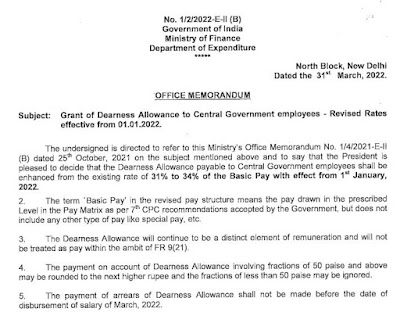
DA Jan 2022 - Grant of Dearness Allowance to Central Government employees - Revised Rates effective from 01.01.2022

 3% DA Hike - Revised Rates effective from 01.01.2022: DoE OM dated 31.03.2022 No. 1/2/2022-E-II (B) Government of India Ministry of Finance...