Tuesday, 1 December 2015

7th Pay Commission Recommendations on Non-Practising Allowance (NPA)

7th Pay Commission Recommendations on Non-Practising Allowance (NPA) – 7th CPC proposes for reduced NPA at the rate of 20% of Basic Pay as against NPA of 25% paid presently

Rate of NPA:

Non Practicing Allowance (NPA), at the rate of 25 percent of Basic Pay, is paid to medical doctors occupying posts for which minimum qualification of a medical degree is prescribed. There are demands to raise this allowance to 40 percent of Basic Pay.

Analysis and Recommendations

The VI CPC had included a detailed rationale for the grant of NPA in its recommendations. Most of the reasons are still valid and there is no need to reiterate them here. However, in line with our general approach of rationalizing the percentage based allowances by a factor of 0.8, we recommend that NPA should be paid at the rate of 20 percent of Basic Pay, subject to the condition that Basic Pay + NPA should not exceed the average of Apex Level and the level of Cabinet Secretary.

7th CPC’s remarks on taking NPA for the purpose of calculating HRA

Currently, in the case of those drawing either NPA or MSP or both, HRA is being paid as a percentage of Basic Pay+NPA or Basic Pay+MSP or Basic Pay+NPA+MSP respectively. HRA is a compensation for expenses in connection with the rent of the residential accommodation to be hired/leased by the employee and is graded based on the level of the employee, and therefore should be calculated as a percentage of Basic Pay only. Add-ons like NPA, MSP, etc. should not be included while working out HRA.

Whether NPA can be taken in to account while calculating Transfer Grant

Presently NPA and MSP are included as a part of Basic Pay while determining entitlement for grant of CTG. The Commission finds no justification for doing so, as the expenditure and inconvenience involved in relocation on transfer/retirement is similar for all employees. Hence, no other add-ons should be allowed in Basic Pay while calculating CTG.

Source: gconnect.in

7th Pay Commission Recommendations on PRIS

7th Pay Commission Recommendations on PRIS – Performance Related Incentive Scheme to continue as such.  No PRIS for Non-Scientific Staff. DRDO can continue with their existing system.

7th CPC report has been submitted to Finance Ministry for implementation.  The recommendations made by the 7th CPC about PRIS is given below.

Performance Related Incentive Scheme (PRIS)

PRIS is operational in Departments of Atomic Energy and Space. PRIS is a variable component of pay and is awarded on the basis of the performance of individual/ group/organization, measured against goals set for a given period of assessment. PRIS is non- additive and non-cumulative. The form of PRIS envisaged is organization and design specific and is payable as a cash incentive either when it becomes due or on a monthly/quarterly/annual basis. It is based on the principle of differential reward for differential performance. The scheme is transparent and centrally implementable. The Scheme has three components- Organizational, Group and Individual.

Organizational PRIS

Organizational PRIS or PRIS (O) is awarded to all personnel in the department and its constituent units based on accomplishment of various objectives at the organizational level, in the form of Special Allowance at the rate of 20 percent of pay, payable on a six monthly basis and subject to fulfilling the following eligibility criteria:
  • Attendance of not less than 175 working days during the preceding financial year.
  • Incentive shall not be admissible for the period of EL/HPL/Commuted Leave etc. availed singly or in combination, in excess of 30 days during the financial year for which the organizational incentive is otherwise payable.
  • APAR grading should be Good/B+ or above.
  • Should not be under suspension or deputation.

Group PRIS

Group PRIS or PRIS (G) is awarded to all employees belonging to specific groups identified in all Units of the Department–scientific, technical, administrative and auxiliary, exhibiting excellence which have significantly contributed towards the realization of the organizational objective in a particular year, in the form of Special Allowance at the rate of 10 percent of the basic pay of the individual during the financial year, based on annual assessment and which is further subject to fulfilling the following eligibility criteria:
  • Overall grading in APAR of the preceding reporting year should be Very Good or above.
  • For SC/ST personnel, the same should be Good or above.
  • Other criteria remain the same as PRIS (O).

Individual PRIS

Individual PRIS or PRIS (I) are variable additional increments granted to all eligible Scientific and Technical personnel at the time of promotion in recognition of individual meritorious performance subject to fulfilling the following eligibility criteria:
  • Variable increments awarded to Scientific and Technical personnel are specific to the Grade.
  • An employee will enter into PRIS (I) only after the first merit promotion.
  • A promoted candidate should not get less PRIS (I) increments than what the candidate was drawing before the effective promotion date.
  • Eligibility condition of 175 working days is not applicable for grant of PRIS (I).
  • The DPC/Standing Selection Committee, after considering the total length of time taken by an employee to earn promotion, will recommend the total number of variable incentives payable under PRIS (I)
  • Up to six increments can be recommended to the officers in the grade of Scientist H and above (except Officers at Apex Scale), four increments to the officers in the grade of Scientist C to Scientist G and maximum three increments to Technical Staff.
  • Variable increment will be multiple of one increment, but subject to the ceiling of Rs.10,000 per month.
  • The amount of incentive increment payable as PRIS (I) has no relation with the normal rate of increments under pay fixation/annual increment.
The Commission has been informed that of the three components, only PRIS (O) and (I) are under implementation and that PRIS (G) is yet to be awarded.

Demands

Associations of scientific staff in Departments of Atomic Energy and Space have submitted that PRIS, as presently implemented, has gone a long way in arresting attrition and accordingly need to be continued. They have however sought an increase in the incentive percentage of PRIS (O) and PRIS (G) as lately the attrition rate has somewhat increased. They have also demanded extension of PRIS (I) to the apex level posts of the organizations presently covered under the scheme, the stated justification being that Heads of Organization have a critical role to play in the formulation and implementation of scientific policy of the government. The associations have also requested extension of PRIS (I) to the entire department instead of limiting it to the scientific cadres. Demands have also been made for exempting Medical Leave for fulfilling the conditionality of attendance for being considered eligible for grant of PRIS (O) and PRIS (G). A demand has also been placed to extend PRIS to DRDO.

In response to a query, current data on attrition rate was supplied by Departments of Atomic Energy and Space, as well as DRDO. The attrition rate, defined as the number of scientists resigning/taking VRS during a year as a percentage of total scientists on the payroll at the end of that year, is shown in the table below:

Attrition Rate of Scientists
(percentage)
 
Years
  Space   Atomic Energy   DRDO
  2010-11  
1.34
 
0.57
  0.87
  2011-12  
1.50
 
0.70
  1.16
  2012-13  
1.23
 
0.51
  0.93
  2013-14  
1.25
 
0.70
  0.82
  2014-15  
0.86
 
0.48
  0.53

From the table above it is seen that attrition rate has been on decline in all the three scientific departments which would be partly due to PRIS and partly due to salary increase after VI CPC.

Analysis and Recommendations

It is noted that contrary to the assertion by Departments of Atomic Energy and Space, the attrition rate has continued to fall. Therefore, while the Commission sees merit in continuing with PRIS for arresting attrition in these organizations, it is not in favour of increasing the incentive percentage. The PRIS (O) and PRIS (G) taken together already amount to 30 percent of the basic pay, which is substantial. This would be more so when the rise in pay levels post implementation of VII CPC recommendations is taken into account. The demand to bring apex level functionaries under PRIS (I) is not supported as Heads of Organizations have sufficient incentive to perform being in the position they are in and like others are already the beneficiaries of PRIS (O). The Commission is also not in favour of extending PRIS (I) to non-scientific staff. The demand for exempting medical leave from the eligibility conditions of PRIS is a matter that may be dealt with administratively. The Commission also does not recommend extension of PRIS to DRDO as they have a separate system of variable increments in place which is similar to PRIS (I).


Source: gconnect.in

Expected DA Jan 2016 : AICPIN for the month of October 2015

Expected DA Jan 2016 : AICPIN for the month of October 2015

No. 5/1/2015- CPI
GOVERNMENT OF INDIA
MINISTRY OF LABOUR & EMPLOYMENT
LABOUR BUREAU
`CLEREMONV, SHIMLA-171004
DATED : 30th October, 2015
Press Release

Consumer Price Index for Industrial Workers (CPI-IW) – September, 2015

The All-India CPI-IW for September, 2015 increased by 2 points and pegged at 266 (two hundred and sixty six). On 1-month percentage change, it increased by (+) 0.76 per cent between August and September, 2015 which was static between the same two months a year ago.

The maximum upward pressure to the change in current index came from Food group contributing (+) 1.78 percentage points to the total change. At item level, Arhar Dal, Masur Dal, Moong Dal, Urd Dal, Mustard Oil, Onion, Cauliflower, Green Coriander Leaves, Potato, Tea (Readymade), Sugar, Electricity Charges, Private Tuition Fee, Flower/Flower Garlands, etc. are responsible for the increase in index. However, this increase was restricted by Wheat, Fish Fresh, Poultry (Chicken), Eggs (Hen), Apple, Coconut, Tomato, Petrol, Washing Soap, etc., putting downward pressure on the index.

The year-on-year inflation measured by monthly CPI-IW stood at 5.14 per cent for September, 2015 as compared to 4.35 per cent for the previous month and 6.30 per cent during the corresponding month of the previous year. Similarly, the Food inflation stood at 5.71 per cent against 3.55 per cent of the previous month and 6.46 per cent during the corresponding month of the previous year.

At centre level, Chhindwara reported the highest increase of 10 points followed by Varanasi (9 points), Pune, Tripura, Jalpaiguri and Bhilwara (6 points each). Among others, 5 points rise was observed in 5 centres, 4 points in 7 centres, 3 points in 8 centres, 2 points in 16 centres and 1.point in 19 centres. On the contrary, Goa recorded a maximum decrease of 4 points followed by Ernakulam 3 points. Among others, 2 points decrease was observed in 4 centres and 1 point in 2 centres. Rest of the 9 centres’ indices remained stationary.

The indices of 36 centres are above All India Index and other 42 centres’ indices are below national average.

The next issue of CPI-IW for the month of October, 2015 will be released on Monday, 30th November, 2015. The same will also be available on the office website www. labourbureau.gov. in.

(S. S. NEGI)
DEPUTY DIRECTOR GENERAL

Source : labour Bureau

7th Pay Commission’s Recommendations on Gratuity

7th Pay Commission’s Recommendations on Gratuity

7th CPC recommends for raising Gratuity from the existing Rs.10 lakh to Rs.20 lakh from 01.01.2016. 7th Pay Commission further proposes for DA indexed Gratuity viz., increase by 25 percent whenever DA rises by 50 percent.

Enhancement in the Gratuity Ceiling and its Indexation

A number of representations have been received by the Commission stating that there is a need to revise the existing ceiling of Rs.10.00 lakh with regard to payment of service gratuity.

Analysis and Recommendations

Rule 49 and 50 of the CCS (Pension) Rules provides that a government servant is entitled to get retirement gratuity equal to one-fourth of his emoluments for each completed six monthly period of qualifying service subject to a maximum of 16.5 times of the last emoluments subject to a maximum of Rs.10 lakh.
The Commission sought the views of the government in this regard. The Department of Pension and Pensioners Welfare stated that the VI CPC has increased the amount of gratuity from Rs.3.5 lakh to Rs.10 lakh w.e.f. 01.01.2006. This amount, in the view of the department, is not commensurate with emoluments that are available to senior officers at the time of retirement. The department has suggested to the Commission that a view could be taken to index gratuity with amount of DA admissible at the time of retirement.

The Commission notes that there is merit in the argument advanced to index the ceiling on gratuity so that the benefits of the enhanced ceiling are available to personnel in a manner which is more even over a time frame. The Commission recommends enhancement in the ceiling of gratuity from the existing Rs.10 lakh to Rs.20 lakh from 01.01.2016. The Commission further recommends, as has been done in the case of allowances that are partially indexed to Dearness Allowance, the ceiling on gratuity may increase by 25 percent whenever DA rises by 50 percent.

Rationalisation of Death Gratuity

The Commission has received representations pointing to a need for rationalization of current slabs for death gratuity, especially for the slab of 5 to 20 years of qualifying service in which family pensioners are stated to be placed at a disadvantageous position.

Analysis and Recommendations

As per Rule 50 of Pension Rules, the death gratuity admissible will be as follows, subject to the maximum limit prescribed for the gratuity:

Length of Service Rate of Death Gratuity
Less than one year 2 times of monthly emoluments
One year or more but less than 5 years 6 times of monthly emoluments
5 years or more but less than 20 years 12 times of monthly emoluments
20 years or more Half month of emoluments for every complete six monthly period of qualifying service subject to a maximum of 33 times of monthly emoluments

The Commission sought the views of the government in this regard. Department of Pension and Pensioners Welfare stated that it had received similar demands from pensioners’ association and it feels a need for a review of the existing slabs for death gratuity.

The Commission, after examination of the matter, recommends the following revised rates for payment of death gratuity:

Length of Service Rate of Death Gratuity
Less than one year 2 times of monthly emoluments
One year or more but less than 5 years 6 times of monthly emoluments
5 years or more but less than 11 years 12 times of monthly emoluments
11 years or more but less than 20 years 20 times of monthly emoluments
20 years or more Half month of emoluments for every complete six monthly period of qualifying service subject to a maximum of 33 times of emoluments

Reduction in the time period for Restoration of Basic Pension
The Commission has received a number of representations requesting reduction of restoration period of commuted portion of pension from the existing 15 years.

Source: gconnect.in

7th Pay Commission – Recommends Abolition of 52 Allowances

7th Pay Commission – Recommends Abolition of 52 Allowances – The list of outdated government perks is pretty long. Sample this: select postal department employees are entitled to a Rs 90-per month cycle allowance.

The 7th Pay Commission, headed by Justice Ashok Kumar Mathur submitted its report to the finance ministry about 10 days back. It has made many recommendations to the Government pertaining to salary, pension etc., etc. It has also recommended abolition of 52 allowances that the 7th Pay Commission found obsolete.

The list of outdated government perks is pretty long. Sample this: select postal department employees are entitled to a Rs 90-per month cycle allowance, if the employee fulfills a number of conditions including the submission of proof that there has been an “extensive use” of the bicycle. Indian Foreign Service officers are given a monetary incentive that’s ridiculously low for learning an optional foreign language — Rs 100 per month if the officer turns “proficient” in that language and Rs 200 per month if the officer becomes “above proficient”.

Sounds odd, but Central Industrial Security Force (CISF) personnel receive a haircutting allowance at the rate of Rs 5 per month, the lowest among 196 government allowances that prevail today. This allowance should have been discarded long ago, as haircutting is very much a part of the CISF cadres’ composite personal maintenance allowance. But no one probably had spotted this till the 7th Central Pay Commission found it “outdated” and recommended its abolition.

So, when the 7th Central Pay Commission chairman Justice AK Mathur along with two members of the Commission had to evaluate the demands of IAS, IFS, IPS, Central government services and defence personnel in several rounds of meetings spanning nearly two years, they encountered a humongous task of rationalising as many as 196 allowances in addition to weighing in on the core issues of pay hike and pay parity. The list of allowances includes the well-known ones like DA and HRA.

And the Central Pay Commission, which submitted its report 10 days ago to the finance ministry, clearly recommended abolition of 52 allowances that they found obsolete. We give below a selected list of a few allowances which have been recommended for abolition:

1. Hair cutting Allowance
2. Cash Handling Allowance
3. Hutting Allowance
4. Secret Allowance
5. Cycle Allowance
6. Diet Allowance
7. Soap Toilet Allowance
8. Funeral Allowance

Source: The Economic Times

Monday, 30 November 2015

LDC-UDC Matter & MACP on Promotional Hierarchy in 7th CPC Recommendation: AIAAS(NG) writes to Confederation

LDC-UDC Matter & MACP on Promotional Hierarchy in 7th CPC Recommendation: AIAAS(NG) writes to Confederation

Message from Secretary AIAAS(NG) :-

This Association has taken up the LDC/UDC, MACP on Promotional Hierarchy, and other issues related to Administrative Staff with Confederation. Copy of the letter sent to the Secretary General, Confederation is given below: All our LDC/UDC friends are requested to raise the issue in their respective Association to force them to represent the issue to Confederation/JCM Staff Side.
ALL INDIA ASSOCIATION OF ADMINISTRATIVE STAFF (NG)
MINISTRY OF STATISTICS AND PROGRAMME IMPLEMENTATION
Bhopal,
Dated 25/11/2015
To
Com. M Krishnan,
Secretary General,
Confederation of Central Government Employees & Workers,
New Delhi

Dear comrade,

This is in connection with LDC/UDC, MACP on Promotional hierarchy and other issues related to Administrative Staff of Subordinate offices. It is surprising to note that the 7th Pay Commission has turned down the genuine issue of LDC & UDC on the ground that the government has stopped direct recruitment for the clerical cadre and gradually phasing out the existing incumbents. If this is true, it is a matter of great concern that the Government has chosen to take a unilateral decision on an important policy matter without consulting the Staff side. The reason given for rejection of the demand is not convincing.
Besides Confederation/Staff Side JCM, several Departments had recommended upgradation of grade pay of LDC & UDC of Administrative Offices especially the LDC & UDCs of subordinate offices of Government of India.
Extracts of the Pay Commission comments on the matter is given below:
By analyzing the demand of SVP, National Police Academy under Para 11.22.100 the Commission has said “This issue has been dealt in Chapter 7.7. Recommendations made there would apply in this case also”
As against the demand of Directorate of Printing under Para 11.52.32 Commission maintained that “posts like LDC, UDC, Accountant are common to a number of ministries/ departments. Recommendations regarding their pay are contained in Chapter 7.7 and Chapter 11.35.”
But, in Chapter 7.7, deals common category, no recommendation for LDC/UDC is given.
However by recording disagreement to increase promotional quota of MTS to LDC under Para 7.7.37 & 11.35.28 Commission has said that “government has already stopped direct recruitment for the clerical cadre and gradually phasing out the existing incumbents, this demand cannot be accepted.”
But the fact is that Staff Selection Commission is frequently conducting recruitment for the post of LDC. Combined higher secondary examination for the selection of LDC also has been conducted recently. Moreover, no alternative recommendation to replace the LDC post is given in the report.  It is to be noted that the normal ratio of LDC and UDC in subordinate offices is 5:2 and thus LDCs have been allocated responsible sections and in many smaller offices LDC alone is handling the work of entire Administration.
On the other hand rejecting Central Secretariat Clerical service demand for parity with DEO, the commission observes “Even though the entry requirements are similar, historically the pay scales of the two posts have been different. Besides, they comprise two distinct cadres with different set of roles and responsibilities. Hence, the demand for parity of pay of LDC with DEOs cannot be acceded to by the Commission.”(Para 11.35.38).
Historically these cadres may be different set of roles but the fact is that functions of LDC are more complex than that of DEO and same was brought before the commission by various Associations/Administrative Authorities. Earlier pay Commissions have fixed Pay Scale to DEO considering their work on computer. But today LDCs are selected on the basis of their expertise in computer operation also.
By concluding the LDC issue, I give hereunder two comments among the dozens of comments/e-mail received us on the subject. This signifies the sufferings of LDCs in subordinate offices.
(1)   I am really disappointed with the decision of 7th CPC, I was hoping that I would get atleast GP 2400 as per their calculation, they don’t even think about lower classMyself Ashutosh, LDC and I am appointed on 2012, 3000 KM far from my house and from last 2 years I am doing the work of cashier along with all the work of Income Tax and budget, apart from me 4 more LDC’s are working here instead of UDC’s and they are the backbone of their branch but as per 7th CPC words we are not having as much responsible work they think LDC’s are recruits only for “dispatch” and “typing” which is not true.
I request to them, sir please come and see how much responsibility we have and what we are getting,
(2)    I am s murugan LDC, handling with pay bills, income tax, TDS and what are related to taxable income such as LTC encashment, final bills, HRA claim and etc…
In 7th Cpc report every where it is stated that this is dealt with chapter 7.7 and 11.35. But, there are no clear instructions for clerical.
The major error is clerical cadre is not included in common categories (chapter 7).
II      Grant of MACP on Promotional Hierarchy:
Even though the Confederation has clarified that the Commission has recommended MACP on promotional hierarchy, the report of the Commission is confusing and contradictory. Para 5.1.44 reads in the new Pay matrix, the employees will move to the immediate next level in the hierarchy. This can be interpreted as fixation in the same principle as that for a regular promotion. But Para 11.52.45 is contradictory.

III     The Grade Pay of  Assistants/Stenographers of Central Secretariat is brought down to Rs. 4200 from the existing Rs. 4600 and NFSG granted to the UDCs of Central Secretariat has been withdrawn thereby the demand for parity with the Grade Pay of Assistant/UDC of Central Secretariat is turned down.
Comrades, Government is bent upon to contractorise all the Administrative posts below the post of Assistants. The demand for merger of Grade Pay of LDC & UDC and upgradation to Rs. 2800, as recommended by the staff side is genuine in accordance with duties assigned. Confederation/JCM (Staff Side) is requested to please help LDC/UDC and other Administrative Staff of subordinate Offices to resolve these genuine issues.
Yours fraternally TKR Pillai
General Secretary
Source: http://aiamshq.blogspot.in/2015/11/this-association-has-taken-upthe-ldcudc.html

LIC India: BONUS Info: Reversionary Bonus Rates declared as a result of valuation as at 31st March 2015

LIC India: BONUS Info: Reversionary Bonus Rates declared as a result of valuation as at 31st March 2015
LIC BONUS RATES 2015


L – 42 (Annexure)
IRDA Public Disclosure
S.No. Plan Term* Bonus Rates
(Per Rs. 1000/- Sum Assured)**

2015
1. Whole Life Type Plans
(2,5,6,8,10,28 – before conversion,
35,36,37,38,
49,77,78,85 & 86)

70
2. Endowment Type Plans
(14,17,27 – after conversion,
28 – after conversion,
34,39,40,41,42,50,54,79,
80,81,84,8 7,90,91,92,95,101,102,
103,109,110 & 121)
< 11 34
11 to 15 38
16 to 20 42
> 20 48
3. New Endowment Plan (814) 12 to 15 38
16 to 20 42
> 20 48
4. Single Premium Endowment Plan (817) 10 to 15 41
16 to 20 46
> 20 51
5. Money Back Assurances Plans (75 & 93) 20 39
25 44
6. New Money Back Plans (820 & 821) 20 39
25 44
7. Jeevan Surabhi Plans (106,107 & 108) 15 34
20 41
25 50
8. Jeevan Mitra (Double Cover Plan), Jeevan Saathi (88,89) 15 40
16 to 20 44
> 20 48
9. Jeevan Mitra (Triple Cover Plan) (133) < 16 40
16 to 20 45
> 20 50
10. Limited Payment Endowment Plan (48) <16 40
16 to 20 44
> 20 49
11. Limited Premium Endowment Plan (830) 12 40
16 45
21 50
12. New Children Money Back Plan (832) 13 to 15 38
16 to 20 42
> 20 48
13. Jeevan Lakshya Plan (833) 13 to 15 41
16 to 20 45
> 20 49
14. Jeevan Anand Plan (149) 5 38
6 to 10 38
11 to 15 41
16 to 20 45
> 20 49
15. New Jeevan Anand Plan (815) 15 41
16 to 20 45
> 20 49
16. Jeevan Rekha Plan (152) < 11 49
11 to 15 44
16 to 20 40
> 20 34
17. Jeevan Anurag Plan (168) < 11 38
11 to 15 40
16 to 20 42
> 20 44
18. New Jeevan Suraksha – I Plan (147) < 6 21
6 to 10 27
11 to 15 31
> 15 35
19. New Jeevan Dhara – I Plan (148) < 6 21
6 to 10 27
11 to 15 31
> 15 35
20. Jeevan Tarang Plan (178) 10 47
15 48
20 49
21. Jeevan Madhur Plan (182) < 11 21
11 to 15 26
22. Child Career Plan (184) 11 to 15 40
16 to 20 38
> 20 40
23. Child Future Plan (185) 11 to 15 38
16 to 20 42
> 20 44
24. Jeevan Bharti Plan (160) 15 38
20 40
25. Jeevan Shree – I Plan (162) 10 44
15 45
20 48
25 52
26. Jeevan Nidhi Plan (169) < 11 38
11 to 15 40
16 to 20 42
> 20 44
27. Jeevan Pramukh Plan (167) 10 47
15 48
20 51
25 55
28. Jeevan Amrit Plan (186) 10 to 15 30
16 to 20 30
> 20 30
29. Jeevan Bharti – I Plan (192) 15 29
20 31
Note:

* Plan – 149 & 152 : Premium Paying Term in place of Term

Plan – 178: Accumulation Period in place of Term

Plan – 147,148 & 169: Deferment Period in place of Term

** Plan – 147 & 148: Bonus rates are per thousand Notional Cash Option

Plan – 182: Bonus rates are per thousand Death Benefit Sum Assured

Plan – 186: Bonus rates are per thousand premium paid
Source: www.licindia.in

Check out top 10 points to clear all doubts in mind regarding the 7th Pay Commission pension, pay scales, MSP, MACP and more:

7th Pay Commission pension, pay scales, MSP, MACP
Check out top 10 points to clear all doubts in mind regarding the 7th Pay Commission pension, pay scales, MSP, MACP and more:


7th Pay Commission pension, pay scales – highlights: 
The 7th Pay Commission report has recommended an average 23.55% hike in salaries and allowances of Central government staff and the same is likely to be replicated in all the states too, except Puducherry where the same system as in Centre is already applicable – minimum pay set at Rs 18,000 per month and maximum pay at Rs 2,50,000 per month – recommended date of implementation: 01, January, 2016.
Here we provide all you ever wanted to know in 10 points on most crucial aspects of the 7th Pay Commission report:
1. 7th Pay Commission pension, pay scales, allowances – Minimum Pay:
Based on the Dr Wallace Aykroyd formula (nutrition) , the minimum pay (salary) in government is recommended to be set at Rs 18,000 per month; Maximum Pay: Rs 2,25,000 per month for Apex Scale and Rs 2,50,000 per month for Cabinet Secretary and others presently at the same pay level. If passed, the salary hikes this report is recommending are likely to boost demand for consumer goods across the spectrum, even though it could also be inflationary. (Reuters)
2. 7th Pay Commission pension, pay scales, allowances – Advances:
a. All non-interest bearing Advances have been abolished; b. Regarding interest-bearing Advances, only Personal Computer Advance and House Building Advance (HBA) have been retained. HBA ceiling has been increased to Rs 25 lakhs from the present Rs 7.5 lakhs. (PTI)
3. 7th Pay Commission pension, pay scales, allowances – Pension:
The Commission recommends a revised pension formulation for civil employees including CAPF personnel as well as for Defence personnel, who have retired before 01.01.2016. This formulation will bring about parity between past pensioners and current retirees for the same length of service in the pay scale at the time of retirement. The 7th Pay Commission received many grievances relating to New Pension System (NPS). It has recommended a number of steps to improve the functioning of NPS. It has also recommended establishment of a strong grievance redressal mechanism. (PTI)
4. 7th Pay Commission pension, pay scales, allowances – Performance Related Pay:
The Commission has recommended introduction of the Performance Related Pay (PRP) for all categories of Central Government employees, based on quality Results Framework Documents, reformed Annual Performance Appraisal Reports and some other broad Guidelines. The Commission has also recommended that the PRP should subsume the existing Bonus schemes. (PTI)
5. 7th Pay Commission pension, pay scales, allowances – New Pay Structure:
Considering the issues raised regarding the Grade Pay structure and with a view to bring in greater transparency, the present system of pay bands and grade pay has been dispensed with and a new pay matrix has been designed. Grade Pay has been subsumed in the pay matrix. The status of the employee, hitherto determined by grade pay, will now be determined by the level in the pay matrix. The rate of Annual Increment is being retained at 3 percent. (PTI)
6. 7th Pay Commission pension, pay scales, allowances – Modified Assured Career Progression (MACP):
a. Performance benchmarks for MACP have been made more stringent from “Good” to “Very Good”; b. The Commission has also proposed that annual increments not be granted in the case of those employees who are not able to meet the benchmark either for MACP or for a regular promotion in the first 20 years of their service; c. No other changes in MACP recommended. (Thinkstock)
7. 7th Pay Commission pension, pay scales, allowances – Military Service Pay (MSP):
The Military Service Pay, which is a compensation for the various aspects of military service, will be admissible to the Defence forces personnel only. As before, Military Service Pay will be payable to all ranks up to and inclusive of Brigadiers and their equivalents. The current MSP per month and the revised rates recommended are as follows: (Reuters)
8. 7th Pay Commission pension, pay scales, allowances – Short Service Commissioned Officers:
Short Service Commissioned Officers will be allowed to exit the Armed Forces at any point in time between 7 and 10 years of service, with a terminal gratuity equivalent of 10.5 months of reckonable emoluments. The Seventh Pay Commission also says they will further be entitled to a fully funded one year Executive Programme or a M.Tech. programme at a premier Institute to better their prospects in later life. (PTI)
9. 7th Pay Commission pension, pay scales, allowances – Allowances:
The Commission has recommended abolishing 52 allowances altogether. Another 36 allowances have been abolished as separate identities, but subsumed either in an existing allowance or in newly proposed allowances. Allowances relating to Risk and Hardship will be governed by the proposed Risk and Hardship Matrix. a. Risk and Hardship Allowance: Allowances relating to Risk and Hardship will be governed by the newly proposed nine-cell Risk and Hardship Matrix, with one extra cell at the top, viz., RH-Max to include Siachen Allowance. (PTI)
10. 7th Pay Commission pension, pay scales, allowances – Financial Implications:
The total financial impact in the FY 2016-17 is likely to be Rs 1,02,100 crore, over the expenditure as per the “Business As Usual” scenario. Of this, the increase in pay would be Rs 39,100 crore, increase in allowances would be Rs 29,300 crore and increase in pension would be Rs 33,700 crore. In percentage terms the overall increase in pay & allowances and pensions over the “Business As Usual” scenario will be 23.55 percent. Within this, the increase in pay will be 16 percent, increase in allowances will be 63 percent, and increase in pension would be 24 percent. (Image by PTI)

Source:  financialexpress.com

Retired Employee’s Liberalized Health Scheme (RELHS)

GOVERNMENT OF INDIA
MINISTRY OF RAILWAYS
(RAILWAY BOARD)
No. 2013/H/PNM/NFIR
New Delhi, Dated: 17.11.2015
General Managers,
All Indian Railways/PUS
(Including RDSO).

Subj- Retired Employee’s Liberalized Health Scheme (RELHS).

Ref:- This office letter of even No. dated 08.09.2015.

The decision of competent authority in the Ministry of Railways to extend the facility of joining RELHS-97 to those Railway employees who retired at the normal age of ‘superannuation irrespective of number of years of their service before superannuation, was conveyed to the Zonal Railways Vide Board’s letter cited under reference. However, one of the Zonal Railways has raised the issue of cut-off date of implementation of the order. The issue has been examined in consultation with Finance Directorate in the Board’s office.

In this context it is clarified that the instruction issued vide Board’s letter cited under reference is applicable to all Railway employees who have retired or retiring from-Railway service on attaining age of superannuation without any Cut-Off date.

This issues with the concurrence of Finance Directorate in the Board’s office.
(R.S. Shukla)
Joint Director/Health
Railway Board
Download NFIR letter No.2013/H/PNM/NFIR dated 17.11.2015 (Retired-Employees-Liberalized-Health-Scheme)

Strengthening of Administration – Premature retirement of Railway servants – Periodical review

Railway Board has issued a communication to all the General Managers of Indian Railways regarding the guidelines to be followed on premature retirement of Railway employees.

GOVERNMENT OF INDIA
MINISTRY OF RAILWAYS
(RAILWAY BOARD)
RBE No.143/2015
No. E(P&A)I-2015/RT-38
New Delhi dated 10/12-11-2015.
The General Managers,
All Indian Railways.

Sub:- Strengthening of Administration – Premature retirement of Railway servants – Periodical review under rule 1802 (a)/ 1803 (a)/ 1804 (a) – R- II, 1987 edition – Regarding.

DOP&T vide their OM No. 25013/1/2013-Estt (A) dated 21.03.2014 and 25013/01/2013-Estt.A-IV dated 11.09.2015 have reiterated the instructions on Compulsory Retirement under FR 56(1), 560) or Rule 48(1) (b) of CCS (Pension) Rules, 1972 with a view to improve efficiency and strengthening of the administrative machinery at all levels. They have asked to follow these instructions strictly and to review the performance of Govt. servants periodically with a view to ascertain whether the Government servant should be retained in service or retired from service in the public interest. Provisions in this regard are contained in FR 56(j), 56(I) or Rule 48(1) (b) of CCS (Pension) Rules, 1972. The corresponding rules in railways are Rule 1802 (a)/1803 (a)/1804 (a) of IREC, Vol-II, 1987 edition.

2. DOP&T has also drawn attention to the observation made by Hon’ble Supreme Court in State of Gujarat Vs Umedbhai M. Patel, 2001 (3) SCC 314, which are as follows:
(i) Whenever the services of a public servant are no longer useful to the general administration, the officer can be compulsorily retired for the sake of public interest.
(ii) Ordinarily, the order of compulsory retirement is not to be treated as a punishment coming under Article 311 of the Constitution.
(iii) “For better administration, it is necessary to chop off dead wood, but the order of compulsorily retirement can be passed after having due regard to the entire service record of the officers.”
(iv) Any adverse entries made in the confidential record shall be taken note of and be given due weightage in passing such order.
(v) Even un-communicated entries in the confidential record can also be taken into consideration.
(vi) The order of compulsory retirement shall not be passed as a short cut to avoid Departmental enquiry when such course is more desirable.
(vii) If the officer was given a promotion despite adverse entries made in the confidential record, that is a fact in favour of the officer,
(viii) Compulsory retirement shall not be imposed as a punitive measure.
3. In order to ensure that the power, conferred on the authorities empowered to retire a railway employee prematurely is exercised fairly and impartially and not arbitrarily, consolidated instructions relating to premature retirement of railway servants with a view to strengthening of administration were issued under the Board’s letter No. E(P&A)I-77/RT-53 dated 15.11.1979. These guidelines have, however, not been adequately followed by the Appointing Authorities. With the Government’s commitment to provide clean administration, it is essential that the power for premature retirement in public interest is availed of to weed out all those employees whose integrity is doubtful, with due regard to the appropriate procedure laid down for action for premature retirement.

4. The entire service records should be considered in every review. Here Service record will take in all relevant records viz. ACR/APAR dossier along with personal file of the officer containing valuable material. Similarly, the work and performance of the officer could also be assessed by looking into files dealt with by him or in any papers or reports prepared and submitted by him. All these data along with a comprehensive brief should be prepared for consideration by the Review Committee. Even un-communicated remarks in the ACRs/APARs may be taken into consideration also. In case of those officers who have been promoted during the last five years, the previous entries in the ACRs may be taken into account if the officer was promoted on the basis of seniority cum fitness, and not on the basis of merit.

5. As far as integrity is considered, the following observations of the Hon’ble Supreme Court, while upholding compulsory retirement in the case of S. Ramachandra Raju Vs State of Orissa, may be kept in view:-

“The officer would live by reputation built around him. In an appropriate case, there may not be sufficient evidence to take punitive disciplinary action of removal from service. But his conduct and reputation is such that his continuance in services would be a menace to public service and injurious to public interest.”
Thus while considering integrity of an employee, actions or decisions taken by the employee which do not appear to be above board, complaints received against him, or suspicious property transactions, for which there may not be sufficient evidence to initiate departmental proceedings, may be taken into account. Judgment of the Apex Court in the case of Shri K. Kandaswamy, I.P.S (TN:1966) in K. Kandaswamy vs Union Of India & Anr, 1996 AIR 277, 1995 SCC (6) 162 is relevant here. There were persistent reports of Shri Kandaswamy acquiring large assets and of his getting money from his subordinates. He also indulged in property transactions which gave rise to suspicion about his bonafides. The Hon’ble Supreme Court upheld his compulsory retirement under provisions of the relevant Rules.

6. Similarly, reports of conduct unbecoming of a Government servant may also form basis for compulsory retirement. As per the Hon’ble Supreme Court in State of UP And Others vs Vijay Kumar Jain, Appeal (Civil) 2083 of 2002:-
“If conduct of a government employee becomes unbecoming to the public interest or obstructs the efficiency in public services, the government has an absolute right to compulsorily retire such an employee in public interest.”

7. Further, CVO in the case of gazetted officers, or his representative in the case of non-gazetted officers, will be associated in case of record reflecting adversely on the integrity of any employee.

8. In addition to above, internal committees may be constituted to assist the Review Committees in reviewing the cases. These Committees will ensure that the service record of the employees being reviewed, along with a summary bringing out all relevant information, is submitted to the Cadre Authorities at least three months before the due date of review.

9. In view of DOP&T’s present guidelines, the Board’s letters No. E(P&A)I-77/RT-53 dated 15.11.1979 and E(P&A)I-87/RT-4 dated 17.10.89 containing the provisions on Premature Retirement under Rule 1802 (a)/1803(a)/1804(a) – IREC, Vol-II, 1987 edition are enclosed for guidance. In addition to this, instructions issued by Board from time to time on the subject may also be linked while deciding such matters. Further, all Zonal railways are requested to follow the above instructions and periodically review the cases of railway servants as required under Rule 1802 (a)/1803(a)/1804(a) – IREC, Vol. II, 1987 edition. The quarterly data in enclosed proforma in respect of reviewing the cases of retirement under the aforesaid provisions during the period from 01.04.2014 to 31.03.2015 may be furnished immediately.

10. As per the latest guidelines of DOPcSiT’s OM dated 21.03.2014, para II 3 (c) (d) of the Board’s enclosed letter dated 15.11.1979 should be read as under:

“(c) While the entire service record of an officer should be considered at the time of review, no employee should ordinarily be retired on grounds of ineffectiveness if his/ her service during the preceding 5 years or where he/she has been promoted to a higher post during that 5 year period, his/her service in the highest post, has been found satisfactory.

Consideration is ordinarily to be confined to the preceding 5 years or to the period in the higher post in case of promotion within the period of 5 years, if compulsory retirement is sought to be made on grounds of ineffectiveness. There is no such stipulation, however where the employees is to be retired on grounds of doubtful integrity.”

“(d) No employee should ordinarily be retired on ground of ineffectiveness, if, in any event, he/she would be retiring on superannuation within a period of one year from the date of consideration of his/ her case.
Ordinarily no employee should be retired on grounds of ineffectiveness if he is retiring on superannuation within a period of One year from the date of consideration of the case. It is clarified that in a case where there is a sudden and steep fall in the competence, efficiency or effectiveness of an officer, it would be open to review his case for premature retirement.

The above instruction is relevant only when an employee is proposed to be retired on the ground of ineffectiveness, but not on the ground of doubtful integrity. The damage to public interest could be marginal if an old employee, in the last year of service, is found ineffective; but the damage may be incalculable if he is found to be corrupt and demands or obtains illegal gratification during the said period for the tasks he is duty bound to perform.”

11. The first sentence of para 4 of Boards letter dated 15.11.1979 should be added as under:
“The Supreme Court had not only upheld the validity of FR 56(3) but also held that no show-cause notice need be issued to any Government servant before a notice of retirement is issued to him under the aforesaid provisions.”

12. Kindly acknowledge the receipt.
(Anil Kumar)
Deputy Director E(P&A)I, Railway Board.
Download Railway Board letter RBE No.143/2015 No. E(P&A)I-2015/RT-38 dated 12.11.2015.

Flash News

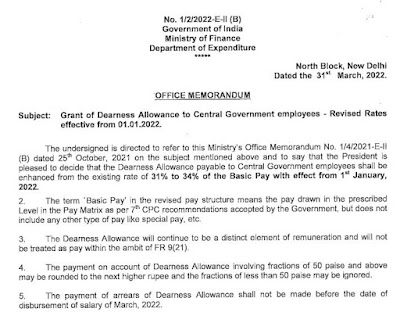
DA Jan 2022 - Grant of Dearness Allowance to Central Government employees - Revised Rates effective from 01.01.2022

 3% DA Hike - Revised Rates effective from 01.01.2022: DoE OM dated 31.03.2022 No. 1/2/2022-E-II (B) Government of India Ministry of Finance...