Tuesday, 13 October 2015

7CPC News: 7th Pay Commission faces pay gap problem

7th Pay Commission faces pay gap problem

New Delhi: 7th Pay Commission faces serious challenge in submitting its recommendation to government till December for hiking salaries and allowances for central government employees as the employees’ unions test its account of controversial pay gap between top and bottom level government officials.

The previous pay commission showed a wide gap in pay between the top bureaucrats and the government employees at the bottom.

The first pay commission was recommended pay of the top bureaucrats 41 times higher than the government employees at the bottom. The top bureaucrats were given salary Rs 2,263 while the lowest earning employees got Rs 55.

Subsequent pay commissions reduced the ratio of pay between lowest earning employees and top bureaucrats from 1:41 in 1947 to about 1:12 in 2006. The minimum basic salary of central government employees is now Rs 7730 while maximum salary at the level of Secretary is Rs 80,000.

Accordingly, the 7th Pay Commission will have to consider reduction in the disparity of pay ratio between its highest and lowest paid employees because it determines the socialism view of the government and the higher number of central government employees are in the minimum pay slabs.

The pay gap increases employee’s turnover and work-related illness, with all the associated economic consequences.

The bureaucrats with high pay are generally happier, healthier and a better place to live for almost everyone in them compare to the lower earning employees.

A pay gap is calculated as the ratio of the pay of the highest paid employee of an organisation to the pay of the average or lowest paid employee in that organisation.

7th Pay Commission can make recommendations on promoting pay fairness in the central government employees’ fraternity by tackling disparities between the lowest and the highest paid central government servants.

The 7th Pay Commission, headed by Justice Ashok Kumar Mathur was appointed in February 2014 and its recommendations are scheduled to take effect from January 1, 2016.

As part of the exercise, the 7th Pay Commission holds discussions with various stakeholders, including organisations, federations, and groups representing civil employees as well as defence services.

The Commission is ready with its recommendations on revising emoluments for nearly 50 lakh central government employees and 55 lakh pensioners, and will submit report to the Finance Minister till December 31.

TST

Public Servants (Furnishing of Information and Annual Return of Assets and Liabilities and the Limits for Exemption of Assets in Filing Returns) Third Amendment Rules, 2015.

Public Servants (Furnishing of Information and Annual Return of Assets and Liabilities and the Limits for Exemption of Assets in Filing Returns) Third Amendment Rules, 2015.

THE GAZETTE OF INDIA : EXTRAORDINARY

MINISTRY OF PERSONNEL, PUBLIC GRIEVANCES AND PENSIONS
(Department of Personnel and Training)

NOTIFICATION
New Delhi, the 12th October, 2015

G.S.R. 776(E) —In exercise of the powers conferred by sub-section (1) read with clause (k) and clause (l) of subsection (2) of section 59 read with section 44 and section 45 of the Lokpal and Lokayuktas Act, 2013 (1 of 2014), the Central Government hereby makes the following rules further to amend the Public Servants (Furnishing of Information and Annual Return of Assets and Liabilities and the Limits for Exemption of Assets in Filing Returns) Rules, 2014, namely:-

1. (1) These rules may be called the Public Servants (Furnishing of Information and Annual Return of Assets and Liabilities and the Limits for Exemption of Assets in Filing Returns) Third Amendment Rules, 2015.

(2) They shall come into force on the date of their publication in the Official Gazette.

2. In the Public Servants (Furnishing of Information and Annual Return of Assets and Liabilities and the Limits for Exemption of Assets in Filing Returns) Rules, 2014, in rule 3, in sub-rule (2),-
(a) in the first proviso, for the words and figures “on or before the 15th day of October, 2015″, the words and figures “on or before the 15th day of April, 2016″ shall be substituted;

(b) in the second proviso, for the words and figures “on or before the 15th day of October, 2015″, the words and figures “on or before the 15th day of April, 2016″ shall be substituted.

[F. No. 407/12/2014-AVD-IV(B)]
JISHNU BARUA, Jt. Secy.

Note — The principal rules were published in the Gazette of India, Extraordinary, vide notification number G.S.R. 501(E), dated the 14th July, 2014 and amended vide notification numbers G.S.R. 638(E), dated the 8th September, 2014, G.S.R. 918(E), dated the 26th December, 2014, G.S.R. 322(E), dated the 27th April, 2015 and G.S.R. 536(E), dated the 3rd July, 2015.

Source: http://ccis.nic.in/WriteReadData/CircularPortal/D2/D02ser/776E-12102015.pdf

Outcome of MACP anomalies meeting held between the Railway Board and the Federations on 12th October 2015.

Outcome of MACP anomalies meeting held between the Railway Board and the Federations on 12th October 2015.
N F I R
National Federation of Indian Railwaymen
3, CHELMSFORD ROAD, NEW DELHI - 110 055
Affiliated to:
Indian National Trade Union Congress (INTUC)
International Transport Workers' Federation (ITF)
Dated: 12/10/2015
No. IV/MACPS/09/Part 9
The General Secretaries of
Affiliated Unions of NFIR
Dear Brother,
Sub: MACP anomalies meeting held between the Railway Board (Executive Directors) and the Federations-reg.
The position relating to discussions held between the Railway Board (EDS) and the Federations at Rail Bhavan on 12th October 2015 is briefly placed below:-
 
1. Financial up-gradation under MACPS to the directly recruited Gradate Engineers Considering entry Grade Pay as Rs. 4600/- for the purpose of MACP to all the directly recruited Engineering Graduates in Design/Drawing Cadre and other Cadres. (NFIR’s PNM item No. 18/2011)
 
After discussion the Official Side stated that they will collect position relating to Graduate Engineers recruited in Pay Scale of Rs. 5500-9000 who were deprived of MACP benefit while those recruited later on and got Pay Scale of Rs. 6500-10500 through LDCE against 20% DR Quota for further View.
 
2. Third financial up-gradation under MACPS on completion of 20 years of service from the first promotion or 10 years after second promotion or 30 years after regular appointment - Whichever is earlier?
&
7. Grant of financial up-gradation under MACPS to the staff who are in the same Grade Pay for more than 20 years. (NFIR’s PNM Item No. 1/2011).
 
It was agreed to re-consider and discuss with the Federations before making out conclusion on these issues.
 
3. Grant of financial up-gradation under MACP Scheme in the promotional hierarchy (instead of Grade Pay hierarchy) - as per judgment of various Courts.
 
Federation explained that the Grade Pay Rs. 2000 is not existing in the Railways and invited attention of Railway Board to the minutes of the Joint Committee meeting held at the level of DoP&T for review. It was agreed to take action accordingly.
 
4. MACPS benefits to railway employees - cases of employees joining another unit/organization on request.
 
It was agreed to review and re-iterate DoP&T O.M. as it is.
 
5. Provision of all benefits on financial upgrading under MACPS - including entitlements for travel & treatment in hospital etc.
 
Discussed. Official Side stated that the MACP benefits have already been extended as per DoP&T guidelines.
 
6. Non-grant cf benefit of financial up-gradation under MACPS to the staff on North Western Railway.
 
Particulars of individual employees will be obtained from N.W. Railway for considering the case. NFIR invited Board’s attention to its letter dated 13/01/2014.
 
8. Abolition of Pay Scale and Introduction of up-graded Pay Scale with revised designation -Senior Section Engineers (Drawing) - Clarification on entry Grade Pay.
 
Case of Diploma Holder Tracers appointed against DR Quota vacancies as per Board’s orders (pursuant to DC/J CM decision) will be considered positively.
 
9. Non-grant of financial up-gradation under MACP Scheme to the Stock Verifiers working in Zonal Railways/Production Units.
 
Agreed to consider.
 
10. Grant of financial up-gradation under MACP Scheme - Wrongful clarification issued by the Railway Board.
 
NFIR quoted the case of Pharmacists, Guards besides Sr. Clerks joined against Graduate Quota having cleared RRB Examination. It was also contended that the LDCE being part of DR Quota, all such promotions are to be ignored for the purpose of MACP. It was agreed to consider.
 
11. Wrong implementation of MACP Scheme in IT Cadre/Granting of financial benefit under MACP Scheme to EDP Staff.
 
Will be examined.
 
Yours fraternally,
 
(Dr. M. Raghavaiah)
General Secretary
 
Source: NFIR
[https://drive.google.com/file/d/0B40Q65NF2_7UeHVvTUV1YVJmUUE/view]

Issuing copies of ACR / APAR to retired officers – Department of Posts

Issuing copies of ACR / APAR to retired officers – Department of Posts

No.25-13/2015-SPG
Government of India
Ministry of Communication and IT
Department of Posts
New Delhi, dated 29th Sept, 2015
To
All Heads of Circles

Director, RAKNPA, Ghaziabad/ PMGs/ A11 Directors PTCs Department of Posts.

Subject : Providing copies of ACRs/ APARs to retired officers.

Madam/ Sir,
I am directed to forward a copy DOP&T’s Office Memorandum No. 21011/1/2005-Estt (A) (Part.III) dated 2nd April, 2012 on the above subject.

All head of Circles/ Units of Department of Posts are requested to bring the above guidelines to the notice of all concerned.
Yours faithfully,
(Manoj Sharma)
Assistant Director General,,(SGP)
Authority: www.indiapost.gov.in

Holidays to be observed in Central Government Offices during the year 2016 – corrigendum : Dopt Order October 2015

Holidays to be observed in Central Government Offices during the year 2016 – corrigendum : Dopt Order October 2015

F.No.12/7/2015-JCA-2
Government of India
Ministry of Personnel, Public Grievances and Pensions
(Department of Personnel and Training)
North Block, New Delhi
Dated the 12th October, 2015
CORRIGENDUM
Subject: Holidays to be observed in Central Government Offices during the year 2016- corrigendum — reg.

Reference is invited to circular No. 12/7/2015-JCA-2 dated 11th June, 2015 circulating the list of holidays to be observed in Central government Offices during the year 2016.

2. In para 9 of the said circular, the words “Mahatma Gandhi’s Birthday” mentioned in lines 5 and 6 may be deleted, as it is already included as one of the three National Holidays.

3. Rest of the terms and conditions of circular dated 11/6/2015 shall remain unaltered
(G. Srinivasan)
Deputy Secretary to the Government of India
Authority: www.persmin.gov.in
Click to view order

LIC Wage Revision : No Strike on 14.10.2015 – Final talks on 16th, 17th October 2015

LIC Wage Revision : No Strike on 14.10.2015 – Final talks on 16th, 17th October 2015

The Joint Forum of Unions in LIC met on 29th of September 2015 at Pune and decided the following programme of action to realise satisfactory wage revision and one more option for pension:
1) Lunch hour demonstrations 6th and 13th October, 2015.
2) ONE DAY STRIKE ON 14th October, 2015.
3) Lunch hour demonstrations on 16th & 18th November, 2015.
4) TWO DAYS strike on 19th and 20th November 2015.
And following the agitation, LIC management has called NOINO and all joint front constituents for final discussion on wage revision. The talks are at Mumbai on 16th & 17th October 2015.

In view of above invitation for talks, it has been decided by all constituent unions in Joint Forum to suspend the current agitational programmes (including strike action on 14th October 2015).

News Courtesy: http://noinocentral.blogspot.in/

Monday, 12 October 2015

Bonus Orders 2015 : Adhoc Bonus Orders for Central Government employees

Bonus Orders 2015 : Adhoc Bonus Orders for Central Government employees

As pe the information available in the official blog of Karnataka COC, bonus order for this year likely to be issued after 12.10.2015 only. The message is reproduced and given below for your information…

Adhoc Bonus Orders

The Union Finance Minister, Shri Arun Jaitley is on tour to USA and Peru in connection with recent developments in the global economy and lack of progress in the implementation of the 2010 IMF quota reforms during his official tour to Peru from October 7-11 .  

Hence Adhoc Bonus orders is likely to be issued after 12th October 2015.

7th Pay Commission likely to propose highest pay hike since 1947

7th Pay Commission likely to propose highest pay hike since 1947

7th pay commission
New Delhi: The Seventh Pay Commission is likely to propose pay hike for central government employees, which will be highest since first pay commission’s proposal in 1947.
The first pay commission was constituted in 1946, while its submitted its report on May, 1947 to the interim government of India. ‘Living wage’ — the guiding principle for the first Pay Commission — is long past.
‘Now is Seventh Pay Commission time’, which is also to take in to account living cost of central government employees cost of their appraisal.
The cost of living measures the annual cost of necessities for one adult to live a secure, yet modest, lifestyle by estimating the costs of housing, food, transportation, health care, other necessities, and taxes.

Every government employee likely has a six-member family including his parents. So, Seventh Pay Commission is likely to increase salaries and allowances to minimise the impact on the cost of living for 50 lakh central government employees and 56 lakh pensioners including dependents.
Inflation pushes living cost, inflation, is an economic concept. The effect of inflation is the prices of everything going up year by year. A central government employee got salary Rs 3000 in 1987 under Sixth pay commission, now he gets Rs 80,000 with two promotion, this is called inflation, the price of everything goes up. When the price goes up, the salaries go up.
Every successive Pay Commission has roughly tripled pay. This means that simply by hiking up living cost for 10 years, a government employee would have tripled his pay.
The first pay commission was recommended Rs 55 salary to the lowest earning employee, second Rs 80, third Rs 185, fourth Rs 750, fifth Rs 2550 and sixth Rs 6660.
Accordingly, the Seventh Pay Commission is likely to propose minimum basic salary Rs 20,000 of central government employees, sources in the pay panel said.
The main reason behind the proposal of Seventh Pay Commission is to hike highest pay since 1947 on the account of Dearness Allowance (DA). The central government employees will get Dearness Allowance likely 125 percent at the time implementation of Seventh pay Commission. They never got such type of Dearness Allowance hike before implementation of any Pay Commission.
Dearness Allowance always merges with salaries and allowances under every pay commission’s proposal.
“The Seventh Pay Commission is ready with recommendations and the report will be submitted soon,” according to sources.
Headed by Justice Ashok Kumar Mathur, the Seventh Pay Commission was appointed in February 2014 and its recommendations are scheduled to take effect from January 1, 2016.
The government constitutes the Pay Commission almost every 10 years to revise the pay scale of its employees and often states also implement the panel’s recommendations after some modifications. The first pay commission was constituted in 1946, second in 1957, third in 1970, fourth in 1983, fifth in 1994, sixth in 2006 and seventh in 2014.
As part of the exercise, the Seventh Pay Commission holds discussions with various stakeholders, including organisations, federations, groups representing civil employees as well as defence services.
Meena Agarwal is the secretary of the Commission. Other members are Vivek Rae, a retired IAS officer of 1978 batch and Rathin Roy, an economist.
The Sixth Pay Commission was implemented with effect from January 1, 2006, the fifth from January 1, 1996 and the fourth from January 1, 1986.

TST

Leave applicable to railway school staff, Child Care Leave and Commuted Leave – FAQ

Leave applicable to railway staff, Child Care Leave and Commuted Leave – Frequently Asked Questions RBE 100/2015
Text of the Railway Board’s letter No. No. E(P&A)I-2008/CPC/LE-8 dated 10.09.2015 (RBE No. 100/2015) addressed to The General Managers/FA&CAOs. All Indian Railways and Production Units etc.
Sub; Leave applicable to railway school staff, Child Care Leave and Commuted Leave – Frequently Asked Questions.
Please refer to the provisions contained in Rule Nos. 525, 551E, 521 of IREC Vol-I in respect of Leave applicable to school staff, Child Care Leave and Commuted leave/Leave on Production of Medical Certificate by the Railway servants.
2. Now, DOP&T has inter-alia issued clarification on Leave to school staff, Child Care Leave and Commuted Leave in the form of frequently asked questions (FAQ) in terms of their Office Memorandum No. 21011/08/2013-Estt(AL). The text of OM is tabulated below for guidance of all concerned.
Sl. No. Questions Answer
1.
What are the leave entitlements of Railway servants serving in Railway schools?
The Rule No. 525 of IREC VOL-I, which came into effect from 1.9.2008 regulates the grant of Leave an Average Pay for persons serving in the Railway Schools. The said rule provides for as follows:-
(1) (a) A Railway servant serving in a Railway School such as a teacher, principal, headmaster, librarian, laboratory assistant or a waterman shall not be entitled to any Leave an Average Pay in respect of duty performed in any year in which he avails himself of the full vacation.
(b) In respect of any year in which a Railway servant avails a portion of the vacation, he shall be entitled to Leave an Average Pay in such proportion of 30 days, as the number of days of vacation not taken bears to the full vacation.
Provided that no such leave shall be admissible to a Railway servant not in permanent employment or quasi-permanent employment in respect of the first year of his service.
(c) If, in any year, the Railway servant does not avail any vacation, Leave on Average Pay shall be admissible to him in respect of that year under Rule 523.
  • For the purpose of this rule, the term “year” shall be construed not as meaning a calendar year in which duty is performed but as meaning twelve months of actual duty in a Railway School.
  • A Railway servant entitled to vacation shall be considered to have avoi led a vacation or a portion of a vacation unless he has been required by general or special order of a higher authority to forgo such vacation or portion of a vacation.
  • Provided that if he has been prevented by such order from enjoying more than fifteen days of the vacation, he shall be considered to have availed himself of no portion of the vacation.
  • When a Railway servant serving in a Railway School proceeds on leave before completing a full year of duty, the Leave on Average Pay admissible to him/her shall be calculated not with reference to the vacations which fall during the period of actual duty rendered before proceeding on leave but with reference to the vacation that falls during the year commencing from the date on which he completed the previous year of duty.
  • As per Rule 526 of IREC Vol-I the half pay leave account of every Railway servant, permanent or temporary including the one who is serving in a Railway school, shall be credited with Leave on Half Average Pay in advance, in two installments of ten days each on the first day of January and July of every calendar’ year. This is subject to conditions laid down in Board’s letter- No.E(P&A)I-2008/CPC/LE-10 dated 06.03.2009.
2. Whether Govt. servant can be permitted to station/go abroad while on CCL? Child care leave is granted to a woman employee to take care of the needs of the minor children. If the child is studying abroad or the Railway servant has to go abroad for taking care of the child she may do so subject to other conditions laid down for this.
3. What is the intention behind the instruction that CCL is to be treated like LAP and sanctioned as such? The intention is that CCL should be availed with prior approval of leave sanctioning authority and that the combination of CCL with other leave, if any, should be as per the restriction on LAP. The restriction of the limit of 180 days at a stretch as applicable in the case of LAP will not a l in case of CCL.
4. Whether commuted leave is admissible based on medical certificates of Hospitals/Medical Practitioner approved by the employer of the spouse in cases where the concerned employee has been allowed to avail such facilities from the employer of the spouse? Leave on medical grounds may be allowed on the basis of certificates issued by Hospitals/Medical Practitioners approved by the employer of the spouse in such cases.

3. This issues with the concurrence of the Finance Directorate of the Ministry of Railways.

http://www.er.indianrailways.gov.in/cris/uploads/files/1443006561881-132%202015.pdf

Fixation of pay of ex-servicemen re-employed on the Railways – clarification reg.

Fixation of pay of ex-servicemen re-employed on the Railways – clarification reg.

RBE No.122/2015
GOVERNMENT OF INDIA
MINISTRY OF RAILWAYS
RAILWAY BOARD
New Delhi, dated 08.10.2015
No.E(G)2013/EM 1-5
The General Manager(s),
All Indian Railways &
Production Units.

Sub: Fixation of pay of ex-servicemen re-employed on the Railways – clarification reg.

The issue regarding fixation of pay of ex-servicemen re-employed on the Railways was taken up by NFIR in the PNM. It was pointed out that the policy instructions on the issue were not been implemented on the Zonal Railways in their proper perspective and there was a lot of confusion in the matter. They had requested for issue of suitable guidelines/clarification in the matter.

2. As the Railway administration are aware, fixation of pay of ex-servicemen re-employed on the Railways is done on the basis of instructions contained in Railway Board’s letter No. PC-VI/2009/1/RSRP/2 dated 30/4/2009 read with instructions contained in letter No.E(G)86/EM 1/8 dated 21/1/87 and the clarificatory instructions issued vide letter No.E(G)2013/EM 1-4 dated 24/7/2013 and E(G)2010/EM1/2 pt. dated 12/12/2011.

3. It may be stated that Para 3 (iv) of the DOP&T’s OM dated 05.04.2010 as circulated vide Board’s letter No. E(G)2010/EM 1/2 pt. Dated 12.12.2011 is applicable in respect of persons re- employed prior to 01.01.2006 and were in re-employment as on 01.01.2006. Thus, for this category of persons, pay would have been already fixed as per V CPC provisions as on 01.01.2006. Para 3(iv) prescribes manner of pay fixation/migration to VI CPC scales, in case of PBOR persons, Commissioned Officers etc.

4. Para 3(v) of the OM dated 05.04.2010 prescribes manner of pay fixation/migration to VI CPC scales, in case of PBOR persons, Commissioned Officers etc., who retired prior to 01.01.2006 and have been re-employed after 01.01.2006 and before issue of the OM dated 05.04.2010.

5. Thus, the Paras 3(iv) and 3(v) have detailed provisions for pay fixation/fitment as per VI CPC rates, for allranks of re-employed pensioners who retired prior to 01.01.2006 and re-employed as on and after 01.01.2006 and before issue of the OM dated 05.04.2010 respectively.

6. It may also be stated that the Orders make a clear distinction between fixation of pay of those who were Commissioned Officers and those who were non-commissioned. In the case of Commissioned Officer, non-ignorable pension is deducted, but last pay drawn (with Grade Pay in the re-employment post) is allowed, in terms of para 2 of OM dated O5.04.2010.

7. In the case of non-commissioned officers, pension is not deducted and pay is allowed only at the Entry pay in the revised pay structure of the re-employed post applicable in the case of Direct Recruits appointed on or after 01.01.2006 as notified vide section II of First Schedule to RS(RP) Rules, 2008, in terms of para 2 of the OM dated 05.04.2010.

8. As regards the Federation’s demand that MSP will have to be reckoned for fixation of pay, the provision is already there vide DOP&T’s OM No. 3/19/2009-Estt. Pay-II dated 8/11/2010 which was circulated to the Railways vide Board’s letter No.E(C)2013/EM 1-4 dated 24/7/2013 which stipulates that all defence officers/personnel whose pension contains an element of MSP, that need not be deducted from the pay fixed on re-employment.

9. Please acknowledge receipt.

10. Hindi version will follow.
(D. Joseph)
Dy. Director Estt(Genl)
Source:- NFIR

Flash News

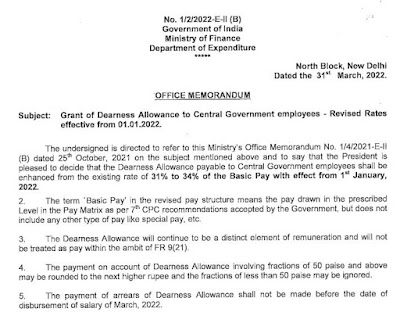
DA Jan 2022 - Grant of Dearness Allowance to Central Government employees - Revised Rates effective from 01.01.2022

 3% DA Hike - Revised Rates effective from 01.01.2022: DoE OM dated 31.03.2022 No. 1/2/2022-E-II (B) Government of India Ministry of Finance...