Friday, 7 November 2014

Central Government Pensioners/Family Pensioners should submit Life Certificate to their respective banks

Central Government Pensioners/Family Pensioners should submit Life Certificate to their respective banks

Government of India
Ministry of Finance
Department of Expenditure
Central Pension Accounting Office
Trikoot-II, Bhikaji Coma Place
New Delhi — 110 066

CPAO/Tech/Life Certificate/2014-15/670-711
31.10.2014
OFFICE MEMORANDUM

Sub: Submission of Life Certificate in the month of November, 2014

Attention is invited to this Office OM No. CPAO/Tech/Pre-2006/Revision/2011-12/191 dated 23rd October, 2012 circulating therewith a copy of CPAO’s’ advertisement in English released in the leading national and regional dailies on 21st October, 2012 regarding obtaining of life certificate in the revised format by the authorized banks from the Central Civil pensioner/ family pensioner in November every year.

It was also advised that the information on the current address and telephone number collected from the Life Certificates is to be updated on the banks master data with the CPPC and the updated master data is required to be sent to CPAO not later than the last week of December every year.

Since the pensioners/family pensioners would start approaching the banks for life certificate from 1st of November, it is reiterated that all Pension Account Holding Branches must be sensitized to ensure the receipt of Life Certificate in the revised format (copy enclosed).

The updated master data must reach CPAO not later than the last week of December, 2014. The modified format of Life Certificate is also available on CPAO’s website www.cpao.nic.in at the link “Forms-For Pensioners” appearing on the left pane of Home Page.
(Vijay Singh)
Sr.Accounts Officer(Tech)
Click to download Life Certificate format

No improvement in IBAs offer – UFBU decides to go ahead with the strike on 12.11.2014

No improvement in IBAs offer – UFBU decides to go ahead with the strike on 12.11.2014

Conciliation meeting held by CLC today(5.11.2014) – No improvement in IBAs offer – CLC calls for further meeting on 10th instant – UFBU decides to go ahead with the strike

Further to the Strike notice served on the IBA by the UFBU, conciliation meeting was held today in New Delhi by Mr. P.P. Mitra Chief Labour Commissioner, Ministry of Labour, Government of India. IBA was represented by Mr. M.V. Tanksale, Chief Executive, Mr. Unnikrishnan, Dy. Chief Executive and other officials. UFBU was represented by all the constituent unions.

During the conciliation proceedings, the IBA contended that due to the reducing profitability of the Banks, they are unable to accept the demands of the UFBU and stated that for the sake of an amicable settlement, they would be willing to consider improving their present offer provided UFBU agrees to substantially reduce the demands. IBA also suggested that UFBU should defer the strike so that the negotiations may be further continued.

On behalf of the UFBU, we explained the reasonability and justification of our demands and stated that the IBAs offer falls too short of our expectations and hence not at all acceptable. We further stated that looking to the runaway inflation as well as the increasing stress and workload under which bank employees and officers are working now-a-days, we deserve adequate wage revision. We also said that besides improvement in emoluments and service conditions, other demands like 5 day banking, regulated working hours for officers, improvement in pension scheme, extending the old pension scheme to the newly recruited employees, etc. are also needed to be resolved but the IBA is not forthcoming on these issues.

IBA informed that they are willing to continue the negotiations further and appealed to the UFBU to defer the strike to facilitate a better atmosphere. UFBU informed that the strike call has been forced on the Unions due to the unhelpful approach and unacceptable offer of the IBA and reiterated its preparedness for further negotiations provided IBA would come forward with substantial improvement in their offer.

After hearing both sides, the Chief Labour Commissioner suggested that both IBA and the UFBU should take steps to reconcile the differences and reach an amicable settlement. He further advised the IBA to talk to the UFBU to find out how the strike could be averted. He also adjourned the conciliation proceedings to 3-00 PM on 10th November, 2014 for further discussions.

Thus, our demands remained unresolved and UFBU decided to go ahead with the strike. Hence, we call upon all our constituent unions and members to march on to 12th November 2014 strike withouut any let up.

sd/
- M V Murali
Convener

Aadhaar Biometric Attendance System – Central Government Employees Attendance Record to be Modernized


Aadhaar Biometric Attendance System

Aadhaar Biometric Attendance System – Central Government Employees Attendance Record to be Modernized

A decade before, all the government offices had printed ‘Attendance Register’ in which employees used to sign against their names in order to record their attendance. The register would usually be kept in front of an Section officer and register should be initialed at the bottom by the Section Officer. Every employee should note down the time of arrival and departure under his /her initial in ink in the Attendance Register. At the end of the 10 minutes grace time, the register would be taken to the department head’s table.
This system was followed by various computerized methods like smartcard, swipe card, and show card. The most popular method now is the Biometric Attendance System, which captures the employees’ fingerprint to record his/her attendance. The Government explained that the new system has been implemented in order to reduce late-coming. The point worth noting is that no changes can be made in the registered time of arrival or leaving, in this method. Higher officials get immediate reports on the time the employee arrived and the time he/she left the office.

Now, the Central Government has gone one step further and has made these attendance records accessible to all. All information including real time chart can be monitored by public also. Through its website, http://attendance.gov.in/, facilities have been made to view the attendance record in real time to bring more transparency. Through the ‘Aadhar’ card-based system, the employee’s fingerprint is captured in the Biometric Attendance device. The details of the employees, including their Aadhar card numbers, are immediately updated on the website. The information collected from various biometric attendance devices are gathered on a centralized Management Information System (MIS) website. All the gathered information is then presented in the form of a Real Time Chart.

All Central Govt Employees Federations have objected to the new attendance system. An order was issued in DOPT dated 28.01.1988, that said that the members of the National Council JCM Staff Side should be consulted with before implementing any new technologies. They asked if the NC JCM’s opinion was considered in this scheme. They have demanded that Pick-up Point System facility must be implemented in order to avoid late-coming in crucial industries, including infrastructure development. They said, every employee is expected to be on seat and to start work at the prescribed opening of office hour.

Thursday, 6 November 2014

‘Swamysnews’ – Unbreakable bond with Central Government employees continues


'Swamysnews’

‘Swamysnews’ – Unbreakable bond with Central Government employees continues
The name ‘Swamysnews’ makes people assume that it is a spiritual publication. But the truth is – the publication has nothing even remotely connected to divinity or religion. It however has got everything to do with information that are relevant to the Central Government employees. In fact, it could be called a treasure trove of details. There is no Central Government employee who doesn’t know about Swamysnews because the publication has answers to all the questions..!

Swamy Publishers Private Limited is a company mainly publishing books on Central Government Rules. For more than 55 years now, the publication, which was started in 1958, continues to provide crucial information in the form of books, to Central Government employees and their offices.

The founder of this organization, Mr.Muthuswamy, was an employee of the Postal Department, a Central Government organization. After getting promoted in his job, he started the service in order to create awareness in the midst of Central Government employees. He had the opportunity to conduct regular free classes for the benefit of his junior colleagues. He edited his lectures and circulated cyclostyled notes on a non-profit basis to examinees in other cities as well. The not-for-profit venture created new openings for him. The books that he published started gaining popularity. Employees found them very useful. He became well known in many Central Government Offices across the country as a reliable instructor and interpreter in the field of Guide Books for Service Rules.

Swamys books are broadly classified into Reference Books, Special Books, Guide Books and a monthly magazine ‘swamysnews’. These books were not only of high quality, but the information contained in them was verified and up-to-date. The books gained further credibility due to the explanations and interpretations of the Government Orders that they featured. Due to their long history in accurately presenting Central Government employees related news, the publication gained the Centre’s approval. Swamysnews Publishers are the only publication with Government approval.

Their monthly publication, ‘Swamysnews’ is their specialty. They usually contain all the latest Government Orders, Case-Law Section, Supreme Court Judgments, Tribunal Judgments and Question and Answer(Readers Forum) section. The Q&A section contains only selected questions. The crystal-clear manner in which they strongly present their answers and explain them shows their confidence and their mastery of the subject.

The crowning achievement of the publication is its annual ‘Swamy’s Handbook for Central Government Employees’. The book is an encyclopedia of information.

In the current age of the Internet, it is possible to find all information on the computer screen. But, it is hard to ignore or forget the contributions made by a publication that they supplied important rules and orders through books in time to all the Departments of Central Government and many Public Sector Undertakings, especially in the North-eastern states.

Even in this age, books continue to be respected. The proof lies in the undiminished sales of their publications.

The strong bond between the Central Government employees and Swamysnews shall only get stronger.

Dopt advised to upload ‘Working Hours, Holidays, Public Dealing Hours on the websites of Indian Government

Dopt advised to all Ministries/Departments to post/upload the working hours, holiday list and public dealing hours, if any, on the home page of their websites.

No.13/2/2014-JCA-2
Government of India
Ministry of Personnel, Public Grievances & Pensions
(Department of Personnel & Training)
North Block, New Delhi,
Dated the 5th November, 2014
OFFICE MEMORANDUM

Sub.: Posting of Information relating to Working Hours etc. on “Indian Government Websites.”

To make the general public and concerned stakeholders aware of the office timing in Government Offices, Department of Personnel & Training has posted this information on the Home page of its website www.persmin.nic.in. The matter regarding posting/ uploading of “Working Hours” etc. on the Websites of Indian Government has been considered in this Department in order to provide information to the citizens staying/residing abroad who seek Indian Government Websites.

2. All Ministries/Departments are advised to post/upload “Working Hours”, Holidays List and Public dealing hours, if any, on the Home Page of their Web-sites. Offices under these Ministries/ Departments who are having their own website may also be advised accordingly.

sd/-
(Ashok Kumar)
Director (JCA)

Source: www.persmin.gov.in
[http://ccis.nic.in/WriteReadData/CircularPortal/D2/D02est/AB.14017_11_2014-Estt-RR.pdf]

Wednesday, 5 November 2014

DA TABLE – DEARNESS ALLOWANCE TABLE - CENTRAL GOVERNMENT EMPLOYEES NEWS

DA TABLE – DEARNESS ALLOWANCE TABLE - CENTRAL GOVERNMENT EMPLOYEES NEWS 

Month Year Base Year
2001=100
Total Average App. DA DA
May 2008 139 1613
June 2008 140 1623 135.25 16.84 16
July 2008 143 1634
Aug 2008 145 1646
Sep 2008 146 1659
Oct 2008 148 1673
Nov 2008 148 1687
Dec 2008 147 1700 141.67 22.38 22

Jan 2009 148 1714
Feb 2009 148 1727
Mar 2009 148 1738
Apr 2009 150 1750
May 2009 151 1762
June 2009 153 1775 147.92 27.78 27
July 2009 160 1792 149.33 29.00
Aug 2009 162 1809 150.75 30.23
Sep 2009 163 1826 152.17 31.45
Oct 2009 165 1843 153.58 32.67
Nov 2009 168 1863 155.25 34.11
Dec 2009 169 1885 157.08 35.70 35

Jan 2010 172 1909 159.08 37.42
Feb 2010 170 1931 160.92 39.01
Mar 2010 170 1953 162.75 40.59
Apr 2010 170 1973 164.42 42.03
May 2010 172 1994 166.17 43.54
Jun 2010 174 2015 167.92 40.05 45
July 2010 178 2033 169.42 46.35
August 2010 178 2049 170.75 47.50
Sep 2010 179 2065 172.08 48.65
Oct 2010 181 2081 173.42 49.81
Nov 2010 182 2095 174.58 50.81
Dec 2010 185 2111 175.92 51.97 51

Jan 2011 188 2127 177.25 53.12
Feb 2011 185 2142 178.50 54.20
Mar 2011 185 2157 179.75 55.28
Apr 2011 186 2173 181.08 56.43
May 2011 187 2188 182.33 57.51
Jun 2011 189 2203 183.58 58.59 58
July 2011 193 2218 184.83 59.67
August 2011 194 2234 186.17 60.82
Sep 2011 197 2252 187.67 62.12
Oct 2011 198 2269 189.08 63.34
Nov 2011 199 2286 190.50 64.56
Dec 2011 197 2298 191.50 65.43 65

Jan 2012 198 2308 192.33 66.15
Feb 2012 199 2322 193.50 67.15
Mar 2012 201 2338 194.83 68.31
Apr 2012 205 2357 196.42 69.67
May 2012 206 2376 198.00 71.04
Jun 2012 208 2395 199.58 72.41 72
Jul 2012 212 2414 201.17 73.78
August 2012 214 2434 202.83 75.22
Sep 2012 215 2452 204.33 76.51
Oct 2012 217 2471 205.92 77.88
Nov 2012 218 2490 207.50 79.25
Dec 2012 219 2512 209.33 80.83 80

Jan 2013 221 2535 211.25 82.49
Feb 2013 223 2559 213.25 84.22
Mar 2013 224 2582 215.17 85.87
Apr 2013 226 2603 216.92 87.38
May 2013 228 2625 218.75 88.97
Jun 2013 231 2648 220.67 90.62 90
Jul 2013 235 2671 222.58 92.28
Aug 2013 237 2694 224.50 93.93
Sep 2013 238 2717 226.42 95.59
Oct 2013 241 2741 228.42 97.32
Nov 2013 243 2766 230.50 99.12
Dec 2013 239 2786 232.17 100.56 100

Jan 2014 237 2802 233.50 101.71
Feb 2014 238 2817 234.75 102.79
Mar 2014 239 2832 236.00 103.87
Apr 2014 242 2848 237.33 105.02
May 2014 244 2864 238.67 106.17
Jun 2014 246 2879 239.92 107.25 107

Jul 2014 252 2896 241.33 108.47


Source: http://www.cgstaffportal.in/

Status Report of Cadre Review of Group ‘A’ Central Services as on 31st October, 2014: DoPT Order

Status Report of Cadre Review of Group ‘A’ Central Services as on 31st October, 2014: DoPT Order
I-11019/25/2014-CRD
Government of India
Ministry of Personnel, Public Grievances & Personnel
(Department of Personnel & Training)
3rd Floor, Lok nayak Bhawan
Khan Market, New Delhi – 110003
October 31, 2014
Subject: – Status Report of Cadre Review of Group ‘A’ Central Services
With reference to the Note of even number dated 12th September, 2014 on the above subject.
2. For the month of October 2014, the status report as on 31st October, 2014 is enclosed.

(Mona Singh)
Director(CRD)
Status of Cadre Review proposals processed in DoPT from 
1st January, 2011 to 31st October 2014
A. Approved by Cabinet
S.no Name of the service CRC* Meeting Cabinet Approval
1. CPWD Central Engineering Service, Central Electrical & Mechanical Engineering Service and Central Architecture Service 27th June, 2011 3rd January, 2012
2. Military Engineering Services(Indian Defence Service of Engineers, Architect Cadre and Surveyor Cadre) 22nd September 2011 and 23rd January 2012 18th April 2013
3. Indian Radio Regulatory Service 19th Feb. 2013 3rd July 2013
4. Indian Revenue Service 19th Feb 2013 and GoM** on 29th April 2013 23rd May 2013
5. Indian Customs & Central Excise 27th Aug. 2013 5th Dec. 2013
6. Indian Cost Accounts Service 29th October 2013 2nd January 2014
7. Central Labour Service 19th Feb. 2013 17th July 2013
8. Central Power Engineering Service 11th December 2013 13th May 2014
9. Indian Ordnance Factory Service 19th March, 2014 Cabinet Meeting held on 29.10.2014
*CRC – Cadre Review Committee
**GoM – Group of Ministers

B. Pending Proposals
Sl. No. Name of Service Status
(i) With Cadre Controlling Authority/Ministry Concerned – CRC meeting held but Cabinet approval pending
1. Indian Civil Accounts Service CRC meeting held on July 17, 2013. Recommendation of CRC approved by MOS (PP), referred to. DoE on 21.8.2013 for taking approval of Cabinet; In View of observation of PMO and Cabinet Secretariat on the CPSMS post, DoE had sought comments of DoPT. Comments of DoPT after holding meeting on 26.08.2014 have been conveyed to DoE.
2. Railway Protection Force CRC meeting held on July 29, 2013. Decision with the approval of MOS (PP) and FM has been communicated to the Ministry of Railways for taking Cabinet approval.
3. Indian Naval Material Management Service The CRC meeting. held on 24 October, 2013. Approval of MoS (PP) and FM has been conveyed to Ministry of Defence on 4th March 2014 for taking Cabinet approval.
4. Indian Statistical Service Approval of MoS (PP) and FM has been conveyed to Ministry of Statistics & Programme Implementation for taking Cabinet approval.
5. Indian Trade Service CRC meeting held on 06.05.2014. Approval of MoS (PP) and FM has been conveyed to Ministry of Commerce & Industry for taking Cabinet approval.
6. Indian information Service CRC meeting held on 30.07.2014. Approval of MoS (PP) and FM has been conveyed to Ministry of information Broadcasting for taking Cabinet approval.
(ii) With Cabinet Secretariat
7. Defence Aeronautical Quality Assurance Service Approval of Secretary (P) has been obtained and the cadre review committee meeting is to be held on 14th November, 2014.
(iii) With Department of Personnel & Training
8. Central Engineering Service (Roads) The Proposal was received on 24.04.2014 but lacked many essential information and therefore clarifications I were sought from MoRTH, Reply has been received on 16.10.2014. The Proposal is under consideration.
9. DGET & Women Training Directorate A presentation has been made on 29 October, 2014 before Secretary (P) by DGET. The proposal is under consideration.
10. Indian P&T Acctt. and Fin. Service Clarifications have been received from DoT. The proposal is under consideration.
11. Indian Railways Personnel Service Clarifications have been received from Ministry of Railways. The proposal is under consideration
12. Indian Railways Accounts Service -do-
13. Indian Railways Stores Service -do-
14. Indian Railways Service of Signal Engineers -do-
15. Indian Railways Service of Electrical Engineers -do-
(iv) With Ministry concerned for clarification
16. Indian P&T Building Works Clarifications are awaited from DoT.
17. Indian Postal Service Proposal received on 19.09.2014. An ID note dated 30 September, 2014 seeking clarifications.
18. Border Road Engineering Service Proposal received on 10.10.2014. By lD note dated 28 October, 2014, the proposal has been returned to MoRTH.

Source: www.persmin.nic.in
[http://ccis.nic.in/WriteReadData/CircularPortal/D2/D02adm/MX-M452N_20141103_183713.pdf]

AIRF Latest News - Concept Note: Proposed Scheme for Cashless treatment of RELHS beneficiaries in Private empanelled hospitals.

Concept Note: Proposed Scheme for Cashless treatment of RELHS beneficiaries in Private empanelled hospitals.

Concept Note: Proposal for implementing Scheme of cashless treatment for RELHS beneficiaries in medical emergency situations at Railway empanelled private hospitals.

GOVERNMENT OF INDIA (BHARAT SARKAR)
MINISTRY OF RAILWAYS(RAIL MANTRALAYA)
(RAILWAY BOARD)
No.2014/H/28/Smart Card/Part A
dated 27.10.2014
The General secretaryAIRF,4, State Entry Road
New Delhi-110055
The General Secretary,NFIR,3,Chelmsford Road,
New Delhi-110055

Dear Sirs,
Sub: Proposed Scheme for cashless treatment of RELHS beneficiaries in private empanelled hospitals

To discuss the above mentioned subject with the Federations, a spate meeting has been fixed for 05.11.201 at 11.00 Hrs in Chamber of DG(RHS), room .No.348, Railway Board, Rail Bhawan, New Delhi. President and General Secretary of the Federations may kindly make it convenient to attend the Meeting. A ‘Concept Note’ the subject is also sent herewith.
Your faith fully
Sd/-
(D.Malik)
Director,Estt.(IR)
DA: As above (7 pages)
CONCEPT NOTE

Sub: Proposal for implementing Scheme of cashless treatment for RELHS beneficiaries in medical emergency situations at Railway empanelled private hospitals.

The basic requirements for implementing the scheme of cashless treatment for RELHS beneficiaries in empanelled hospitals can be summarized as follows:

1) The RELHS beneficiary should be able to prove his identity and eligibility to the private hospitals. –

2) The private hospital should be able to communicate with the railway authorities and send relevant clinical details of the patient admitted to railway empanelled private hospital.

3) Railway medical authority after examination of clinical details should be able to authorize/decline the treatment.

4) Private hospital should be able to raise the bill as per the mutually agreed rates.
The model suggested by the committee takes care of all these requirements. For this committee has suggested a model in which a chip based card shall be issued by Railway to every beneficiary. However in the changed scenario it is reasonable to assume that almost every RELHS beneficiaries will be having an Adhaar card or will be getting it shortly. Hence the railway can implement the solution as outlined by committee without issuing a chip based smart card. The identification of the railway beneficiary can be established with the help of Adhaar card

Brief outline of the scheme with Adhaar Card

ARPAN has the data base of almost all the retired employees. Very soon it is supposed to have the data base of all the past retirees and all the PPOs in future shall also be issued through it. All the information required for the provision medical facilities are present in this data base except for the photograph and biometric details. For identification photograph and biometric details like fingerprint is required. These details are available with the Unique Identification Authority of India website. Railway can get its website developed as outlined by the committee with all the functionalities recommended by the committee.
For the purpose of identification of the beneficiary railway can enter into an MOU with UIDAI. From henceforth Personnel Department will write the Adhaar Card number of all the beneficiaries in the railway medical identity card. For the past retirees Personnel Department will have to undertake a onetime exercise of writing the Adhar Card No. of the beneficiaries in the respective medical identity cards.

ILLUSTRATION OF “A TYPICAL CASE SCENARIO” WITH ADHAAR CARD BASED MIC

1. RELHS beneficiary develops Acute Chest Pain at 2 ‘o’ clock in the night while staying in a different city with relatives.

2. The beneficiary is taken to a recognized hospital near the house by the family members, after locating a nearby recognized hospital from the list given at the website.

3. The MIC with Adhaar card No. is presented to the hospital. Hospital logs on to the ARPAN website and enters the Adhaar card No. of the patient. The following case scenarios may happen:

A. If the beneficiary is conscious, he is asked to put his/her thumb on the fingerprint reader. The fingerprint is sent to UIDAI website through ’ARPAN’ automatically. After comparing the physical fingerprint with the UIDAI website stored data, authenticity of the patient as an authorized RELHS beneficiary is confirmed to ARPAN. ARPAN confirms the identity and eligibility of the patient to the hospital.

B. If the beneficiary has been taken to ICU, or otherwise is not in a position to put his finger on fingerprint reader, ’ARPAN’ may confirm the identity and eligibility of the beneficiary based on the Adhaar card no. However, this confirmation will be treated as provisional. Hospital will be instructed to confirm the identity, by sending physical finger print of the patient to ARPAN and subsequent confirmation, before discharge.

C. A situation may occur wherein the internet connectivity of hospital is down at the time of presentation of patient. The hospital may start the treatment after verifying physical information present on the card. As soon as the internet connectivity is restored, the hospital may verify the identity of patient from ’ARPAN’ and get the authorization from Railway authorities. In case’the internet connectivity is not expected to be restored for 24 hrs or more then the authorization will have to be obtained by some other mean like FAX, telephone etc. Note: When the Zonal Railways are entering into an agreement with the
empanelled/ recognized private hospitals, they must insist upon the hospitals to ensure availability of finger print/ Retinal scan reader facility and internet connectivity etc., before signing the agreement.

4. At the same time a case file opens at ARPAN, an e-mail (giving relevant details of the patient’s clinical condition) is sent to the Railway Medical Officer(s), who has to authorize the treatment. An SMS alert is also sent to the Railway Medical Officer(s) to check the mail.

5. On checking the e-mail, if Railway Medical Officer is satisfied that emergency exists, authorizes the treatment or declines or some more information may be asked by the Railway Medical Officer, which hospital should send, before authorization is given.

6. If treatment is authorized, then the patient is treated, discharged (after taking a finger print in case sheet, in case it is required in future) and bill is sent to the same Railway hospital/Health Unit which authorized the treatment.

7. If treatment is not authorized, then, depending upon the condition of the patient:-
The Railway empanelled hospital may be asked to send an ambulance to transfer the patient to Railway hospital.
OR

The patient may be asked to come to Railway hospital during next working day.

8. The bill, after checking that it is as per CGHS rates, shall be sent to Associate Accounts department. Money shall be paid to hospital on passing of bill.

9. If required, debit note shall be raised by the local Accounts department to the concerned Railway, where the RELHS/ Smart card is registered.

How to Implement the Solution of Smart Card for treatment of RELHS beneficiaries in Emergency Situations
The various activities to be undertaken for the implementation of the Smart Card Scheme are as follows, along with responsibilities of various department/functionaries:
A. Western Railway, which has awarded the work of ’ARPAN’ to CMC, may be asked to extend the scope of the present work to include following:
To develop various modules on the ’ARPAN’ required for running the smart card scheme, the modules shall be as follows:

i. List of recognized hospitals, zone, state, city and area wise, along with information on the services/ specialities for which the hospital is recognized.

ii. The authorized persons from the Railway administration side should be able to log on to the site with unique id and password and authorize treatment and communicate with the hospitals.

iii. The recognised hospitals will have a read only access to the database on the site with a unique id and password to establish the identity and eligibility of the patient reporting to them, and communicate with the Railway medical authorities.

iv. The basic data, Adhaar card no. with the key number being the PPO number, of all the beneficiaries should be stored at the website. Ideally, the initial identification of the beneficiary at the time of presenting himself to the hospital should be through comparison of the patient’s fingerprints/retinal scan (at the hospital’s finger print reader) to the UIDAI website stored biometric parameters only. However, there may be times when internet is down or the hospital is experiencing difficulty in connectivity. In such situations, the hospital can verify the identity of the person through the details available on the card. However, it will be the duty of the hospital to establish the identity of the patient through fingerprint(s)/ retinal scan stored on the UIDAI website before discharge, otherwise it will not be considered authorized treatment by Railways. In all cases, the hospital will take the fingerprint of the patient treated in the case sheet, so that random checks may be administered by Railway, whenever required.

v. ’Aadhar Number’ shall be a part of the database and till ’Aadhar Number’ is not available the beneficiary shall not be able to avail the facility of cashless treatment in railway empanelled private hospital at the time of emergency. It shall be considered mandatory or prerequisite for establishing identity. Railway can enter into a MOU with UID Authority of India for identification of its beneficiaries.

vi. Whenever an empanelled hospital request authorization, a case file with a unique number should open at the website and all the communication (through website) from the hospital to the railway authorities and vice versa should be stored in the file, till the case is closed.
B. Process of making the Card
a. Personnel Department of every zone/PU/other units of railway shall take out advertisements in newspapers and other mass media advising all the RELHS card holders to come to their respective personnel office along with their Aadhar Cards for getting their AADHAR numbers incorporated in the RELHS card. Personnel Department shall verify the bonafide of the members included in the card and make a new card for each member in which the AADHAR card number of eligible beneficiary shall also be included. At the same time personnel department shall update the database of ARPAN with the AADHAR card number of the beneficiary.

b. Similarly, after commencement of the scheme, at the end of every month, establishment section (personnel department) of every office shall issue the RELHs card with AADHAR Card number of eligible beneficiaries, Updating the database at the same time.
Note- The points given above will take care of both the group of retirees, those who have already retired and those who will be retiring in future. Those who are left out in the first instance (among already retired) can be issued cards at the time of monthly exercise of issue of cards.
C. Duties of different Departments
a. Personnel department: a.) They will be updating the database on real time basis egg. on death of a beneficiary or a dependent son/daughter getting married (becoming ineligible), the particular card will be disabled, by sending information to the external agency (CMC). b.) They will be issuing the RELHS cards for all the retirees in the future, and undertake the one time exercise. c.) Retired personnel/Family pensioner shall give a declaration once every year about the eligible family members for medical treatment which will be verified and matched with the data base.

b. Medical Department of zonal railways will empanel private hospitals (located in its geographical limits) recognized by CGHS at the same rates and enter into an MOU with them. if there is no CGHS empanelled hospital at a place, then Railways will recognize suitable hospital(s) as per the already existing procedure. All the zonal HQs will be communicating the list of empanelled Hospitals to the agency maintaining the site on real time basis. Each empanelled hospital will be allotted a particular Railway Health institution which is nearest/ suitable as decided by the zonal authorities. For every administrative function e.g. treatment authorization, bill submission, bill payment etc. the empanelled hospital will have to communicate with that particular Health Institution of Railways only. Information about any railway patient admitted to that hospital will be communicated to that Railway Health Institution. Authorization for treatment Will be given by Railway Health Institution (through its designated Railway medical Officers) based on clinical parameters communicated by the hospital within 24 hrs. If authorization is declined, then the patient will be taken over by the railway hospital for further treatment. Suitable clauses to this effect will have to be incorporated in the MOU with hospitals and retired Railway Beneficiaries will also be required to give an undertaking to this effect at the time of applying for Smart Card.

c. Accounts Department: Will pass the bills submitted by the Private Hospitals to the local Railway Health Institutions, as per the rules. In case the patient belongs to some other zone then the debit may be raised to the concerned zone at a later stage, but the bill shall be passed by the local accounts only.

d. The departments which are maintaining the personal details/ service records etc. (e.g. Accounts Department, RPF) of its retired employees will perform the same duties as Personnel Department, for implementation and smooth running of this scheme.
D. Creation of additional post
This will entail additional work for medical, personnel and accounts department. It is proposed that two posts of data entry operator/clerk shall be created by the zones/ PU at every divisional and zonal hospital by matching surrender. Similarly, every personnel department (for continuously updating data base of ARPAN) and accounts department (for clearing bill) may create an additional post of clerk at divisional level.
E. Benefits of the Scheme if implemented as outlined
1. All RELHS persons living away from railway hospital will be able to get Medical treatment at the time of emergency without worrying about the payment. It will be a confidence inspiring welfare measure. Even the serving employees will feel more confident about their old age health needs.

2. No unauthorized person will be able to utilize the card fraudulently for getting treatment. Thus, it will save Railway revenue.

3. It will streamline the whole process of treatment, hospital bill payment etc.

4. It will result in decreased number of medical reimbursement cases.

5. Railway will not make unnecessary expenditure on issuing smart cards.

6. Since the proposed website shall be developed in conjunction with ARPAN the expenditure on it will be minimal.

7. There will be no unnecessary expenditure on development of a separate website on a different server. There will be optimum utilization of the existing resources.

8. Railway shall be rolling out this scheme in line with the flagship programme of the Government of India, namely, UIDAI and shall be, making good utilisation of existing Government of India resources.

9. The RELHS beneficiaries will face minimum difficulty in becoming the member of this scheme. They will not be required to get any new card made.

10. These cards and website will seamlessly integrate to the HIMS system, whenever it is implemented by the Railway in its hospitals.

11. If Personnel department installs finger print readers at the points of issuing complimentary passes, the whole process can be streamlined and will become verifiable through the data base of ARPAN. it will decrease the possibility of fraudulent issue of complimentary passes.

12. The data base of ARPAN shall become complete with the addition of photographs and biometric details.


Source: www.airfindia.com
[http://www.airfindia.com/Orders%202014/RELHS_03.11.14.pdf]

Tuesday, 4 November 2014

Expected DA from Jan 2015 – Comparison of DA Calculation from 2006 to 2014

Expected DA from Jan 2015 – Comparison of DA Calculation from 2006 to 2014

Expected-DA-jan-2015
Expected DA from Jan 2015 – AICPIN Points for September Released – Remains Unchanged at 253


One of the most important department functioning under the Central Government is the Labour Bureau. The department releases a number of important statistics and conducts surveys. In the year 1872, the department had successfully conducted the population census of the entire country. This census gave not only the count of number of persons, but also the number of gainfully employed. Since then every census has thrown useful data on workers in different industries and occupations every 10 years. The bureau also releases official information, economic indicators like Consumer Price Index Numbers for Industrial, Agricultural and Rural Labourers; wage rate indices and data on industrial relations etc. that are followed by a number of government departments.
One such indicator is the monthly Consumer Price Index Numbers (Industrial Workers 2001=100), which is used to calculate the Dearness Allowance for Central Government employees. Prices of 24 essential commodities (from rice to bathing soap) are observed in 78 cities all over the country in order to calculate the average index of CPI(IW).
It is based on these statistics that, once every six months, the Centre announces Dearness Allowance for its employees. Based on the AICPIN(All India Consumer Price Index Numbers) between January and June, and between July and December, the Finance Ministry decides the percentage of hike in Dearness allowance and Dearness Relief according to the recommendations of 6th CPC and informs the Government. The Centre makes its decision after discussing the recommendation during the cabinet meeting.
Now, ‘Expected DA from Jan 2015′ is the first installment of next year and only three months’ data have been collected as of now, for the Dearness Allowance. Accurate D.A percentage can be calculated only after the remaining 3 months’ AICPIN points are announced.
But, we believe that based on October’s AICPIN points, we can conclude if the next D.A hike is going to be for 6% or 7%.
The Dearness Allowance announcements since 2006 have been tabulated and presented, as additional information.
Year wise DA Calculation tables form 2006 to 2014…
DA-Calculation-for-Jan-2006           DA-Calculation-for-Jul-20061
DA-Calculation-for-Jan-2007          DA-Calculation-for-Jul-20071
DA-Calculation-for-Jan-2008          DA-Calculation-for-Jul-20081
DA-Calculation-for-Jan-2009         DA-Calculation-for-Jul-20091
DA-Calculation-for-Jan-2010         DA-Calculation-for-Jul-20101
DA-Calculation-for-Jan-2011         DA-Calculation-for-Jul-20111
DA-Calculation-for-Jan-2012         DA-Calculation-for-Jul-2012
DA-Calculation-for-Jan-2013         DA-Calculation-for-Jul-2013
DA-Calculation-for-Jan-2014        
DA-Calculation-for-Jul-2014 

Monday, 3 November 2014

Inclusion of Aadhaar (Unique Identification) number in Service Book of Government servants

Inclusion of Aadhaar (Unique Identification) number in Service Book of Government servants

It has been decided to include the respective Aadhaar numbers also of all Government servants in their Service Books. The e-Service Book format already provides fields for Aadhaar number of the Government servant. DoPT Order:-


No.Z-20025/9/2014-Estt.(AL)
Government of India
Ministry of Personnel, Public Grievances & Pensions
Department of Personnel & Training


Block-IV, Old JNU Campus,
New Delhi, November 3rd 2014


OFFICE MEMORANDUM

    Subject: Inclusion of Aadhaar (Unique Identification) number in Service Book of Government servants

The undersigned is directed to invite attention to the provisions of the Supplementary Rules which relate to maintaining records of service of a Government employee. As per provisions of SR 199 every step in a Government servants’ official life must be recorded in his Service Book and each entry attested by the Head Of Office. As per SR 202, Heads of Offices are to obtain the signatures of the Government servants in token of their having inspected their Service Books annually. Further Rule32 of the CCS (Pension) Rules 1972 provides for issuing a communication on completion of 18 years of service, as part of preparatory work for sanctioning pensionary benefits. The Service Books at present contains details of bio data, posting details, qualifying service, security details, HBA, CGHS, CGEGIS, LTC, etc.

2. It has been decided to include the respective Aadhaar numbers also of all Government servants in their Service Books. The e-Service Book format already provides fields for Aadhaar number of the Government servant.

3. All Ministries/Departments of the Government of India are requested to ensure that the Service Books of all employees have an entry of the employees’ Aadhaar number. The attached and subordinate offices under their control may also be suitably instructed for compliance,


(Mukul Ratra)
Director
Source: www.persmin.nic.in
[http://ccis.nic.in/WriteReadData/CircularPortal/D2/D02est/Z-20025_9_2014-Estt-AL..pdf]

Flash News

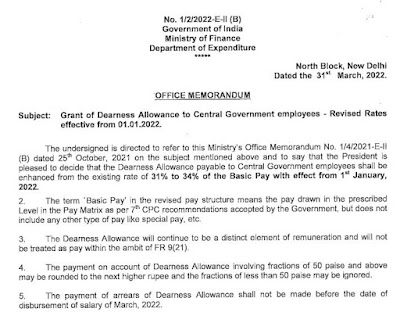
DA Jan 2022 - Grant of Dearness Allowance to Central Government employees - Revised Rates effective from 01.01.2022

 3% DA Hike - Revised Rates effective from 01.01.2022: DoE OM dated 31.03.2022 No. 1/2/2022-E-II (B) Government of India Ministry of Finance...