Showing posts with label AIRF Latest News. Show all posts

Friday, 12 April 2019

Inclusion of important categories of staff within the ambit of Risk And Hardship Matrix of 7th CPC for payment of Risk And Hardship Allowance


Inclusion of important categories of staff within the ambit of Risk And Hardship Matrix of 7th CPC for payment of Risk And Hardship Allowance

A.I.R.F.
All India Railwaymen’s Federation
4, State Entry Road, New Delhi - 110055

No.AIRF/Sub-Committee 294
Dated: April 11, 2019
The Convener,
Committee on Risk & Hardship Allowance and
EDPC-II, Railway Board,
DFCC Building, Pragati Maidan Metro Station,
New Delhi

Dear Sir,
Sub: Inclusion of important categories of staff within the ambit of Risk And Hardship Matrix of 7th CPC for payment of Risk And Hardship Allowance

Technical Staff(Helpers, Technicians, JEs and SSEs) of all Engineering Disciplines(Civil, Electrical, Mechanical and S&T Deptts.), staff engaged in train operation, sanitation and many staff of Medical Department are prone to Risk and Hardship. Their level of Risk and Hardship may vary according to their job contents, working conditions, weather conditions, work pressure and surrounding environments at the respective places.

While drawing structure of Risk and Hardship Matrix, it is clarified that, the Matrix only aims to compensate for Risk and Hardship involved in job/work environment and it does not determine status in any way.

1. Categories of Civil Engg. Deptt. (Helpers to SSEs)

(i) P. Way - JEs/SSEs, Technicians(Blacksmith, Welder, Carpenter), Helpers of Blacksmith and Welder.
Track Maintainers of Constn. Org. and USFD Staff.
(ii) Track Machine - Staff working on Openline and Workshops(JEs, SSEs, Technicians and Helpers)
(iii) Bridge Deptt., Openline and Workshops - JEs, SSEs, Technicians(Sarang, Riveter, Welder, Blacksmith, Grinder, Fitter, Machinist, Turner, Driller and Helpers).
(iv) Technicians and SSEs(Works) and also staff attending drainage cleaning.
(v) Gateman

2. Categories of Electrical Deptt.

(i) TRD Staff (Helpers, Technicians, JEs and SSEs)
(ii) TRS Staff (Helpers, Technicians, JEs and SSEs) of Openline and Workshops
(iii) Power Staff (Helpers, Technicians, JEs and SSEs) of Openline
(iv) Air-conditioning and Train Lighting Staff (Cell and Battery Fitter and Helpers)
(v) Tower Wagon Driver
(vi) General Services Staff, including Power Houses and Sub-Station Operator.
(vii) EOT Crane Driver, Slingers, Gunners

3. 7th CPC Risk And Hardship Allowance - AIRF Letter Dt.11.4.2019

(i) JEs/SSEs, Technicians and Helpers of C&W Maintenance Depots and Workshops.
(ii) JEs/SSEs, Technicians and Helpers of Locomotive Sheds and Workshops.
(iii) Lab. Sudt., C&MAs
(iv) Technicians (Fitters, BH Painters, Machinists, Welders, Millwright)
(v) Auto/ Forklifter/ Drivers, Crane Drivers, Gunners, Slingers

S&T Deptt.

(i) JEs/ SSEs (Signal), ESMs, MSMs and Helpers
(ii) JEs/ SSEs (Telecom.), TCMs, WTMs and Helpers

5. Operating Deptt.

(i) SMs, YMs, TNCs, Pointsman, Shuntman, Shunting Jamadar, Shunting Master, Traffic Asstt.

6. Medical Deptt.

Radiographers, Safaiwala, Malaria Staff

7. Technical Staff (JEs/ SSEs, Technicians, Helpers) of Production Units of all Engg. Disciplines

All categories, having job contents, related to Annexure of RBE No.44/2013 dated 02.05.2013.
Yours faithfully,
sd/-
(Shiva Gopal Mishra)
General Secretary
Source: AIRF

Friday, 15 July 2016

AIRF: Salary of August month will be based on 7th CPC recommendations

AIRF: Salary of August month will be based on 7th CPC recommendations

7th Pay Commission – Clarification regarding salaries to be paid

A.I.R.F.
All India Railwaymen’s Federation
No.AIRF/405(VII CPC)
Dated: July 13, 2016
The General Secretaries,
All Affiliated Unions,
Dear Comrades!

In continuation of our earlier letter of even number dated 8th July, 2016, wherein clarification was issued, whether payment of salaries based on 7th CPC recommendations will be made from current month or otherwise, it is hereby clarified that; salary of August month will be based on 7th CPC recommendations.

airf-letter-7thCPC

Thursday, 30 June 2016

No improvement in Minimum Wage and Multiplying Factor – AIRF

No improvement in Minimum Wage and Multiplying Factor – AIRF

We should go ahead with our preparations for “Indefinite Strike – Com. Shiva Gopal Mishra
It is quite unfortunate that, our demand for improvement in the report of the VII CPC has not been considered by the government.

Therefore, it would be quite appropriate that, we should go ahead with our preparations for “Indefinite Strike”, slated to be commended from 06:00 hrs. on 11th July, 2016…. Complete letter is uploaded below:-

A.I.R.F
All India Railwaymen Federations
4,STATE ENTRY ROAD, NEW DELHI-110055
No.AIRF/160
Dated: June 29, 2016
The General Secretaries,
All Affiliated Unions,

Dear Comrades!
Sub: Cabinet approval on the VII CPC report

As all of you are aware that the Union Cabinet has accepted the report of the VII CPC today.

It has been noticed that there is no improvement in Minimum Wage and Multiplying Factor as well, which was our hard pressed demand. Instead, wages, as recommended by the VII CPC have been accepted as it is, which is highly disappointing.

Only two committees have been formed, one to take care of the allowances and another for National Pension Scheme, which will submit their reports within four months time.

It is quite unfortunate that, our demand for improvement in the report of the VII CPC has not been considered by the government.

Therefore, it would be quite appropriate that, we should go ahead with our preparations for “Indefinite Strike”, slated to be commended from 06:00 hrs. on 11th July, 2016.

You are also advised to intensify the mass mobilization.
With fraternal greetings!
Yours faithfully
(Shiv Gopal Mishra)
General Secretary
Source: AIRF

Thursday, 16 June 2016

Empowered Committee meeting scheduled on 11.6.2016 has been cancelled – AIRF

Empowered Committee meeting scheduled on 11.6.2016 has been cancelled – AIRF

Internal meeting of group of secretaries scheduled on 11.06.2016 on 7th Pay commission didn’t take place

Internal meeting of group of secretaries which was scheduled to be held on 11.06.2016 has been cancelled. Meeting didn’t take place at all. Shri P.K. Sinha Cabinet Secretary is heading the committee of Group of Secretaries.

On the clarion call of the National Joint Council of Action (NJCA), against the retrograde recommendations of the VII CPC, 11-point Charter of demands of the Central Government employees as also non-settlement of long pending genuine demands of the Railwaymen, AIRF and its affiliates organized huge demonstrations at all Zonal Headquarters of Indian Railways on 9 June 2016. On this occasion the employees of Indian Railway participated in mass demonstrations with full enthusiasm with holding banners in hand and shouting slogans for early redressal of their long pending genuine demands.

On the one hand AIRF and its affiliates are fighting for the cause of Railway employees and on the other hand rumour mongers are spreading false news through social media. Rumour mongers are coming out daily with different kind of news and pay scales about 7th Pay Commission. They have even declared that government would take a final call on 7th Pay Commission during internal meeting of group of secretaries on 11th of June, 2016.

We will update on the issue soon. Please don’t believe rumour mongers on What’sAPP, Facebook and other social media sources.

We request all comrades to not to believe such rumour mongers. These fellows have no benefits but to lighten the feelings of agitated working class. AIRF urge comrades to be prepared for Indefinite strike which is scheduled on 11, July 2016 at 06:00 AM.

Source: AIRF

Thursday, 19 February 2015

AIRF writes to PM in respect of his support in defending justify to Strike for workers

AIRF writes to PM in respect of his support in defending justify to Strike for workers

Com. Shiva Gopal Mishra writes to Prime Minister of India in respect of his support in defending justify to Strike for workers.
A.I.R.F.
All India Railwaymen’s Federation
4, State Entry Road,
New Delhi – 110055, India
No.AIRF/128
Dated: February 18, 2015
Shri Narendra Modi Ji,
Hon’ble Prime Minister,
(Government of India),
South Block,
New Delhi

Respected Sir,

I write today to alert you to the serious situation faced by the International Labour Organization.
The Employers’ Group in the Committee on the Application of Standards precipitated a crisis by challenging the independence of the long-established and authoritative Committee of the Experts on Application of Conventions and Recommendations(CEACR), a group of highly qualified persons, vetted and appointed through the tripartite Governing Body of the ILO.

Since June 2012 there have been a number of discussions in the ILO Governing Body, “Informal Discussions” with the experts and tripartite consultations. The Swiss Government facilitated, to no avail, an attempt to reach a consensus on a way forward.

To date, the employers have not fundamentally altered their position. The employers simply refuse to defer to the observations of the experts, while at the same time refusing to avail themselves of the judicial means available under the ILO constitution to challenge those observations which creates great instability for the entire ILO supervisory system. While not binding as only the International Court of Justice can issue a legally binding interpretation of a Convention under the ILO Constitution, the work of the supervisory system, particularly the ILO Committee of Experts, is recognized as having persuasive validity and should stand in the absence of higher authority.

Instead, they continue to insist that the experts’ reports state clearly that they have not been approved by the
Tripartite Constituents. This is part of their effort to put the political bodies, rather than independent experts, in charge of interpreting the conventions. The employers do not find that the existing, detailed statement of the experts’mandate already found in the reports is sufficiently clear and thus want a “Clarification”, “Statement of Truth”, or “Disclaimer”, which defines to the Employers’ Group satisfaction the mandate of the Committee of Experts and the legal status of their opinions.

The effective cornerstone of the ILO for many decades, its Supervisory System, is under threat.

Prime Minister Sir, the ILO was founded by governments with the foresight to provide a unique and tripartite forum where labour matters and concerns could be discussed in a mature and respectful context and balances between diverging interests sought.

Without it, workers are left without this important recourse to justice and fairness.

I urge you to make your support for the ILO and its Supervisory System known to the social partners of your country.
Yours sincerely,
(Shiva Gopal Mishra)
General Secretary

Wednesday, 5 November 2014

AIRF Latest News - Concept Note: Proposed Scheme for Cashless treatment of RELHS beneficiaries in Private empanelled hospitals.

Concept Note: Proposed Scheme for Cashless treatment of RELHS beneficiaries in Private empanelled hospitals.

Concept Note: Proposal for implementing Scheme of cashless treatment for RELHS beneficiaries in medical emergency situations at Railway empanelled private hospitals.

GOVERNMENT OF INDIA (BHARAT SARKAR)
MINISTRY OF RAILWAYS(RAIL MANTRALAYA)
(RAILWAY BOARD)
No.2014/H/28/Smart Card/Part A
dated 27.10.2014
The General secretaryAIRF,4, State Entry Road
New Delhi-110055
The General Secretary,NFIR,3,Chelmsford Road,
New Delhi-110055

Dear Sirs,
Sub: Proposed Scheme for cashless treatment of RELHS beneficiaries in private empanelled hospitals

To discuss the above mentioned subject with the Federations, a spate meeting has been fixed for 05.11.201 at 11.00 Hrs in Chamber of DG(RHS), room .No.348, Railway Board, Rail Bhawan, New Delhi. President and General Secretary of the Federations may kindly make it convenient to attend the Meeting. A ‘Concept Note’ the subject is also sent herewith.
Your faith fully
Sd/-
(D.Malik)
Director,Estt.(IR)
DA: As above (7 pages)
CONCEPT NOTE

Sub: Proposal for implementing Scheme of cashless treatment for RELHS beneficiaries in medical emergency situations at Railway empanelled private hospitals.

The basic requirements for implementing the scheme of cashless treatment for RELHS beneficiaries in empanelled hospitals can be summarized as follows:

1) The RELHS beneficiary should be able to prove his identity and eligibility to the private hospitals. –

2) The private hospital should be able to communicate with the railway authorities and send relevant clinical details of the patient admitted to railway empanelled private hospital.

3) Railway medical authority after examination of clinical details should be able to authorize/decline the treatment.

4) Private hospital should be able to raise the bill as per the mutually agreed rates.
The model suggested by the committee takes care of all these requirements. For this committee has suggested a model in which a chip based card shall be issued by Railway to every beneficiary. However in the changed scenario it is reasonable to assume that almost every RELHS beneficiaries will be having an Adhaar card or will be getting it shortly. Hence the railway can implement the solution as outlined by committee without issuing a chip based smart card. The identification of the railway beneficiary can be established with the help of Adhaar card

Brief outline of the scheme with Adhaar Card

ARPAN has the data base of almost all the retired employees. Very soon it is supposed to have the data base of all the past retirees and all the PPOs in future shall also be issued through it. All the information required for the provision medical facilities are present in this data base except for the photograph and biometric details. For identification photograph and biometric details like fingerprint is required. These details are available with the Unique Identification Authority of India website. Railway can get its website developed as outlined by the committee with all the functionalities recommended by the committee.
For the purpose of identification of the beneficiary railway can enter into an MOU with UIDAI. From henceforth Personnel Department will write the Adhaar Card number of all the beneficiaries in the railway medical identity card. For the past retirees Personnel Department will have to undertake a onetime exercise of writing the Adhar Card No. of the beneficiaries in the respective medical identity cards.

ILLUSTRATION OF “A TYPICAL CASE SCENARIO” WITH ADHAAR CARD BASED MIC

1. RELHS beneficiary develops Acute Chest Pain at 2 ‘o’ clock in the night while staying in a different city with relatives.

2. The beneficiary is taken to a recognized hospital near the house by the family members, after locating a nearby recognized hospital from the list given at the website.

3. The MIC with Adhaar card No. is presented to the hospital. Hospital logs on to the ARPAN website and enters the Adhaar card No. of the patient. The following case scenarios may happen:

A. If the beneficiary is conscious, he is asked to put his/her thumb on the fingerprint reader. The fingerprint is sent to UIDAI website through ’ARPAN’ automatically. After comparing the physical fingerprint with the UIDAI website stored data, authenticity of the patient as an authorized RELHS beneficiary is confirmed to ARPAN. ARPAN confirms the identity and eligibility of the patient to the hospital.

B. If the beneficiary has been taken to ICU, or otherwise is not in a position to put his finger on fingerprint reader, ’ARPAN’ may confirm the identity and eligibility of the beneficiary based on the Adhaar card no. However, this confirmation will be treated as provisional. Hospital will be instructed to confirm the identity, by sending physical finger print of the patient to ARPAN and subsequent confirmation, before discharge.

C. A situation may occur wherein the internet connectivity of hospital is down at the time of presentation of patient. The hospital may start the treatment after verifying physical information present on the card. As soon as the internet connectivity is restored, the hospital may verify the identity of patient from ’ARPAN’ and get the authorization from Railway authorities. In case’the internet connectivity is not expected to be restored for 24 hrs or more then the authorization will have to be obtained by some other mean like FAX, telephone etc. Note: When the Zonal Railways are entering into an agreement with the
empanelled/ recognized private hospitals, they must insist upon the hospitals to ensure availability of finger print/ Retinal scan reader facility and internet connectivity etc., before signing the agreement.

4. At the same time a case file opens at ARPAN, an e-mail (giving relevant details of the patient’s clinical condition) is sent to the Railway Medical Officer(s), who has to authorize the treatment. An SMS alert is also sent to the Railway Medical Officer(s) to check the mail.

5. On checking the e-mail, if Railway Medical Officer is satisfied that emergency exists, authorizes the treatment or declines or some more information may be asked by the Railway Medical Officer, which hospital should send, before authorization is given.

6. If treatment is authorized, then the patient is treated, discharged (after taking a finger print in case sheet, in case it is required in future) and bill is sent to the same Railway hospital/Health Unit which authorized the treatment.

7. If treatment is not authorized, then, depending upon the condition of the patient:-
The Railway empanelled hospital may be asked to send an ambulance to transfer the patient to Railway hospital.
OR

The patient may be asked to come to Railway hospital during next working day.

8. The bill, after checking that it is as per CGHS rates, shall be sent to Associate Accounts department. Money shall be paid to hospital on passing of bill.

9. If required, debit note shall be raised by the local Accounts department to the concerned Railway, where the RELHS/ Smart card is registered.

How to Implement the Solution of Smart Card for treatment of RELHS beneficiaries in Emergency Situations
The various activities to be undertaken for the implementation of the Smart Card Scheme are as follows, along with responsibilities of various department/functionaries:
A. Western Railway, which has awarded the work of ’ARPAN’ to CMC, may be asked to extend the scope of the present work to include following:
To develop various modules on the ’ARPAN’ required for running the smart card scheme, the modules shall be as follows:

i. List of recognized hospitals, zone, state, city and area wise, along with information on the services/ specialities for which the hospital is recognized.

ii. The authorized persons from the Railway administration side should be able to log on to the site with unique id and password and authorize treatment and communicate with the hospitals.

iii. The recognised hospitals will have a read only access to the database on the site with a unique id and password to establish the identity and eligibility of the patient reporting to them, and communicate with the Railway medical authorities.

iv. The basic data, Adhaar card no. with the key number being the PPO number, of all the beneficiaries should be stored at the website. Ideally, the initial identification of the beneficiary at the time of presenting himself to the hospital should be through comparison of the patient’s fingerprints/retinal scan (at the hospital’s finger print reader) to the UIDAI website stored biometric parameters only. However, there may be times when internet is down or the hospital is experiencing difficulty in connectivity. In such situations, the hospital can verify the identity of the person through the details available on the card. However, it will be the duty of the hospital to establish the identity of the patient through fingerprint(s)/ retinal scan stored on the UIDAI website before discharge, otherwise it will not be considered authorized treatment by Railways. In all cases, the hospital will take the fingerprint of the patient treated in the case sheet, so that random checks may be administered by Railway, whenever required.

v. ’Aadhar Number’ shall be a part of the database and till ’Aadhar Number’ is not available the beneficiary shall not be able to avail the facility of cashless treatment in railway empanelled private hospital at the time of emergency. It shall be considered mandatory or prerequisite for establishing identity. Railway can enter into a MOU with UID Authority of India for identification of its beneficiaries.

vi. Whenever an empanelled hospital request authorization, a case file with a unique number should open at the website and all the communication (through website) from the hospital to the railway authorities and vice versa should be stored in the file, till the case is closed.
B. Process of making the Card
a. Personnel Department of every zone/PU/other units of railway shall take out advertisements in newspapers and other mass media advising all the RELHS card holders to come to their respective personnel office along with their Aadhar Cards for getting their AADHAR numbers incorporated in the RELHS card. Personnel Department shall verify the bonafide of the members included in the card and make a new card for each member in which the AADHAR card number of eligible beneficiary shall also be included. At the same time personnel department shall update the database of ARPAN with the AADHAR card number of the beneficiary.

b. Similarly, after commencement of the scheme, at the end of every month, establishment section (personnel department) of every office shall issue the RELHs card with AADHAR Card number of eligible beneficiaries, Updating the database at the same time.
Note- The points given above will take care of both the group of retirees, those who have already retired and those who will be retiring in future. Those who are left out in the first instance (among already retired) can be issued cards at the time of monthly exercise of issue of cards.
C. Duties of different Departments
a. Personnel department: a.) They will be updating the database on real time basis egg. on death of a beneficiary or a dependent son/daughter getting married (becoming ineligible), the particular card will be disabled, by sending information to the external agency (CMC). b.) They will be issuing the RELHS cards for all the retirees in the future, and undertake the one time exercise. c.) Retired personnel/Family pensioner shall give a declaration once every year about the eligible family members for medical treatment which will be verified and matched with the data base.

b. Medical Department of zonal railways will empanel private hospitals (located in its geographical limits) recognized by CGHS at the same rates and enter into an MOU with them. if there is no CGHS empanelled hospital at a place, then Railways will recognize suitable hospital(s) as per the already existing procedure. All the zonal HQs will be communicating the list of empanelled Hospitals to the agency maintaining the site on real time basis. Each empanelled hospital will be allotted a particular Railway Health institution which is nearest/ suitable as decided by the zonal authorities. For every administrative function e.g. treatment authorization, bill submission, bill payment etc. the empanelled hospital will have to communicate with that particular Health Institution of Railways only. Information about any railway patient admitted to that hospital will be communicated to that Railway Health Institution. Authorization for treatment Will be given by Railway Health Institution (through its designated Railway medical Officers) based on clinical parameters communicated by the hospital within 24 hrs. If authorization is declined, then the patient will be taken over by the railway hospital for further treatment. Suitable clauses to this effect will have to be incorporated in the MOU with hospitals and retired Railway Beneficiaries will also be required to give an undertaking to this effect at the time of applying for Smart Card.

c. Accounts Department: Will pass the bills submitted by the Private Hospitals to the local Railway Health Institutions, as per the rules. In case the patient belongs to some other zone then the debit may be raised to the concerned zone at a later stage, but the bill shall be passed by the local accounts only.

d. The departments which are maintaining the personal details/ service records etc. (e.g. Accounts Department, RPF) of its retired employees will perform the same duties as Personnel Department, for implementation and smooth running of this scheme.
D. Creation of additional post
This will entail additional work for medical, personnel and accounts department. It is proposed that two posts of data entry operator/clerk shall be created by the zones/ PU at every divisional and zonal hospital by matching surrender. Similarly, every personnel department (for continuously updating data base of ARPAN) and accounts department (for clearing bill) may create an additional post of clerk at divisional level.
E. Benefits of the Scheme if implemented as outlined
1. All RELHS persons living away from railway hospital will be able to get Medical treatment at the time of emergency without worrying about the payment. It will be a confidence inspiring welfare measure. Even the serving employees will feel more confident about their old age health needs.

2. No unauthorized person will be able to utilize the card fraudulently for getting treatment. Thus, it will save Railway revenue.

3. It will streamline the whole process of treatment, hospital bill payment etc.

4. It will result in decreased number of medical reimbursement cases.

5. Railway will not make unnecessary expenditure on issuing smart cards.

6. Since the proposed website shall be developed in conjunction with ARPAN the expenditure on it will be minimal.

7. There will be no unnecessary expenditure on development of a separate website on a different server. There will be optimum utilization of the existing resources.

8. Railway shall be rolling out this scheme in line with the flagship programme of the Government of India, namely, UIDAI and shall be, making good utilisation of existing Government of India resources.

9. The RELHS beneficiaries will face minimum difficulty in becoming the member of this scheme. They will not be required to get any new card made.

10. These cards and website will seamlessly integrate to the HIMS system, whenever it is implemented by the Railway in its hospitals.

11. If Personnel department installs finger print readers at the points of issuing complimentary passes, the whole process can be streamlined and will become verifiable through the data base of ARPAN. it will decrease the possibility of fraudulent issue of complimentary passes.

12. The data base of ARPAN shall become complete with the addition of photographs and biometric details.


Source: www.airfindia.com
[http://www.airfindia.com/Orders%202014/RELHS_03.11.14.pdf]

Wednesday, 16 July 2014

AIRF secretary writes a letter to Railway Minister in protest against the Railway Budget

Com. Shiva Gopal Mishra GS/AIRF has written letter to Railway Minister in protest against the Railway Budget.
A.I.R.F
All India Railwaymen’s Federation
4, State Entry Road,
New Delhi.-110055
D.O.No. AIRF/60
Dated: July 14, 2014
Resp. Shri Sadananda Gowda Ji,

Sub: Rail Budget 2014-15

We are very much pained and constrained on the Rail Budget 2014-15, presented by you in the floor of the Lok Sabha.

I had given you a memorandum consisting of suggestions related to Rail Budget, but unfortunately none of them could get place in this Rail Budget, and by and large there is nothing motivational and inspiring for the Railwaymen in the said Rail Budget. This has happened after a long time.

Moreover, direction of the said Rail Budget is towards privatization, and the announcement of Foreign Direct Investment(FDI) in the Railways has created lot of resentment among the Railwaymen. All India Railwaymen’s Federation(AIRF) in its General Council Meeting, held at Chennai on 3-4 July, 2014, unanimously adopted a resolution to oppose all kinds of privatization in the Railways.

AIRF is a recognized federation and having a wider support among 13 lakh Railway employees. We always expect from the Railway Board that before making any announcement, which may change the face/ownership of the Railways, the matter must be discussed transparently with the Federation. But in the matter of FDI and PPP, no discussion has been made with the recognized federations.

If any decision detrimental to the interest of Railway Industry, Railwaymen in particular and the Rail users in general, takes place, we will have no other alternative, but to organize sustained struggle to save the Indian Railways.

In this Rail Budget, something also has been said about the Restructuring of the Railways. Earlier also there had been similar talks of Railway Restructuring through Rakesh Mohan and Prakash Tandan Committees and also under various modes.

We know that, the Planning Commission in the past also tried to privatize the Indian Railways but they could not do so because of pressure from the Railway workers as well as rail users.

I know that, as “Opposition”, at that time, the BJP had also opposed the idea of Privatization and FDI. There should not be any change in that stand on coming into power.

Since lot of demoralization and de-motivation are going down the line among the Railway employees, who are very sensitive and working round-the-clock to keep operative country’s lifeline. It would be appreciated, if a dialogue is organized with the recognized federations, representing 13 lakh Railway employees, at an earliest to clarify various issues, taking the Railways to a different direction.

I do hope, you will take this communication in a very justify perspective because the AIRF throughout the years, after 1974, has tried to maintain industrial peace and still stands for the same, but such announcements may create a breach of industrial peace.

Therefore, an early dialogue is requested.
With kind regards!
Yours Sincerely,
sd/-
(Shiva Gopal Mishra)
General Secretary
Source : AIRF

Wednesday, 2 July 2014

Genuine Demands of Railway Employees for Railway Budget 2014-15 AIRF

Genuine Demands of Railway Employees for Railway Budget 2014-15 AIRF 

Railway Budget 2014-15 – Suggestions of AIRF
All India Railwaymen’s Federation
4, State Entry Road,
New Delhi – 110055
No.AIRF/60
Dated: June 28, 2014
Hon’ble Minister for Railways,
Ministry of Railways,
(Government of India),
New Delhi
Respected Sir,


Sub: Rail Budget 2014-15 – AIRF’s suggestions

All India Railwaymen’s Federation(AIRF), the largest federation of the Ministry of Railways, would like to place following general and genuine demands of the Railwaymen and their dependents for inclusion in the forthcoming Rail Budget 2014-15.

1. The former Hon’ble Minister for Railways had made a number of announcements in regard to various Welfare Schemes while presenting successive Rail Budgets, that include opening of Medical Colleges, Nursing Colleges, Central Schools, Technical Institutions etc. was made. In addition. In addition, “Own Your House Scheme” and provision of Mobile Medical Van for treatment of Railway Staff and their families posted on roadside station, was also announced by them for the Railwaymen. It is unfortunate that the above schemes have yet not been seen the light of the day due to one reason or the other and no proper budget allocation is made for implementation of the same.

Ref.: (i) Para 32 of Hon’be MR’s Rail Budget Speech for the year 2009-10 in respect of setting up of Nursing College and Medical Colleges.
Ref.: (ii) Para 50 of Hon’be MR’s Rail Budget Speech for the year 2010-11 – Setting up of hospitals and educational institutions on surplus railway land.
Ref.: (iii) Para 61 of Hon’be MR’s Rail Budget Speech for the year 2011-12 in respect of setting up of Polytechnics

With a view to secure trust and believe of more than 13 lakh Railwaymen in the Railway Ministry, it would be quite appropriate that necessary budgetary provision is ensured in the forthcoming Rail Budget for the year 2014-15, so that there is some visible progress in this regard.

2. Extension of LARSGESS
The “Liberalized Active Retirement Scheme for Guaranteed Employment of Safety Staff” (LARSGESS) was introduced in the year 2010, modifying the “Safety Related Voluntary Retirement Scheme” in vogue, that came into effect in the year 2005.
This LARSGESS Scheme has been working quite successfully and satisfactorily in maintaining safety standards on the Indian Railways and has equally been found economically viable also, as such the scope of this scheme needs to be extended to cover all Safety Categories Staff working in GP up Rs.4600.

3. Improvement in the condition of Railway Colonies, roads and Running/Rest Rooms
A large number of Railway quarters are over-aged and their maintenance/repair is not practicable due to abnormally high cost. Due to paucity of sufficient funds, neither proper maintenance/repair of the Railway quarters is being managed nor new quarters built in replacement of the old-aged ones. The roads and drainage system in the Railway Colonies is also in very depleted condition. Similar is the condition of most of the Drivers/Guard’s Running Rooms, TTEs Rest Rooms, Subordinate Rest Houses and Rest Rooms for other Railways staff, as a result of which, these staff are not able to take proper rest therein.
Adequate funds needs to be allocated for improvement in the condition of Railway Colonies, Running Rooms, Rest Houses, Rest Rooms etc. as also for provision of separate Ladies Running Rooms/Rest Rooms, Toilets and Change Room for Women Railway Employees.

4. Improvement in medical facilities
Railway Health Services are getting deteriorated day-by-day due to non-availability of adequate number of Railway doctors, paramedical staff and infrastructure. Even life saving medicines are at times not being provided to Railway beneficiaries on account of paucity of resources. Proper allocation of funds for overall improvement in Railway Health Services is, therefore, required to be made so as to engage Specialist Doctors, paramedical staff and availability of proper quality of medicines, particularly life saving medicines from reputed firms. Sufficient number of specialized private or semi-government hospitals are also required to be recognized for treatment of Railway beneficiaries at all important stations.

The already announced “Smart Card” facility for getting cashless treatment in recognized hospitals has not yet been implemented despite lapse of sufficient time, as such this facility be introduced immediately for all existing and retired Railway employees so that they are able to get hassle-free treatment in emergency.
In the wake of present Central Government’s scheme to open Medical Colleges in all the district hospitals, all the Divisional Hospitals in the Railways should also be considered for opening of Associated Medical Colleges, wherein facilities available in this hospitals, like doctors, paramedical staff and other medical facilities can be made use of, because the Divisional Hospitals mostly cover more than one district.
There should be no age bar for getting treatment from the Railway Hospitals/Referral Hospitals for the wards of the Railwaymen, and the same should continue till marriage of the daughter or employment of the son without any age limit.

5. Filling up of Safety Category Posts
It is seen that despite several assurances by the Ministry of Railways, around 1.5 lakh Safety Category Posts always remain unfilled, which is a potential danger to the safety of rail operation. Some new mechanism, therefore, needs to be developed to fill up at least vacancies in the Safety Categories in a time bound manner, wherein priority needs to be given to the wards of the Railwaymen. This procedure was in vogue in the early 1990s

6. Extension of facilities of Privilege/Complimentary Passes
It may be recalled that, one of the former Hon’ble Ministers for Railways had announced to extend the benefit of Privilege/Complimentary Pass to both the parents of the Railwaymen and the officers, but the same is yet to be implemented. In case of Defence employees and other enterprises, both the parents are entitled to avail the facility of free travel, but not in the Railways, which is the largest transport system in our country. This needs to be implemented forthwith.

The facility of Post Retirement Complimentary Passes is being denied to all those Railway employees who could not complete 20 years of Qualifying Service due to their late entry in the Railways, either appointed on compassionate ground or absorption of Coolies, employment of Ex. Servicemen in Railways. Since all these appointments are made under special circumstances, the condition of minimum Qualifying Service of 20 years needs to be relaxed for such employees.

The age limit for entitlement of Passes also needs to be enhanced for dependent son in the present social scenario until they get employment, without any age bar.

7. Revision of New Pension Scheme
During the course of negotiations held with the Railway Board on 07.02.2014 on the 36-point Charter of Demands of the AIRF for Railway Strike, it was unanimously agreed that New Pension Scheme will be replaced with “Old/Guaranteed Pension Scheme” for those employed on or after 01.01.2004 on Indian Railways on the pattern of Defence personnel. The former Hon’ble MR had, therefore, taken up this issue with the Ministry of Finance also. Suitable measures be announced to meet the agreement arrived at between the Staff Side and the Railway Board.

8. Absorption of Quasi-Administrative Staff in the Railways
The Quasi-Administrative Staff employed on the Indian Railways be regularized and Railway Board may be instructed to restore the scheme for Quasi-Administrative Offices as being allowed in case of Railway Officers for engaging TADK/Bungalow Peon.

9. Provision of proper infrastructure and manpower while introducing new trains
New trains are being introduced as a regular measure without providing proper infrastructure and adequate manpower, resulting in increasing workload has become a safety hazard, owing to shortage of staff and improper infrastructure. Therefore, no new trains be introduced until proper infrastructure and adequate manpower is made available for running the same.
With kind regards!

sd/-
(Shiva Gopal Mishra)
General Secretary
Source : AIRF

Thursday, 29 May 2014

Feedback of AIRF’s Preliminary Meeting held with the 7th CPC - AIRF

Feedback of AIRF’s Preliminary Meeting held with the 7th CPC - AIRF
 
ALL INDIA RAILWAYMEN’S FEDERATION
(Estd, 1924)
4,State Entry Road,
New Delhi – 110055
INDIA
No.AIRF/405(VII CPC)
Dated: May 28, 2014
The Secretaries,
All Affiliated Unions,
Dear Coms.,
 
Sub: Feedback of AIRF’s Preliminary Meeting held with the VII CPC 
 
On the invitation of the Seventh Central Pay Commission for having Preliminary Interaction with All India Railwaymen’s Federation(AIRF), a delegation of the AIRF, comprising of Com. Shiva Gopal Mishra, General Secretary AIRF, Com. Rakhal Das Gupta, Working President AIRF, Com. Ch. Sankara Rao, Asstt. General Secretary AIRF and Com. J.R. Bhosale, Treasurer AIRF, met today, i.e. 28th May, 2014, the Seventh Central Pay Commission(Hon’ble Justice Shri Ashok Kumar Mathur, Chairman, Shri Vivek Rae, Member, Dr. Rathin Roy, Member and Ms Meena Agarwal, Secretary, Seventh Central Pay Commission) in Hotel Janpath(Camp Office of the VII CPC), New Delhi.
The following points were raised by the AIRF before the VII CPC:-  

(i) Extension and improvement in Railway Services 
(ii) Safety & Training 
(iii) Wages, Dearness Allowance and Other Allowances 
(iv) Living Wage 
(v) Interim Relief 
(vi) Merger of Dearness Allowance 
 
It was asserted by the AIRF that the Railwaymen are Industrial Workers and are governed by the Industrial Disputes Act, Factories Act and Hours of Employment Regulations etc.
 
It was stressed by the AIRF that, out of 7,000 railway stations, over 6,000 are road side stations where staff are bereft of all civic facilities like housing, electricity, drinking water, sanitation, medical facilities etc., and the education of their children suffers.
 
Indian Railways run 19,000 trains daily and additional train services are being introduced without developing
infrastructure and adding manpower, rather manpower is being reduced day-by-day. In spite of all impediments, there has been tremendous improvement in carrying goods traffic and passenger services.
 
AIRF further stressed that, the Railwaymen are working round-the-clock in all weathers and arduous conditions, even sacrificing their lives to keep the lifeline of the nation(Indian Railways) in operation. On the one hand it used to be said that we(the Railwaymen), are the second line of defence, on the other, when the issue of Wage Structure and Allowances comes, the Railwaymen always get raw-deal, saying, they are “Common Categories”. Quoting examples of the Running Staff, Technician, Technical Supervisor, Operating & Commercial Staff, AIRF asked, where we are common? The VII CPC agreed that they would definitely look into these aspects while deciding wages and allowances of the Railwaymen.
 
It was impressed upon to the Seventh Central Pay Commission that AIRF would lead broad categories/ departments’ representation to VII CPC during oral evidence.
 
It was also stressed that the Seventh Central Pay Commission should consider the matter of granting Interim Relief as well as merger of Dearness Allowance with the Pay.
 
The Members of the Pay Commission, mainly the Chairman himself, interacted with AIRF’s representatives. The Pay Commission gave patient hearing and assured that they could understand the complexity and gravity of the Railway Industry, devotion and dutifulness of the Railwaymen and would try to administer justice to the Railwaymen by way of their recommendations.
 
Thereafter, representatives of the Staff Side, National Council (JCM), lead by Com. Shiva Gopal Mishra, Secretary, Staff Side, National Council(JCM), along with Com. Rakhal Das Gupta, Com. Ch. Sankara Rao and Com. J.R. Bhosale, Members, Standing Committee, NC/JCM/AIRF, held discussions with the VII CPC.
 
The issues of Fixation of Wages, allowances and the matters of Anomalies of VI CPC, Scrapping of New Pension Scheme, Promotional Policy, General Grade Structure along with the demands of Interim Relief and Merger of Dearness Allowance with the Pay were raised by the Staff Side, NC/JCM. Apart from AIRF representatives, in the delegation, Coms. M. Raghavaiah, Guman Singh, S.N. Pathak, S.K. Vyas, Sri Kumar, K.K.N. Kutty and B.C. Sharma were also present on the occasion.
 
The Chairman, VII CPC, on persistent demand of the Staff Side, NC/JCM, suggested that the Staff Side can submit separate Memorandum on Interim Relief and Merger of Dearness Allowance, so that VII CPC can seek necessary advice from the Government, as to how to deal with these issues since there has been no specific reference in the matter from the Government to VII CPC on these subjects.
 
It was decided that detailed memorandum on behalf of Staff Side, National Council(JCM) should be submitted by 30th June 2014, and all the departments, like Railways and others should submit their memorandum by 15th July, 2014.
 
This is for your information and giving wide circulation amongst all sections of the Railwaymen.
Comradely yours,
sd/-
(Shiva Gopal Mishra)
Source: AIRF

AIRF – Preliminary submission to the 7th Pay Commission

AIRF – Preliminary submission to the 7th Pay Commission

Preliminary submission to the VII CPC 
 
ALL INDIA RAILWAYMEN’S FEDERATION
(Estd, 1924)
4,State Entry Road,
New Delhi – 110055
INDIA 
No.AIRF/405(VII CPC)
Dated: May 28, 2014
Justice Shri Ashok Kumar Mathur,
Chairman,
Seventh Central Pay Commission,
New Delhi
 
 
Dear Sir
 
Sub: Preliminary submission to the VII CPC 
 
I, on behalf of 13 lakh Railwaymen, welcome you and the Members of the VII CPC, would like to submit the following as a preliminary step towards our approach and expectations from the VII CPC.
 
All India Railwaymen’s Federation(AIRF) was established in the year 1924, and the leadership of this federation was heralded by the eminent personalities like Shri V.V. Giri, who was one of the founder members of the AIRF and was the General Secretary of the AIRF for long 10 years from 1927-37. Lok Nayak Jayaprakash Narayan was the President of this federation from 1947-57. Last President of the AIRF was Shri Umraomal Purohit, from 1980 to till his death in February 2014. He was also Secretary, Staff Side, National Council(JCM) since 1977.
 
All India Railwaymen’s Federation(AIRF) participated in the Independent struggle. It also saved Railway Industry from economic depression of 1930 and faced other challenging tasks at different times.
Railwaymen are the second line of defence, and during 1962 Chinese aggression, 1965 Pakistan War and 1999 Kargil War etc., Railwaymen stood firm in the duty post and carried out army and the necessary equipments to war front.
 
During natural calamities, like floods, earthquake etc., the Railwaymen transport necessary helps to the victims, and in far-flung areas in the country for conducting smooth elections. The Railwaymen run thousands of Special Trains, and during the 16th Lok Sabha elections, Indian Railways run 5,000 Special Trains in addition to split coaches for ferrying security personnel and election materials.
 
The Railways is a common man’s transport, cheaper than other modes of transport as also eco-friendly. The Indian Railways is the symbol of national integrity.
 
 
EXTENSION AND IMPROVEMENT IN RAILWAY SERVICES 
The Railways generate resources, internally also to a substantial quantity. The Railways is having 16 Railway Zones, 06 Production Units and Metro Rail, Kolkata(a new Railway Zone).
 
 
INDIAN RAILWAYS 
Comparative Statement of improvement in productivity of the Railwaymen is as under:-
 

2005-6 2012-13 Variation
Net Ton Kilometer (Million) 441762 641849 + 45.29
Passenger Kilometer (Million) 615634 1098103 + 78.37
Staff Strength (In Thousands) 1412.4 1287.3 (-) 8.86%


Traffic Unit for 1000 employees*, which is an indicator of improvement is as follows:-

2000-2001 2011-12
535 1408
 
*Traffic Unit represents Passenger Kilometer and NTKM
Indian Railways working is of belt system. It is not an individual’s performance, but collective efforts of all sections of the Railwaymen, which represents improvement in the performance.
 
 
SAFETY 
Safety gets paramount importance in the working of the Indian Railways. Unfortunately, new trains are being
introduced as per the demands, but without increasing line capacity, rolling stock and manpower. Rather manpower is decreasing violating the provision of the Hours of Employment. A committee in respect of Working Hours etc. of the Railwaymen was appointed by the Ministry of Railways, which had submitted its report to the Railway Board in August 2013, but unfortunately, no decision has yet been taken on the report of the said committee despite repeated representations. National average for training is 2% of the total expenditure, but the Railways spent only 0.50%.
 
Railwaymen are the Industrial Workers and govern under the Industrial Disputes Act and Hours of Employment & Regulations, framed under the Railway Act and Factory Act.
 
There are more than 7,000 railway stations, of them over 6,000 are road side stations. Large-number of stations are in the forest and terrorist infested areas. Staff working at the roadside stations are bereft of housing, potable water, sanitation, medical aid, and children education is a far cry.
 
Railwaymen work round the clock, and they have to remain vigilant all the 24 hours in 365 days. A committee was appointed on the Safety of the Railways under the chairmanship of Dr. Anil Kakodkar. Para 2.3 of the said report is cited below:-
 

Killed Injured
Railwaymen 1,600 8,700
Passenger/Public 1,019 2,118
(Unmanned Level Crossing) 723 690
 
 
WAGES, DEARNESS ALLOWANCE AND OTHER ALLOWANCES 
The wages of the Railwaymen are low in comparison to the workers of the PSUs. This has been constantly agitating the minds of the Railwaymen.
 
1st to 7th CPC appointed only after the series of agitations, submission of Charter of Demands or after the Strike Notice.
 
AIRF had to launch country-wide strike against anti-labour report of the 2nd CPC in the year 1960 and against the report of the 3rd CPC(20-day long 1974 strike).
 
LIVING WAGE was propagated by the 1st CPC as back as 1946-47. It has been embodied in the Article 43 of the Constitution of our country, wherein directive principles have been enshrined. Unfortunately, the same is yet to be achieved after 66 years of the Independence and 62 years of adoption of the Constitution.
The 4th CPC in para 7.32 of its report at page 85 had recommended periodical revision/review of wages through bilateral negotiations.
 
Railwaymen need separate consideration in respect of wages, allowance and other benefits. This matter was
agitated before the VI CPC also, and the VI CPC in para 7.36.100 of its report had observed as follows:-
“Various Railway Federations have demanded a special dispensation for Railway employees keeping in view the profitability of their organization. The demand is not without substance especially as employees have to be rewarded for efficient performance of the entire organization that has yielded continuous profits without resorting to any substantial increase in the passenger/freight fares in the recent years. A separate dispensation in terms of pay scales and allowances is not, however, possible, as long as the organization continues to be a Ministry in the Central Government because it will then need to be governed by the common pay scales and allowances for the entire Central Government. In such a scenario, the optimal solution would be corporatization of Indian Railways as a Public Sector Enterprise. This would allow the Railways flexibility in determining its own compensation package”.
 
The Staff Side, National Council(JCM) Standing Committee, had a discussion with the Government on Terms of Reference of the VII CPC on 24.10.2013 and requested to have another round of discussions in the matter, but unfortunately the government issued the said ToR unilaterally, which was protested by the Staff Side, NC/JCM. A meeting of the Standing Committee of NC/JCM was also held on 07.05.2014, wherein the issue of Interim Relief and merger of Dearness Allowance were again raised.
 
It may be mentioned here that, Interim Relief was recommended by the 3rd CPC, and the 4th CPC had recommended two Interim Relief. Before appointment of the V CPC, discussions were held on different dates in September 1993 with the Cabinet Secretary, when an Interim Relief of Rs.100 p.m. to Group `C’ and `D’ employees was sanctioned prior to appointment of V CPC and subsequently V CPC had recommended two Interim Relief. Interim Relief requires to bridge the gap of erosion in the real wage during interregnum period.
 
 
MERGER OF DEARNESS ALLOWANCE 
25% Dearness Allowance was merged in the Pay after series of negotiation with the Cabinet Secretary in September 1993.
The V CPC in its report had also recommended merger of Dearness Allowance when it crosses 50%, and the same was done.
It is necessary to point out here that the inflation trend prevailing during 01.01.1996 to 31.12.2005 and from 01.01.2006 to 01.01.2004 inflation was 74%, whereas from 01.01.2006 to 01.01.2011, it was 51%, and further raised to 100% on 01.01.2014.
 
Yours faithfully,
sd/-
(Shiva Gopal Mishra)
General Secretary
Source : AIRF

Wednesday, 16 April 2014

Additional DA from Jan 2013 : AIRF writes to Finance Minister to declare immediately

DA from Jan 2013 : AIRF writes to Finance Minister to declare immediately…
AIRF General Secretary Shri.Shiva Gopal Sharma writes a letter to Finance Minister to declare the additional DA from Jan 2013 immediately to avoid any confrontation of Railway employees…
The letter is reproduced and given below for your information…

ALL INDIA RAILWAYMEN’S FEDERATION
No.AIRF/13
Dated: April 9, 2013
Shri P.Chidambaram, 
Hon’ble Finance Minister, 
Ministry of Finance. 
(Government of India) 
North Block, 
New Delhi.
Dear Sir,
Sub: Payment of Dearness Allowance to Central Government Employees and Pensioners
It is very unfortunate that the announcement for the payment of Dearness Allowance is being delayed badly and is creating lots of frustration among the Central Government Employees as well as Pensioners. Particularly Railway Employees, who are the prime mover of the wheel of the development and growth of the nation, they also feel frustrated because of inordinate delay in the announcement for the payment of Dearness by the Government of India (Ministry of Finance).
In this connection, it is worth-mentioning that, it has never happened ¡n the past so many years when payment of Dearness Allowance has not been announced before 31st March.
All India Railwaymen’s Federation, representing more than 13 lakh Railwaymen as well lakhs of Central Government Employees and Pensioners (through the NC/JCM), strongly protests against the delay in announcement of Dearness Allowance and demands that it should be announced immediately to avoid any confrontation.
sd/- 
(Shiva Gopal Mishra) 
General Secretary 
Member NC/JCM(Staff Side)
Source : AIRF

Flash News

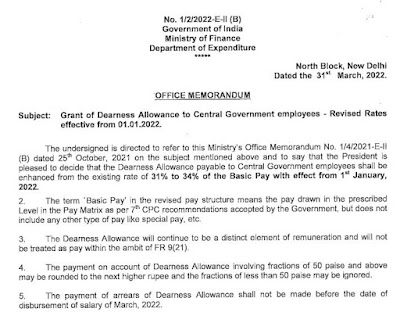
DA Jan 2022 - Grant of Dearness Allowance to Central Government employees - Revised Rates effective from 01.01.2022

 3% DA Hike - Revised Rates effective from 01.01.2022: DoE OM dated 31.03.2022 No. 1/2/2022-E-II (B) Government of India Ministry of Finance...