Tuesday, 7 July 2015

Grant of Special Casual Leave to Railway employees from Hudhud Cyclone & J&K Flash floods effected : Railway Board Order

Grant of Special Casual Leave to Railway employees from Hudhud Cyclone & J&K Flash floods effected : Railway Board Order

RBE No. 72/2015
GOVERNMENT OF INDIA
MINISTRY OF RAILWAYS
RAILWAY BOARD
No. E(G)2015/LE 1-1
Rail Bhawan, New Delhi, dated 30-06-2015

The General Manager(s)
East Coast Railway, Bhubaneswar.
Northern Railway, Baroda House, New Delhi.


    Sub: Grant of special leave to the Railway staff who remained absent from duty to Hudhud Cyclone that affected badly coastal areas of Andhra Pradesh and Odisha States (EcoR) and the flash floods in Jammu and Kashmir State.


The matter regarding grant of Special Casual Leave to Railway employees who could not attend duty due to hudhud cyclone which badly affected the coastal areas ofAndhra Pradesh and Odisha States in the 2nd week of October, 2014, and the flash floods in the State of Jammu and Kashmir, was taken up by All India Railwaymen's Federation(AIRF).

The issue has been carefully considered by the Board and it has been decided that Special Casual Leave upto a maximum of three days may be granted to the affected employees who stay at places far away from their Headquarters, as a result of which they have to commute a long distance to their office, and due to dislocation of traffic arising out of the aforesaid natural calamities they were not able to undertake the journey and report to the Headquarters for duty.

This issues with the concurrence of the Finance Dte. of Ministry of Railways.
(D. Joseph)
Dy. Dir. Estt. (Genl.)
Source: http://www.airfindia.org/wp-content/uploads/2015/07/RBE_72.pdf

Clarifications sought by Chairman & Members of 7th CPC during oral evidence by IRTSA

CLARIFICATIONS SOUGHT BY CHAIRMAN & MEMBERS OF 7TH  CPC DURING ORAL EVIDENCE & PRESENTATION BY IRTSA ON 12-12-2014 AT JODHPUR
 
Inter-action by the Chairman, Secretary & the Members of 7th  CPC with IRTSA and clarification placed by IRTSA delegates during the Presentation.
 
1. Ques. (by Chairman 7th CPC) You said that Senior Technicians are taking instructions from JEs; while the Chief OS (Office Superintendent) took instructions from SSE and you also told that it is Office of Senior Section Engineer which controls all activities and all of them working within that – It appears that there is clear command line available, How it interferes in your Grade Pay?
 
Ans. i. Principle recommended by 6th CPC, which was also accepted by Govt, that, the senior post should be given Higher Grade Pay need to be followed duly considering duties, responsibilities, accountabilities, etc. but the same is being violated by placing the JEs in the same Grade Pay of Rs.4200 as that of Senior Technician whom they supervise and by placing SSE (Senior Section Engineers) in same Grade Pay of Rs.4600 as that of Chief OS whom the SSE supervise. This is against the settled law that an equal cannot be over an equal.
 
ii. 5th CPC recommendations & Supreme Court Judgement supports this argument.
 
iii. Take an example: A senior technician welder working in Bogie Frame manufacturing section is responsible to the extent of welding done by him, where as a Technical Supervisor is responsible for the quality & quantity of output of not only of that welder but for entire section which may contain 20 to 30 Technicians besides others.
 
iv. More than that man, material, machine, other infrastructure etc, are controlled by Technical Supervisors, which possess higher responsibility & accountability than other posts.
 
v. Similar is the case of certification of train, P.Way, Bridge, Power Distribution, Locos, etc.
 
vi. Categories like Ch.OS don’t have direct responsibility on performance & safety of Railways, whereas JE/SSE and their counterparts (CMT, Store) in all Technical Depts. bear direct responsibility in core activities of Railways.
 
2. Ques. Is all 4 tier of Technicians work under your category in all areas?
 
Ans. Yes. In all areas 4 tier of Technicians, along with one Group ‘D’ category besides clerk, material / stores clerk, OS, Ch.OS work under our category.
 
3. Ques. Who writes ACRs for Ch.OS who are working in office of SSE?
 
Ans. Respective AMWs/AEs/AEEs etc.
 
4. Ques. Why can’t SSE write ACRs for Ch.OS who are working in their office?
 
Ans. SSEs who are in the same GP of Rs.4600 cannot write the ACRs for Ch.OS.
 
5. Ques. Who writes ACRs of Senior Technicians who work under JEs?
 
Ans. Senior Technicians’ ACR are written by SSEs
 
6. Ques. What would be the reason for non application of common multiplication factor of 3.25 to SSE (S-13) scale by 5th CPC?
 
Ans. i. 5th CPC had applied common multiplication factor of 3.25 to all scales except to SSE (S-13) scale.
ii. This had been done merely to accommodate a new scale in Gazd scale (Rs.7500-12000) above S-13.
iii. SSE scale had been kept Rs.50 below than Rs.7500, ie.Rs.7450.
 
7. Ques. How the disadvantage of non-application 3.25 multiplication factor carried through to 6th CPC?
 
Ans. i. Initially 5th CPC recommended Rs.7000-11500 to SSE compressing it to accommodate the newly introduced Gazetted scale.
 
ii. If 3.25 multiplication factor had been followed by 5th CPC, the scale would have been placed in 8000-12000 by the 5th CPC and correspondingly Rs.5400 GP in 6th CPC.
 
iii. After the implementation of 5th CPC recommendations, based on demand from staff side when Govt. decided to modify the scale of SSE (S-13) instead of placing it in scale 8000-12000, it had been decided to modify minimum of the scale from Rs.7000 to Rs.7450 to keep it below newly created scale of Rs.7500-12000.
 
iv. Since corresponding increase of Rs.450 had not been done for maximum of scale, Span of the scale has been reduced to 18 years which was 20 years for all other scales.
 
v. The principle of 6th CPC to calculate the Grade Pay as 40% of maximum of the fifth pay commission scales put SSE scale in further disadvantageous position since maximum of scale was low because of 18 years span & non application of 3.25 multiplication factor.
 
8. Ques. You said that there were proposals sent to Finance Ministry from Railway Ministry to upgrade the Grade Pay of SSE from Rs.4600 to Rs.4800 and that have been returned back without throwing proper light into it, can you produce copy of the proposals?
 
The proposals and communications between both the Ministries were very well available with Railway Board. (Later Secretary Pay Commission confirmed availability of Railway Board proposals sent to Fin. Ministry) (Copy of it is also attached herewith as Annexure – 14/2)
 
9. Ques. Is there any link available between the cadre of Group ‘C’ and ‘B’?
 
Ans. No. Promotional avenue from Technical Supervisors in Group ‘C’ to Group ‘B’ is restricted to the vacancies arising from 4200 Group ‘B’ posts, which may be around 0.5% only.
 
10. Ques. As you said, Previous Pay Commissions recommended Group ‘B’ status to your scale DoPT also given their orders, it is only Railway Ministry not followed the classification, is it not Railways to take decision?
 
Ans. i. It is true that Railways have not implemented the classification of posts recommended by Pay Commissions & DoPT orders.
 
ii. We bring to your notice, submission made by DoPT before 5th CPC that even though there were some exemptions in following the classification rules, but the effort was to ensure that posts carrying similar functions were given the same classification.
 
iii. Similarly placed posts in departments like CPWD, Ordinance Factory, MES, Department of Telecom etc, are all classified as Group ‘B’ Gazetted.
 
v. State Governments which are following central pay commission pattern have also followed DoPT orders in classification of posts.
 
v. Railway Board also agreed on the need to increase the managerial posts (from the senior supervisor) on functional justification, but didn’t implement.
 
vi. Hon’ble 7th CPC is requested to give specific instruction for Railways not to deviate from classification rules recommended for all Government Departments.
 
11. Ques. What are all the reasons for lack of promotion to your category?
 
Ans. i. Recruitment happens in the apex scale of Group ‘C’ in the Grade Pay of Rs.4600 with Graduate in Engineering qualification and Railways is the only dept which recruit Engineering Graduates in Group ‘C’.
 
ii. Available Group ‘B’ posts are very meagre to the extent of 4200.
 
iii. For example in Mechanical department of Integral Coach Factory sanctioned cadre strength of Group ‘B’ is only 16. Cadre strength of Technical Supervisors in Mechanical Department (JE & SSE) is 1200. There are roughly 60 Engineering Graduate entrants available many of them completed 20 years of service. There is not enough opportunity available because of meagre Group ‘B’.
 
iv. Confining Cadre Restructure within each Group C, B & A was the main cause of stagnation in Group C.
 
v. Combined cadre structure for Group ‘A’, ‘B’ & ‘C’ is not available in Railways.
 
vi. Apex scale of SSE never received the benefit of Cadre Restructuring.
 
vii. Upgradation from Group ‘D’ to Group ‘C’ and from Group ‘B’ to Group ‘A’ is being done in Railways, but no upgradation done from Group ‘C’ to Group ‘B’.
 
viii. Ratio of Group A& B Gazetted officers vis-à-vis Group C are the lowest on the Railways as compared to all other Departments.
 
ix. During previous 8 years number of Group-B employees in Central Govt Departments have increased by 36% even though employee strength reduced by 25%, But Railways never increased Group ‘B’ posts.
 
x. Gazetted posts were not increased in tune with increase of Railways performance including financial performance. Railways outlay was increased from Rs.60,600 crores during 10th plan to Rs.5.5 lakh crore during 12th plan Railways. Many of increased activities / work load are being managed by outsourcing, since there is negative growth in staff strength.
 
Source: http://www.irtsa.net/pdfdocs/Supplementary_Memorandum_to_7th_CPC.pdf

Monday, 6 July 2015

7th CPC News – Media require specialised approach rather than a hype

7th CPC News – Media require specialised approach rather than a hype
Need for quality information while reporting actual increase out of 6th CPC and Projection in 7th Pay Commission Pay
After 7CPC itself announced in last week of June 2015 to the effect that it has started finalising the report to be submitted to the Govt, News on 7th Pay Commission has started becoming popular.

It would be Needless to say all Government Employees would be interested in 7th CPC report. Though common man may not show much interest in the elaboration and technicalities of 7CPC report, he/she will also be curious to know the quatum of increase in Pay of Central Government Employees in General. At the same time, a common man will always be depending on various News media such as News Prints and Television channels to get these type of news.

But we could see that Pay Commission related news provided by News Media nowadays are misleading in the sense that they are only projecting the number of times the pay was hiked by previous Pay commissions and likely hike by 7th Pay Commission.

Missing information will always be misleading

Media reports on Pay Commission For instance, it was reported by a daily news paper recently, which was quoted later by many blogs that Govt Salaries are set to increase by 2 to 3 times and that 6th Pay Commission suggested 3 times increase in Salaries. It was also reported that 5th CPC recommended 2.6 times in increase in pay of lower Grade Officials.

A common man who is reading this news would be easily mislead and he/she would come to a conclusion that Salary of Government Employees was increased by 3 times by 6th CPC.

But the factual information’s such as 86% of basic Pay paid as Dearness Allowance separately was merged with Pay and increase in pay by 1.86 times is only because of merger of DA with Pay, are missing in this media report.

It is not expected that a news item should report all the intricacies of a pay commission report. But the fact that the net increase in the Pay of Central Government Employees after implementation of 6th Pay Commission report which was around 25% and 40% for most of lower / middle level employees and Higher level employees respectively, should have been correctly reported in the public interest.  This net increase in Pay was made effective from 01.01.2006 after 10 years as the earlier pay revision for Central Government Employees was made on implementation of 5th CPC in 1996.

Even this net increase in pay was only due to introduction of a new pay head called Grade Pay and as far as pre-revised basic Pay is concerned (now called as Pay in Pay band) there is no real increase except merger of DA with Pay.

In the case of Bank Employees wage revision after 10th Wage Settlement signed recently, it was correctly reported in news media that Bank Employees would be getting net increase in pay to the extent of 15%.  This net increase in Pay is exclusive of merger of Dearness Allowance as on Nov 2012 with Pay.  Salary Revision of Bank Employees as per 10th Bipartite Settlement is effective from 01.11.2012 and the same will be valid for 5 Years.

Media Report on Bank Employees Salary revision as per 10th Bipartite Wage Settlement

Source: gconnect.in

Hike in Retirement age of Kerala State Employees – 10th Pay Revision Commission may recommend to hike to 58 years

Hike in Retirement age of Kerala State Employees – 10th Pay Revision Commission may recommend to hike to 58 years

According to recent reports published in the ‘Manoramaonline’, the 10th Kerala Pay Revision Commission expected to recommend to hike in retirement age for Kerala State Govt employees by two years from 56 to 58.

Kerala may raise retirement age to 58

“Thiruvananthapuram: Increasing the retirement age for Kerala government employees by two years to 58 may be one of the recommendations of the 10th Kerala Pay Revision Commission. The commission, led by Justice C.N. Ramachandran Nair, will submit its report on July 10.


The commission is expected to recommend the increase of retirement age to balance the extra burden on the treasury due to a pay rise across the board. The report recommends a minimum salary of Rs 16,000 and a maximum salary of Rs 1 lakh for employees.


The youth wings of all political parties are against increasing the retirement age in the government service. Even the United Democratic Front government’s policies do not favour later retirement. The retirement age was raised to 56 from 55 during the previous Left Democratic Front rule.


Other recommendations include lowering the minimum eligibility for full pension to 25 years in service from the present 30. Full pension is equivalent to half of the basic pay. The report would also have recommendations intended to raise the efficiency of the employees along with their pay scale.”

Read more at www.english.manoramaonline.com

Officers thank MoS DoPT for speedy promotions

Officers thank MoS DoPT for speedy promotions

Press Information Bureau
Government of India
Ministry of Personnel, Public Grievances & Pensions

04-July-2015 20:02 IST
Officers thank MoS DoPT for speedy promotions

A delegation of officers belonging to Central Secretariat Service (CSS) called on the Union Minister of State (Independent Charge) for Development of North Eastern Region (DoNER), MoS PMO, Personnel, Public Grievances, Pensions, Atomic Energy and Space, Dr. Jitendra Singh, here today, to thank him and convey their gratitude for speedy disposal of their promotion cases leading to empanelment of as many 37 officers in one go to the post of Joint Secretary to the Government of India and consequent promotion of 27 officers to the level of Joint Secretary on in-situ basis.

Acknowledging their gratitude, Dr. Jitendra Singh congratulated them and reiterated Shri Narendra Modi Government’s resolve to make governance easy and at the same time make the environment work-friendly for the officers. The government is in favour of doing away with avoidable delays in promotions and empanelments so that the officers can work with enthusiasm and a positive frame of mind.

With the passage of time, Dr. Jitendra Singh said, the pressure on officers has increased because of the increased expectations on one hand and on the other hand increased scrutiny by public as well as media. But, instead of grudging this changing scenario we would have to learn to adapt to it and do our best because transparency and accountability are prime areas of emphasis of Shri Narendra Modi Government.

Meanwhile, in order to deal with the stress of the officers, Department of Personnel & Training (DoPT) has, of late, started a number of new measures including regular daily ‘Yoga’ for officers across the country from 1st of April. Similarly, the DoPT will also contemplate various steps to improve the facilities and privileges available to IAS Officers coming on deputation to union capital so that they need not find themselves at a disadvantage on account of issues related to transport facility, admission of their children in schools, etc.
Dr. Jitendra Singh said, the launch of “Digital India Week” by the Prime Minister on 1st July is also a step towards making the governance easy and reducing the file work pressure on the officers, besides also avoiding unnecessary delays or harassment to the common citizen.

Source: PIB News

Saturday, 4 July 2015

UFESM expected a date for implementation of OROP – Relay hunger strike continues

UFESM expected a date for implementation of OROP – Relay hunger strike continues

Government committed to implement ‘One Rank One Pension': Manohar Parrikar to ex-servicemen
Defence Minister Manohar Parrikar has conveyed the NDA government’s “unequivocal commitment” in implementing ‘One Rank One Pension’ (OROP) when a delegation of ex-servicemen, who are on a strike for past 19 days pressing for its execution, met him.

Not happy with Parrikar’s assurance, the agitating ex-servicemen said the question of ending the protest does not arise without a government announcement on implementing the long-pending demand.

“A six member delegation of United Front of Ex-Servicemen (UFESM) met the Defence Minister last night. Parrikar conveyed unequivocal commitment of the party (BJP)and the government towards implementation of OROP,” said Col (retd) Anil Kaul, spokesman of the Front.

He said Army Chief General Dalbir Singh Suhag was also present at the meeting.

Read more at Economics Times

MPs’ 100 per cent salary hike - Government’s final call

MPs’ 100 per cent salary hike - Government’s final call

New Delhi: BJP today sought to distance itself from a parliamentary panel’s recommendation for a 100 per cent hike in MPs’ salary besides a number of perks, saying it was for the government to take a call on it.

“We have nothing to say. It is our government at the Centre and the panel is headed by a senior member of our party. But the Centre has apparently put the report in cold storage. It is finally for the government to take a call on it,” a party leader said.

The fact that the parliamentary panel is headed by BJP MP Yogi Aditynanath has forced the party to maintain a distance.

The panel has pitched for 100 per cent hike in salary and daily allowances of MPs and 75 per cent raise in pension of ex-MPs apart from facilities for their “companions” in place of “spouses”.

In far-reaching recommendations, it also has sought the doubling of the existing Rs 50,000 salary of MPs and favoured increasing the pension of former parliamentarians from Rs 20,000 to Rs 35,000.

While the government has expressed its readiness to consider their demand for a hike in salary, constituency and office allowances and raising the expenditure limit on furniture, it is not in favour of the other recommendations, official sources said.

The panel is likely to meet on July 13 and prepare a final report taking into account the government’s stand.

PTI

Framing a Transfer Policy in all cadres – regarding: Dopt orders 2015

Dopt orders 2015: Framing a Transfer Policy in all cadres – regarding

G.I., Dept. of Per. & Trg., O.M.No.11013/10/2013-Estt.A, dated 2.7.2015
Subject: Framing a Transfer Policy in all cadres – regarding

The undersigned is directed to refer to the OMs of even number dated 13thJune, 2014, and 3 July, 2015 wherein all the Ministries/Departments were requested to (i) prescribe Minimum Tenure, (ii) set up a mechanism akin to Civil Services Board for recommending transfer, and (iii) place in public domain the transfer policy.

2. The Rotational Transfer Policy should aim to harmonise objectives of institutional memory, avoid development of vested interests, and provide exposure to the employees of working in different organisations, inter alia ensuring overall growth of an officer. The Transfer Policy should provide for both a minimum as well as maximum tenure. Any transfer before completing the minimum prescribed tenure or stay beyond the maximum tenure should be with the approval of the Committee constituted for the purpose, for reasons to be recorded in writing.

3. The draft Rotational Transfer Policy for the Central Secretariat ServiceNavailable on the website of Department of Personnel and Training at www.persmin.nic.in (Annexure). It lays down guidelines on tenures, postings on promotion, posting on return from leave/deputation, outstation postings, mutual transfers etc. Appropriate provisions on these aspects may be made in the Rotational Transfer Policy in each cadre that will best serve public interest.

4. In addition, instructions of Central Vigilance Commission in the Circular No. 03/09/13 (No.004/VGL/090/225553 dated 11.9.2013) reiterate that sensitive posts should be identified and staff working in these posts strictly rotated after every two/three years to avoid developing vested interests. The OMs of this Department also lay down guidelines on postings of spouse at the same station, and postings of disabled Government servants/ parents of disabled children.

4. The Ministries/Departments/Cadre Authorities may communicate action taken report on the following latest by 10.7.2015, (i) framing of Rotational Transfer Policy and putting up in public domain (ii) Identification of sensitive posts (iii) rotation of officers from sensitive posts in true spirit of the provision.

Click to view the original order
Authority : www.persmin.gov.in

Parliament panel wants doubling of pay, automatic pay revision mechanism for MPs

“Pay revision mechanism for parliamentarians like that of pay commission for government employees : The Committee has proposed that an automatic pay revision mechanism for parliamentarians like that of pay commission for government employees.”


Parliament panel wants doubling of pay, automatic pay revision mechanism for MPs
A parliamentary panel has recommended doubling the salary of law makers and also increasing pension of former MPs by almost 75%. The joint committee, which has submitted its recommendations to the government, has also proposed an automatic pay revision mechanism for parliamentarians like that of pay commission for government employees.

Sources said the panel has made a total of around 60 recommendations. “The committee has reasoned that the last revision of MPs salary happened in 2010 and they don’t get any dearness allowance like that of government employees,” said a government source.

At present, sitting MPs get monthly salary of Rs 50,000. The panel has also recommended that the daily allowance of Rs 2,000, which they get for attending the House during Parliament sessions should be increased substantially, sources said.

“The hike is overdue. Our daily expenses only for offering tea to visitors come to around Rs 1,000. Can we stop showing this little courtesy to electorates?” asked a sitting BJP lawmaker.

Read more at TOI

Revised Bio-data / Curriculum Vitae (CV) proforma for submission by the candidate for appointment by deputation — issue of instructions — regarding

G.I., Dept. of Per. & Trg., O.M.F.No.AB.14017/28/2014-Estt.(RR), dated 2.7.2015
Subject: Revised Bio-data / Curriculum Vitae (CV) proforma for submission by the candidate for appointment by deputation — issue of instructions — regarding.

The consolidated instructions on the procedure to be followed in cases where appointment is to be made by transfer on deputation / transfer basis (now termed as deputation / absorption) issued by this Department vide OM No. AB-14017/71/89 — Estt. (RR) dated 3.10.89. In terms of para 4.8 of the instruction, while calling for application for appointment on deputation/absorption basis, Ministries/ Departments are required to call for Bio-data / Curriculum Vitae (CV) of the candidates in the proforma at Annexure A of the OM dated 3.10.89.

2. The revised Bio-data / Curriculum Vitae (CV) proforma was issued by this Department vide OM No. AB-14017/10/2000 — Estt. (RR) dated 29.8.2005. The proforma has been reviewed by UPSC, keeping in view the changes took place due to implementation of 6th Pay Commission recommendation and with the objective to reflect the complete profile of the candidate. The revised proforma suggested by the Commission is at Annexure-I.

3. The modified Bio-data / Curriculum Vitae (CV) proforma is enclosed with the request that this modified proforma may be utilized while calling for applications for appointment on deputation / absorption basis. The administrative Ministries / Departments are also advised to pay attention towards the points indicated in Annexure-II at the time of inviting application and preparation of the deputation proposal before sending the same for the consideration of the Commission.

4. It is requested that these instructions may be circulated to all the subordinate formations of the Ministries / Departments.

Click to view the order

Authority : www.persmin.gov.in

Flash News

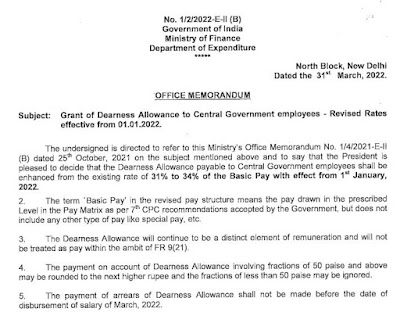
DA Jan 2022 - Grant of Dearness Allowance to Central Government employees - Revised Rates effective from 01.01.2022

 3% DA Hike - Revised Rates effective from 01.01.2022: DoE OM dated 31.03.2022 No. 1/2/2022-E-II (B) Government of India Ministry of Finance...