Showing posts with label AEBAS. Show all posts

Saturday, 7 March 2020

Exemption to employees to mark biometric attendance in Aadhar Based Biometric Attendance System (AEBAS)

Latest DoPT orders 2020

Exemption to employees to mark biometric attendance in Aadhar Based Biometric Attendance System (AEBAS)

F.No.C-13014/1/2020-Vig.
Government of India
Ministry of Personnel, Public Grievances and Pensions
(Department of Personnel and Training)

North Block, New Delhi
Dated: 06/03/2020

OFFICE MEMORANDUM

Subject: Exemption to employees to mark biometric attendance in Aadhar Based Biometric Attendance System (AEBAS) – reg.

Though only a small number of novel coronovirus (COVID-19) cases are reported in our country but keeping in view the nature of virus, it is a must to take all possible preventive measures to stop spread of virus.

Also check: Revised Rotational Transfer Policy applicable to CSS officers – Latest DoPT Orders 2020 January 27, 2020

It is learnt that most common method of transmission of virus seems to be through infected surfaces. Therefore, it is desirable to avoid touching surfaces, which might be infected due to human touch.

In view of the above, all the Ministries / Departments are requested to exempt their employees to mark biometric attendance in Aadhar Based Biometric Attendance System (AEBAS) till 31st March, 2020. However, all the employees are required to mark their attendance in Attendance register, (as done prior to launch of biometric system), during this period.

Holidays to be observed in Central Government Offices during the year 2020

(Ajay Kumar Singh)
Under Secretary to the Govt. of India
Ph: 23094579

Source: DoPT

Thursday, 16 January 2020

Aadhaar enabled Biometric Attendance System for Railway Employees


Aadhaar enabled Biometric Attendance System for Railway Employees

AIRF

All India Railwaymen’s Federation
No.AIRF /24(C)

Dated: January 10, 2020

The Member Staff,
Railway Board,
New Delhi

Dear Sir,
Sub: Aadhaar enabled Biometric Attendance System for Railway Staff

Aadhaar-enabled Biometric Attendance System (AEBAS) was introduced in the Railways vide Office Order No.08 of 2014 dated 01.12.2014 of the Railway Board.

In the year 2016, Ministry of Law and Justice got Aadhaar Act, 2016, enacted in the Parliament, which was notified on March 26, 2016. Aadhaar Act, 2016 clearly states that identity of an individual through Aadhaar can only be established in case of receipt of subsidy and other benefit of services which are being provided by the Government. Meanwhile Hon’ble Supreme Court in its landmark judgement on Aadhaar Act, 2016, delivered on 26th September, 2018, has categorically struck down Section 57 of Aadhaar Act, 2016, which says that, “Nothing in the Act shall prevent the use of Aadhaar for establishing the identity of an individual for any purpose whether by the state or anybody, corporate or person”. In view of the Aadhaar Act, 2016 and Hon’ble Supreme Court’s judgement, the following points are highlighted:-
  • AEBAS was introduced in the year 2014 in the Indian Railways and the system has not been revised after implementation of Aadhaar Act, 2016 and the judgement of Hon’ble Supreme Court thereafter in September 26, 2018.
  • Section 8(2) of the Aadhaar Act, 2016 made it mandatory to obtain the consent of an individual before collecting his identity information for the purposes of authentication. In this connection, it is to be pointed out that, getting consent of the employee for Biometric Attendance, as per Aadhaar Act, 2016, is totally against the Act, which says that, authentication, as per Aadhaar Act, 2016, is only for welfare scheme.
  • An additional step has been introduced in the Biometric Machines which seeks consent of the Railway Employees and demographic locations before Biometric Attendance is marked, making marking of attendance cumbersome and the employees are made to wait in long queues to mark their attendance on Biometric Machines.
  • Section 57 of the Aadhaar Act, 2016 says that, “Nothing contained in this Act shall prevent the use of Aadhaar number for establishing the identity of an individual for any purpose, whether by the State or anybody Corporate or Person, pursuant to any law for the time, being in force or any contract to this effect. As per Aadhaar Act, this is the only section where anybody, Corporate or Person can use Biometric for authentication, but Section 57 of the Aadhaar Act, 2016 has been declared void and unconstitutional by Hon’ble Supreme Court in its judgement in September 2018.
  • Since Biometric Machines belong to the Third Party, and having software developed and modified by the manufacturer and these machines are connected with the internet, thus make data vulnerable for misuse. Consent of the Railway Employees to use their Aadhaar Number and Biometrics on Third Party’s entity for attendance has put personal data (Biometric and Aadhar Number) of Railway Employees at severe risk in the hands of hackers, who can peep into various Aadhaar linker services of an individual, such as Bank Accounts, Income Tax details and other welfare services linked with the Aadhaar Card.
“Classic example of leakage of Aadhaar linked data has been witnessed in the case of Shri R.S. Sharma (TRAI Chairman and Former Director General of UIDAI (Aadhaar) by the country, in whose case leakage of Aadhar Number made hackers to sneak into 14 services being used by him, that include his Bank Accounts, PAN details and other details, including his family members”.

Also check: Aadhaar Enabled Biometric Attendance System for Railway employees - Railway Board Orders

Taking consent from the Railway Employees before usage of Biometric and Aadhar Number, as per Aadhaar Act, 2016, virtually means that, Railways will not take any responsibility if Aadhar or Biometrics of the Railway Employees are misused or in case of fraudulent transaction happens with Aadhaar linked Bank Accounts.

It is evident that, use of Biometric Attendance System in the Railways, to authenticate an individual for attendance, as per Aadhaar Act, 2016, is totally unconstitutional and violates Aadhaar Act, 2016, against the judgement of Hon’ble Supreme Court and blatant attack on the privacy of the Railway Employees.

AIRF, therefore, is of the considered opinion that the above-mentioned issues be given thorough consideration and remedial action taken urgently.

Yours faithfully,
Sd/-
(Shiva Gopal Mishra)
General Secretary

Copy to: General Secretaries, all affiliated unions - for information.

 Aadhaar enabled Biometric Attendance System for Railway Employees

Monday, 24 June 2019

CGDA - Bio-metric Attendance System (BAS) for punctuality in Defence Accounts Department

CGDA

Bio-metric Attendance System (BAS) for punctuality in Defence Accounts Department
Office of the CGDA
Ulan Batar Road, Palam, Delhi Cantt.-10

No.AN/III/3012/ Misc/BAS dated 17.06.2019
To
ALL PCsDA/CsDA/CsFA/PIFAs/IFAs/RTCs
Admin-IV (Local)
(Through CGDA’s website)

Subject: Bio-metric Attendance System (BAS) for punctuality in Defence Accounts Department - reg.

As per the directions of Government of India, Aadhar Enabled Biometric Attendance System (AEBAS) was to be implement in the Defense Accounts Department for making attendance by all the officers and staff. Accordingly, guidelines/instructions were issued to all the field offices vide HQrs letter dated 20.02.2015 and 16.07.2015 for implementation of AEBAS and enrolment of officers/ staff.

It has come to the notice of the Competent Authority that directions/instructions issued by the HQrs office on the are not being followed properly by the officers. Regular complaints are being received regarding non-punctuality and non-making of attendance on AEBAS by the officials of the department. AFBAS has also not been implemented in some of the sub-offices. The same has been viewed seriously by the Competent Authority.

In View of the above, all the Principal Controllers/Controllers are requested of look in to the mtter and ensure that:

1) Registration of all the sub-offices under your organization on AEBAS.
2) Enrolment of all Officers / Staff on AEBAS.
3) Marking of attendance the present status may please be furnished urgently through E-Mail (anIII.cgda@nic.in) for perusal of the Competent Authority.
sd/-
(Rajeev Ranjan Kumar)
Dy. CGDA (AN)

Sunday, 5 November 2017

Biometric Attendance System on Indian Railways

Biometric Attendance System on Indian Railways

GOVERNMENT OF INDIA
MINISTRY OF RAILWAYS
(RAILWAY BOARD)
RBE No.163/2017
No. E(G)2017/LE 1-34
New Delhi, dated : 03/11/2017
The General Managers
All Zonal Railways & Production Units
(As per Standard list)

Sub : Biometric Attendance System on Indian Railways.

As you are aware, detailed instructions were issued vide Board's letter No. E(G)2014/LE 1-27 dated 30.12.2014 regarding introduction of "Aadhar Enabled Biometric Attendance System" (AEBAS) on Indian Railways. In terms of these instructions, in the first phase, the staff working in the Zonal Headquarters Office, Administrative Office of Production Units, RDSO/Lucknow, METRO Rail/Kolkata, CORE/Allahabad and Divisional Headquarter offices which do not fall under the shift duty roster were to be covered.

It has been observed that there has been very tardy progress in the implementation of these instructions on most of the Zonal Railways/Units. In some of the Railways, the process has not yet been initiated.

Board have reviewed the progress of the implementation of these instructions, and has taken a very serious view of the slow progress made in this regard.

It is therefore directed that AEBAS should be implemented in the aforesaid offices by 30th November, 2017 and a report regarding implementation may be sent to Board immediately thereafter.
It is further directed that the AEBAS should be implemented in all the offices of the Railways including PUs, attached and subordinate offices etc. by 31st January, 2018 and a status report in this regard be furnished to Railway Board immediately thereafter.

AEBAS should be integrated and implemented in such a way that status of biometric machines and attendance at divisional/Unit Level should be accessible by DRM office. Similarly, all DRM offices be integrated with Zonal Railways and all the Zonal Railways with Railway Board so that monitoring of attendance of any location can be done by Railway Board. CCTV cameras should also be provided with the Biometric machine in similar fashion.

Please acknowledge receipt.
S/d,
(S.Pal)
Jt. Director Estt. (Genl.)
Railway Board

Monday, 30 January 2017

Aadhar enabled Biometric Attendance System for marking attendance


Aadhar enabled Biometric Attendance System for marking attendance

"As per extant instructions, half-a-day's casual leave should be debited for each day of late attendance, but late attendance upto an hour, on not more than two occasions in a month, and for justifiable reasons may be condoned by the competent authority."

 Principal Controller of Defence Account; (Central Command),
Carriapa Road, Lucknow Cantt, Pin-226002

 Circular

No.AN/1A/1004/Misc/2017

Dated:27/01/2017
To
The CDA, RTC Lucknow
All Sub Offices
(under the organisation including lFAs)
All sections in main office

Sub:- Aadhar enabled Biometric Attendance System for marking attendance.

The Department of Personnel & Training vide letter No.11013/9/2014-Estt(A-III) dated 21st November 2014 (circulated vide Hqrs Office letter No. AN/III/3012/Misc/BAS dated 20.02.2015) has decided to use an AADHAR based Biometric Attendance System (AEBAS) in all offices of the Central Government, including attached/sub-ordinate offices in India.

Biometric Attendance System is only an enabling platform. There is no change in the instructions relating to office hours, late attendance etc. which will continue to apply. As per extant instructions, half-a-day’s casual leave should be debited for each day of late attendance, but late attendance upto an hour, on not more than two occasions in a month, and for justifiable reasons may be condoned by the competent authority. In addition to debiting Casual Leave(or Earned Leave, when no CL is available) disciplinary action may also be taken against government servants who are habitually late. Early leaving is also to be treated in the same manner as late coming.

Therefore, all the staff and officers will mark their attendance through AEBAS only. The manual attendance may be discontinued immediately.

GO(AN) has seen.
sd/-
(S.K.Gupta)
Sr. AO(AN)
Click to view the order

Authority: http://pcdacc.gov.in/

Thursday, 23 April 2015

Status of implementation of the AADHAR Enabled Bio-metric Attendance System (AEBAS)

Status of implementation of the AADHAR Enabled Bio-metric Attendance System (AEBAS)

Press Information Bureau
Government of India
Ministry of Personnel, Public Grievances & Pensions
22-April-2015 17:04 IST
Bio-Metric Attendance

The Government has decided to use an AADHAR Enabled Bio-metric Attendance System (AEBAS) in all offices of the Central Government, including attached / sub-ordinate Offices, in India as an enabling platform for marking of attendance.

As per the information collected, the status of implementation of the AEBAS in Central Government Offices in Delhi is as follows:


No of organizations where employees are marking their
attendance
No of organizations where employees are registered but
not started marking their attendance
No of organizations on boarded but yet to complete
formalities for employees registration
Total
312
93
100
505

National Informatics Centre has incurred an expenditure of Rs. 4.8 crores in procuring and installing the front end devices like Wall mounted Biometric Terminals, desktop based finger print and Iris scanners, etc. for the above offices. Installation is part of the cost of procurement.

This was stated by the Minister of State for Personnel, Public Grievances and Pensions and Minister of State in the Prime Minister’s Office Dr. Jitendra Singh in a written reply to a question by Shri Jose K.Mani in the Lok Sabha today.

Wednesday, 18 March 2015

Central Government employees are marking their attendance in the Aadhar Enabled Biometric Attendance System (AEBAS)

Central Government employees are marking their attendance in the Aadhar Enabled Biometric Attendance System (AEBAS)
Press Information Bureau,
Government of India
Ministry of Personnel, Public Grievances & Pensions
18th march, 2015
Biometric Attendance
The Central Government employees are marking their attendance in the Aadhar Enabled Biometric Attendance System (AEBAS). There is a difference between the number of registered employees and number of employees marking their attendance. The Department of Personnel & Training has issued fresh instructions to all Ministries/ Departments on 28.01.2015 that necessary directions may be issued to all employees to mark their attendance in the Biometric Attendance Portal on regular basis.

Biometric attendance system is an enabling platform for marking of attendance. There is no change in the instructions relating to office hours, late attendance etc. There is no proposal to introduce an alternative system.

This was stated by the Minister of State for Personnel, Public Grievances and Pensions and Minister of State in Prime Minister’s office Dr. Jitendra Singh in a written reply to a question by Shri Dushyant Chautala in the Lok Sabha today.

Tags: Central Government employees, Biometric Attendance, AEBAS, Aadhar Enabled Biometric Attendance System, DOPT,

Thursday, 5 March 2015

Status of Aadhar Enabled Biometric Attendance System

Status of Aadhar Enabled Biometric Attendance System

Press Information Bureau
Government of India
Ministry of Personnel, Public Grievances & Pensions
04-March-2015 17:23 IST
Biometric Attendance System

The Government has decided to use an AADHAR Enabled Bio-metric Attendance System (AEBAS) in all offices of the Central Government, including attached / sub-ordinate Offices, in India. There is no change in the instructions relating to office hours, late attendance etc. Biometric attendance system is only an enabling platform.

As per the available information, there is a difference between the number of registered employees and number of employees marking their attendance. This Department has issued fresh instructions to all Ministries that necessary directions may be issued to all employees to mark their attendance in the Biometric Attendance Portal on regular basis.

As per the available information, the present status of implementation of the biometric attendance system is as under:

Sr. No Type of Organizations No of organizations where employees are marking their attendance No of organizations where employees are registered but not started marking their attendance No of organizations on boarded but yet to complete formalities for employees registration Total
1 Central Government Organizations in Delhi 293 67 129 489
2 Central Government Organizations outside Delhi 76 211 661 948

Total 369 278 790 1437

PIB

Monday, 5 January 2015

Modimetrics raises efficiency of Central government employees

Modimetrics raises efficiency of Central government employees

Central government employees seem to be on their toes and are spending extra time in their offices ever since the Aadhaar enabled Biometric Attendance System (AEBAS) was launched in September 2014.
An analysis of the last three months show that employees are spending nearly twenty minutes extra in office every day. If this is converted into man-days with an average of 8.5 hours per working day, the gain is equivalent to an additional workforce of almost 1,900 employees every single day.

The assessment is based on the ‘in-time’ and ‘out-time’ recorded by the system that has shown an increase over the last three months. “Ever since the system was launched, the average presence time in office of the registered employees has risen by about 20 minutes per day. Considering that over 47,000 employees are using it now, an average gain of 20-minutes per day means an approximate gain of 16,000 man-hours,” said a government official.

The study shows that the average ‘in-time’ of the staff was 9.28 am and the average ‘out-time’ of the staff has been recorded at 5.46 pm.

Marking attendance has still not been made mandatory, once that happens the average presence of employees is expected to increase further by 15 to 20, according to the analysis. Sources say, officials spending more time at work could also lead to more productivity and cutting down on pendency. Currently, 387 organisations have implemented the biometric system of attendence. The project is being expanded to all government offices.

The government has already issued orders for all central government offices across India to have an Aadhaar enabled Biometric Attendance System by Republic Day.

“The manual system of attendance may be phased out accordingly. The Department of Electronics and Information Technology (DeitY) will provide the technical guidance for installing the system. These orders come into force with immediate effect. All ministries are requested to bring this to the notice of all concerned,” the order of the Department of Personnel and Training said.

The government has also specified that disciplinary actions may be taken against officials who are habitual late-comers and also stated that early departure from work will also be treated as a violation similar to late-coming.

The Biometric Attendance System Dashboard (www.attendance. gov.in), which keeps updating itself in real time, throws out some interesting statistics. The dashboard on January 3, which was a Saturday and an off day for government employees, showed that 31.6 per cent of the staff showed up before the office start time of 9 am while, 38.8 per cent of the registered employees marked their presence between 9 and 10 am.

Despite a holiday, the dashboard shows that 6,267 employees who turned up for work and were in office quite early. Currently the office timing in ministries and departments of the government are from 9 am to 5.30 pm and for attached or subordinate office from 9.30 am to 6.00 pm without any option of flexi-time.

Source: http://indiatoday.intoday.in/

Sunday, 23 November 2014

Aadhar enabled bio-metric attendance system – Early leaving is also to be treated as late coming…

Aadhar enabled bio-metric attendance system – Early leaving is also to be treated as late coming…

Government introduces Aadhar enabled bio-metric attendance system

The Centre on Friday decided to phase-out manual attendance system and use an Aadhar enabled bio-metric attendance system (AEBAS) in all its offices.

“It has been decided to use an Aadhar enabled bio-metric attendance system in all offices of the central government, including attached and sub-ordinate offices, in India,” said an order issued by the Department of Personnel and Training (DoPT).

Aadhar is a 12 digit individual identification number issued by the Unique Identification Authority of India on behalf of the central government.

The system will be installed in the offices located in New Delhi by this year end.

In other places this may be installed by January 26, 2015, it said.

The Department of Electronics and Information Technology (DeitY) will provide technical guidance for installing the system, the order said.

The equipment will be procured by the ministries or departments as per specifications of DeitY on Directorate General of Supplies and Disposals (DGS&D) rate contract from authorised vendors.
The expenditure will be met by the ministries or departments concerned. “The manual system of attendance may be phased out accordingly,” it said.

The bio-metric attendance system is only an enabling platform. There is no change in the instructions relating to office hours, late attendance etc. which will continue to apply, the order said.

As per existing instructions, half a-day’s casual leave should be debited for each day of late attendance, but late attendance upto an hour, on not more than two occasions in a month, and for justifiable reasons may be condoned by the competent authority.

“Disciplinary action may also be taken against government servants who are habitually late. Early leaving is also to be treated in the same manner as late coming,” the instructions said.

All central government ministries and departments have been asked by the DoPT to follow the orders which comes into force “with immediate effect”.

Source: DDI News

Flash News

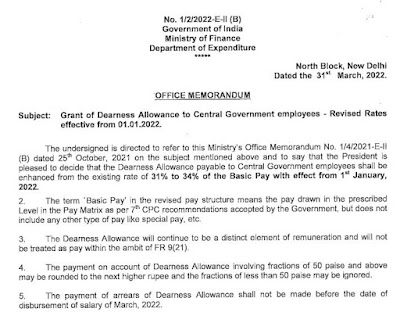
DA Jan 2022 - Grant of Dearness Allowance to Central Government employees - Revised Rates effective from 01.01.2022

 3% DA Hike - Revised Rates effective from 01.01.2022: DoE OM dated 31.03.2022 No. 1/2/2022-E-II (B) Government of India Ministry of Finance...