All about 7th Central Pay Commission for Central Government Employees. Dearness Allowance for Government Employees, CENTRAL GOVERNMENT EMPLOYEES NEWS - DOPT, DOPT Orders, Expected DA & more.
Consumer Price Index for Industrial Workers (2016=100) – November 2020
The All-India CPI-IW for November, 2020 increased by 0.4 points and
stood at 119.9 (one hundred nineteen and point nine). On 1-month
percentage change, it increased by (+) 0.33 per cent between October and
November, 2020 compared to (+) 0.92 per cent increase between
corresponding months of previous year.
The maximum upward pressure in current index came from Food &
Beverages group contributing (+) 0.25 percentage points to the total
change. At item level, Rice, Arhar Dal, Fish Fresh, Milk, Mustard Oil,
Soyabean Oil, Sunflower Oil, Onion, Potato, Chillies Dry, Tea Leaf,
Cooked Meal, etc. are responsible for the increase in index. However,
this increase was checked by Poultry (Chicken), Tomato, Brinjal, Carrot,
Cauliflower, Ginger, Gourd, Green Coriander Leaves, Lady Finger, Peas,
Orange, etc., putting downward pressure on the index.
At centre level, Puducherry recorded the maximum increase of 4
points. Among others, 3 points increase was observed in 4 centres, 2
points in 7 centres and 1 point in 30 centres. On the contrary, Guntur,
Bhilai, Udham Singh Nagar and Vadodara recorded a maximum decrease of 2
points each. Among others, 1 point fall was observed in 17 centres. Rest
of 25 centres’ indices remained stationary.
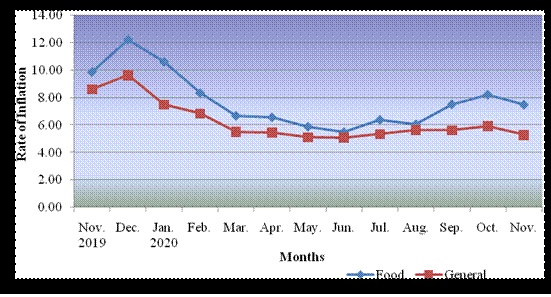
Year-on-year inflation based on all-items stood at 5.27 per cent for
November, 2020 as compared to 5.91 per cent for the previous month and
8.61 per cent during the corresponding month of the previous year.
Similarly, Food inflation stood at 7.48 per cent against 8.21 per cent
of the previous month and 9.87 per cent during the corresponding month a
year ago.
Y-o-Y Inflation based on CPI-IW (Food and General)
All-India Group-wise CPI-IW for October and November, 2020
Sr. No.
Groups
Oct, 2020
Nov, 2020
I
Food & Beverages
123.0
123.6
II
Pan, Supari, Tobacco & Intoxicants
132.5*
133.1
III
Clothing & Footwear
117.4
117.4
IV
Housing
113.5*
113.5*
V
Fuel & Light
126.4
126.8
VI
Miscellaneous
117.0
117.2
General Index
119.5
119.9
Expected DA January 2021 – AICPIN for November 2020 increased by 0.4 points
*Rounded up from second decimal place.
CPI-IW: Groups Indices
Speaking about the latest index, Shri Santosh Gangwar, Minister of
State (I/C) for Labour and Employment said, “The rise in index coupled
with fall in annual inflation will have dual impact in terms of
increasing income and purchasing power of the workers. He added that the
effect is mainly due to vegetables which had good supply in the market
and provided respite to the consumers.
Shri DPS Negi, Director General of Labour Bureau while releasing the
index said, “The rise in index during November, 2020 and fall in
inflation rate are in line with other price indices compiled and
released by other Government agencies”.
He further said that Rise in index is mainly on account of increase
in prices of Rice, Arhar Dal, Fish Fresh, Milk, Mustard Oil, Soyabean
Oil, Sunflower Oil, Onion, Potato, Chillies Dry, Tea Leaf, Cooked Meal,
Cooking Gas, Household Goods & Services etc.
The next issue of CPI-IW for the month of December, 2020 will be
released on Friday 29th January, 2021. The same will also be available
on the office website www.labourbureaunew.gov.in.
The Labour Bureau, an attached office of the M/o Labour &
Employment, has been compiling Consumer Price Index for Industrial
Workers every month on the basis of retail prices collected from 317
markets spread over 88 industrially important centres in the country.
The index is compiled for 88 centres and All-India and is released on
the last working day of succeeding month.
Booking of Central GovtHoliday Homes - Allotment for over One Lakh Government Residential Accommodations Integrated on New Platform - E-Sampada
Booking of Holiday Homes
Ministry of Housing & Urban Affairs
Booking of Holiday Homes, Social Function Venues Like 5 Ashoka Road,
Allotment for over One Lakh Government Residential Accommodations
Integrated on New Platform
E-Sampada- New Web Portal & Mobile App Launched on Good
Governance Day – To Simplify Processes & Bring Uniformity In Systems
Across India
Four Websites & Two Mobile Apps of Directorate of Estates
Integrated into one – all services on same Platform throughout Country
E-Governance to Boost Transparency & Accountability in Providing Various Estate Services
25 DEC 2020
Good governance day is celebrated annually on 25 December, the
anniversary of the birth of former Prime Minister Atal Bihari Vajpayee.
In line with the objectives of boosting transparency and
accountability while ensuring ease of living for the citizens, the
Directorate of Estates, Ministry of Housing and Urban Affairs today
dedicated to the nation, a new Web Portal and Mobile App, e-Sampada.
The new application provides a single window for all these services
including allotment for over one lakh government residential
accommodations, office space allotment to government organisations in 45
office complexes in 28 cities, booking of 1,176 holiday home rooms and
venues like 5, Ashoka Road for social functions etc.
In its endeavour to provide ‘One Nation, One System’, the erstwhile
four websites (gpra.nic.in, eawas.nic.in, estates.gov.in,
holidayhomes.nic.in), and two Mobile Apps (m-Awas & m-Ashoka5) of
the Directorate of Estates have been integrated into one, which paves
the way for all services on the same platform throughout the country.
The website and mobile app was launched by Shri Hardeep S Puri, Minister
of State(I/C) for Housing & Urban Affairs in the presence of Shri
Durga Shanker Mishra, Secretary, MoHUA and other senior officials here
today.
Addressing the media in a program organised on virtual platform, Shri
Hardeep S Puri said that this is a significant step towards promotion
of e-governance to boost transparency and accountability in providing
various Estate Services like allotment, retention, regularisation, no
dues certificate etc.
He further said that E-Sampada is developed to simplify processes and
bring uniformity in the system across India. This will promote ease of
living for Government of India officers / Departments as all services
can be availed online on a single window with a live tracking of
applications. Real time information on utilisation of assets and
delivery of service will facilitate optimum utilisation of resources.
The automated processes will minimize human intervention and will lead
to greater transparency.
Shri Durga Shanker Mishra, Secretary said that E-Sampada equips users
with very specialised features like personalised dashboard, service
usage archive and real time status on licence fees/dues. All payments /
dues are to be made cashless through digital modes. It is user friendly
and is device responsive. Users will have visual experience of services
and will be able to give feedback online.
The portal provides online facility to users across India to lodge
complaints, submit documents and appear for virtual hearing. It will
reduce administrative cost and will save time and resources by reducing
visits to Directorate of Estate. e-Sampada Mobile App and Chatbot
facility has been provided for better user experience. Service level
benchmarks and activity log for officials are incorporated to ensure
accountability.
E-Sampada to benefit all services, across India : Online, Paperless, Cashless
1,09,474 Government Residential Accommodation at 40 locations
1.25 crore sq.ft Office Space Allotment in 45 office complexes at 28 locations
1,176 Holiday Home Rooms/Suits at 62 locations
Booking of Vigyan Bhawan
Booking of venues for social functions
The
new Web Portal and Mobile App have been developed by NIC. The Mobile
App will be available for Android as well as iOS platforms. The Web
Portal can be accessed at www.esampada.mohua.gov.in and Mobile App can be downloaded from Android Play Store / Apple App Store.
Persmin Year End Review 2020 - Ministry of Personnel, Public Grievances and Pensions - PIB News
Persmin Year End Review 2020
Persmin Year End Review 2020
Ministry of Personnel, Public Grievances & Pensions
Year End Review 2020- Ministry of Personnel, Public Grievances and Pensions
Cabinet
approved creation of National Recruitment Agency (NRA), paving the way
for a transformational reform in the recruitment process for central
government jobs
Centre launched “Mission Karmayogi”- National Programme for Civil Services Capacity Building (NPCSCB)
Doorstep Service for submission of Digital Life Certificate through Postman launched
Revamped Scheme for PM’s Awards for Excellence in Public Administration 2020 launched
Interviews for jobs abolished in 23 States and 8 UTs in India so far
31 DEC 2020
Following are the initiatives of the Ministry of Personnel, Public Grievances and Pensions during the year 2020:
Cabinet approved creation of National Recruitment Agency
(NRA), paving the way for a transformational reform in the recruitment
process for central government jobs
The Union Cabinet chaired by the Prime Minister, Shri Narendra Modi
has given its approval in August, 2020 for creation of National
Recruitment Agency (NRA), paving the way for a transformational reform
in the recruitment process for central government jobs.
Recruitment Reform – a major boon for the youth
At present, candidates seeking government jobs have to appear for
separate examinations conducted by multiple recruiting agencies for
various posts, for which similar eligibility conditions have been
prescribed. Candidates have to pay fee to multiple recruiting agencies
and also have to travel long distances for appearing in various exams.
These multiple recruitment examinations are a burden on the candidates,
as also on the respective recruitment agencies, involving avoidable
/repetitive expenditure, law and order/security related issues and venue
related problems. On an average, 2.5 crore to 3 crore candidates appear
in each of these examinations. A common eligibility Test would enable
these candidates to appear once and apply to any or all of these
recruitment agencies for the higher level of examination. This would
indeed be a boon to all the candidates.
National Recruitment Agency (NRA)
A multi-agency body called the National Recruitment Agency (NRA) will
conduct a Common Eligibility Test (CET) to screen/shortlist candidates
for the Group B and C (non-technical) posts. NRA will have
representatives of Ministry of Railways, Ministry of Finance/Department
of Financial Services, the SSC, RRB & IBPS. It is envisioned that
the NRA would be a specialist body bringing the state-of-the-art
technology and best practices to the field of Central Government
recruitment.
Access to Examination Centres
Examination Centres in every District of the country would greatly
enhance access to the candidates located in far-flung areas. Special
focus on creating examination infrastructure in the 117 Aspirational
Districts would go a long way in affording access to candidates at a
place nearer to where they reside. The benefits in terms of cost,
effort, safety and much more would be immense. The proposal will not
only ease access to rural candidates, it will also motivate the rural
candidates residing in the far-flung areas to take the examination and
thereby, enhance their representation in Central Government jobs. Taking
job opportunities closer to the people is a radical step that would
greatly enhance ease of living for the youth.
Major Relief to poor Candidates
Presently, the candidates have to appear in multiple examinations
conducted by multiple agencies. Apart from the examination fees,
candidates have to incur additional expenses for travel, boarding,
lodging and other such. A single examination would reduce the financial
burden on candidates to a large extent.
Women candidates to benefit greatly
Women candidates especially from rural areas face constraints in
appearing in multiple examinations as they have to arrange for
transportation and places to stay in places that are far away. They
sometimes have to find suitable persons to accompany them to these
Centres that are located far away. The location of test centres in every
District would greatly benefit candidates from rural areas in general
and women candidates in particular.
Bonanza for Candidates from Rural Areas
Given the financial and other constraints, the candidates from rural
background have to make a choice as to which examination they want to
appear in. Under the NRA, the candidates by appearing in one examination
will get an opportunity to compete for many posts. NRA will conduct the
first-level /Tier I Examination which is the stepping stone for many
other selections.
CET Score to be valid for three years, no bar on attempts
The CET score of the candidate shall be valid for a period of three
years from the date of declaration of the result. The best of the valid
scores shall be deemed to be the current score of the candidate. There
shall be no restriction on the number of attempts to be taken by a
candidate to appear in the CET subject to the upper age limit.
Relaxation in the upper age limit shall be given to candidates of
SC/ST/OBC and other categories as per the extant policy of the
Government. This would go a long way in mitigating the hardship of
candidates who spend a considerable amount of time, money and effort
preparing and giving these examinations every year.
Standardised Testing
NRA shall conduct a separate CET each for the three levels of
graduate, higher secondary (12th pass) and the matriculate (10th pass)
candidates for those non-technical posts to which recruitment is
presently carried out by the Staff Selection Commission (SSC), the
Railway Recruitment Boards (RRBs) and by the Institute of Banking
Personnel Selection (IBPS). Based on the screening done at the CET score
level, final selection for recruitment shall be made through separate
specialised Tiers (II, III etc) of examination which shall be conducted
by the respective recruitment agencies. The curriculum for this test
would be common as would be the standard. This would greatly ease the
burden of candidates who are at present required to prepare for each of
the examinations separately as per different curriculum.
Scheduling Tests and choosing Centres
Candidates would have the facility of registering on a common portal
and give a choice of Centres. Based on availability, they would be
allotted Centres. The ultimate aim is to reach a stage wherein
candidates can schedule their own tests at Centres of their choice.
OUTREACH ACTIVITIES BY NRA
Multiple languages
The CET would be available in a number of languages. This would
greatly facilitate people from different parts of the country to take
the exam and have an equal opportunity of being selected.
Scores – access to multiple recruitment agencies
Initially the scores would be used by the three major recruitment
agencies. However, over a period of time it is expected that other
recruitment agencies in the Central Government would adopt the same.
Further, it would be open for other agencies in the public as well as
private domain to adopt it if they so choose. Thus, in the long run, the
CET score could be shared with other recruiting agencies in the Central
Government, State Governments/Union Territories, Public Sector
Undertaking and Private Sector. This would help such organizations in
saving costs and time spent on recruitment.
Shortening the recruitment cycle
A single eligibility test would significantly reduce the recruitment
cycle. Some Departments have indicated their intention to do away with
any second level test and go ahead with recruitment on the basis of CET
scores, Physical Tests and Medical examination. This would greatly
reduce the cycle and benefit a large section of youth.
Financial Outlay
The Government has sanctioned a sum of Rs. 1517.57 crore for the
National Recruitment Agency (NRA). The expenditure will be undertaken
over a period of three years. Apart from setting up the NRA, costs will
be incurred for setting up examination infrastructure in the 117
Aspirational Districts.
Cabinet approved “Mission Karmayogi”- National Programme for Civil Services Capacity Building (NPCSCB)
The Union Cabinet chaired by the Prime Minister, Shri Narendra Modi has approved launching of a National Programme for Civil Services Capacity Building (NPCSCB) with the following institutional framework in September, 2020: –
Prime Minister’s Public Human Resources (HR) Council,
Capacity Building Commission.
Special Purpose Vehicle for owning and operating the digital assets
and the technological platform for online training,
Coordination Unit headed by the Cabinet Secretary.
Salient Features
NPCSCB has been carefully designed to lay the foundations for
capacity building for Civil Servants so that they remain entrenched in
Indian Culture and sensibilities and remain connected, with their roots,
while they learn from the best institutions and practices across the
world. The Programme will be delivered by setting up an Integrated Government Online Training- iGOT Karmayogi Platform. The core guiding principles of the Programme will be:
Supporting Transition from ‘Rules based’ to ‘Roles based* HR
Management.Aligning work allocation of civil servants by matching their
competencies tothe requirements of the post.
To emphasize on ‘on-site learning’ to complement the ‘off-site’ learning,
To create an ecosystem of shared training infrastructure including that of learning materials, institutions and personnel,
To
calibrate all Civil Service positions to a Framework of Roles,
Activities and Competencies (FRACs) approach and to create and deliver
learning content relevant to the identified FRACs in every Government
entity,
To make available to all civil servants, an opportunity
to continuously build and strengthen their Behavioral, Functional and
Domain Competencies in their self-driven and mandated learning paths.
To
enable all the Central Ministries and Departments and their
Organizations to directly invest their resources towards co-creation and
sharing the collaborative and common ecosystem of learning through an
annual financial subscription for every employee,
To encourage
and partner with the best-in-class learning content creators including
public training institutions, universities, start-tips and individual
experts,
To undertake data analytics in respect of data emit
provided by iGOT- Karmayogi pertaining to various aspects of capacity
building, content creation, user feedback and mapping of competencies
and identify areas for policy reforms.
Objectives
It is also proposed to set up a Capacity Building Commission,
with a view to ensure a uniform approach in managing and regulating the
capacity building ecosystem on collaborative and co-sharing basis.
The role of Commission will be as under-
To assist the PM Public Human Resources Council in approving the Annual Capacity Building Plans.
To exercise functional supervision over all Central Training Institutions dealing with civil services capacity building.
To create shared learning resources, including internal and external faculty and resource centers.
To coordinate and supervise the implementation of the Capacity Building Plans with the stakeholder Departments.
To make recommendations on standardization of training and capacity building, pedagogy and methodology
To set norms for common mid-career training programs across all civil services.
To suggest policy interventions required in the areas of HR Management and Capacity Building to the Government.
iGOT- Karmayogi platform brings the scale and
state-of-the-art infrastructure to augment the capacities of over two
crore officials in India. The platform is expected to evolve into a
vibrant and world-class market place for content where carefully curated
and vetted digital e-learning material will be made available. Besides
capacity building, service matters like confirmation after probation
period, deployment, work assignment and notification of vacancies etc.
would eventually be integrated with the proposed competency framework.
Mission Karmayogi aims to prepare the Indian Civil Servant for the
future by making him more creative, constructive, imaginative,
innovative, proactive, professional, progressive, energetic, enabling,
transparent and technology-enabled. Empowered with specific
role-competencies, the civil servant will be able to ensure efficient
service delivery of the highest quality standards.
Financial implications
To cover around 46 lakh Central employees, a sum of Rs.510.86 crore
will be spent over a period of 5 years from 2020-21 to 2024-25. The
expenditure is partly funded by multilateral assistance to the tune of
USD 50 million. A wholly owned Special Purpose Vehicle (SPV) for NPCSCB
will be set up under Section 8 of the Companies Act, 2013. The SPV will
be a “not-for-profit” company and will own and manage iGOT- Karmayogi platform. The SPV will create and operationalize the content, market place and manage key business services of iGOT- Karmayogi
platform, relating to content validation, independent proctored
assessments and telemetry data availability. The SPV will own all
Intellectual Property Rights on behalf of the Government of India. An
appropriate monitoring and evaluation framework will also be put in
place for performance evaluation of all users of the iGOT– Karmayogi platform so as to generate a dashboard view of Key Performance Indicators.
Background
Capacity of Civil Services plays a vital role in rendering a wide
variety of services, implementing welfare programs and performing core
governance functions. A transformational change in Civil Service
Capacity is proposed to be affected by organically linking the
transformation of work culture, strengthening public institutions and
adopting modern technology to build civil service capacity with the
overall aim of ensuring efficient delivery of services to citizens.
A Public Human Resources Council comprising of
select Union Ministers, Chief Ministers, eminent public HR
practitioners, thinkers, global thought leaders and Public Service
functionaries under the Chairmanship of Hon’ble Prime Minister will
serve as the apex body for providing strategic direction to the task of
Civil Services Reform and capacity building.
Doorstep Service for submission of Digital Life Certificate through Postman launched Huge relief for pensioners to submit Life certificate while staying at home.
India Post Payments Bank, IPPB of Department of Posts & Meity
have successfully launched the initiative of the Department of Pension
& Pensioners’ Welfare: “Doorstep Service for submission of Digital
Life Certificate through Postman” in November, 2020. The facility to
submit life certificate online through Jeevan Pramaan Portal was
launched by the Hon’ble Prime Minister in November, 2014 with the
objective to provide a convenient and transparent facility to pensioners
for submission of Life Certificate.
Ever since, DoPPW, under the able guidance of Dr. Jitendra Singh,
Minister of State, Ministry of Personnel, PG & Pensions, has been
leveraging technology year after year, to make the system seamless and
more and more convenient for the elderly Pensioners.
In order to make this facility available across the country, DoPPW
roped in the India Post Payments Bank (IPPB) and utilise its huge
network of Postmen and Gramin Dak Sevaks in providing doorstep facility
to pensioners for submission of life certificate digitally.
IPPB
has customized its Bank software and dovetailed the same with Jeevan
Pramaan software of Ministry of Electronics & Information Technology
(MeitY) and UIDAI, to provide DLC services at the doorstep of
Pensioners. This facility shall be in addition to other facilities such
as withdrawal of money from bank account etc. while sitting at home.
IPPB is utilising its national network of more than 1,36,000 access
points in Post Offices and more than 1,89,000 Postmen & Gramin Dak
Sevaks with smart phones and biometric devices to provide Doorstep
Banking Services. As a result a huge number of pensioners across the
country shall be able to avail doorstep service through Postmen/ Gramin
Dak Sevak, without visiting to bank branch or standing in a queue
outside the bank branches.
In order to avail “doorstep service for submission of DLC”
through IPPB, pensioners can get detailed information on
ippbonline.com. It is a chargeable service and will be available to all
Central Government Pensioners across the country irrespective of the
fact their pension accounts are in different bank. The process to avail “doorstep service of DLC”
through IPPB can be viewed @ Youtube(Pension DOPPW) and facebook of D/o
Pension & Pensioners Welfare . In view of current pandemic, it is a
huge relief for pensioners to submit Life certificate while staying at
home.
Union Minister Dr. Jitendra Singh launched the
revamped Scheme for PM’s Awards for Excellence in Public Administration
2020 and web portal www.pmawards.gov.in
In July, 2020, the Union Minister of State (Independent Charge) Development of North Eastern Region (DoNER),
MoS PMO, Personnel, Public Grievances, Pensions, Atomic Energy and
Space, Dr Jitendra Singh launched the revamped PM’s Awards for
Excellence in Public Administration and the web portal
www.pmawards.gov.in. Addressing the Central Ministries and State/ UT
Governments on this occasion, Dr. Jitendra Singh said that the Scheme
has been revamped in tune with Prime Minister Shri Narendra Modi’s
governance model of citizen participation. He said that the Mantra of
“Maximum Governance, Minimum Government” is incomplete without citizen
participation and citizen centricity and added that transparency and
accountability are its twin hallmark.
The Scheme Prime Minister’s Awards for Excellence in Public
Administration 2020, has been revamped to recognize the performance of
the District Collectors towards outcome indicators, economic
development, peoples’ participation and redressal of public grievances.
Nominations have been called in four major categories – District
Performance Indicators Programme, Innovation General Category,
Aspirational Districts Program and Namami Gange Program. Under the
District Performance Indicators Programme, District Collectors would be
evaluated on their contribution to Inclusive Development through credit
flow to priority sector, Promoting peoples movements – Jan Bhagidari
through effective implementation of priority sector schemes of SBM
(Gramin) and SBM (Urban) programs, Improving service delivery and
redressal of Public Grievances. The Innovations category of the Scheme
has been broad-based to provide separate award categories for
innovations at National, State and District level. The period of
consideration for the awards is 1st April 2018 to 31st March 2020. In
all 15 Awards would be conferred under the Scheme in 2020.
Interviews for jobs abolished in 23 States and 8 UTs in India so far
Interview for jobs has been abolished in 23 States and 8 Union
Territories of India. This is a follow up to the abolition of interview
for Group-B (Non- Gazetted) and Group – C posts in the Central
Government ever since 2016.
It was on the 15th of August 2015, while speaking from the rampart of
Red Fort on the occasion of Independence Day, Prime Minister Narendra
Modi had suggested abolition of interview and making the job selection
totally on the basis of written test because whenever an interview call
was received by a candidate, his entire family would get disturbed with
apprehension and anxiety. On a quick follow up to the Prime Minister’s
advice, the DoPT undertook an expeditious exercise and within three
months completed the entire process to announce abolition of interview
for recruitment in Central Government with effect from 1st January,
2016.
Three new Information Commissioners administered oath of office in November
The Chief Information Commissioner Shri Y.K. Sinha administered the
oath of office to Information Commissioners Shri Heeralal Samariya, Ms.
Saroj Punhani and Shri Uday Mahurkar at a swearing-in ceremony organized
in Central Information Commission in November this year. With their
induction, the total number of Information Commissioners including the
Chief Information Commissioner has risen to 8 in the Central Information
Commission.
Shri Heeralal Samariya, a former IAS officer, was Secretary, Ministry
of Labour & Employment in Government of India before retirement. He
holds a Bachelor’s degree in Civil Engineering. His area of expertise
includes Administration and Governance.
Ms. Saroj Punhani, an IA&AS officer, before joining as
Information Commissioner in the Central Information Commission, was
holding the post of Deputy Comptroller & Auditor General (HR &
Training) in Government of India. She holds a Bachelor’s degree in
Humanities. Her area of expertise includes Administration and
Governance.
Shri Uday Mahurkar, a veteran journalist, before joining as
Information Commissioner in the Central Information Commission, was
functioning as Senior Deputy Editor with a leading media house. He
graduated from Maharaja Sayajirao University in Indian History, Culture
and Archaeology. His area of expertise includes his vast experience in
media.
DoP 2020 - YEAR END REVIEW 2020 DEPARTMENT OF POSTS
Ministry of Communications
YEAR END REVIEW 2020 DEPARTMENT OF POSTS
New version of DARPAN-PLI App deployed in Core Integration System
(CIS) with facility of processing various financial and non-financial
requests of PLI/RPLI insurants at 127115 Branch Post Offices
17,092 villages brought under the coverage of Bima Gram Yojana (BGY) From January, 2020 to November, 2020
Over 7 lakh Passport applications and more than 99 lakh requests for
Aadhar enrollments / updations processed from January, 2020 to
November, 2020
India Post tied-ups with Indian Drug Manufacturers Association,
Director General of Health Services and a number of private firms and
online pharmaceutical companies for delivery of medicines from their
facilities to hospitals and beneficiaries during COVID-19
31 crore financial transactions enabled through Post Office and IPPB accounts during COVID 19 period
India Post won India Today Healthgiri Award for providing the best logistic services during COVID 19
Posted On: 29 DEC 2020
YEAR END REVIEW 2020 DEPARTMENT OF POSTS
For more than 150 years, the Department of Posts
(DoP) has been the backbone of the country’s communication and has
played a crucial role in the country’s social economic development. It
touches the lives of Indian citizens in many ways: delivering mails,
accepting deposits under Small Savings Schemes, providing life insurance
cover under Postal Life Insurance (PLI) and Rural Postal Life Insurance
(RPLI) and providing retail services like bill collection, sale of
forms, etc. The DoP also acts as an agent for Government of India in
discharging other services for citizens such as Mahatma Gandhi National
Rural Employment Guarantee Scheme (MGNREGS) wage disbursement and old
age pension payments. In the year 2020, the Department strengthened its
supply chain through capacity upgradation and expanding Road Transport
Network. It played important role in countering impact of COVID-19
pandemic by enabling doorstep delivery of financial services and
medicines etc. The Year End Review for Department of Posts highlights
the achievements, and progress on various initiatives of department in
the year 2020.
Supply Chain and e-Commerce: Mail, Express Services and Parcel:
Capacity upgradation: Parcel handling capacity has increased from 6.0 crore per annum to 7.5 crore per
annum.
Road Transport Network:
National level dedicated Road Transport Network rolled out on 56 routes
touching 80 cities. Approx. 15000 bags containing 75 tonnes of parcels
are being carried daily through the setup network.
Improvement in Pan – India Average Transit Time for Speed Post:
Average Transit time of Speed Post reduced from 105 hrs. in July,2019 to 81 hrs. in Feb,2020.
Real-Time updation of
Delivery:
Postman Mobile App implemented in 1.47 Lakh POs including 98,454 post
offices in rural areas. Real time delivery status of 14 crore Speed Post
and Registered articles done through the Postman Mobile App.
E-Commerce exports:
‘DakGharNiryat Kendra’ are being established at around 800 Post Offices
covering all District headquarters to promote exports of MSMEs.
International
Tracked Packet Service extended to 3 more countries Mongolia, Bhutan
and Sri Lanka taking the total from 12 to 15 countries.
Banking Services and Financial Inclusion:
Digital Financial empowerment of the public at large:
DOP serves more than 50 crore POSB customers through 1.56 lakh post
offices across length & breadth of the country and have an
outstanding balance of Rs. 10,81,293 crore under Post Office Savings
Bank (POSB) Schemes. The Post Office CBS system is the largest network
in the world with 23,483 Post Offices already on this network. Further
1,29,151 Branch Post Offices have been also enabled to access the
network on real time basis. The CBS has enabled the DOP in providing
24×7 services through ATMs, Internet & Mobile Banking.
Financial Empowerment of Rural Populace:
All the 9 Small Savings Schemes of MoF are available in 1.56 lakh Post
Offices. 5 Schemes, namely, Monthly Income Scheme, Senior Citizens
Savings Scheme, Public Provident Fund, National Savings Certificate
& KisanVikas Patra have been introduced in BOs through SB Order
27/2020 dated 23.07.2020. People living in rural India will not be
required to come to town & cities to do any Post Office Savings Bank
(POSB) transaction. The same will be available at their doorstep
through local Branch Post Offices.
Economic Empowerment of Girl Child:
Sukanya Samriddhi Account (SSA) scheme is also known as girl child
prosperity scheme and was launched by Prime Minister Shri Narendra Modi
Ji on 22nd January, 2015 in Panipat, Haryana. SSA scheme ensures a
bright future for girl children. This scheme has facilitated them in
proper education, marriage expenses and securing their future. The
Sukanya Samriddhi Account can be opened in any post office. A total of
1.83 Crore Sukanya Samriddhi Accounts have been opened with deposits
amounting to Rs. 58,822.62 Crore, by the Department of Posts, till
November, 2020 since introduction of the scheme.
Insurance and Pension coverage of masses at reasonable rates:
The PM Jan Suraksha Schemes, namely, Pradhan Mantri Suraksha Bima
Yojana (PMSBY), Pradhan Mantri Jeewan Jyoti Bima Yojana (PMJJBY) &
Atal Pension Yojana (APY) were launched by Hon’ble Prime Minister in
May, 2015. The DOP has been playing an active role under these
Government of India flagship schemes and had made 3.2 Lakh Atal Pension
Yojana (APY), 5.9 Lakh Pradhan Mantri Jeevan Jyoti Bima Yojana (PMJJBY)
and 1.17 crore Pradhan Mantri Suraksha Bima Yojana (PMSBY) enrolments so
far.
Simplified processing of deceased claim cases to expedite
deceased claim settlement process and help claimants to get the claim
amount expeditiously.
Post Bank of India: More
than 1.36 Lakhs Access Points enables for India Post Payments Bank
(IPPB) transactions thus creating largest single bank network across the
country. More than 2.90 Lakhs Gramin Dak Sewaks (GDS) and Postmen
enables to act as Doorstep Banking Service Providers taking Banking
services to the doorstep. More than 3.61 crore people benefitted from
Aadhar enabled Payment System (AePS) transactions involving an amount of
Rs.7,667 crore, majority of them during COVID-19 lockdown.
Direct Benefit Transfer (DBT):
More than 3.99 crores transactions were performed involving an amount
of Rs. 4,040 crore for a period from January, 2020 to November, 2020.
Disbursed benefits of more than 275 schemes of different Ministries to
beneficiaries including those in remote and rural areas.
Digital Inclusion: 1,29,159
Branch Post offices are using SIM based handheld POS devices. 40 crore
digital transactions have been facilitated through promotion of Remotely
Managed Franking Machines for a period from January, 2020 to November,
2020.
Postal Life Insurance (PLI)/ Rural Postal Life Insurance (RPLI) :
Bonus of PLI for the financial years 2016-17,
2017-18, 2018-19, 2019-20 and 2020-21 have been declared in the month of
March, 2020. Similarly, Bonus of RPLI for the financial years 2016-17,
2017-18, 2018-19, 2019-20 and 2020-21 have been declared in the month of
April, 2020.
A total of 26,54,652 transactions were done in
respect of PLI/ RPLI amounting to Rs. 5,15,14,03,966/- in the month of
April, 2020, inspite of nation-wide lockdown and extension of premium
payment period to June, 2020.
Since, April, 2020, there has been 48% increase in monthly PLI/RPLI online transactions.
Inspite
of lockdown and severe restrictions on transportation and staff
attendance in offices, more than 90% of Central Processing Centres
(CPCs) across the country were functional, more than 70,000 new
proposals were processed and more than 40,000 claims were sanctioned in
the month of April, 2020.
Wirecard, the then existing payment
gateway has been replaced by PayU for online premia payment, offering
multiple channel of payment by customers, namely Debit Card, Credit
Card, Net Banking, Wallets and UPI.
To simplify the process of
acceptance of new proposals and facilitate settlement of claims within
citizen charter’ norms, approver limits for acceptance of new proposals
and settlements of claims have been revised and has been decentralized
to Head Post Office/ GPO/ Divisional Level (except for early death
claims involving inquiry, for which approving authority is Director).
Accordingly, Rules 55, 55(1), 55(2), 58(1) and 59(2) of PLI (Postal Life
Insurance) Rules, 2011 were amended.
The process of settlement
of Death Claim, Maturity Claim and handing of Loan requests in PLI/ RPLI
has been simplified by prescribing Comprehensive Standard Operating
Procedure (SoP) for each.
To facilitate faster processing of
death claim cases, Rule 39 of PLI (Postal Life Insurance) Rules, 2011
has been amended keeping in line with the existing Industry practice.
A
new version of DARPAN-PLI App has been deployed in Core Integration
System (CIS) with facility of processing various financial and
non-financial requests of PLI/RPLI insurants at level of 127115 Branch
Post Offices including those in remote and rural areas.
Department has brought in more transparency in communication with customer by
adding more SMSs relating to policy servicing.
Department
has removed 2 revival restrictions during the policy contract. Along
with this, provision for revival of policy in instalments has been
provisioned in the PLI system.
Business Performance of PLI and RPLI: As
on 30-11-2020, there were a total of 96.79 lakh active PLI and RPLI
policies with an aggregate sum assured of Rs. 2.05 lakh crores.
Investment Functions of PLI / RPLI Fund: The total
corpus of PLI / RPLI fund has reached Rs 1.13 lakh crore by 30-11-2020.
Bima Gram Yojana:
From January, 2020 to November, 2020, 17,092 villages brought under the
coverage of Bima Gram Yojana (BGY). Each BGY village has at least 100
households covered by one RPLI policy.
Citizen Centric Services:
Post Office Passport Seva Kendras (PoPSK): With
the growing need of its citizens for a passport for various purposes,
Ministry of External Affairs and Department of Posts mutually agreed for
setting up Post Office Passport Seva Kendras (PoPSKs) in post offices
to utilise the post office infrastructure and reach for delivering
passport services. 426 PoPSKs have been made operational till date, of
which 02 PoPSKs opened in 2020 namely (i) Seoni, Madhya Pradesh and (ii)
Port Blair, Andaman & Nicobar Island. 7,27,329 applications have
been processed through PoPSKs from January, 2020 to November, 2020.
Aadhar Enrolment and Updation Centres:
The facility has brought convenience to the citizens by way of
generating new Aadhaar and updating their Aadhaar cards in case of any
change/ mis-match. More than 42,000 Postal Officials/ MTS/ GDS have been
trained/ certified to perform Aadhaar operations. The Aadhaar
Enrolments are done free of cost. A sum of Rs. 100/- is reimbursed by
UIDAI for every successful Aadhaar Enrolment to India Post. Aadhaar
Updations are chargeable and a sum of Rs. 50/- is collected from the
citizens for every demographic updation and Rs. 100/- is collected from
the citizens for every biometric updation.13,352 Post Office Aadhaar
Centres have been set up across the country. 99,25,630requests for
enrollments / updations have been processed by these Centres from
January, 2020 to November, 2020.
A total no of 3,43,296 Gangajal Bottles have been supplied for the period from January, 2020 to
November, 2020.
Digital Advancement of Rural Post Offices for a New India (DARPAN): Carried
out 17.41 crores online Postal and financial transactions involving Rs.
23,251/- crores for a period from January, 2020 to November, 2020
through 1.29 lakh Branch Post Offices in the rural areas of the country.
More than 1.5 crores transactions per month are taking place through
DARPAN devices.
PO-CSC (Post Office-Common Service Centres):
A convergence of Post Offices and Common Service Centres (Part of CSC
e-Governance Services India Limited under Ministry of Electronics &
Information Technology) for effective delivery of various citizen
centric services is a part of the five-year Vision Document of the
Department of Posts. Accordingly,10136 Post Offices are now providing
services of Common Service Centres through the Digital Sewa portal of
CSC. As on 30.11.2020, 48234 transactions worth Rs. 4.62 Crore were
delivered through these Post Offices.
There are 100+ CSC
Services which are offered through these post offices which include
Government to Citizen Schemes(G2C) such as Pradhan Manthri Street
Vendors’ Athma nirbhar Nidhi Yojana (PMSVANIDHI), Pradhan Manthri Jan
Arogya Yojana (Ayushman Bharat), Pradhan ManthriShram Yogi
Maan-dhanYojana (PM-SYM), Pradhan Mantri Laghu Vyapari Maan-dhan Yojana
(PM-LVM), The Election Card Printing, E-Stamp Service, and Various
e-District Services. Some of B2C (Business to Citizens) Services offered
includes Bharat Bill Payment System Bills (Electric, Gas, Water bills
etc…), Renewal Premium collection for Life Insurance Policies and
General Insurance such as Motor Vehicle, Health and Fire Insurance etc,
Third party services such as EMI collections for various loans offered
by financial institutions and submission of online application forms for
loans and Travel services such as Ticket booking service is available
for Flight, Train and Bus Tickets.
Opening of new Branch Post Offices (BOs) in 90 identified Left Wing Extremism (LWE) affected districts in the country:
In pursuance of the Ministry of Home Affairs (MHA) Note for Cabinet
Committee on Security(CCS), a proposal for opening of 4903 new Branch
Post Offices (BOs) in 90 identified LWE districts in the country was
under taken. In the first Phase, 1789 Branch Post Offices in Panchayats
not having post offices opened in LWE districts across the country, of
which 16 Branch Post Offices have been opened from January, 2020 to
November, 2020.
Public Grievances:
Centralized Public Grievance Redress and Monitoring System (CPGRAMS):
Department of Posts processes complaints registered by consumers of
postal services in the Centralized Public Grievance Redress and
Monitoring System (CPGRAMS). Streamlining of CPGRAMS was done by mapping
over 1.55 lakh Post Offices till the level of Branch Post Offices by
intuitive navigation of complaints to the line-end offices for faster
resolution. This was done in collaboration with Department of
Administrative Reforms & Public Grievances (DARPG) and the new
version 7.0 was successfully launched in September 2019. Department of
Posts is the only Department selected for the pilot study for the
revamping by DARPG. The details of the complaints handled in 2020 upto
30.11.2020 are as under:
S. No.
Year
Complaints received
during the period
Complaints settled during the period
% of
settlement
Average disposal time (days)
1
01.01.2020 to
30.11.2020
57604
56935
98.8%
16
Social Media Cell: Social media Cell is an
independent entity and deals with the Twitter and Facebook accounts of
the Department of Posts. The social media cell monitors the complaints
sent to all the Circles on daily basis. The average first response time
is approximately 4 hours. The details of the complaints handled in 2020
upto 30.11.2020 are as under: –
S. No.
Year
Complaints received
during the period
Complaints settled during the period
% of
settlement
1
01.01.2020 to
30.11.2020
197801
195896
99%
India Post Call Centre (IPCC): ln wake of the
initiatives taken up by Prime Minister to bring transparency and
accountability in the Government, Department of Posts established
2ndIndia Post Call Centre with 24x7x365 IVRS (Interactive Voice Response
System) facility for the citizens in Patna on 01.07.2019. IPCC is
working in the four languages namely Hindi, English, Odiya and Bengali
for the convenience of the citizens. 36,72,136 calls were received in
IPCC from 01.01.2020 to 30.11.2020.
Implementation of Dynamic Queue Management System (DQMS) in Post Offices: Dynamic
Queue Management System (DQMS) has been installed in 57 Head Post
Offices in the last one year having six or more than six working
counters. Overall DQMS have been installed in 340 Post Offices. The
Objectives & scope of DQMS are given below:-
To reduce waiting time.
To increase processing capacity.
To reduce
miscommunication among customers.
To give a comfort level to staff and customers.
To monitor customer flow.
Initiatives taken by the Department in the COVID-19 situation:
Postal services were identified as essential services during
lockdown. The vast network of post offices had been galvanized to
respond to the challenges in coordination with State Governments and
local bodies. Control Rooms at India Post HQ and Circle (State) HQs were
established to manage, receive and respond for immediate needs.
Supply Chain: Road
Transport Network connecting 56 routes and 75 cities was commenced in
April, 2020 utilizing Departmental Mail Vans. The network came handy to
delivery essentials, medicines and medical equipment including
ventilators, defibrillators, COVID 19
testing kits, masks and PPE kits. Around 36,000 tonnes of material were
delivered through postal channels which also include use of Parcel
Trains. Supply chain arrangements were also made for farmers to connect
their farm produce to markets.
Financial Inclusion:
During lockdown and initial phase of unlocking more than 33.95 crore
transactions valuing around Rs. 7.02 lakh crore were made through POSB
accounts. Around 78 lakh POSB ATM transactions amounting to Rs. 2389
crore were made.
Instructions issued during lockdown for the ease of customers:
Waive
off penalty/ revival fee (default fee) in RD/ PPF/ SSA Accounts for the
deposits due in FY 2019-20 and April, 2020, till June, 2020.
Relaxation in guidelines in respect of PPF/ SSA Accounts for a Single
Deposit pertaining to FY 2019-20 till June, 2020.
Extension
of the prescribed time limit of one month post retirement for retirees,
of Feb 2020 to April 2020, to invest in Senior Citizen Savings Scheme
(SCSS) till June, 2020.
Relaxation in provisions for rebate on
RD Advance deposits & default fee for the month of March 2020 to
May, 2020 without default/ revival fee, till June, 2020.
Reduction in TDS rate in POSB Schemes for the period from 14.05.2020 to March,
2021.
Various relaxation under POSB schemes extended till 30.07.2020 instead of 30.06.2020.
India Post tied-ups with Indian Drug Manufacturers Association,
Director General of Health Services and a number of private firms and
online pharmaceutical companies for delivery of medicines from their
facilities to hospitals and beneficiaries.
During COVID period,
Rs. 5200 crore disbursed to 2.5 crore beneficiaries through AePS at the
doorstep who were not able to access banking facilities.
31 crore financial transactions enabled during COVID19 period through Post
Office and IPPB accounts.
Taking
initiative in public interest, special features have been added to Post
info App for accepting emergent service requests from people. More than
60,000 service requests have been attended by Department of Posts
during lockdown.
Activated Mobile Post Offices across the country to provide basic postal services, food and masks distribution
etc.
Free distribution of around 10 lakhs food and ration packets was made to the needy.
Launched
dedicated Road Transport Network in April, 2020 on 56 long haul routes
and connected farm produce of farmers to markets by activating postal
supply chain.
India Post won India Today Health giri Award for
providing the best logistic services during COVID19. The selfless
service of the employees of India Post did not go unnoticed!
Special
Covers, Post Cards and Special Impressions were issued with messages to
create awareness about social distancing and to express gratitude to
Corona Warriors.
A grace period was provided to all the
Registered Newspapers from March, 2020 to November, 2020 for printing
and posting of their editions as per their convenience.
Department
of Posts has extended the Postal Life Insurance (PLI) / Rural Postal
Life Insurance (RPLI) premium payment period due on March, 2020, April,
2020 and May, 2020 upto 30.06.2020 without penalty/default fee due to
outbreak of COVID19.Due to outbreak of COVID19, date for revival of
lapsed policies, in which premia have not been paid during the last 5
years, was extended in phases.
CPGRAMS Portal: A
separate category for ‘COVID-19’ grievances was created on CPGRAMS to
address and monitor grievances of the public with regard to their postal
needs in the backdrop of the pandemic. 1235 grievances have been
resolved within the prescribed timeline of 3 days since the creation of
the category i.e. from 30.03.2020.
Social Media: Social
Media (Twitter handle of India Post) had a mitigating effect in this
pandemic by providing immediate relief to the citizens by redressing
their concerns in booking and delivering medicines and arranging
financial transactions in post offices. 1.54 lakh grievances have been
resolved during the period of lockdown.
Separate category of
COVID 19 Grievances provided on the Online portal. IPPC services over 25
Lakh calls during COVID 19 lockdown.
Miscellaneous:
Human Resource Management: The Department has
conducted various training sessions and a total no of 92,824 officers /
officials were trained for the period from January, 2020 to November,
2020.
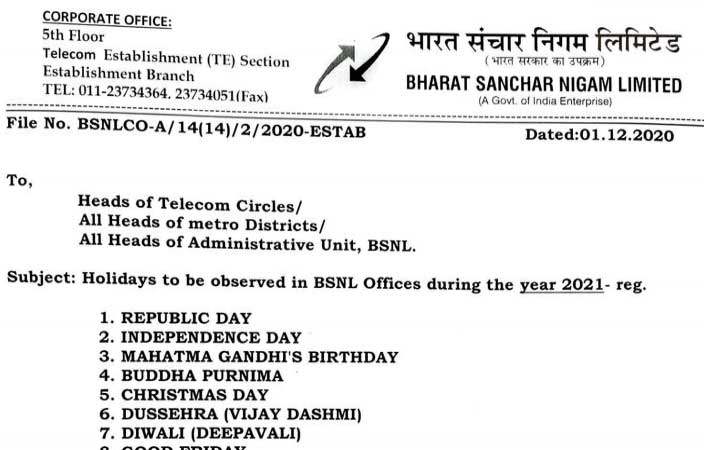
Holidays to be observed in BSNL Offices during the year 2021 - BSNL Holidays 2021
BSNL Holidays 2021
BHARAT SANCHAR NIGAM LIMITED (A Govt. of India Enterprise)
File No. BSNLCO-A/ 14(14)/2/2020-ESTAB
Dated:
01.12.2020
To, Heads of Telecom Circles/ All Heads of metro Districts/ All Heads of Administrative Unit, BSNL.
Subject: Holidays to be observed in BSNL Offices during the year 2021- reg.
In accordance with Ministry of Personnel, Public Grievances &
Pensions (Deptt. of Personnel & Training O.M. No. 12/9/2020-JCA-2
dated 10th June 2020, it has been decided by the Competent Authority
that the holidays as specified in the Annexure I to this O.M. will be
observed in all the BSNL Offices located at Delhi / New Delhi during the
year 2021. In addition, each employee will also be allowed to avail
himself/ herself of any two holidays to be chosen by him/her out of the
list of Restricted Holidays in Annexure II.
BSNL Administrative Offices located outside Delhi / New Delhi shall
observe the following holidays compulsorily in addition to three
holidays as per para 3.1 below:
REPUBLIC DAY
INDEPENDENCE DAY
MAHATMA GANDHI’S
BIRTHDAY
BUDDHA PURNIMA
CHRISTMAS DAY
DUSSEHRA (VIJAY DASHMI)
DIWALI (DEEPAVALI)
GOOD FRIDAY
GURU NANAK’S
BIRTHDAY
IDUL FITR
IDU’L ZUHA
MAHAVIR
JAYANTI
MUHARRAM
PROPHET MOHAMMAD’S BIRTHDAY (ID-E-MILAD)
3.1 In addition to the above 14 Comnpulsory holidays mentioned in
para 2, three holidays shall be decided from the list indicated below by
the Circle Heads of Territorial Circles in consultation with the Circle
Staff Welfare Board and the representative Union and keeping in view
the recommendation of the Central Government Employees Coordination
Committee in the State Capitals. The final list applicable uniformly to
all BSNL offices within the territorial jurisdiction of the concerned
State shall be notified accordingly and a copy endorsed to the Corporate
Office within a period of 4 weeks of issue of this letter and no change
can be carried out thereafter. It is also clarified that no change is
permissible in regard to festivals and dates as indicated.
3.2 No substitute holiday should be allowed if any of the festival
holidays, initially declared, subsequently happens to fall on a weekly
off or any other non-working day or in the event of more than one
festival falling on the same day.
4. The list of Restricted Holidays appended to this O.M. is meant for
BSNL Offices located in Delhi/ New Delhi. The Heads of Territorial
Circle in consultation with the Circle Staff Welfare Board and the
representative Union and keeping in view the recommendations of the
Central Government Employees Co-ordination Committee in the State
Capitals may draw up separate list of Restricted Holidays keeping in
view the occasions of local importance but the 9 occasions left over,
after choosing the 3 variable holidays in para 3.1 above, are to be
included in the list of restricted holidays.
5.1 For offices in Delhi New Delhi, any change in the date of
holidays in respect of Idu’l Fitr, Idu’l Zuha, Muharram and Id-e-Milad,
if necessary, depending upon sighting of the Moon, would be declared by
the Ministry of Personnel, Public Grievances and Pensions after
aScertaining the position trom the Govt. of NCT of Delhi (DCP, Special
Branch, Delhi Police).
5.2 For offices outside Delhi / New Delhi, the Heads of Territorial
Circles are authorized to change the date of holiday, if necessary,
based on the decision of the concerned State Governments / Union
Territories, in Muharram respect of ldu’l Fitr, Idu’l Zuha, and
Id-e-Milad.
5.3 It may happen that the change of date of the above occasions has
to be declared at a very short notice. In such a situation, announcement
could be made through P.I.B/ T.V. /A.l.R. / Newspapers and the Heads of
Territorial Circles may take action according to such an announcement
without waiting for a formal order, about the change of date.
6. During 2021, Diwali (Deepavali) falls on Thursday, November 4,
2021 (kartika 13). In certain States, the practice is to celebrate the
occasion a day in advance, i.e., on “Naraka Chaturdasi Day”. In view of
this, there is no objection if holiday on account of Deepavali is
observed on- “Naraka Chaturdasi Day (in place of Deepavali Day)
compulsory for the holiday BSNL Offices for Diwali in a State if in that
State that day alone is declared as a for the offices of the State
Government.
7. BSNL Offices which include industrial, commercial and would
observe upto 16 trading establishments holidays in a Republic Day, year
including three national holidays viz. Independence Day and Mahatma
Gandhi’s birthday, as holidays. The compulsory of Circle remaining
holidays / occasions may be determined by respective Heads themselves
for the year 2021, subject to para 3.2 above.
Keshav Kumar) Assistant General Manager (Estt.II) Enc: Lists of Holidays.
Sub: PROPOSAL OF MEDICAL INSURANCE SCHEME FOR RAILWAY EMPLOYEES.
Ref: 1) Railway Board letter No.E(W)2020/Misc/ Dashboard- GIS, dated 27.10.2020 2) Railway Board order No.ERB-1I/2020/23/30, dated
20.10.2020.
1) Ministry of Railways constituted a committee to examine and tender
their recommendations to bring all Railway Employees under the Medical
Insurance Scheme for obtaining treatment in private hospitals. IRTSA
submits the following for the kind consideration of Railway Board.
2) Indian Railways Medical Service (IRMS)
is spread
across the length and breadth of the country. IRMS is having 125
hospitals and 586 dispensaries, manned by 33,300 medical staff catering
to approximately 66 lakh beneficiaries including 12.27 lakh serving
employees. In the year 2018-19 Railway Hospitals treated 2.01 crore OPD
patients, 5.08 lakh in-patients and performed 1.02 lakh major and
specialty surgeries.
3) Railway Hospitals performed pre-placement medical examination for
38,000 candidates and carried out periodical medical examination for
1.14 lakh employees. They also examined 12.51 lakh food and water
samples.
4) Indian Railways total medical services expenses for the year
2018-19 including cost of medical staff is Rs. 6888.34 crore. That makes
average medical expense per beneficiary as Rs.10,500.
5) No medical insurance company in India handles 66 lakh
beneficiaries. Medical Insurance doesn’t cover OPD. Since Railway is
catering 2.01 crore OPD patients in a year, it may not be possible to
include huge OPD beneficiaries in private managed medical insurance.
6) In existing Railway medical system all medical services like OPD,
diagnosing, medicines, Surgeries, in-patient care, major
treatment/surgeries carried out in referral private/ CGHS hospitals and
follow-up checking are part of employees’ welfare scheme offered to
employees and their dependents. It is a part of service condition. For
retired employees and their dependents who opted for RELHS on onetime
payment, same medical services are extended.
7) In the Railway Medical system, no cost ceiling is fixed for
entitlement of any required treatment. On the other hand, medical
insurance cover is basically extended to in-patient treatments and for
surgeries with a ceiling based on the premium paid.
8) For example, United India Insurance Company Limited offers Rs.10
lakh sum insured at premium rate per member Rs.12,386 in age group
41-45. If all 66 lakh Railway beneficiaries are covered under above
premium Rs.8370.78 crore will be paid as total premium. Whereas total
medical expense of Indian Railways for the year 2018-19 is Rs. 6888.34
crore which is for diverse services given in the Annexure.
9) In the same time there is a need for addition of more private
empanelled hospitals in Indian Railways Medical Services with seamless
cashless treatment, since large number of serving and retired health
care beneficiaries live in the newly developed suburbs of various cities
throughout India. It is pertinent to note that in case of emergency,
beneficiaries first require to approach Railway Hospital, then they are
referred to private hospitals and in many cases precious golden hours
are lost in mere formalities endangering the life.
10) Beneficiaries living in faraway places from Railway Hospitals
also find it difficult to get their regular treatments and minor
treatments occasionally, since they are required to travel long distance
to reach Railway Hospitals. These beneficiaries will be benefited if
cashless treatment is extended to them in the hospitals available near
their living place.
11) Hence it is requested that,
a. Existing Indian Railways Medical Service facilities may please be continued.
b. The proposal for Medical Insurance Scheme for Railway employees /
Pensioners and their depended may please be made as additionally
facility to the beneficiaries to get their regular treatments including
OPD & IPD in empaneled private hospitals, premium thereof may please
be borne by Railways.
Thanking You
Yours faithfully, (Harchandan Singh), General Secretary, IRTSA
Annexure
List of diverse services performed by Indian Railways Medical Service (IRMS)
1) Attending Railway accidents and similar incidents; 2) Emergency medical treatment for sick passengers; 3) Pre-employment medical
examination for prospective employees; 4) Periodical medical examination for employees; 5) Medical boards and other medical
certification for employees; 6) Safe water supply at Railway stations; 7) Safe food supply at Railway stations; 8) Running
medical first-aid posts for IR factories under the Factories Act; 9) Certification of dead bodies; 10) Certification of perishable
goods; 11) Curative healthcare; and 12) Preventive healthcare.
Consumer Price Index for Industrial Workers (2016=100) – October 2020
AICPIN for the month of Oct 2020
The Labour Bureau, an attached office of the M/o Labour &
Employment, has been compiling Consumer Price Index for Industrial
Workers every month on the basis of retail prices collected from 317
markets spread over 88 industrially important centres in the country.
The index is compiled for 88 centres and All-India and is released on
the last working day of succeeding month. The index for the month of
October, 2020 is being released in this press release.
The All-India Consumer Price Index for Industrial Workers (CPI-IW)
for October, 2020 increased by 1.4 points and stood at 119.5 (one
hundred nineteen and point five). On 1-month percentage change, it
increased by (+) 1.19 per cent between September and October, 2020
compared to (+) 0.93 per cent increase between corresponding months of
previous year.
The maximum upward pressure in current index came from Food &
Beverages group contributing (+) 1.29 percentage points to the total
change. At item level, Arhar Dal, Poultry (Chicken), Eggs (Hen), Goat
Meat, Mustard Oil, Sunflower Oil, Brinjal, Cabbage, Carrot, Cauliflower,
Chillies Green, Gourd, Lady Finger, Onion, Peas, Potato, Electricity
Domestic, Doctor’s Fee, Bus Fare, etc. are responsible for the increase
in index. However, this increase was checked by Wheat, Fish Fresh,
Tomato, Apple, etc., putting downward pressure on the index.
At centre level, Doom-Dooma Tinsukia, Patna and Ramgarh recorded the
maximum increase of 4 points each. Among others, 3 points increase was
observed in 9 centres, 2 points in 24 centres and 1 point in 33 centres.
Rest of 19 centres’ indices remained stationary.
Year-on-year inflation based on all-items stood at 5.91 per cent for
October, 2020 as compared to 5.62 per cent for the previous month and
7.62 per cent during the corresponding month of the previous year.
Similarly, Food inflation stood at 8.21 per cent against 7.51 per cent
of the previous month and 8.60 per cent during the corresponding month a
year ago.
All-India Group-wise CPI-IW for July and August, 2020
Sr. No.
Groups
August,
2019
Jul, 2020
August, 2020
I
Food
Group
330
119.7
123.0
II
Pan, Supari, Tobacco &
Intoxicants
391
131.6
132.5*
III
Fuel & Light
282
117 .6
117
.4
IV
Housing
434
113.5
113.5*
v
Clothing, Bedding &
Footwear
226
125.6
126.4
VI
Miscellaneous Group
254
116.8
117
.0
General Index
320
118.1
119.5
The next issue of CPI-IW for the month of November, 2020 will be
released on Thursday 31st December, 2020. The same will also be
available on the office website labourbureaunew.gov.in.
Key Points:-
All-India CPI for Industrial Workers (2016=100) for October,
2020 increased to 119.5 points compared to 118.1 points for September,
2020.
In percentage terms, it rose by 1.19%
w.r.t. previous month mainly due to Food group items having a share of
39.17% in the total weight which recorded a rise of 76% between these
two months. During the period, increase in prices of food items viz.
Arhar Dal, Poultry Chicken, Goat Meat, Egg, Mustard Oil, Onion, Potato,
Brinjal, Peas, Doctor’s Fee, Bus Fare, etc., had greater impact.
Year-on-year
inflation based on all-items stood at 5.91 per cent for October, 2020
compared to 5.62 per cent for September, 2020 and 7.62 per cent during
the corresponding month of the previous year. Similarly, Food inflation
stood at 8.21 per cent against 7.51 per cent of the previous month and
8.60 per cent during the corresponding month a year ago.
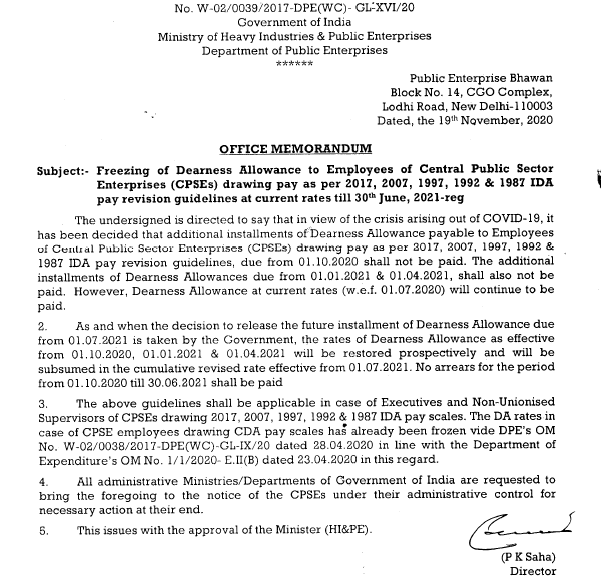
Freezing of DA rates - CPSEs IDA pay scales revision guidelines at current rates till 30th June 2021
Highlights of the Freezing
IDA order:
IDA will be freezed till 30th June 2021.
IDA rate from 01.07.2020 to be continued till 30.06.2021.
From 1st July 2021,
the effective IDA rate will consider the 3 missed IDA rate of 01.10.2020, 01.01.2021, 01.04.2021.
No arrears will be paid for these 3
missed quarters (01.10.2020, 01.01.2021, 01.04.2021).
Industrial Dearness Allowances to be revised quarterly for Central
Public Sector Enterprises (CPSEs) or PSUs has been freezed by Department
of Public Enterprises under the ministry of Heavy Industries &
Public Enterprises.
Freezing of DA rates – CPSEs IDA pay scales revision till 30th June
2021
Freezing of IDA, Dearness Allowances for CPSE employees till 30th June 2021:
Freezing of Dearness Allowances to employees of Central Public Sector
Enterprises (CPSEs) drawing pay as per 2017, 2007, 1997, 1992 and 1987
IDA pay revision guidelines at current rates till 30th June 2021 order
has been issued on 19th Nov’ 20.
The ministry of Heavy Industries & Public Enterprises has already
freezed DA /DR for Central Government employees on 23.03.2020. Now,
Government of India has issued IDA freezing order for CPSE employees
too.
Government of India had released average AICPIN for the quarter
Jun’20, Jul’20, Aug’20. With these average AICPIN numbers, the IDA for
3rd PRC should have been increased by 2.52 % from October 2020 for 2017
(3rd PRC) pay scales. Similarly, the IDA from October 2020 for 2nd PRC
should have been increased by 5.55 % for 2007 (2nd PRC) pay scales. But, now these increments have been frezzed till 30th June
2021.
IDA rate calculation for 2nd PRC and 3rd PRC from 1st October 2020
From 01.10.2020, IDA will increase to 20.9 %, increased by 2.52 % for
3rd PRC or 2017 pay scale employees. For 2nd PRC or 2007 pay scale, IDA
will increase to 165.4 % increased by 5.55 % after declaration of
August AICPIN on 30.09.20.
Since, the DA increments have been freezed, so the DA from 1st OCT’20
number will be added while calculating DA from 1st July 2021.
The AICPI – IW (All-India Consumer Price Index – Industrial Workers)
is released by Labour Bureau, under Ministry of Labour and Employment,
on the last working day of every month for previous month. And based on
the consecutive 3 months, means 1 quarter, calculation of average is
done to finalize the IDA rate, which may be more or less than the
previous quarter IDA rate.
IDA for 3rd PRC from 1st October 2020 will be 20.9 %, increased by 2.52 % for 2017 pay scale.
IDA for 2nd PRC from 1st October
2020 will be 165.4 %, increased by 5.55 % for 2007 pay scale.
IDA from from 1st October 2020 is yet to be declared for 1997 pay
scale.
IDA from from 1st October 2020 is yet to be declared for for 1987 & 1992 pay scale (based on the pay-band).
AICPIN -IW of last 3 months
22.10.2020 – Sep AICPIN – 340 (118 x 2.88 = 340)
30.09.2020 – Aug
AICPI – 338
31.08.2020 – Jul AICPI – 336
Based on the AICPI-IW data, Department of Public Enterprises (DPE)
under Ministry of Heavy Industries & Public Enterprises calculates
the new IDA rate and releases the press note indicating the change in
IDA rate.
Similarly, after the release of aicpin-iw data of September 2020,
October 2020 and November 2020 by the Ministry of labour and employment,
the IDA from 1st January 2021 for PSU, CPSE and Govt. employees will be
decided for 3rd PRC, 2nd PRC etc.
Past change of IDA for CPSE employees for 2017 (3rd PRC), 2007 (2nd PRC), 1997, 1987 & 1992 with DPE letter:
The current data of IDA since 01.01.2018 for all the pay scale as
well as the historical data of all the CPSE pay scales implemented from
year 2017, 2007, 1997 and 1987 & 1982 are compiled here.
This will give you the reference to compare all the data among the
different pay scales in different times, how much differences are among
the pay scales and in same pay scale, what is the timeline of IDA
change.
Here the IDA change has been written for a quarter for all the pay
scales. These letters are issued by the DPE under MHIPE. The official
letters issued by them has been attached here in the link. Click on the
‘IDA % number’ link to fetch the official letter from the DPE website.
Compassionate
appointment to ensure transparency in selection process
F.No.A.12012/8/ 2020- Ad.III.B Government of India Ministry of Finance Department of Revenue Central Board of Indirect Taxes & Customs
Gr. Floor, Hudco Vishal Building, Bhikaji Cama Place, RK Puram, New Delhi-66, Dated: 18.11.2020
To
(i) DGHRD, (HRM-II) , Customs & Central Excise, 507, Deep Shikha, Rajendra Place, New Delhi- 110 008
(ii) The All Cadre Controlling Authorities Under Central Board of Indirect Tax & Customs
Subject: Clarification for selecting of applicants who secured equal weightage points on the 100 points scale in merit –
reg.
Sir/ Madam,
Please refer to Board’s letter F.No.A.12012 / 52/ 2018-Ad.III B dated
15th May, 2019 wherein a standard operating procedure based on a
100-point scale was circulated for compassionate appointment to ensure
transparency and maintain uniformity and to avoid litigation in the
selection process.
2. It has been reported to the Board by one CCA that while applying
100 points scale parameters, as mentioned in SOP, some candidates have
equal marks in merit and Cadre Controlling Authority is unable to decide
the merit of such candidates in case of tie of marks secured by some
candidates. The matter has been deliberated in the Board to resolve such
situation.
3. After examination the issue in detail, it is felt that the tie breaking factor can be per dependant available
income e.
total of first three financial parameters prescribed in SoP
(Pension-annualised, total terminal benefits and annual income of
earning members and income from property) divided by total number of
dependants (spouse, parents, unmarried daughters, minor children,
unmarried major son below 25 years and dependant major sons who are
physically/ mentally challenged). The lesser the per dependant availableincome, the higher the
rank amongst the applicants whose scores hada tie.
4. In case of tie even after applying the factor of per dependant
availableincome, then
the left-over service of Government Servant can be conside This is
suggested as it is felt that longer the left-over service of the
deceased, the more is the impact on the family. Applicants related to
Government servant with higher left-over service would be considered
over the one with lesser left-over service. In case of tie even then,
the next factor can be age of the applicant, with elder applicants given
preference .
5. The tie breaking factor(s) in the order indicated above, should be
used only to decide relative merit of the applicants scoring same
points on 100- point scale and only if the applicants scoring same
points cannot be accommodated against available All the above details
are already included in the SOP and hence would be readily available
with CCAs in case of a tie.
6. It is requested to offer your comments/ suggestions, if any, on
the proposed formula to resolve the Tie cases not later than 26th Nov,
2020.
Yours faithfully,
Sd/- (MohammadAshit) Under
Secretary to the Govt. of India 011-26 162780
Copy to: The Director General System & Data Management, New Delhi
Appointment on
With reference to the above, it is stated that Para 9 of Annexure to
Board’s letter dated 10.06.2009 (RBE No. 101/2009) explicitly mentions
that … “Regular service for the purpose of the MACPS
shall commence from the date of joining of a post in direct entry grade
on a regular basis either on direct recruitment basis or on absorption
re-employment basis. Service rendered on ad-hoc contract basis before
regular appointment on pre-appointment training shall not be taken into
reckoning… “. As such. ad-hoc service is not to be counted
for the purpose of MACPS and, therefore. the concerned employee is
entitled for 3rd financial upgradation under MACPS wef 11.10.2012
subject to fulfillment of other terms and condition as contained in
Board’: letter dated 10-06-09 (RBE No. 101/2009).