Saturday, 10 February 2018

India Post Payments Bank (IPPB) to enable Digital Payments in Post Offices by April 2018


Ministry of Communications
India Post Payments Bank (IPPB) to enable Digital Payments in Post Offices by April 2018
India-Post-Payments-Bank-IPPB

10 FEB 2018
India Post Payments Bank (IPPB) Expansion Programme continues to make brisk progress and a nation-wide roll-out is scheduled beginning April 2018. No decision has been taken to revise the timelines as reported in some sections of the media on Tuesday, 06th February 2018. Once the proposed expansion is completed, IPPB will be providing the largest financial inclusion network in the country, covering both urban as well as rural hinterland with ability to provide digital payment services at the doorstep with the help of Postmen and GraminDakSewaks (GDS). IPPB will also enable more than 17 crore active account-holders of Post Office Savings Bank to make interoperable digital payments including the benefit of NEFT, RTGS, UPI and bill payment services. Additionally, the IPPB will enable acceptance of digital payments across post offices in the country in line with the digital payments initiative of the government.

PIB

29 cases resolved at the Second 'Pension Adalat'


29 cases resolved at the Second 'Pension Adalat'

Ministry of Personnel, Public Grievances & Pensions
29 cases resolved at the Second 'Pension Adalat'
Use of technology improves Grievance redressal: Jitendra Singh

The Union Minister of State (Independent Charge) Development of North-Eastern Region (DoNER), MoS PMO, Personnel, Public Grievances & Pensions, Atomic Energy and Space, Dr Jitendra Singh attended the second 'Pension Adalat' here today. The Pension Adalat was organized by the Department of Pension & Pensioners’ Welfare. The objective of the Pension Adalat was to provide on-the-spot resolution of unresolved grievances and also to reduce the delays in the settlement of legitimate dues of the pensioners

Addressing the Pension Adalat, MoS, Shri Jitendra Singh congratulated the Department of Pension & Pensioners’ Welfare for successfully conducting the second 'pension Adalat' where out of 31 grievance cases 29 were resolved within few hours of hearing. He said that technology can play a vital role in facilitating the pensioners in disposing off their cases and for speedy redressal system for them.

He added that earlier Department of Pension & Pensioners Welfare is now a days in the news for all good reasons as it has done a lot good to the old pensioners. It has brought smile to the pensioners faces by resolving their cases quickly and amicably.

Appreciating the Centre Government's initiatives under the leadership of Prime Minister, Shri Narendra Modi for older generation in the field of pension and health, he said , it has brought changes in society where old people feel neglected. He also suggested for starting a helpline by the Department of Pension & Pensioners’ Welfare for the pensioners in resolving their problems.

In this Pension Adalat 34 pension grievances cases were listed and the various Stakeholders from Ministries, Departments, Banks, and CPAO have been called upon to redress the issue on spot. The issue includes revision of Family Pension, Commutation of Pension, final settlement of GPF, Fixed Medical Allowance etc.

Friday, 9 February 2018

7th Pay Commission Minimum Pay Calculation: Comparison of Methodology for calculation of minimum Pay of Central Government and a few State Governments as on 1/7/2017

7th Pay Commission Minimum Pay Calculation: Comparison of Methodology for calculation of minimum Pay of Central Government and a few State Governments as on 1/7/2017

7th-Pay-Commission-Minimum-Pay-Calculation


Comparison of Minimum Pay

Comparison of Minimum Pay of Central Government and a few State Governments as on 1/7/2017.

Pay Commission Objective: It is the endeavour of every pay commission to ensure that the pay and allowances of employees should be ‘fair and reasonable'. The pay structure should also motivate the employees to reasonable levels of performance in the tasks assigned to them, so that the general public derive the benefit of their service as intended.

7th CPC of Central Government: The Central Government has been following the practice of pay revision for employees once in ten years. Pay scales of the Central government employees have been revised with effect from 1.1.2016 based on the report of the Seventh Central Pay Commission. The revised minimum pay effective from 01.01.2016 is 2.57 times the pre-revised basic pay. The minimum pay of the central employees has been worked out at Rs.18,000/- per month and represents a real increase of 14.29% of the pre-revised wages. The multiplication factor adopted for revising all the other scales ranges between 2.57 and 2.72 resulting in maximum pay of Rs.2,05,400 corresponding to the highest pre-revised pay scale other than the apex pay scale of Rs.80,000 which is raised to Rs.2,25,000. The Cabinet Secretary's pay is fixed at Rs.2,50,000.
Employees Associations (Staff side JCM) have also sought minimum pay revision to Rs.26,000 with effect from 01.01.2016.

Pay Revision of various State Governments

Government of Kerala Pay Scales: The revised pay structure introduced by the Government of Kerala witheffect from 1.7.2014 is based on the recommendations of the 10th PayRevision Commission and relates to index level of 239.92 points ofAIACPI (IW). Basic Pay of Group "D" employee is fixed at Rs 16500/-
The rates of increment range from Rs.500 to Rs.2,400. The payment of DA formula is unaltered and continues to be as per the central government formula to neutralise the price rise over and above the 239.92 points twice in a year.

Andhra Pradesh Pay Scales: The revised pay structure formulated by Government of Andhra Pradeshon the basis of the recommendation of 10th Pay Revision Commissionrelates to index level of 220.61 points of AIACPI (IW), Basic Pay of Group "D" employee is fixed at Rs 13000/-
The HRA ranges from 30% to 12% of basic pay subject to a maximum of Rs.20,000 depending upon the classification of places and pay.

Karnataka Pay Scales: The revised pay structure formulated by Government of Karnataka on the basis of the recommendation of 6th Pay Revision Commission relates to index level of 276.9 of AIACPI (IW).

Costs of consumable items obtained from the Department of Economics & Statistics, Government of Karnataka are utilised for their calculation.

CLICK HERE FOR REPORT 
http://www.finance.kar.nic.in/6thPay/6thPayComReport .pdf

(For English version read from page number 135 on wards)

The 6th pay commission appointed by the Karnataka Government recommended a 30% increase in the salaries of around 5,20,000 government employees and 73,000 employees from "aided institutions".

The revision of pay and pension is to come into effect from 1 July 2017 with benefits paid from 1 April 2018. The Group "D" minimum basic pay is fixed at Rs 17000/-.

Methodology for calculation of minimum wage adopted by Pay commissions both Central and State Pay Commissions

Central pay commissions as well as pay commissions in some states have adopted the approach of determining the minimum pay for employees based on the cost of a minimum acceptable standard of living for a household. This is calculated on the basis of the current prices of daily necessities like food, clothing, housing, etc., for a family of three consumption units typical in the case of young employees starting their careers in government. The normative consumption requirements of the family as adopted in the 15th Indian Labour Conference in 1957 are considered for this purpose. While the minimum pay is thus worked out on the basis of a set of quantitative norms and based on Dr. Wallace Aykroyd's formula , the maximum pay for employees at the highest levels is to be determined as that required to attract and retain persons of qualifications and skills appropriate for the higher positions in government services.

Comparative picture of pay of Central Government and State Government in regards to minimum wage as on 1.7.2017

Govt. of India
Group "C" Min Basic Pay =Rs 18000/-
DA 5% = Rs 900/-
Total Basic Pay + DA =Rs 18900/-

Andhra Pradesh & Telangana
Group "D" Min Basic Pay =Rs 13000/-
Provide for Skill by adding 25% =Rs 3250-
Total Group "C" Min Basic Pay = Rs 16250/-
DA @ 24.1% = 3916/-
Total Basic Pay + DA=Rs 20166/-

Kerala
Group "D" Min Basic Pay =Rs 16500/-
Provide for Skill by adding 25% Rs 4125/-
Total Group "C" Min Basic Pay =Rs 20625/-
DA @ 14% = 2887/-
Total Basic Pay + DA= Rs 23512/-

Karnataka
Group "D" Min Basic Pay = Rs 17000/-
Provide for Skill by adding 25% = Rs 4250-
Total Group "C" Min Basic Pay = Rs 21250/-
DA = NIL
Total Basic Pay + DA = Rs 21250 /-

Ratios between minimum and maximum pay
The existing ratios between minimum and maximum pay of the central government and the States is as follows:
Government of India 1 :12.5
Andhra Pradesh 1:8.527
Kerala 1 :7
Karnataka 1:8.86

The gap is highest in Central Government should be reduced ratios between minimum and maximum pay to 1: 8

Hence there is need for revision of minimum wage for Central Government employees and also fitment formula on the lines of the State Government Pay Commissions, the State Government economic conditions are not as good as the Central Government still the State Governments are paying more for their employees comparing it to the Central Government, in case of the 7th CPC the Central Government Employees got only 14.29% , the Group "A" and above officers of Central Government got more pay hike due to higher fitment formula of 2.72 . Thus injustice is done for Group "C" and Group "B".

whereas the Karnataka State Government employees got 30% wage hike , Central Government Employees got only 14.29% wage hike , the uniform multiplication factor should be fixed for the Central Government employees and also Central Government Employees should also get 30% wage hike .

Source:www.karnatakacoc.blogspot.in

JOINT CAMPAIGN OF CONFEDERATION & AISGEF AGAINST NPS AND OUTSOURCING


JOINT CAMPAIGN OF CONFEDERATION & AISGEF AGAINST NPS AND OUTSOURCING - SIGNATURE CAMPAIGN FEBRUARY 10TH TO MARCH 10TH - COPY OF MEMORANDUM TO BE SUBMITTED TO PRIME MINISTER AFTER OBTAINING SIGNATURE

To
The Hon'ble Prime Minister of India

We, those who signed in this memorandum are state and Central Government Employees of the country. We may submit the following burning issues of the state and central Government Employees for your kind consideration and disposal.

The system of pension as a social security benefit to the employees in Government sector in India has been existing since the early British days. After independence the pension system was further improved and family pension was also introduced . The Defined pension scheme for the government employees is a well- built scheme as the best of all social security benefits for the employees and they are not required to contribute anything for pension.

Government of India introduced contributory pension to employees those who entered in government service on or after 1.1.2004 .Majority of the state Government s also introduced the same for their employees. The Contributory Pension Scheme is totally depend on the profit and loss in the share market and Government have no control on the fund and it has nothing to do with the welfare of the employees or any individual or even Government finances.

The concept of pension as elaborated by the 4th Central Pay Commission, is 'Pensions to the former members of armed forces and civilian employees of Central Government is not by way of charity on an ex-gratia payment, or a purely social welfare measure was totally changed by . It is in the nature of a "right" which is enforced by the law". Later the concept was further strengthened by the Land mark Judgement delivered by the Supreme Court in 1982 in a Writ Petition filed by D.S.Nakara Vs the Union of India. Supreme court declared that the Pension is not only compensation for loyal service rendered in the past but has also a broader significance in that it is a measure of socio-economic justice which inheres economic security in the fall of life .The PFRDA Act is against the earlier ruling of the Supreme Court on the employees' Right to Defined Benefit Pension as cited earlier.
There is no assurance, for getting pension ,except market based guarantee in NPS. The stock markets have never remained consistently strong over a long period of time. This volatility of stock market is a cause of serious concern about the sustainability of the National Pension Scheme itself.

The transition from this Defined Benefit Pension System to the Defined Contribution Pension System will make civil services more unattractive. Majority of State Governments are reluctant to remit the employer's contribution to the pension fund. There is no assurance in getting the pension to the employees and workers.

For all these reasons, particularly the cut in salary and pension of the employees, absence of Government guarantee for retirement benefits in the National Pension Scheme and the distinct possibility of a sustainable Defined Benefit Pension System along with extension of social security system for the unorganised sector, we are not in a position to accept the National Pension Scheme. We strongly urge that a more in depth factual and analytical discussion is essential on National Pension System.

Contract Labour is one of the acute form of unorganized labour. Under the system of contract labour, workers are employed on the contract basis. The contract worker is a daily wager or the daily wages are accumulated and given at the end of the month. Contract workers are paid much lower wages than they would be entitled to under direct employment. This system led to whole-scale exploitation of labour, and a series of demands were made before tribunals for the abolition of contract labour system.

The system of employing contract labour is prevalent in civil service and in the services sector. The civil service has a major role in the smooth functioning of a Democratic Government. As part of overall development of the society and increase in population, the civil service also must be extended its wing. Education, Health, Public Transport, Communication, Welfare measure to women and children are all developed much. Numerous job opportunities have created round the world in Government Service.

The regular appointment to government sector ceased. Instead contract employment started. As such it is seen that the number of regular employees in the civil service are decreasing day by day, whereas the number of daily waged/contract/outsourced employees are increasing . By this time all the centrally sponsored schemes also emphasis on contract appointment. All the flagship programmes of Government of India are implementing with Daily waged/Contract/Casual appointment.

Bypassing UPSC and State Public Service Commission and Employment Exchanges which are the main recruitment agencies for central and State Governments, Unemployment among the educated youth is the main reason for Contract Employment. On contract employment the appointment is for limited monthly income. This is a kind of exploitation of labour.

The Supreme Court of India in a Land mark Judgment ruled that temporary employees performing similar duties and functions as discharged by permanent employees are entitled to draw wages at par with similarly placed permanent employees. The principle must be applied in situations where the same work is being performed, irrespective of the class of employees. The constitutional principle of 'equal pay for equal work' has been upheld by the Supreme Court of India.

Hence we appeal to the Hon'ble Prime Minister of India to take urgent measures to repeal the National Pension system and ensure defined pension to all employees and to regularise all Contract / Casual Employees and ensure equal wages for equal work for all employees including contract and casual employees. We appeal the Government of India to heed the demands of the employees in the country and take appropriate action in this regard.

New Delhi

Source: Confederation Of Central Government Employees

Railways: Cleanliness and Maintenance of Passenger Rail Coaches

Ministry of Railways
Cleanliness and Maintenance of Passenger Rail Coaches
09 FEB 2018

Every endeavour is made to keep the coaches in properly maintained and clean condition. All efforts are made by the Railways to address the complaints.

Some of the major initiatives taken by Indian Railways towards improvement of cleanliness and maintenance of coaches are as follows :

Cleaning of coaches of trains at both ends including mechanized cleaning.

On Board Housekeeping Service (OBHS) has been provided in more than 970 pairs of trains including Rajdhani, Shatabdi and other important long distance Mail/Express trains for cleaning of coach toilets, doorways, aisles and passenger compartments during the run of the trains.

'Clean My Coach' service is provided on demand in nearly 950 pairs of important Superfast/Mail/Express long distance trains having On Board Housekeeping Service.

Clean Train Station (CTS) scheme has also been prescribed for limited mechanized cleaning attention to identified trains including cleaning of toilets during their scheduled stoppages enroute at nominated stations.

Regular maintenance and upkeep of all passenger coaches is carried out during laid down maintenance schedules at the Coaching depots and workshops to ensure that they remain in good condition.

Some special measures like running of model rake trains (like Mahamana Express), upgradation of identified Rajdhani / Shatabdi trains to Swarn Standard, running of Humsafar, Tejas, Antyodaya trains etc. have also been taken to improve travelling experience.

This information was given by the Minister of State for Railways Shri Rajen Gohain in a written reply to a question in Rajya Sabha today.

PIB

Thursday, 8 February 2018

Revision of the rates of Hospital Patient Care Allowance (HPCA) and Patient Care Allowance (PCA) to Railway employees working in Railway Hospitals and Health Units/Clinics

Revision of the rates of Hospital Patient Care Allowance (HPCA) and Patient Care Allowance (PCA) to Railway employees working in Railway Hospitals and Health Units/Clinics

HPCA-PCA-Railway-Employees
  
GOVERNMENT OF INDIA
MINISTRY OF RAILWAYS
(RAILWAY BOARD)

S.No.PC-VII/91
RBE No.15 /2018
No.E(P&A)II-2017/AL-3
New Delhi, dated 30.01.2018

The General Managers/CAOs,
All Indian Railways & Production Units.

Sub:- Revision of the rates of Hospital Patient Care Allowance (HPCA) and Patient Care Allowance (PCA) to Railway employees working in Railway Hospitals and Health Units/Clinics-regarding.

Hospital Patient Care Allowance (HPCA)/Patient Care Allowance (PCA) was introduced on the Railways in terms of Board’s letter No.E(P&A)II-98/HW-6, dt. 09.01.2008 (RBE No.1/2008). Subsequently, on implementation of 6th CPC recommendations, the rates of HPCA/PCA have been revised vide Board’s letter No.E(P&A)II-2013/AL-3, dt. 20.02.2013 (RBE No.15/2013) and dt. 14.07.2014 (RBE No.74/2014).

2. Consequent upon the decision taken by the Government of India on the recommendations of the 7th CPC, the President is pleased to decide that Hospital Patient Care Allowance (HPCA)/Patient Care Allowance (PCA) shall be admissible only to existing eligible Group 'C' and 'D'  (Non-Ministerial) Railway employees as per R1H3 of the newly proposed Risk and Hardship Matrix ( Rs.4100 for level 8 and below and Rs.5300 for level 9 and above).

3. The revised rates of HPCA/PCA shall be admissible with effect from the 1st of July, 2017.

4. The other terms and conditions regarding admissibility of HPCA/PCA as contained in Board’s letter dt. 09.01.2008 (RBE No.1/2008) and subsequent letters in this regard will remain in force.

5. These orders would be subject to any modification after issue of instructions by the Nodal Ministry i.e. Ministry of Health & Family Welfare.

6. This issues with the concurrence of the Finance Directorate of the Ministry of Railways.

7. Hindi version is enclosed.


(Salim Md. Ahmed)
Dy.Director, E(P&A)II
Railway Board
Source: www.airfindia.org

PROCEEDINGS OF THE GOVERNMENT OF KARNATAKA


PROCEEDINGS OF THE GOVERNMENT OF KARNATAKA

Subject: Grant of Central Government Pay Scales to the Employees of the Hon'ble High Court of Karnataka - reg.

READ:
1. Letter dated: 06-10-2004 by the Hon'ble Chief Justice of the Karnataka High Court.
2. W.A. No.441ll20l1 Sri Nijaguni V/s the High Court of Karnataka & Ors.
3. CCC No.1241 & 124412016, Nijaguni.M.Karadigudda &Anr., V/s Subhashchandra Kuntia & Ors.
4. SLP (C) No.23220-2322112017, Subhashchandra Kuntia & Ors.V/s Nijaguni.M. Karadigudda & Anr.

PREAMBLE:
The officers and staff of the High Court of Karnataka are inherently given State Scales of pay. As and when the State pay scales are revised as per the recommendations of the Expert Bodies, the benefit thereof is extended to Officers and Officials of High Court on par with State Government employees.
However, the Hon'ble Chief Justice in his letter dated: 6-10-2004 read at (1) above had opined that the Pay Scales of the High Court employees should be raised to the level of Central Government pay scales annexing therewith his proposal and had sought the financial conculrence for the same.
The Hon'ble High Court of Karnataka in its judgement dated: 12-10-2011 passed in W.A. No.441ll20l1 read ar (2) above had directed the Respondent State Government to place the recommendations of the Hon'ble Chief Justice of Karnataka dated: 06-10-2004 before the Cabinet and to take appropriate decision to implement the recommendation of the Hon'ble Chief Justice of High Court of Karnataka dated: 06- 1 0-2004 in the light of the observations made by the Apex Court in the matter of Union of India V/s S.B.Vohra (AIR 2004 SC 1402).

Sequel to the Order of the Hon'ble High Court of Karnataka dated: 14-07-2017 passed in CCC No.1241 & 124412016 read at (3) above the State Government preferred Appeal against the said Order before the Hon'ble Supreme Court of Iqdia vide SLP (C) No. 23220-232211201,7 read at (4) above. However, the Hon'ble Supreme Court of India in its order dated: 18-09-2017 dismissed the Appeal preferred by the State Government and directed the Appellant therein to comply with the orders of the Hon'ble High Court of Karnataka and to report the compliance within 4 months from the date of order.

In furtherance thereof and in terms of the judgment dated 12-10-2011 directing implementation of the recommendations of the Hon'ble Chief Justice of the Karnataka High Court dated 06-10-2004 in the light of the observation made by the Hon'ble Apex Court in the matter of Union of India vs. S.B.Vohra, said judgment mandating the communication by the Hon'ble Chief Justice to be treated as the "Rule" made by the Hon'ble Chief Justice of the Court, in terms Article 229(2) of the Constitution of India, further requiring the approval of the Governor of the State; steps are required to be taken.
Accordingly, the State Cabinet in its meeting held on 02-01-2018 has accepted and approved the proposal of the Hon'ble Chief Justice dated: 06-10-2004 vide its decision in Case No.868/2017 advising for such approval by the Governor. Subsequently, the proposal was submitted for the approval of His Excellency the Governor of Karnataka as required under Article 229(2) of the Constitution of India. His Excellency the Governor of Karnataka was pleased to approve the proposed Rule.

In the circumstances and for the reasons stated above the following orders are issued.

GOVERNMENT ORDER NO.F'D 38 SRP 20I7
BANGALORE, DATED 11TH JANUARY 2018

Govemment are pleased to accord financial concurence on the approval of the Governor under Article 229(2) of the Constitution of India to the proposed Rule of the Hon'ble Chief Justice of the Karnataka High Court as sought in letter dated: 06-10-2004 to extend the Central Government Pay Scales to the Employees of the High Court of Karnataka.

2. Law Department shall constitute a Joint Consultative Committee in consultation with the High Court of Karnataka with the following terms and conditions.
i) The Joint Consultative Committee shall consists of Members from the High Court of Karnataka and State Government.
ii) The Committee shall work out a suitable fitment table by determining the equivalence of posts between different category of posts in the High Court of Karnataka and in the Central Government.
iii) The Committee shall suggest a suitable Pay Rules.
3. The decision taken pursuant to the recommendations of the Committee shall be intimated to the State Government.

By Order and in the name of the Governor of Karnataka,
(D.S.JOGOJE)
Deputy Secretary to Government
Finance Department (Services-2)

Visit, the Official Website of Finance Department, GOK : www.finance.kar.nic.in

Women Joining Army - Defence


Women Joining Army

DEFENCE-WOMEN-ARMY
Posted On: 07 FEB 2018

The induction of women in Indian Army is based on the organizational requirements, fighting efficiency, combat effectiveness and functionality. Presently, women are recruited in Indian Army in the Military Nursing Service and as Officers through Short Service Commission (SSC) on all India merit basis in specific branches like Army Service Corps, Army Ordinance Corps, Army Education Corps, Judge Advocate General, Signals, Intelligence and Electrical and Mechanical Engineering branches.

Government has taken a number of measures to encourage both men and women from all parts of the country including Maharashtra to join the defence forces, viz. (i) sustained image projection; (ii) publicity campaign to create awareness among the youth on the advantages of taking up a challenging and satisfying career; (iii) participation in career fairs and exhibitions; (iv) motivational lectures in schools and colleges etc.

This information was given by RakshaRajyaMantriDr.SubhashBhamrein a written reply to Shri Ashok MahadeoraoNetein LokSabha today.

PIB

Filling up the post of Financial Adviser in National Company Law Tribunal (NCLT) under the Ministry of Corporate Affairs


Filling up the post of Financial Adviser in National Company Law Tribunal (NCLT) under the Ministry of Corporate Affairs

F. No. 9/2/2018-EO (MM-II)
Government of India
Ministry of Personnel, Public Grievances & Pensions
Department of Personnel & Training
(Officer of the Establishment Officer) 

North Block, New Delhi
Dated, the 7th February, 2018
 OFFICE MEMORANDUM
 
Subject: Filling up the post of Financial Adviser in National Company Law Tribunal (NCLT) under the Ministry of Corporate Affairs.

This is regarding filling up the post of Financial Adviser in NCLT under the Ministry of Corporate Affairs on deputation basis.

2. Officers of the rank of Deputy Secretary/Director level from any Organized Finance & Accounts Service of the Government of India or equivalent level, eligible for appointment under Central Staffing Scheme are eligible for the post. The period of deputation is 4/5 years at Deputy Secretary/Director level respectively.

3. The post may be circulated amongst officers eligible to be appointed at Deputy Secretary/Director or equivalent levels in the Government of India on priority basis. Names of willing and eligible officers who can be spared by the Ministries/Departments may be forwarded to this Department along with cadre clearance, vigilance clearance, detailed bio-data in the enclosed proforma and CR Dossiers for the last five years. For officers working in the cadre, it may also be ensured that the 'Cooling off, after a previous stint on deputation, if any, is completed and the officer is eligible for appointment on Central Deputation as per extant instructions.

4. The Post is a Non-Central Staffing Scheme post to be filled up through the Civil Services Board (CSB) procedure. It may be noted that no 'Mandatory Posting Certificate' for allotment/retention of Government accommodation would be issued by this office to the officer appointed on the above referred post. However, those officers who have served and are currently serving on Central Staffing Scheme post in Delhi for at least four years and require to retain Government accommodation, would be issued a certificate to the effect that the officer concerned has served for at least four years in CSS post and he/she needs to retain Government accommodation for his/her tenure on non-CCS post.

5. It is requested that the application(s) of the eligible candidate(s) may please be forwarded so as to reach this Department within one month from the date of issue of this circular.

Yours faithfully,

(J. Srinivasan)
Director (MM)
biodata

Source: DoPT

Wednesday, 7 February 2018

Clarification regarding benchmark for MACP after 25.07.2016


Clarification regarding benchmark for MACP after 25.07.2016

Clarification regarding benchmark for placement under MACP in respect of the official who are due for placement in MACP after 25.07.2016

No.20-45/2016-SPB-II
Government of India
Ministry of Communications
Department of Posts
(Personnel Division)

Dak Bhawan, Sansad Marg, New Delhi – 110 001
Dated the 22nd January, 2018
To,
The Chief Postmaster General,
Maharashtra Circle,
Mumbai

Subject: Clarification regarding benchmark for placement under MACP in respect of the official who are due for placement in MACP after 25.07.2016.

Sir,
I am directed to refer to Maharashtra Circle's letter no. STA/MACPs/Bench Mark/2017 dated & 12.2.2017 on the subject cited above and to say that 'Promotion' and 'Modified Assured Career Progression Scheme' (MACP) are two different matters. The first involves higher duties & responsibilities while latter don't.

2.For MACP, DOP&T has issued instruction vide OM No. 35034/3/2015-Estt(D) dated 28.09.2016, accordingly to which the prescribed benchmark would be 'Very Good' for all posts and it will come into effect from 25.07.2016. The communication DOP&T has already been circulated by Estt. Division of the Directorate vide letter no. 7-8/2016-PCC dated 5.10.2016 (Copy enclosed)

3.For promotion, Personnel Division vide letter no. 20-24/2016-SPB-II dated 13.02.2017 has clarified to follow instructions contained DOPT's OM No. 35034/7/97-Estt(D) dated 8.02.2002 until further clarification is issued by DOPT or Department of Posts.
Yours faithfully,
sd/-
(Satya Narayana Dash)
Source: http://fnpohq.blogspot.in/

Flash News

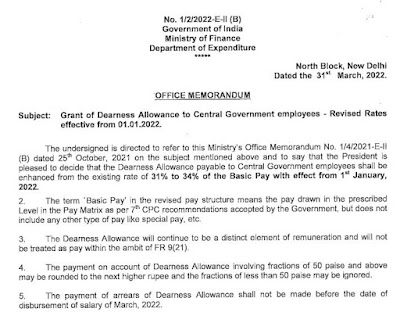
DA Jan 2022 - Grant of Dearness Allowance to Central Government employees - Revised Rates effective from 01.01.2022

 3% DA Hike - Revised Rates effective from 01.01.2022: DoE OM dated 31.03.2022 No. 1/2/2022-E-II (B) Government of India Ministry of Finance...