Wednesday, 21 December 2016

Review of CSSS officers in the Grade of Private Secretary (PS) under FR 56(j) and Rule 48 of CCS (Pension) Rules, 1972

Review of CSSS officers in the Grade of Private Secretary (PS) under FR 56(j) and Rule 48 of CCS (Pension) Rules, 1972
Reminder-II
4/3/2016-CS.II(A)
Government of India
Ministry of Personnel, Public Grievances and Pension
Department of Personnel & Training

Lok Nayak Bhavan, Khan Market,
New Delhi-110003, 20th December, 2016

OFFICE MEMORANDUM

Subject: Review of CSSS officers in the Grade of Private Secretary (PS) under FR 560) and Rule 48 of CCS (Pension) Rules, 1972 - reg.

The undersigned is directed to refer to this Department's D.O. letter No 3/8/2015-CS.I (D) dated 26.02.2016 and subsequent reminders dated 09.06.2016 & 08.11.2016 vide which all the cadre units of CSSS were requested to furnish the inputs in the format annexed therewith with respect to the officers who in the opinion of the Ministry/Department, are covered under extant provisions of FR 56G)/Rule 48 of CCS (Pension) Rule, 1972. However, the inputs sought in respect of PS Grade are still awaited from several Cadre Units.

2. All defaulting Cadre Units (as per Annexure) are ,therefore, requested to furnish the requisite information in respect of PSs Grade who are due for review under the provisions of FR 560) to this Department without further delay.
(Umesh Kumar Bhatia)
Under Secretary to the Government of India
Tel.No.24623157
To
Under Secretaries of all the defaulting cadre units of CSSS
Get the circular here

Filling up the post of Executive Director (North), Delhi, in Food Corporation of India under Department of Food and Public Distribution


F.No. 9/6/2016-EO(SM-I)
Government of India
Ministry of Personnel, Public Grievances and Pensions
Department of Personnel and Training
Office of the Establishment Officer

North Block, New Delhi, 15th December, 2016
To
1. The Chief Secretaries, All State Governments.
2. The Secretaries of all the Ministries/Departments of Government of India.

Subject: Filling up the post of Executive Director (North), Delhi, in Food Corporation of India under Department of Food and Public Distribution.

Sir/Madam,
It is proposed to fill up the post of Executive Director (North), Delhi, in Food Corporation of India in the pay band of Rs. 37,400-67,000/- (PB-4) + Grade Pay Rs. 10,000/- (prerevised) on deputation basis vice Shri Bhagwan Shankar, lAS (SK:88). The post is a Non-Central Staffing Scheme post to be filled up through the Civil Services Board (CSB) procedure.

2. Names of willing and eligible officers, who have been empanelled to hold Joint Secretary or equivalent posts at the Centre, may be recommended to this office along with cadre clearance, vigilance clearance, detailed bio-data, viz. name, date of birth, service, batch, contact telephone number, e-mail address, educational qualifications, complete experience/posting detailsetc. CR dossiers/certified ACRs for the last five years, details of debarment & cooling off in respect of past central deputation. In case the officers are currently on Central deputation, their nomination may be forwarded with the approval of the Minister-in-charge concerned.

3. The post is a Non-Central Staffing Scheme post to be filled up through the Civil Services Board (CSB) procedure. It may be noted that no 'Mandatory Posting Certificate' for allotment/retention of Government accommodation would be issued by this office to the officer appointed on the above referred post. However, those officers who have served and are currently serving on Central Staffing Scheme post in Delhi for at least four years and require to retain Government accommodation, would be issued a certificate to the effect that the officer concerned has served for at least four years in CSS post and he/she needs to retain Government accommodation for his/her tenure on non-CSS post.

4. It is requested that the applications of the eligible candidates may be forwarded so as to reach this Department within one month from the date of issue of this circular.
Yours faithfully,
(Rajender Kumar)
Deputy Secretary to Government of India
Source: persmin.nic.in

Government Clarification on Amendment to Payment of Wages Act

Government Clarification on Amendment to Payment of Wages Act

It is seen from the media reports that there is a general impression that is being created that the Government is bringing an amendment to the Payment of Wages Act to make mandatory the payment of wages to the workers only through cheque or accounts transfers. This is not the correct position.
It is clarified that the government proposes to bring an amendment to Section 6 of the Payment of Wages Act which will further provide crediting the wages in the bank account of the employees or payment through cheque along with the existing provisions of payment in current coin or currency notes.

This is being done to facilitate the employers from making payment of wages using the banking facilities also in addition to the existing modes of payment of wages in current coin or currency notes.
Also, the appropriate Government (Centre or State) will have to come up with the notification to specify the industrial or other establishments where the employer shall pay wages through cheque or by crediting the wages in employees’ bank account. It is, therefore, clear that the option of payment through cash is still available with the employers for payment of wages.

It may be understood that the Payment of Wages Act was passed in the year 1936 (eighty years ago) and the situation prevailing at that point of time has completely undergone a technological revolution. Most of the transactions now take place through the banking channels. The proposal of Ministry of Labour and Employment to bring an amendment to Section 6 of the Act is an additional facility of crediting the wages in the bank account of the employees or payment through cheque along with the existing provisions of payment in current coin or currency notes.

The above proposed amendment will also ensure that minimum wages are paid to the employees and their social security rights can be protected. Thus the employers can no longer under-quote the number of employees employed by them in their establishments to avoid becoming a subscriber to the EPFO or ESIC schemes.

It is also pointed out that the states like Andhra Pradesh/Telangana, Kerala, Uttarakhand, Punjab and Haryana have already come out with notifications to provide for payment through banking channels.

PIB

Bonanza for Central government employees: 7th Pay Commission recommendations rolled out


Bonanza for Central government employees: 7th Pay Commission recommendations rolled out

New Delhi: The government had in January 2016 had set up the high-powered panel to process the recommendations of the 7th Pay Commission which will have bearing on the remuneration of nearly 50 lakh central government employees and 58 lakh pensioners.

The Union Cabinet on June 29 cleared the recommendations of the 7th Pay Commission headed by AK Mathur in respect of the hike in basic pay and pension. However, the decision on 7th Pay Commission suggestions relating to allowances had been referred to a Committee headed by the Finance Secretary.
The Committee will complete its work in a time bound manner and submit its reports within a period of 4 months. Till a final decision, all existing allowances will continue to be paid at the existing rates.
The 7th Pay Commission examined a total of 196 existing allowances and, by way of rationalization, recommended abolition of 51 allowances and subsuming of 37 allowances. Given the significant changes in the existing provisions for allowances which may have wide ranging implications, the Cabinet decided to constitute a Committee headed by Finance Secretary for further examination of the recommendations of 7th CPC on allowances.

On 29 June 2016, Government accepted the recommendation of 7th Pay Commission Report with meager increase in salary of 14 percent after six month of intense evaluation and successive discussions. The Finance Minister of India claimed it historical increase of salaries due to little knowledge of Sixth Pay Commission.

The new scales of pay provide for entry-level basic are now up from Rs 7,000 per month to Rs 18,000, while at the highest level i.e. Secretary, it would go up from Rs 90,000 to Rs 2.5 lakh. For Class 1 officers, the starting salary will be Rs 56,100.

The recommendations will benefit over 1 crore employees. This includes over 47 lakh central government employees and 53 lakh pensioners, of which 14 lakh employees and 18 lakh pensioners are from the defence forces.

Here are the Key Highlights
  • Gratuity ceiling doubled to Rs 20 lakh
  • Housing loan allowance hiked from Rs 7.5 lakh to Rs 25 lakh
  • Minimum pension increased from Rs 3,500 to Rs 9,000
  • 7th Pay Commission recommendations to be implemented within 6 months from due date
  • Existing rates of monthly contribution towards Group Insurance to continue
  • Total annual burden of pay, pensions and arrears of 7th Pay Commission recommendations: Rs 1, 02,100 crore
  • 7th Pay Commission recommendations on allowances to be referred to a Committee headed by Secretary
  • Based on minimum pay, fitment factor of 2.57 approved for revising pay of all employees uniformly across all level
  • Minimum pay fixed at Rs 18,000 per month; maximum pay at Rs 2.25 lakh
    The Cabinet approval will benefit nearly 50 lakh central government employees and 58 lakh pensioners
  • Pay hike to be implemented from January 1, 2016
  • Budgetary allocation
While the Budget for 2016-17 fiscal did not provide an explicit provision for implementation of the 7th Pay Commission, the government had said the once-in-a-decade pay hike for government employees has been built in as interim allocation for different ministries. Around Rs 70,000 crore has been provisioned for it.

Source: zeenews

Ex-gratia lump sum compensation - Recommendations of the Seventh Central Pay Commission

Ex-gratia lump sum compensation - Recommendations of the Seventh Central Pay Commission
Office of the CGDA, Ulan Batar Road, Palarn, Delhi Cantt-10

No.5613/AT-P/Vol.XXXI/Ex-Grata
Dated: 20/12/2016
To,
The PCDA (P),
Allahabad-211014

Subject: Ex-gratia lump sum compensation - Recommendations of the Seventh Central Pay Commission.

Government of India, Ministry of Defence D(Pay/Services) vide their letter No.20(2)/2016/D(Pay/Services) dated 2nd November,2016 has issued order on the above subject matter. The same has been uploaded on HQrs. Office website viz. www.cgda.nic.in that may please be downloaded and circulated to all concerned with necessary implementation instructions. The copy of the implementation instructions may also be uploaded on your website under intimation to this HQrs. Office.
Jt.CGDA (Pen) has seen
(A.K. Maiviya)
Sr.AO (AT-Pen)
Original Copy

Tuesday, 20 December 2016

7th Pay Commission benefits to autonomous bodies and Contract Employees - Government reply

7th Pay Commission benefits to autonomous bodies and Contract Employees - Government reply

Minister's reply to Loksabha on 7th Pay Commission benefits to autonomous bodies and Contract Employees

Loksabha has published Shri Arjun Ram Meghwal reply regarding 7th Pay Commission benefits to autonomous bodies and Contract Employees.

GOVERNMENT OF INDIA
MINISTRY OF FINANCE
LOK SABHA
UNSTARRED QUESTION NO: 4128
ANSWERED ON: 09.12.2016
R.P. MARUTHARAJAA
JANARDAN SINGH SIGRIWAL
LALLU SINGH

Will the Minister of FINANCE be pleased to state:-

(a) whether the Government proposes to implement the recommendations of the Seventh Central Pay Commission(CPC) also for the employees of the autonomous bodies including the Council of Advancement of Peoples Action and Rural Technology(CAPART) and the employees working on contract basis under Central Government;

(b) if so, the details thereof and if not, the reasons therefor; and

(c) the details of the amount paid to the employees after implementing the recommendations of the Commission?

ANSWER

MINISTER OF STATE FOR FINANCE
(SHRI ARJUN RAM MEGHWAL)

(a) to (c): An appropriate decision in regard to extension of the recommendations of the 7th Central Pay Commission pertaining to pay matters, as already accepted and notified by the Central Government in respect of Central Government employees, in regard to employees of the Quasi-Government Organizations, Autonomous Organizations and Statutory Bodies, etc set up and funded/controlled by the Central Government, would be taken having regard to all relevant factors. However, there is no proposal at present under consideration to extend revised pay based on the 7th Central Pay Commission, as accepted by the Government in case of regular Central Government employees, in regard to contract employees.

Source : Loksabha

7th Pay Commission: Central Govt employee union calls nationwide strike on February 15, demand settlement of 21 points charter demand


7th Pay Commission: Central Govt employee union calls nationwide strike on February 15, demand settlement of 21 points charter demand

After a massive Parliament march conducted by the central government employees on December 15, the union has called again for a nationwide strike on February 15, 2017, demanding the Union Government to make an immediate settlement of their 21 points charter demands in 7th Pay Commission (7CPC). The strike has been called in a joint cooperation by several central government employees union against what they say “the betrayal and breach of assurance by Home Minister Rajnath Singh, Finance Minister Arun Jaitley and Railway Minister Suresh Prabhu”.

On 15th December a massive Parliament march was conducted in which around 15,000 central government employees from all over the states participated. In the Parliament march autonomous bodies employees and pensioners also extended their support by joining the rally. During the rally which the central government employees union view as a success also declared a one-day nationwide strike on February 15.

The strike has been announced by the National President of the Confederation KKN Kutty, Secretary General M Krishnan and several other leaders present at the rally.

According to reports, the rally condemned the authoritarian attitude of the NDA Government and also the breach of an assurance given by the trio Union Ministers to NJCA leaders who met them after the implementation of 7th Pay Commission.

What are 21 Points Charter Demands made by central government employees:

1) The central government employees union asked the government to settle the demands raised by NJCA regarding modifications of 7th Pay Commission recommendations as submitted in the memorandum to Cabinet Secretary on 10th December 2015. Honour the assurance given by the Union Ministers to NJCA on 30th June 2016 and 6th July 2016, especially increase in minimum wage and fitment factor. Grant revised HRA at the existing percentage itself ie: 30 per cent, 20 per cent and 10 per cent. Accept the proposal of the staff side regarding transport allowance. Settle all anomalies arising out of implementation of 7th CPC recommendations, in a time bound manner.

2) Implement option-I recommended by 7th Pay Commission and accepted by the Government regarding parity in pension of pre-2016 pensioners, without any further delay. Settle the pension related issues raised by NJCA against item 13 of its memorandum submitted to Cabinet Secretary on 10th December 2015.

3) Scrap PFRDA Act and New Pension System (NPS) and grant pension and Family Pension to all Central Government employees recruited after 1st January 2004, under CCS (Pension) Rules 1972.

4) Treat Gramin Dak Sewaks of postal department as civil servants, and extend all benefits like pay, pension, allowances etc. of departmental employees to GDS. Publish GDS Committee report immediately.

5) Regularise all casual, contract, part-time, contingent and Daily rated mazdoors and grant equal pay
and other benefits. Revise the wages as per 7th CPC minimum pay.

6) No downsizing, privatisation, outsourcing and contractorisation of government functions.

7) Withdraw the arbitrary decision of the Government to enhance the benchmark for performance appraisal for promotion and financial up-gradations under MACP from “GOOD” to VERY GOOD” and also decision to withhold annual increments in the case of those employees who are not able to meet the bench march either for MACP or for regular promotion within the first 20 years of service. Grant MACP pay fixation benefits on promotional hierarchy and not on pay-matrix hierarchy. Personnel promoted on the basis of examination should be treated as fresh entrants to the cadre for grant of MACP.

8) Withdraw the draconian FR 56 (J) and Rule 48 of CCs (Pension) Rules 1972 which is being misused as a short cut as purity measure to punish and victimize the employees.

9) Fill up all vacant posts including promotional posts in a time bound manner. Lift ban on creation of posts. Undertake cadre Review to access the requirement of employees and their cadre prospects. Modify recruitment rules of Group-‘C’ cadre and make recruitment on Regional basis.

10) Remove 5% ceiling on compassionate appointments and grant appointment in all deserving cases.

11) Grant five promotions in the service career to all Central Govt. employees.

12) Abolish and upgrade all Lower Division Clerks to Upper Division Clerks.

13) Ensure parity in pay for all stenographers, Assistants, Ministerial Staff in subordinate offices and in all organized Accounts cadres with Central Secretariat staff by upgrading their pay scales. Grant pay scale of Drivers in Loksabha Secretariat to Drivers working in all other Central Government Departments.

14) Reject the stipulation of 7th CPC to reduce the salary to 80 per cent for the second year of Child Care leave and retain the existing provision.

15) Introduce Productivity Linked bonus in all department and continue the existing bi-lateral agreement on PLB wherever it exists.

16) Ensure cashless medical treatment to all Central Government employees & Pensioners in all recognized Government and Private hospitals.

17) Revision of Overtime Allowance (OTA) and Night Duty Allowance (NDA) w.e.f 01.01.2016 based on 7th CPC pay scale.

18) Revision of wages of Central Government employees in every five years.

19) Revive JCM functioning at all levels. Grant recognition of the unions/Associations under CCS (RSA) Rules 1993 within a time frame to facilitate effective JCM functioning.

20) Implementation of the Revised Pay structure in respect of employees and pensioners of autonomous bodies consequent on implementation of CCS (Revised Pay) Rules 2016 in respect of Central Government employees and pensioners w.e.f. 01.01.2016.

21) Implementation of the “equal pay for equal work” judgement of the Supreme Court in all departments of the Central Government.

Source: India

Timely and advance action in filling up of the Direct Recruitment (DR) vacancies


No. 39020/18/2016-Estt (B)/3127101
Government of India
Ministry of Personnel, Public Grievances and Pensions
(Department of Personnel and Training)
North Block, New Delhi
Dated 19 December, 2016
OFFICE MEMORANDUM

Sub: Timely and advance action in filling up of the Direct Recruitment (DR) vacancies.

The undersigned is directed to refer to this Departments OM No.22011/1/2011-Estt.(D) dated 27.10.2016 regarding timely and advance action in convening of Departmental Promotion Committee meeting in terms of Model Calendar and to request that advance action may be taken by the Ministries/Departments /and their Attached and Subordinate Offices of the Government of India, etc for reporting vacancy position w.r.t. Direct Recruitment (DR) posts also to the concerned recruitment agencies i.e. Union Public Service Commission (UPSC) and Staff Selection Commission (SSC) etc. for filling up of such Direct Recruitment vacancies in a timely manner.

(Pramod Kurhar Jaiswal)
Under Secretary to the Government of India
Source: Get the Circular

7th CPC Revision of Pre-2016 Pension: Minutes of the 7th Meeting of the Committee to examine the feasibility of implementation of 7th CPC recommendations


7th CPC Revision of Pre-2016 Pension: Minutes of the 7th Meeting of the Committee to examine the feasibility of implementation of 7th CPC recommendations

No. 38/37/2016-P&PW(A)
Government of India
Ministry of Personnel, P.G. and Pensions
Department of Pension & Pensioners Welfare

3rd Floor, Lok Nayak Bhavan
New Delhi, dated the 31st October, 2016

OFFICE MEMORANDUM

Subject: Minutes of the Seventh meeting of the Committee set up to examine feasibility of implementation of recommendation of 7th CPC for revision of pension of pre-2016 pensioners held on 17.10.2016 -reg.

The 'minutes of the seventh meeting of the Committee set up to examine feasibility of implementation of recommendation of 7th CPC for revision of pension of pre-2016 pensioners held under the Chairmanship of Special Secretary & FA, Ministry of Home Affairs with JCM (Staff Side) on 17.10.2016 at Sardar Patel Bhawan, New Delhi is hereby forwarded for information and further necessary action.
Sd/-
(Harjit Singh)
Director (Pension Policy)

Minutes of the 7th meeting of the Committee set up to examine feasibility of implementation of recommendation of Seventh CPC for revision of pension of Pre-2016 held on 17.10.2016 at Sardar Patel Bhawan, New Delhi.

7th meeting of Committee for examination of feasibility of implementation of recommendation of 7th Central Pay Commission for revision of pension of pre-2016 pensioners was held on 17.10.2016 at Sardar Patel Bhawan, New Delhi. As Secretary (Pension) was on leave, Ms. Sanjeevanee Kutty, Special Secretary & Financial Advisor, Ministry of Home Affairs chaired the meeting. The following were present from official side:

1. Sh. Ashok Kumar Dash, Member (Personnel), Department of posts.
2. Sh. Rozy Agarwal, Joint (CGDA), Ministry of Defence.
3. Sh. R. K. Chaturvedi, Joint Secretary, Implementation Cell, Department of Expenditure.
4. Ms. Santosh, Joint Secretary, Department of Ex-Servicemen Welfare.
5. Ms. Vandana Sharma, Additional Secretary, DOP&PW (representing Secretary, Department of Pension & PW).
6. Sh. Sanjay Singh, Chief Controller (Pension), CPAO (representing Controller General of Accounts).
7. Sh. Tanveer Ahmad, Executive Director, Railway Board (representing Member Staff Railway Board).

2. The following were present from JCM (Staff side) :
1. Shiv Gopal Mishra, Secretary, JCM.
2. Sh. Guman Singh, Member
3. Sh. J. R. Bhosale, Member
4. Sh. K. K. N. Kutty, Member
5. Sh. C. Srikumar, Member
6. Sh. M. S. Raja, Member

3. Recalling the discussion in the last meeting on 6.10.2016, Additional Secretary (Pension) requested the Staff side of the JCM for their considered views in regard to the alternate method of fixation of notional pay in each intervening Pay Commissions for revision of pension as on 1.1.2016, which was suggested by the Committee in that meeting.

4. The Staff side appreciated the concern shown by the Committee for finding a viable solution to the issue of revision of pension of Pre-2016 pensioners. They agreed that the increments method recommended by the Pay Commission for fixation of notional pension for revision of pension of pre-2016 pensioners may result in large scale anomalies and that the method of notional pay fixation in each intervening Pay Commission is a much more rational and scientific method. The pay fixation method would benefit almost all pre-2016 pensioners and would ensure smoother and faster revision of pension. In fact, JCM (Staff side) had, itself, suggested the pay fixation method for revision of pension to the Seventh CPC.

5. JCM (Staff side), however, mentioned that since the increment method recommended by the Seventh CPC has been accepted by the Cabinet subject to its implementation being found feasible by the Committee, a small number of pensioners who are likely to get higher benefit by increments method (mostly retired before 1.1.1996) may feel aggrieved if their pension is not revised by that method. This may lead to litigation.

6. Sh. Tanveer Ahmad, Executive Director, Railway Board mentioned that pensioners who were promoted just before their retirement would be at a disadvantageous position on implementation of the Increment Method.. Chief Controller, CPAO mentioned that when large scale anomalies are visualized even before actual implementation of the increment method, it would not be advisable to go ahead with implementation of that method.

7. Staff side suggested that both the options i.e. Increments Method as well as Pay Fixation Method may be offered to the pre-2016 pensioners along with the 2.57 Fitment Method (already implemented) and they may be asked to choose one of these options for revision of their pension w.e.f. 1.1.2016. This may also reduce the chances of anomalies on account of implementation of the Increments Method.

8. Special Secretary & FA, Ministry of Home Affairs informed that the Committee will take an appropriate view in the matter after taking into account all the relevant aspects including the views expressed by the Staff side of the JCM.

9. The meeting ended with a vote of thanks to the chair.

Source: http://www.airfindia.org

CBT recommends 8.65% interest on EPF to its subscribers for the year 2016- 17

Press Information Bureau
Government of India
Ministry of Labour & Employment
19-December-2016 16:54 IST

Shri Bandaru Dattatreya chaired the 215th meeting of the Central Board of Trustees (EPF)

CBT recommends 8.65% interest on EPF to its subscribers for the year 2016- 17

The Minister of State for Labour and Employment (Independent Charge) Shri Bandaru Dattatreya chaired the 215th meeting of the Central Board of Trustees (EPF) in Bengaluru today.

Following are the key decisions of the Board.

1. The Board adopted the 63rd Annual Report on the work and activities of the EPFO for the year 2015-16 for placing it before the Parliament.

2. Paragraph 60(1) of Employees’ Provident Funds Scheme 1952, requires EPFO to credit to the account of each member interest at such rate as determined by the Central Government in consultation with the Central Board. The interest is credited to the members account on monthly running balances basis with effect from the last day in each year. Interest rates are dependent on return on investments done following the pattern of investment prescribed by the Central Government from time to time under Para 52 of the Scheme.

To recommend the rate of interest for the year 2016-17, the status of estimated amount to the credit of the members as on 01.04.2016, budget estimates (BE) of the Contributions and Withdrawals during 2016-17 and the estimated income from the investment holdings are taken into consideration. Interest income from Provident Fund investments for the year 2016-17 has been estimated mainly on the basis of interest income received/receivable in the financial year 2016-17 including surplus from previous year of Rs 410 crore. It may be noted that the last year income included a surplus from previous year of Rs 1604 crore.

Taking into account relevant factors, the Central Board decided to recommend 8.65% interest to its subscribers for the year 2016-17. Roughly 17 crore subscribers’ accounts will be updated with this interest rate upon acceptance by the Government.

3. Enrolment and Establishment coverage campaign 2017

This special campaign will be run in the following manner:

For effective monitoring and implementation the Zonal Addl. CPFCs shall lead the campaign. District Offices of EPFO will be activated and sufficient number of officers will be exclusively engaged.
Meetings with the stakeholders namely Employer & Employee associations and State Governments will be held to make it a success. During the campaign wide publicity of PMRPY and PMPRPY benefits will also be undertaken. Online enrollment facilities to workers will form a key feature of the campaign.
Window will be provided from 01.01.2017 till 31.03.2017.

Following recommendation will be made for approval of the Government.
i. A nominal rate of levy of damages from the establishment for payment of contribution for the past period during the campaign for enrolment will be Rs one (Rs.1) per annum.

ii. Any employer during the campaign period, may send declaration for membership of the employees who were required or entitled to become members of the fund on or after the 1st day of April, 2009 but before the 1st day of January, 2017 who could not be enrolled for any reason.

iii. For the declaration made under this campaign, the employer shall be responsible to remit the contributions and interest payable in accordance with the provisions of the Act and the Schemes read with special provisions notified by the Central Government for enrolment campaign.

iv. No administrative charges will be leviable for the past period in respect of the employees enrolled during the campaign. The necessary amendments will be carried out under the relevant provisions of EPF & EDLI Scheme

v. The interest of workers enrolled under the campaign will be fully protected and they shall be eligible to get all eligible interest and benefits as laid down in the Schemes.

vi. To have uniform and nominal rate of levy of damages from the establishment for payment of contribution for the past period during the campaign for enrolment shall be fixed at Rs one (Rs.1) per annum. Enabling provision shall be inserted under para 32(a) of the EPF Scheme 1952 and under para (5) of Employees Pension Scheme, 1995 and para 8-A of EDLI Scheme, 1976.
This campaign will be suitably staffed and resourced so that employers who come forth to extend social security to their employees receive all possible assistance from EPFO. The action will meet the twin objectives of increasing the enrolment, extending social security benefits to all workers and reducing litigation.

4. The Board approved a set of guidelines for streamlining process of surrender of exemption granted to establishments. Surrender of exemption is a situation where an establishment requests to discontinue the exemption granted to it. As the Act and Scheme is silent regarding the procedure of surrender of exemption by an establishment, the decision assumes importance in helping ease of doing business.

5. The Supreme Court in SLP no.33032-33033 in the matter of R. C. Gupta & others has passed certain orders of credit of amounts in the EPF accounts to the previous accounts of employees in respect of wages more than the statutory wage limit. The orders are to the effect that if amounts exceeding statutory wage ceiling have been credited to EPFO, the classification thereon shall be at the joint option of employers and employees. In accordance, the Central Board approved a proposal for facilitating compliance. The 8.33% of the employer’s contribution proportionate to the salary of employees in excess of Rs.6500/- shall now be credited to the pension scheme along with the interest accrued in the provident fund account The employees however shall be required submit joint application along with their employer wherever the same has not been done. This will be applicable only in those case where the members/pensioners have contributed on higher wages than the statutory wage ceiling of Rs.6500/- with or without exercise of option prior to the issue of notification for increase of wage ceiling to Rs.15000/- effective from 01.09.2014.

6. The administration cost of the Employees’ Provident Fund (EPF) and Employees’ Deposit Linked Insurance Scheme (EDLI), 1976, is met from the administrative and inspection charges collected from the employers of un-exempted and exempted establishments. No charges however are levied to run Employees’ Pension Scheme (EPS), 1995.

The Central Government in consultation with the Central Board of Trustees, EPF fixes the administrative charges from time to time. The administrative charges were last reduced from 1.10% to 0.85% with effect from 1st January, 2015.Considering the need to promote the “Ease of Doing Business in India” and to make Indian business more competitive, and in response to the financial efficiency gained by EPFO, the Central Board decided to recommend further reduction of administrative charges to 0.65 %. It also recommended to abolish administrative charges levied in implementing the EDLI Scheme, 1976 passing on the benefits of efficiency and computerisation to employers. The Central Board also decided to constitute a sub-committee of CBT with members drawn from employees and employer representatives to make a pragmatic study of employment trends for next 10 years and recommend appropriate administrative charges to the Central Board.

7. The Chairman, CBT and the Minister of State for Labour and Employment (Independent charge) announced that Organisational Restructuring has been approved by the Union Government for implementation. This includes Cadre Restructuring which will ensure career progression of 20,000 staff/officers of EPFO. The Minister announced that this will be implemented as a New Year gift.

Flash News

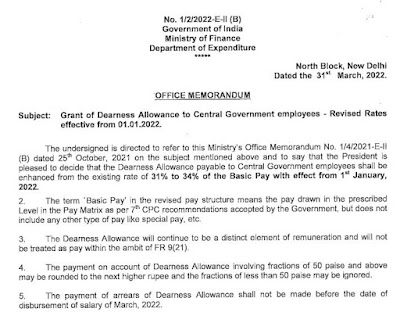
DA Jan 2022 - Grant of Dearness Allowance to Central Government employees - Revised Rates effective from 01.01.2022

 3% DA Hike - Revised Rates effective from 01.01.2022: DoE OM dated 31.03.2022 No. 1/2/2022-E-II (B) Government of India Ministry of Finance...