Wednesday, 4 March 2015

Status of Cadre Review proposals processed in DoPT from 1st January, 2011 to 28th February, 2015

Status of Cadre Review proposals processed in DoPT from 1st January, 2011 to 28th February, 2015
A. Approved by Cabinet
Sl. No. Name of the Service CRC* Meeting Cabinet Approval
1. CPWD Central Engineering Service,
Central Electrical Mechanical Engineering Service and Central
Architecture Service
 27th June, 2011 3rd January, 2012
2. Military Engineering Services (Indian
Defence Service of Engineers, Architect Cadre and Surveyor Cadre
22nd September 2011 and 23rd January
2012
18th April 2013
3. Indian Radio Regulatory Service 19th Feb, 2013 3rd July 2013
4. Indian Revenue Service 19th Feb 2013 and GoM** on 29th April
2013
23rd May 2013
5. Indian Customs & Central Excise 27th Aug. 2013 5th Dec. 2013
6. Indian Cost Accounts Service 29th October 2013 2nd January 2014
7. Central Labour Service 1th9 Feb. 2013 17th July 2013
8. Central Power Engineering Service 11th December 2013 13th May 2014
9. Indian Ordnance Factory Service 19th March, 2014 29th October, 2014
10. Indian Civil Accounts Service 17th July, 2013 16th January, 2015

*CRC – Cadre Review Committee
**GoM – Group of Ministers
B. Pending Proposals
Sl. No. Name of the Service Status
(i) With Cadre Controlling
Authority/Ministry Concerned – CRC meeting held but Cabinet approval pending
1. Railway Protection Force CRC meeting held on July 29th, 2013. Decision
with the approval of MOS (PP) and FM has been communicated to the Ministry
of Railways for taking Cabinet approval.
2. Indian Naval Material Management Service The CRC meeting on 24th October, 2013.
Comments of DoPT on Cabinet Note have been provided on 21st January, 2015.
3.  Indian Statistical Service CRC meeting held on 24.06.2014. Approval of
MoS (PP) and FM has been conveyed to Ministry of Statistics Programme
implementation for taking approval of the Cabinet.
4. Indian Trade Service CRC meeting held on 06.05.2014. Comments of
DoPT on Cabinet Note have been provided on 26th December, 2014.
5. Indian information Service CRC meeting held on 30.07.2014. Comments of
DoPT on Cabinet Note have been provided on 15th December, 2014.
(ii) With Cainet Secretariat
6. Border Road Engineering Service Approval of Secretary (P) & Secretary (Exp)
has been obtained. CRC Note is under preparation.
(ii) With Department of
Expenditure
7. Indian Postal Service Approval of Secretary (P) has been obtained
and the has been referred to DoE for approval of Secretary (Exp)
8. Defence Aeronautical Quality Assurance
Service
CRC Meeting held on 8 January, 2014. Approval
of MoS (PP) has been obtained and the file has been referred to DoE for
approval of Finance Minister.
9. Indian P&T Acctt. and Fin. Service Reply received on 07.01.2015 from DoT
has been forwarded to DoE for comments
10. DGET & Women Training Directorate Approval of Secretary (P) has been obtained
and the file has been referred to DoE for approval of Secretary (Exp)
11. Ministry of Micro, Small and Medium Enterprises (MSME) Approval of Secretary (P) has been obtained
and the file has been referred to DoE for approval of Secretary (Exp)
(iv) With Department of
Personnel & Training
12. Indian Railways Personnel Service Reply of clarifications is received on 08.01.2015 from
Ministry of Railways. A meeting with Ministry of Railways will be held on
02.03.2015
13. Indian Railways Accounts Service Under Examination.
14. Indian Railways Stores Service -do-
15. Indian Railways Service of Signal
Engineers
-do-
16. Indian Railways Service of Electrical
Engineers
-do-
(v) With Ministry
concerned for clarification
17. Indian P&T Building Works Clarification are awaited from DoT.
Cabinet Secretariat has ben requested to convey date of meeting.
18. Central Engineering Service (Roads) The Proposal was received on 24.04.2014 but
lacked many essential information and therefore clarifications were sought
from MoRTH, Reply has been received on 16.10.2014.  A revised structure
suggested to MoRTH for their comments.  Reply from MoRTH is awaited.
19. Indian Railways Traffic Service Ministry of Railways is requested to provide
information.  Reply awaited.

Source: www.persmin.nic.in
[http://ccis.nic.in/WriteReadData/CircularPortal/D2/D02adm/MX-M452N_20150302_162501.pdf]

7th Pay Commission invited the Standing council members of National Council of JCM – INDWF

7th Pay Commission invited the Standing council members of National Council of JCM – INDWF

7th CPC meeting with National Council JCM on 25.02.2015

INTUC
INDIAN NATIONAL DEFENCE WORKERS FEDERATION
R.Srinivasan
General Secretary
INDWF/Circular/012/2015
Date: 25/2/2015
To
All Affiliated of INDWF

Dear Colleagues,

VII Central Pay Commission invited the Standing council members of National Council of JCM for submission of oral evidence on the JCM/Common memorandum submitted by the National Council constituents to the commission on Pay and Allowances, Pay determination, Minimum and Maximum Pay, Pensionery benefits, Commutations, Revision of Pension for Pensioners etc on 25/2/2015 at 11.00 Hrs.
The Standing Committee members attendted the meeting with the 7th Central Pay Commission from 11.00 Hrs ti 12.30 Hrs and the details are given as under :

1. At the outset Leader and Secretary Staff Side raised the issues that 6th CPC Chairman invited the Standing Committee NC(JCM) for oral evidence on 17th, 18th and 19th April, 2008 on the common memorandum submitted by the National Council Consituents. Therefore, we need minimum three days to supplement and give oral evidence to the VII CPC and one day for Retirement benefits.
a. Determination Pay and Minimum Pay as well as Maximum Pay
b. Pay and Allowances
c. Special Benefits on particular categories
d. Terminal and Retirement Benefits etc.
After receiving the names and dates for discussion we shall be able to allot time for discussion on those matters mentioned in the memorandum.

2. We have demanded that sufficient time to be given to the Federation to present their respective Ministries/Departments specific problems particularly Railways, Defence, Postal, Health Ministry where the issues are different from each other. Chairman agreed to give time after requestes from the respective Federations.

3. Regarding merger of DA and Granting of interim report on granting Interim Relief as per our request, Chairman said that this has not been included in the Terms of reference. However, we have insisted upon that the erosion of pay due to increase in prices and inflation the DA has crossed more than 100%, therefore merger of DA is important and Interim Relief should be granted. Chairman 7th CPC said there is no mention in the Terms of Reference and there are directives from Government on this issue. However, he assured that he will a DO letter to the Government whether 7th CPC can consider to recommend and submit an Interim Report on this matter.

The National Council JCM agreed to submit the names of members and dates for further discussion on the memorandum after having internal discussions among us and also approach the Government of India to give directives to 7th CPC for submitting an Interim Relief on merger of DA and Interim Relief for both employees and pensioners.

The meeting ended after the above discussions.
Yours Sincerly,
sd/-
(R.SRINIVASAN)
General Secretary
Source: INDWF

Outcome of Meeting with DoPT on Joint Declaration and Charter of Demands of Central Government employees submitted by NC JCM Staff Side – INDWF

Outcome of Meeting with DoPT on Joint Declaration and Charter of Demands of Central Government employees submitted by NC JCM Staff Side – INDWF

INTUC
INDIAN NATIONAL DEFENCE WORKERS FEDERATION

R.Srinivasan
General Secretary
INDWF/Circular/013/2015
Date: 25/2/2015
To
All Affiliated of INDWF

Dear Colleagues,

The National Council (JCM) constituents had their convention at New Delhi on 11.12.2014 and issued a joint declaration on Charter of Demands of Central Government employees and also declared their proposed action programme which you all are aware.

A letter has been sent to Cabinet Secretary alongwith Joint Declaration and Charter of Demands.

After reveiving the joint declaration and Charter of Demands, the Secretary, DoP&T called for a meeting to below for the information of all the unions affiliated to INDWF.

1. It was very much emphasised that the forum of JCM councils should be made effective. All the Departmental councils and National Council JCM should be conducted regularly so that the issues of Government employees can be discussed. It was agreed to take necessary steps to conduct the meetings regularly.

2. All agreed anomalies should be implemented particularly the fixation of pay between direct recruitees and promotees.

3. Anomaly committee should be convened to settle the pending issues.

4. MACP issues wherever courts have given judgements that should be considered and orders should be given to implement the same before 7th CPC report.

5. Wherever the Departments have recommended for improvement in Grade Pay of certain categories of employees should be considered by DOP&T and Ministry of Finance.
Further on Charter of Demands were discussed :

6. Pay Revision should be given effect from January 2014 due to the DA increase. Also in future, pay should be reivsed on completion of every 5 years.

7. Merger of DA upto 100%. It was insisted to direct the 7th CPC to consider and given their report by Ministry of Finance. After receiving a request from Staff Side it was agreed to consider.

8. Similarly on Interim Relief, after receiving a request letter from Staff Side, this will be processed.

9. Merger of Unskilled and Semi Skilled to Rs.1800/- Grade Pay, DoP&T has rejected to grant w.e.f.1.9.2008 which is against the CDS(RP) Rules 2008. It will be reconsidered after receiving a note from Defence Ministry.

10. MACP should be granted w.e.f.1.1.2006 for the benefit of reitired employees.

11. Wherever the promotion posts and feeder posts are identical (MAC and Chargeman) that should not be treated as promotion on their movement and ACP/MACP to be granted.

12. Railways and Defence employees should be exempted from NEW PENSION SCHEME.

13. On compassionate ground appointments ceiling of 5% to be removed which is without any rational.
The above points will be considered for remaining points, another meeting will be held with progress.
Yours Sincerely,
sd/-
(R.SRINIVASAN)
General Secretary
Source: INDWF

Tuesday, 3 March 2015

Government getting ready for 7CPC report – First reaction through Budget Speech by FM

Government getting ready for 7CPC report – First reaction through Budget Speech by FM


But no signs of implementation from 1st January 2016 as no fund allocated for 7th CPC outgo in Budget 2015-16

Budget Speech of Finance Minister says “7th Pay Commission impact may have to be absorbed in 2016-17″.

Until now, Government did not consider the demands of Central Government Employees such as grant of interim relief, DA merger with pay etc.  However after Budget Speech employees have got a ray of hope as it is indicated that Govt has started finding funds to meet out the outgo on implementation of 7th Pay Commission in 2016-17.

The following is an extract of Budget Speech 2015-16 in which the need for funds for implementing 7th Pay Commission and its impact on GDP.

Budget  2015-2016

Speech  of Arun Jaitley Minister of Finance

February 28,  2015

Fiscal Roadmap

23. I want to underscore that my government still remains firm on achieving the medium term target of 3% of GDP.  But that journey has to take account of the need to increase public investment.  The total additional public investment over and above the RE is planned to be `1.25 lakh crore out of which `70,000 crore would be capital expenditure from budgetary outlays.  We also have to take into account the drastically reduced fiscal space; uncertainties that implementation of GST will create; and the likely burden from the report of the 7th Pay Commission.  Rushing into, or insisting on, a pre-set time-table for fiscal consolidation pro-cyclically would, in my opinion, not be pro-growth.  With the economy improving, the pressure for accelerated fiscal consolidation too has decreased.  In these circumstances, I will complete the journey to a fiscal deficit of 3% in 3 years, rather than the two years envisaged previously.  Thus, for the next three years, my targets are: 3.9%, for 2015-16; 3.5% for 2016-17; and, 3.0% for 2017-18.  The additional fiscal space will go towards funding infrastructure investment.
***
In document to study Medium Term Fiscal Policy Statement for further 3 years: Para 12:-
MEDIUM TERM FISCAL POLICY STATEMENT
12. However, it is pertinent to note that the resource base of the Centre will be constrained following the implementation of the FFC. With steep jump in the sharing pattern of tax revenues, the revenues of the States, which is surplus in most of the cases, will be further augmented on one side and the Centre will face resource crunch in one of the difficult phases of consolidation underway. While, therevenues are constrained in the FY 2015-16, it would continue over the medium term framework in FY 2016-17 and 2017-18.
Moreover, the 7th Pay Commission impact may have to be absorbed in 2016-17. The phase of consolidation, extended by one year, will be also be spanning out in the period. Thus, in the medium term framework the fiscal position will continue to be stressed. However, with necessary corrections on the Plan side under the new paradigm of Centre-State fiscal relationship and reforms on the subsidies, with better targeting and policy initiatives, it is expected that over the medium framework much of the fiscal correction would have taken shape, leaving room for building up better fiscal management thereupon. The change is monumental; and needs dextrous manoeuvrings in this initial phase.
(c) Pensions
42. The expenditure on pension payments of the Central Government includes both defence as well as civil pensions. Pension payment, in nominal terms was estimated at ` 74,076 crore in RE 2013-14 and at the year-end it was accounted at ` 74,896 crore. In BE 2014-15, pension payment in nominal terms was estimated at ` 81,983 crore. In RE 2014-15, it has been revised at ` 81,705 crore. The pension payment of Central Government for the past few years has been growing faster than the salary expenditure. The main reason for this is that there is an increase in number of pensioners due to higher retirements and increased life expectancy. In view of the likely impact of VII Pay Commission, Pension payment of the Government likely to be about 0.7 per cent of GDP in FY 2016-17 and FY 2017-18 respectively
**
In document to study Medium Term Fiscal Policy Statement for further 2 years:

FISCAL POLICY STRATEGY STATEMENT
Expenditure Management Commission:
37. While Government has managed to control the expenditure through rationalization in the fiscal consolidation phase, quality of expenditure remains an area that needs to be addressed. The ongoing fiscal consolidation has been successful in taming the fiscal deficit; however there is still imbalance in the public finance on the revenue side. As discussed in earlier section, concerted efforts are required to accomplish the target set for the revenue deficit and effective revenue deficit in the new FRBM regime. This entails structural changes in the Plan spending and definitive measures to contain Non-Plan spending within sustainable limits. Moreover, in the medium term, award of VII Pay Commission and XIV Finance Commission pose significant downside risk to Public Finance. Thus, time has come to look into the places where Government spends money and output achieved from it. Government will constitute an Expenditure Management Commission, which will look into various aspects of expenditure reforms to be undertaken by the Government.

MEDIUM TERM FISCAL POLICY STATEMENT
(c) Pensions

39. The expenditure on pension payments of the Central Government includes both defence as well as civil pensions. Pension payment, in nominal terms was estimated at ` 74,076 crore in RE 2013-14 and at the year end it was accounted at ` 74606 crore, marginally above the RE figure. In BE 2014-15, pension payment in nominal terms estimated at `81,983 crore. The pension payment of Central Government for the past few years has been growing faster than the salary expenditure. The main reason for this is that there is an increase in number of pensioners due to higher retirements and increased life expectancy. Accordingly, keeping past trend in view the Pension Expenditure of the Government has been projected to grow at 10.4 per cent in FY 2015-16. In view of the likely impact of VII Pay Commission, higher growth is assumed in FY 2016-17.
Source: India Budget

Railway Board Order: Advance reservation period increased from 60 days to 120 days w.e.f.1.4.2015

Railway Board Order: Advance reservation period increased from 60 days to 120 days w.e.f.1.4.2015


It has been decided to increase the advance reservation period from 60 days to 120 days (excluding the date of journey) w.e.f. 01.04.2015. CRIS will make necessary changes in the software for this purpose under intimation to all Zonal Railways as well as Board’s office.

There will be no change in case of certain day time Express Trains like Taj Express, Gomti Express, special trains, etc. where lower time limits for advance reservations are at present in force. There will also be no change in case of the limit of 360 days for foreign tourists.

Board desire that the above change may be given wide publicity well in advance of its implementation. Suitable instructions to all concerned may be issued to ensure smooth change-over to the new time limit.

Time limit for Advance Reservations in Railways has been increased from 60 to 120 days effective from 1.4.2015

Railway board issued orders on increasing the time limit for advance reservation in IRCTC has been enhanced from 1st April 2015

Source: 90paisa blog

Central Government staff demand early implementation of wage revision

Central Government staff demand early implementation of wage revision

Members of the Joint Council of Action South Zone which represents employees from the Railway, Defence, Postal and other Central Government departments organised a protest meeting near the Collectorate premises here on Monday.

More than 300 members of various associations, including Southern Railway Mazdoor Union (SRMU), All India Defence Employees’ Federation (AIDEF) and National Federation of Postal Employees (NFPE), participated in the protest meeting. Zonal president Raja Sridhar and divisional secretary J.M. Rafiq addressed the meeting.

The members also submitted a petition at the Collectorate along with a copy of the demands adopted by the National Convention of the Central Government Employees in December 2014.

In their 37-point charter of demands, the employees asked for the implementation of wage revision for Central government employees, which should be done once in every five years.

‘No privatisation’

They also demanded that no privatisation or Foreign Direct Investment should be allowed in railways and defence establishments, and opposed corporatisation of postal services.

Among other things, they also opposed outsourcing and privatisation of governmental functions and asked the government to withdraw the proposed move to close down printing presses.

Stating that many residential quarters needed renovation, the employees urged the Central government to carry out repairs, not to compel staff to stay in inhabitable quarters, and pay house rent allowance.

Source: thehindu

7th Pay Commission likely to submit report in October 2015

After 14th Finance Commission, 7th pay panel’s report looms

Finance ministry fears that its revenue will be affected in 2016-17 as it has to absorb new pay panel recommendations
New Delhi: After the recommendations of the Fourteenth Finance Commission (FFC) forced the government to reduce its plan expenditure in the 2015-16 budget, the Union finance ministry fears its revenues will remain constrained in 2016-17 as well since it has to absorb the recommendations of the Seventh Pay Commission (SPC) in that year.
The Seventh Pay Commission will submit its report by October 2015. 
 
 
“The 7th Pay Commission impact may have to be absorbed in 2016-17. The phase of consolidation, extended by one year, will also be spanning out in this period. Thus, in the medium-term framework, the fiscal position will continue to be stressed,” the finance ministry said in the macroeconomic framework statement laid before Parliament along with the budget on Saturday.
 
 
The government appointed the Seventh Pay Commission on 28 February 2014 under chairman justice Ashok Kumar Mathur with a timeline of 18 months to make its recommendations. Though the deadline for submitting the report ends in August this year, the Seventh Pay Commission is likely to seek extension till October.
 
 
The Sixth Pay Commission which was constituted in October 2006 had submitted its report in March 2008.
 
As a result of the recommendations of the Sixth Pay Commission, pay and allowances of the Union government employees more than doubled between 2007-08 and 2011-12—from Rs.74,647 crore to Rs.166,792 crore, according to the Fourteenth Finance Commission estimates.
 
 
“As a ratio of GDP, it jumped from a little over 0.9% in 2007-08 to 1.2% in 2008-09 and about 1.4% in 2009-10 on account of both pay revision and payment of arrears. However, it moderated to little over 1% in 2012-13,” the Finance Commission said.
 
 
The recommendations of the Sixth Pay Commission were implemented by states with a delay mainly between 2009-10 and 2011-12, with “significant expenditure outgo” in arrears on both pay and pension counts, the FFC said.
 
 
The FFC said that while the finance ministry projects an increase in pension payments by 8.7% in 2015-16, a 30% increase is expected in 2016-17 on account of the impact of the Seventh Pay Commission, followed by an annual growth rate of 8% in subsequent years.
 
 
However, it maintained that given the variations across states and the lack of knowledge about the probable design and quantum of award of the Seventh Pay Commission, it is neither feasible, nor practicable, to arrive at any reasonable forecast of the impact of the pay revision on the Union government or the states. “Further, any attempt to fix a number in this regard, within the ambit of our recommendations, carries the unavoidable risk of raising undue expectations,” added the Finance Commission.
 
 
A senior Pay Commission official, speaking under condition of anonymity, said its recommendations will surely have significant impact on the revenues of the central government. “The 14th Finance Commission was at a disadvantage since it did not have the benefit of the recommendations of the Pay Commission unlike its predecessors,” he added.
 
 
N.R. Bhanumurthy, professor at the National Institute of Public Finance and Policy, said the FFC has tried to factor in the impact of the recommendations of the SPC on the central government expenses. “The FFC report shows the capital outlay of the central government will dip in 2016-17 to 1.4% of GDP from 1.64% a year ago due to the implementation of the Pay Commission recommendation before it starts rising to 2.9% of GDP by 2019-20,” he added.
 
 
The FFC said that all states had asked it to provide a cushion for the pay revision likely during the award period. The FFC advocated for a consultative mechanism between the centre and states, through a forum such as the Inter-State Council, to evolve a national policy for salaries and emoluments.
 
 
The FFC also recommended that pay commissions be designated as Pay and Productivity Commissions, with a clear mandate to recommend measures to improve productivity of employees, in conjunction with pay revisions. “We recommend the linking of pay with productivity, with a simultaneous focus on technology, skills and incentives. We urge that, in future, additional remuneration be linked to increase in productivity,” it said.
 
 
The Pay Commission official quoted earlier said it has been mandated to recommend incentive schemes to reward excellence in productivity, performance and integrity, which it will do. “Though previous Pay Commissions have talked about linking pay with productivity, the earlier governments have not accepted such recommendations. Since this government has shown strong political will, we hope they will accept our recommendations,” he added.
Read at: http://www.livemint.com

Monday, 2 March 2015

7CPC: Provision for 7th Pay Commission in Budget 2015-16

7CPC: Provision for 7th Pay Commission in Budget 2015-16

The Budget is also gravely silent on fund allocations for the Seventh Pay Commission award, due for implementation in 2016.  The budgetary documents are stressing upon likely burden from the report of the 7th Pay Commission.  However the funds are allocated for Commission'ss establishment.  The extract of budgetry documents which are related to 7th CPC are mentioned below:-

Speech of Finance Minister - Heading Fiscal Roadmap para 23:-


Budget  2015-2016
Speech  of
Arun Jaitley
Minister of Finance

February 28,  2015
Fiscal Roadmap
23. I want to underscore that my government still remains firm on achieving the medium term target of 3% of GDP.  But that journey has to take account of the need to increase public investment.  The total additional public investment over and above the RE is planned to be `1.25 lakh crore out of which `70,000 crore would be capital expenditure from budgetary outlays.  We also have to take into account the drastically reduced fiscal space; uncertainties that implementation of GST will create; and the likely burden from the report of the 7th Pay Commission.  Rushing into, or insisting on, a pre-set time-table for fiscal consolidation pro-cyclically would, in my opinion, not be pro-growth.  With the economy improving, the pressure for accelerated fiscal consolidation too has decreased.  In these circumstances, I will complete the journey to a fiscal deficit of 3% in 3 years, rather than the two years envisaged previously.  Thus, for the next three years, my targets are: 3.9%, for 2015-16; 3.5% for 2016-17; and, 3.0% for 2017-18.  The additional fiscal space will go towards funding infrastructure investment.
***

In document to study Medium Term Fiscal Policy Statement for further 3 years: Para 12:-

MEDIUM TERM FISCAL POLICY STATEMENT
12. However, it is pertinent to note that the resource base of the Centre will be constrained following the implementation of the FFC. With steep jump in the sharing pattern of tax revenues, the revenues of the States, which is surplus in most of the cases, will be further augmented on one side and the Centre will face resource crunch in one of the difficult phases of consolidation underway. While, the revenues are constrained in the FY 2015-16, it would continue over the medium term framework in FY 2016-17 and 2017-18.
Moreover, the 7th Pay Commission impact may have to be absorbed in 2016-17. The phase of consolidation, extended by one year, will be also be spanning out in the period. Thus, in the medium term framework the fiscal position will continue to be stressed. However, with necessary corrections on the Plan side under the new paradigm of Centre-State fiscal relationship and reforms on the subsidies, with better targeting and policy initiatives, it is expected that over the medium framework much of the fiscal correction would have taken shape, leaving room for building up better fiscal management thereupon. The change is monumental; and needs dextrous manoeuvring in this initial phase.
(c) Pensions
42. The expenditure on pension payments of the Central Government includes both defence as well as civil pensions. Pension payment, in nominal terms was estimated at ` 74,076 crore in RE 2013-14 and at the year-end it was accounted at ` 74,896 crore. In BE 2014-15, pension payment in nominal terms was estimated at ` 81,983 crore. In RE 2014-15, it has been revised at ` 81,705 crore. The pension payment of Central Government for the past few years has been growing faster than the salary expenditure. The main reason for this is that there is an increase in number of pensioners due to higher retirements and increased life expectancy. In view of the likely impact of VII Pay Commission, Pension payment of the Government likely to be about 0.7 per cent of GDP in FY 2016-17 and FY 2017-18 respectively
***
In document to study Medium Term Fiscal Policy Statement for further 2 years:

FISCAL POLICY STRATEGY STATEMENT
Expenditure Management Commission:
37. While Government has managed to control the expenditure through rationalization in the fiscal consolidation phase, quality of expenditure remains an area that needs to be addressed. The ongoing fiscal consolidation has been successful in taming the fiscal deficit; however there is still imbalance in the public finance on the revenue side. As discussed in earlier section, concerted efforts are required to accomplish the target set for the revenue deficit and effective revenue deficit in the new FRBM regime. This entails structural changes in the Plan spending and definitive measures to contain Non-Plan spending within sustainable limits. Moreover, in the medium term, award of VII Pay Commission and XIV Finance Commission pose significant downside risk to Public Finance. Thus, time has come to look into the places where Government spends money and output achieved from it. Government will constitute an Expenditure Management Commission, which will look into various aspects of expenditure reforms to be undertaken by the Government.
MEDIUM TERM FISCAL POLICY STATEMENT
(c) Pensions
39. The expenditure on pension payments of the Central Government includes both defence as well as civil pensions. Pension payment, in nominal terms was estimated at ` 74,076 crore in RE 2013-14 and at the year end it was accounted at ` 74606 crore, marginally above the RE figure. In BE 2014-15, pension payment in nominal terms estimated at `81,983 crore. The pension payment of Central Government for the past few years has been growing faster than the salary expenditure. The main reason for this is that there is an increase in number of pensioners due to higher retirements and increased life expectancy. Accordingly, keeping past trend in view the Pension Expenditure of the Government has been projected to grow at 10.4 per cent in FY 2015-16. In view of the likely impact of VII Pay Commission, higher growth is assumed in FY 2016-17.


Details of funds allocated for Establishment of 7th CPC:-
(In crores of Rupees)

Major Head Actual 2013-2014 Budget 2014-2015 Budget 2015-2016 Revised 2014-2015


Plan Non-Plan Total Plan Non-Plan Total Plan Non-Plan Total Plan Non-Plan Total
Other Administrative Services


6. Seventh Central Pay Commission 2070 ... 0.22 0.22  ... 11.91 11.91 ... 10.76 10.76  ... 11.54  11.54

Grant of Night Duty Allowance on the basis of actual salary of 6th CPC

Grant of Night Duty Allowance on the basis of actual salary of 6th CPC

An All India Federation of Defence Workers, BPMS has published the message about the current status of Night Duty Allowance in Ordnance Factories.

Grant of Night Duty Allowance on the basis of actual salary of 6th CPC

Contempt Petition No. 200/2014 arising out of O.A. No. 2017/2014 Shri Arving Girija Sing & Ors Vs Union of India & Ors was heard by Hon’ble Mumbai Bench of CAT on 23.02.2015 and after hearing both sides Hon’ble CAT disposed of the Contempt Petition with an order to grant NDA as per revised rate within 03 months from the date of receiving the order. Further, CAT expressed that if required, a senior officer of O.F.Board should be deputed to the Ministry of Defence and Representative/Officer of MOD alongwith officer of O.F.Board should liaise with Ministry of Finance, Department of Expenditure to expedite the matter.

Since the period granted by Hon’ble CAT would expire on 23.05.2015, Secretary MOD has approved the proposal and the same has been vetted by FA (Def Fin) and now file is being sent to Min of Fin for concurrence so that CAT order may be implemented.

It is the status of the NDA as on 26.02.2015.
MUKESH SINGH
Secretary
01.03.2015

Pensioners Portal provides a platform for retiring Central Govt Employees to showcase commendable work done during service


“Pensioners Portal is in the process to providing a platform for retiring Central Govt Employees to showcase commendable work done during serivce. 

It is envisaged that this would provide satisfaction to the retiring employee and also act as a motivator for serving employees. This would also be a wonderful opportunity to garner the resource of retiring employees for voluntary contribution to nation building post retirement. The retiring employee may submit a write-up, not more than 5000 words alongwith appropriate attachments where need be”.

‘Anubhav’ – showcasing outstanding work done during service – submission of details by a retiring Government employee – to be uploaded on Departmental website

No. 4/2/2013-P&PW (Coord.)
Government of India
Ministry of Personnel, Public Grievances and Pensions
Department of Pension and Pensioners’ Welfare

Lok Nayak Bhavan, Khan Market,
New Delhi, the 19 th February, 2015
Office Memorandum

Sub: ‘Anubhav’ – showcasing outstanding work done during service – submission of details by a retiring Government employee – to be uploaded on Departmental website – reg.

The Department of Pension & Pensioners’ Welfare is in the process of providing a platform for the retiring Central Government employees to showcase commendable work done during service. It is envisaged that this would provide satisfaction to the retiring employee and also act as a motivator for serving employees. This would also be a wonderful opportunity to garner the resource of retiring employees for voluntary contribution to nation building post retirement. The retiring employee may submit a write-up, not more than 5000 words alongwith appropriate attachments where need be.

2. All Ministries/Departments are requested to inform retiring employees that they may, voluntarily, submit the details in the enclosed Form alongwith Form 5 of CCS (Pension) Rules, 1972.

3. It may be noted that –
(a) Since most successful ventures would have contributions of the entire team, retiring persons may indicate names of other members of the team in the writeup.
(b) Any work that has contributed to the efficiency, economy and effectiveness in government functioning or / and any innovation which led to improved work culture or any other contribution considered significant by the retiring employee may be submitted.
(c) Comments which are religious or political in nature (or gender based or based on caste and creed) will not be permitted. The content should not be such as to disturb communal harmony or be against national interest. There should not be any sensitive or secret information in the write-up.

4.The Head of Office shall check the contents to ensure that the submission is as per format and submit to the administrative head/ authority designated for approval., This exercise would be completed at least one month before retirement and the result uploaded on the concerned departmental website on the facility to be provided by Department of Pension & P.W.

5. The Department of Pension and Pensioners’ Welfare would coordinate and collate the data and information received from various departments.

6. (a) For the employee not belonging to AIS , the write-up would be uploaded on the website of the Department from where he retires and the website of the cadre controlling authority.
b) For employee of AIS, the write-up would, in addition, be uploaded on the website of the cadre controlling authority and the State cadre to which he belongs.

7. While an online system is being designed for this purpose, for which separate set of instructions would be issued, it would be possible for employees to submit hardcopies instead of going online.

8. The Departmental website while displaying the write-up will have a disclaimer that the contents and suggestions are as provided by the retiring employee and the department is not responsible for factual inaccuracies and the veracity of the claims.

(Vandana Sharma)
Joint Secretary to the Government of India

Authority  : www.pensionersportal.gov.in

Flash News

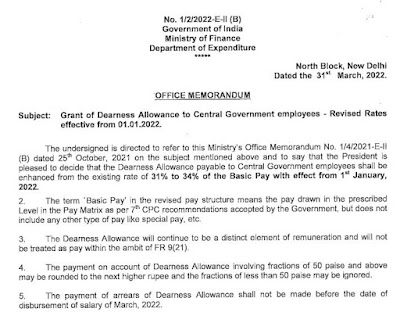
DA Jan 2022 - Grant of Dearness Allowance to Central Government employees - Revised Rates effective from 01.01.2022

 3% DA Hike - Revised Rates effective from 01.01.2022: DoE OM dated 31.03.2022 No. 1/2/2022-E-II (B) Government of India Ministry of Finance...