Showing posts with label VII PAY COMMISSION. Show all posts

Saturday, 31 October 2015

7th Pay Commission may bring pay parity in civil servants, officers up in arms.

7th Pay Commission may bring pay parity in civil servants, officers up in arms.

HYDERABAD: Officers of the Indian Administrative Service (IAS), the top rung of the country’s bureaucracy, are up in arms after rumours that the Seventh Pay Commission could bring about parity between them and other civil servants who are lower down in the civil service hierarchy.

Associations of IAS officers have held several formal and informal meetings to weigh options before them to thwart any attempt to whittle away at the advantages they now enjoy over others by virtue of securing top grades in the civil services exam.

Nearly 200 young IAS officers have so far submitted their representations to Cabinet secretary Pradeep Kumar Sinha, the country’s top bureaucrat, and to the central IAS officers’ association, airing serious concerns over the reported move by the pay panel towards salary parity and doing away with the IAS edge in what is known as empanelment. “I was astonished to see media reports on the proposals towards parity between the services, which is nothing but an attempt to equate the gold medallist with last-benchers.Such proposals not only go against the principles of competition but also penalise top performers in the name of parity,” said 1993 batch IAS officer on condition of anonymity .

Top-ranked students in the civil services exam are assigned the IAS and Indian Foreign Service, followed by other branches such as the Indian Police Service (IPS) and the Indian Revenue Service (IRS). Empanelment refers to the selection of officer to a post which has the rank of joint secretary in the central government. The next step could be a petition by the Central Indian Civil and Administrative Association, the lobby group of IAS officers, to the cabinet secretary, who is also an IAS officer.

Sanjay Bhoosreddy, the honorary secretary for the association, told ET that over 100 IAS officers have expressed anguish with his grouping so far about the reported recommendations of the pay panel which is due to submit its report by the end of this year. “The key concerns of the junior IAS officers pertain to emoluments and losing edge in empanelment,” he said. For years, officers from branches such as the IPS and IRS have complained that they do not make it to the rank of joint secretary in the same numbers that IAS officers do, and that their salaries are lower than those of IAS officers despite working on equally complex assignments.

There are some 4,800 IAS officers across India. TS Krishnamurthy , an IRS officer who went on to become the Central Election Commissioner, argued that handing non-IAS officers a permanent handicap is not such a good idea.Instead, after some length of time, all those in the All-India Services should be treated equally . “I had a disadvantage; every time I had a handicap of two years and I feel no reason why there should be differentiation after 18 or 20 years,” he said.

“While we are recruiting some of the best people through a rigorous competitive examination, there is a widespread perception that the country is not getting best out of them over a period of time irrespective of which service they belong to.”

Source: economictimes.indiatimes.com

Tuesday, 3 March 2015

Government getting ready for 7CPC report – First reaction through Budget Speech by FM

Government getting ready for 7CPC report – First reaction through Budget Speech by FM


But no signs of implementation from 1st January 2016 as no fund allocated for 7th CPC outgo in Budget 2015-16

Budget Speech of Finance Minister says “7th Pay Commission impact may have to be absorbed in 2016-17″.

Until now, Government did not consider the demands of Central Government Employees such as grant of interim relief, DA merger with pay etc.  However after Budget Speech employees have got a ray of hope as it is indicated that Govt has started finding funds to meet out the outgo on implementation of 7th Pay Commission in 2016-17.

The following is an extract of Budget Speech 2015-16 in which the need for funds for implementing 7th Pay Commission and its impact on GDP.

Budget  2015-2016

Speech  of Arun Jaitley Minister of Finance

February 28,  2015

Fiscal Roadmap

23. I want to underscore that my government still remains firm on achieving the medium term target of 3% of GDP.  But that journey has to take account of the need to increase public investment.  The total additional public investment over and above the RE is planned to be `1.25 lakh crore out of which `70,000 crore would be capital expenditure from budgetary outlays.  We also have to take into account the drastically reduced fiscal space; uncertainties that implementation of GST will create; and the likely burden from the report of the 7th Pay Commission.  Rushing into, or insisting on, a pre-set time-table for fiscal consolidation pro-cyclically would, in my opinion, not be pro-growth.  With the economy improving, the pressure for accelerated fiscal consolidation too has decreased.  In these circumstances, I will complete the journey to a fiscal deficit of 3% in 3 years, rather than the two years envisaged previously.  Thus, for the next three years, my targets are: 3.9%, for 2015-16; 3.5% for 2016-17; and, 3.0% for 2017-18.  The additional fiscal space will go towards funding infrastructure investment.
***
In document to study Medium Term Fiscal Policy Statement for further 3 years: Para 12:-
MEDIUM TERM FISCAL POLICY STATEMENT
12. However, it is pertinent to note that the resource base of the Centre will be constrained following the implementation of the FFC. With steep jump in the sharing pattern of tax revenues, the revenues of the States, which is surplus in most of the cases, will be further augmented on one side and the Centre will face resource crunch in one of the difficult phases of consolidation underway. While, therevenues are constrained in the FY 2015-16, it would continue over the medium term framework in FY 2016-17 and 2017-18.
Moreover, the 7th Pay Commission impact may have to be absorbed in 2016-17. The phase of consolidation, extended by one year, will be also be spanning out in the period. Thus, in the medium term framework the fiscal position will continue to be stressed. However, with necessary corrections on the Plan side under the new paradigm of Centre-State fiscal relationship and reforms on the subsidies, with better targeting and policy initiatives, it is expected that over the medium framework much of the fiscal correction would have taken shape, leaving room for building up better fiscal management thereupon. The change is monumental; and needs dextrous manoeuvrings in this initial phase.
(c) Pensions
42. The expenditure on pension payments of the Central Government includes both defence as well as civil pensions. Pension payment, in nominal terms was estimated at ` 74,076 crore in RE 2013-14 and at the year-end it was accounted at ` 74,896 crore. In BE 2014-15, pension payment in nominal terms was estimated at ` 81,983 crore. In RE 2014-15, it has been revised at ` 81,705 crore. The pension payment of Central Government for the past few years has been growing faster than the salary expenditure. The main reason for this is that there is an increase in number of pensioners due to higher retirements and increased life expectancy. In view of the likely impact of VII Pay Commission, Pension payment of the Government likely to be about 0.7 per cent of GDP in FY 2016-17 and FY 2017-18 respectively
**
In document to study Medium Term Fiscal Policy Statement for further 2 years:

FISCAL POLICY STRATEGY STATEMENT
Expenditure Management Commission:
37. While Government has managed to control the expenditure through rationalization in the fiscal consolidation phase, quality of expenditure remains an area that needs to be addressed. The ongoing fiscal consolidation has been successful in taming the fiscal deficit; however there is still imbalance in the public finance on the revenue side. As discussed in earlier section, concerted efforts are required to accomplish the target set for the revenue deficit and effective revenue deficit in the new FRBM regime. This entails structural changes in the Plan spending and definitive measures to contain Non-Plan spending within sustainable limits. Moreover, in the medium term, award of VII Pay Commission and XIV Finance Commission pose significant downside risk to Public Finance. Thus, time has come to look into the places where Government spends money and output achieved from it. Government will constitute an Expenditure Management Commission, which will look into various aspects of expenditure reforms to be undertaken by the Government.

MEDIUM TERM FISCAL POLICY STATEMENT
(c) Pensions

39. The expenditure on pension payments of the Central Government includes both defence as well as civil pensions. Pension payment, in nominal terms was estimated at ` 74,076 crore in RE 2013-14 and at the year end it was accounted at ` 74606 crore, marginally above the RE figure. In BE 2014-15, pension payment in nominal terms estimated at `81,983 crore. The pension payment of Central Government for the past few years has been growing faster than the salary expenditure. The main reason for this is that there is an increase in number of pensioners due to higher retirements and increased life expectancy. Accordingly, keeping past trend in view the Pension Expenditure of the Government has been projected to grow at 10.4 per cent in FY 2015-16. In view of the likely impact of VII Pay Commission, higher growth is assumed in FY 2016-17.
Source: India Budget

Wednesday, 2 July 2014

Proposed Pay Structure in the Final Memorandum of NC JCM to 7th CPC

National Council JCM , Staff Side has finalised its Memorandum to be submitted to 7th Pay Commission and it has been posted in its website NCJCMstaffside.com for all central government employees. The Full Final Memorandum consists 98 pages and the download link is provided below this post

Chapter —VII
Proposed Pay Structure and Rate of Increment

In the preceding chapters we have dealt with the various principles of pay determination as was enunciated by the successive Pay Commissions. The 6 CPC introduced the new concept of Pay Band and Grade Pay. We are not able to comprehend any logical methodology having been adopted by the 6th CPC in constructing the Pay Band and Grade Pay. In the ultimate analysis, we found that there had been no uniform multiplication factor. It varied from 2.2 time to 3. The changes effected by the Government while implementing the recommendations of the 6th cpc further compounded the confusion and making t more irrational and arbitrary. The 6 cPC in their report stated that they have upgraded certain pay scales having appreciated the contention made by the employees organizations. They merged certain other pay scales in an effort to delayering the functions. But the new pay that emerged from such upgradation/merger was not equivalent to the higher pay scales in the said group. For instance, the erstwhile pay scales of Rs.5000-8000, 5500-9000 and 6500-10500 were merged. The multiplication factor for pay band construction was 1.86 times of the minimum. Therefore the pay band for the pre merged pay scales was determined to begin at Rs.9300/-. Having merged, the pay band must have begun at 12,090/-, i.e. 1.86 times of 6500/- in which the other pay scales were merged.

7.2 The manner in which the Grade pay was devised is also questionable. At the lower level the Grade Pay progresses @ Rs.100/- ,i.e. 1800, 1900, 2000, etc. The pay in the Band + Grade Pay at the entry level is 5200 + 1800 = 7000. An employee is entitled for 3% increment every year. He gets a financial benefit of Rs. 210 every year on account an increment whereas on promotion his grade pay gets increased by just Rs.100/. only. The Grade Pay was devised at 40% of the maximum of the pre revised time scale of pay. The maximum of any time scale of pay will depend upon the rate of increment and the span of the scale of pay. The ratio between the minimum and the maximum of all pay scales was not uniform, rather it could not be uniform. Therefore, prescribing Grade Pay as a percentage of such variable maximum, in our opinion, was erroneous. Normally fitment benefit represent the gap between pre revised minimum and the revised minimum. The 6th CPC recommendation of Grade Pay did not serve this purpose also. Having been expressed in absolute quantum amount it gave varied benefit in different pay bands as also at different stages in the same pay bands.

7.3 The Grade Pay system brought about various anomalies, which were raised at the NAC but found no resolution despite discussions on several occasions in the last 6 years. We are of the firm view that the 7” CPC should revert to the Pay Scale System which has been time tested. We have constructed the pay scales maintaining the relativities with the time scale of pay suggested by both 5’ and 6th cPC•

7.4 While constructing the pay scales we have taken the rate of increments at 5% instead of 3% presently available. We have done so on the ground that most of the PSUs including the banking industries provide the incremental rate at 5% and over a period of time it raises the salary level of the personnel. We therefore request that the 7th CPC may recommend the rate of annual increment at 5%. Incidentally we may also state that the uniform date of increment prescribed by the 6th CPC has encountered certain problems and anomalies. We, therefore, suggest that the 7th cpc may recommend, for administrative expediency, two specific dates as increment dates, Viz. 1st January and 1st  July. Those recruited/appointed/promoted during the period between l January and 30th June will have their increment date on 1stt January and those recruited/appointed/promoted between 1st July and 31st December will have it on 1st  July next year. This apart we request the Commission to specifically recommend that those who retire on 30th June or 31St December are granted one increment on the last day of their service.

7.5 We have also felt that a further reduction in the number of pay scales is needed. While constructing the pay scales we have removed those pay scales pertaining to Grade Pay of Rs.1900, 2400, 4600, 8700 and the scale of pay of Rs. 75500-80000. We are of the opinion that the instrument of Special Pay which was in operation earlier should be brought back to address the need of intermediary grades in certain organizations. The Associations and Federations representing the employees and officers of various departments and various categories will submit their memorandum indicating the pay scales to be assigned to the categories of the employees and officers they represent taking into account the nature of functions assigned to those categories separately.

7.6 Presently, functional promotion is made to the next hierarchical position whereas MACP promotion ¡s Grade Pay based, irrespective of the fact whether a particular Grade Pay exist in the hierarchy or not in the concerned department. Our suggestion to reduce the number of pay scales go a great extent to obviate the difficulty encountered due to the dual system of promotion.

7.7 We have constructed open- ended pay scales. This is to ensure that no employee stagnates without increment. The pay of the Secretary and the Cabinet Secretary has been kept as a fixed amount as has been the recommendation of the 6th CPC. In consonance with our view on the need for further de-layering, we have suggested only 14 Pay scales indicating in the table the minimum of each of them. The said 14 pay scales are given below:

In Table 7.2, the corresponding pay scales of the 6” CPC recommended Grade Pay are given for reference.

Table No. 7.1.

Proposed pay scale minimum.

Sl. No. Pay scale No. Present PB PB No. Grade Pay Proposed minimum of the pay scale.
1 S.1 5200-20200 PB.1 1800 26000
2 S-2 5200-20200 PB 1 2000 33000
3 S-3 5200-20200 PB 1 2800 46000
4 S-4 9300-34800 PB 2 4200 56000
5 S-5 9300-34800 PB 2 4800 74000
6 S-6 9300-34800 PB 2 5400 78000
7 S-7 15600-39100 PB 3 5400 88000
8 S-8 15600-39100 PB 3 6600 102000
9 S-9 15600-39100 PB 3 7600 120000
10 S-10 37400-67000 PB 4 8900 148000
11 S-11 37400-67000 PB 4 10000 162000
12 S-12 75500-80000 HAG 0 193000
13 S-13 80000( Fixed ) Apex scale. 0 213000
14 S-14 90000 (Fixed) Cabinet Secy 0 240000

Table 7.2.

New Pay scale minimum

SL.No.    Grade pay of 6thCPC      Minimum of the  new pay scale
1           1800 26000
2 1900 31000
3 2000 33000
4    2400 41000
5    2800 46000
6 4200 56000
7   4600 66000
8     4800 74000
9    5400 78000
10 5400 in PB3 88000
11   6600 102000
12     7600 120000
13  8700 139000
14  8900 148000
15   10000 162000
16    12000 193000
17   75000-80000 202000
18    80000 fixed 213000
19 90000 fixed 240000

Download :FULL-FINAL-Memorandum of NC JCM
Source : NC JCM Staffside.com

Flash News

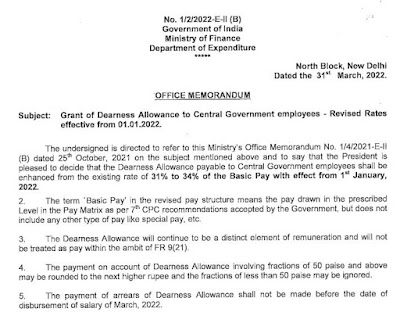
DA Jan 2022 - Grant of Dearness Allowance to Central Government employees - Revised Rates effective from 01.01.2022

 3% DA Hike - Revised Rates effective from 01.01.2022: DoE OM dated 31.03.2022 No. 1/2/2022-E-II (B) Government of India Ministry of Finance...