Showing posts with label Postal Employees. Show all posts

Saturday, 16 January 2021

Extension of orders for officials above 50 years of age and pregnant women were allowed to avail commuted leave without Medical Certificate due to Covid -19 pandemic

Extension of orders for officials above 50 years of age and pregnant women were allowed to avail commuted leave without Medical Certificate due to Covid -19 pandemic

 NFPE - 

National Federation of Postal Employees
NFPE

NATIONAL FEDERATION OF POSTAL EMPLOYEES
1st Floor North Avenue Post Office Building, New Delhi-110001

Ref: PF/NFPE/ Commuted Leave

Dated  11.01.2021

To
The Secretary
Department of Posts
Dak Bhawan, New Delhi  110001

Sub:  Extension of orders for grant of commuted leave without Medical Certificate to eligible officials.

Sir,

In the orders issued in Covid-19 guidelines the officials above 50 years of age and pregnant women were allowed to avail commuted leave without Medical Certificate due to Covid -19 pandemic.

The same may kindly be extended further till the Covid-19 Crisis is over as there is no loss to the Department by giving this facility to the elderly officials and pregnant women officials.

Providing vaccine of Corona to the Postal Employees on priority basis – NFPE

Such officials will get more relief during this period of Crisis.

Hoping for a positive action

With regards,

Yours sincerely,
(R. N. Parashar)
Secretary Genera


Thursday, 10 September 2020

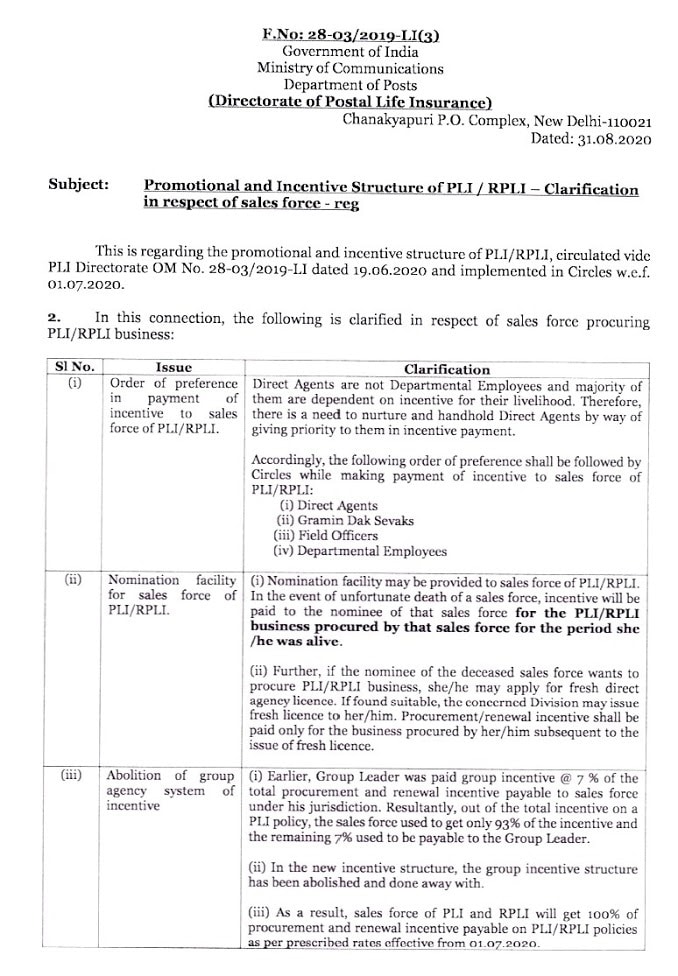
Promotional and Incentive Structure of PLI / RPLI - Clarification in respect of sales force

Latest Central Government Employees News

F.No: 28-03/2019-L1(3)Government of India
Ministry of Communications
Department of Posts
(Directorate of Postal Life Insurance)
Chanakyapuri P.O Complex,
New Delhi-110021
Dated 31.08.2020
Sub: Promotional and Incentive Structure of PLI / RPLI - Clarification in respect of sales force - reg
This is regarding the promotional and incentive structure of PLI/RPLI, circulated vide PLI Directorate OM No. 28-03/2019-LI dated 19.06.2020 and implemented in Circles w.e.f. 01.07.2020.
2. In this connection, the following is clarified in respect of sales force procuring, PLI/ RPLI business:

Sl. No.IssueClarification
(i)Order of preference in payment of incentive to sales force of PLI/RPLI.Direct Agents are not Departmental Employees and majority of them are dependent on incentive for their livelihood. Therefore, there is a need to nurture and handhold Direct Agents by way of giving priority to them in incentive payment. Accordingly, the following order of preference shall be followed by Circles while making payment of incentive to sales force of PLI/RPLI:
(i) Direct Agents
(ii) Gramin Dak Sevaks
(iii) Field Officers
(iv) Departmental Employees
(ii)Nomination facility for sales force of PLI/RPLI.(i) Nomination facility may be provided to sales force of PLI/RPLI. In the event of unfortunate death of a sales force, incentive will be paid to the nominee of that sales force for the PLI/RPLI business procured by that sales force for the period she/he was alive.
(ii) Further, if the nominee of the deceased sales force wants to procure PLI/RPLI business, she/he may apply for fresh direct agency licence. If found suitable, the concerned Division may issue fresh licence to her/him. Procurement/renewal incentive shall be paid only for the business procured by her/him subsequent to the issue of fresh licence.
(iii)Abolition of group agency system of  incentive(i) Earlier, Group Leader was paid group incentive @ 7 % of the total procurement and renewal incentive payable to sales force under his jurisdiction. Resultantly, out of the total incentive on a PLI policy, the sales force used to get only 93% of the incentive and the remaining 7% used to be payable to the Group Leader.
(ii) In the new incentive structure, the group incentive structure has been abolished and done away with.
(iii) As a result, sales force of PLI and RPLI will get 100% of procurement and renewal incentive payable on PLI/RPLI policies as per prescribed rates effective from 01.07.2020.
(iv) In the new structure, Development Officer will be paid procurement incentive @ 1 % of total PLI/RPLI new business premium procured by Direct Agents attached to that Development Officer. The incentive payable to Development Officer will be over, and above the incentive payable to Direct Agents working under her/him.
(iv)Procurement of business by family members of Development Officer.In order to avoid conflict of interest, members of family of business by family of Development Officer are not allowed to procure PLI/RPLI business and claim incentive. Members of the family for this purpose would include the following:
(a) The spouse, but not including a separated spouse or one living separately while judicial separation proceedings are on;
(b) Children and stepchildren but not including children and stepchildren of whose custody the serving postal employee has been deprived by law;
(c) Other persons such as wards and parents, who are dependent on and live with the Development Officer.
(v)Rate of incentive payable on PLI/RPLI policies.Incentive payable on PLI/RPLI policies is being explained with the help of following illustration:For a PLI policy procured on 1st November 2009, the procurement and renewal incentive payable on this policy is detailed as under:
(i) 01.11.2009 to 31.10,2010 (First Year Premium):
PLI Procurement Incentive during this period will be paid as per the procurement incentive rate applicable during that period.
(ii) 91.11.2010 to 30.06.2020:Renewal Incentive during this period will be paid as per the renewal incentive rate applicable during that period.
(iii) 91.07.2020 onwards:
Renewal Incentive from 01.07.2020 onwards will be paid @ 1% of renewal premium.

3. This issues with approval of the competent authority.


Wednesday, 6 May 2020

Transfer policy guidelines for Postal Employees


Transfer policy guidelines for Postal Employees

File No.X-12/1/ 2019-SPB-II
Government of India
Ministry of Communications
Department of Posts
(Personnel Division)

Dak Bhawan, Sansad Marg
New Delhi - 110 001
Dated: 30th April, 2020

To
The Chief Postmaster General,
All Postal Circles

Subject : Transfer policy guidelines - clarifications.

Madam / Sir,
I am directed to refer to Directorate’s communication number 141-141/2013-SPN-II dated 17.01.2019 vide which revised ‘Guidelines for transfer’ was circulated to all Postal Circles.
  1. Para 5 (i) of ibid communication prescribes that the official having more length of service in a unit (Circle or Division, as the case may be) will be placed above the official(s) having less length of service in a unit. Accordingly, PwD officials having less service has to be placed below senior officials. As a result, PwD officials have lesser chance for getting their Rule-38 transfer despite exemption in probation period Or 2 years service. The matter has been examined by the Directorate and Competent Authority has decided as under: –
Transfer requests received from Persons with Disabilities shall be registered first in the request registers (inward & outward) above all other officials based on length of their service but below the wait listed PwD officials if any in a particular year. The officials whose transfer request could not be approved in that particular year and are in the waiting list shall be placed on the top in the request register of subsequent year. Thereafter, fresh applications received during 1st April to 30th June of current year shall be registered by giving preferences to PwD officials (based on length of their service) as previously done. Fresh transfer requests received from PwD officials for current year shall be registered above all other officials (Other than pwD) who are in waiting list Of previous year based on length of service.

Further, preference shall also be given to such officials at the time Of their posting in transferee unit subject to administrative constraints.

Illustration :- Entry in request register for a particular year (2020)

Four officials namely A, B, C (PwD) & D (PwD) have applied for their transfer under Rule 38 during 1st April to 30th June in the year 2020. A is the senior most among all, B is junior to A, D is junior to B and C is the junior most official. As such, PwD officials shall be registered first in the request register based on length of their service followed by two other officials based on length of their service as well. Accordingly, serial of officials in request register shall be as under: -

Sl.No.Name of the Official
1D(PwD)
2C(PwD)
3A
4B
Moreover, two officials namely X and Y (PwD) are in waiting list of previous year (2019). Therefore, these two officials shall be placed in top of request register of current year (2020). However, fresh transfer requests received from PwD officials shall be placed above X and below Y (as Y is PWD). Accordingly, serial Of officials in request register for current year (2020) shall be as under :–

Sl.No.Name of the Official
1Y (PwD)
2D (PwD)
3C (PwD)
4X
5A
6B
3.Apart from above, following has also been decided by the Competent Authority:

i. Instructions issued by Department of Personnel & Training regarding posting of husband and wife at same station shall be taken into account while considering request for transfer under Rule-38 on spouse ground.

ii. Rule-38 transfer under mutual exchange shall be considered whenever received in the office of concerned CPMG instead of following schedule prescribed in Transfer Policy Guidelines.

Yours faithfully,
Sd/-
(Muthuraman C)
Assistant Director General (SPN)

Saturday, 7 March 2020

7th CPC Dress Allowance and Grant of Various allowance to Central Government Employees

7th CPC Dress Allowance and Grant of Various allowance to Central Government Employees


7th CPC Dress Allowance and Grant of Various allowance to Central Government Employees

F.No.41-2/2017-PAP
Government of India
Ministry of Communications
Department of Posts
(Establishment Division)
Dak Bhawan, Sansad Marg,
New Delhi -110001.
Dated: 05 March, 2020.

To,

  1.     All Chief Postmasters General/ Postmasters General
  2.     Chief General Manager, BD Directorate/ Parcel Directorate/ PLI Directorate
  3.     Director RAKNPA/ GM CEPT) Directors of All PTCs,
  4.     Addl. Director General, Army Postal Service, R.K. Puram, New Delhi
  5.     All General Managers (Finance)/ DAP/ DDAP

Sub: Implementation of the recommendation of 7th CPC- Grant of Various allowance to Central Government Employees – Dress Allowance – reg.

Sir/Madam,

This is regarding issues raised by the units for the payment of Dress Allowances to the fresh recruits and the persons retiring and have less than one years service.

2. The issue was examined by the committee constituted for the purpose and following recommendations were made for payment of dress allowance on the issue of admissibility of full / part dress allowance on non completion of full year:


(1) On the issue of admissibility of full / part Dress Allowance on non-completion of full one year, the Committee recommends the following stipulations that the Dress Allowance shall be paid in the month of July only:-

  " (i) (In case of Persons Retiring)

    Person retiring after December of the calendar year shall be eligible for full Dress Allowance. Those retiring by December in the calendar year shall be eligible for half of the Dress Allowance.

    (ii) (In cases of Persons newly joining the Department)

    For person joining service during July to December of the previous calendar year shall get full Dress Allowance in next calendar year. Those who join after December will be entitled to half of the Dress Allowance in July of the year.

3. The above recommendation of committee has been accepted by the competent authorized with retrospective effect from 01.07.2017.

Read: 7th CPC Dress Allowance – DoPT Orders

4. It is requested to take necessary action as per the above recommendations and in any case of deviation from the above, the advice of the Directorate may be sought for.

5. This issues with the concurrence of AS & FA vide diary No.190/FA/2019-CS dated 27.02.2020.

Yours faithfully,

(D.K. Tripathi)
Assistant Director General (Estt.)

Saturday, 8 February 2020

7th CPC Outstation Allowance to the staff working in RMS Sections of Railway lines


7th CPC Outstation Allowance to the staff working in RMS Sections of Railway lines

Latest Central Government Employees News

No.7-2/2016-PCC
Government of India
Ministry of Communications
Department of Posts
(PCC Section)

Dak Bhawan, Sansad Marg
New Delhi - 110001
Dated: 05.02.2020

To
All Chief Postmasters General / Postmasters General

Subject: Continuation of Outstation Allowance to the staff working in RMS Sections of Railway lines - reg.

Sir / Madam,
The Outstation Allowance payable to the RMS staff was discontinued w.e.f. 01.07.2017 vide Department of Expenditure, Ministry of Finance OM No. 29/1/2017-E.II (B) dated 11.07.2017 and circulated vide Directorate letter No. 7-2/2016-PCC dated 14.07.2017.

Also check: DoP - Instructions regarding Rotational transfer

The proposal for continuation of Outstation Allowance to the staff working in RMS Sections of Railway lines was referred to Department of Expenditure, Ministry of Finance for consideration and approval. The Department of Expenditure, Ministry of Finance has considered and approved for continuation of Outstation Allowance (OSA) at the following revised rates for a period of absence from their headquarters, on duty, exceeding six hours (for every six hours or part thereof) as given below:-

SL. No.Categories of RMS StaffRevised rates (Amount in Rs.)
iMTS61.87 or 62/-
iiMail Guard61.87 or 62/-
iiiHead Mail Guard66.82 or 67/-
ivSorting Assistant66.82 or 67/-
vLSG Sorting Assistant70.875 or 71/-
The revised Outstation Allowance (OSA) would be payable with effect from 01st July, 2017.

Also check: Postal Unions demands regarding enhancement of Dress Allowance from Rs.5000/- to Rs.10,000/-

This issues with the approval of Department of Expenditure, Ministry of Finance vide their ID No. A-27023/ 5/2017/E.IIB (7th CPC) dated 04th Feb, 2020.

(SB Vyavahare)
Assistant Director General (GDS/PCC)
7th CPC Outstation Allowance to the staff working in RMS Sections of Railway lines

Source: cept.gov.in

Tuesday, 14 January 2020

Deduction of TDS in respect of Cash Withdrawal above One Crore by a National Savings Schemes account holder - DoP

Deduction of TDS in respect of Cash Withdrawal above One Crore by a National Savings Schemes account holder - DoP

TDS-National-Savings-Schemes-DoP


SB Order No. 02/2020
F.No 109-27/2019-SB
Govt. of India Ministry of Communication
Department of Posts (F.S. Division)

Dak Bhawan, New Delhi-110001
Dated: 09.01.2020

To,
All Head of Circles / Regions
Addl. Director General, APS, New Delhi

Subject :- Deduction of TDS in respect of Cash Withdrawal above Rs. 1 Crore by an account holder of National Savings Schemes regarding .

Sir / Madam,
The undersigned is directed to inform that Government of India has inserted Section 194 N in the Income Tax Act, 1961, through Finance Act (No.2) 2019 for deduction of TDS @2% on cash withdrawals in excess of Rs. 1 crore in a year, from 1.9.20 19, and the new provision mentioned in Section 194 N is applicable from the financial year 2019·20. Text of the new Section is reproduced below :-

Payment of certain amounts in cash.
194 N. Every person, being,-
  • a banking company to which the Banking Regulation Act, 1949 (10 of 1949) applies (including any bank or banking institution referred to in section 51 of that Act);
  • a co-operative society engaged in carrying on the business of banking; or
  • a post office,
Also check: National Savings Certificates Scheme 2019 - Gazette Notification

who is re possible for paying any sum, or, as the case may be, aggregate of sums, in ca h, in excess of one crore rupees during the previous year, to any person (herein referred to as the recipient) from one or more accounts maintained by the recipient with it shall, at the time of payment of such sum , deduct an amount equal to two per cent of sum exceeding one crore rupees, as income tax:
Provided that nothing contained in this sub-section shall apply to any payment made to,
  • the Government;
  • any banking company or co-operative society engaged in carrying on the business of banking or a post office.
  • any business correspondent of banking company or co-operative society engaged in carrying on the business of banking, in accordance with the guidelines issued in this regard by the Reserve Bank of India Act, 1934 ( 2 of 1934);
  • any white label automated teller machine operator of a banking company or co­ operative society engaged in carrying on the business of banking, in accordance with the authorization issued by the Reserve Bank of India under the Payment and Settlement Systems Act, 2007 (51of 2007);
  • such other person or class of persons, which the Central Government may, be notification in the Official Gazette, specify in consultation with the Reserve Bank of India ;
Further Clarification issued by CBDT on 30.8.2019
(extract from press release of CBDT dated 30.08.2019)

“…..The CBDT, having considered the concerns of the people, hereby clarifies that section 194N inserted in the Act, is to come into effect from 1st September, 2019. Hence any cash withdrawal prior to 1st September, 2019 will not be subjected to the TDS under Section 194N. However, since the threshold of Rs. 1crore is with respect to the previous year, calculation of amount of cash withdrawal for triggering deduction under section 194N shall be counted from 1st April, 20 19. Hence, if a person has already withdrawn Rs. 1crore or more in cash up to 31st August , 2019 from one or more accounts maintained with a banking company or a cooperative bank or a post office, the 2% TDS shall apply on all subsequent cash withdrawals made on or after 1st September, 2019.”

Also read: National Small Savings Schemes 2020 interest rate

2. With this amendment, now TDS @2% will be applicable on all cash withdrawals above Rs. One Crore taken by an account holder in his/ her all type of Small Savings Schemes Accounts / Certificates taken together, from 1.4.2019 onwards. However, for the current financial year (2019-20) as per clarification issued by CBDT, TDS will be deducted on cash withdrawals taken on or after 1.9.2019, even if cash withdrawals are taken in excess of Rs.1 Crore from 1.4.2019 to 31.8.2019. The TDS @ 2% is to be deducted on all subsequent cash withdrawal (from 01.09.2019) to be taken by a customer who has taken cash withdraw als in excess of Rs. lcrore during 2019-20 in his/ her all accounts.

3. Necessary changes in FINACLE will be done in due course to automatically deduct TDS at the time of such cash withdrawal. Till these changes are done, CEPT Team will inform details of such Account Holders in the first week of every month to the respective CPC which will inform the concerned Post Office to deduct TDS @2%. Post Offices have to ensure that PAN number of such account holder are invariably taken and fed in Finacle. TDS so deducted should be accounted under Section 194N and incorporated in TDS return of HO (for HO and its SOs). Account holder should be informed of such deduction at the time of cash withdrawal.

4. It is requested to circulate this amendment to all concerned for information and guidance and necessary action.

5. This issues with the approval of Competent Authority.

Yours Faithfully,
(Devendra Sharma)
Assistant Director (SB)

Monday, 21 October 2019

7CPC Cash Handling and Treasury Allowance

7CPC Cash Handling and Treasury Allowance

7th-Central-Pay-Commission-Cash-Handling-and-Treasury-Allowance

Seventh Central Pay Commission Cash Handling and Treasury Allowance

File No.06-4/2018-PAP
Government of India
Ministry of Communications
Department of Posts
(Establishment Division)
P.A.P. Section
Dak Bhawan, Sansad Marg,
New Delhi -110001
Dated: 17th October, 2019.
To

The Chief Postmaster General,
Mumbai 400001

Sub: Implementation of the recommendations of Seventh Central Pay Commission - Cash Handling and Treasury Allowance - Clarifications.

A reference has been received in the Directorate seeking clarification regarding admissibility of Cash Handing and Treasury Allowance on DOPT OM No - 4/6/2017-Estt. (Pay-II) Date 18.01.2019 ,circulated vide Directorate letter No. 06-04/2018-PAP dated 22.01.2019, on the following issues from Chief Postmaster General Mumbai vide his letter No.Estt/19-1/Cash Handling Allowance/2008-14 dated at Mumbai 28.06.19


Also check: Implementation of the recommendations of Seventh Central Pay Commission - Cash Handling and Treasury Allowance

The matter has been considered in the Directorate and clarified the queries are as under.

Query No.1. Whether the revised rates of 7th CPC for Cash Handling Allowance and Treasury Allowance are also applicable for cash handling to the Sub Postmasters in single and double handed Post offices and to those Sub Postmasters in Post Offices where there is no separate Treasury is justified.

Clarification: Not applicable. Already clarified in para 2 (iv) and (v) of DOPT OM No. 4/6/17- Estt.(Pay-II) dated 18.01.2019.

Query No.2: Whether Rs. 700/- rate of Cash Handling Allowance and Treasury Allowance is to be granted directly to all eligible operative staff as it fixed for amount <=5 lakh average monthly cash handled or whether it is to be calculated and fixed every year based on the statistics of previous financial year’s average quantum cash disbursed for the Treasurers and Sub Postmasters in Post Offices where there is no separate Treasurer is justified.

Clarification: As per para 2(iii) of the said OM dated 18.01.2019 ” the Cash Handling and Treasury Allowance should be reviewed every financial year.”

Query No.3. Whether Cash Handling Allowance and Treasury Allowance will be allowed to all Treasurers in big offices if more than one Treasurer is working in those offices.

Clarification: No. Already clarified in para 2(vi) of the of the aforesaid mention OM dated 18.01.2019 that “not more than one official should be allowed the Cash Handling Allowance and Treasury Allowance in an office.”

(D.K.Tripathi)
Assistant. Director General (Estt.)
Phone No - 011-23096191

View the order

Saturday, 28 September 2019

CGHS facilities to NPS covered Pensioners


NPS covered pensioners allowed to use CGHS facilities without any bar of minimum qualification service

CGHS facilities to NPS covered Pensioners

CGHS facilities to NPS covered Pensioners

 National Council (Staff Side)


The Secretary,
Ministry of Health & Family Welfare,
Nirman Bhawan,
New Delhi-110011
Dated: September 26, 2019
Dear Sir,

Sub: CGHS facilities to NPS covered Pensioners - Req.
Ref.: Ministry of Health & Family Welfare, Government of India’s G.O.No.S.11011/ 10/2012- CGHS(P)/ EHS dated 28.03.2017

Your kind attention is invited towards the above referred to O.M. dated 28th March, 2017, wherein a condition of Minimum Qualifying Service of 10 years has been laid down for availing CGHS facilities for NPS covered pensioners.

Also check: Good news for NPS employees

In this connection, it would not be out of context to mention that, a substantial number of Gramin Dak Sewaks became regular employees of the Postal Department, crossing age of 50 years. All these CDSs, on having been regularised as Postal Employees after 50 years of age, are thus deprived of CGHS facilities on account of above-mentioned condition of minimum 10 years Qualifying Service, as such, the said condition is uncalled for an irrational.

It is, therefore, requested that, the matter may please be looked into in the foregoing, and the same be dispensed with, so that, any regular Government Employee on superannuation, may be NPS covered pensioners, should be allowed to avail CGHS facilities without any bar of Minimum Qualifying Service in the larger interest of justice.

Also check: Guidelines regarding Merger of 33 Postal dispensaries with CGHS
Yours faithfully,
(Shiva Gopal Mishra)
Secretary
CGHS-facilities-to-NPS-covered-Pensioners


Friday, 20 September 2019

Child Education Facilitation Allowance for Gramin Dak Sevaks - GDS

GDS

Child Education Facilitation Allowance for Gramin Dak Sevaks - GDS
No.17-31/2016-GDS
Government of India
Ministry of Communications
Department of Posts
(Establishment Division)
Dak Bhawan, Sansad Marg,
New Delhi – 110001
Dated: 18.09.2019
Office Memorandum

Implementation of recommendations of One-Man Committee on introduction of Children Education Facilitation Allowance for Gramin Dak Sevaks (GDS).

The undersigned is directed to convey the approval of the Competent Authority on recommendations of One-Man Committee on introduction of Children Education Facilitation Allowance for Gramin Dak Sevaks (GDS).

Also check: GDS: Gramin Dak Sevak Committee Report Major Recommendations

Keeping in view the above, it has been decided to issue consolidated instructions on the subject of Children Education Facilitation Allowance as under :-
(i) The reimbursement of Children Education Facilitation Allowance can be claimed only for the two eldest surviving children with the exception that, in case the second child birth results in twin/multiple birth. In case of failure of sterilization operation, the Children Education Facilitation Allowance would be admissible in respect of children born out of the first instance of such failure beyond the usual two children norm.

(ii) The amount of reimbursement of Children Education Facilitation Allowance will be Rs.6000/- per annum (fixed) per child. This amount of Rs.6000/- is fixed irrespective of the actual expenses incurred by the GDS. In order to claim reimbursement of Children Education Facilitation Allowance, the GDS should produce a certificate issued by the Head of the Institution for the period/year for which claim has been preferred. The Certificate should confirm that the child studied in the school during the previous academic year. In case such certificate can not be obtained, self-attested copy of the report card or self attested fee receipt(s) {including e-receipt(s)} confirming/indicating that the fee deposited for the entire academic year can be produced as a supporting document to claim Children Education Facilitation Allowance. The period/year means academic year i.e. twelve months of complete academic session.

(iii) Children Education Facilitation Allowance can be claimed in a single form only for the two eldest surviving children with the exception that, in case the second child birth results in twin/multiple birth (Proforma enclosed).

(iv) In case both the spouses are GDS/ Government servant, only one of them can avail reimbursement under Children Education Facilitation Allowance or CEA (in case of Government servant).
(v) The reimbursement of Children Education Facilitation Allowance will be done just once in a financial year after completion of the financial year.
(vi) The reimbursement of Children Education Facilitation Allowance shall have no nexus with the performance of the child in his/her class. In other words, even if a child fails in a particular class, the reimbursement of Children Education Facilitation Allowance shall not be stopped. However, if the child is admitted in the same class in another school, although the child has passed out of the same class in previous school or mid- session, Children Education Facilitation Allowance shall not be reimbursable.

Also check: Guidelines for Payment of Children Education Allowance as per 7th CPC

(vii) If a GDS dies while in service, the Children Education Facilitation Allowance shall be admissible in respect of his/her children subject to observance of other conditions for its grant provided the wife/husband of the deceased is not engaged as GDS or not employed in service of the Central Govt., State Government, Autonomous body, PSU, Semi Government Organization such as Municipality, Port Trust Authority or any other organization partly or fully funded by the Central Govt./State Governments. In such cases the Children Education Facilitation Allowance shall be payable to the children till such time the GDS would have actually received the same, subject to the condition that other terms and conditions are fulfilled. The payment shall be made by the office in which the GDS was working prior to his death and will be regulated by the other conditions, laid down in this OM.
(viii) In case of discharge, dismissal or removal from engagement, Children Education Facilitation Allowance shall be admissible till the end of the academic year in which the GDS ceases to be in engagement due to discharge, dismissal or removal from engagement in the course of an academic year. The payment shall be made by the office in which the GDS worked prior to these events and will be regulated by the other conditions laid down in this OM.

ix) The upper age limit for Divyaang children has been set at 22 years. In the case of other children the age limit will be 20 years or till the time of passing 12th class whichever is earlier. There shall be no minimum age.

(x) Reimbursement of Children Education Facilitation Allowance shall be applicable for children from class nursery to twelfth, including classes eleventh and twelfth held by the junior Colleges or school affiliated to Universities or Boards of Education.
(xi) Children Education Facilitation Allowance is allowed in case of children studying through “Correspondence or Distance Learning” subject to other conditions laid down in this OM.

(xii) The Children Education Facilitation Allowance is admissible in respect of children studying from two classes before class one to 12th standard and also for the initial two years of a diploma/certificate course from Polytechnic/ITI/ Engineering College, if the child pursues the course after passing 10th standard and the GDS has not been granted Children Education Facilitation Allowance in respect of the child for studies in 11th and 12th standards.

(xiii) In respect of schools/institutions at nursery, primary and middle level not affiliated to any Board of education, the reimbursement under the Scheme may be allowed for the children studying in a recognized school/institution. Recognized school/institution in this regard means a Government school or any education institution whether in receipt of Govt. Aid or not, recognized by the Central or State Government or Union Territory Administration or by University or a recognized educational authority having jurisdiction over the area where the institution/school is situated.

(xiv) In case of a Divyaang child studying in an institution i.e. aided or approved by the Central/State Govt. or UT Administration or whose fees are approved by any of these authorities, the Children Education Facilitation Allowance paid by the GDS shall be reimbursed irrespective of whether the institution is ‘recognized’ or not. In such cases the benefits will be admissible till the child attains the age of 22 years.

(xv) The Children Education Facilitation Allowance shall be admissible to a GDS while he/she is on duty or is under put off duty or is on leave. Provided that during any period which is treated as ‘non counted for duty’, the GDS shall not be eligible for the Children Education Facilitation Allowance for that period.
3. These above instructions would come into effect from 1st October, 2019. For the current financial year, GDS shall be eligible for CEFA @ Rs.3000/- per child.

4. This issues in consultation with Department of Personnel and Training vide their ID No DoP&T I.D.No. A- 27012/02/2018-Estt. (AL) dated 05.09.2018 & Department of Expenditure, Ministry of Finance, ID Note No.7-31/2016-E.III (A) dated 06.09.2019/ eFTS 1170513/2019.

5. Hindi version will follow.
(S.B.Vyavahare)
Assistant Director General (GDS/PCC)
Tel. No. 011-23096629
Email- adggds@indiapost.gov.in

Monday, 16 September 2019

LDCE - Revision of syllabus for promotion to PS Group 'B' cadre

LDCE

Revision of syllabus for promotion to PS Group 'B' cadre

No. 9-04/2018-SPG -II
Government of India
Ministry of Communications
Department of Posts
(Personnel Division)
Dak Bhawan, Sansad Marg,
New Delhi - 110 001.
Dated : 5 Sep, 2019.
To
All Chief Postmasters General
Sub : Revision of syllabus for promotion to PS Group 'B' cadre - Regarding.

Sir/Madam,
I am directed to say that the syllabus for Limited Departmental Competitive Examination (LDCE) for promotion to Postal Services Group 'B' cadre has been revised with the approval of the Competent Authority and the same is enclosed herewith.

The date for holding the Examination will be communicated separately by the DE Branch from time to time.

Yours faithfully,
Encl : as above.
(Vinayak Mishra)
Assistant Director General (SPG)

Also check: Grant of benefit of pay fixation at time of promotion to Inspector posts

Revised syllabus for promotion to PS Group 'B' cadre.

Paper - I
Acts
1) Consumer Protection Act, 1986
2) Prevention of Money Laundering Act, 2002

Inland/ Foreign Post
1) Indian Post Office Rules, 1933
2) Post Office Guide Part I
3) Post Office Guide Part II
4) Domestic/ Foreign Post guidelines issued by Directorate
5) Book of BO Rules

Mail Operations -
1) Postal Manual Volume V
2) Guidelines issued by Directorate from time to time on Mail Network optimization Project I PNOP I Business Development

Money Remittance -
Guidelines issued by Directorate on eMO, iMO, IMTS and IFS MO

Saving Bank Scheme and Certificates
 1) Post Office Saving Bank General Rules, 1981.
2) Post Office Saving Account Rules, 1981
3) National Savings Recurring Deposit Rules, 1981.
4) National Savings Time Deposit rules, 1981.
5) National Savings MIS Rules, 1987.
6) National Savings Certificates Rules, 1960.
7) Senior Citizen Savings Scheme Rules, 2004.
8) National Savings Certificates (VIII Issue), 1989
9) Kisan Vikas Patra Rules, 2014
10) Public Provident Fund Scheme, 1968 ll) Sukanya Samridhi Yojana Rules, 2014
12) Post Office Saving Bank Manual Volume I & II
13) SB orders issued by Directorate from 01.01.2007 onwards.
14) Guidelines issued by Directorate from time to time on Core Banking Services
15) Post Office Saving Bank (CBS) Manual

Postal Life Insurance and Rural PLI -

Check this: Promotion and Posting Orders – Merit List of AAO LDCE 2018

1) Post Office Life Insurance Rules, 2011
2) Guidelines issued by Directorate from time to time on PLI/ RPLI and Core Insurance solution

Organization of the Department -
1) Postal Manual Volume II (Chapter - I- organization),
2) Citizen Charter of Department of Posts.
3) Guidelines and instructions on complaint grievances handling in Department of Posts.

Guidelines issued by Directorate from time to time on IT modernization Project of Department of Posts
  1. Handbook on Philately
  2. Directorate instructions on Philately
Office Procedure -
1) Postal Manual Volume II - Chapter XI -Misc. Rules
2) Manual of Office Procedure
3) Annual Reoorts and Book of Information of D/o Posts

Material Management -
1) Postal Manual Volume II - Chapter VI (Stock), VIII(Printing), IX(Contracts), XII (Budget Estimates and control)
2) Chapter 6 of General Financial Rules,2017
3) CVC guidelines on Public procurement, guide-lines and instructions on e­ procurement.
4) Manual on policies and procedure for purchase of goods and services available on website of Ministry of Finance.

Establishment and Administrative matters -
1) Postal Manual Volume IV.
2) Instructions issued by Directorate and DoP&T on maintenance of APAR.
3) Schedule of Financial Powers of Divisional Heads, Head of the Circle, etc.
4) Welfare measures available to Departmental Employees and Gramin Dak Sevak of DoP.
5) DoP&T instructions issued from time to time on Establishment and administration.
6) Brochure on reservation, instructions regarding sports person reservation, compassionate appointment guidelines issued by DoP and DoP&T from time to time.
7) Recruitment Rules relating to various cadres in D/o Posts
8) Establishment Norms

Current Affairs 15 questions for 30 marks
Noting and Drafting for 25 marks each

Paper - II

Subjects
  1. Central Civil Services (Conduct) Rules, 1964
  2. Central Civil Services (Classification, Control and Appeal) Rules, 1965
  3. Postal Manual Volume III
  4. Central Civil Services (Temporary Service Rules), 1965
  5. Brochure on Casual labourer
  6. Central Civil Services (Pension) Rules, 1972
  7. New Pension Scheme, 2004
  8. Central Civil Services (Commutation of Pension) Rules, 1981
  9. Central Civil Services (Leave) Rules, 1972
  10. Central Civil Services (Joining Time) Rules, 1979
  11. General Provident Fund (Central Service) Rules, 1960
  12. Central Services (Medical Attendance) Rules, 1944
  13. Fundamental and Supplementary Rules
  14. Central Civil Services (Leave Travel Concession) Rules, 1988
  15. Central Civil Services (Revised Pay) Rules, 2016
  16. Postal Financial Handbook Volume I and II
  17. General Financial Rules 20 17 other than public procurement
  18. Rules relating to Children Education allowance and reimbursement of Hostel Subsidy
  19. Central Government Employees Group Insurance Scheme, 1980
  20. Gramin Dak Sevak (Conduct and Engagement) Rules, 2011.
  21. Central Administrative Tribunal Act, 1985 and its Rules
  22. Right to Information Act 2005 and RTI Rules 2012
  23. Sexual Harassment of Women at Workplace (Prevention, Prohibition and Redressal) Act, 2013
  24. Public Accountants Default Act, 1850
  25. Revenue Recovery Act, 1890
  26. Prevention of corruption Act, 1890
  27. Central Civil Services (Recognition of Service Association) Rules, 1993
  28. Goods and Services Tax (GST) Act, 2017
  29. Postal Manual Volume II Chapter III -Appeals and Petitions,
    Chapter IV - Personal matters,
    Chapter V - Security Deposits ,
    Chapter VII - Forged counterfeit stamps and defaced postage stamps, coins and currency notes
  30. Interface with India Post Payment Bank
  31. Preservation and Disposal of Postal Records
  32. Swatchh Bharat
  33. Inspection questionnaires.
  34. CSI Operating Manuals
Note : In both the papers, circular/ order/ guidelines/ Rules issued upto 31st December of the year preceding the year of examination will be part of the syllabus except the Annual Report and Book of Information for which latest report and information available in India Post Website will be taken for the purpose.

Revised Pattern for the promotion to PS Group "B" cadre


S. No. Heading Revised Pattern
  1. Marks Each paper will carry 300 marks
  2. Duration Duration for each paper is 3 hours
  3. No. of Questions 125 Questions of MCQ type in Paper I and Noting & Drafting for 25 marks each. 150 Questions of MCQ type in Paper II.
  4. Qualifying Marks 40% marks in each paper subject to an overall average of 45% for General category and 33% marks in each paper subject to overall average of 38% for SC/ST categories.
  5. Whether books allowed or not Both the papers of the examination will be conducted without books.
Source: Dept of Posts

Wednesday, 19 June 2019

DoP - Revision in period of Induction training of PA-CO/ RO/ DO


DoP - Revision in period of Induction training of PA-CO/ RO/ DO

No: 01-64/2009-Trg. (Vol.III)
Government of India
Ministry of Communications
Department of Posts
(Training Division)
Dak Bhawan. Sansad Marg,
New Delhi - 110001
Dated: 17.06.2019
To,
All CPMsG
Director, All PTCs
Assistant Director, RTC, Nashik

Subject: Revision in period of Induction training of PA-CO/ RO/ DO

In suppression of the instructions on the subject matter contained in the Division's letter no.01-74/2009-Trg. dated 19-01-2015, it has been ordered by the Competent Authority that the Induction training of PA-CO/ RO/ DO will henceforth be of 4 weeks only, which will include three weeks of Institutional training at PTCs/ RTCs at the started course followed by one week of field attachment at the place of posting. A certificate of succesfull completion of field attachment is to be forwarded to PTCs/ RTCs by Circle concerned for each trainee, where these certificates will be kept on record before issuing certificate of successful completion of Induction training.

Probation and / or confirmation of such officials along-with PA-SBCO and PA-Foreign Posts will be governed as per instructions contained in Directorate letter no.37-47/ 2010- SPB-I dated 16-04-2015 and Training Division's letter no.01-2/2010- Trg. dated 22-03-2017. Its is informed that Induction/In-service training of PA-Foreign Posts is proposed to be conducted at PTCs/ RTCs in near future.

Duration of such training, currently being conducted in the department, need not to be altered after issue of these instructions. PTCs/ RTCs are requested to issue suitable orders in respect of all such forthcoming training at their centre.

This has the approval of the competent authority.
(Priyanka Mishra)
ADG (Training)

Friday, 3 May 2019

Nature of discipline and a punishment appropriate to the seriousness of the offense committed

Nature of discipline and a punishment appropriate to the seriousness of the offense committed

No.C-14016/09/2019-VP
Government of India
Ministry of Communications
Department of Posts
Dak Bhawan, Sansad Marg,
New Delhi- 110 001
Dated: 24.04.2019
To
All Chief Post Masters General

Subject: Nature of disciplinary action and quantum of punishment to be commensurate with the gravity of the offence committed- reg.

Madam / Sir,
It has been observed by the Competent Authority that in some of the Rule9 cases submitted to this office for Presidential Order the charge sheets under Rule-14 of CCS (CCA Rules, 1965 are issued to the officials in cases having low gravity of offence committed by the delinquent officials immediate before their retirement. These proceedings are deemed to be continued under Rule-9 of CCS (Pension) Rules, t972 after their retirement.

On examining such cases, the misconduct or negligence cannot be established grave enough which warrants imposition of penalty by way of withholding pension / gratuity or both in terms of Rule-9 of CCS (Pension) Rules, 1972. As such the proposal is dropped by the Competent Authority. This results in payment of interest on delayed payment of Gratuity to the official.

Instruction on the subject matter have already been circulated vide letter No 6/19/72Disc.1 dated 29.11.1972 (DG P&T order 2 below Rule’14 of CCS (CCA) Rules, 1965). It is, therefore, reiterated that in future while issuing charge sheet to the delinquent officials, the Disciplinary Authority should determine the with care and deliberation gravity of office and nature of action to be taken in each case on its merits.
Yours faithfully,
Shailendra Dashora)
DDG (VP, SR &Legal)

Monday, 29 April 2019

POSTAL LIFE INSURANCE - ELIGIBILITY - FACILITIES - POST OFFICE GUIDE


POSTAL LIFE INSURANCE - ELIGIBILITY - FACILITIES - POST OFFICE GUIDE

Postal Life Insurance
Postal life insurance was introduced on 1-2-1884 as a welfare measure for the benefit of Postal employees and now the scheme covers the employees of the following organizations :-

Eligibility for P.L.I.
(i) Central Government employees.
(ii) State Government employees.
(iii) Employees of Railways.
(iv) Employees of Defence – Armed Forces Personnel and civilians.
(v) Extra- Departmental Agents of P&T Department.
(vi) Industrial and workcharged employees of the P&T Department. All permanent and temporary employees with three years’ service of the following establishments :-
(vii) Local Fund/local bodies.
(viii) Universities established by Government.
(ix) Government aided educational institutions.
(x) Kendriya Vidyalayas.
(xi) Council of Scientific and Industrial Research.
(xii) Indian Standards Institution.
(xiii) Medical Council of India
(xiv) Dental Council of India.
(xv) Nursing Council of India.
(xvi) Pharmacy Council of India.
(xvii) Provident Fund Organisation.
(xviii) Indian council of Agricultural Research and its subordinate organizations.
(xix) Agricultural Produce Marketing Committee.
(xx) Reserve Bank of India.
(xxi) State Bank of India and its subsidiaries.
(xxii) Nationalised Banks.
(xxiii) Five Central Financial Institutions i.e. :
(a) Industrial Development Bank of India
(b) Industrial Finance Corporation of India.
(c) Industrial Credit and Investment Corporation of India.
(d) Industrial Reconstruction Corporation of India.
(e) Unit Trust of India.
(xxiv) Employees State Insurance Corporation.
(xxv) Khadi and Village Industries Commission
The following types of policies are issued by the P.D.I.F. :

(i) Whole Life Assurance :
Premium has to be paid monthly until the person reaches the age of 50, 55, 58, 60 or 70 years. The full value with the bonus accrued will be paid to the nominee assigns/successor on the death of the insurant

(ii) Endowment Assurance :
Premium has to be paid monthly until the person attains the age of 30, 33, 35, 40, 45, 50, 55, 58 or 60. the full value with the bonus accrued will be paid to the insurant when the policy matures. In case of earlier death the full value with bonus accrued till the time of death will be paid to the nominee/assignee successor.

(iii) Convertible whole life assurance :
Premium is required to be paid monthly at the rate applicable to whole life policy with premium ceasing at the age of 70. For the first five years, there will be an option to convert it into Endowment policy maturing at the age of 50, 55, 58 or 60, by agreeing to pay appropriate enhanced premium, at the end of 5 year from the commencement.

(iv) Anticipated endowment assurance :
This plan has two terms viz. 15 year term and 20-year term. In the case of policy for 15 years 20% of the sum assured is paid to the insurant at the end of 6th, 9th & 12th years and the remaining 40% with bonus accrued at the end of 15 years. In the case of 20 year policy, 20% of the sum assured is paid to the insurant at the end of 8th 12th and 16th year and the remaining 40% of the sum assured with bonus accrued at the end of 20th year. In the event of death of the insurant during the currency of these policies, the full amount assured with the bonus accrued will be paid to the Nominee/ assignee/ successor irrespective of the amounts already paid as survival benefits. (See Tables IV). The maximum age limit for a 15-year policy is 45 years and 40 years for 20-year policy.
Eligible persons may insure for a sum not less than Rs. 100/- and not more than Rs. 100000 in the cases 3(i) (ii) & (iii) above, and a minimum of Rs. 5,000/- and a maximum of Rs.1,00,000 in case of 3(iv) above.

P.L.I. offers the following special facilities :-

Lower premiums. - PLI premiums are lower. Extra premiums are not charged from Defense personnel, for war/aviation/high sea risk. Rebate at the rate of 5 paise per month per thousand is allowed on policies of Rs. 20,000/- and above. Rebate of 2 percent is admissible if premium for a year is paid in advance in cash.

Premium can be deducted at source from salary every month. The optional facility of payment of premiums in cash at the post office is also available. Premium Receipt Book is issued when premia are paid in cash.

Special concessions for payment of premiums to the insurants affected, by natural calamities.
There is provision for payment of premium by cheque when the amount is Rs.20/- and above.

INCOME TAX REBATE. - PLI premiums are eligible for income tax rebate, under section 80-C of I.T. Act.

Loans can be obtained easily against PLI policies and repayment of principal before maturity is optional.

Whole life policy can be converted into an Endowment Policy.

Non-medical policies are also issued for those below 28 years of age under certain conditions.

Exemption from Stamp Duty.- PLI policies and loan bonds are exempt from stamp duty.
All PLI policies are with profit policies.

Nominations. - Facility of nomination and assignment is available at no extra cost.

Higher Bonus. - PLI gives higher bonus. The latest rates of bonus on postal life insurance policies declared for the valuation period 1978 – 81 are as under :-

(i) Endowment Policies Rs. 35.00 (Per thousand of sum assured per Bonus is paid on paid up policies also annum.)
(ii) Whole Life Policies Rs. 44.00 (Per thousand of sum assured per Bonus is paid on paid up policies also annum.)

Credit is admitted on production of disbursing officer’s certificate.

Exemption from production of succession certificate in hard cases.

Payments for claims are made from the nearest Post Office.

Proposal forms for effecting insurance are available at departmental Post Offices. The forms should be filled in by the proposer in the presence of his immediate superior Development Officer who will then affix his signature at the proper place. After the Principal Record Officer/immediate superior furnishes the required certificates on the proposal form, the same will be made available to the nearest Government Medical Officer, authorized private medical practitioner. The Medical Officer, will after examination of the proposer will furnish the required certificates, to the P.M.G. for acceptance of the proposal in this regard.

Rates of Premia. - The tables of premium for all the four types of policies are furnished at the end of this Section.

Manner of realizing premia. 
-
(i) The first premium should be paid in cash in the Post office selected by the proposer on or before the date intimated by the P.M.G. who accepts the proposal.

(ii) Subsequent premia can also be paid in cash in any post office selected by the insurant on or before 21st of every month, in case the insurant has exercised option to pay the premium in cash. In that case he will be issued a premium receipt book in which entries relating to the payment of each premium shall be made. Alternately, the premia can be recovered from the pay of the insurant. In such cases the premium for the month is recovered from the pay of the previous month (i.e. premia for February is recovered from the pay for January) and it will be the responsibility of the insurant to ensure that the premia are regularly recovered and credited to P.O.I.F by his premia are regularly recovered and credited to P.O.I.F. by his employer every month. Until recovery from pay commences premia should continue to be paid in cash at the Post Office.

(iii) In case of any insurant whose premium is recovered from pay, ceasing to be an employee of the organization which made him eligible for PLI and does not join any other organization of this nature as an employee for any reason, after the insurance has been effected, he should pay further premia in cash at a post office selected by him. He should inform the PMG about the change and request for issue of a Premium Receipt Book.

Conversion. - Alteration of policy terms, reduction, discontinuance or commutation of premiums are permissible under certain conditions. Details can be ascertained from the P.M.G.

Revival of policies. - A policy becomes void, if any premium due on it remains unpaid. It can, however, be revised by the PMG at his discretion, if all the premia due with such fine as he may impose are paid and a medical certificate of continued good health is produced. An application for revival should be made to the PMG.

Loans. - Loans are granted on the security of the policies, provided the policy has been in force for at least three years, in the case of endowment policies; and five years. In the case of whole life policies, applications for loans should be made to the PMG.

Surrender. - A policy may be surrendered for an immediate payment in cash, provided the policy is of not less than three years duration and is in force on the date of application.

Settlement of claim. - 1.(a) The face value of the policy together with the bonus accrued on it becomes payable either :
(i) on the insurant attaining the age specified in the policy, or
(ii) on the death of the insurant.
(b) In the former case, the sum assured alongwith the bonus accrued will be paid to the insurant on his applying for it in the prescribed proforma (see appendix) and enclosing the following documents alongwith the application: -

(1) Policy document or the loan repayment book if a loan was taken.

(2) Premium receipt Book, in case premia was paid in cash.

(3) Certificate from the pay disbursing authority showing the recoveries of the last 6 instalment of premia, in case premium was paid through recovery from the pay of the insurant. The application with the documents should be submitted immediately after paying the last premium to the Postmaster General.

(c) In the case of the death of the insurant, the sum assured and bonus accrued is payable to the nominee/assignee of the insurant. In the absence of the nomination or assignment on the policy, the total amount will be paid to the legal heir/successor on production of evidence to that effect. The claimant should apply in the prescribed proforma (see appendix) and forward it to the Postmaster General along with the following documents: -

(1) Policy document or loan repayment book, if a loan was taken on the policy.
(2) Certificate of death of insurant.
(3) Premium receipt Book, if premia were paid in cash or pay recovery certificate for the last 6 months if premia were recovered from the pay of the insurant.
(4) Legal evidence to show that the claimant is the successor/legal heir to the insurant, in case there is no nomination or assignment.

Bonus. - The rate of bonus for each type of policy is declared once in three years. The next valuation is due in 1984.

Wednesday, 24 April 2019

GDS: Limited Transfer Facility for all categories of Gramin Dak Sevaks - Recommendation of Kamlesh Chandra Committee


GDS: Limited Transfer Facility for all categories of Gramin Dak Sevaks - Recommendation of Kamlesh Chandra Committee
No. 17-31/2016-GDS
Government of India
Ministry of Communications
Department of Posts
(GDS Section)
Dak Bhawan Sansad Marg,
New Delhi110001
Dated: 15.04.2019
To
The Chief Postmaster General
Kerala Circle
Thiruvananthapuram-695 033

Subject : Implementation of recommendation of Kamlesh Chandra Committee on Limited Transfer Facility for all categories of Gramin Dak Sevaks (GDS).

Kindly refer to your office letter No. ST/120/GDS Tfr/2018 dated 27.03.2019 on the above noted subject and to inform that, the GDSs transfer cases, which were received before 04.01.2019 i.e. date of issue of revised instruction on the subject may be considered for transfer of GDSs, only if they are fulfilling conditions mentioned in DG Posts’ OM dated 04.01.2019.

Copy to:-
All the Heads of Circle (except Kerala Circle):- for information and similar action.
sd/-
(S.B. Vyavahare)
Assistant Director General (GDS/ PCC)

Thursday, 18 April 2019

Transfer under Rule 38 against vacancies reported for filling up through Direct recruitment examination conducted by Staff Selection Commission

Transfer under Rule 38 against vacancies reported for filling up through Direct recruitment examination conducted by Staff Selection Commission

No. 12- 1/2019-SPN-II(Pt.)
Government of India
Ministry of Communications
Department of Posts
(Personnel Division)

DakBhawan, Sansad Marg
New Delhi - 110 001
Dated: 12th April, 2019

To
1 All Chief Postmasters General / Postmasters General

  1. Chief General Manager, BD Directorate / Parcel Directorate / PLI Directorate
  2. Director, RAKNPA / GM, CEPT / Directors of all PTCs
  3. Addl. Director General, Army Postal Service, New Delhi
  4. All General Managers (Finance) / Directors Postal Accounts / DDAP
 Subject: - Considering transfer under Rule 38 against vacancies reported for filling up through Direct recruitment examination conducted by Staff Selection Commission.

Sir/Madam,
As per guidelines for transfer under Rule 38 of Postal Manual Volume-IV, vacancies left over after considering transfer cases are reported for filling up through Direct recruitment / LDCE. Moreover, transfer under Rule 38 is considered only against concerned mode of recruitment and category of an employee seeking transfer.

It is observed that Circles are not considering transfer requests against reported vacancies presumably for the reason that candidates in relevant category will be allocated on completion of examination process.

Examination process is a time consuming affair and the concerned unit has to wait for almost two (2) years for appointment of a candidate from the date of reporting of vacancies by Circles. Resultantly, inspite of availability of vacancies in a Circle, officials from other Circles seeking transfer are waiting for vacancy to arise in subsequent recruitment year.

Request for transfer under Rule 38 is made by an employee on personal grounds, primarily for joining their family who are away from their workplace.

The matter has been examined in detail and it has been decided as under:

a) Before consideration of transfer under Rule-38 as per the schedule for the year 2019, which will cover the vacancy to be occurred in 2020 recruitment year (01.01.2020 ta 31.12.2020), all applications pending till 31.03.2019 may be considered even if vacancy for Direct Recruitment through SSC/Examinations conducted by the Department has been reported/earmarked.

b) While considering the applications as at (a) above, the following shall be taken into consideration:-

  • Transfer against vacancy reported or earmarked for Direct Recruitment through Staff Selection Commission (SSC) can be considered if the application was received prior to end of the recruitment year for which vacancy has been reported. [E.g. Applications received till 31.03.2018 can be considered only if relevant category of vacancy has been reported for 2017-18 recruitment year or subsequent recruitment years.] As on date, vacancy has been reported to SSC for (i) CGL 2017, (ii) CGL 2018, (iii) CHSL 2017, (ii) CHSL 2018 examinations.
  • Transfer against vacancy earmarked for Limited Departmental Competitive Examination ODCE) / Competitive Examination limited to Gramin Dak Sevak (GDS) can be made only if the examination for relevant recruitment year is yet to be held by relevant Circle (s), i.e. in case of inter-Circle transfer, examination should not have been held in both Circles. Transfer against vacancy of a recruitment year can be considered only if the application was received prior to end of the relevant recruitment year as explained above.
  • Guidelines circulated vide Directorate communication No.141-141/2013- SPB II dated 31.01.2014 shall be followed for vacancy available till 31.12.2018. Guidelines circulated vide Directorate Communication No. 141- 141/2013-SPB II dated 31.07.2018 shall be followed for vacancy available during 2019 recruitment year (01.01.2019 to 31.12.2019).
  • Since transfer under Rule 38 is permissible against relevant category of vacancy, (“e.g. SC/ST/ OBC/UR candidate against SC/ST/ OBC/UR vacancy respectively), instructions issued by the Government for appropriate representation of SC/ST/OBC, etc. should be followed.
  • An official belonging to a particular category in Circle-X can be transferred to CircIe-X only if Circle-Y has reported vacancy for that category in the relevant recruitment year and after approval of the transfer under Rule-38, relevant category of vacancy of Circle-Y will be transferred to Circle-X for allocation of relevant category of candidate. [E.g. An OBC candidate of Circle-X applied for transfer in July 2018 can be transferred to Circle-Y only if Circle-Y has reported OBC vacancy for 2018 or 2019 recruitment year. After approval of the transfer of the official under Rule-38, one (1) OBC category of vacancy will be reduced from the total number of OBC vacancy reported by Circle- Y and consequently one (t) OBC category of vacancy will be added to the total number of OBC vacancy reported by Circle-Y for allocation of candidate.

  • (vi) This will be a one time exercise to be completed by Circles by 15.05.2019. After completion of the exercise, Circles shall inform the details of inter Circle transfer made, category-wise, against vacancy reported for Direct Recruitment through SSC. For vacancy earmarked for examinations conducted by Directorate, revised vacancy status shall be communicated to DE Section of the Directorate. For examination conducted at Circle level, concerned Circle will take appropriate action.

Yours faithfully,
(Muthuraman C)
Assistant Director General (SPN)

Wednesday, 17 April 2019

Department of Posts: Regarding premature closure of RD/TD/MIS accounts


Department of Posts: Regarding premature closure of RD/TD/MIS accounts

No: - 8-01/2016-Inv.
Government of India
Ministry of Communications
Department of Posts
(Investigation Section)
Dak Bhawan, Sansad Marg,
New Delhi - 110 001,
Dated: 11 April, 2019.
To
All Heads of Circles/All Heads of Regions

Sub: Regarding premature closure of RD/TD/MIS accounts.

I am directed to convey the observation of competent authority made during a recent review meeting of Loss & Fraud cases held in Directorate on 27.03.2019. In some of the fraud cases committed in the past the modus operation adopted was premature closure of RD/MIS/TO accounts without the knowledge of the depositors by making payment to agents or by crediting the amount to fake POSB accounts. Therefore, the competent authority has desired that premature closure of RD/TD/MIS and others scheme may be allowed only if depositors are personally present. You are therefore requested to issue necessary instructions to all concerned to ensure this.

(C.R Ramakrishnan)
Director (Investigation)
Source: NFPE

Saturday, 23 March 2019

Guidelines of Resident Welfare Association - Department of posts

Guidelines of Resident Welfare Association - Department of posts

Guidelines of Resident Welfare Association - Department of posts
Government of India
Ministry of Communications
Department of posts
(Welfare & Sports Section)
Dak Bhawdn, Sansad Marg,
New Delhi-110001
No.1 - 1 12017 -WL/Sports
To
All Heads of postal Circle

Subject: Guidelines of Resident Welfare Association.

Madam / Sir,
The undersigned is directed to forward herewith the guidelines of Resident welfare Association for information, guidance and compliance.

The Scheme is approved by Member (planning & HRD).

Guidelines for Residential Welfare Associations

1. Objective of establishment of residential colonies:

The Department built residential colonies to provide accommodation to its employees and this accommodation is made available to them in lieu of monthly house rent allowance. The main objective of the Department in arranging housing facility for employees and their family members is to provide for their convenience and a healthy environment, so that employees can work without stress and their performance can be enhanced.

2. Requirement of Residential Welfare Association (RWA):

To handle maintenance and other types of problems in the residential
colonies built by the Department, the need for Residents' Welfare Associations (RWAs) was fell. Ail the employees residing in these colonies should be provided membership of the RWA. There should be a process by which the Governing Council of the RWA is chosen. The main duties of the Governing Council will be to redress the grievances, like electricity , water, sanitation, hygiene, safety, wear & tear, etc., of the residents quickly.

3. Main duties of the RWA:

  • To maintain a non-discriminative, cordial and collaborative atmosphere for all the employees and their families members living in the colony.
  • To ensure that there is adequate security in the colony and the colony is always kept clean. The security and cleanliness of the colony should be reviewed regularly
  • To organise community programmes for the employees residing in the colony.
  • To ensure participation of maximum number of residents of the colony in the celebrations on the occasion of National Festivals like Republic Day, Independence Day & Gandhi Jayanti and also on the occasion of the celebration of the anniversaries of eminent persons with a National stature.
  • To facilitate various extra-curricular activities for the employees and their family members.
  • To organise medical camps regularly in the colony for the residents of the colony.
  • To maintain cordial relations with local elected people's representatives.
  • To reduce the loss of lives and properties during natural disaster such as earthquake, flood, fire, etc. in cooperation and coordination with all the stakeholders and act as a bridee between the administration and the residents of the colony.
  • To be of assistance, without any discrimination & influence, if any family living in the colony faces any problem.
  • To report any unethical activity, being done/carried out in the colony by its residents or external elements, to the local administration and the Department.
  • To prevent wastage of water & electricity in the colony and to make adequate arrangement for saving the resources.
  • To keep the record of the expenses out of the assistance granted by the Department, as well as items provided by employees who reside in the colony and inform the same to the Department from time to time and to the residents during the quarterly meeting of the RWA.
  • To ensure early disposal of the complaints lodged in the complaint book.
  • To follow the rules contained in the Constitution of RWA .
  • The meeting of the Governing Council should be held at least once every quarter to discuss the ways to solve the issues pertaining to colony.
  • Every two year a schedule for the election of the Governing Council of RWA should be issued. An election supervisor should also be appointed from Divisional Office for the above elections to ensure peaceful election process.
  • The Department should be informed regularly about the problems being faced by RWA and the activities being organised by them.
  • To plant more trees/Plants/natural vegetation within the available space in the premises of the colony to develop Park (s) wherever feasible and creating environmental friendly complex.
  • To find solution for any issues in the colony, through mutual discussion and the rules set forth in the Constitution of the RWA.
  • To ensure that the welfare activities in the colony are run smoothly and all kinds of tasks are completed in the fixed time frame.

4. Responsibilities of Divisional Office / Circle Office:

  • Divisional Office/ Divisional Office should meet the Governing Council of RWA at regular intervals and give the status report on old issues.
  • The Divisional should nominate an officer in the Governing Council of
  • RWA, whose responsibility will be to advise the RWA from time to time, to be present as observer during RWA elections and to work as an interface between the RWA and the Department.
  • The concerned Senior Superintendent/Superintendent of Post Offices should conduct quarterly visits of the departmental colony and submit the visit report to the Circle Office.
  • The RWA requires funds from time to time for carrying out various day to day basic activities such as cleaning, security, etc., for which collection of the monthly subscription should be made from each residential quarter. The ' rates of the said subscription and other contributions by the member of RWA are to be decided by the respective governing council of PRWA's. The responsibility for collection of subscription and accounts maintenance will jointly be with the Treasurer and Secretary of the PRWA Governing Council. This provision should also be mentioned in the allotment letter
  • during allotment of a house to the employee.

5. Postal Residential Welfare Association Guidelines

(1) Tenure: The tenure of the RWA will be two years.
(2) Membership: The provisions for the membership of an RWA are as
follows:
  • Governing council (GC) may enhance membership monthly contribution considering the monthly expenditure of colony.
  • Each employee living in the colony in allotted accommodation will be a member of the RWA.
  • The following posts are provided in the Governing Council (GC) of
  • Postal Residential Welfare Association:
President-One Post
Vice-President-One Post
Secretary-One Post
Joint Secretary-One Post
Treasurer Convenor,-One Post
Civic facilities and Health services Convenor,-One Post
Sports and Cultural activities Convenor,-One Post
Environment, consumer rights and Security-One Post
Members-Two Post
(iv) The Composition of the GC may be altered by convening a'GBM while
following other formalities. However, the approval of Divisional Office
is required for such a change.
(v) Under normal circumstances the tenure of every Governing Council will
be two years and election for all the above posts will be held at the , beginning of every financial year at the same time. All elections of RWA
should be completed by the month of May.
(vi) The meeting of the Governing Council should be held at least once in a
quarter and the date of the meeting must be notified at least three days
before the said meeting.
(vii) A copy of the minutes of each meeting of the Council should be sent to
the concerned Divisional Office.
(viii) The quorum of all the meetings of Governing Council, except emergency meetings, is one-third of total members of the Governing Council.
(ix) The Governing Council should take all kinds of administrative as well as financial decisions on the basis of the majority present and voting and
before implementing these decisions it should be brought to the notice
of the Divisional office.
(x) In case two-thirds of the members of RWA including GC members are in
favour of dissolving the current GC, re-elections would be required by
dissolving the current GC. The tenure of new GC will be valid for the
balance of the tenure of the previous GC
(xi) Every GC has to submit the audited statement of accounts of the RWA to
the Circle office annually by 31" Muy. Audited statement of account t
should be formatted as per boPT letter no.7/01/2016-welfare dated 22nd
June, 2016 (Annexure-I).
(xii) A joint account will be opened in the nearest BanVPost Office for the
purpose of PRWA in the name of Secretary and Treasurer of the PRWA
and the subscription collected from those residing in colony will be
deposited in the said account. The account will be operated jointly the
Secretary and Treasurer. The account must be maintained by RWA in
the name of Secretary and treasurer for the purpose of receipt and
expenditure of the funds.
(xiii) An Audit committee will be constituted by the Controlling Office for
auditing the functions and expenses, etc. of the RWA. The Audit
Committee shall audit the accounts of PRWA once in a year and submit
its report to controlling Office/circle Office. The account of RWA will
have to be audited by the Committee constituted by Chief Welfare
Officer ie. CPMG. These audit reports would be submitted to the Circle
Offices annually.

6. Powers and Duties of the Members of GQ:

  • President - He shall preside over the meetings of the General Body/Managing Committee and exercise general supervision over the activities of the Association. He may dispose of such important and urgent ' matter which for want of time cannot be put up to the Governing Council and report the same in the next meeting of the Governing council. He may also authorize expenditure up to Rs.350/- expenditure and the expenditure so incurred should be got approved by the governing council at its next meeting. He would be treated as 'head' of the association. In the event of resignation by any office bearer/member, the President shall arrange to convene a meeting of the Governing council within a week of receipt of resignation in which the nominated representative of the Divisional Office will be present.
  • Vice-President - He will discharge all responsibilities assigned to him by the President from time to time. During the absence of the President, Vice President will act as President and will also bear all the powers and responsibilities of the post.
  • Secretary - He shall (i) maintain a register containing the names and addresses of the members of the association, (ii) issue notice of the meeting is consultation with the Presidents and record the minutes of the meetings,(iii) be responsible to the Governing council for all activities of the Association and will conduct corespondence on behalf of the association, have authority to incur expenditure not exceeding Rs.150/- in anticipation of formal sanction, such expenditure being reported to the governing Council for approval at its next meeting (v) submit a report on the working of Association for the preceding year at the annual general Meeting and (vi) execute contracts on behalf of the Association as and when authorized to do so by the governing council, (vii) keep all the records (excluding cash and accounts) of the corespondence with him.
  • Joint Secretary - He will discharge all responsibility assigned to him by the President and Secretary from time to time. During the absence of the Secretary, the Joint Secretary will act as Secretary and will exercise all the powers and responsibilities of the post.
  • Treasurer -He shall (i) be responsible for making all collections and receive cash and give receipts thereon on behalf of the Association and be responsible for the proper maintenance of Association accounts, (ii) keep regular accounts of money received and disbursed and be responsible for the pt6p.r maintenance of the accounts book and other registers of the Association and for this pu{pose, he shall post all the receipts of income and expenditure regularly in the cash book and put it up for information of the Governing Council in its next meeting, (iii) work as Financial Advisor to the President/Secretary of the Association, (iv) keep cash in hand up to Rs.350/- only and to deposit excess funds, if any, in the Bank, (v) prepare annual statement of accounts at the end of the financial year and after approval of the Governing council submit it to the annual General Body Meeting duly audited (along with the auditor's report and replies thereto, if any).
  • Convenor - Convenor would carry out their related responsibilities under the supervision of RWA President and Secretary.

7. General Body:

  • It should be consist of all members of the RWA.
  • The meeting of GB are to be conducted within a period of time which the members of the RWA think fit.
  • A GB can be a called by a written notice of at least 14 days. The quorum for the said meeting shall be ll4th of the total numbers of members.
  • Removal of officer bearers etc. can be done by the General Body of RWA, following due formalities, with prior intimation to, and approval of
  • Divisional Office.

Election Process:

  • There is a provision for general election for all the posts of GC. All member of the General Body are eligible to vote. Retired persons retaining their accommodation of the permissible period can also vote.
  • In normal circumstances the election process must be completed by 31st May every two years and election to all the posts of GC will be held in a single phase.
  • Disposal of all election-related disputes would under the jurisdiction of the concerned Divisional Office. The person nominated by the Divisional Office will act as the interface between RWA and the Department and he
  • shall be present as an Observer for Election process.
Download
Guidelines of Resident Welfare Association - Department of posts
Government of India
Ministry of Communications
Department of posts
(Welfare & Sports Section)
Dak Bhawdn, Sansad Marg,
New Delhi-110001
No.1 - 1 12017 -WL/Sports
To
All Heads of postal Circle

Subject: Guidelines of Resident Welfare Association.

Madam / Sir,
The undersigned is directed to forward herewith the guidelines of Resident welfare Association for information, guidance and compliance.

The Scheme is approved by Member (planning & HRD).

Guidelines for Residential Welfare Associations

1. Objective of establishment of residential colonies:

The Department built residential colonies to provide accommodation to its employees and this accommodation is made available to them in lieu of monthly house rent allowance. The main objective of the Department in arranging housing facility for employees and their family members is to provide for their convenience and a healthy environment, so that employees can work without stress and their performance can be enhanced.

2. Requirement of Residential Welfare Association (RWA):

To handle maintenance and other types of problems in the residential
colonies built by the Department, the need for Residents' Welfare Associations (RWAs) was fell. Ail the employees residing in these colonies should be provided membership of the RWA. There should be a process by which the Governing Council of the RWA is chosen. The main duties of the Governing Council will be to redress the grievances, like electricity , water, sanitation, hygiene, safety, wear & tear, etc., of the residents quickly.

3. Main duties of the RWA:

  • To maintain a non-discriminative, cordial and collaborative atmosphere for all the employees and their families members living in the colony.
  • To ensure that there is adequate security in the colony and the colony is always kept clean. The security and cleanliness of the colony should be reviewed regularly
  • To organise community programmes for the employees residing in the colony.
  • To ensure participation of maximum number of residents of the colony in the celebrations on the occasion of National Festivals like Republic Day, Independence Day & Gandhi Jayanti and also on the occasion of the celebration of the anniversaries of eminent persons with a National stature.
  • To facilitate various extra-curricular activities for the employees and their family members.
  • To organise medical camps regularly in the colony for the residents of the colony.
  • To maintain cordial relations with local elected people's representatives.
  • To reduce the loss of lives and properties during natural disaster such as earthquake, flood, fire, etc. in cooperation and coordination with all the stakeholders and act as a bridee between the administration and the residents of the colony.
  • To be of assistance, without any discrimination & influence, if any family living in the colony faces any problem.
  • To report any unethical activity, being done/carried out in the colony by its residents or external elements, to the local administration and the Department.
  • To prevent wastage of water & electricity in the colony and to make adequate arrangement for saving the resources.
  • To keep the record of the expenses out of the assistance granted by the Department, as well as items provided by employees who reside in the colony and inform the same to the Department from time to time and to the residents during the quarterly meeting of the RWA.
  • To ensure early disposal of the complaints lodged in the complaint book.
  • To follow the rules contained in the Constitution of RWA .
  • The meeting of the Governing Council should be held at least once every quarter to discuss the ways to solve the issues pertaining to colony.
  • Every two year a schedule for the election of the Governing Council of RWA should be issued. An election supervisor should also be appointed from Divisional Office for the above elections to ensure peaceful election process.
  • The Department should be informed regularly about the problems being faced by RWA and the activities being organised by them.
  • To plant more trees/Plants/natural vegetation within the available space in the premises of the colony to develop Park (s) wherever feasible and creating environmental friendly complex.
  • To find solution for any issues in the colony, through mutual discussion and the rules set forth in the Constitution of the RWA.
  • To ensure that the welfare activities in the colony are run smoothly and all kinds of tasks are completed in the fixed time frame.

4. Responsibilities of Divisional Office / Circle Office:

  • Divisional Office/ Divisional Office should meet the Governing Council of RWA at regular intervals and give the status report on old issues.
  • The Divisional should nominate an officer in the Governing Council of
  • RWA, whose responsibility will be to advise the RWA from time to time, to be present as observer during RWA elections and to work as an interface between the RWA and the Department.
  • The concerned Senior Superintendent/Superintendent of Post Offices should conduct quarterly visits of the departmental colony and submit the visit report to the Circle Office.
  • The RWA requires funds from time to time for carrying out various day to day basic activities such as cleaning, security, etc., for which collection of the monthly subscription should be made from each residential quarter. The ' rates of the said subscription and other contributions by the member of RWA are to be decided by the respective governing council of PRWA's. The responsibility for collection of subscription and accounts maintenance will jointly be with the Treasurer and Secretary of the PRWA Governing Council. This provision should also be mentioned in the allotment letter
  • during allotment of a house to the employee.

5. Postal Residential Welfare Association Guidelines

(1) Tenure: The tenure of the RWA will be two years.
(2) Membership: The provisions for the membership of an RWA are as
follows:
  • Governing council (GC) may enhance membership monthly contribution considering the monthly expenditure of colony.
  • Each employee living in the colony in allotted accommodation will be a member of the RWA.
  • The following posts are provided in the Governing Council (GC) of
  • Postal Residential Welfare Association:
President-One Post
Vice-President-One Post
Secretary-One Post
Joint Secretary-One Post
Treasurer Convenor,-One Post
Civic facilities and Health services Convenor,-One Post
Sports and Cultural activities Convenor,-One Post
Environment, consumer rights and Security-One Post
Members-Two Post
(iv) The Composition of the GC may be altered by convening a'GBM while
following other formalities. However, the approval of Divisional Office
is required for such a change.
(v) Under normal circumstances the tenure of every Governing Council will
be two years and election for all the above posts will be held at the , beginning of every financial year at the same time. All elections of RWA
should be completed by the month of May.
(vi) The meeting of the Governing Council should be held at least once in a
quarter and the date of the meeting must be notified at least three days
before the said meeting.
(vii) A copy of the minutes of each meeting of the Council should be sent to
the concerned Divisional Office.
(viii) The quorum of all the meetings of Governing Council, except emergency meetings, is one-third of total members of the Governing Council.
(ix) The Governing Council should take all kinds of administrative as well as financial decisions on the basis of the majority present and voting and
before implementing these decisions it should be brought to the notice
of the Divisional office.
(x) In case two-thirds of the members of RWA including GC members are in
favour of dissolving the current GC, re-elections would be required by
dissolving the current GC. The tenure of new GC will be valid for the
balance of the tenure of the previous GC
(xi) Every GC has to submit the audited statement of accounts of the RWA to
the Circle office annually by 31" Muy. Audited statement of account t
should be formatted as per boPT letter no.7/01/2016-welfare dated 22nd
June, 2016 (Annexure-I).
(xii) A joint account will be opened in the nearest BanVPost Office for the
purpose of PRWA in the name of Secretary and Treasurer of the PRWA
and the subscription collected from those residing in colony will be
deposited in the said account. The account will be operated jointly the
Secretary and Treasurer. The account must be maintained by RWA in
the name of Secretary and treasurer for the purpose of receipt and
expenditure of the funds.
(xiii) An Audit committee will be constituted by the Controlling Office for
auditing the functions and expenses, etc. of the RWA. The Audit
Committee shall audit the accounts of PRWA once in a year and submit
its report to controlling Office/circle Office. The account of RWA will
have to be audited by the Committee constituted by Chief Welfare
Officer ie. CPMG. These audit reports would be submitted to the Circle
Offices annually.

6. Powers and Duties of the Members of GQ:

  • President - He shall preside over the meetings of the General Body/Managing Committee and exercise general supervision over the activities of the Association. He may dispose of such important and urgent ' matter which for want of time cannot be put up to the Governing Council and report the same in the next meeting of the Governing council. He may also authorize expenditure up to Rs.350/- expenditure and the expenditure so incurred should be got approved by the governing council at its next meeting. He would be treated as 'head' of the association. In the event of resignation by any office bearer/member, the President shall arrange to convene a meeting of the Governing council within a week of receipt of resignation in which the nominated representative of the Divisional Office will be present.
  • Vice-President - He will discharge all responsibilities assigned to him by the President from time to time. During the absence of the President, Vice President will act as President and will also bear all the powers and responsibilities of the post.
  • Secretary - He shall (i) maintain a register containing the names and addresses of the members of the association, (ii) issue notice of the meeting is consultation with the Presidents and record the minutes of the meetings,(iii) be responsible to the Governing council for all activities of the Association and will conduct corespondence on behalf of the association, have authority to incur expenditure not exceeding Rs.150/- in anticipation of formal sanction, such expenditure being reported to the governing Council for approval at its next meeting (v) submit a report on the working of Association for the preceding year at the annual general Meeting and (vi) execute contracts on behalf of the Association as and when authorized to do so by the governing council, (vii) keep all the records (excluding cash and accounts) of the corespondence with him.
  • Joint Secretary - He will discharge all responsibility assigned to him by the President and Secretary from time to time. During the absence of the Secretary, the Joint Secretary will act as Secretary and will exercise all the powers and responsibilities of the post.
  • Treasurer -He shall (i) be responsible for making all collections and receive cash and give receipts thereon on behalf of the Association and be responsible for the proper maintenance of Association accounts, (ii) keep regular accounts of money received and disbursed and be responsible for the pt6p.r maintenance of the accounts book and other registers of the Association and for this pu{pose, he shall post all the receipts of income and expenditure regularly in the cash book and put it up for information of the Governing Council in its next meeting, (iii) work as Financial Advisor to the President/Secretary of the Association, (iv) keep cash in hand up to Rs.350/- only and to deposit excess funds, if any, in the Bank, (v) prepare annual statement of accounts at the end of the financial year and after approval of the Governing council submit it to the annual General Body Meeting duly audited (along with the auditor's report and replies thereto, if any).
  • Convenor - Convenor would carry out their related responsibilities under the supervision of RWA President and Secretary.

7. General Body:

  • It should be consist of all members of the RWA.
  • The meeting of GB are to be conducted within a period of time which the members of the RWA think fit.
  • A GB can be a called by a written notice of at least 14 days. The quorum for the said meeting shall be ll4th of the total numbers of members.
  • Removal of officer bearers etc. can be done by the General Body of RWA, following due formalities, with prior intimation to, and approval of
  • Divisional Office.

Election Process:

  • There is a provision for general election for all the posts of GC. All member of the General Body are eligible to vote. Retired persons retaining their accommodation of the permissible period can also vote.
  • In normal circumstances the election process must be completed by 31st May every two years and election to all the posts of GC will be held in a single phase.
  • Disposal of all election-related disputes would under the jurisdiction of the concerned Divisional Office. The person nominated by the Divisional Office will act as the interface between RWA and the Department and he
  • shall be present as an Observer for Election process.
Download

Flash News

DA Jan 2022 - Grant of Dearness Allowance to Central Government employees - Revised Rates effective from 01.01.2022

 3% DA Hike - Revised Rates effective from 01.01.2022: DoE OM dated 31.03.2022 No. 1/2/2022-E-II (B) Government of India Ministry of Finance...