Wednesday, 4 June 2014

Memorandum to VII CPC on merger of DA with Pay and Interim Relief

Memorandum to VII CPC on merger of DA with Pay and Interim Relief:-

National Council (Staff Side)
Joint Consultative Machinery
for Central Government Employees
13-C, Ferozshah Road, New Delhi - 110001
Shiva Gopal Mishra
General Secretary
No.NC4JCM/2O14/VII CPC
Dated: June 3, 2014
Justice Shri Ashok Kumar Mathur,
Chairman,
Seventh Central Pay Commission,
New Delhi
Dear Sir
Sub: Memorandum to VII CPC on merger of DA with Pay and Interim Relief
As was decided in the Preliminary Discussion Meeting, held on 28”‘ May, 2014, with the VII CPC, we submit herewith Memorandum on Merger of Dearness Allowance with Pay and Interim Relief, on behalf of Staff Side, National Council(JCM).
Yours faithfully,
sd/-
(Shiva Gopal Mishra)
Copy to: Ms Meena Agan/val, Secretary, Seventh Central Pay Commission (Government of India), New Delhi, along with a copy of above cited memorandum.
Encl: As above
Copy to: All Constituent Organizations of the NC/JCM(Staff Side), along with a copy of above cited memorandum.
Encl: As above
MEMORANDUM 
ON MERGER OF DA WITH PAY AND INTERIM RELIEF. 

We solicit the kind reference of the 7th Central Pay Commission to the discussion during the informal interaction the staff side of the National Council had with the Commission on 28.5.2014, when we inter alia raised the issue of merger of Dearness allowance and Interim Relief.
2. Before we dwell upon the issues, it may not be out of place to refer to the evolution of the JCM which later became the negotiating platform for the entirety of Central Government employees and workers It was conceived to bring about a conflict free industrial climate in Civil Service in the wake of the tumultuous experience of an industrial strike action in 1960. The National Council, the apex forum under the three tier system headed by the Cabinet Secretary was empowered to deliberate upon the common issues of the Central Government employees. The Staff Side, National Council, thus became the united voice of the entirety of the Central Government employees on fundamental issues like Wages, Pay Scales, Rate of increment, Dearness compensation and other general allowances.
3. However, over the years, JCM became an ineffective instrument to address the basic issues and demands of the employees. We shall detail the requirements to empower and streamline the functioning of the JCM as a negotiating forum in our Main Memorandum to the Commission.
4. The twin issues viz. Merger of DA and Interim relief had been the subject matter of discussion with the Government when the Staff side was called upon to present their views in the matter of finalization of the terms of reference for the 7th CPC by the Secretary, Personnel, (Department of Personnel and Training) in his capacity as Chairman, Standing Committee, National Council JCM. Though we pleaded for the specific reference of the above two issues, to the 7th CPC, the final 1 version of the terms of reference approved by the Government did not find a place for our views. We have, therefore, been constrained to take recourse to clause 5 in the terms of reference, which enables the Commission to send interim report to the Government.
MERGER OF DA WITH PAY: 
5. Dearness allowance is considered as a device to protect, to a greater or lesser extent, the real income of wage earners and salaried employees from the effects of rise in prices. As per the vagaries of price fluctuation in the market, the allowances are bound to go up and down. Constant rise in the price level, might bring about a situation whereby the quantum of allowance shall go up. Such a phenomenon of constant increase of prices of commodities gave rise to the demand for merger of Dearness allowances with pay so as to make it pay, rather than an allowance, with all concomitant benefits. A committee to advice the Govt. on the portion of such DA to be treated as pay was appointed on 15th July, 1952 (Resolution No. F6(6)E-II/52). The terms of reference of the Committee was :
“Taking in to consideration the rates of dearness allowance that have been sanctioned to date for Central Govt. servents, and the level at which cost of living index are likely to stabilize in the foreseable future, to recommend the percentage of dearness allowance now given to the Central Govt. servents which should be allowed to be treated as pay for all purposes in future, provided that by doing so the present total pay and dearness allowance is not enhanced:”
6. The said committee was headed by Shri N.V. Gadgil, Member of Parliament. The Committee in its report concluded that
“We have recorded the various reasons which we have taken into account in arriving at the conclusion that the appropriate level below which the All India cost of living index is not likely to fall, should be taken as 265-284. We find that for the index figure of 265, the Central Pay Commission formula allows Govt. Employees in the lowest pay group a dearness allowance of Rs.20/- and this amount remain unchanged until the cost of living index go above the index of the next level i.e. 285. We, therefore, consider that the employees in this pay group, a sum of Rs. 20/- which represents 50% of the present dearness allowance of Rs. 40 per month should be treated as pay (page 22 chapter V Report of the Dearness allowance Committee).”
7. The Committee also enumerated in their report the purposes for which the DA shall be treated as pay as under:-
  • Retirement Benefits
  • Travelling allowance
  • Compensatory allowance
  • House rent allowance
  • Compensation of Leave Salary etc.
8. The 3rd CPC, whose recommendations were implemented with effect from 1.1.1973 had no reference from the Govt. on the question of merger of DA. Still while dealing with the issue of Dearness allowance (vol.IV – Page 1 Ch.55) the Commission noted that “no other country in the world (except Ceylon and Pakistan) seems to be following the practice of paying dearness allowance or cost of living allowance as a separate element of wage. In most of the countries compensation to Govt. employees for the increase in the price level is given by way of periodical salary revisions Prior to the setting up of the 3rd CPC, pursuant to the discussion in the National Council, JCM, the entire dearness allowance as on 1.8.1966 was treated as Dearness pay and the consequent increase in allowance was granted by the Government with effect from 1.12.1968. In para 16, the Commission recommended that should the price level rise above twelve monthly index of 272 ( 1960=100) the Government should review the position and decide whether the Dearness allowance Scheme should be extended further or the pay scale themselves should be revised. ( Page 4 Chapter 55. Vol. 4 3 rd CPC report). On crossing the index point of 272, the Government conceded the demand for merger of 36% of DA with pay. Later, based on an agreement reached at the National Council JCM the DA granted upto the index level of 320 points i.e. 60% of the Basic Pay was merged through executive instructions for purpose of allowances and pension. Before the 4th CPC was set up in 1983, the issue of further merger of DA with Pay was raised by the employees. Conceding the demand the Government decided that DA entitled to be drawn upto the index average of 568 points be treated as pay for all purposes.

9. Since the Pay Scales were to be constructed with reference to the consumer price index as on the date of revision, every Commission had to perforce merge the entire DA when the actual revision was made. The DA on such revised pay is to be computed on the basis of annual average rise of index after every six months interval. Therefore, the question of merger of DA again rose at the time of negotiation with the Government for setting up the 5th CPC. An agreement was reached on merger of certain percentage of DA and interim relief. (Rs. 100/-) in September, 1993. In April, 1994, the Government issued notification setting up the 5 th CPC (resolution No. 5(12)E-III/93 dated 9.4.1994).
10. The Staff Side placed before the 5th CPC the necessity to merge DA with Pay at an index level below which prices were not likely to move downwards. Pointing out that in the last two decades i.e. 1980s and 1990s there had been not a single occasion when the annual average index had fallen consequent upon which the DA rates were to be reduced, they requested the Commission to merge the entire DA which had been at 97% of the Basic pay as on 1.7. 1993. (The AICPI index being 1201.66). The Commission after deliberations on the memorandum and discussion with the staff Side, recommended that 97% of Basic Pay as DA admissible from. 1.7. 1993 be treated as Pay for all purposes. However, they suggested that the said merger might be given effect only from 1.4. 1995.
The 5th CPC submitted its final report to the Government on 19th January, 1997. Before the Commission, the Staff side had demanded that as and when the consumer price index exceeds 25% of the base index at which the pay is fixed that proportion of Dearness allowance should be treated as Pay for all purposes and the decision on this must not be left at the discretion of the Government. The Commission considering this demand observed that:
“From the past trend of CPI given in annexure 11’8.1 it is observed that 50% increase in prices generally takes around five years to materialise. A mid-term quinquennial revision of salaries of the Government employees is not something the Government should grudge. In view of the above, we recommend that DA should be converted into Dearness Pay each time the CPI increases by 50% over the base index used by the last Pay Commission. Such DA should be termed as Dearness Pay and be counted for all purposes including retirement benefits. (Chapter 105 page 157)”. The 5th CPC thus regularised the periodical merger of DA into a well thought 11. out scheme. They also established that wage revision is needed either when the DA exceeds 50% over the base index or after five years .
12. The Government, however, did not act upon this recommendation, when the percentage of DA exceeded 50( 52%) as on 1.7.2002, though it had accepted the recommendation in 1997. With the persistent persuasion, ultimately, the Government issued orders treating 50% DA as Dearness Pay for all purposes with effect from.1.4.2004.
13. Even though the 5th CPC had brought about a finality on the approach to the question of merger of DA with pay, the 6th CPC reopened the issue afresh. The Commission made the following observation-
“This conversion (merger of DA with Pay) is however not necessary in the revised structure being recommended where increments are payable as a percentage of Pay in the Pay Band and Grade Pay thereon and provision has been made for all allowances/benefits to be revised periodically, linked to the increase in the price index. The Commission is, therefore, not recommending merger of DA with Basic pay at any stage.”
14. The 3rd, 4th and 5th Central Pay Commissions had approvingly endorsed the recommendations made by Gadgil Committee in 1952. The practice of periodical merger had been followed as a device to protect the erosion in the real value of wages (including allowances) especially at the lowest level of employees. This erosion becomes unbearable when DA crosses over 50%. To say that the increment rate which is presently 3% of pay would take care of the erosion is to say the least, atrocious. Increment is granted as a legitimate reward for the service rendered by an employee for a year. It has nothing to do with the erosion in the real value of wages. No doubt, the 6th CPC has recommended that a few allowances should be revised by 25% as and when the DA crosses over the stipulated 50%. Such allowances are very in number. Moreover, 25% rise as a compensation when the DA itself rises to 50% is arbitrary and conceived to compensate the worker with lesser amount than what he is entitled to.
15. We, therefore, strongly plead before the Commission, for the reasons enumerated in the foregoing paras, that the Dearness allowance as on 1.1.2014 which stood at 100% may be recommended to be merged and treated as Dearness Pay for grant of all benefits, allowances, pension and other retirement entitlements.
16. We further submit that Merger of D.A. as on 1.1.2014 may also be recommended in respect of pensioners and Gramin Dak Sewaks of Postal Departments.
INTERIM RELIEF 
Barring the 6th Central Pay Commission, all other Commissions had recommended grant of Interim Relief to the Central Government Employees. As per the 5thCPC, Interim relief represented a provisional arrangement during the period between setting up of a Pay Commission and submission of a report by the Commission and its acceptance by the Government. Most of the earlier Commissions with the exception of Ist and 6th Central Pay Commission had taken 2-3 years and sometimes more to finalise their recommendations. Despite the specific reference made to the 6th CPC, by the Government to consider grant of Interim Relief the Commission took the position that having decided to submit its recommendation within the stipulated period of eighteen months and having arrived at a view that its recommendations must be effective from 1.1.2006, it shall not waste time on the question of interim relief. What the 6th CPC failed to appreciate was the erosion in the real value of wages that had taken place over the years due to inflation and rise in prices of essential commodities and the inability especially of the employees at the lower level to make the both ends meet with the available wages. No doubt, the employees had been to some extent benefitted by the decision of the Government to merge 50% Dearness allowance and treat it as pay for all purposes including DA thereon.
2. Every Pay Commission which had recommended Interim Relief had made it amply clear that it was intended to provide some relief to the employees pending a comprehensive determination of their salary structure and other benefits. The relief granted was treated as sui generis (one of its own kind, unique) and it was not taken into account for determining any allowance or benefit.
3. We give below briefly the course of negotiation and approach of various earlier Pay Commissions on the question of grant of interim relief.
4. The Second Pay Commission gave a report within a month’s time and recommended an Interim Relief of Rs. 5/-. The third pay Commission gave three instalments of Interim Relief on varying rates. After appoint of the 4th CPC in July, 1983, Government sanctioned (Vide Department of Expenditure O.M.No. 7(39)-E III/83 dated 2nd August, 1983) on their own initiative Interim Relief at varying rates of Rs. 50 and Rs. 100 per month. In March, 1985, 4th CPC submitted a report and granted a further interim relief at 10% of Basic pay subject to a minimum of Rs. 50 per month. Again before the setting up of the 5th CPC, the Government sanctioned Rs. 100 as interim Relief. As it was not considered adequate, the staff side of the National Council, JCM submitted a memorandum to the 5th CPC demanding additional interim relief. The Govt. vide their Department of Expenditure, Resolution No. 5(12)EIII/93 dated 12.01.1995 amended the terms of reference to enable the Commission to decide upon the additional interim relief. The 5th Central Pay Commission in their interim report submitted on 2 nd May, 1995, recommended Interim Relief equal to 10% of Basic Pay subject to a minimum of Rs. 100/-. The terms of reference of 6th CPC on the issue of Interim Relief was as under:-
“2.g. To examine desirability and need to sanction any interim relief till the time the recommendations of the Commission are made and accepted by the Government. “
5. It has to be recalled that the Government did not initially refer the question of Interim Relief to the 5th CPC but when the Staff Side submitted their memorandum to the Commission on I.R., the Government had to amend the terms of reference and refer the issue to the Commission for their decision.

6. These go to establish the need for a relief in view of the erosion in the real value of wages, the need to fill the widening gap in wages when compared to outside rates and the fact that final recommendations of the 7 th Pay Commission are bound to revise the wage structure and above all the need to provide some relief to the employees who would retire before the Commission’s recommendations are finally submitted to the Government and accepted by them.
7. We give hereunder a table indicating the retail prices of the commodities which goes into the computation of minimum wage as per Dr.Ackroyd formula as on 1.1.2006 (quoted by the 6th CPC in their report. Page 53. Table 2.1`.1 Chapter 2.2.) and the actual retail price of those very commodities as on 1.1.2011. The percentage increase in the prices of each commodity is also given in the table. The average rise in prices was of the order of 174%, whereas the Dearness allowance entitlement was only 51%.. The table clearly indicate the erosion in the real value of the wages.
Sl.No
Name of articles
Price as 1.1.2006
As on date
%increase
1
Rice
18
38
120
2
Dhall 4 varieties; average
40
87
120
3
Raw vegetables
10
40
400
4
Green veg.
10
56
560
5
Other veg
10
40
400
6
Fruits
30
100
330
7
milk
24
32
40
8
Sugar,jiggery. average
24
43
95
9
Edible oil.3 varieties.average
50
95
95
10
Fish
120
300
150
11
meat
120
240
100
12
egg
2
3
50
13
Detergents/soap
200
350
75
14
Cloth
80
120
50
Average increase
174

8. The need based minimum wage computed on the basis of Dr Ackroyd formula as on 1.1.2014 will be around Rs. 26,000 bringing about a gap of almost 12,000 at the level of an MTS. We shall submit the details thereof in our main memorandum.

9. The only Public Sector undertaking in which the wage agreement has been reached in 2013 is the Coal India Limited. As per the said agreement, the minimum wage at the lowest level of the worker as on 1.12014 is:
Basic Pay --------------------------------Rs. 15, 712
Dearness allowance:  29.6%
Special allowance: 4.0%
Special DA: 1.795%
Attendance bonus:  10%
Total: 49.395%-------------------------- Rs. 7132.46
Total salary:  -----------------------------Rs.22844.46 
At the MTS level 22.844.46 x 130% ---- Rs.29697.


10. As per the formula adopted by the 5th CPC, the minimum wage will work out to Rs. 22,857 as under:

A. Per Capita NNP at constant price for 2004-05 - Rs. 24,143
B. Per capita NNP at constant price for 2011-12 - Rs. 38,037
C. The increase registered over 8 years. - Rs. 13,894.
D. Percentage increase over 2004-05 - 57.54877.
E. Emoluments of an MTS as on 1.1.2014 - Rs. 14,000
F. 57.55% of Rs. 14,000.  - Rs. 8,857.
G. Wage to be fixed in thecase of MTS as on1.1.14. - Rs. 22857.

From the above it is seen that Central Government employees presently have a very depressed salary structure. The final outcome of the deliberations of the 7 th CPC will become available only by 2016. It is, therefore, needed that the employees have to be compensated in the form of Interim Relief. In our opinion the Commission may, as has been done by the various earlier Pay Commissions, recommend atleast 25% of Pay in Pay Band plus Grade Pay as Interim Relief subject to a minimum of Rs. 4000/-. Incidentally we may point out that the grant of interim relief will enable the Government to spread out the financial outlay on account of wage revision over a period of more than three years.
We further urge that the Commission may kindly recommended Interim Relief at the above rate subject to minimum of Rs.2000/- to as pensioners and Gramin Dak Sevaks of Postal Department.

SHIVA GOPAL MISHRA
Secretary, Staff Side, National Council JCM.

Source: http://ncjcmstaffside.com/wp-content/uploads/2014/06/Memorandum-for-IR-and-DA-merger_03.06.2014.pdf

ESIC clarification on applicability of CCS (Pension) Rules i.r.o. pre 2004 employees who resigned technically to join ESIC

ESIC clarification on applicability of CCS (Pension) Rules  in respect of employee(s), who have entered into the services of Central Government/ Autonomous  Body, on or before 31-12-2003 and resigned  technically to join ESIC:-

HEADQUARTERS
EMPLOYEES' STATE INSURANCE CORPORATION
(An ISO 9001-2000 certified organisation)
PANCHDEEP BHAWAN C.I.C MARC NEW DELHI-2
No. A-40/12/858/2013-E.III
Date: 23.05.2014
    Sub.: Applicability of CCS (Pension) Rules - reg.

Sir,
References/representations are being received from various quarters/ individuals requesting for continuation of coverage under old pension scheme in respect of employee(s), who have entered into the services of Central Government/ Autonomous  Body, on or before 31-12-2003 and resigned  technically to join ESIC, though the individual(s) has opted to draw pension from previous employer.


In this connection, it is informed that as per para 5(1) (a) of GOI OM dated 29.8.1984, "The Central Govt. employees who have already been sanctioned or have received pro-rata retirement benefits or other terminal benefits for their past service will have the option to retain such benefits and in that event their past service will not qualify for pension under the Autonomous Body or the Central Govt."

Since the individual(s) has exercised the option to draw pension from his/her previous deptt., his/her past service will not qualify for pension in this Organization. Moreover, in case, the individual doesn't wish to get his past in two (or more) Govt. services service counted, there will be no continuity and the individual will be governed by New Pension Scheme, as Old Pension Scheme has been discontinued w.e.f. 1.1.2004.

You are, therefore, requested to regulate such cases accordingly.

This has the approval of Insurance Commissioner (P&A).

Yours faithfully,
sd/-
(S.P. PANDEY)
ASST. DIRECTOR
Source: http://www.esic.nic.in/CIRCULARS/cir_EIII_26.5.14.pdf

Most Anticipated Points in 7th Pay Commission..!

Most Anticipated Points in 7th Pay Commission..!
 
The Central Government constituted 7th Pay Commission on February 28, 2014, to examine various issues relating to emoluments’ structure, retirement benefits and other service conditions of Central Government employees and to make recommendations on the changes required.
 
Within days, the 4-member Commission began its work and prepared a 42-points questionnaire covering 15 different topics. The Commission is now waiting for replies from different perspectives. That’s why the list of people who want to give their opinions – general public, individuals, associations, organizations, unions and federations – keeps growing. Unlike before, instead of confining to Postal, Courier, Telegram, email and fax services, this time the Commission is also offering online option so that people can share their opinions from any part of the world. The online survey mode is going to be especially useful for pensioners, women, differently abled persons and senior citizens. In addition to these, the 7th Pay Commission is also expecting memorandums and replies from various unions and associations.

If we assume that the 7th Pay Commission started working in the month of March, then its 18-month tenure ends on August 2015. The Terms of Reports states that the Commission has to submit its complete report within 18 months, and that, or when necessary, present an interim report to the Government.
With three months having already ended, the 7th Pay Commission has stepped up its pace. If the 7th Pay Commission Recommendation Report gets presented in August 2015, then within four months, or as early as 01.01.2016, the Government could implement the suggestions.
 
These are believed to be some of the most eagerly awaited aspects of the 7th Pay Commission:
1. Will the salary revision be increased by 3 times?
2. Will the Grade Pay Structure continue?
3. What will the increment percentage hike be?
4. How much will the Children Education Allowance be increased by?
5. Calculation of minimum pension amount?
6. Will there be a change in the increment date?
7. Will MACP be given as per promotional hierarchy?
8. Will the 10 years mandatory period for MACP be reduced?
9. Will there be changes in the DA calculation method?
10. What will the HRA percentage be?
11. Will bonus ceiling be increased?
In addition to these, there are a number of other expectations too in the minds of Central Government employees.
 
Will the 7th Pay Commission fulfil all these desires? We will have to wait and watch.
 
[http://90paisa.blogspot.in/2014/06/most-anticipated-points-in-7th-pay.html]

CGDA Orders: Enhancement of EDP Allowance by 25% everytime DA payable on the revised pay structure goes up by 50%

CGDA Orders: Enhancement of EDP Allowance by 25% everytime DA payable on the revised pay structure goes up by 50%

Office of the Controller General of Defence Accounts,
Ulan Batar Road, Palam, Delhi Cantt -110010
No.: EDP/6/Manpower/DB
Dated: 26.05.2014
To
All PCSDA/CsDA
The PCA (Fys.) Kolka
The CIA (Fys.) Kolkata

Subject: Enhancement of EDP Allowance by 25% everytime DA payable on the revised pay structure goes up by 50%.

Consequent upon issue of Ministry of Finance OM date 27.03.2014 enhancing the rate of Dearness Allowance (DA) from existing 90% to 100%, approval of competent authority is conveyed for 25% Increase on the basic allowance in the quantum of EDP Allowance being paid to the officers/staff who are employed for EDP jobs, w.e.f. 01.01.2014 i.e. the date on which the Dearness Allowance (DA) on the revised pay scales has gone upto 100%.

2. EDP Special Allowance is granted by the HQrs. Office, to the officers/staffs deployed on specific EDP Jobs as prescribed In Govt. of India, MOD (Fin.) letter No. F.29(7)(5)/ C/98 dated 13.07,1998, against specific EDP vacancy, In any particular office, based on the recommendations of the PCDA/CDA concerned. Accordingly, the EDP Special Allowance shall be discontinued immediately on transfer out of such officers/staffs from that specific EDP task. Whenever, such officers/staffs are re-deployed op EDP jobs either in the same office or in some other office, fresh proposals alongwith necessary certificates/recommendations are required to be submitted to HQrs. Office for proper sanction, as per procedure prescribed In HQrs. Office letter dated 18/19.02.2010. EDP Special Allowance should not be paid, in a routine manner, based on the Last Pay Certificate etc., issued by the previous office.

3. It is also requested to ensure that any change in the details of EDP personal is reported to HQrs. Office, on monthly basis: by 10th of every month.
S.Dy.CGDA (IT) has seen.
Please acknowledge receipt.
sd/-
(Praveen Kakkar)
AO(EDPS)
Source: www.pcafys.gov.in
[http://pcafys.gov.in/files/enhancement%20of%20edp%20allce.pdf]

Sunday, 1 June 2014

AICPIN FOR THE MONTH OF APRIL 2014 – PRESS RELEASE ISSUED BY LABOUR BUREAU

AICPIN FOR THE MONTH OF APRIL 2014 – PRESS RELEASE ISSUED BY LABOUR BUREAU
Labour Bureau,
Government of India

Press Release
Consumer Price Index Numbers for Industrial Workers on Base 2001=100

CPI(IW) Base 2001=100 Monthly Index Letter – APRIL 2014

JANUARY 2014 237
FEBRUARY 2014 238
MARCH 2014 239
APRIL 2014 242

AICPIN FOR THE MONTH OF APRIL 2014 -   Press Release of CPI-IW for April, 2014:

No.5/1/2014-CPI
GOVERNMENT OF INDIA
MINISTRY OF LABOUR & EMPLOYMENT
LABOUR BUREAU

‘CLEREMONT’, SHIMLA-171004
DATED: the 30th May, 2014
Press Release
Consumer Price Index for Industrial Workers (CPI-I W) – April, 2014
The All-India CPI-1W for April, 2014 increased by 3 points and pegged at 242 (two hundred and forty two). On 1-month percentage change, it increased by 1.26 percent between March, 2014 and April, 2014 when compared with the rise of 0.89 percent between the same two months a year ago.

The largest upward pressure to the change in current index came from Food group contributing 2.53 percentage points to the total change. At item level, Rice, Wheat, Wheat Atta, Moong Dal, Fish Fresh, Goat Meat, Milk (Buffalo), Vegetab’es & Fruits, Sugar, Electricity Charges, etc, are responsible for the increase in index. However, this increase was restricted to some extent by Petrol putting downward pressure on the index.

The year-on-year inflation measured by monthly CPI-1W stood at 7.08 percent for April, 2014 as compared to 6.70 per cent for the previous month and 10.24 percent during the corresponding month of the previous year. Similarly, the Food inflation stood at 7.76 per cent against 7.50 per cent of the previous month and 12.39 per cent during the corresponding month of the previous year.

At centre level, Angul-Talcher, Amer and Asansol recorded the maximum increase of 7 points cach followed by Ludhiana, Ernakulam, Kodarma, Giridih and Tiruchirapally (6 points each) and Nagpur, Ghaziabad, Rangapara-Tezpur. Salem and Jabalpur (5 points each). Among others, 4 points rise was registered in 12 centres, 3 points in 16 centres, 2 poInts in 24 centres and 1 point In 8 centres. On the contrary, Munger-Jamalpur reported a decline of 4 points. Indices of remaining 4 centres observed no change.

The indices of 36 centres are above and other 41 centres are below national average. The index of Munger-Jamalpur is at par with all-India index.

The next index of CPI-1W for the month of May, 2014 will be released on Monday, 30 June, 2014. The same will also be available on the office website www,labourbureau.gov.in
sd/
(S.S.NEGI)
DIRECTOR
Source: http://labourbureau.gov.in/Press_IW_APR2014.pdf
aicpin+april+2014
Source: http://labourbureau.nic.in/MIL_APR_2014_E.pd

Friday, 30 May 2014

AICPIN FOR APRIL 2014 – EXPECTED DA JULY 2014 – 4th STEP COMPLETED

AICPIN FOR APRIL 2014 – EXPECTED DA JULY 2014 – 4th STEP COMPLETED

As per the press release of Labour Bureau, All India Consumer Price Index (Industrial workers Base Year 2001=100) for  the month of April, 2014 increased by three points from 239 to 242.

According to the hike of index for the month of April 14, the Expected DA from July 2014 is also increased by two percent from 3 to 5…

The below table is clearly indicate the movement of AICPIN with increasing additional Dearness allowance month wise…

AICPIN for the month of April 2014 begged at 242

Month/
Year
AICPIN (IW)
Base Year
2001=100
Increased/
Decreased
Points in
AICPIN
Total Points
Increased
Total of
12 Months
12 Months
Average
% Increase
over 115.763
Approximate
DA
Total DA % DA% Increase
Month wise
Jan-14 237 -2
2802 233.5 117.74 101.71 101 1
Feb-14 238 1
2817 234.75 118.99 102.79 102 2
Mar-14 239 1
2832 236 120.24 103.86 103 3
Apr-14 242 3 3 2848 237.33 121.57 105.02 105 5
 
Simple Calculator for Central Government Employees…

Each month, the Central Government announces the AICPIN points based on prices and inflation. It is based on these points that the Dearness Allowance is calculated. A new calculator has been created that calculates the Dearness Allowance based on the AICPIN point given by the user. When you type in your anticipated AICPIN point for the following month at the ENTER VALUE field, the calculator will show you the change in Dearness Allowance.
Source: 90pasisa.blogspot.in
[http://90paisa.blogspot.in/2014/05/aicpin-for-april-2014-expected-da-july.html]

Recommendation of Department Related Parliamentary Standing Committee on Compassionate Appointment-Regarding.

Recommendation of Department Related Parliamentary Standing Committee on Compassionate Appointment-Regarding.
Parliament Committee Matter
IMMEDIATE
No.41013/1/2013-Estt(D)
Government of India 
Ministry of Personnel, Public Grievances and Pensions 
(Department of Personnel and Training) 
 
OFFICE MEMORANDUM 
 
Subject:- Recommendation of Department Related Parliamentary Standing Committee on Compassionate Appointment – Regarding. 
 
The undersigned is directed to invite reference to the Department of Personnel and Training Office Memorandum of even number dated 25.03.2013 (copy enclosed) on the above mentioned subject wherein all the Ministries/Departments were requested to furnish an annual report in the enclosed proforma latest by 30th April of every year, indicating the status of implementation of Government instructions on compassionate appointment as on 31st March of that year. Initially separate reports for three years covering the period from 01.04.2010 to 31.03.2011, 01.04.2011 to 31.03.2012 and 01.04.2012 to 31.03.2013 should be sent. Thereafter, an annual report covering the period from 15th April of the preceding year to 31st March of the current years be sent.
 
2. The requisite information from the Ministries/Departments is still awaited. The Ministries/Departments are once again requested to furnish information urgently.
sd/-
(Mukta Goel)
Director(E-I)
 
Source: www.persmin.gov.in
[http://ccis.nic.in/WriteReadData/CircularPortal/D2/D02est/41013_1_2013-Estt-D-.pdf]

Dopt Orders on revision of format for OBC Caste Certificate

Dopt Orders on revision of format for OBC Caste Certificate

Revision of format for OBC Caste Certificate
 
No.36036/2/2013- Estt.(Res.)
Government of India
Ministry of Personnel, Public Grievances & Pensions
Department of Personnel & Training
North Block, New Delhi
Dated: 30th May. 2014
To,
The Chief Secretaries of all the State Governments/Union Territories
 
Subject: Revision of format for OBC Caste Certificate
 
Madam/Sir,
The Government of India had issued instructions on 8th September, 1993 vide DoPT OM. No. 36012/22/93-Estt.(SCT) providing for reservation to Other Backward Classes in the services and posts under the Government of India. The format of the Caste Certificate was prescribed vide Annexure A of the O.M. No. 36012/22/93-Estt.(SCT) dated 15th November 1993. In the said format, the then Ministry of Welfare’s Resolution No. 12011/68/93-BCC(C) dated 10th September 1993 was mentioned, which contained the list of castes and communities treated as OBC’s till that time. Since then, a large number of castes and communities have been added to the Central List of OBCs through various resolutions of the Ministry of Social Jusiice and Empowerment. The details of the resolutions subsequent to the Resolution dated 10th September 1993 do not find mention in the existing format. The said format also prescribes that the certificate issuing authority should certify that the candidate does not belong to the persons/sections (Creamy Layer) mentioned in Column 3 of the Schedule to the aforesaid OM. dated 8.9.1993.

2. Representations have been received in this Department wherein candidates belonging to OBC Communities have reportedly faced difficulty in getting the benefits of reservation. This is because of the fact that in the caste certificate issued by the concerned district authorities, although the name of the caste/community is mentioned in the certificate, the specific resolution by which the said caste/community has been included in the Central List of  OBCs is not indicated.
 
3. Keeping in view such problems faced by the candidates, this issue was examined in consultation with the National Commission for Backward Classes and it has been decided to revise the existing format of OBC Caste Certificate. A copy of the revised format is enclosed(Anuexure). All the certificate issuing authorities are requested to invariably mention the details of the Resolution (Number and Date) by which the castec/community of the candidate has been included in the Central List of OBCs and also to ensure that he/she does not belong to the persons/sections (Creamy Layer) mentioned in Column 3 of the Schedule to the aforesaid O.M. dated 8.9.1993 as amended from time to time.
 
4. I am to request that the revised format of the Certificate may please be brought to the notice of authorities under the State Governments/Union Territories who are empowered to issue the Caste Certificate.
 
Yours faithfully,
sd/-
(Sandeep Mukherjee)
Under Secretary to the Government of India
Annexure
 
FORM OF CERTIFICATE TO BE PRODUCED BY OTHER BACKWARD CLASSES 
APPLYING FOR APPOINTMENT TO POSTS UNDER THE GOVERNMENT OF INDIA
 
This is to certify that Shri/Smt./Kurnari_______________son/daughter of _______________________of village/town in District/Division __________________________in the State/Union Territory____________________belongs to the __________________community which is recognised as a backward class under the Government of India, Ministry of Social Justice and Empowerment’s Resolution No. _________________dated____________________*. Shri/Smt./Kumari ____ ______________ and/or his/her family ordinarily reside(s) in the ____________________________ District/Division of the__________________________ State/Union Territory. This is also to certify that he/she does not belong to the persons/sections (Creamy Layer) mentioned in Column 3 of the Schedule to the Government of India, Department of Personnel & Training O.M. No. 36012/22/93 – Estt.(SCT)dated 8.9.1993.**
 
District Magistrate
Deputy Commissioner etc.
Dated:
Seal
 
* – The authority issuing the certificate may have to mention the details of Resolution of
 Government of India, in which the caste of the candidate is mentioned as OBC.
** – As amended from time to time.
 
Note:- The term “Ordinarily” used here will have the same meaning as in Section 20 of the Representation of the People Act, 1950.
 
Source: www.persmin.gov.in
[http://ccis.nic.in/WriteReadData/CircularPortal/D2/D02adm/36036_2_2013-Estt-Res_30052014.pdf]

NFIR writes to 7th CPC to send Interim Report to the Government along with the aspect of merger of dearness allowance with basic pay…

NFIR writes to 7th CPC to send Interim Report to the Government along with the aspect of merger of dearness allowance with basic pay…
Preliminary inter-action meeting between 7th CPC & NFIR — reg.
NFIR
National Federation of Indian Railwaymen
3, Chelmsford Road, New Delhi-110 055
Affiliated to :
IndIan National Trade Union Congress (INTUC)
International Transport Workers’ Federation (ITF)
No.IV/NFIR/7th CPC/2013/Pt.Ii
Dated: 29-05-2014
The Chairman,
Seventh Central Pay Commission,
New Delhi
Respected Sir,
Sub: Preliminary inter-action meeting between 7th CPC & NFIR — reg.
Ref: Seventh CPC’s D.O. No.7CPC/22/Meeting dated 12th May, 2014.
We express our sincere gratitude to the 7th CPC for extending invitation to the NFIR to take part in the inter-action meeting. As this being the first meeting of preliminary inter-action nature. NFIR submits certain facts briefly for appreciation. The Federation would, however submit detailed memorandum separately on various issues as well as the proposed pay structure for Railwaymen/ Women and the need for upward revision of various allowances, incentive etc.
NATIONAL FEDERATION OF INDIAN RAILWAYMEN (N.F.I.R.)
NFIR is one of the major Federations in the railways functioning for the cause of rail workforce (serving & retired) and equally for the growth of Nation as well Railways since the last over six decades.
NFIR is one of the major constituents of the Joint Consultative Machinery (JCM). M. Raghavaiah, General Sccrctary/NFIR, is also the Leader of Staff Side/JCM.
INDIAN RAILWAYS
Indian Railways is a unique and complex transportation system under the control of Central Government, serving the needs of people since the last more than 160 years. Indian Railways handle over 19,000 regular trains (Freight & Passenger) per day besides about 3000 special trains a day during various seasons. Its route kilometerage is 65,187.
During the year 2012-13, Indian Railways moved more than 1010 Metric Tonnes of freight traffic and joined as fourth member of the select Billion Tonne Club of USA, China and Russia. The operating ratio has been around 90% barring the 3 years period between 2005-06 & 2008. The Indian Railways incur losses as a result of fulfilling the social service obligations. The approximate loss on this account is around Rupees Twenty Thousand Crores per annum.
RAILWAY EMPLOYEES’ ROLE:
The railway employees perform duties for ensuring uninterrupted flow of services. They Work at over 7000 railway stations. Most work places do not have access to facilities and basic amenities for their living. The employees are compelled to work under the open sky and inclement weather conditions. They face hazards associated with the job environment, remoteness. inhospitable terrain etc.,
Although, railway employees are part of Central Government Employees, their nature of work, duties and responsibilities are uncommon and not comparable with any other system/industry. The staff who maintain railway tracks, rolling stock, signal/telecom network, train operations, trains planning, punctuality, safety are skillful and devoted to the system but however, these factors have not been given due weighage by successive Pay Commissions. The running staff i.e. Loco Pilots, Asst. Loco Pilots, Guards. operating staff, station masters, controllers etc.. perform their jobs facing many odds. They are expected lo perform duties even beyond the prescribed duty hours.
We may incidentally cite para 2.3 of the report of the Chairman, High Level Safety Review Committee headed by Dr.Anil Kakodkar submitted to the Railway Ministry. According tlo the said report the number of railway employees killed in the course of performing duties has been higher as can be seen from the following figures (period 2007—08 to 2011)

Killed Injured
(a) Railwaymen 1,600 8,700
(b) Passenger/Public 1,019 2,110
(c) Unmanned Level Crossing 723 690
The nature of work, duties, responsibilities of railway staff justify grant of better pay structtire and other benefits treating the Railway Workforce as unique and not comparable with other Central Government employees. We shall explain the facts through our memorandum for consideration of Hon’ble 7th CPC.
NFIR‘s MEMORANDAM AND EVIDENCE:
As the NFIR is one of the major constituents of the JCM, our memorandum will be drafted and finalized after the submission of memorandum by JCM (Staff Side). In view of this, we request that we may be given time to submit our memorandum by 31st July, 20l4.
As the Hon’ble Pay Commission is aware that 1.3 million staff belonging to hundreds of caegories are working in the railways, we request that the Federation be given more slots in phases to facilitate us to explain the case of every important category cogently.
SATISFACTION LEVEL OF 6th CPC REPORT:
We may submit that the 6th  report, more particularly the concept of Grade Pay and Pay Band had generated many anomalies. This led to dis-satisfaction among different categories of railway employees. These anomalies are yet to be rectified by the Government. The proposals of Railway Ministry on 6th CPC issues are pending with Finance Ministry. MACPS aberrations have also been very large in number. Our efforts at the level of Railway Ministry as well Ministry of Personnel/MoF have not yielded positive result.
We hope that the Seventh Central Pay Commission would look into these issues in a realistic manner for mitigating the injustice caused to staff.
DEARNESS ALLOWANCE — IT’s MERGER WITH PAY:
Honhle Pay Commission may kindly appreciate that the Dearness Allowance (D.A.) has become 100% of pay w.e.f. 01/01/2014. This scenario was never anticipated by the 6th CPC. It may however be appreciated that in the past, the Government had merged DA with pay when it crossed 50% (In the year 2004). We are expecting 6% DA w.e.f. July 1, 2014, thus the DA% would be 106% of pay in July, 2014.
We therefore, request the Hon’ble Pay Commission to kindly consider this aspect for sending interim report to the Government recommending merger.
CONCLUDING:
NFIR assures its co-operation to the Pay Commission by way providing facts and material & equally hopes that this Pay Commission would render justice to the Railway employees.
Yours faithfully,
sd/-
(M.Raghavaiah)
General Secretary/NFIR
Forwarded to the Affiliated Unions of NFIR. lt was explained very effectively the uniqueness and uncommon working of the rail work force justifying different pay package. Speciai thrust was DA merger. The response has been positive.

Source: NFIR

NFIR writes to Finance Minister to merge 50% of Dearness allowance with basic pay – 28.05.2014

NFIR writes to Finance Minister to merge 50% of Dearness allowance with basic pay – 28.05.2014

On 28th May 2014, NFIR General Secretary writes to new Finance Minister Shri. Arun Jaitley to consider the huge anticipated demand of merging dearness allowance with basic pay for Central Government employees and Pensioners…
 
The letter is reproduced and given below for your ready reference… 
 
NFIR
National Federation of Indian Railwaymen
3, Chelmsford Road, New Delhi-110 055
Affiliated to :
IndIan National Trade Union Congress (INTUC)
International Transport Workers’ Federation (ITF)
No.1/5(A)/Pt.I
Dated: 28/05/2014
Sh. Arun Jaitley
Hon’ble Minister for Finance,
Government of India,
North Block
New Delhi
 
Dear Sir,
 
Sub: Merger of Dearness Allowance with Pay-reg.
 
While enclosing copy of Federation’s letter No. 1/5(A) dated 27/09/2013, NFIR desires to bring to your kind notice, the following facts for consideration.
 
2. In the Standing Committee meeting held under the chairmanship of the Secretary DoP&T, on 7th May 2014, the agenda item pertaining to merger of D.A. with pay was discussed by the JCM/Staff Side representatives. There has, however, been no positive response from the Official Side on the issue probably the VII CPC has started working on the terms of reference.
 
3. Now that the D.A. has become 100% of pay w.e.f. 01/01/2014 and another instalment of D.A. @ 6% of pay is likely to be granted by the Government w.e.f. 01/07/2014 as per the figures of Consumer Price Index, continuing D.A., without merger, is highly unjustified. In the past i.e. during the year 2004, the Government of India had merged 50% DA with pay for all purposes. Similar decision has, unfortunately, not been taken by the previous Government.
 
4. Seventh Central Pay Commission has already sent communications to JCM constituent organisations etc.. to submit Memorandums. At this juncture, it would be proper to convey to the Chairman, 7th CPC to consider the JCM (Staff Side) demand for merger of DA with pay with retrospective effect and send interim report to the Government for consideration.
 
NFIR, therefore, requests you to kindly consider our request and see that the Government makes reference to 7th CPC to consider DA merger with pay and to send its interim report to the Government for favourable consideration.
Thanking you.
Yours faithfully,
sd/-
(M.Raghavaiah)
General Secretary
Source: NFIR

Flash News

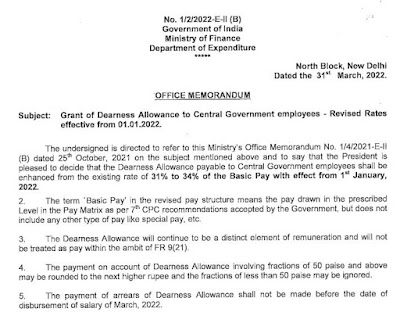
DA Jan 2022 - Grant of Dearness Allowance to Central Government employees - Revised Rates effective from 01.01.2022

 3% DA Hike - Revised Rates effective from 01.01.2022: DoE OM dated 31.03.2022 No. 1/2/2022-E-II (B) Government of India Ministry of Finance...