Friday, 24 June 2016

How did Media arrive the 7th CPC Minimum Pay as Rs.23400?

How did Media arrive the 7th CPC Minimum Pay as Rs.23400?

For the past few days some News Agencies belongs to TV networks are blabbering about 7th CPC Minimum Pay and Implementation.

They repeatedly claimed that Empowered Committee recommends 30% Increase in minimum wage. Thus Minimum Pay will be increased from 18000 to 23400 and highest pay will be increased from 250000 to 325000.

They actually exposing their ignorance by saying 30% increase will increase the Minimum Pay to 23400/-
The 7th CP recommended 14.29 % increase in minimum Pay

The Minimum Pay in Sixth CPC = 7000
Total DA as on 1.1.2016 125% = 8750
Total Pay = 15750
Minimum Pay Recommended by 7th CPC = 18000
Increase Over Sixth CPC Pay = 14.29%

If the Cabinet Committee decides to increase 30% , The Minimum Pay will be Rs. 20475. Rounding of to 1000 may take it to Rs.21000.

How are Some familiar and Established news Media telling that 30% increase will take the Minimum Wage to Rs.23400?

Without knowing the fundamentals of fixing Minimum Pay, they simply calculated 30% increase over Rs.18000 (which already has 14.29% inbuilt increase) and predicted Rs.23400 will be the Minimum Wage. This false news created buss among cg employees. Now everybody talking about Rs.23400 as Minimum Pay.

The NCJCM demanded to fix Rs.26000 as Minimum Wage according to Dr. Akroyd Formula based on the retail prices as on 1.1.2014. This is 65% increase over sixth CPC Minimum Wage +125% DA (7000+8750=15750).

If the government decide to increase the Minimum Wage 30% level, then the Minimum Pay will be Rs.21000 and Fitment factor will be fixed at 3.0.

Source: Govtstaffnews.in

Action Taken Report on the minutes of the 27th SCOVA meeting held on 13.10.2015 and Fresh Agenda Items to be discussed in 28th SCOVA meeting

Action Taken Report on the minutes of the 27th SCOVA meeting held on 13.10.2015 and Fresh Agenda Items to be discussed in 28th SCOVA meeting

F.No. 42/05/2016-P&PW(G)
Government of India
Ministry of Personnel, P.G and Pensions
Department of Pension & Pensioners Welfare
********
3rd Floor, Lok Nayak Bhawan
Khan Market, New Delhi-110003
Date:- 22nd June, 2016

All the Pensioners Association included in SCOVA vide Resolution dated 25.08.2015

Subject:- Action Taken Report on the minutes of the 27th SCOVA meeting held on 13.10.2015 and Fresh Agenda Items to be discussed in 28th SCOVA meeting.

Please find enclosed herewith copies of ATR on the decision of the 27th SCOVA meeting held on 13.10.2015 and a list of Fresh Agenda Items to be discussed in the 28th SCOVA meeting to be held on 27.06.2016 under the Chairmanship of Hon’ble MOS(PP).


(Charanjit Taneja)
Under Secretary to the Government of India

Read more : Circular

New Pension Scheme: Guidelines for processing of Family Pension Cases

New Pension Scheme: Guidelines for processing of Family Pension Cases

PENSION FUND REGULATORY
AND DEVELOPMENT AUTHORITY
B-14/A, Chhatrapati Shivaji Bhawan
Qutab Institutional Area, Katwaria Sarai
New Delhi~110016
F. No. PFRDA/24/Exit/1
May 26, 2016
Shri Amit Sinha
Executive Vice President,
NSDL e-Governance Infrastructure Limited,
1st Floor, Times Tower.
Kamla Mills Compound,
Senapati Bapat Marg, Lower Parel,
Mumbai - 400013
Subject: Guidelines for processing of Family Pension Cases.
Dear Mr Sinha,
This has with reference to regulation 6(e) of the PFRDA (Exit and Withdrawals under NPS) Regulation 2015 relating to family pension and transfer of corpus from subscribers NPS account to government nodal office, if the subscriber or the family members of the deceased subscriber avails the benefit of family pension.
The Authority after examining the issue has finalized the policy with respect to transfer of accumulated pension wealth of the subscribers to government and where the subscribers family has availed the additional relief given by the government in the family of family pension Accordingly, the guidelines for processing of such claims are being enclosed herewith for your guidance and implementation of the same.
Therefore, you are advised to intimate to all the accounting formations under the central government, state governments (excluding the states which have clarified that they do not provide the benefit including Punjab & Sikkim) and autonomous bodies falling under their jurisdiction about the policy guidelines and also the process to be followed

The same shall be made part of the online exit module. In case if you want any clarifications on the matter. you may write back to us
Yours sincerely,
(Venkateswarlu Peri)
General Manager
Enclosure: a/a
CC:
Shri Kamal Chaudary
Chief Executive Officer,
National Pension System Trust,
3'd Floor, Chatrapati Shivaji Bhawan
B-14/A, Qutab Institutional Area
New Delhi 3100 016

Guidelines for processing of Family Pension cases
 
Online processing of Withdrawal request in case family pension is provided by the Nodal Office to the claimant(s)/subscriber(s)
 
 
 1. The family member(s)/subscriber(s) who is/are availing Family Pension from will submit the No objection certificate (Annexure-II) to the concerned Nodal Office.
2. Nodal Office will authenticate the Annexure II.
 
3. Nodal Office shall fill in the declaration form Annexure I & provide necessary authentications.
 
4. Nodal Office (first User) will login into CRA system to select the option that the family pension is being/ has been granted to the family members of the deceased subscriber or to the subscriber.
 
5. Nodal office will enter the details of family member(s)/subscriber(s) into the CRA system to whom the family pension is being given (as mentioned under Annexure II).
 
6. A new field - Nodal Office bank detail will be enabled. Nodal Office will provide its bank details as per Nodal Office Declaration form (Annexure I).
 
7. Nodal Office (first User) will submit post entering the complete details.
 
8. Nodal Office (second User) will authenticate and authorise the said request. Claim ID will get generated on successful submission of Withdrawal request.
 
9. Nodal Office will print the online form dispatch the same along with duly filled attested both the Annexures - I and II to CRA.
 
10. On receipt of documents, CRA will initiate the withdrawal request in the CRA system.
 
11. The accumulated pension wealth, of the particular deceased subscriber or the subscriber (in case of disability) for whom the withdrawal request is raised, will be transferred to the Nodal Office bank account as per the settlement cycle.

Aadhaar Enrollments for Defence Civilians

Aadhaar Enrollments for Defence Civilians

GOVERNMENT OF INDIA
MINISTRY OF DEFENCE
OFFICE OF THE PRINCIPAL CONTROLLER OF ACCOUNTS (FYS)
ADMIN – I SECTION
10-A, S.K.BOSE ROAD, KOLKATA: 700001

E-mail ID: cda-cal@nic.in
Website: www.pcafys.nic.in
Phone No: (033) 2248-5077 to 5080 Extn- 329
Fax No: (033) 2248-0991
No. 2390/AEBAS/MO
Dt: 21/06/2016
To
All CFA (Fys),
Bengal Gr., Kanpur Gr., Jabalpur Gr., Dehradun Gr., Ambaghasi Gr., Avagi Gr., Kiskee Gr., Bolangir, Medak

Sub: Aadhaar Enrollments for Defence Civilians
 ****** ******* ******

HQrs. Office vide their letter No. 5049/AT-P/Vol-XXIII Dated- 16.05.2016 has once again called for data on entollment of Aadhaar in respect of Defence Civilian Employees as well as Pensioners for reviewing the progress of “Digital Life Certificate Scheme”, introduced by GOI in November, 2014.

In the process of reviewing the progress of the Scheme, the Defence Secretary in a meeting on 12.03.2015 has directed that CGDA in consultation with UIDAI, RGI and other agencies would get themselves registered as Registers for Aadhaar enrollment in r/o defence civilians. In this regard, a weekly report was introduced vide CGDA’s letter of even no. dated 31.08.2015. The Weekly Report is required to be furnished to the Nodal Office i.e. O/o the CDA (IDS) New Delhi to reflect the correct number of defence civilians for Aadhar seeding/ Enrollment in the following format w.e.f. 31st of May 2016.

Number of Defence Civilians Number of Defence Civilians who have Aadhaar No. Number of Defence Civilians who are not Aadhaar enrolled

Now all Controllers are also required to submit the ibid report on weekly basis. Since no report in this regard is being endorsed to this office till date, it is requested to forward a copy of the weekly report to enable this office for further action at this end.

Further it is observed that marking of attendance through Aadhaar Enabled Biometric Attendance System [AEBAS] has since been implemented only in a few Branch Accounts Offices under the Organisation of PCA (Fys) Kolkata the Competent Authority has desired information on the present status on the progress of implementation of AEBAS in the Offices under each Branch Controller.

It is, therefore, requested to inform the present status on enrolment of Aadhaar and implementation of AEBAS in the offices under the Group. In case any difficulty is being faced at any stage i.e. at the time of ‘On Boarding’ or ‘Procurement of Devices’ or ‘Registration’ stage assistance of this office may be sought for accordingly.

[M.C. Chakrabortty]
Controller of Accounts (Fys)

Download signed copy here

Thursday, 23 June 2016

One Rank One Pension – More delay in OROP – Government Gives Six Month Extension to Panel

One Rank One Pension – More delay in OROP – Government Gives Six Month Extension to Panel

With the extension, the implementation of One Rank One Pension (OROP) may take more time as the panel can submit its report by December 14, official sources said.

benefits-one-rank-one-pension


One Rank One Pension – More delay in OROP – The tenure of the committee formed on implementation of One Rank One Pension (OROP) scheme has been extended.

The tenure of the committee formed on implementation of One Rank One Pension (OROP) scheme has been extended by six months upto the middle of December this year.

The government recently amended the gazette notification issued last year under which the committee headed by former Chief Justice of Patna High Court Justice (Retd) L Narasimha Reddy was scheduled to submit its report by June 14. With the extension, the implementation of OROP may take more time as the panel can submit its report by December 14, official sources said.

The government had announced implementation of OROP on November 7, 2015 to benefit over 25 lakh ex-servicemen and war widows. The OROP mandates payment of uniform pension to the armed forces personnel retiring in the same rank with the same length of service, regardless of their date of retirement, which implies that bridging the gap between the rate of pension of current and past pensioners at periodic intervals.

The other Terms of Reference of the Committee will continue which include measures for the removal of anomalies that may arise in the implementation of the OROP as notified by the government.

The panel is also looking into the measures for the removal of anomalies that may arise out of inter-services issues of the three forces due to implementation of OROP besides implications on service matters. The Committee is examining all other matter referred to it by the central government on implementation of the OROP or related issues.

In making its recommendations, the Committee shall take into account the financial impact of its recommendations, as per its Terms of Reference. The panel, if necessary, may give interim reports to the government on any of the matters related to its terms of reference.

Source: NIE

Incentives announced for textiles will help create jobs

Incentives announced for textiles will help create jobs

The “extra push” given to the textiles industry through an incentive package will help create more jobs and push exports, Commerce and Industry Minister Nirmala Sitharaman said today.

“It is a sector where India has gained a lot of advantage … It has a great potential for job creation,” the minister told reporters here.

This “extra push” was given to the sector due to various global developments, she said.

The Union Cabinet yesterday approved a Rs 6,000 crore package for textiles and apparel sector with an aim to create one crore new jobs in three years and attract investments of USD 11 billion while eyeing USD 30 billion in exports.

Textiles exports contribute significantly to the country’s total exports at about USD 17 billion in 2014-15. The sector is witnessing huge competition from small countries like Bangladesh and Vietnam, which have access to developed markets at lower tariffs.

When asked about the impact of Brexit (possible exit of Britain from European Union) on India, Sitharaman said that the government is “watching the situation”.

“We will be observing the developments. It is too early for me to comment (on its impact),” she added.
Talking about the stalled India-EU free trade agreement, the minister said India is waiting for the dates to resume the talks.

“We are waiting for the dates. It is my doubt that if because they are waiting for the outcome of Brexit, they have not yet given the dates as yet. The moment they give the dates, we will be keenly wanting to continue the talks to reach the conclusion at the earliest,” she added.

Launched in June 2007, the negotiations for the proposed agreement have witnessed many hurdles with both sides having major differences on crucial issues like intellectual property rights, duty cut in automobile and spirits, and liberal visa regime.

The pact is aimed at reducing or significantly eliminating tariffs on goods, facilitating trade in services and boosting investments between the two sides.

When asked about Apple Inc’s proposal to open single brand retail stores in the country after announcement of the tweaked FDI policy in the sector, Sitharaman said: “We have announced the policy. We will wait to hear from them”.

The ministry has stated that it will give exemption to foreign firms such as Apple Inc coming with state-of-the-art technology from the mandatory local sourcing norms in the single-brand retail sector for up to three years.

PTI

Fixation of range of seniority for promotion from PA to PS grade of CSSS- Select List Year 2015 – regarding

Fixation of range of seniority for promotion from PA to PS grade of CSSS- Select List Year 2015 – regarding

 REMINDER-III
No.4/1/2016-CS-II(A)
Government of India
Ministry of Personnel, Public Grievances and Pensions
Department of Personnel & Training

3rd Floor, Lok Nayak Bhawan, Khan Market,
New Delhi – 110003.
Dated the 23rd June, 2016
OFFICE MEMORANDUM

Subject: – Fixation of range of seniority for promotion from PA to PS grade of CSSS- Select List Year 2015 – regarding.

Reference is invited to this Departments O.M. of even number dated 29.03.2016 and subsequent reminders dated 13.05.2016 & 08.06.2016 on the above mentioned subject. The requisite information regarding recommendation of DPC for promotion of eligible PAs to PS Grade of CSSS for the Select List Year-2015 was required to be furnished by the Cadre Units of CSSS in the prescribed proforma by 29.04.2016.

2. The requisite information received from the Cadre Units, as per Annexure, is either incomplete or has not at all been received till date. The non-receipt of this information is delaying the process of finalizing the panel of eligible officers for appointment to PS Grade of CSSS for the Select List Year-2015.The concerned Cadre Units are once again requested to furnish the requisite information without any further delay.

(AK Saha)
Deputy Secretary to the Government of India
Tel .No.24622365
Encl:- as above
To
Joint Secretary in charge of(Admn.) of the concerned cadre units.

DoPT Circular

7th Pay Commission – Recommendation for more Leave and Holidays

The following paragraphs bring out, the different kinds of holidays and leave admissible, demands received (if any) and views of the 7th Pay Commission on each one of them. 

7th-Pay-Commission-leave-holidays

7th Pay Commission – Recommendation for more Leave and Holidays – Presently Central Government offices observe a five-day week which results in 104 holidays every year on account of weekends.

Presently Central Government offices observe a five-day week which results in 104 holidays every year on account of weekends. In addition, there are three National Holidays, fourteen Gazetted Holidays and two Restricted Holidays. Further, civilian government employees are entitled to 8 days’ Casual Leave, 20 days’ Half Pay Leave (commutable to Medical Leave) and 30 days’ Earned Leave. Besides the above, quite a few other types of leave are admissible.

The following paragraphs bring out, the different kinds of holidays and leave admissible, demands received (if any) and views of the 7th Pay Commission on each one of them. Unless otherwise stated, the existing terms and conditions regulating these holidays and leave shall remain unchanged.

Casual Leave (CL) – Casual Leave is granted to enable a government servant to attend to sudden/ unforeseen needs / tasks. Presently 8 days CL is normally granted to a Central Government employee per calendar year. The number goes up to 10 days for Industrial Workers, 20 days for Defence Officers and 30 days for Defence PBORs. Certain other categories of staff, particularly in the Railways, are granted CL ranging from 11 to 13 days in a year. Demands have been made to increase the number of CL to 15 days for Industrial Workers and 12 days for other employees. CAPFs have also sought parity with defence forces in matters of Casual Leave.

Child Adoption Leave
– This leave is granted to female employees, with fewer than two surviving children on valid adoption of a child below the age of one year, for a period of 135 days immediately after the date of valid adoption.

Commuted Leave – Presently, Commuted Leave not exceeding half the amount of half-pay leave due can be taken on medical certificate. A demands have been made to do away with the need for medical certificate.

Child Care Leave (CCL) – Child Care Leave (CCL) is granted to women employees for a maximum period of two years (i.e., 730 days) during their entire service for taking care of their minor children (up to eighteen years of age). There are several demands relating to CCL which include converting the same into “family care” leave, extending the facility to male parents and many representations stressing that it should be extended at least to single male parents. Suggestions have also been received that in cases where the child is differently abled, the clause stipulating that the child should be minor, should be done away with. Single mothers have highlighted their unique problems and requested the Commission for liberalising the grant of CCL. Interestingly, representations have also been made for discontinuance of the CCL, primarily on the grounds that it disrupts office working and also because it promotes gender discrimination.

Earned Leave (EL) or Leave on Average Pay (LAP) – Presently 30 days EL per annum is granted to Civilian employees and 60 days to Defence personnel. EL can be accumulated up to 300 days in addition to the number of days for which encashment has been allowed along with LTC. Suggestions have been made to increase the accumulation to 450 days, allow encashment of 50 percent of the accumulated EL after 20 years of service and delink encashment of leave from LTC.

Paternity Leave – Presently, a male employee with less than two surviving children may be granted Paternity Leave for a period of 15 days during the confinement of his wife, up to 15 days before or six months from the date of delivery of child. Paternity leave may also be granted to a government servant with less than two surviving children on valid adoption of a child below the age of one year, within a period of 6 months from the date of valid adoption. There are demands to increase the period to 30 days.

Maternity Leave – Maternity leave is granted to women government employees–up to 180 days for pregnancy and 45 days in the entire service for miscarriage/abortion. Maternity leave can be combined with any other leave upto two years without medical certificate. The 7th pay Commission has received representations for enhancement of Maternity leave to 240 days with full pay and further 120 days with half pay.

It is noted that Maternity Leave was raised from 135 days to 180 days and ‘period in continuation’ raised from 1 year to 2 years by the VI CPC. No further increase is warranted. Status quo is recommended.

Special Disability Leave – It is admissible to civilian employees when disabled by injury intentionally or accidentally inflicted or caused by or in consequence of the due performance of official duties or in consequence of official position held. Full pay is admissible for the first 120 days and half pay thereafter. The leave may be combined with any other kind of leave due and admissible, provided the total period of leave does not exceed 24 months.

There are demands to remove the ceiling limit of 24 months–the duration of leave may be left to the discretion of doctor and full pay paid for the entire period.

Source: Patrika.com

Most important demand of CG employees is minimum wage and fitment formula – P.S.Prasad

Most important demand is that of the CG employees is the minimum wage and fitment formula – P.S.Prasad
7cpc-minimum-wage-demands-cg-employees

“The formal announcement by the of the 7th CPC acceptance is likely to be made by the Government just before the 11th July strike by the CG employees indicating the actual minimum wage and fitment formula.”

7th CPC latest
Comrades,
The empowered committee of Secretaries headed by the Cabinet Secretary had discussion from past five months on the charter of demands raised by the staff side, The finance ministry is working out the financial implications arising out of the improved recommendations of the 7th CPC especially on the minimum wage and fitment formula being improved, granting two increment on promotion and having annual increment on 1st Jan and 1st July instead of just on 1st July. This will benefit a lot of persons on promotion. The other aspect is considering grant of advances, which the 7th CPC has recommended for abolition.

The formal announcement by the of the 7th CPC acceptance is likely to be made by the Government just before the 11th July strike by the CG employees indicating the actual minimum wage and fitment formula.
The cabinet Secretary will present the view of the empowered committee of Secretaries before the Union Cabinet meeting based upon the principle adopted in actual calculation of the minimum wage and fitment formula. The 7th CPC had adopted the Dr Aykroyd formula minimum wage is calculated on the basis of the 15th ILC norms. But erred in many aspects for example the average of prices of last 12 months was taken, The housing weight age , education weight age etc . The prices of essential items are rising from past many years, even in last six months the retail inflation is rising above 5.4%.

Secondly the prices quoted by the GOVERNMENT OF INDIA MINISTRY OF LABOUR & EMPLOYMENT LABOUR BUREAU CLEREMONV, SHIMLA http://labourbureaunew.gov.in/ , the Director of Economic & statics , Ministry of Agriculture and Farmers Welfare, Government of India, New Delhi & the retail market prices are varying .

If we calculate the minimum wage based upon the LABOUR & EMPLOYMENT LABOUR BUREAU taking prices as on 1st July 2015 the minimum wage works out to Rs 21,000 / and fitment formula works to 3.00. This will result in 34% wage hike without allowances.

If we calculate the minimum wage based upon the Director of Economic & statics , Ministry of Agriculture and Farmers Welfare, Government of India, New Delhi taking prices as on 1st July 2015 the minimum wage works out to Rs 23,000 / and fitment formula works to 3.30. This will result in 50% wage hike without allowances.

If we calculate the minimum wage based upon the retail market taking prices as on 1st July 2015 the minimum wage works out to Rs 28,000 / and fitment formula works to 4.00. This will result in 70% wage hike without allowances.

The most important demand is that of the CG employees is the minimum wage and fitment formula.

The Staff side had demand of minimum wage of Rs 26000/- & fitment formula of 3.71. Against this the 7th CPC had recommended minimum wage of Rs 18000/- & fitment formula of 2.57. The 7th CPC recommendations has provided only at 14% wage hike at Group “C” level it is only ranging from Rs 2240/- to Rs 3500/- increase per month, and at Group “B” level ranging from Rs 4000/- to Rs 6500/- increase per month. After deductions & income tax the net increase will be just from Rs 500/- to Rs 3000/- only.

This increase is lowest by any pay commission, hence vast changes are required as the prices of essential commodities have gone up and also the inflation rate has gone up.

Comrades it is the time to struggle, we should educate the members and prepare for struggle, so that we should get at least 50 % wage hike without allowances, as allowances are not taken into pension benefit.
Only struggle will get us benefit. Please don’t believe on rumours. Now it is now or never.

Comradely yours
(P.S.Prasad)
General Secretary

Indefinite Strike Called by NJCA from July 11th will play a vital role to determine the fate of the 7th Pay Commission

Indefinite Strike Called by NJCA from July 11th will play a vital role to determine the fate of the 7th Pay Commission

Govt has to decide on 7th Pay Commission before Indefinite Strike

The Indefinite Strike Called by National Joint Council of Action from July 11th will play a vital role to determine the fate of the 7th Pay Commission. The amount of pressure exerted on the Government through this agitation may change the Govt Views over Pay Commission.

It is evident that the present NDA Government is not in favour of Bapus. And the Public opinion about Government Employee’s attitude and work Culture is too not in favour of CG Employees. So it is now the unity among Central Staffs and their undisputed faith over Unions, Staff Associations and Federations only will get them expected results.

At this juncture, somehow, the call for Indefinite Strike is a timely decision taken by NJCA and it is the only weapon, through which the powerless Central Staffs can intimidate the Government to do Justice for them in respect of Pay Revision and Improving Service Conditions.

That is why Federations are keep on telling the CG Staffs to be prepared for Indefinite Strike. They are, however, alarming the affiliated unions to be vigilant about the rumors about 7th Pay Commission. They informed that Social Media and Some News Agencies are publishing the false news which may deteriorate the Spirit of Govt Servants.

The Success rate of agitation Programs to be conducted by NJCA in order to prepare the Central Government Employees for Indefinite Strike will be the Pressure indicator to the Central Government to take decisions on 7th CPC issues and Pending demands prior to the Strike.

The Indefinite Strike is a well-defined and calculated move by NJCA to give the pressure to the Central Government as the Govt is reluctant to address the issues of CG Staffs and implement the 7th CPC recommendations.

It is inevitable to the Government to take decision on 7th Pay Commission before the commencement of Indefinite Strike.

Flash News

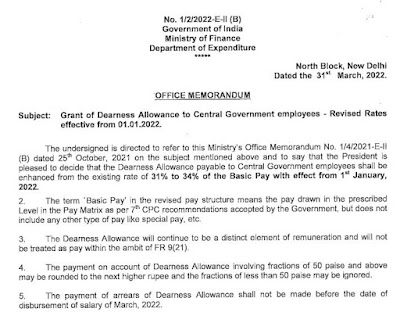
DA Jan 2022 - Grant of Dearness Allowance to Central Government employees - Revised Rates effective from 01.01.2022

 3% DA Hike - Revised Rates effective from 01.01.2022: DoE OM dated 31.03.2022 No. 1/2/2022-E-II (B) Government of India Ministry of Finance...