Showing posts with label 7th CPC implementation. Show all posts

Saturday, 18 March 2017

7th Pay Commission : From Higher Allowance to Implementation where does the story Stands


7th Pay Commission : From Higher Allowance to Implementation where does the story Stands

7th Pay Commission : On Friday senior officials of Union Cabinet were expected to meet members of the panel over Higher Allowance and National Pension Scheme (NPS).

However sources indicate that the meeting did not take place.

As almost a year has passed, we try to figure out where does the story of 7th Pay Commission stand today. The panel was constituted a day after the implementation of the 7th Pay Commission recommendations.
This panel on the higher allowance, named 'Committee on Allowance' was also expected to make a major announcement on Friday following the submission of the report to the government. However that too didn’t happen.

As we all know, Prime Minister gave the nod for an additional 2 per cent increase in Dearness Allowance(DA) for all Central Government employees. Moreover, along with the DA, for pensioners, the Dearness Relief (DR) has been increased by 2 per cent with effect from January 1, 2017.

While reports claim that the increasing of the Dearness Allowance has benefited 48.85 lakh employees and 55.51 lakh pensioners, the central Government employees are now concerned about the Committee on Allowance’s decision.

But more importantly, although the DA has been hiked, the Committee headed by Finance Secretary Ashok Lavasa is yet to submit the reports on other allowances, which were also scheduled to be increased once the 7th Pay Commission was implemented.

However, the National Joint Council of Action (NJCA) on behalf of the Central Government employees expressed their dissatisfaction over the hiked 2% DA and said it should have been increased by at least 3%.

April 1, 2017, was the rumoured date for implementing the allowance hike but now that the report has not yet been submitted, it seems the rumour is to stay as it is.

Following this, the NJCA has warned of dire consequences if the Centre fails to implement the allowance hike from April 1.

Source: India.com

Saturday, 7 January 2017

Meeting with the Staff Side (JCM) on the recommendations of the 7th CPC and their implementation


Meeting with the Staff Side (JCM) on the recommendations of the 7th CPC and their implementation
Shiva Gopal Mishra
Secretary
No.NC/JCM/2016
Ph.: 23382286
National Council (Staff Side),
13-C, Ferozshah Road, New Delhi - 110001
E Mail : ncjcm.np@gmail.com
Dated: December 29, 2016
The Addl. Secretary(Exp.),
Department of Expenditure,
Ministry of Finance,
North Block,
New Delhi

Dear Sir,
Sub: Meeting with the Staff Side (JCM) on the recommendations of the 7th CPC and their implementation.

We had our last meeting on 24th October, 2016, wherein, while concluding, it was assured that, you would consult the Secretary (Expenditure) and would hold next meeting shortly. It is quite unfortunate that, so far much time have passed and nothing has been heard from your end.

Inordinate delay in Revision of Minimum Wage and Fitment Formula is creating lots of problems, and the Central Government Employees are agitated because this issue had been agitating their minds since implementation of 7th CPC Report

You are, therefore, requested to call a meeting with the Staff Side(JCM) to discuss and resolve these issues at the earliest.
With Kind Regards!
Sincerely yours,
(Shiva Gopal Mishra)
Source : ncjcmstaffside

Sunday, 25 December 2016

MACPS for Railway Employees - 7th CPC Implementation

MACPS for Railway Employees - 7th CPC Implementation

Modified Assured Career Progression Scheme (MACPS) for the Railway Employees
RAILWAY ORDERS
GOVERNMENT OF INDIA
MINISTRY OF RAILWAYS
(RAILWAY BOARD)
S.No.PC-VII/12
No.PC-V/2016/MACPS/1
RBE No.155/2016
New Delhi, dated 19.12.2016
The General Managers
All Indian Railways & PUs
(As per mailing list)

Subject: Modified Assured Career Progression Scheme (MACPS) for the Railway Employees - Implementation of seventh CPC recommendations.

The Modified Assured Career Progression Scheme was introduced with effect from 01.09.2008 in pursuance of the recommendations of the Sixth Pay Commission by this Ministry’s letter No. PC-V/2009/ACP/2, dated 10.06.2009 (RBE No.101/2009). Thereafter, subsequent amendments/clarifications were issued from time to time. These instructions are in force with effect from 01.09.2008.

2.The 7th Central Pay Commission (CPC) in para 5.1.44 of its report has recommended inter-alia as follows:
MACP will continue to be administered at 10,20 and 30 years as before. In the new Pay Matrix, the employee will move to immediate next level in hierarchy. Fixation of pay will follow the same principle as that for a regular promotion in the Pay Matrix. MACPS will continue to be applicable to all employees up to Higher Administrative Grade (HAG) level except members of Organised Group 'A' Services.
3.The Government has considered the above recommendation and has accepted the same. In the light of the recommendations of the 7th CPC accepted by the Government, the Modified Assured Career Progression Scheme (MACPS) will continue to be administered at 10, 20 and 30 years as before. Further, Para 1 and 2 of the existing Scheme (Annexure to this Ministry’s letter No.PC-V/2009/ACP/2, dt.10.06.2009) will be substituted by the following words:
"1. There shall be three financial upgradations under the MACPS as per 7th CPC recommendations. counted from the direct entry grade on completion of 10, 20 and 30 years services respectively or 10 years of continuous service in the same level in Pay Matrix, whichever is earlier.
2. The MACPS envisage merely placement in the immediate next higher level in the Pay Matrix as given in PART ‘A’ of Schedule of Railway Services (Revised Pay) Rules. 2016. Thus, the level in the Pay Matrix at the time of financial upgradation under the MACPS can, in certain cases be different than what is available in the normal hierarchy at the time of regular promotion in one’s AVC. In such cases, the higher level in the Pay Matrix attached to the next promotion post in the hierarchy of the concerned cadre/organization will be given only at the time of regular promotion.”

4. The 7th Central Pay Commission (CPC) in Para 5.1.45 of its report has in teralia recommended as follow:

"Benchmark for performance appraisal for promotion and financial upgradation under MACPS to be enhanced from 'Good' to'Very Good'. "

5. The Government has considered the above recommendation and has accepted the same. In the light of the recommendations of the 7th CPC accepted by the Government, Para 17 of the Scheme (Annexure to Board’s letter No.PC-V/2009/ACP/2, dt. 10.02.2009) shall be substituted by the following words:-
" 17. For grant of financial upgradation under the MACPS, the prescribed benchmark would be ‘Very Good’ for all the posts."
6. These changes will come into effect from 25th July, 2016, i.e., from the date of resolution notified by Department of Expenditure, Ministry of Finance regarding acceptance of the recommendations of the 7th CPC.

6.1 MACPS where it was due earlier to 25.07.2016, but not decided yet due to Administrative delay, will be decided as per criteria prevalent at that time. Cases that became due on or after 25.07.2016, will be decided as per new criteria. However, Past Cases, decided otherwise, need not be re-opened.

7. The comprehensive MACP Scheme on acceptance of Seventh Central Pay Commission recommendations will be issued separately.

8. This issues with the concurrence of the Finance Directorate of the Ministry of Railway.

9. Hindi version is enclosed.

(Authority: DOP&T’s OM No.350344/3/2015-Estt.(D), dt.28.09.2016)

(N.P.Singh)
Dy.Director,Pay Commission-V
Railway Board

Original copy

Friday, 24 June 2016

How did Media arrive the 7th CPC Minimum Pay as Rs.23400?

How did Media arrive the 7th CPC Minimum Pay as Rs.23400?

For the past few days some News Agencies belongs to TV networks are blabbering about 7th CPC Minimum Pay and Implementation.

They repeatedly claimed that Empowered Committee recommends 30% Increase in minimum wage. Thus Minimum Pay will be increased from 18000 to 23400 and highest pay will be increased from 250000 to 325000.

They actually exposing their ignorance by saying 30% increase will increase the Minimum Pay to 23400/-
The 7th CP recommended 14.29 % increase in minimum Pay

The Minimum Pay in Sixth CPC = 7000
Total DA as on 1.1.2016 125% = 8750
Total Pay = 15750
Minimum Pay Recommended by 7th CPC = 18000
Increase Over Sixth CPC Pay = 14.29%

If the Cabinet Committee decides to increase 30% , The Minimum Pay will be Rs. 20475. Rounding of to 1000 may take it to Rs.21000.

How are Some familiar and Established news Media telling that 30% increase will take the Minimum Wage to Rs.23400?

Without knowing the fundamentals of fixing Minimum Pay, they simply calculated 30% increase over Rs.18000 (which already has 14.29% inbuilt increase) and predicted Rs.23400 will be the Minimum Wage. This false news created buss among cg employees. Now everybody talking about Rs.23400 as Minimum Pay.

The NCJCM demanded to fix Rs.26000 as Minimum Wage according to Dr. Akroyd Formula based on the retail prices as on 1.1.2014. This is 65% increase over sixth CPC Minimum Wage +125% DA (7000+8750=15750).

If the government decide to increase the Minimum Wage 30% level, then the Minimum Pay will be Rs.21000 and Fitment factor will be fixed at 3.0.

Source: Govtstaffnews.in

Tuesday, 21 June 2016

7th Pay Commission Latest News – Two more Committee Meetings likely to happen soon

7th Pay Commission Latest News – Two more Committee Meetings likely to happen soon

Even as 7th Pay Commission Empowered Committee is in the process of finalising its report, Staff Side Associations are relentlessly trying for Negotiations with Govt before final decision on increase in pay and allowances is taken by Cabinet 

7th Pay Commission Latest News – Two more Committee Meetings in the offing before final decision on 7th CPC implementation is taken by Government

Latest developments in the process of 7th Pay Commission report by Empowered Committee indicates that decision by the Committee would not be taken as quickly as it was expected earlier.

India.com, a news website from Zee News Group reports that Empowered Committee has called for more data from 7th Pay Commission implementation cell, the administrative wing appointed by govt to process 7th CPC report, after the meeting held last week.

To look into these data and to decide further increase in minimum pay and fitment factor over and above recommended by 7th Pay Commission, two more Empowered Committee Meetings may be held, India.com reports.

Consequently, final decision of Cabinet on implementation of 7th Pay Commission may not be taken this month. However, news sources close to finance ministry indicates that final decision on 7th Pay Commission report may not take much longer. If the Empowered Committee continues to process the report without any break which is the case now, its report would be submitted within a month, after which Cabinet will take its final call.

Earlier, many media reports suggested that Empowered Committee is likely to take a decision of increasing the minimum of Central Government Employees to Rs. 23,500 as against Rs. 18,0000 proposed by 7th Pay Commission.

7th Pay Commission had arrived at the additional burden of Govt on increase in Salary and pension at 23.55 % and 24 % respectively as Rs 73,650 crore for Central Government Employees, Defence Personnel & Pensioners and Rs 28,450 crore for Railway Employees and Pensioners.

Now, it is needless to say, additional increase over and above the pay and allowances recommended by 7th Pay Commission would require more allocation for Central salary than the Budget Estimates.

Source: India.com (Zee News Group)

Tuesday, 23 February 2016

7th Pay Commission Latest News – Implementation could affect Capital Spending

7th Pay Commission Latest News – Implementation could affect Capital Spending

Economists predicts that spending pressures out of additional Salary expenditures out of 7th Pay Commission implementation, increase in food subsidies, Crop Insurance Scheme etc
7th Pay Commission Latest News – Cost of 7th CPC implementation could affect Capital Spending needed for Railways, Roads, Ports and Power Projects
A $16 billion (Rs 1.1 lakh crore) pay rise for government employees and costly food and farm programmes could force Finance Minister Arun Jaitley to cut capital spending in its annual budget, officials and economists say.

The spending pressure on Jaitley threatens to worsen imbalances in India’s $2 trillion economy as consumption outpaces investment.

A populist budget, ahead of assembly elections in four states this year, could stoke inflation even as structural measures such as Prime Minister Narendra Modi’s proposed tax and labour reforms look less likely.

It could also eat into capital spending needed for railways, roads, ports and power projects, seen as vital to India’s integration into the global economy.

“It is not going to be a revolutionary or inspirational (budget) … given the spending pressures,” said Shilan Shah at Capital Economics. “It is most likely to lead to a sell-off in the bond market if the salary increase is implemented.”

Jaitley presents his third budget on February 29 and is expected to implement the recommendations of a government commission to raise pay for 1 crore government workers and pensioners by 23.5 percent.

While that hike would boost demand, economists question whether a policy dating back to an era of double-digit inflation is justified today, when Reserve Bank of India Governor Raghuram Rajan has driven consumer price growth below 6 percent.

Officials with direct knowledge of budget discussions said Jaitley could raise taxes on services and petroleum products to help cover the extra outlays.

He would still have some room to ease tax rules on foreign investment and hit his deficit target of 3.5 per cent of gross domestic product in the 2016/17 fiscal year.


COSTLY PROMISES

The promised pay hike, an increase in food subsidies and a new crop insurance scheme for farmers would cost at least Rs 1.2 lakh crore ($17.5 billion) – equivalent to 0.9 per cent of forecast GDP in 2015/16.

India’s cash-strapped state railways, which employ 13 lakh, are also seeking central funds to cover higher pay – squeezing its investment budget and creating pressure to hike fares. Most of India’s 29 states will raise wages soon.

Rajan, who cut policy rates by 125 basis points in 2015, has said the pay commission award, if implemented, could lead to higher inflation for one to two years.

Much depends on the timing of the government pay rises, which sources say could take retroactive effect on January 1, 2016. Economists and ratings agencies say the fiscal deficit target may have to be raised to 3.8 per cent of GDP to cover the hike.


LOSING PATIENCE


Analysts say the country’s finances and economic performance, a rare bright spot for emerging markets over the past two years, are now under close investor scrutiny.

Foreign investors have been net sellers of Indian stocks and bonds this year, erasing all of the gains in the Sensex since Modi’s landslide general election victory in May 2014.

Despite the windfall of low oil prices, half of which was clawed back through higher energy taxes, India’s consolidated fiscal deficit exceeds 6 percent of GDP and the national debt, at 68 percent, is high by emerging market standards.

And although growth is forecast at 7.6 percent in the current fiscal year, India’s banks are hobbled by growing bad debts and do not have the means to fund new growth projects.

Source: Fist Post

Wednesday, 19 August 2015

7TH CPC Will Increase Central Government Pay Only By 15% – Should We Accept?

7TH CPC Will Increase Central Government Pay Only By 15% – Should We Accept?

Big Expectations from 7th CPC and Low possibilities projected by Union Finance Minister!

Honourable Finance Minister Shri.Arun Jaitely had spoken about the possible impact of 7th CPC recommedations in Parliament.

The Speech is critically reviewed by Comrade Elangovan of DREU.

I am reproducting the comments of Comrade Elangovan for the consideration of our members:

7TH CPC WILL INCREASE CENTRAL GOVERNMENT PAY ONLY BY 15% - SHOULD WE ACCEPT?
R.ELANGOVAN,
WORKING PRESIDENT, DREU

1. The Medium Term Expenditure Framework statement has not yet been uploaded in Finance Ministry’s website.However I have taken the figures provided by print media including The Hindu.As per their statement the expenditure on salaries will rise by 9.56% in the fiscal 2015-16 as a result of 7th CPC implementation over the normal estimated expenditure in the 2015-16 budget to Rs.100619 crores. This means that the expenditure projected was Rs.91,839cr which if increased by 9.56% becomes Rs.100619 crores.

2. While going through the earlier framework statements I have come to the conclusion that the ‘salaries’ shown is pay with normal increments plus DA projected.

3. As per the estimated strength and provision there of statement laid as part of finance budget,the normal projection as PAY was Rs.60731 cr and so DA is Rs 31,108 as deducted from Rs 91 839 cr.The budget document does not give the DA expenditure separately. It gives the total expenditure on all allowances. I have therefore arrived at the figure based on calculations. However I have sought the expenditure on DA, HRA, and Transport Allowance separately through RTI.

4. The increase proposed is Rs.100619 cr from Rs.91,839 cr which means that there will be an increase of Rs.8780 cr. There won’t be any DA after 1-1-2016 up to 31-3-2016 in the fiscal 2015-16.Therefore the whole increase is on basic pay in this fiscal.

5. As we have already seen that the basic pay is Rs.60731 cr. the increase of Rs.8780 cr. is over this Rs.60731.This increase is 14.45% only.The expenditure projected for 2016-17 is Rs.1,12,000cr which is Rs.11,400 more over 2015-16 which works out to 11.32%. This is due to Increment, DA,HRA, TRA etc.The projection for 2017-18 is 1,16,000 cr.

6. If 40% of Basic Pay is to be given,the increase of expenditure in the fiscal 2015-16 must be Rs. 24000 cr as against the Rs. 8780 cr. The demand of JCM Staff side is that there must be an increase of 371% of basic pay as on 1-1-2016. With the 119% DA we would be drawing 219% already. The real increase demanded is 152% of Basic Pay. So not the 152% or 40% of 5th and 6th CPC is intended to be given to us. Only around 15% is going to be given. As The Terms Of Reference of 7TH CPC directs them to recommend only what is ‘FEASIBLE AND DESIRABLE’ to the Government.Now the Government In Parliament states only 15% is FEASIBLE AND DESIRABLE. ARE WE TO ACCEPT IT.? Some PSUs got 15%. But that is for 5 years. But for Central Government Employees it is for Ten Years. Are We To Accept?

7. Pension expenditure for civilian pensioners was estimated to be Rs.27,145cr and defence pension Rs.54,500 cr. The total is Rs.81645 cr. This is expected to go up to Rs.88521 cr, which is an increase of Rs.6876 cr.As there will be no Dearness Relief for the fiscal 2015-16 the increase is to be accounted only to Basic Pension.

8. I have sought the expenditure break up for dearness relief under RTI. However the rough calculation shows a near increase of same 15% in Pension.

9. The impact of 6th CPC on expenditure as per estimated strength of establishment and provision there of in respect of Central Government civilian employees was as follows:

ARREARS Rs 26084 cr. For three years mostly on Pay and DA regular PAY Increase per annum: Rs 8685 cr. These are actual figures.The 219% ofRs. 8685 cris Rs.19000 cr. EVEN THIS IS NOT GIVEN.

10.We must issue a warning to the government afresh demanding acceptance of our demand.I recall my earlier note where in I had quoted Bibek Debroy’s report that the 7th CPC will not be that destabilising to the Government as that of 6th CPC. GOVERNMENT PROVES THAT.

Source: http://postalpensioners.blogspot.in/

Flash News

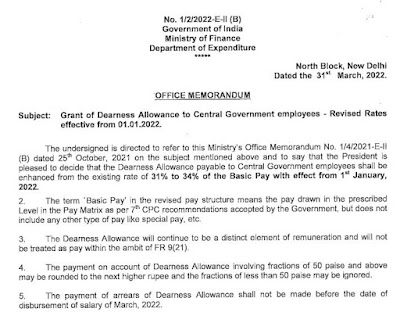
DA Jan 2022 - Grant of Dearness Allowance to Central Government employees - Revised Rates effective from 01.01.2022

 3% DA Hike - Revised Rates effective from 01.01.2022: DoE OM dated 31.03.2022 No. 1/2/2022-E-II (B) Government of India Ministry of Finance...