Friday, 24 July 2015

Central Civil Services (Conduct) Rules, 1964 and the Lokpal and Lokayuktas Act, 2013 – Submission of Declaration of Assets and Liabilities by the Public Servant for each year – Regarding

Central Civil Services (Conduct) Rules, 1964 and the Lokpal and Lokayuktas Act, 2013 – Submission of Declaration of Assets and Liabilities by the Public Servant for each year – Regarding
F. No. 11013/7/2014-Estt.(A-III)
Government of India
Ministry of Personnel, Public Grievances & Pensions
Department of Personnel & Training
Establishment Division
North Block, New Delhi — 110001
Dated July 23rd, 2015
OFFICE MEMORANDUM

Subject: Central Civil Services (Conduct) Rules, 1964 and the Lokpal and Lokayuktas Act, 2013 – Submission of Declaration of Assets and Liabilities by the Public Servant for each year – Regarding

The undersigned is directed to refer to this Department’s OM No. 11013/3/2014 Estt.(A) dated the 17th February, 2015 regarding submission of declaration of assets and liabilities by the public servants under the Central Civil services (Conduct) rules, and the Lokapl land Lokayuktas Act, 2013 and to say that as per the rule 18 (1) (i) of the Central Civil Services (Conduct) Rules, 1964, every Government servant shall on his first appointment to any service or post submit a return of his assets and liabilities, in the form prescribed by the Government, giving the full particulars of movable, immovable and valuable property and debts and other liabilities, etc.. Similarly, Government servants other than newly appointed, belonging to Group ‘A’ and Group ‘B’ are required to submit an annual return in prescribed form giving full particulars of the immovable property inherited/ owned/ acquired by him/ her or held by him/her on lease/ mortgage either in his/ her own name or in the name of any member of his/ her family or in the name of any other persons.

2. The Lokpal and Lokayuktas Act, 2013 (Lokpal Act) notified by the Government  requires all public servants to declare, on first appointment and subsequently every year, a declaration of his/ her assets & liabilities. In exercise of powers conferred by sub-section

(1), clause (k) and clause (I) of sub-section (2) of Section 59 read with section 44 and 45 of  the Act, this Department has notified the Public Servants (Furnishing of Information and Annual Return of Assets and Liabilities and the Limits for Exemption of Assets in Filing Returns) Rules, 2014. The form for declarations is at Annexure-I. All Government servants i.e., belonging to Group A, Group B, Group C and erstwhile Group D, are now required to furnish the declaration of their assets & liabilities in the enclosed format.

3. Vide D. 0. No. 407/12/2014-AVD-IV-B dated the 30th April, 2015, this Department has informed all concerned the time-lines for filing the returns regarding assets and liabilities under the Lokpal Act, which are as follows:
(i) The first return under the Lokpal Act (as on 1st August, 2014) should be filed on or before 15th October. 2015;

ii) The next annual return under the Lokpal Act, for the year ending 31st March. 2015 should be filed on or before 15th October 2015; and

(iii) The annual returns for subsequent years as on 31st March every year should be filed on or before 31st July of that year.
4. It is, therefore, requested that all concerned may be suitably advised to file the return within the time indicated in paragraph 3. It is relevant to state here that as per section 45 of the Lokpal Act, if any public servant wilfully or for reasons which are not justifiable, fails to (a) to declare his assets; or (b) gives misleading information in respect of such assets and is found to be in possession of assets not disclosed or in respect of which misleading information was furnished, then, such assets shall, unless otherwise proved, be presumed to belong to the public servant and shall be presumed to be assets acquired by corrupt means.

(Mukesh Chaturvedi)
Director (E)
Tel: 23093176
Click to see the original order

Jammu and Kashmir government women employees can now get 2-years child care leave

Jammu and Kashmir government women employees can now get 2-years child care leave

Srinagar: In a major welfare measure for women employees in Jammu and Kashmir, the state government today approved Child Care leave for them for a period of two years to look after their children.

The Government issued a notification allowing the Child Care leave for its women employees. As per the new provision, a women employee can avail a maximum period of 730 days of child care leave during her entire service for taking care of her two eldest children, an official spokesman said.

He said the leave can be taken to look after the children’s education, illness and other similar requirements. The spokesman said after approval by Chief Minister Mufti Mohammad Sayeed, the Finance Department has issued the notification incorporating the child care leave in the Jammu and Kashmir Civil Services (Leave) Rules.

During the period of child care leave, a woman employee shall be paid leave salary equal to pay drawn immediately before proceeding on leave and the child care leave can be combined with any other kind of leave, the spokesman said.

However, the leave shall not be granted for more than three spells in a calendar year, he said. The spokesman said though child care leave can be claimed only after completion of probation period by the employee, yet as a humanitarian gesture, some minimum child care leave can be allowed to a probationer in certain extreme circumstances.

The present PDP-BJP coalition Government in its first budget had announced that the child care leave shall be introduced in the State Leave Rules so that the difficulties faced by working mothers is resolved and women employees get this benefit at par with Central Government employees.

PTI

Recruitment against Sports Quota on the basis of medal winning position in All India Inter University Championships only through Open Advertisement Quota.

Recruitment against Sports Quota on the basis of medal winning position in All India Inter University Championships only through Open Advertisement Quota.

RBE No.81/2015
Clarification/Corrigendum No.59
Government of India
Ministry of Railways
(Railway Board)
No.2015/E(Sports)/4(1)/11/Open Adv.
New Delhi, dated 16th July, 2015
The General Managers (P),
All Zonal Railways including
CLW, DLW, ICF, RCF, RWF, Metro Railway/Kolkata,
The CAO(R), DMW/Patiala,
ThG DG, RDSOz/Lucknow.
 
Recruitment against Sports Quota on the basis of medal winning position in All India Inter University Championships only through Open Advertisement Quota.

Board’s letter no. (i) 2010/E (Sports)/4(1)/1 (policy) dated 31-12-2010 (RBE No: 189B/2010) and clarifications/ corrigendum issued thereto.

(ii) 2012/E(Sports)/4(1)/1/Policy Clarification dated 18.04.2012 (RBE No.52/2012).
During the Presidents Secretaries Meeting (PSM) of Railway Sports Promotion Board, held at Rail Bhawan on 18.05.2015, it was decided to stop recruitment of sports persons against sports quota through Talent Scouting, on the basis of medal winning position in All India Inter University Championships, as per Board’s policy letters mentioned above- The proposal has accordingly been considered and approved by Railway Board.

2. It is, accordingly, advised that for all future recruitment (from the year 201-16 onwards) in Grade Pay Rs. 1900/2000 in scale Rs.1900/2000 in scale Rs.5,200-20,200 (PB-I) against sports quota on the basis of medal winning performance (at least 3rd position) in All India Inter University Championships may only be considered for recruitment against Open Advertisement Quota. However, in such cases where trials have already been conducted for recruitment through Talent Scouting, before the date of issue of this letter, the some may be finalized as Per Policy.

3. This issues with approval of Board (MS).
(Rakesh Rawat)
by Director, Estt.(Sports)
Source: NFIR

7th Pay Commission must rationalise India’s obese and unwieldy bureaucracy

7th Pay Commission must rationalise India’s obese and unwieldy bureaucracy

The Seventh Pay Panel report should press for the rationalisation of government salaries and making bureaucracy leaner and more efficient.

The four-member Seventh Central Pay Commission, led by former Supreme Court Justice Ashok Kumar Mathur, will soon come up with its recommendations to determine a salary structure for central government employees. As always, the salary structure is supposed to be linked to “the need to attract the most suitable talent to government service, promote efficiency, accountability and responsibility in the work culture, and foster excellence in the public governance system”.

Salaries in government must perforce be benchmarked to the income of the general population as also those of private sector employees. According to a World Bank survey, the average salary of a government employee in the UK during 1995-2000 was £19,000 per year – 1.4 times the average income of British citizens. This ratio was 1.0 in Indonesia, 1.2 in China, 1.4 in the US, 1.5 in South Korea and so on. The average annual income of government employees in India on the other hand was as much as 4.8 times the average income of the Indian citizen.

A disproportionately liberal remuneration package in comparison with the private sector generates an unhealthy clamour for government jobs and distorts the labour market. The bureaucracy also enjoys a plethora of perks such as residential bungalows, cars, a retinue of personal staff and so on, all of which put additional burden on the state exchequer.

An obese and unwieldy bureaucracy is the single most pernicious malady afflicting governance. It clogs the channels of communication, leads to delays, diffusion of responsibility, and spiralling costs. Foreign investors find it harrowing to do business in India on account of what Arun Shourie calls multiple silos in which ministries function, thereby creating a sclerotic system.

Thanks to regular cadre restructures and inter-service competition, the bureaucracy has seen a steady expansion. In 1947 the number of secretariat departments at the Centre was 18. Today, the number of Secretary level officials is over 150. There are as many Additional Secretaries or equivalent, not to speak of a battalion of Joint Secretaries. The authorised IAS cadre strength now exceeds 6,150 – up from 1,230 in 1951.

In the corporate world slimming a workforce by a tenth of its size is standard practice. Why shouldn’t governments do it too if needed? Sweden and Canada have done it and yet managed to retain effective public services. In 1993 then US President Bill Clinton had laid out a blueprint aiming at reducing the federal work force by 2,52,000, designed to bring about a savings of $108 billion over a five-year period.
Recommendations of the Fifth Central Pay Commission (CPC-V) had included a 30% reduction in government jobs over a period of 10 years; reduction of the number of Secretary level posts from 90 to 30; abolishing 3,50,000 vacant posts; pruning the current five to six administrative layers to not more than two; functional multi-tasking and so on. But these recommendations got a quiet burial.

The Indian state today has a lopsided staff structure. Ninety-five per cent of its employees belong to categories ‘C’ and ‘D’. In most states, almost three-fourths of all government employees are parasitical support staff such as peons, chowkidars, drivers and clerks. Nothing has really happened on CPC-VI’s recommendation to phase out Group ‘D’ staff, most of whom are unskilled and sometimes even illiterate.
Government today needs more specialists, fewer generalists. Several senior positions can be better filled by short-term contracts, enabling lateral entry of technocrats, professionals and entrepreneurs to supplement and strengthen a system dominated by the general elite.

Pay panels impose no small burden on the country’s finances. The central fiscal deficit under the impact of CPC-VI jumped from 2.5% in 2007-08 to 6.5% in 2009-10. Post-CPC-V, the annual wage bill of central government employees rose from Rs 21,885 crore in 1996-97 to Rs 43,568 crore in 1999-2000. Likewise, state governments’ expenditure on salaries increased from Rs 51,548 crore to Rs 89,813 crore during the same period, compelling 13 states to seek central help to pay staff salaries.

Again, post CPC-VI, and between 2007-08 and 2013-14, the annual wage bill of central employees more than doubled to Rs 1,15,000 crore. The wage bill of government staff in the states jumped to Rs 2,86,000 crore from Rs 1,36,000 crore. A World Bank study revealed that “employees have effectively captured control over state spending in health and education, and diverted most of it to themselves through salaries, with negative consequences for service delivery”.

While the aam admi – the peasant, the stone breaker, the daily wage earner, the rural landless, the urban slum dweller – toils, these entitled babus take their place in government for granted. No hearts should bleed for privileged government employees battening on their inflation-indexed dearness allowance installments.

Is the Seventh Central Pay Commission listening?
The writer is former Managing Director, Container Corporation of India

Blog Times of India

Guidelines of regularization of GPRA in the name of the eligible spouse / ward of the allottee in the event of death/retirement/transfer

Guidelines of regularization of GPRA in the name of the eligible spouse / ward of the allottee in the event of death/retirement/transfer


No.12031/1/2013-Pol.II
Government of India
Ministry of Urban Development
Directorate of Estates

Nirman Bhawan,
New Delhi-110 108.
Dated the 17th July, 2015
 OFFICE MEMORANDUM

Subject: Guidelines on regularization/ allotment of alternate general pool residential accommodation in the name of the eligible spouse / ward of the allottee in the event of death/retirement/transfer of the allottee.

Vide instructions of this Directorate O.M. of even number dated 18.2.2014, guidelines on regularization / allotment of alternate general pool residential accommodation in the name of the eligible spouse / ward of the allottee in the event of death/retirement/transfer of the allottee were issued. On review of the said guidelines, it is found that the issue related to regularization of general pool residential accommodation in the name of eligible spouse/ward of allottee, who owns a house at the place of posting or his / her family owns a house at the place of posting, but his /her policy is covered by allotment of that house has not been inadvertently incorporated in the OM dated 18.2.2014.

2. Therefore, paragraph 2(iv)(f)(i) of the said guidelines is modified and shall be read as below instead of existing entries in the OM dated 18.2.2014:

    “Where the allottee or any member of his / her family owns a house at the place of posting where regularization is being sought. However, either one type below accommodation or same accommodation may be regularized in the name of ward / spouse only in case his / her date of priority was covered on the date of retirement of the retiring allottee or on the date of death of the deceased allottee, irrespective of the fact that they are house-owner at the place of their posting subject to the condition that the licence fee is charged on house owing allottees of general pool residential accommodation as per the guidelines from time to time; and.”

(Swarnali Banerjee)
Deputy Director of Estates(Policy)

Source: http://www.estates.nic.in/WriteReadData/dlpolicyorders/PolicyOrders20180.pdf

LTC advance – 65 days before the proposed date of outward journey

LTC advance – 65 days before the proposed date of outward journey

Period for applying LTC advance

A Government servant can draw the Leave Travel Concession advance 65 days before the proposed date of outward journey.

Indian Railways has fixed the advance reservation period as 120 days excluding the date of journey w.e.f. 01.04.2015 for all long distance mail/express trains as well as Shatabdi Express trains.

The issue of any change in instructions relating to drawal of advance for LTC has to be decided keeping in view all factors including changes made by the Railways, as well as financial implications.

This was stated by the Minister of State in the Ministry of Personnel, Public Grievances and Pensions and Minister of State in the Prime Minister’s Office, Dr. Jitendra Singh in a written reply to a question by Shri Kiranmay Nanda in the Rajya Sabha today.

PIB News

Thursday, 23 July 2015

Child Care Leave to West Bengal Female Teachers at par with Central Government Employees

Child Care Leave to West Bengal Female Teachers at par with Central Government Employees

Already granted Child Care Leave for maximum period of 2 years (730 days) with effect from Jan 2012 to the female employees of State Government. Now, this 2 years leave facility may be granted to female teachers and non-teaching employees, who are having minor children, working under State Govt/Non Govt aided Schools. The detailed order has been uploaded in the WB Finance Portal and the same reproduced is given below for your ready reference…

Government of West Bengal
Finance (Audit) Department
‘Nabanna’
Howrah – 711 102
No.5560-F(P)
Dated, the 17th July, 2015
MEMORANDUM

The matter regarding extension of benefit of the Child Care Leave for a maximum period of 2 (two) years i.e. 730 days to the regular female teaching and non-teaching employees of Government sponsored/Non-Govt. aided Schools, Boards, District Primary School Councils, School Service Commission as well as to the regular female employees of Panchayat Raj and other Local Bodies, Undertakings, Corporations, Statutory Bodies was under active consideration of the State Government.

Now after careful consideration, the Governor is hereby pleased to decide to extend the said benefit to the regular female employees of the educational institutions, establishments, organizations, entities etc. as mentioned above subject to the following conditions –
i) The same will be admissible during the entire period of service for taking care of upto 2 (two) children upto 18 years of their age whether for rearing or to look after any of their needs like examination, sickness etc.

ii) During the period of such leave, the female employees shall be paid leave salary equal to the pay drawn immediately before proceeding on leave.

iii) It may not be granted in more than 3 (three) spells in a calendar year.

iv) It may not be granted for less than 15 days in a spell.

v) Child Care Leave shall not be debited against the leave account.

vi) It may be combined with leave of the kind due and admissible.

vii) Child Care Leave should not ordinarily be granted during the probation period except in case of certain extreme situations where the leave sanctioning authority is fully satisfied about the need of Child Care Leave to the probationer. It may also be ensured that the period for which such leave is sanctioned during probation is minimal.

viii) Other terms and conditions as applicable to sanctioning Earned Leave shall be applicable in the matter of sanctioning Child Care Leave. ix) An account for the purpose shall have to be maintained under proper attestation by the leave sanctioning authority.
2.This order shall take effect from 1st August, 2015.”

3. Necessary amendments in the relevant rules or regulations or bye-laws as applicable may be made by the concerned administrative department in due course.
Sd/-
A. K. Das
O.S.D. & E.O. Joint Secretary to the
Government of West Bengal
Source: www.wbfin.nic.in
Click to view the order
Click to view the order for Government Staff

Purchase of Car through CSD – Discontinuing Centralised Car Sanction Process

Purchase of Car through CSD – Discontinuing Centralised Car Sanction Process

Centralised Car Sanction by CS Dte on behalf of the QMG is being discontinued with effect from 20 Jul 2015 and individual will process the car sanction through the CSD Depots as hither- to- fore prior to Jan 2012. The detailed order has been published by CS Dte on behalf of QMG.

DISCONTINUING CENTRALISED CAR SANCTION FOR PURCHASE OF CAR THROUGH CSD
Tele: 2309 3660

Integrated HQ of MOD (Army)
Quartermaster General’s Branch
Dy Dte Gen Canteen Services
Army Headquarters
Room No. 14A, L-1 Block,
Church Road, New Delhi- 110001
No. 96410/Q/DDGCS/
13th July 2015
To
All Head Quarters including OFB & KSB

DISCONTINUING CENTRALISED CAR SANCTION FOR PURCHASE OF CAR THROUGH CSD

1. Refer following letters:-
(a) This HQ letter No 96410/Q/DDGCS dated 15 Apr 2011.
(b) This HQ letter No 96410/Q/DDGCS dated 16 Jan 2012

2. Due to budgetary constraints, the car sanction was centralised in Jan 2012. However, due to the improved Budgetary allocations, the centralised Car Sanction by CS Dte on behalf of the QMG is being discontinued with effect from 20 Jul 2015. Individual(s) will process the car sanction through the CSD Depots as hither-to-fore prior to Jan 2012. The new indent form to be submitted to CSD Depot is att at Appx and also can be downloaded from www.csdindia.gov.in/www.indianarmy.nic.in. Guidelines for purchase of four wheeler from CSD is also enclosed.

3. The countersigning authorities and CSD Depots will exercise due diligence while scrutinising the documents to verify the authenticity of applicant and ensure that only eligible category avail this facility as enunciated vide our letter No 95286/SG/Q/DDGCS dated 29 Apr 2015 (Copy att). The onus of correctness of application will be on both applicant and countersigning authority to prevent any misuse/malpractice of this facility. Each application will be vetted by CSD Depot for orrectness in all respects. In case any malpractice/misuse is noticed, strict disciplinary action will be initiated.

4. This Letter be given vide publicity inculuding display in the notice boards in Station HQs Zila Sainik Boards and URCs for information of all concerned.
sd/-
(Vivek Siwach)
Lt Col
Joint Director
Canteen Services
for DDGCS
Source: http://csdindia.gov.in/

CSD Car purchase order

Finance Ministry issued orders on upgradation of cities / towns on the basis of Census 2011 for the purpose of House Rent Allowance

Finance Ministry issued orders on upgradation of cities / towns on the basis of Census 2011 for the purpose of House Rent Allowance
The new and revised list of cities & towns has been declared by the Finance Ministry today for the purpose of House Rent Allowance on the basis of Census 2011.
House Rent Allowance to Central Government employees is now calculated on the basis of the population census of 2001. The cities and towns are classified as X, Y, and Z, based on their population. Employees in these towns are eligible for 30%, 20% and 10% House Rent Allowances respectively.

Population census is conducted once every ten years. The most recent census was held in 2011. Official information and findings of the Census was sent by the registrar General & Census Commissioner to the Finance Ministry a long time ago.

There is no denial in the fact that the Confederation of Central Government Employees has been constantly demanding this upgrading. The Confederation had, on 28.04.2014, sent a letter to the Finance Ministry. The letter said that even though the 2011 Census Report CD was received, there is no official announcement from the Government in this regard. The letter also demanded that a revised HRA and TA be implemented immediately in the reclassification of cities and towns on the basis of 2011 Census. On 30.07.2014, the Finance Ministry had, in reply to the mail, said that steps are being taken to implement the revised HRA and TA rates to the Central Government employees of these cities and towns.

Now, Finance Ministry issued orders on re-classification / upgradation of cities / towns on the basis of Census 2011 for the purpose of House Rent Allowance to Central Govt employees with effect from 1.4.2015.
G.I. Min. of Finance, Dept. of Exp. O.M.No.2/5/2014-E.II(B), dated 21.7.2015

Subject : Re-Classification / Upgradation of Cities / Towns on the basis of Census-2011 for the purpose of grant of House Rent Allowance (HRA) to Central Government employees.

Reference is invited to this Department’s O.M. No.2(13)/2008-E.II(B) dated 29.08.2008 relating to grant of House Rent Allowance (HRA) to Central Government employees on the recommendations of the 6th Central Pay Commission (CPC) whereby a list of cities / towns classified as “X”, “Y” and “Z” for the purpose of grant of HRA was enclosed as Annexure. The matter relating to re-classification of cities / towns on the basis of Census-2011 for the purpose of grant of HRA to Central Government employees has been considered by the Government.

2. The President is pleased to decide that in supersession of all the existing orders relating to classification of cities/towns for the purpose of grant of HRA to Central Government employees, cities/towns shall now be re-classified as “X”, “Y” and “Z” for the purpose of HRA as enumerated in the Annexure to these orders.

3. Consequent upon implementation of the recommendations of the 5th Central Pay Commission, certain cities / towns were placed in a lower classification as compared to their existing classification for HRA purpose, vide this Department’s O.M. No.2(30)/97-E.II(B) dated 03.10.97. However, these cities/towns were allowed to retain their existing higher classification, vide Para 3 thereof; and further extended vide O.M. No.2(21)/E.II(B)/2004 dated 16.03.2005 & O.M. No.2(13)/2008-E.II(B) dated 07.01.2009. As other cities / towns to which protection of retaining earlier higher classification was allowed, got upgraded during the intervening period and as on date only two cities i.e. Ajmer in Rajasthan and Durgapur in West Bengal were retaining such protection. Consequent upon upgradation of these two cities also on the basis of their population as per Census-2011, provisions contained in Para 3 of this Department’s O.M. No. 2(30)/97-E.II(B) dated 03.10.97 which Were allowed to further continue vide O.M. dated 16.03.2005 & 07.01.2009, stand withdrawn/discontinued.

4. Special orders allowing continuance of HRA at Delhi (‘X” class city) rates to Central Government employees posted at Faridabad, Ghaziabad, NOIDA and Gurgaon, at Jalandhar (“Y” class city) rates to Jalandhar Cantt., at “Y” class city rates to Shillong, Goa & Port Blair vide this Department’s O.M. No.2(13)/2008-E.II(B) dated 29.08.2008, and continuance of HRA at par with Chandigarh (“Y” class city) to Panchkula vide this Department’s O.M. No.2(13)/2008-E.II(B) dated 04.03.2011, shall continue to be applicable till the recommendations of 7th CPC are considered by the Government.

5. These orders shall take effect from 1st April, 2015.

6. The Orders will apply to all civilian employees of the Central Government. The orders will also be applicable to the civilian employees paid from the Defence services Estimates. In respect of Armed Forces personnel and Railway employees, separate orders will be issued by the Ministry of Defence and the Ministry of Railways, respectively.

7. In so far as the persons serving in the Indian Audit and Accounts Department are concerned, these orders issue in consultation with the comptroller & Auditor General of India.
Authority: www.finmin.nic.in

Click to view the order in English

Wednesday, 22 July 2015

7th CPC contemplates to recommend the Compensatory City allowance again

7th Pay Commission contemplates to recommend the Compensatory City allowance again

Sources said that the 7th CPC may recommend the Compensatory City allowance in its report for Central Govt employees. Upto 5th Pay Commisson, CCA has been granted to all CG Employees and we all know that the 6th CPC has abolished. The NC JCM Staff Side strongly suggested in its memorandum to introduce again the CCA to submitted to 7th Pay Commission earlier. The unconfirmed sources said, the CCA will come with two criteria as granting in the 5th CPC.

The Compensatory City allowance has been granted to Central Government employees since the First Central Pay Commission. This allowance was sanctioned to compensate for the high cost of living in bigger cities classified as such for grant of house rent allowance. Upto 3rd CPC it used to be certain percentage of pay for different pay ranges and different classified towns. The 4th and 5th CPC, however, recommended lump sum amounts as CCA. 5th CPC in para 106.10 (Pge 1582) of their report has commented that :
“We also do not support the demand for making CCA a percentage of basic pay because this amounts to admitting a firm and casual relationship between CCA and income.”
When it is admitted that CCA is essentially an allowance given to offset the imperfection in Dearness allowance as a measure of relative expensiveness of classified Cities, it really becomes an additional DA. When the DA is at a percentage of Pay, how can CCA not be fixed as a percentage of pay. The basis on which the lumpsum amount of CCA was recommended by the 4th and 5th CPCs had also not been disclosed and therefore, it appears to be an arbitrary decision.

The 6th CPC on the other hand recognised that the only two factors viz. accommodation and transportation contribute to high cost of living in classified towns. They, recommended the revised HRA and Transport allowance to adequately compensate for relative expensiveness of the classified cities. In view of that contention, they stated that the CCA stands subsumed in Transport allowance. We are unable to agree with the idea of subsuming CCA in Transport allowance as recommended by the 6th CPC on the consideration that the relative expensiveness in bigger cities is only on account of problems of accommodation and transportation. There are various other factors due to which the expensiveness of a particular city either increases or decreases. CCA was a component in determination of overtime allowance prior to the implementation of the 6th CPC recommendations. By allowing this to be subsumed in the transport allowance, it became difficult to factor the CCA component in the computation of over time allowance.
For these reasons, we propose the Commission to recommend the following rates of City Compensatory allowance
7cpc-Compensatory-City-allowance

Source: http://7thpaycommissionnews.in/

Flash News

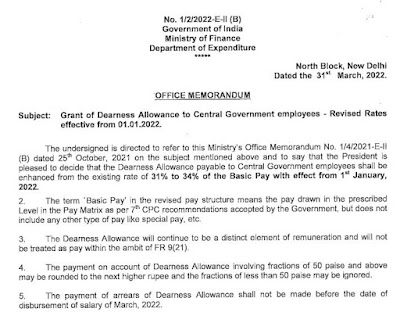
DA Jan 2022 - Grant of Dearness Allowance to Central Government employees - Revised Rates effective from 01.01.2022

 3% DA Hike - Revised Rates effective from 01.01.2022: DoE OM dated 31.03.2022 No. 1/2/2022-E-II (B) Government of India Ministry of Finance...