Monday, 16 June 2014

Government’s Travel Allowances for the MPs

Government’s Travel Allowances for the MPs
Recently, there were controversies regarding the travel allowances of Members of the Parliament. Let’s take a look at the actual travel allowance granted by the Central Government to the MPs:
Members of the Parliament are given concessions to travel to attend the Parliament sessions and to participate in the meetings. These to-and-from travel concessions are given from the usual place of residence of these members to the Parliament or to the place where the meeting is going to be held.
Via Train/Airplane: In case of train journey, charges for one First Class ticket and one Second Class ticket are given. The concession is given for whatever class the MP travels in.
For travel via air, 1.5 times the fare is given to the MP. For travel via road, the member is paid up to Rs. 13 per kilometre. If there is no direct air-route from the MP’s place of residence to the place where the Parliamentary session is being held, then the member is given the option to choose the travel mode that could get him/her to the destination within a day. The member’s spouse is entitled to accompany him/her once during the general session and twice during the budget meetings – adding up to not more than 8 times in a year – to New Delhi and back, via air/train or by road, from the place of residence.
Free Train Travel: Each MP and his/her spouse are given special identity cards that entitle them to travel free of cost, to any part of the country, by train, in First Class air-conditioned coach. His/her personal assistant is given identity cards that qualify them for free travel in Second Class air-conditioned railway coaches. These cards are valid for the entire tenure of the Member of Parliament.
8 trips via Air: Each year, the Member of Parliament is entitled, either with his/her spouse, assistants, or with relatives, to make 34 trips by airplane to any part of the country. The spouse or assistant can make 8 trips by air to meet the Member of Parliament. In case of physically challenged Members of Parliaments, the personal assistant is allowed to travel with him/her constantly. Members of Parliament are entitled to many such benefits and allowances.
Source: CGEN.in
[http://centralgovernmentemployeesnews.in/2014/06/governments-travel-allowances-for-the-mps/]

Government okays salary cap hike for EPF; threshold for savings raised from Rs 6,500 a month to Rs 15,000

Government okays salary cap hike for EPF; threshold for savings raised from Rs 6,500 a month to Rs 15,000

NEW DELHI: Employees earning upto Rs 15,000 a month will soon come under the Employees’ Provident Fund (EPF) net, with the Narendra Modi government approving a hike in the threshold for mandatory PF savings from Rs 6,500 a month to Rs 15,000.

Though the Manmohan Singh government had approved the hike in the EPF threshold this February after years of deliberations, the change couldn’t be notified before the election code of conduct kicked in.
Another UPA decision to assure a minimum monthly pension of Rs 1,000 for members of the employees’ pension scheme run by EPFO, in its final weeks in office, was also not notified before the polls.
Ministry officials had sought a fresh approval on the salary ceiling hike from the new minister for labour and employment Narendra Singh Tomar.

“The minister has approved the higher salary ceiling for mandatory EPF savings, and we will issue a notification soon for it to become effective,” said a senior government official aware of the development.

The ministry is also learnt to be examining if the minimum Rs 1,000 pension promise is sustainable.

The finance ministry, which had approved the pension promise with great reluctance and several conditionalities, had only provided funds to finance the bonanza for 2014-15.

At a board meeting in February, officials had warned that the pension assurance may have to be rolled back next year as there was no funding support beyond the first year. But their concerns were over-ruled by the previous labour minister Oscar Fernandes, who was the board’s chairman.

The Employees’ Provident Fund Organisation or EPFO oversees the retirement savings of over 8 crore members at present and the number could go up sharply as those earning between Rs 6,500 and Rs 15,000 will come under its fold once the new rules are notified and implemented.

The EPFO’s present ceiling for statutory contributions is a mere Rs 6,500 per month – lower than the minimum wage prescribed across the country.

Twenty-four percent of an employee’s salary (up to the ceiling) is mandatorily deducted and parked with the PF office.

Read more at: http://economictimes.indiatimes.com

Central Administrative Tribunal suspends promotion of 148 Income Tax inspectors

Central Administrative Tribunal suspends promotion of 148 Income Tax inspectors
TNN | Jun 13, 2014

HYDERABAD: The Hyderabad bench of the Central Administrative Tribunal (CAT) comprising B Venkateshwar Rao, (member judicial) and Minnie Mathew (member administration) on Thursday suspended the promotions given to 148 income tax inspectors by the IT chief commissioner of AP, Hyderabad.

The bench was dealing with a petition by office superintendents and senior tax assistants of the department challenging the action of the chief commissioner in superseding an earlier order of the Centre.

Dr K Lakshmi Narasimha, counsel for the petitioners, said as per the order of the Centre all the posts of office superintendents, senior tax assistants, and stenographers were merged in a single cadre called executive assistants and promotions had to be effected by taking staff from this new category. He alleged that the chief income tax commissioner ignored the rule and effected the promotions.

The bench noted that the petition was filed on June 2 and the IT authorities sought several adjournments and, during the pendency of the petition, the commissioner convened the Departmental Promotion Committee (DPC) meeting and gave promotions.

Source: The Times of India

Grant of Dearness Relief to CPF beneficiaries in receipt of ex-gratia payment w.e.f. 01.01.2014: Railway Board Order

Grant of Dearness Relief to CPF beneficiaries in receipt of ex-gratia payment w.e.f. 01.01.2014: Railway Board Order No. 60/2014 dated 30.05.2014:-

GOVERNMENT OF INDIA/भारत सरकार
MINISTRY OF RAILWAYS/रेल मंत्रालय
(Railway Board)/रेलवे बोर्ड
S.No PC-VI/341
No. PC-V/2009/ADR/1
RBE No. 60/2014
New Delhi, dated 30.05.2014
The Managers/CAO(R)
All Indian Railways
(As per standard mailing list)

Sub: Grant of Dearness Relief to CPF beneficiaries in receipt of ex-gratia payment w.e.f. 01.01.2014.

A copy of Office Memorandum No. 42/10/2014-P&PW(G) dated 07th May, 2014 of Ministry of Personnel, Public Grievances & Pensions (Department of Pension & Pensioners' Welfare) on the above subject is sent herewith for your information and necessary action.

2.   In pursuance of the enhanced rates of ex-gratia to the surviving SRPF(C) retirees issued vide Board's letter No. F(E)III/98/PN1/Ex-Gr/3 dated 15.11.2006 para 1(i) of DoP&PW's O.M. dated 07th May, 2014 may be read as under:-

"The surviving Group "A", "B", "C" and "D" SRPF (Contributory) beneficiaries who had retired form service during the period from 01-041957 to 31-12-1985 and have been sanctioned enhanced slab-wise ex-gratia @ Rs.3,000/-, Rs.1000/-, Rs.750/- and Rs.650/- per month respectively w.e.f. 01.11.2006, in lieu of uniform rate of Rs.600/- p.m. are entitled to Dearness Relief @ 200% w.e.f. 01.01.2014."

3. A concordance of various instructions and orders referred to in the enclosed office memorandum with reference to corresponding Railway instructions is indicated below:-

S.No.Para No. and Date of OMNo. and date of Deptt. of Pension & Pensioner's
welfare's O.M.
No. & date of Corresponding orders issued by Railway
Board
1.Para-1 of OM dt 07.05.2014OM No. 42/13/2012-P&PW (G) dated 17th Oct, 2013PC-V/2009/A/DR/1 dated 14.11.2013
2.Para-1 of OM dt. 07.05.2014OM No. 45/52/97-P&PW (E) dt. 16-12-97F(E)III/97/PNI/EX-Gr/3 dated 31-12-1997

4.  This issues with the concurrence of the Finance Directorate of the Ministry of Railways.

5.  Hindi version is enclosed.

DA: As above.
sd/-
(N.P. Singh)
Dy. Director, Pay Commission-V
Railway Board
Source: AIRF
[http://www.airfindia.com/Orders%202014/RBE%2060_2014.pdf]

Thursday, 12 June 2014

Transfer of sportsperson recruited against sports quota from one Railway/ Unit/ Division to another Railway/ Unit/ Division

Transfer of sportspersons recruited against sports quota from one Railway/ Unit/ Division to another Railway/ Unit/ Division: Railway Board Order RBE No. 58/2014

RBE No. 58/2014
Clarification/Corrigendum No. 48

GOVERNMENT OF INDIA (BHARAT SARKAR)
MINISTRY DF RAILWAYS (RAIL MANTRYALAY)
(RAILWAY BOARD)

No.2014/E(Sports)/4(1)/1/Policy Clarification
New Delhi dt. 29.05.2014
The General Managers(P)
All Zonal Railways including .......

    Sub:- Transfer of sportsperson recruited against sports quota from one Railway/ Unit/ Division to another Railway/ Unit/ Division

Ref: Railway Board's letters No. 2011/E(Sports)/4(3)/4(Transfer Policy) dated 17.02.2011 & 07.03.2012.

Please connect Board's Policy letters mentioned above on the subject matter.


2.  Ministry of Railways (Railway Board) have decided that non-active sports persons who are not involved in coaching or sports in any capacity and fulfilling the eligibility condition as mentioned in Para 2(i) of Board's letter No. 2011/E(Sports)/4(3)/4(Transfer Policy) dated 17.02.2011, their cases be considered as per policy instructions for own request transfer of other Railway employees.

(This disposes of NR's letter No. 939#/228/IRT/DLI/EIIIA dt. 23.05.2014)

sd/-
(Rakesh Rawat)
Dy. Director Estt. (Sports)
Source: AIRF
[http://www.airfindia.com/Orders%202014/RBE%2058_2014.pdf]
- See more at: http://centralgovernmentstaffnews.blogspot.in/2014/06/transfer-of-sports-persons-recruited.html#sthash.Kjmj2I8D.dpuf

Transfer of sportspersons recruited against sports quota from one Railway/ Unit/ Division to another Railway/ Unit/ Division: Railway Board Order RBE No. 58/2014

Transfer of sportspersons recruited against sports quota from one Railway/ Unit/ Division to another Railway/ Unit/ Division: Railway Board Order RBE No. 58/2014

RBE No. 58/2014
Clarification/Corrigendum No. 48

GOVERNMENT OF INDIA (BHARAT SARKAR)
MINISTRY DF RAILWAYS (RAIL MANTRYALAY)
(RAILWAY BOARD)

No.2014/E(Sports)/4(1)/1/Policy Clarification
New Delhi dt. 29.05.2014
The General Managers(P)
All Zonal Railways including .......

    Sub:- Transfer of sportspersons recruited against sports quota from one Railway/ Unit/ Division to another Railway/ Unit/ Division

Ref: Railway Board's letters No. 2011/E(Sports)/4(3)/4(Transfer Policy) dated 17.02.2011 & 07.03.2012.

Please connect Board's Policy letters mentioned above on the subject matter.


2.  Ministry of Railways (Railway Board) have decided that non-active sports persons who are not involved in coaching or sports in any capacity and fulfilling the eligibility condition as mentioned in Para 2(i) of Board's letter No. 2011/E(Sports)/4(3)/4(Transfer Policy) dated 17.02.2011, their cases be considered as per policy instructions for own request transfer of other Railway employees.

(This disposes of NR's letter No. 939#/228/IRT/DLI/EIIIA dt. 23.05.2014)

sd/-
(Rakesh Rawat)
Dy. Director Estt. (Sports)
Source: AIRF
[http://www.airfindia.com/Orders%202014/RBE%2058_2014.pdf]

A new website for National Council JCM Staff Side

A new website for National Council JCM Staff Side 
The National Council Joint Consultative Machinery was formulated in order to present the demands of the central government employees to the Government and successfully negotiate with them to ensure their implementation. 
Due to the efforts of the organization’s current Secretary, Mr. Siva Gopal Mishra, an exclusive official website for the employees of the National Council JCM Staff Side was launched. Although the website was launched last year, it has only now started gaining popularity among employees. 
Creation of such official websites greatly diminishes the possibilities of rumours. These websites enable the dissemination of information to millions of employees in a very short time. It is also possible now for the employees to give their feedback on the news articles and latest developments, and share them with the rest of the world.
There is no doubt that these initiatives of the National Council JCM, to keep its members updated on its various activities via the internet, would receive tremendous response from one and all. 

Union Finance Minister Holds Pre-Budget Consultation Meeting With the Representatives of Trade Union Groups

Union Finance Minister Holds Pre-Budget Consultation Meeting With the Representatives of Trade Union Groups
Press Information Bureau 
Government of India
Ministry of Finance 
06-June-2014 15:31 IST

Union Finance Minister Holds Pre-Budget Consultation Meeting With the Representatives of Trade Union Groups; Skill Development to be Given Priority for Generating Employment Oppurtunities.
The Union Finance Minister Shri Arun Jaitley said that skill development would be given priority so that more and more trained workers join the Indian economy. He said that the Government will give due consideration to the Ten Point Joint Charter of Demands given by the Central Trade Unions while formulating the budgetary proposals. The Finance Minister was speaking here today while interacting with the representatives of the Central Trade Unions as part of his Pre-Budget Consultation meetings.

Along with the Finance Minister, the meeting was attended by Ms. Nirmala Sitharaman, Minister of State for Finance and Corporate Affairs, Shri Ratan P. Watal, Expenditure Secretary, Shri Rajiv Takru, Revenue Secretary, Smt. Gauri Kumar, Secretary, Ministry of Labour and Employment and senior officers of the Ministry of Finance among others.
The participating Central Trade Unions gave a joint memorandum to the Finance Minister for his consideration and positive response. Some of the specific proposals contained there in are given below:
Take effective measures to arrest the spiraling price rise and to contain inflation; Ban speculative forward trading in commodities; universalize and strengthen the Public Distribution System(PDS); ensure proper check on hoarding; rationalize, with a view to reduce the burden on people, the tax/duty/cess on petroleum products.
Massive investment in the infrastructure in order to stimulate the economy for job creation. Public Sector should take the leading role in this regard. The plan and non-plan expenditure should be increased in the budget to stimulate jobs creation and guarantee consistent income to people.
Minimum wage linked to Consumer Price Index (CPI) must be guaranteed to all workers, taking into consideration the recommendations of the 15th Indian Labour Conference . It should not be less than Rs. 15,000/- p.m.
FDI should not be allowed in crucial sectors like defence production, telecommunications, railways, financial sector, retail trade, education, health and media.
The Public Sector Units (PSUs) played a crucial role during the year of severe contraction of private capital investment immediately following the outbreak of global financial crisis. PSUs should be strengthened and expanded. Disinvestment of shares of profit making public sector units should be stopped forthwith. 
Budgetary support should be given for revival of potentially viable sick CPSUs.
In view of huge job losses and mounting unemployment problem, the ban on recruitment in Government departments, PSUs and autonomous institutions (including recent Finance Ministry’s instruction to abolish those posts not filled for one year) should be lifted as recommended by 43rd Session of Indian Labour Conference. Condition of surrender of posts in government departments and PSUs should be scrapped and new posts be created keeping in view the new work and increased workload.
Proper allocation of funds be made for interim relief and 7th Pay Commission.
The scope of MGNREGA be extended to agriculture operations and employment for minimum period of 200 days with guaranteed statutory wage be provided, as unanimously recommended by 43rd Session of 
Indian Labour Conference.
The massive workforce engaged in ICDS, Mid Day Meal Scheme, Vidya volunteers, guest teachers, Siksha Mitra, the workers engaged in the Accredited Social Health Activities (ASHA) and other schemes be regularized. No to privatization of centrally funded schemes. Universalization of ICDS be done as per Supreme Court directions by making adequate budgetary allocations.
Steps be taken for removal of all restrictive provisions based on poverty line in respect of eligibility coverage of the schemes under the Unorganized Workers Social Security Act 2008 and allocation of adequate resources for the National Fund for Unorganised Workers to provide for social security to all unorganised workers including the contract/casual and migrant workers in line with the recommendations of the Parliamentary Standing Committee on Labour and also the 43rd Session of Indian Labour Conference. The word BPL redefined and redistributed at the earliest.
Remunerative prices should be ensured for agricultural produce and Government investment, public investment in agriculture sector must be substantially augmented as a proportion of GDP and total budgetary expenditure. It should also be ensured that benefits of the increase reach the small, marginal and medium cultivators only.
Budgetary provision should be made for providing essential services including housing, public transport, sanitation, water, schools, crèche, health care etc, to workers in the new emerging industrial areas. Working women’s Hostels should be set-up where there is a concentration of women workers.
Requisite budgetary support for addressing crisis in traditional sectors like jute, textiles, plantation, handloom, carpet and coir etc.
Budgetary provision for elementary education should be increased, particularly in the context of the implementation of the ‘Right to Education’ as this is the most effective tool to combat child labour.
The system of computation of Consumer Price Index (CPI) should be reviewed as the present index is causing heavy financial loss to the workers.
Income tax exemption ceiling for the salaried persons should be raised to Rs. 5.00 lakh per annum and fringe benefits like housing, medical and educational facilities and running allowances should be exempted from income tax net in totality.
Threshold limit of 20 employees in EPF Scheme be brought down to 10 as recommended by CBT-EPF. Pension benefits under the EPS unilaterally withdrawn by the Government should be restored. Government and employers contribution be increased to allow sustainability of Employees Pension Scheme and for provision of minimum pension of Rs. 3000/- p.m.
New Pension Scheme be withdrawn and newly recruited employees of Central And State Governments on or after 1.1.2004 be covered under Old Pension Scheme;
Demand for Dearness Allowance merger by Central Government and PSU employees be accepted and adequate allocation of fund for this be made in the budget.
All interests and social security of the domestic workers to be statutorily protected on the lines of ILO Convention on domestic workers.
The Cess management of the construction workers is the responsibility of the Finance Ministry under the Act and the several irregularities found in collection of cess be rectified as well as their proper utilization must be ensured.
In regard to resource mobilization, the Trade Unions have emphasized on the following:
A progressive taxation system should be put in place to ensure taxing the rich and the affluent sections who have the capacity to pay at a higher degree. The corporate service sector, traders, wholesale business, private hospitals and institutions etc should be brought under broader and higher tax net. Increase taxes on luxury goods and reduce indirect taxes on essential commodities.
Concrete steps must be taken to recover huge accumulated unpaid tax arrears which has already crossed more than Rs. 5.00 lakh crore on direct and corporate tax account alone, and has been increasing at a geometric proportion. Such huge tax evasion over and above the liberal tax concessions already given in the last two budgets should not be allowed to continue.
We welcome the constitution of SIT for black money and urge for speedy action.
Effective measures should be taken to unearth huge accumulation of black money in the economy including the huge unaccounted money in tax heavens abroad and within the country. Provisions be made to bring back the illicit flows from India which are at present more than twice the current external debt of US $ 230 billion. This money should be directed towards providing social security.
Concrete measures be expedited for recovering the NPAs of the banking system from the willfully defaulting corporate and business houses. By making provision in Banking Regulations Act, CMDs and executives to be made accountable for creation of NPAs.
Tax on long term capital gains to be introduced, so also higher taxes on the security transactions to be levied.
The rate of wealth tax, corporate tax, gift tax etc to be expanded and enhanced.
ITES, outsourcing sector, educational institutions and health services etc run on commercial basis should be brought under the Service Tax net.
Small saving instruments under postal and other agencies be encouraged by incentivizing commission agents of these scheme.
Other suggestions include holding of post budget consultations with the representatives of Central Trade Unions, need for directional change in policies such as stopping of mindless deregulation, encourage entrepreneurship to tackle problem of unemployment, more spending on education and skill development, removal of ceiling on gratuity, bonus and pension etc of workers and following the principle of “Same work, same wages” among others.
Representatives of different Central Trade Union groups who participated in today’s meeting included Shri B.N. Rai, Bhartiya Mazdoor Sangh (BMS), Shri Chandra Prakash Singh, Indian National Trade Union Congress (INTUC), Shri Shanta Kumar, INTUC, Ms Amarjeet Kaur, Indian National Trade Union Congress (INTUC), Shri D.L. Sachdeva, Indian National Trade Union Congress (INTUC), Shri Sharad Rao, Hind Mazdoor Sabha (HMS), Shri Harbhajan Singh Sidhu, Hind Mazdoor Sabha (HMS),  Shri Swadesh Devroye, Centre of Indian Trade Unions (CITU), Shri Tapan Sen, MP (RS), Centre of Indian Trade Unions (CITU), Shri Dilip Bhattacharya, All India United Trade Union Centre (AIUTUC), Shri Sankar Saha, All India United Trade Union Centre (AIUTUC), Shri Sheo Prasad Tiwari, Trade Union Coordination Centre (TUCC), Shri V.Suburaman, Labour Progressive Federation (LPF), Shri M. Shanmugum, LPF, Shri Prechandan, United Trade Union Congress (UTUC), Shri Abni Roy, United Trade Union Congress (UTUC) and Dr. Virat Jaiswal, National Front of Indian Trade Unions among others.
Source: PIB News

Tuesday, 10 June 2014

Raising of exemption limit for Income Tax and exemption of all allowances from Income Tax: NC JCM writes to Finance Minister

Raising of exemption limit for Income Tax and exemption of all allowances from Income Tax: NC JCM writes to Finance Minister

 Raising of exemption limit of Income Tax to Rs. 5 lakh for Individuals, Rs. 7 lakh for Senior Citizens above 60 years and Rs. 10 lakh for the very old and exemption of all allowances from Income Tax – Com. Shiva Gopal Mishra Secy/NC JCM writes to Finance Minister for including this demand into Union Budget

Shiva Gopal Mishra
Secretary
National Council (Staff Side)
Joint Consultative Machinery
for Central Government Employee
13-C, Ferozshah Road, New Delhi - 110001
No.Nc-JCM/2014/IT
Dated: June 9, 2014
Shri Arun Jaitley,
Hon’ble Minister of Finance,
Ministry of Finance,
North Block, New Delhi

Resp. Sir,

Sub: Raising of exemption limit for Income Tax and exemption of all allowances from Income Tax

Exemption limit from Income Tax is very low and neither realistic nor justified. It is not linked with Inflation nor is it appropriately revised every year.

Fixing of exemption limit for Income Tax is done arbitrarily. No systematic norms are followed while fixing the same. There is no transparency about the norms or policy adopted for fixing the Exemption limit for Income Tax.

Low ceiling of exemption is one of the root cause of build up of huge amounts of Black Money.

It is also a major impediment in the growth and development of the National economy as the spending by the common man gets restricted due to the low ceiling of Income Tax. This, according to experts, adversely affects the National Development as a whole.

Taxing of Dearness Allowance, House Rent Allowance and Transport Allowance etc., erodes the real income of the Salaried Class, as these Allowances are compensatory in nature and as such should be exempted from Income Tax, as recommended by the Fifth Central Pay Commission(vide Chapter 167 of their Report).

Taxing of Pension of Senior Citizens, especially Additional Pension of the very old Senior Citizens, is totally unjustified, and as such should be exempted from Income Tax, as recommended by the Fifth Central Pay Commission.

It is, therefore, requested that:-

(i) Exemption limit for Income Tax be raised to Rs. 5 lakh for Individuals, Rs. 7 lakh for Senior Citizens above 60 years and Rs. 10 lakh for the very old - above 80 years of age.

(ii) All the allowances, i.e. Dearness Allowance/Dearness Relief, HRA and Transport Allowance, may please be exempted from the Income Tax to avoid erosion of real wages as recommended by the Fifth Pay Commission vide Chapter 167 of their Report and Para 95 of Summary of Recommendations (Please see excerpts of Fifth CPC Report attached herewith as Annexure).

(iii) Fixed Medical Allowance to Pensioners may please be exempted from Income Tax as it is reimbursement of the expenses for day-to-day medical treatment.


Yours faithfully,
Sd/-
(Shiva Gopal Mishra)
Secretary(Staff Side)
NC/JCM
Encl: Excerpts of the recommendations of Fifth CPC

Copy to: All Constituent Organizations of the National Council, JCM(Staff Side) - for information.

ANNEXURE

EXCERPTS FROM THE REPORT OF FIFTH PAY COMMISSION REG. EXEMPTION OF ALL ALLOWANCES FROM INCOME TAX

The Fifth Pay Commission vide Chapter 167 & Para 95 of Summary of Recommendation had recommended as under:-

“Para 95 The Commission has felt that the salaries and pensions recommended by it are not really adequate if they are to be fully taxed. Accordingly, it has recommended that all Allowances and Pensions should be paid Net of Taxes”.

The Fifth CPC in Para 167.7 had observed as under:-

‘‘If such Allowances are taxed, then either the Basic Salary gets eroded in its real value from Year to Year or the partial Reimbursement of Expenditure incurred on certain items becomes less and less with the passage of time.  In both the cases, the objective of giving Allowances is partially nullified”.

The Fifth CPC further observed in Para 167.8 that -

“We have observed that Ministry of External Affairs pays ‘Net of Tax’ Salaries to its employees on Foreign Posting. Provision for paying Net of Tax Salary already exists Under Sec.195A of the Income Tax Act. Under the Section, employees do not have to pay Income Tax on the salaries received by them and it is the liability of the employer to pay the same to the Income Tax Department.”

“The solution to the problem of the Central Government Employees in general lies in the application of this legal provision” (Fifth CPC - Para 167.9).

Source: http://ncjcmstaffside.com/2014/raising-of-exemption-limit-of-income-tax-exemption-of-all-allowances-from-income-tax/

Revision of Medical Reimbursement Claim (MRC) Form for CGHS beneficiaries - reg.

New Medical Reimbursement Claim (MRC) Form for CGHS beneficiaries. The Medical Reimbursement Claim Form has been reviewed and further simplified. Separate forms have been developed for serving beneficiaries and pensioner beneficiaries with requirement of minimum information required for processing of the claims. CGHS Order:-

No.S. 11011/9/2012-CGHS (P)
Government of India
Ministry of Health & Family Welfare
CGHS (Policy)
Nirman Bhawan, New Delhi
Dated the 5th June, 2014
OFFICE MEMORANDUM
Sub:- Revision of Medical Reimbursement Claim (MRC) Form for CGHS beneficiaries - reg.
The undersigned is directed to state that it has been the constant endeavour of the Ministry of Health & Family Welfare to improve the facilities under CGHS and simplify / liberalize the procedures to make the Scheme user friendly.
2. In furtherance of the above objective, the Medical Reimbursement Claim Form has been reviewed and further simplified. Separate forms have been developed for serving beneficiaries and pensioner beneficiaries with requirement of minimum information required for processing of the claims. The CGHS beneficiaries are required to submit their medical reimbursement claims in the prescribed forms with requisite documentary evidences to their Department / office or CGHS, as the case may be for further processing and settlement as per approved CGHS rates and guidelines.
3. The following forms have been prescribed:

Form MRC(S) - For Serving CGHS beneficiaries,
Form MRC(P) - For Pensioner CGHS beneficiaries.

Specimen Forms are enclosed
Encl: As Above
sd/-
[V.P. Singh]
Director
Click on following images to save or view:-
medical+reimbursement+claim+form+for+employees+page1
Medical Reimbursement Claim Form for Serving Employees Page 1

medical+reimbursement+claim+form+for+employees+page2
Medical Reimbursement Claim Form for Serving Employees Page 2

medical+reimbursement+claim+form+for+pensioner+1
Medical Reimbursement Claim Form for Pensioner Page 1

medical+reimbursement+claim+form+for+pensioner+2
Medical Reimbursement Claim Form for Pensioner Page 2

medical+reimbursement+claim+form+annexure
Medical Reimbursement Claim Form Annexure-I

medical+reimbursement+claim+form+annexure-II
Medical Reimbursement Claim Form Annexure-II

Source: http://msotransparent.nic.in/writereaddata/cghsdata/mainlinkfile/File692.pdf

Flash News

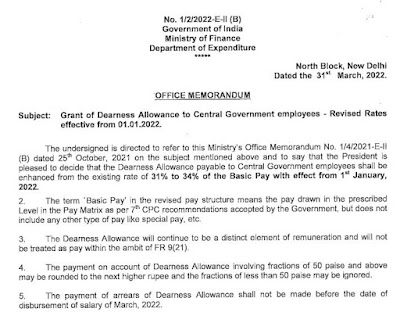
DA Jan 2022 - Grant of Dearness Allowance to Central Government employees - Revised Rates effective from 01.01.2022

 3% DA Hike - Revised Rates effective from 01.01.2022: DoE OM dated 31.03.2022 No. 1/2/2022-E-II (B) Government of India Ministry of Finance...