Tuesday, 27 May 2014

President appoints Cabinet Ministers, Ministers of State (Independent Charge) and Ministers of State

President appoints Cabinet Ministers, Ministers of State (Independent Charge) and Ministers of State


Press Information Bureau 
Government of India
President's Secretariat 

26-May-2014 22:20 IST

President appoints Cabinet Ministers, Ministers of State (Independent Charge) and Ministers of State

The President of India has appointed Shri Narendra Damodardas Modi as the Prime Minister of India. Further, as advised by the Prime Minister, the President has appointed the following as members of the Council of Ministers.
(Updated news...)
PRESS COMMUNIQUE

The President of India, as advised by the Prime Minister, has directed the allocation of portfolios among the following members of the Union Council of Ministers :-

1 Shri Narendra Modi 
Prime Minister
Personnel, Public Grievances and Pensions
Department of Atomic Energy
Department of Space
All important policy issues and all other portfolios not allocated to any Minister

CABINET MINISTERS

1 Shri Raj Nath Singh Home Affairs
2 Smt. Sushma Swaraj External Affairs
Overseas Indian Affairs
3 Shri Arun Jaitley Finance
Corporate Affairs  Defence
4 Shri M. Venkaiah Naidu Urban Development
Housing and Urban Poverty Alleviation
Parliamentary Affairs
5 Shri Nitin Jairam Gadkari Road Transport and
Highways Shipping
6 Shri D.V. Sadananda Gowda Railways
7 Sushri Uma Bharati Water Resources,
River Development and
Ganga Rejuvenation
8 Dr. Najma A. Heptulla Minority Affairs
9 Shri Gopinathrao Munde Rural Development
Panchayati Raj
Drinking Water and Sanitation
10 Shri Ramvilas Paswan Consumer Affairs,
Food and Public Distribution
11 Shri Kalraj Mishra Micro, Small and Medium Enterprises
12 Smt. Maneka Sanjay Gandhi Women and Child Development
13 Shri Ananthkumar Chemicals and Fertilizers
14 Shri Ravi Shankar Prasad Communications and Information Technology
Law and Justice
15 Shri Ashok Gajapathi Raju Pusapati Civil Aviation
16 Shri Anant Geete Heavy Industries and Public Enterprises
17 Smt. Harsimrat Kaur Badal Food Processing Industries
18 Shri Narendra Singh Tomar Mines
Steel
Labour and Employment
19 Shri Jual Oram Tribal Affairs
20 Shri Radha Mohan Singh Agriculture
21 Shri Thaawar Chand Gehlot Social Justice and Empowerment
22 Smt. Smriti Zubin Irani Human Resource Development
23 Dr. Harsh Vardhan Health and Family Welfare

MINISTERS OF STATE

1 General V.K. Singh Development of North Eastern Region (Independent Charge)
External Affairs
Overseas Indian Affairs
2 Shri Inderjit Singh Rao Planning (Independent Charge)
Statistics and Programme Implementation (Independent Charge)
Defence
3 Shri Santosh Kumar Gangwar Textiles (Independent Charge)
Parliamentary Affairs
Water Resources,
River Development and Ganga Rejuvenation
4 Shri Shripad Yesso Naik Culture (Independent Charge)
Tourism (Independent Charge)
5 Shri Dharmendra Pradhan Petroleum and Natural Gas (Independent Charge)
6 Shri Sarbananda Sonowal Skill Development,
Entrepreneurship,
Youth Affairs and Sports (Independent Charge)
7 Shri Prakash Javadekar Information and Broadcasting (Independent Charge) Environment,
Forest and Climate Change (Independent Charge)
Parliamentary Affairs
8 Shri Piyush Goyal Power (Independent  Charge)
Coal (Independent Charge)
New and Renewable Energy (Independent Charge)
9. Dr. Jitendra Singh Science and Technology (Independent Charge)
Earth Sciences (Independent Charge)
Prime Minister Office Personnel, Public Grievances & Pensions Department of Atomic Energy
Department of Space
10 Smt. Nirmala Sitharaman Commerce and Industry (Independent Charge)
Finance Corporate Affairs
11 Shri G.M. Siddeshwara Civil Aviation
13 Shri Nihalchand Chemicals and Fertilizers
14 Shri Upendra Kushwaha Rural Development Panchayati Raj Drinking Water and Sanitation
15 Shri Radhakrishnan P Heavy Industries and Public Enterprises
16 Shri Kiren Rijiju Home Affairs
17 Shri Krishan Pal Road Transport and Highways Shipping
18 Dr. Sanjeev Kumar Balyan Agriculture Food Processing Industries
19 Shri Mansukhbhai Dhanjibhai Vasava Tribal Affairs
20 Shri Raosaheb Dadarao Danve Consumer Affairs, Food and Public Distribution
21 Shri Vishnu Deo Sai Mines Steel Labour and Employment
22 Shri Sudarshan Bhagat Social Justice and Empowerment

Source: PIB News

Promotion from Group ‘B' to Group ‘A’, after CR

CBEC Cadre Restructuring: Chairperson's Note regarding promotion from Gp "B" to Gp "A" after CR


Chairperson's note dated 26.05.2014 regarding Promotion from Group 'B' to Group ' A' , after CR:-
GOVERNMENT OF INDIA
MINISTRY OF FINANCE/DEPARTMENT OF REVENUE
CENTRAL BOARD OF EXCISE & CUSTOMS
NORTH BLOCK,NEW DELHI-110001
J.M. Shanti Sundharam
Special Secretary & Chairman
D.O. No. F5/1/2014-CH(EC)
26th May, 2014
Dear Colleagues,
Sub: Promotion from Group ‘B' to Group ‘A’, after CR.

In my previous message dated 19.5.2014, at step No. VII, I had referred to the work relating to promotions of 2,118 officers from Group ‘B’ to Group ‘A’. The Board has since reviewed the work of Committee No. II, Sub-Committee No.1, which is looking after this task, along with the officers from the Ad.II Sections of the CBEC and DG, HRD.

2. After obtaining the tentative consideration zone and the All India seniority list of Superintendents/ Superintendents(P)/ Appraisers from the DG, HRD in December, the Sub-Committee No.1 has obtained around 5000 folders from the various CCAs. Individual folders for each of the eligible officers has been prepared containing the ACRs/APARs for the preceding 5 years. Work is in progress for ensuring that CR/APAR folder is up-to-date which would include availability of vigilance status, integrity certificates, penalty statements (where necessary) availability of part period ACR/APAR, if any, in a particular financial year, completion of action in respect of ‘Below Bench Mark’ cases, No Report/No Review certificates, additional ACRs/APARs in he last mentioned types of cases, etc. Check List has been maintained in respect of each folder. Review of the work revealed that there are 256 dossiers from eight CCAs which are yet to be sent:-

Sl. No.Cadre Controlling Zone/CommissionerateNo. of Dossiers
1.Kolkata Central Excise96
2.Delhi Central Excise54
3.Allahabad Central Excise52
4.Mumbai-I Central Excise37
5.Chandigarh Central Excise12
6.Vadodara Central Excise5
7/8.Bhopal & Indore Central Excise4

3. Though Member (P&N) has been contacting the above mentioned CCAs, it would be appreciated if the Group ‘B’ Gazetted Officers Associations if these zones take up the matter of ensuring that the missing dossiers are forwarded to the Committee without delay. The Sub-Committee has moved forward with the action for completion of the dossiers and same is expected to be completed shortly. However, it is reiterate that unless the pending dossiers are also received and the same rigorous scrutiny done, we would not be in a position to  move the UPSC for obtaining a date for DPC. All CCAs are, therefore, requested ti bestow personal attention in the matter and‘ the Associations re also requested to coordinate with the administration
in this regard

4. At the level of Ad.II Section in CBEC, necessary action is being taken for de ling with all representations received from individuals as also from Associations. The Ad.II Section will also be providing to the DG, HRD the number of carry forward / backlog vacancies which require to be filled so that the same can be included in the DPC proposal. he Ad.II will send the vetted list of the zone of consideration to the Sub-Committee to enable them to properly identify the dossiers required for the DPC. Once the dossiers are completed and forwarded by the Sub-Committee, the same will have to be completely vetted again before being certified by the appropriate authority in Ad.II and submission to the UPSC through the single window.

5. . I would again emphasise that existence of complete and correct dossiers is necessary before the proposal for DPC can be sent to UPSC. Therefore, I could request all CCAs and Associations to ensure that the action, a required at the zonal level, is expedited. It is evident that delay b even one zone would put in jeopardy the legitimate aspirations rid expectations of the officers of remaining zones. Therefore, I look forward to a coordinated and quick response from you.
Best wishes,
Yours
(J.M. Shanti Sundharam)

Source: http://www.cbec.gov.in/deptt_offcr/cadre-restruct/chairprsn-note-26may2014.pdf

Sunday, 25 May 2014

Railway Board Order: List of various allowance enhanced 25% from 01.01.2014

Railway Board Order: List of various allowance enhanced 25% from 01.01.2014

Railway Board Order for Enhancement in the rate of various allowances again by 25% as a result of enhancement of Dearness Allowance w.e.f. 01.01.2014 & List of Allowance enhanced:-

GOVERNMENT OF INDIA
MINISTRY OF RAILWAYS
(RAILWAY BOARD)
RBE No. 50/2014
No. E(PA)I-2014/SP-1/GenL. 2
New Delhi, dated 19.05.2014.
The General Managers/FA & CAOs,
All Indian Railways/Production Units.

Sub: Enhancement in the rate of various allowances again by 25% as a result of enhancement of Dearness Allowance w.e.f. 01.01.2014

In accordance with The recommendations of VI CPC, the rates of various allowances admissible to different categories of railway staff were doubled.  The VI CPC while making recommendations in this regard had also recommended that the rates of these Allowances will be increased by 25% every time the Dearness Allowance goes up by 50%. Railway Board accordingly issued instructions in respect of various allowances listed in the enclosed Annexure.

2. Consequent upon the enhancement in the rate of Dearness Allowance to 51% from 01.01.2011 it was reiterated vide Board’s letter No. No. E(P&A)I-2011/SP-1/Misc.1 dated 13.06.2011 that the rates of allowances shall increase by 25%.

3. Therate of Dearness Allowance has now been enhanced to 100% w.e.f 01.01.2014.  In order to dispel any doubts that may arise in the Railways, it is clarified that the rates of allowance listed in the enclosed Annexure shall again increase by 25% (on original VI CPC rates prescribed by Ministry of Railways) with Dearness Allowance now again having gone up ;by 50% w.e.f. 01.01.2014

4. This issues with the concurrence of the Finance Directorate of the Ministry of Railways.

5. There is no change in the other terms and conditions for grant of these allowances.

6. Kindly acknowledge receipt.
sd/-
(K. Shankar),
Direfior Estt.(P&A)
Railway Bayard.
ANNEXURE
LIST OF THE VARIOUS ALLOWANCE5 THAT STAND REVISED W.E.F. 02.01.2014 ON ACCOUNT OF ENHANCEMENT IN THE RATE or DA To 100%
S.No. Name of Allowance
  1.     National Holiday Allowance
  2.     Special Allowance to Gate Keepers of Civil Engineering Level Crossings
  3.     Night Patrolling Allowance
  4.     Uniform Allowance, Nursing Allowance & Washing Allowance for Nursing Staff
  5.     Uniform Allowance, Kit Maintenance Allowance & Washing Allowance (RPF/SRPF Group “A”)
  6.     Special Allowance to various categories of staff:- (i) Health & Malaria Inspectors (ii) Commercial Staff in-charge of Flag Stations (iii) Teachers doing Library work (iv) Announcers – ECRCs/Comml. Clerks/TCs (v) Train Supdts/Dy. Trains Supdts. of Rajdhani Train (vi) Stewards (Dy. Train Supdt.) of Rajdhani Trains (vii) CTIs/TTEs working in HQ Flying Squad (viii) Cook/Cook mate (ix) Sr. Scale, JA Grades & SA Grade Officers entrust with the Administrative control of Hindi works
  7.     Post Graduate and Annual Allowance to Medical Officers
  8.     Breakdown Allowance to (a) Helper Gr.II/Helper Gr.I/Other Gr.’D’ Staff (b) Technician Gr.III (c) Technicians Gr.II/Technicians Gr. I/Supervisors (erstwhile Mistry) (d) Sr. Technicians/Junior Engineers and staff in higher scales
  9.     Risk Allowance to eligible unskilled staff on railways
  10.     Special Allowance to staff working in Central Ticket Checking Squad
  11.     Special Allowance to Track Maintainer deployed for manning any of the Engineering Gates
Source: AIRF
http://www.airfindia.com/Orders%202014/Enhancement%20of%20Allowances%20RBE%2050_2014.pdf

Early Closure of Offices in connection with the Swearing in Ceremony of the newly elected Prime Minister of India on 26.05.2014

Early Closure of Offices in connection with the Swearing in Ceremony of the newly elected Prime Minister of India on 26.05.2014
 No.12/15/2014-JCA 2
Government of India
Ministry of Personnel Public Grievances and Pensions
(Department of Personnel and Training)
North Block, New Delhi
Dated the 23rd May, 2014
OFFICE MEMORANDUM

Sub: Early Closure of Offices in connection with the Swearing in Ceremony of the newly elected Prime Minister of India on 26.05.2014

In connection with arrangements for the Swearing in Ceremony of the newly elected Prime Minister of India on 26.05.2014, it has been decided that the Government offices located in the North Block, South Block and Hutments would be closed early at 13:00 hrs. on 26th May, 2014 (Monday).
2. Hindi version will follow.
sd/-
(Ashok Kumar)
Deputy Secretary (JCA)

Source: www.persmin.gov.in
[http://ccis.nic.in/WriteReadData/CircularPortal/D2/D02est/12_15_2014_JCA-2.pdf]

Friday, 23 May 2014

When will the 7th CPC submit its recommendations? When will the recommendations of 7th CPC be implemented?

When will the 7th CPC submit its recommendations? When will the recommendations of 7th CPC be implemented?

These questions are now constantly on the minds of Central Government employees!

Although highly placed sources say that the commission will compile its reports and recommendations in 18 months and that these recommendations will be implemented on 01.01.2016, there are also many who wonder aloud because there are no official confirmations yet.

This is not an exaggeration. The proof lies in the fact that two months ago, the question was raised in the Parliament. While the Terms of Reference make it clear that the Panel Committee has given 18 months time for the 7th CPC to submit its recommendations, a question was raised on when the report would be submitted. The concerned minister’s reply was vague. In other words, there was no concrete announcement.
Let us hope that the Commission submits its reports and recommendations on time.

7th Pay Commission is seeking the considered views of all stakeholders

7th Pay Commission is seeking for suggestions on various issues

The 7th Pay Commission compiled a list of questions and sent it along with a circular to all the Ministries/Departments of Indian Government, inviting their suggestions. It has come to our knowledge that the circular was also sent to all the Central Government employee federations. This could be treated as a irrefutable proof of the fact that the 7th Pay Commission has already started its work! 

Although this is part of the usual procedure, it is a well known fact that Central Government employees treat certain questions as an indication of the mindset of the 7th Pay Commission. 

Let’s see the questions…

What kind of impact did the 6th Pay Commission’s reforms on the Pay Scale structure have, when they were implemented? Do you think such changes were required? The Pay Commission has included questions about the results and procedures of reducing Pay Scale and Pay Bands. 

Has Grade Pay Concept been effective? If no, the Commission wants to know what could be done to get the desired results. 

The questions regarding increments have triggered curiosity and interest. Has the purpose behind making July 1 the date of implementing the annual increment, served its purpose? Or, are there any changes required in it?
With annual increment fixed at 3%, what, according to you, would be a reasonable and acceptable level?

What are the pros and cons of the MACP Scheme?
House Rent Allowance is currently being given according to three categories, based on the population of the city. What criteria should be taken into account for the calculation of House Rent Allowance? This particular question assumes great significance.

Questions have been raised about the ratio of the salary of the lowest level employee and the top management. While debates on this issue have been on for a while now, it is worth pointing out that the question has also appeared on the 7th Pay Commission’s list. 

The list also has questions and a number of sub-questions about raising Government salaries to match the payments given in private sectors. 

Questions have been asked about the possibility of incorporating attributes like talent and performance in job evaluation.  

The sub-list also has questions regarding bonus, variable increments, performance-based schemes, State Government employees’ pay scales, and pensions. 

One thing is for sure – the circular and its questions have become the hottest topic of discussion and countless debates among government employees right now. 

Source: www.90paisa.blogspot.in
[http://90paisa.blogspot.in/2014/04/7th-pay-commission-is-seeking-for.html]

7th CPC Report – When is it going to be submitted?

7th CPC Report – When is it going to be submitted

7th Pay Commission Report and the Need for Timeliness 

Background of the 7th Pay Commission

The 7th pay commission report – when is it going to be submitted?
 
The announcement about the 7th pay commission report came out on September the 25th of 2013. This pay commission unlike the 6th pay commission was set up well in advance. This became possible due to significant efforts of various organisations, union lists and the finance commission report. Announcements say that the 7th pay commission will be implemented from 1.1.2016 and it will take approximately 18 months time for the report to be submitted. 

Recently, the 7th pay commission Chairman and the members gave out a public statement on 4.2.2014 and after that on 22.2.2014 the important 7th cpc terms and references were released. Now, the thought that floats on everyone’s mind is whether the 7th pay commission report will be submitted within the 18 months time period and will the employees be able to get the benefits along with their salary from 1.1.2016.
Recently, in the Lok Shaba during the question and answer session, it was pointed out that no specific time limit can be specified as of now for the implementation of the 7th pay commission. However, the finance ministry is now recruiting people for the 7th pay commission pay cell on deputation basis. This is a good attempt which boosts our confidence in the fact that the 7th pay commission will be put into effect on time. 


Reports of the Earlier Pay Commissions

If the employees get the benefits of the 7th pay commission along with our salary on 1.1.2016, then, this will be the first time we are given the pay commission benefits without arrears. I am providing a link containing reports about when the previous pay commissions were set and when they were implemented.

Pay Commission Date of Appointment Date of submission of report Financial impact (Rs. In crores) Time
First Pay Commission May, 1946 May, 1947 N.A 1 YEAR
Second Pay Commission August, 1957 August, 1959 39.62 2 YEARS
Third Pay Commission April, 1970 March, 1973 144.60 3 YEARS (aprx)
Fourth Pay Commission June, 1983 3 reports submitted in June, 1986; Dec. 1986 and May, 1987 1282 4 YEARS(aprx)
Fifth Pay Commission April, 1994 January, 1997 17,000 3YEARS (aprx)
Sixth pay commission July 2006 March 2008 18 months

Arrears of the 6th Pay Commission :- When you see the timetable above, you can understand that none of the previous pay commissions were implemented on time and without the payment of arrears. When the 6th pay commission was implemented, the government paid a huge amount as arrears in two instalments. This impacted the economy considerably and caused changes in inflation rate and GDP. This shocking fact was revealed by the 13th finance committee report. 

The Benefits of the Timely Implementation of the 7th Pay Commission :- What benefits will the employees get if the 7th pay commission is implemented on 1.1.2016? Let us have a look. 

Firstly, all the allowances and benefits can be got on 1.1.2016. When the benefits are paid as arrears the employees will not get some of the allowances due to exclusion. 

Secondly, the government will not have to pay a huge amount as arrears and thereby can avoid economic burden. 

Thirdly, if a National Anomaly Committee is set up and the shortcomings of the 7th pay commission are corrected immediately, employees can receive the benefits easily. We have to note that several points mentioned the anomaly committee report of the 6th pay commission still remain problematic and uncorrected. 

Fourthly, let us have a look at the elements of ACP and MACP. Like the ACP and MACP, the financial up gradation is going to be introduced in the 7th Pay Commission; the issues that may arise due to this have to be resolved in a timely manner so that everyone may be benefitted by it.   In the 5th pay commission, the time limit for promotion through ACP remained at 12 years, and in the 6th pay commission the time limit for promotions through MACP remained at 10 years. In the 5th pay commission, a new method of promotion through hierarchy was introduced. In the 6th pay commission promotions happened through grade pay structure. 

The main aim of introducing ACP and MACP is to make sure that an employee gets minimal promotion at least thrice in his life time of service. If this is the case, the minimal service period of an employee should be at least 30 years. But presently, employees are appointed even at the age of 37 and so their service period is just 23 years. Such problems have to be carefully considered well in advance and solved before the 7th pay commission is implemented. 

Let us believe that the 7th pay commission will be the first arrears-free pay commission and implemented on time as per the guidelines of the 13th finance commission.
 

Will the 7th CPC fulfil the demands of LDCs and UDCs?

Will the 7th CPC fulfil the demands of LDCs and UDCs?
 
For a number of years now, especially after the 6th CPC, the problems faced by LDCs and UDCs have started gaining prominence. The unity and sense of purpose among them makes them look all set for the kind of victory that Pharmacists had. Common sense of purpose, unity and dedication sure make success possible!
 
In order to decrease the number of grades, the 6th Pay Commission combined all the different grades between Grade Pay 1300 to Grade Pay 1800 into a single grade – Grade Pay 1800, thereby wiping out the entire Group ‘D’. As a result, everybody became Group ‘C’ employees. Even those who lacked the minimum education levels, illiterates and everybody else were lumped into Group ‘C’. Their Grade Pay was also raised to Rs. 1800. But, at the same time, employees working as LDCs, who have a minimum educational qualification of Class XII and also possess some technical education, were not given any upgrading. Instead, they now had to share their grade with lesser-qualified former Grade ‘D’ employees.

The next huge trouble originated from the MACP. Those who didn’t get any promotion for years are given career upgradations through MACP. LDCs who didn’t get any promotions for more than 10 years were given their next grade pay, from Rs. 1900, their pay rose to Rs. 2000. The increase of mere Rs. 100 turned out to be a huge disappointment to many. Similarly, those with Grade Pay 2400 were hoping for a jump to Grade Pay 4200, but were instead forced to upgrade with only Grade Pay 2800 as per MACP rules. That anger kept seething too, because the different is 1400.
 
The most important demand of the LDCs and UDCs is to upgrade the current Pay Scale-Grade Pay.
 
Grades are decided based on the educational qualification of the employees. An LDC possesses a minimum educational qualification of Class XII and also has some technical qualifications. The basic salary of an LDC is just Rs. 1900 + 5830 = Rs. 7730.00. They want it revised to Rs. 2400 + 7510 = Rs. 9910.
 
The big question is – will the 7th CPC grant this demand?
 
[http://90paisa.blogspot.in/2014/05/will-7th-cpc-fulfil-demands-of-ldcs-and.html]

Why is Annual Increment denied to employees retiring in June?

Why is Annual Increment denied to employees retiring in June?

Until 01.01.2006, the date of implementing employee’s annual increment was fixed on the basis of his/her date of appointment or promotion option. After the 6th CPC, it was decided that 1st July of each year would be the uniform date of implementation of annual increment for all Central Government employees.

Employees who are appointed after January 1st are not eligible for that year’s annual increment on July 1. They qualify for annual increment only the next year.

The revised pay rules said that “If an employee is on leave or is availing joining time on the 1st of July, the benefit of annual increment in pay will be drawn only from the date on which he resumes duty and not from the first of July. Each year, employees who retire in the month of June are not given the annual increment of the year since they do not report to work on 1st July. Only those employees who resume duty on July 1st are eligible to receive the annual increment. Or, the day they report back to work is taken as the date for implementing the annual increment. Since there are no possibilities for the retired employees to return to work, they are not considered as qualified to receive the annual increment.

The revised pay rules states that only those who have been receiving the same basic pay continuously for 6 months are considered as qualified for annual increment. According to the another rule of qualification for increment, the person should have complete one year in service after receiving the annual increment. Therefore, despite being qualified, these employees are denied their annual increment.

There is an order that states that those who retire on July 1st should complete the retirement formalities in the month of June.

Instead of strictly looking into such technicalities, it would be a nice gesture on the part of the Government to extend the benefits of annual increment to those senior employees too who retire from service in the month of June.

Source: 90paisa.blogspot.in
[http://90paisa.blogspot.in/2014/05/why-is-annual-increment-denied-to.html]

Thursday, 22 May 2014

Expected DA-Status, as of March 2014

Expected Dearness Allowance from July 2014 for Central Govt Employees and Pensioners...


Expected DA- Status, as of March 2014
Expected Dearness Allowance from July 2014 : This time there is a considerable slackening in the pace of the expected DA. It looks as if there are plenty of reasons for it.

As of March, the AICPIN has increased by one point and is at 239. The rapid increase in Consumer Price Index (IW) has been brought under control now. Election is believed to be one of the reasons for it. Since price rise and inflation are under control, there is not much of an increase in All India Consumer Price Index for Industrial Workers. With a fall in the prices of essential commodities, the AICPIN points have actually reduced.

Another reason is the reduction of AICPIN by 4 points in December 2013. The Consumer Price Index, which was steadily rising till then, slumped by 4 points. It wasn’t much of a shock then because the Additional DA for the month of January 2014 increased by 10% and had touched 100%.
The All India Consumer Price Index for Industrial Workers Base Year 2001=100, which was at 243, fell by 4 points to end up at 239. It again fell by 2 points to touch 237, thus dampening the expectations surrounding the next additional Dearness Allowance announcements. It looks highly unlikely that the AICPIN would rise by 4 points to return to its previous levels.


We are of the opinion that there will not be much of a change in what we had said last time(Expected da from Jul 14 - Feb).

The table given below will easily explain you why…
Month/
Year
AICPIN
(IW) Base Year 2001=100
Increased/
Decreased Points
in AICPIN
Total Points Increased Total of 12 Months 12 Months Average % Increase over 115.763 Approximate DA Total DA % DA%
Increase Month wise
Jan-1322122535211.2595.4982.49822
Feb-1322322559213.2597.4984.22844
Mar-1322412582215.1799.4185.87855
Apr-1322622603216.92101.1687.38877
May-1322822625218.75102.9988.97888
Jun-132313122648220.67104.9190.629010
Jul-1323542671222.58106.8292.28922
Aug-1323722694224.5108.7493.93933
Sep-1323812717226.42110.6695.59955
Oct-1324132741228.42112.6697.32977
Nov-1324322766230.5114.7499.12999
Dec-13239-482786232.17116.41100.5610010
Jan-14237-22802233.5117.74101.711011
Feb-1423812817234.75118.99102.791022
Mar-14239102832236120.24103.861033
Apr-14
May-14
Jun-14

‘Expected DA from July 2014’ completed its third step..!

[http://90paisa.blogspot.in/2014/05/expected-da-status-as-of-march-2014.html]

Flash News

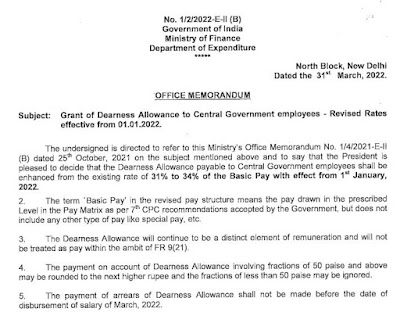
DA Jan 2022 - Grant of Dearness Allowance to Central Government employees - Revised Rates effective from 01.01.2022

 3% DA Hike - Revised Rates effective from 01.01.2022: DoE OM dated 31.03.2022 No. 1/2/2022-E-II (B) Government of India Ministry of Finance...