Sunday, 12 March 2017

Merger of Dearness Allowance equal to 50% of basic pay w.e.f. 01/04/2004 - Reckoning as pay for running staff

Merger of Dearness Allowance equal to 50% of basic pay w.e.f. 01/04/2004 - Reckoning as pay for running staff

GOVERNMENT OF INDIA
MINISTRY OF RAILWAYS
RAILWAY BOARD
No. EP&A)-II/2006/RS-28.
New Delhi, dated 22.11.2016.
The General Secretary,
National Federation of Indian Railwaymen,
3, Chelmsford Road,
New Delhi - 110 055.

Sub.:- Merger of Dearness Allowance equal to 50% of basic pay w.e.f. 01/04/2004 -Reckoning as pay for running staff.
Ref.: (i) DC/JCM Item No. 15/2009.GS/NFIR's letter No. IV/RSAC/Conl/Vol.VI dated 28/03/2016

Please refer to your letter dated 28.03.2016 under reference no. (ii) on the subject noted above. Iii this connection, it is mentioned that Board’s letter dated 21.10.2014 addressed to both the Federations highlighted that the basis for the exclusions was the Ministry of Finance's OM dated 01.03.2004 on the merger of 50% DA with Basic Pay that was adopted by the Ministry of Railways. Vide letter dt.
28.03.2016, however, NFIR. has not agreed with the reply and has reiterated that the exclusions violate the IREM provision of. Running Allowance and that the OM dt. 01.03.2004 of MoF is not relevant in this connection.

For a better understanding of the logic on which the three exclusions have been made the table given below may kindly be seen:-
Clause No.Benefit of 30% pay element (mentioned in the clause)applicable to Running StaffRelevant wording in MoF O.M. dated 01.03.2004 pertaining to the benefitRemarks
aEntitlement for pass/ PTOLTC Specifically excluded from revision of entitlement on merger of 50% DA with Basic PayAs Railways do not have LTC. Pass /PTO revision excluded accordingly vide RBE No.77/2008
dFixation in pay in Stationary PostsFixation of pay not included as an admisssble benefit for revision of entitlement on merger of 50% DA with Basic PayCounting of the benefit (of merger of DA with Basic) for Fixation of pay is an issue pertaining to all Government employees and not merely Running Staff of Railways. When this benefit has not been extended to any Government employee, it cannot be extended to Running Staff consolation. RBE No.77/2008 has been issued accordingly. As erest while Basic Pay element (without merger of 50% DA) however continued to be admissible for Fixation of pay of Running Staff in Stationary posts, there is no violation of relevant REM provision.
gEntitlement of QuartersGovernment accomadation specifically excluded from revision of entitlement on merger of 50% DA with Basic PayAs Railway Quarters are Government accomadation, revision of entitlement has been excluded accordingly vide RBE No.77/2008

As brought out in the table above there has been no violation of the Rules.It is therefore requested that the item may be closed.
For Secretary Railway Board

Click here to View the Full Order

PFRDA: Let government staffs pension funds to invest 50% in equities


PFRDA: Let government staffs pension funds to invest 50% in equities

Hyderabad: The pensions fund regulator Pfrda wants government to more than treble investment levels in equity markets by government subscribers under the National Pension System (NPS) up to 50 per cent from 15 per cent now.

The regulator has sent a proposal to government seeking to allow government subscribers (state and Central government employees) invest up to 50 per cent in equities under the NPS, Pension Fund Regulatory and Development Authority chairman Hemanth Contractor said here today.

The authority manages about Rs 1.70 trillion of funds belonging to 1.5 crore subscribers who come from government and non-government sectors. Of this 85 per cent are government subscribers which are managed by seven fund managers.

We have taken up very strongly with the government that government subscribers should be given the same choices as are available to the non-government subscribers who can invest up to 50 per cent in equity markets.

"So, what we are telling the government is that you give the same choices. Since government subscribers account for bulk of the fund this will mean a big change. Lot of money can start flowing in to equities," Contractor said.

The government is quite sympathetic to our view, he said, adding they had several rounds of discussions and he expects this to happen in the next couple of months.

"We are quite optimistic about this. It should happen," he added.

According to him, the non-government sector accounts for 15 per cent of the overall corpus.

Replying to a query, he said he has written to government seeking clarity on the regulation of some pension products offered by mutual funds and insurance companies as they are currently regulated by another regulator Irdai.

"Since we became a statutory body in 2013, we are the designated regulator of the pensions industry. So we’ve told government that all the other pension schemes floated by MFs, insurance companies should actually be regulated by us. The government is looking into our demand and has in fact set up a committee to look into the issues," Contractor said.

On the growth of the sector, he said the NPS recorded a growth of 35 per cent in the number of subscribers last year and a little over 40 per cent in the fund that it manages and this year also the growth would be on similar lines.

Contractor also said they have suggested to the government to raise the age-limit for subscribers of Atal Pension Yojana to 50 from 40 now and increase the pension slab from the present Rs 5,000 to Rs 10,000 a month.

Meanwhile, Karvy Compushare was appointed as the second central record-keeping agency (CRA) for serving subscribers of NPS by the Pfrda.

PTI

6-month limit to complete graft enquiries against babus


6-month limit to complete graft enquiries against babus

New Delhi: The government has decided to fix six-month deadline for completion of corruption enquiries against IAS and IPS officers among others.

The Department of Personnel and Training (DoPT) has finalised draft rules to put a time limit for each stage of the enquiries to ensure expeditious disposal of corruption cases.

"The Inquiring Authority should conclude the inquiry and submit his report within a period of six months," the draft rules said.

However, this period can be extended for a further period of six months after recording reasons of the Inquiring Authority in this regard, it said.

At present, there are no rules that define time limit for conducting corruption enquiries.

As per the government proposal, officers will get copy of articles of charges from the disciplinary authority and they should give their response mandatorily within 15 days.

In cases, where a disciplinary authority decides to consult Union Public Service Commission (UPSC) in the matter involving a delinquent officer, its advice need to be shared with such charged employee.
The UPSC conducts civil service examination to select officers for various services including Indian Administrative Service (IAS) and Indian Police Service (IPS) and it is consulted by authorities concerned before acting against a civil servant.

The government servant will be given 15 days to submit his representation on receipt of such advice from the Commission.

All ministries have been asked to share their comments on the proposed changes in the rules, which if comes into force will be applicable to IAS, IFS and IPS officers and those belonging to other civil services.

PTI

Maternity Benefit (Amendment) Bill, 2016 passed in the Parliament


Maternity Benefit (Amendment) Bill, 2016 passed in the Parliament

The Bill seeks to increase maternity leave available to working women from the current 12 weeks to 26 weeks for the first two children

The Lok Sabha has passed the Maternity Benefit (Amendment) Bill, 2016 today. The Bill had already been passed by the Rajya Sabha during the Winter Session. With this, the Bill stands passed in the Parliament.
The Bill seeks to amend the Maternity Benefit Act, 1961 to provide for the following:-
(i) Maternity leave available to the working women to be increased from 12 weeks to 26 weeks for the first two children.
(ii) Maternity leave for children beyond the first two will continue to be 12 weeks.
(iii) Maternity leave of 12 weeks to be available to mothers adopting a child below the age of three months as well as to the "commissioning mothers". The commissioning mother has been defined as biological mother who uses her egg to create an embryo planted in any other woman.
(iv) Every establishment with more than 50 employees to provide for creche facilities for working mothers and such mothers will be permitted to make four visits during working hours to look after and feed the child in the creche.
(v) The employer may permit a woman to work from home if it is possible to do so.
(vi) Every establishment will be required to make these benefits available to the women from the time of her appointment.
The Minister of Women and Child Development, Smt. Maneka Gandhi thanked the Minister for Labour and Employment, Shri Bandaru Dattatreya for taking up the demand of lakhs of women across the country and for having steered the Bill through Rajya Sabha as well as the Lok Sabha. In her message to the working women, Smt. Gandhi congratulated the women who are planning to have a child and has stated that the Ministry of Women and Child Development will continue to work for the empowerment of women.

The amendments in the Bill were taken up following the request by the WCD Minister to the Hon'ble Labour Minister to bring about these changes so that a working woman gets time to exclusively breast-feed her child for 6 months after the birth. This period also enables the working mother to recuperate herself before she goes to back to work. In her communication to the Labour Ministry, the WCD Minister had also highlighted the concerns of commissioning and adopting mothers who also require maternity leave.

PIB

GST Bill likely to be tabled before Cabinet on March 22


GST Bill likely to be tabled before Cabinet on March 22

New Delhi: Maintaining the tempo for the much-awaited Goods and Services Tax (GST) against the backdrop of the crucial Uttar Pradesh Assembly elections, sources in the Finance Ministry on Wednesday said the bill will be presented before the Cabinet on March 22.

The government, which is leaving no stone unturned to lose its sight on the biggest tax reform, has said that the Central GST Law, Integrated GST Law, State GST Law and Union Territory GST and Compensation Law will be put together for the Cabinet’s approval on March 22.

However, the Finance Ministry has said that it will table the CGST, IGST and Compensation Law before the Parliament on March 27.

The Finance Minister sources have also cleared the air on SGST and UTGST, which will be cleared in the GST Council meet scheduled on March 16.

Also, it is likely that few more cesses will be added in the kitty to boost resources to compensate states. It will include Infra cess, Oil industry Development cess, and Swachh Bharat cess amongst others.

Earlier, the GST Council chaired by Finance Minister Arun Jaitley approved the draft CGST Bill and the draft I GST Bill as vetted by the Union Law Ministry. It cleared the deck for the Central Government to take these two Bills to the Parliament for their passage in the ongoing Budget Session.

ANI

Anti-labour steps of the Railway Board (Ministry of Railways)


Anti-labour steps of the Railway Board (Ministry of Railways)

No.AIRF/24(C)
Dated: March 7, 2017
The General Secretaries,
All Affiliated Unions

Dear Comrades!
Sub: Anti-labour steps of the Railway Board (Ministry of Railways)

In the DC/JCM Meeting, held today with the Railway Board, AIRF strongly lodged its protest against anti-labour steps of the Railway Board(Ministry of Railways) in general and encroachment on trade union rights by way of issuing orders dated 30.01.2017, in particular, debarring the Supervisory Staff, belonging to Safety Category, working in Grade Pay of Rs.4200 and above from becoming officebearers of the railway unions.

General Secretary AIRF, while expressing his anguish on the attitude of the Ministry of Railways, also pointed out that, despite already arrived at agreements on the following issues, Railway Board have failed to issue instructions for implementation thereof despite lapse of substantial period of time:-

(i) Upgradation of apex level Group 'C' staff to Group 'B' Gazetted.
(ii) Placement of the Supervisors in the erstwhile Grade Pay of Rs.4800 in place of GP Rs.4600 .
(iii) Non-implementation of the agreed structure of the Trackmen in the ratio of 10:20:20:50 and
their promotional avenue.
(iv) Stepping-up of pay of the Loco Inspectors.
(v) Issues related to Running Staff, already agreed upon in the Fast Track Committee.
(vi) For financial upgradation under MACPS and regular promotions, existing Benchmark(prior to VII CPC) should continue.
(vi) Regularization of Course Completed Act Apprentices, trained in Railway Establishments, in the Railways, etc. etc.

General Secretary, while expressing serious discontentment over these issues specifically, mentioned that, Ministry of Railways is directly interfering in the functioning of the trade union by issuing dictatorial instructions, which AIRF and the entire Staff Side is not going to tolerate, and that is why, meeting of the DC/JCM is bycotted.

Pursuant to the above, it has been jointly decided by both the recognized federations to launch undernoted agitational programme all over the Indian Railways:-
(a) 16th March, 2017 - Mass agitations, dharnas, demonstrations at the Branch and Depot levels.
(b) 23rd March, 2017 - Mass agitations by holding dharnas, demonstrations, rallies at the Divisional level.
(c) 30th March, 2017 - Massive demonstrations at the Zonal Headquarters, wherein memorandum addressed to Minister of Railways be handed over to the respective GMs, mentioning therein that, if no corrective action is taken by the Ministry of Railways, organized labour shall be at liberty to go for direct action, entire responsibility of which shall squarely rest with the Railway administration.
All of you are requested to take appropriate action accordingly, and report of the same may be forwarded to AIRF for better appreciation.
With Good Wishes of Holi!
Comradely yours,
sd/-
(Shiva Gopal Mishra)
General Secretary
Source: AIRF

DoPT Instruction regarding fixing of timelines for finalizing disciplinary proceedings


DoPT Instruction regarding fixing of timelines for finalizing disciplinary proceedings

F.No.11012/9/2016-Estt.A-III
Government of India
Ministry of Personnel, Public Grievances and Pensions
Department of Personnel & Training Establishment Division

North Block, New Delhi - 110001
Dated: 7 March, 2017
OFFICE MEMORANDUM

Subject: Amendment in Central Civil Services (Classification, Control & Appeal) Rules, 1965 regarding fixing of timelines for finalizing disciplinary proceedings - regarding.

The undersigned is directed to say that it has been proposed to amend the CCS(CC&A) Rules 1965 by introducing stringent timelines for completing Disciplinary proceedings in a time bound manner. The proposed draft Notification for amending CCS (CCA) Rules, 1965 is enclosed herewith. Before framing the Rules, all stakeholders, Ministries / Departments are requested to offer their comments/views, if any, in this regard at the e-mail address poulose.ev13.nic.in latest by 21st March, 2017.

(Poulose.E.V)
Under Secretary to the Govt. of India
Authority: www.dopt.gov.in

Last date of submission of Digital Life Certificate through Jeevan Pramaan Patra extended upto 31st March 2017


Last date of submission of Digital Life Certificate through Jeevan Pramaan Patra extended upto 31st March 2017

EPF & MP Act, 1952 made applicable to all staff employed in ECHS on contractual basis
A single page composite claim form in death cases replaces Form 20, form 5-IF and Form 10-D

Noticing that many pensioners are yet to submit Aadhaar authenticated Jeevan Pramaan as life certificate for continuation of drawal of pension, the EPFO has further extended the last date of submission of Digital Life Certificate through Jeevan Pramaan Patra upto 31st March 2017. Earlier the last date was 28th February 2017.

Members and pensioners of the Employees Pension Scheme, 1995 are required to furnish Aadhaar number by 31st March 2017. In case a member has not been allotted Aadhaar Number, a copy of Aadhaar Enrolment ID slip is required to be attached for settlement of claim under EPS, 1995, namely for pension processing and monthly pension payments. Aadhaar number however is not required in case a member of pension scheme having less than 10 years of service chooses to withdraw by making an application in Form 10-C.

An Employee Enrolment Campaign-2017, started by EPFO on January 1st 2017 to cover left out workers, continues upto 31st March 2017. Under the scheme:
  • The employee's share of contributions if not deducted by the employer is waived.
  •  Nominal damages to be paid by the employer, in respect of the employees for whom declaration has been made under this campaign, is at the rate of Rupee One per annum.
  • Administrative charges have been waived.
Even though the EPF & MP Act, 1952 does not differentiate between casual, contractual and regular employees, it was noted that a large number of contractual employees hired by principal employer including those by the government departments, PSU and autonomous Organizations have remained out of coverage under EPFO. It is the duty of the principal employer to ensure compliance of their outsourced / regular / contract / casual / daily wager to the schemes under EPF Act.

To ensure coverage of workers, principal employers have been advised to ensure that their contractors are registered with EPFO before award of any contract or making any payments. EPFO provides relevant information in this regard to principal employers online.

A health care scheme called ECHS was formulated by Ministry of Defence for its ex-servicemen. The contractual workers of ECHS till now were deprived of the social security benefits under EPFO. The ECHS now has been brought under the ambit of the EPF Act. Ministry of Defence has issued necessary directions to the ECHS for enrolling their contractual staff. Similarly, all eligible workers engaged by contractors working with Military Engineering Services (MES) and Indian Railways have also being requested to ensure coverage of contractual employees under EPFO.

Towards continuous strive to bring increased conveniences and efficiency, a single page Composite Claim Form (Aadhar) replaces Forms No. 19 (UAN), 10C (UAN) & 31(UAN) for subscribers seeding their Aadhar number with UAN. This can be submitted without the attestation of employers. For subscribers who are yet to seed Aadhaar and Bank details with their UAN, a new Composite Claim Form (Non-Aadhar) replaces the existing Forms No. 19, 10C & 31.

In addition, a Composite Claim Form in death cases replaces the existing Forms No, 20, 5-IF and 10-D. The claimants can apply for claim of Provident Fund, Insurance Fund and monthly pension through this single page composite claim form in case of death of a member.

Source: PIB

GPF Withdrawals - Amendment orders issued on 7.3.2017


GPF Withdrawals - Amendment orders issued on 7.3.2017

Amendment to the provisions of General Provident Fund (Central Service )Rules 1960 - liberalization of provisions for withdrawals from the Fund by the subscribers - regarding.

No.3/2/2017-P&PW(F)(ii)
Ministry of Personnel, PG & Pensions
Department of Pension & Pensioners' Welfare
Desk-F
3rd Floor, Lok Nayak Bhavan,
Khan Market, New Delhi-11 0003
Dated the 7th March, 2017.
OFFICE MEMORANDUM

Subject: Amendment to the provisions of General Provident Fund (Central Service) Rules 1960 - liberalization of provisions for withdrawals from the Fund by the subscribers - regarding.

The General Provident Fund (Central Service )Rules came into force in 1960 and Rule 15 of the said rules provide for withdrawals by the subscribers. Some amendments have been made from time to time to address the concerns raised by the subscribers. However, the provisions, largely remain restrictive. There is a felt need to liberalize provisions, raise limits and simplify the procedure.

2. The provisions in the rules have been reviewed and it has now been decided to permit withdrawals from the fund by the subscriber for the following purposes:
(i) Education - This will include primary, secondary and higher education, covering all streams and institutions,
(ii) Obligatory Expenses viz. betrothal, marriage, funerals, or other ceremonies of self or family members and dependants,
(iii) Illness of self, family members or dependants,
(iv) Purchase of consumer durables.
3. It has been decided to permit withdrawal of upto twelve months payor three-fourth of the amount standing at credit, whichever is less. For illness, the withdrawal may be allowed upto 90% of the amount standing at credit of the subscriber. A subscriber may seek withdrawal after completion of ten years of service.
(v) Housing including building or acquiring a suitable-house or a ready-built flat for his-residence,
(vi) Repayment of outstanding housing loan,
(vii) Purchase of house site for building a house,
(viii) Constructing a house on a site acquired,
(ix) Reconstructing or making additions on a house already acquired,
(x) Renovating, additions or alterations of ancestral house.
4. A subscriber may be allowed to withdraw upto ninety percent of the amount standing at credit for the above purposes. It is also decided do away with the present instructions which lay down that subsequent to the sale of house for which GPF withdrawal has been availed, the amount. withdrawn has to be deposited back. GPF withdrawal for housing purpose will no longer be linked with the limits prescribed under HBA rules. A subscriber may be permitted to avail the facility at any time during his service.
(xi) Purchase of motor car/motor cycle/ scooter etc. or repayment of loan already taken for the purpose,
(xii) Extensive repairs /overhauling of motor car,
(xiii)Making deposit to book a motor car/motor cycle/scoter, moped etc.
5. A subscriber may be permitted to withdraw three- fourth of the amount standing at credit or cost of the vehicle, whichever is less for the above purposes. Withdrawal for the above purpose will be permitted after completion of 10 years of service.

6. Presently, withdrawal of upto 90% of balance without assigning reasons is allowed for Government servants who are due for retirement on superannuation within a year. It is proposed that this may be allowed for upto two years before superannuation.

7. In all cases of withdrawal from the fund by the subscriber, the declared Head of Department is competent to sanction withdrawal. No documentary proof will be required to be furnished by the subscriber. A simple declaration form by the subscriber explaining the reasons for withdrawal would be sufficient.

8. As per the GPF(CS) Rule 1960, no time limit has been prescribed for sanction and payment of withdrawal amount. Therefore, it has been decided to prescribe a maximum time limit of fifteen days for sanction and payment of withdrawal from the Fund. In case of emergencies like illness etc., the time limit maybe restricted to seven days.

9. Necessary amendment to the GPF(Central Service)Rules 1960, giving effect to the above provisions will be issued in due course.

10. In so far as persons serving in Indian Audit and Accounts Department are concerned, these orders issue in consultation with the Comptroller and Auditor General of India.

11. This issues with approval of Department of Expenditure, vide their ID No. 4(1 )/EV/2017 dated 28.02.2017.

12. Hindi version of this OM will follow
sd/-
(Sujasha Choudhu)
Director
Click to view the order
Authority: http://www.pensionersportal.gov.in/

KV School Fee Structure : No Proposal to Increase at present


KV School Fee Structure : No Proposal to Increase at present

There is no such proposal to increase the fee structure is under consideration of the Central Government at present. The Minister of State for Human Resource Depvelopment Shri Upendra Kushwaha said in a wirtten reply to a question in Rajya Sabha on 2.2.2017.

No such proposal is under consideration of the Government at present. However, while issuing guidelines for pay revision of employees of Quasi - Government Organizations, Autonomous Organizations, Statutory Bodies etc., set up by and funded / controlled by the Central Government, the Government has inter alia stipulated that the autonomous organizations are expected to manage their affairs in such a fashion that their dependence on Central Government for financial support to meet the extra financial implications is minimal, as such autonomous organizations are expected to be financially self-sufficient so as not to cause any extra burden on the Central Exchequer.

Flash News

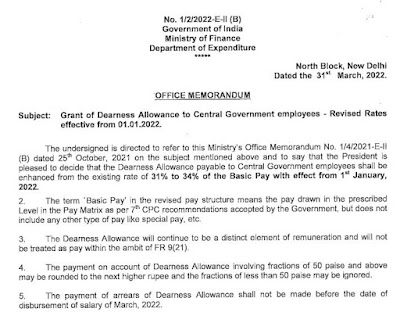
DA Jan 2022 - Grant of Dearness Allowance to Central Government employees - Revised Rates effective from 01.01.2022

 3% DA Hike - Revised Rates effective from 01.01.2022: DoE OM dated 31.03.2022 No. 1/2/2022-E-II (B) Government of India Ministry of Finance...