Friday, 26 February 2016

Incomplete Data in Web Based Cadre Management System for CSS Officers of Under Secretary

No.21/1/2016-CS.I(U)
Government of India
Ministry of Personnel, Public Grievances & Pension
Department of Personnel & Training
2nd Floor, Lok Nayak Bhavan
Khan Market, New Delhi.
Dated 26th February, 2016.
OFFICE MEMORANDUM

Subject: Incomplete Data in Web Based Cadre Management System for CSS Officers of Under Secretary

The undersigned is directed to refer to this Department’s O.M. No.21.1.2014-CS.I (PR/CMS) dated 31st December, 2015 (copy enclosed) requesting the nodal officers in the Ministries/ Department for updation of data in the web based cadre management system hosted at cscms.nic.in in respect of all the CSS/CSSS/CSCS officers working under them. Data in respect of two modules viz. experience and promotion details can only be modified by CS.I / CS.II Divisions.

2. It is imperative that data in the web based system is maintained up to date always to facilitate carrying out of various cadre management activities. However, it has been seen that the experience details of Under Secretaries whose names are given in the Annexure to this OM are not complete in the web based cadre management system. In order to complete the data in the system by CS Division, it is requested to fill up the particulars of such Under Secretaries in the attached format duly certified by the Admn. Division latest by 10.3.2016.

3. The Nodal Officers should update the remaining data of officers in other modules viz. Employee Details, Basic Details, Address Details, Training and Qualification. For any technical assistance they may contact CMC Official at Telephone No.24629890.
(V Srinivasaragavan)
Under Secretary to the Government of India
Tele: 24629412
Telefax:24629414
To
Ministries / Departments
Under Secretary (Admn.)
(As per list attached).
21/1/2014-CS.l (PR/CMS)
Government of India
Ministry of Personnel, PG and Pensions
Department of Personnel & Training
2nd Floor, Lok Nayak Bhavan, New Delhi-110003
Dated the 31st December, 2015
OFFICE MEMORANDUM

Subject: Web Based Cadre Management System – updation of data of CSS/CSSS/CSCS officers

As Ministries/Departments are aware, the Web Based Cadre Management System for CSS, CSSS and CSCS has been operational since January, 2013. The system is hosted at cscms.nic.in. Despite lapse of more than two years, complete and up to date data is still not available in the system in respect of several officers. The prime objective of the web based system is to ensure accurate real time data of all the officers to enable quicker decisions relating to cadre management functions. Unless the data is maintained upto date, the purpose of the web based system will be defeated.

2. Nodal Officers in all the Ministries/Departments are, therefore, requested as under:
(a) Employee module: Nodal officers should ensure that correct and up to date personal information in respect of all personnel posted there is available. Nodal officers have been empowered to modify/correct (i) Employee details (ii) Basis Details (iii) Address details (iv) Training details and (v) qualification details. All the officers belonging to CSS/CSSS/CSCS may also be advised to verify their data in the system and bring discrepancies to the notice of the nodal officers for correction. If there is any difficulty in this regard, nodal officers should call CMC Ltd. Engineers at Tele: 24629890.
(b) Experience and Promotion data: CS.I Division will modify data in these two fields. If any modification is required duly certified information may be sent to CS Division for correction.
(c) Pay: Please ensure that pay of the officer is correctly indicated in the system. After drawl of increment on 1st July every year the data should be corrected.
(d) APAR: Ensure that APAR grading is entered in the system and the APAR is scanned and uploaded in the system. If there is any difficulty in this regard, please call the CMC Ltd. Engineers at Tele: 24629890.
(e) IPR and Lokpal return:All the officers of CSS/CSSS/CSCS are requested to file their returns online. It may be noted that defaulting officers will not be granted cadre clearance for deputation, foreign training, empanelment etc.
(f) Deputation : Ensure that all Officers apply for cadre clearance through the system. If any application is received in CS.I Division without online application it will not be entertained. Prior to forwarding application online, nodal officers should also ensure that correct and up to date information or the officer concerned is available in the system.
(g) Foreign Training: All nominations for foreign training should be processed through the web based cadre management system in respect of all Officers. Their reliving for the training will also be updated in the system to capture the details of foreign trainings attended. If the training period is more than three months, the nodal officers will forward the online request to CS.I Division for cadre clearance in respect of US and above level officers.
(h) Domestic Training: All nominations for domestic training should be processed through the web based cadre management system in respect of’ all officers. If the training period is exceeding one year, the nodal officers will forward the online request to CS.I Division for further processing in respect of’ US and above level officers.
(i) Permission to vis it abroad: All requests for private foreign visits should be processed through the web based cadre management system to capture such information.
(j) Furnishing of in formation of death of an employee: In case of death of an employee, the nodal officer of the Ministry/Department concerned will henceforth immediately update the information in the web based system to enable capture of the vacancy to facilitate provision of a substitute.
(k) Furnishing of information of long leave of an employee: If any employee proceeds on leave for six months or more, the nodal officer concerned should update the information in the web based system immediately to capture the vacancy to facilitate provision of a substitute.
(l) Voluntary Retirement: CS.l Division conveys approval of MoS (PP) for voluntary retirement or us and above level officers of CSS. Henceforth, i I’ the request for voluntary retirement is not received through the system, the same will not be entertained.
(m) Resignation: Resignation requests from employees should be obtained and processed in the web based system so that such vacancies are brought to the notice of the cadre controlling authority immediately.
(n) Technical resignation: Requests for technical resignation to Join another employment under the Government should also be obtained and processed in the web based cadre management system.

(o) Vigilance status: Vigilance clearance whenever required in connection with cadre management activities will be sought and obtained through the system. In respect of US and above level officer it will be updated both by the Ministries/Department and by AVD.I of DoP&T. Upto SO level, Ministries/ Departments will update the system.
3. This circular may be brought to the notice of all CSS Officers for their information and active cooperation to ensure correctness of data.

4. Nodal officers may also depute their subordinates to CS.I Division to clear doubts if any about the functioning of the system.
( V.Srin ivasaragavan)
Under Secretary to the Govt. of lndia
Tele.: 24629412
To
Ministries/ Departments
Director/Deputy Secretary (Administration)
Official Circular

Performance of Central Public Sector Enterprises (CPSES) during 2014-15.

Performance of Central Public Sector Enterprises (CPSES) during 2014-15.

Ministry of Heavy Industries & Public Enterprises
Press Information Bureau,
Government of India
26-February, 2016

The Public Enterprises Survey (2014-15), brought out by the Department of Public Enterprises, Ministry of Heavy Industries & Public Enterprises, Government of India on the performance of Central Public Sector Enterprises was placed in both the Houses of Parliament today. There were 298 CPSEs in 2014-15, out of which 235 were in operation. Rest (63) of the CPSEs were under construction. The major Highlights of the performance of Central Public Sector Enterprises (CPSE), during 2014-15 is mentioned below.

2014-15 2013-14
Overall net profit of 235 CPSEs is Rs.1,03,003 crore in 2014-15 Overall net profit of 234 CPSEs is Rs.1,28,295 crore in 2013-14
157 CPSEs posted net profit of Rs.1,30,363 crore in 2014-15 164 CPSEs posted net profit of Rs.1,49,636 crore in 2013-14
77 CPSEs incurred net loss of Rs.27,360 crore in 2014-15 70 CPSEs incurred net loss of Rs.21,341 crore in 2013-14
Total investment in 298 CPSEs stood at Rs. 10,96,057 crore in 2014-15 Total investment in 290 CPSEs stood at Rs. 9,92,096 crore in 2013-14
Dividend paid by CPSEs during 2014-15 is Rs. 56,527 crore Dividend paid by CPSEs during 2013-14 is Rs. 65,115 crore

Highlights
  • Total paid up capital in 298 CPSEs as on 31.3.2015 stood at Rs. 2,13,020 crore compared to Rs. 1,98,722 crore as on 31.3. 2014 (290 CPSEs), showing a growth of 7.19%.
  • Total investment (equity plus long term loans) in all CPSEs stood at Rs. 10,96,057 crore as on 31.3.2015 compared to Rs. 9,92,096 crore as on 31.3.2014, recording a growth of 10.48%.
  • Capital Employed (Paid up capital plus reserve & surplus and long term loans) in all CPSEs stood at Rs. 18,67,730 crore on 31.3.2015 compared to Rs. 17, 39,090 crore as on 31.3.2014 showing a growth of 7.40 %.
  • Total turnover/gross revenue from operation of all CPSEs during 2014-15 stood at Rs 19, 95,902 crore compared to Rs. 20, 66,057 crore in the previous year showing a reduction in turnover of 3.40 %.
  • Total income of all CPSEs during 2014-15 stood at Rs. 19, 65,254 crore compared to Rs. 20, 56,336 crore in 2013-14, showing a reduction in income of 4.43%.
  • Profit of profit making CPSEs stood at Rs. 1, 30,363 crore during 2014-15 compared to Rs 1,49,636 crore in 2013-14 showing a decline in profit of 12.88%.
  • Loss of loss incurring CPSEs stood at Rs.27, 360 crore in 2014-15 compared to Rs 21, 341 crore in 2013-14 showing a increase in loss by 28.20 %.
  • Overall net profit of all 235 CPSEs during 2014-15 stood at Rs 1,03,003 crore compared to Rs 1,28,295 crore during 2013-14 showing a decrease in overall profit of 19.71%.
  • Reserves & Surplus of all CPSEs went up from Rs. 7, 46,994 crore in 2013-14 to Rs 7, 71,672 cores in 2014-15, showing an increase by 3.30 %.
  • Net worth of all CPSEs went up from Rs 9,45,717 crore in 2013-14 to Rs 9,84,692 crore in 2014-15 registering a growth of 4.12 %.
  • Contribution of CPSEs to Central Exchequer by way of excise duty, customs duty, corporate tax, interest on Central Government loans, dividend and other duties and taxes increased from Rs 2,20,982 crore in 2013-14 to Rs 2,00,585 crore in 2014-15, showing a decline of 9.23%.
  • Foreign exchange earnings through exports of goods and services decreased from Rs 1,45,196 crore in 2013-14 to Rs 1,03,071 crore in 2014-15, showing a reduction of 29.01%.
  • Foreign exchange outgo on imports and royalty, know-how, consultancy, interest and other expenditure decreased from Rs.6,76,870 crore in 2013-14 to Rs.5,44,560 crore in 2014-15 showing a reduction of 19.55%.
  • CPSEs employed 12.91 lakh people (excluding contractual workers) in 2014-15 compared to 13.49 lakh in 2013-14, showing a reduction in employees by 4.30%.
  • Salary and wages went up in all CPSEs from Rs.1,22,322 crore in 2013-14 to Rs 1,27,387 crore in 2014-15 showing a growth of 4.14 %.
  • Total Market Capitalization 45 CPSEs traded on stock exchanges of India as on 31.03.2015. Based on stock prices on Mumbai Stock Exchange, as on 31.03.2015, the market capitalization of 45 CPSEs stood at Rs. 13,27,127 crore as against Rs. 11,02,730 crore stood as on 31.03.2014. Thus, there was increase in market capitalization of CPSEs by 20.35% (Rs.2,24,397 crore) as on 31.03.2015 over market capitalization as on 31.03.2014.
  • M_Cap of CPSEs as per cent of BSE M_Cap decreased from 14.87% as on 31.3.2014 to 13.08% as on 31.3.2015.
PIB

Preliminary Staff Side meeting of the Standing Committee members will be held on 1.3.2016

Preliminary Staff Side meeting of the Standing Committee members will be held on 1.3.2016

NCJCM-7TH-CPC-STAFF-SIDE-7CPC

NATIONAL JOINT COUNCIL OF ACTION

NOTICE FOR MEETING OF THE JCM (NC) STAFF SIDE
STANDING COMMITTEE MEMBERS

The meeting of Empowered Committee of Secretaries (E-CoS) under the Chairmanship of Cabinet Secretary with Standing Committee members of JCM (NC) staff side is scheduled to be held on 1st March 2016 at 06:45 PM in the Committee Room, Cabinet Secretariat, Rashtrapati Bhawan, New Delhi vide Under Secretary (IC) letter F. No. 1-2/2016-IC dated 24.02.2016.

It has therefore been decided that the preliminary Staff Side meeting of the Standing Committee members will be held on 1st march 2016 at 11.00 AM in the office of National Council (JCM), 13-C, Ferozshah Road, New Delhi – 110001 for internal discussion.

You are requested to make it convenient to attend the said meeting on the date and time referred to above.
Thanking you,
Yours faithfully
(Shiv Gopal Mishra)
Convenor, NJCA
Source: Confederation

Casual Labourers with temporary status-clarification regarding contribution to GPF and Pension under the old pension scheme

Casual Labourers with temporary status-clarification regarding contribution to GPF and Pension under the old pension scheme
No.49014/2/2014-Estt (C)
Government of India
Ministry of Personnel, Public Grievances and PG
Department of Personnel and Training
Establishment Division
New Delhi, North Block,
February 26th , 2016
OFFICE MEMORANDUM

Subject: Casual Labourers with temporary status-clarification regarding contribution to GPF and Pension under the old pension scheme

Undersigned is directed to refer to this Department’s OM No. 51016/2/90-Estt (C) dated the 10th September, 1993 vide which a scheme for grant of temporary status to the casual employees was framed. The scheme applied to those casual labourers who were in employment on the date of the issue of the OM and had rendered one year of continued service in Central Government offices, which meant that they must have been engaged for a period of at least 240 days (206 days in the case of offices observing 5 days week). The scheme did not apply to Departments of Telecom & Posts and Ministry of Railways.

2. As per the scheme, after rendering three years’ continuous service after conferment of temporary status, the casual labourers were to be treated at par with temporary Group ‘D’ employees for the purpose of contribution to the General Provident Fund. Further, after their regularisation, 50% of the service rendered under temporary status would be counted for the purpose of retirement benefits.

3. As per para 8 of the scheme, two out of every three vacancies in Group ‘D’ cadres in respective offices where the casual labourers have been working would be filled up as per extant recruitment rules and in accordance with the instructions issued by Department of Personnel and Training from amongst casual workers with temporary status. However, regular Group ‘D’ staff rendered surplus for any reason will have prior claim for absorption against existing/future vacancies. In case of illiterate casual labourers or those who fail to fulfill the minimum qualification prescribed for post, regularisation will be considered only against those posts in respect of which literacy or lack of minimum qualification will not be a requisite qualification. They would be allowed age relaxation equivalent to the period for which they have worked continuously as casual labourer.

4. Vide the O.M. No.49014/1/2004 -Estt (C) dated the 26 thApril, 2004, the above scheme was reviewed in the light of introduction of New Pension Scheme in respect of persons appointed to the Central • Government service on or after 1.1.2004 as under:
(i) As the new pension scheme is based on defined contributions, the length of qualifying service for the purpose of retirement benefits has lost its relevance, no credit of casual service, as specified in para 5 (v), shall be available to the casual labourers on their regularisation against Group ‘D’ posts on or after 1.1.2004.

(ii) As there is no provision of General Provident Fund in the new pension scheme, it will not serve any useful purpose to continue deductions towards GPF from the existing casual employees, in terms of para 5 (vi) of the scheme for grant of temporary status. It is, therefore, requested that no further deduction towards General Provident Fund shall be effected from the casual labourers w. e. f. 1.1.2004 onwards and the amount lying in their General Provident Fund accounts, including deductions made after 1.1.2004, shall be paid to them.
2. The existing guidelines contained in this Department’s OM No. 49014/2/86-Estt.(C) dated 7.6.88 may continue to be followed in the matter of engagement of casual workers in the Central Government Offices.

5. The OM dated 26th April, 2004 has been quashed by various benches of CAT/High Courts who have decided that the scheme could not be modified retrospectively. The SLPs filed in the Hon’ble Supreme Court have been dismissed by the Apex Court in UOI & Ors v Rameshwar Singh, CC 1829/2014, UOI & Ors v Ramsaran & Ors, SLP (C) No. 25360-25362 of 2008, SLP 17358/2008, SLP 25360-62/09, Union of India etc v Ajay Kumar & Ors, SLP No.19673-19678/2009.

6. The position has been reviewed in the light of the Court judgements in consultation with the Department of Expenditure. It has now been decided that the casual labourers who had been granted temporary status under the scheme, and have completed 3 years of continuous service after that, are entitled to contribute to the General Provident Fund.

7. 50% of the service rendered under temporary status would be counted for the purpose of retirement benefits in respect of those casual labourers who have been regularised in terms of para 8 of the OM dated 10.09. 1993.

8. It is emphasised that the benefit of temporary status is available only to those casual labourers who were in employment on the date of the issue of the OM dated 10th September, 1993 and were otherwise eligible for it. No grant of temporary status is permissible after that date. The employees erroneously granted temporary status between 10.09.1993 and the date of Hon’ble Supreme Court judgement in Union Of India And Anr vs Mohan Pal, 2002 (3) SCR 613, delivered on 29 April, 2002, will however be deemed to have been covered under the scheme of 10.09.93.

9. Ministries/Departments are also requested to identify cases where temporary status has been granted wrongly to those not covered under the OM dated 10.09.1993 and fix responsibility for the same.
sd-
(Mukesh Chaturvedi)
Director (E)
Authority: www.persmin.gov.in
Click to view the order

Meeting of Empowered Committee with NC JCM on 1.3.2016


An another important meeting of Empowered Committee with NC JCM will be held on 1.3.2016. Official letter published by Confederation and the same given below for your information…

Meeting of Empowered Committee of Secretaries (E-CoS) with Office bearers of Staff Side of Standing Committee of National Council (JCM) on recommendations of the 7th Central Pay – Postponement

F.No.1-2/2016-IC
Government of India
Ministry Of Finance
Department of Expenditure
Implementation Cell
Dated: 25th February 2016
To
Shri Shiva Gopal Mishra
Secretary
National council (Staff Side)
13-C, Ferozshah Road
New Delhi – 110 001
Fax- 23363167)

Subject: Meeting of Empowered Committee of Secretaries (E-CoS) with Office bearers of Staff Side of Standing Committee of National Council (JCM) on recommendations of the 7th Central Pay – Postponement – reg.

Sir,
In partial Supersession of this office letter of even number dated 24.02.2016 it is intimated the meeting of the office bearers of the staff side of Standing Committee of National Council (JCM) with the Empowered Committee of Secretaries (E-CoS) will now be held on 01.03.2016 at 6.45 PM in the Committee Room, Cabinet Secretariat,Rashtrapati Bhawan, New Delhi.

2. The above change in the date and time of the meeting may please be noted.

3. Inconvenience caused is regretted.

Thanking you

Yours faithfully
sd/-
(Ram Gopal)
Under Secretary (IC-I)
Tel: 26116647
Source: www.confederationhq.blogspot.in

Travel Insurance For Rail Passengers Soon

Travel Insurance For Rail Passengers Soon

In order to minimise financial loss to passengers from untoward incidents, Railways will launch a travel insurance scheme.

“Currently there are railways claims tribunals which provide compensation in case of mishaps. One can claim compensation in case of accidents. Now we are offering additional service of insurance,” Railway Board Chairman A K Mittal said.

However, he said the insurance scheme is optional and passengers will be given the option at the time of booking tickets.

PTI

Thursday, 25 February 2016

NFIR: Highly disappointing Rail Budget 2016

disappointing-railway-budget-2016-NFIR
Railway Minster did not make any announcement for making payment of PL Bonus at revised rate of 7000
 NFIR
National Federation of Indian Railwaymen
3, CHELMSFORD ROAD
, NEW DELHI – 110 055

Press Statement

Highly disappointing Rail Budget
 
The National Federation of Indian Railwaymen (NFIR) expresses its serious disappointment over the Rail Budget (2016-17) presented by Shri Suresh Prabhu, Railway Minister in the Parliament on 25th February 2016. According to the President and General Secretary NFIR Shri Guman Singh and Raghavaiah, the Rail Budget document is “towards journey for privatization of Indian Railways in the name of transformation”. It is sad to note that the Railway Minister has not given due recognition to the dedicated services being rendered by various categories of Railway employees who toil hard day and night.
NFIR leaders said that the Rail Budget is totally uninspiring and on the contrary generating resentment among Railway employees as the aim of the Budget is to “aggressively implement privatization, outsourcing” of regular Railway activities.
NFIR expressed its unhappiness as the commitments given by the previous Railway Ministers thro’ Budget announcements have not been fulfilled notably: Free Medical treatment to the dependant parents of Railway employees and construction of New Railway quarters under the corporate welfare plan drawn up years back by the Railway Ministry. The announcement of previous Railway Ministers on the floor of the Parliament that “House for all” has unfortunately been forgotten.
It is quite disappointing that although the Bonus Act has been amended w.e.f. 01.10.4.2014 for calculation of Bonus rates to Rs. 7000/- p.m., the Railway Minster did not make any announcement for making payment of PL Bonus to Railway employees at revised rate of Rs. 7000/- p.m. for the year 2014-15.
NFIR said that the condition of Railway colonies and Railway quarters are totally deteriorated. The Rail Budget has not addressed this welfare aspect adequately.
The Federation expresses its anguish over the failure of Railway Ministry in filling up vacancies of 2.5 lakh vacancies in Railways, out of which over 1.5 lakh vacancies belong to safety categories.
The Federation also expresses its unhappiness over the non-allocation of adequate resources for improving the Railway Hospitals, Health Units and creating Super Specialty facilities atleast in the Zonal Railway Hospitals. The long pending demand of NFIR for making provision of Road Mobile Medical Vans for ensuring Medical treatment to the Railway employees working at remote places, jungle areas, has not been given due priority in the Rail Budget.
NFIR is also of the view that the Rail Budget has not satisfied any section of people.
sd/-
(Dr.M.Raghavaiah)
General Secretary
Source: NFIR

RAILWAY BUDGET 2016-2017 : Ministry of Railways

RAILWAY BUDGET 2016-2017 : Ministry of Railways

railway-budget-2016-2017

  • No Hike in Passenger Fare
  • 65,000 Additional Berths and 17,000 Bio Toilets to be Installed
  • Operations Audit to Improve Punctuality of trains Proposed
  • Wi Fi Facilities in 400 more Stations
  • Stations to be Developed Under PPP Mode
  • Award of Civil Contracts for Dedicated Freight Corridor to be Over by the end of this Financial Year
  • Capacity of E-Ticketing System to be Enhanced
  • Increased Quota of Lower Berth for Senior Citizens and Women
  • 820 Robs / Rubs constructed
  • Operating Ratio to Increase from 90% to 92% Proposed
  • Nargol- Hazira Port Connectivity to be taken up under PPP Mode
There is no hike in passenger fare in this year’s Railway Budget. Presenting the Railway Budget 2016-17 in the Parliament today Railway Minister Shri Suresh Prabhakar Prabhu said the budget seeks to fulfil the long-felt desires of the common man such as reserved accommodation on trains available on demand, time tabled freight trains, high end technology to improve safety record, elimination of all unmanned level crossings, improved punctuality, higher average speed of freight trains, semi high speed trains running along the golden quadrilateral, zero direct discharge of human waste by the year 2020. He said Cabinet approval has been received for re-development of stations under PPP mode.

Shri Suresh Prabhu said the Indian Railways budget proposes to overcome challenges by Reorganizing Restructuring and Rejuvenating Indian Railways with the Slogan “Chalo, Milkar Kuch Naya Karen’”. The strategy for this will have three pillars i.e. Nav Arjan – New revenues, Nav Manak – New norms, and Nav Sanrachna – New Structures.

In order to make travel on Indian Railways more comfortable, the Indian Railways proposes to give more facilities to the passengers . 65,000 additional berths will be provided in the trains and 2500 water vending machines will be installed . The railways have developed world’s first Bio-Vaccum toilet and 17,000 Bio-toilets will be provided in the trains. With the purpose of improving punctuality of trains operations audit from Ghaziabad to Mughalsarai section will be introduced. The Indian Railways proposes to introduce 1,780 Automatic Ticket Vending Machines all over the country with mobile apps and GoIndia smartcard for cashless purchase of UTS and PRS tickets. The capacity of e-ticketing system will be enhanced from 2,000 tickets per minute to 7,200 tickets per minute to support 1,20,000 concurrent users as against 40,000 earlier. 400 more stations will be provided with Wi Fi facilities.

As a part of social initiatives, online booking of wheelchairs and Braille enabled new coaches will be introduced for the Divyang. Increased quota of lower berths for senior citizens and women and reserving middle bays for women in reserved coaches has been proposed. Passengers security will be enhanced through more helplines and CCTVs.

To reduce accidents at level crossings, the budget proposes to eliminate 1000 unmanned level crossings and closures of 350 manned level crossings. 820 Rail Over Bridges (ROB)/ Rail Under Bridges (RUB) will be completed during the current financial year and work is going on in additional 1350 of them.

Referring to the progress of Dedicated Freight Corridor Project the Railway Minister said that almost all contracts for civil engineering works will be awarded by the end of this financial year. He said Rs.24,000 crore worth contracts were awarded since November 2014 as against Rs. 13,000 crore contracts awarded during the last six years. Shri Prabhu said Railways proposes to take up North-South, East-West and East Coast freight corridors through innovative financing including PPP.

Underlining the importance of Jammu and Kashmir and North East the Minister said work on Katra-Banihal section of Udhampur-Srinagar-Baramulla Rail Link Project is progressing satisfactorily and 35 kms of tunnelling out of total of 95 kms has been completed. He said decongestion work on Jalandhar – Jammu section is in full swing and doubling of two bridges will be over by next month, while the other two bridges will be completed by 2016-17. In North East , Mizoram and Manipur will shortly come on BG map of the country with commissioning of the Kathakal-Bhairabi and Arunachal-Jiribam Gauge conversion projects.
Giving the progress card of port connectivity projects the Minister informed that Tuna Port connectivity project has been commissioned and rail connectivity projects to ports of Jaigarh, Dighi, Rewas and Paradip are under implementation. He said implementation of rail connectivity for the ports of Nargol and Hazira will be taken up under PPP in 2016-17.

Referring to the financial performance the Minister said during 2015-16 a saving of Rs.8720 crore could be achieved neutralizing the most of the revenue shortfall with operating ratio of 90%. He said the budget proposes operating ratio of 92%, restricting growth of ordinary working expenses by 11.6% after building in immediate impact of 7th PC, reduction in diesel and electricity consumption and Revenue generation of Rs. 1,84,820 crore for 2016-17. He said during 2015-16 investment would be close to double of average of previous five years.

Shri Suresh Prabhu said Railways would be able to achieve annualized savings of Rs.3000 crore in the energy sector during the next financial year itself, a year earlier than announced. He said this could be achieved by procuring power directly at competitive rates.

The Railway Minister said social media will be used as a tool to bring in transparency. All procurement including procurement of works will be moved to e-platform. He said the trial of awarding tender electronically was successful and it will be rolled out on Pan India basis in 2016-17.

Giving an outline of the way ahead, the Minister informed Parliament that his Ministry proposes to take various measures to improve quality of travel which will include introduction of unreserved superfast Antyodaya Express Trains, introduction of Tezas train with the speed of 130 Km. and above with onboard entertainment and Wi Fi etc., unreserved Deen Dayalu coaches with portable water and higher number of mobile charging points and introduction of AC and non AC double decker trains on busy routes with the potential to increase carrying capacity by almost 40%. Sale of tickets through hand held terminals; e- ticketing facility to foreign debit/credit cards; bar coded tickets, expansion of Vikalp – train on demand to provide choice of accommodation in specific trains to wait-listed passengers. E-booking of tickets facility on the concessional passes available to journalists; facility of cancellation through the 139 helpline post verification using ‘One Time Password’ sent on registered phone number, CCTV cameras on tatkal windows and periodic audit of PRS website will also be introduced.

Shri Suresh Prabhu said it is proposed to convert all operational halts into commercial halts for the benefit of common man. The Minister said Sarathi Seva in Konkan Railway will be expanding to help the old and disabled passenger. The existing services for enabling passengers to book battery operated cars, porter services, etc. on a paid basis in addition to the existing pick up and drop, and wheel chair services will be strengthened. All stations under redevelopment will be accessible for Divyang. There will be at least one Divyang friendly toilet at each platform in A1 class stations during the next financial year and availability of wheelchairs in sufficient numbers at these stations will be ensured. Children’s menu items, baby foods, hot milk and hot water would be made available under Janani Sewa.

SMART (Specially Modified Aesthetic Refreshing Travel) Coaches will be introduced to ensure higher carrying capacity and provision of new amenities including automatic doors, bar-code readers, bio-vacuum toilets, water-level indicators, accessible dustbins, ergonomic seating, improved aesthetics, vending machines, entertainment screens, LED lit boards for advertising, PA system. It is also proposed to integrate all facilities into two mobile apps dealing with ticketing issues and for receipt and redressal of complaints and suggestions. With a view to improve customer interface information boards in trains enumerating the on-board services and GPS based digital displays will be installed inside coaches to provide real time information regarding upcoming halts. Work is underway for the installation of a high-tech centralized network of 20,000 screens across 2000 stations for enabling real time flow of information to passengers and also to unlock huge advertising potential. All A1 class stations will be manned with duly empowered Station Directors supported by cross functional teams, to make one person accountable for all facilities on trains.
Shri Suresh Prabhu said it is proposed to take up on priority the provision of passenger amenities and beautification on stations at pilgrimage centres including Ajmer, Amritsar, Bihar Sharif, Chengannur, Dwarka, Gaya, Haridwar, Mathura, Nagapattinam, Nanded, Nasik, Pali, Parasnath, Puri, Tirupati, Vailankanni, Varanasi and Vasco. Aastha circuit trains will be introduced to connect important pilgrim centres.

He said optional travel insurance for rail journeys at the time of booking and clean my coach through sms will also be introduced in due course. High speed passenger corridor from Ahmedabad to Mumbai will be developed with the financial assistance from Government of Japan. FM Radio Stations will be invited to provide train borne entertainment, Rail Bandhu Mazagine will be provided in all reserved coaches in all regional languages.

Referring to the financial performance of 2015-16 the Railway Minister said Stringent economy and austerity measures adopted to contain the Ordinary Working Expenses (O.W.E.) due to which budgeted OWE of Rs 1,19,410 crore decreased in the Revised Estimates 2015-16 to Rs. 1,10,690 crore i.e. by Rs 8,720 crore. BE provided for an appropriation of Rs. 34,900 crore to the Pension Fund. However, based on trend, the pension outgo moderately decreased to Rs. 34,500 crore in RE. Internal resource generation diminished and appropriation to DRF moderated to Rs. 5,500 crore in RE from the BE 2015-16 provisioning of Rs. 7,900 crore. Excess of receipts over expenditure in RE 2015-16 stands at Rs. 11,402.40 crore. Plan size for 2015-16 is currently estimated at 1,00,000 crore i.e. the BE level.

Regarding Budget Estimates 2016-17 the Minister informed that the Gross Traffic Receipts are kept at Rs 1,84,820 crore . Passenger earnings growth has been pegged at 12.4 % and earnings target budgeted at Rs. 51,012 crore. The freight traffic is pegged at incremental traffic of 50 million tonnes, anticipating a healthier growth in the core sector of economy. Goods earnings is accordingly proposed at Rs. 1, 17,933 crore.

Other coaching and sundries projected at Rs. 6,185 crore and Rs. 9,590.3 crore respectively. OWE provides for the implementation of the 7th CPC.Pension outgo budgeted at Rs 45,500 crore in 2016-17.

Higher staff cost and pension liability impacts the internal resource position of the Railways. Accordingly, appropriation to DRF from revenue placed at Rs 3,200 crore and that from Production Units at Rs 200 crore. A withdrawal of Rs 3,160 crore from DRF on net basis proposed though the gross expenditure to be met from DRF in the Annual Plan estimated at Rs 7,160 crore. Rs 5,750 crore proposed to be appropriated to the Capital fund. With a draw-down of Rs 1,250 crore from previous balances in the fund, plan requirement of Rs 7,000 crore for repayment of principal component of lease charges to IRFC have been met. Railways are preparing a Plan size of Rs. 1,21,000 crore in 2016-17, the Minister added.

PIB

Government servant getting retirement benefit from deputation office

Government servant getting retirement benefit from deputation office

Appointment to a post on deputation basis is made for a period normally specified in the Recruitment Rules of the deputation post, unless the period of deputation is extended by the Government in terms of prevailing instructions. After expiry of such deputation period, the Government servant is required to revert back to the parent organization/ office. The Guidelines regulating premature repatriation from Central Deputation also provide for repatriation to parent cadre in certain cases such as to avail benefit of promotion. However, there are no specific instructions which require a Government servant on deputation to be reverted back to the parent organization/ office before retirement only to facilitate fixation of pensionary benefits.

Rule 33 of Central Civil Services (Pension) Rules prescribes the emoluments to be taken into account for calculating pension.

This was stated by the Minister of State in the Ministry of Personnel, Public Grievances and Pensions and Minister of State in the Prime Minister’s Office Dr. Jitendra Singh in a written reply to a question by Shri Motilal Vora in the Rajya Sabha today.

Highlights of the Railway Budget 2016-17 – An Official Report

Highlights of the Railway Budget 2016-17 – An Official Report

Highlights of the Railway Budget 2016-17

Theme of the Budget : Overcoming challenges – Reorganize, Restructure Rejuvenate Indian Railways: ‘Chalo, Milkar Kuch Naya Karen’

Three pillars of the strategy i.e. Nav Arjan – New revenues, Nav Manak – New norms, Nav Sanrachna – New Structures.

Financial Performance : 2015-16- Savings of Rs. 8,720 crore neutralizing most of the revenue shortfall, expected OR 90%;

2016-17- Targeted Operating Ratio (OR) – 92%, restrict growth of Ordinary Working Expenses by 11.6% after building in immediate impact of 7th PC, reductions planned in diesel and electricity consumption, Revenue generation targeted at Rs. 1,84,820crore.

Investments and Resources : Process bottlenecks overhauled including delegation of powers to functional levels; average capital expenditure over 2009-14 is Rs. 48,100 crore, average growth of 8% per annum.

2015-16 investment would be close to double of the average of previous 5 years.

2016-17 CAPEX pegged at Rs. 1.21 lakh crore; implementation through joint ventures with states, developing new frameworks for PPP, etc.

Vision : By 2020, long-felt desires of the common man to be fulfilled i.e, reserved accommodation on trains available on demand, time tabled freight trains, high end technology to improve safety record, elimination of all unmanned level crossings, improved punctuality, higher average speed of freight trains, semi high speed trains running along the golden quadrilateral, zero direct discharge of human waste. 

2015-16-Achievements : Action initiated on 139 budget announcements of 2015-16. 

Project execution : 2015-16 – assured funding through LIC; commissioning of 2,500 kms Broad Gauge lines; commissioning of 1,600 kms of electrification, highest ever. In 2016-17 – targeted commissioning 2,800 kms of track; commissioning Broad Gauge lines @ over 7 kms per day against an average of about 4.3 kms per day in the last 6 years. Would increase to about 13 kms per day in 2017-18 and 19 kms per day in 2018-19; will generate employment of about 9 crore man days in 2017-18 and 14 crore man days in 2018-19. Outlay for railway electrification increased in 2016-17 by almost 50%; target to electrify 2,000 kms.

Dedicated Freight Corridor : Almost all contracts for civil engineering works to be awarded by March 31st 2016; Rs. 24,000 crore contracts awarded since November 2014 as against Rs. 13,000 crore contracts awarded in last 6 years; propose to take up North-South, East-West & East Coast freight corridors through innovative financing including PPP.

Port connectivity : Tuna Port commissioned and rail connectivity projects to ports of Jaigarh, Dighi, Rewas and Paradip under implementation; implementation of rail connectivity for the ports of Nargol and Hazira under PPP in 2016-17.

North East : BG Lumding-Silchar section in Assam opened thus connecting Barak Valley with rest of the country; Agartala brought on to the BG network. States of Mizoram and Manipur shortly to come on BG map of the country with commissioning of the Kathakal-Bhairabi and Arunachal-Jiribam Gauge Conversion projects.

Jammu and Kashmir : Work on Katra-Banihal section of Udhampur-Srinagar-Baramulla Rail Link Project progressing satisfactorily- 35 kms of tunnelling out of total of 95 kms completed; Decongestion work on Jalandhar – Jammu line in full swing and doubling of two bridges to be commissioned by March 2016, while the other two bridges will be completed by 2016-17.

Make in India: Finalised bids for two loco factories; proposed to increase the current procurement of train sets by 30%.

Capacity Building for the future through: Transparency – initiated recruitments online in 2015-16, process now being replicated for all positions, social media being used as a tool to bring in transparency, all procurement including procurement of works moved to the e-platform, completed trial of process leading to award of tender electronically and to be rolled out on a PanIndia basis in 2016-17.

Governance – delegation led to compression of project sanction time to 6-8 months from 2 years earlier, key result areas identified to judge performance of GMs and DRMs, performance related MOUs signed with few Zones, to be replicated for all zones.

Internal audit measures – specialised teams mandated to screen railway operations in specific areas to detect inefficiencies and prevent wastages, every zone preparing 2 reports by March 31, 2016.
Partnerships – Cabinet approval for JVs with State Governments, 17 consented and 6 MOUs signed with State Governments. 44 new partnership works covering about 5,300 kms and valuing about Rs. 92,714 crore have been indicated in the Budget documents.

Customer Interface : Interaction and feedback through social media & dedicated IVRS system.
Making travel comfortable by generating over 65,000 additional berths, installing 2,500 water vending machines; introducing ‘Mahamana Express’ with modern refurbished coaches; 17,000 bio-toilets in trains; world’s first Bio-Vacuum toilet developed.

Improving punctuality – operations audit for Ghaziabad to Mughalsarai section.

Ticketing: Introduced 1,780 Automatic Ticket Vending Machines, mobile apps & GoIndia smartcard for cashless purchase of UTS and PRS tickets, enhanced capacity of e-ticketing system from 2,000 tickets per minute to 7,200 tickets per minute and to support 1,20,000 concurrent users as against only 40,000 earlier.

Social initiatives: One-time registration for availing concessions while booking tickets online, online booking of wheelchairs & Braille enabled new coaches introduced for the Divyang, increased quota of lower berths for senior citizens and women, middle bays reserved in coaches for women.

Wi-Fi provided in 100 stations, to be provided in 400 more.

Stations being redeveloped – financial bid received for Habibganj, Bhopal; Cabinet approval for stations to be taken up under PPP.

Security through helplines & CCTVs.

Safety – 350 manned level crossings closed, eliminated 1,000 unmanned level crossings, 820 ROB/RUB completed in the current year and work going on in 1,350 of them.

Other major achievements : Energy: annualized savings of Rs. 3,000 crore to be achieved in the next financial year itself, a year earlier than announced; achieved by procuring power directly at competitive rates using IR’s status as Deemed Distribution Licensee.

Rail University – initially identified the National Academy of Indian Railways at Vadodara.
Digital India: application of Track Management System (TMS) launched, inventory management module of TMS has resulted in inventory reduction by 27,000 MT resulting in saving of Rs.64 crore and scrap identification of 22,000 MT equivalent to Rs.53 crore.

The Way Ahead Improving quality of travel For the unreserved passenger –Antyodaya Express unreserved, superfast service.

Deen Dayalu coaches – unreserved coaches with potable water and higher number of
mobile charging points.

For the reserved passenger – Humsafar – fully air-conditioned third AC service with an optional service for meals 

Tejas – will showcase the future of train travel in India. Will operate at speeds of 130 kmph and above.Will offer onboard services such as entertainment, local cuisine, WiFi, etc. through one service provider for ensuring accountability and improved customer satisfaction Humsafar and Tejas to ensure cost recovery through tariff and non-tariff measures UDAY – overnight double-decker, Utkrisht Double-Decker Air-conditioned Yatri Express on the busiest routes, has the potential to increase carrying capacity by almost 40%.

Ticketing: Sale of tickets through hand held terminals; e- ticketing facility to foreign debit/credit cards; bar coded tickets, scanners and access control on a pilot basis. Expansion of Vikalp – train on demand to provide choice of accommodation in specific trains to wait-listed passengers. 

E-booking of tickets facility on the concessional passes available to journalists; facility of cancellation through the 139 helpline post verification using ‘One Time Password’ sent on registered phone number, to improve tatkaal services CCTV cameras on windows and periodic audit of PRS website.

Cleanliness -‘Clean my Coach’ service through SMS, ranking of A1 and A stations based on periodic third party audit and passenger feedback; waste segregation and recycling centres; ‘Awareness campaigns’; additional 30,000 bio-toilets; providing portable structures with biotoilets at all platforms of select stations for senior citizens, Divyang and women travellers, plan to explore innovative means of providing and maintaining toilets such as advertisement rights, CSR, voluntary support from social organizations.

Catering and stalls at stations -IRCTC to manage catering services in a phased manner; explore possibility of making catering services optional, adding 10 more IRCTC operated base kitchens; to build local ownership and empowerment, weightage will be given to district domicile holders for commercial licenses at stations. Stoppages: convert all operational halts into commercial halts for the benefit of the common man. Rail Mitra Sewa: expanding Sarathi Seva in Konkan Railway to help the old and disabled passengers, strengthening the existing services for enabling passengers to book battery operated cars, porter services, etc. on a paid basis in addition to the existing pick up and drop, and wheel chair services.
 
Measures for Divyang: all stations under redevelopment accessible by Divyang; to provide at least one Divyang friendly toilet at each platform in A1 class stations during the next financial year and also ensure availability of wheelchairs in sufficient numbers at these stations.

Travel Insurance to passengers – to offer optional travel insurance for rail journeys at the time of booking.

Hourly booking of retiring rooms – will be handed over to IRCTC.

Expanding the freight basket of IR – to start time-tabled freight container, parcel and special commodity trains on a pilot basis, container sector would be opened to all traffic barring coal, specified mineral ores and part-loads during the non-peak season. All existing terminals/sheds would be granted access to container traffic, where considered feasible. Rationalising the tariff structure – undertake review of tariff policy to evolve a competitive rate structure vis a vis other modes, permit multi-point loading/unloading and apply differentiated tariffs to increase utilization of alternate routes, explore possibility of signing long term tariff contracts with our key freight customers using pre-determined price escalation principles.

Building terminal capacity – proposed to develop Rail side logistics parks and warehousing in PPP mode, 10 goods sheds will be developed by TRANSLOC, the Transport Logistics Company of India, in 2016-17. To soon inaugurate India’s first rail auto hub in Chennai. Encourage development of cold storage facilities on vacant land near freight terminals. Local farmers and fisherman would be given preferential usage of the facility. A policy in this regard would be issued in the next 3 months.

Nurturing customers – will appoint Key Customer Managers to liaison with our major freight stakeholders; each Zonal Railway will develop customer commitment charter indicating service level commitments of IR, will explore the feasibility of opening up leasing of general purpose wagons.

Annex-2 of the speech details the Implementation of Budget announcements 2015-16

Source: Indian Railway

Flash News

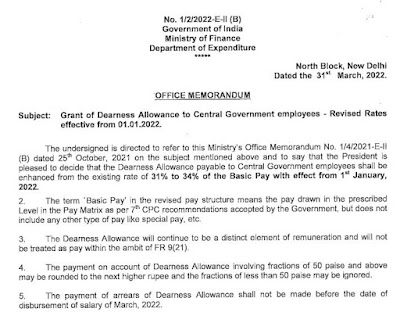
DA Jan 2022 - Grant of Dearness Allowance to Central Government employees - Revised Rates effective from 01.01.2022

 3% DA Hike - Revised Rates effective from 01.01.2022: DoE OM dated 31.03.2022 No. 1/2/2022-E-II (B) Government of India Ministry of Finance...