Monday, 28 September 2015

2nd SEP 2015 – Historic Strike was a grand success in almost all the sectors of working clasw

EDITORIAL POSTAL CRUSADER OCTOBER-2015

2nd SEPTEMBER-2015 –A HISTORIC STRIKE
2nd September 2015. Historic Strike was a grand success in almost all the sectors of working class whether it is Government Sector, Public Sector, Private Sector – organized or unorganized. Crores and crores workers have taken part in it and established so many mile stones in the history of working class movement. The grand success of this strike in strategic fields like Road transport, Coal Mines, Petroleum, Power, Tele Communication is one of the important phenomenas.

This strike was organized by the sponsoring Committee of all Central Trade Unions pursuing 12 points Charter of Demands including withdrawal of anti Labour Laws amendments and FDI in strategic sectors, in protest against lend acquisition Ordinance and Bill and peasants distress and for changing the neo-liberal path of development.

The strike was the result of hard labour of the thousands of Trade Union activists who mobilized and launched vigorous campaign for the months together..

This strike of crores of workers has given clear indication to present Central Government that now the worker has awakened and he is not going to allow the attacks and dangers being unleashed on him in the pursuance of neo-liberal economic policies.

This time this strike was a grand success among Central Government Employees.

In Postal except some circles it was grand success and better than the previous strikes. It shows that the Postal Workers are also not agreed to accept the proposals and recommendations submitted by Task Force Committee headed by T.S.R. Subramanian Ex. Cabinet Secretary as Chairman who laid out a road map of corporatization and Privatization of Department of Post. This is also culmination of anger and protest of Postal Employees that the 50% Work force of this Department i.e. Gramin Dak Sevaks, who are not treated as Civil servant. The demand of NFPE and PJCA for inclusion of GDS in 7th CPC has not been accepted by Government of India. The Cadre restructuring proposals of all Cadres of Postal; were agreed long back but not being implemented. Thousands and thousands of posts in all Cadres are also not being filled besides vigorous pursuance by the NFPE and PJCA.

The PJCA comprising NFPE, FNPO, AIPU-GDS (NFPE) and NUGDS has viewed very seriously with grave concern the totally negative attitude of the Government of India and Department of Post and has decided to go on indefinite strike from 23rd Nov-2015 on the above demands.

NFPE appeals to the entirety of Postal, RMS and GDS Employees to start preparations justify now to make the indefinite strike from 23rd November-2015a grand success to compel the Government of India and Department of Post to concede our demands. Nothing in past has been achieved without struggle and nothing is going to be achieved without struggle. So unite and fight and achieve.

UNITY FOR STRUGGLE AND STRUGGLE FOR UNITY.
Working Class Zindabad
Postal Workers Zindabad.

Source: National Federation of Postal Employees

A Readers’concerns of false news about 7th pay commission recommendation

A Readers’concerns of false news about 7th pay commission recommendation

One of our readers  Shri.Jai Kishan Desais‘ concerns of false News items posted in media recently about 7th pay commission recommendations is given below..

“….The Central Government employees are fed up with the false news items that keep coming about 7th Pay Commission which are published in Dailies and blogs and in Social Media recently. Baseless Predictions, groundless assumptions, imaginary calculators, truth less articles and to this extreme… Dubious Projects are also being published about 7th Pay commission recommendation

What is the reason behind these false report keep coming in News Media and Blogs? What is the intention which prompt them to publish these rubbish articles regarding 7th pay commission in their websites?
The intention behind publishing these article is not to give the correct information to central government employees but promoting their websites using the trending news and key words. Among central government employees the attracting word now is 7th pay commission, 7th pay commission pay scale and date of submission of 7th pay commission report.

Recently the articles which have been published in some leading news websites showed their lack of knowledge in the matters of service condition of central government employees and 7th pay commission.
The main focus of these articles are attracting people to their website and to increase the ranking in search results. Merely promoting their websites in search results, they started publishing articles which has no value and bearing misleading facts. The same old story repeated in every articles published

Recently many articles, which are published in websites about the recommendation of 7th pay commission, are nothing more than gimmicks. One article posted in a blog says ….

        7th pay commission recommendations for …
> Children education Allowance will be Rs.40 to 50
>  Allowance for disabled children will be Rs.100/-
> Hostel Subsidy will be Rs.300/-
7th pay commission recommendation


This News went viral in Social Media and surprisingly many websites posted this information without knowing that it was recommended by Fifth Pay Commission.
pay commission recommendation of CEA 

This News went viral in Social Media and surprisingly many websites posted this information without knowing that it was recommended by Fifth Pay Commission.
pay commission recommendation of CEA

Another Example is, in a leading website the story mentioned below was published

“There will be 5 to 6% performance-based increment every year and those who are under-performing could retire by 55 years of age or after 30 years of service, added sources. House Rent Allowance could also be hiked by 10% to 30%”

7th PAy commission recommendation of HRA
It seems that those who wrote these articles didn’t know not even the existing rates of allowances paid to central government employees, but they try to impress the central government employees by their prediction about the Pay scales and Allowances of 7th pay commission going to be recommended in future.
It is the readers’ responsibility to identify these websites and to keep themselves aware of it.
  • Jai Kishan Desai, Pune

COMPULSORY RETIREMENT AFTER 30 YEARS OF SERVICE/ON REACHING 50 YEARS OF AGE?VIEWS OF EMPLOYEES

COMPULSORY RETIREMENT AFTER 30 YEARS OF SERVICE/ON REACHING 50 YEARS OF AGE?VIEWS OF EMPLOYEES

Recently, the Central Government Employee’s Welfare Ministry released an announcement which has created panic and commotion among the central government employees.

In the announcement it has been said that senior officials have to analyse the service record and decide whether employees who have completed thirty years of service or reached their 50th year should continue their service or be advised to leave service after three months notice.

Does it take a management to learn that an official or an employee is unfit to continue in service when he has reached his 50th year? Does it take thirty years of continuous service to assess the efficiency of an employee?
Can’t the ability of an employee be learnt during his probation period? Leaving an employee at such times and trying to force him out of service when he is old appears rather inhumane.

When problems like educations expenses of children, marriage and housing loan afflict employees, the announcement of compulsory retirement will certainly be a great shock.

Hence, Central Government should provide an explanation about the announcement and help clear the doubts of the central Government Employees. Changes have to be made at the beginning itself. If the Central Government brings changes at a very late period then the purpose for which it released this very announcement would become futile and ineffective. On the contrary, it will only lead to a loss of trust that employees have on the Central Government.

Source: 7-paycommission.in

Sunday, 27 September 2015

Expected Dates for 7th pay commission Report

Expected Dates for 7th pay commission Report

Comrades,
There are lot of enquiries about the 7th CPC report submission. Let us examine the following facts.
1) The 7th CPC had issued following statement in July 2015 in its website http://7cpc.india.gov.in/ . Even today the same status is existing.

“Further to the memorandum received from a variety of Organisations, Federations, Groups representing civil employees in the Government of India as also from the Defence Services, the Commission has had fruitful and wide ranging discussions on relevant issues with all stakeholders. Such interactions have now been concluded. Valuable inputs have been received and the work of compilation and finalization of the report is underway, so that the Commission completes its task in the time frame given to it. Accordingly, any future requests for meeting with the Commission will not be entertained.”

This shows clearly that the 7th CPC wanted to present its report on 28th August 2015 itself with no extension of time.

2) On August 7, 2015 National Council (Staff Side) Secretary Comrade Shiva Gopal Mishraji met the Chairman, Seventh Central Pay Commission, Shri Ashok Kumar Mathur and Secretary, Mrs. Meena Agarwal. It was assumed that the report of the VII CPC, as was promised for 28th August this year, may be delayed by one month.

This shows that the 7th CPC was delayed only one month..

3) Many news papers including Danik Bhaskar, Times of India, NDTV CNN IBN, Hindu etc had reported that the 7th CPC will be submitting its report on 30th September 2015 itself.

4) The 7th CPC chairman had informed in a PTI interview Justice Ashok Kumar Mathurji had stated that “The Commission will submit its report by the end of September,”

5) The Hon’able Finance Minister had also informed the 7th CPC report will be submitted shortly.

6) The 7th Pay Commission has asked for a two month extension from the government. That the Commission is hoping that the government would take a call on One Rank One Pension, so they could modulate their own formulation in terms of pay revision. Now the one rank one pension issue has been resolved, but the formal orders are not issued, it will be issued only next month. After the issue of the OROP orders then 7th Pay Commission will submit its report.

7) Now four month extension of term of 7th Central Pay Commission is made the Union Cabinet chaired by the Hon’able Prime Minister, gave its approval for the extension of the term of the 7th Central Pay Commission by four months up to 31.12.2015. The Government had issued notification on 8th September “The Commission will make its recommendations by 31st December, 2015. It may consider, if necessary, sending reports on any of the matters as and when the recommendations are finalized.”

8) Now the delay in submission of report and its implementation will be there and actual benefit of 7th CPC will occur only from April 2016. As Government will constitute its own committee to study the implementation of the 7th CPC report and issuing orders. It will benefit the Government as allowances effective date may be from April 2016 instead of January 2016.

9) When will the 7th CPC submit its report? There are three possibilities now on submission date.
a) If the 7th CPC feels that the assigned work has been completed it can submit its report any time, it’s only up to the 7th CPC and the Central Government. If the 7th CPC report is completed and ready for release as per paper reports then in these case the 7th CPC can directly submit its report to the Finance Ministry on 30th September without publishing the report in public due to Bihar elections. If election commission gives clearance then the 7th CPC report will be made public.

b) There is one more possibility is that the 7th CPC report will be submitted after Bihar elections ie after November 6th.

c) Last option is that report will be submitted only in December 2015 only.

We sincerely hope the 7th CPC report will be submitted at the earliest and the Central Government will implement the report at the earliest, so that the aspiration of the Central Government employees are taken care by the Central Government.

Comradely yours

(P.S.Prasad)
General Secretary

Source: http://karnatakacoc.blogspot.in/

7th Pay Commission likely to recommend up to 30% pay hike

7th Pay Commission likely to recommend up to 30% pay hike

7th Pay Commission likely to recommend up to 30% pay hike – There will be 5 to 6% performance-based increment every year and those who are under-performing could retire by 55 years of age or after 30 years of service, added sources. House Rent Allowance could also be hiked by 10% to 30%.

The government constitutes the Pay Commission almost every 10 years to revise the pay scale of its employees and often these are adopted by states after some modifications. As part of the exercise, the Commission holds discussions with various stakeholders, including organisations, federations, groups representing civil employees as well as Defence services.

The 7th Pay Commission is ready with its report and is expected to hand over the recommendations to the Central Government any time now. The Department of Personnel and Training will examine the recommendations and consult the Finance Ministry on them. After which the recommendations will be implemented from January 1, 2016.

We have information from reliable sources, which if true, will make the Central Government employees happy. The Seventh Pay Commission is likely to recommend a substantial pay hike which could be up to 30% or even more, said sources on Thursday.

There will be 5 to 6% performance-based increment every year and those who are under-performing could retire by 55 years of age or after 30 years of service, added sources. House Rent Allowance could also be hiked by 10% to 30%.

The Commission, whose recommendations may also have a bearing on the salaries of the state government staff, was given more time by the Union Cabinet just a day before its original 18-month term was to end. Headed by Justice AK Mathur, the Commission was appointed by the previous UPA government in February 2014.

Source: CNN IBN

Saturday, 26 September 2015

Payment of Dearness Allowance to Railway employees – Revised rates effective from 01.07.2015

DA from July 2015 for Railway Employees – Railway Board Order for increase of DA from 113% to 119% with effect from July 2015
Payment of Dearness Allowance (119%) to Railway employees w.e.f 01.07.2015
GOVERNMENT OF INDIA
MINISTRY OF RAILWAY
(RAILWAY BOARD)


S.No.PC-VI/356
RBE No.115/2015
No.PC-VI/2008/I/7/2/1
New Delhi, dated 24/09/2015
The GMs CAO(R)
All zonal Railways & Production Units
(as per mailing list)

Sub: Payment of Dearness Allowance to Railway employees – Revised rates effective from 01.07.2015

Please refer to this Ministry’s letter of even number dated 13.04.2015 (S.No.PC – VI 349, RBE No.35/2015) on the subject mentioned above. The president is pleased to decide that the Dearness Allowance payable to Railway employees shall be enhanced from the existing rate of 113% to 119% with effect from 1st July, 2015.

2. The provisions contained in para 3,4 & 5 of this Ministry’s letter of even number dated 09.09.2008 (S.No.PC-VI.3, RBE NO.106/2008) shall continue to be applicable while regulating Dearness Allowance under these orders.

3. The additional installment of Dearness Allowance payable under these orders shall be paid in cash to all railway employees. The arrears may be charged to the salary bill and no honorarium is payable for preparing separate bill for this purpose.

4. This issues with the concurrence of the Finance Directorate of the Ministry of Railways.

Sd/-
(M.K.Panda)
Jt. Director, Pay Commission
Railway Board.
Railway Board Signed Copy

Friday, 25 September 2015

7th Pay Commission: Salary rises should be based on performance

7th Pay Commission: Salary rises should be based on performance

New Delhi: The Seventh Pay Commission is likely to recommend to rise the salary of central government employees should be based on performance in the office, rather than just time served.
The central government urged the Seventh Pay Commission to make proposal for enhanced pay and special incentives as performance based annual increments.

Appraisals for government employees were introduced since British period but didn’t affect pay. Eight years ago, the Sixth Pay Commission asked to link the performance of central government employees with their pay.

The Sixth Pay Commission had carried out a study through the Indian Institute of Management, Ahmedabad, on a performance-based incentive system, to ostensibly improve the performance outputs of Central government employees.

The study was aimed at working out a model whereby a base salary is attached to each post based on skills and responsibility and simultaneously, a second component would be payable over and above the salary on the basis of the productivity and performance of employees, either individually or as a group.

The government employees believe pay should reflect the cost of living while private sector workers believe pay should reflect performance.

Accordingly, the Narendra Modi government plans to move towards making increment programmes based on performance rather than on time-served through the Seventh Pay Commission and automatic annual incremental pay progression would be scrapped in central government ministries and departments.

The original idea behind performance incremental pay is that every central government employee takes a while to become fully competent in a role, so government can reward them as they grow in competence and experience.

Despite the government having powers to withhold increments, but nowadays, very few do, so there is a culture of government employees moving up the pay scale irrespective of their performance.

The bottom line is if government doesn’t get rid of automatic incremental progression, the government can’t control pay, and that is what the Modi government has realised.

The central government employees can play a vital role in this way in nation building.

Therefore, the Seventh pay commission may recommend up to 5 percent performance-based increment instead of automatic annual increment for central government employees.

TST

Grant of CSD Canteen Facilities to retired Defence Civilians: CGDA’s instructions

Grant of CSD Canteen Facilities to retired Defence Civilians: CGDA’s instructions
Consequent to the grant of CSD Canteen Facilities to the Defence civilians Pr. Controllers/Controller to nominate an Officer for countersigning the application forms 

Pr. Controllers/Controller to nominate an Officer for countersigning the application forms received from the retired Defence Civilians for grant of CSD Canteen facilities

Pr. Controllers/ Controllers are requested to nominate an Officer not below the rank of an Under Secretary to Govt of India or equivalent for countersigning the application forms received from the applicants of Defence Civilians for grant of CSD Canteen facilities.

GOVERNMENT OF INDIA
MINISTRY OF DEFENCE
DEFENCE ACCOUNTS DEPARTMENT
No.AN/VIl/7089/CSD/ Corr
Dated : 21.09.2015
To
1. All PCsDA/ CsDA
2. PCA(Fys) Kolkata

Subject: Grant of CSD Canteen Facilities to retired Defence Civilians,

Reference : This office letter of even No dated 14.08/2015

A copy of the DDGCS letter 96301/Q/DDGCS/Policy dated 12.08.2015 regarding CSD Canteen facilities to retired Defence Civilians. is forwarded herewith for information and necessary action. The letter is to be given wide publicity by displaying on the notice boards/ websites.

2. Further, attention is invited to point 7 and 9 of the letter wherein action to be taken on the part of the Department from where the Officer/ employee has retired has been mentioned. The Pr. Controllers/ Controllers are requested to nominate an Officer not below the rank of an Under Secretary to Govt of India or equivalent for countersigning the application forms received from the applicants.

The orders should be promulgated and the details be forwarded to DDGCS, Army Headquarters, New Delhi.
(Sangeet)
Dy.CGDA(AN)

Thursday, 24 September 2015

Centre notifies hike in dearness allowance to 119%

Centre notifies hike in dearness allowance to 119%

New Delhi: Centre notified its decision to raise dearness allowance (DA) to 119%, from 113%, benefiting 50 lakh central government employees and 56 lakh pensioners including dependents.

The union cabinet had decided on 9 September, to release an additional instalment of DA and dearness relief (DR) to pensioners with effect from 1 July 2015. Thus, the central government employees as well as pensioners are entitled for DA/DR at the rate of 119% of the basic with effect from 1 July 2015.

“…the President is pleased to decide that DA payable to central government employees shall be enhanced from existing rate of 113% to 119% with effect from 1 July 2015,” the Finance Ministry’s Office Memorandum No.1/3/2015-E-II-(B) dated September 23, said.

According to the official order, the additional instalment of DA payable under these orders shall be paid in cash.
In regard to armed forces personnel and railway employees, separate orders will be issued by the ministry of defence and ministry of railways, it said.

The government has estimated that the combined impact on exchequer on account of both DA and DR would be Rs 4,436.76 crore in the remaining months of the current financial year and Rs 6,655.14 in a year.
The DA rate increase is based on an average of 12-month consumer price index-industrial workers (CPI-IW) from 1 July, 2014 to 30 June, 2015. This is in line with the Sixth Central Pay Commission.

In April, the government had hiked DA by six per cent to 113 per cent of their basic pay with effect from January.

Finance Minister Arun Jaitley said the Seventh Pay Commission will shortly submit its report to the government and will consider this amount of DA in its recommendations. Recently, its term was extended till December 31.

The commission was constituted in February 2014 and was to submit its recommendations within 18 months.
TST

DA Order July 2015 – Finmin issued orders for the payment of DA at 119% from 1.7.2015

DA Order July 2015 – Finmin issued orders for the payment of DA at 119% from 1.7.2015

Payment of Dearness Allowance to Central Government employees – Revised Rates effective from 1.7.2015
No.1/2/2015-E-II (B)
Government of India
Ministry of Finance
Department of Expenditure
North Block, New Delhi
Dated: 23rd September, 2015.
OFFICE MEMORANDUM

Subject: Payment of Dearness Allowance to Central Government employees – Revised Rates effective from 1.7.2015

The undersigned is directed to refer to this Ministry’s Office Memorandum No.1/2/2015-E-II (B) dated 18th September, 2015 on the subject mentioned above and to say that the President is pleased to decide that the Dearness Allowance payable to Central Government employees shall be enhanced from the existing rate of 113% to 119% with effect from 1st July, 2015.

2. The provisions contained in paras 3, 4 and 5 of this Ministry’s O.M. No. 1(3)/2008-E-II(B) dated 29th August, 2008 shall continue to be applicable while regulating Dearness Allowance under these orders.

3. The additional installment of Dearness Allowance payable under these orders shall be paid in cash to all Central Government employees.

4. These orders shall also apply to the civilian employees paid from the Defence Services Estimates and the expenditure will be chargeable to the relevant head of the Defence Services Estimates. In regard to Armed Forces personnel and Railway employees, separate orders will be issued by the Ministry of Defence and Ministry of Railways, respectively.

5. In so far as the employees working in the Indian Audit and Accounts Department are concerned, these orders are issued with the concurrence of the Comptroller and Auditor General of India.
Sd/-
(A. Bhattacharya)
Under Secretary to the Government of India

Authority: www.finmin.nic.in

DA ORDER 2015 FROM 1.7.2015 ENGLISH

Flash News

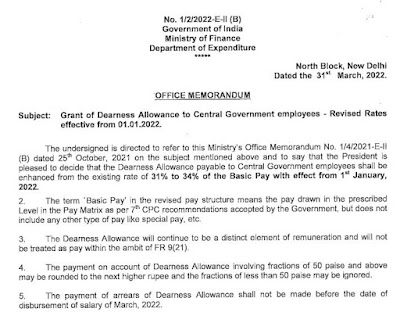
DA Jan 2022 - Grant of Dearness Allowance to Central Government employees - Revised Rates effective from 01.01.2022

 3% DA Hike - Revised Rates effective from 01.01.2022: DoE OM dated 31.03.2022 No. 1/2/2022-E-II (B) Government of India Ministry of Finance...