Thursday, 30 July 2015

What are the expectations of the Central Government employees from the 7th Pay Commission?

What are the expectations of the Central Government employees from the 7th Pay Commission?

“It is impossible for the 7th Pay Commission to fulfill all the demands of the Central Government employees. The question is – will it at least address the concerns of majority of them?”

The media is full of unconfirmed reports on the submission of 7th Pay Commission report to Central Government. Recently in an interview with a leading English newspaper, Neelakanth Mishra, India equity strategist of Credit Suisse expressed his strong opinions about the 7th Pay Commission and the implementation of its recommendations.
The big question is – what are the expectations of the Central Government employees from the 7th Pay Commission?
In an exclusive interview to NDTV, Neelkanth Mishra said that there are possibilities of a 40% hike in the salaries of Central Government employees. He believed that the 7th Pay Commission will submit its report to the Government in the month of September and the recommendations will be implemented next year.
The employees are likely to get a hike of 30-40%. This time around, the implementation wouldn’t be like it was previously, during the 6th Pay Commission, due to the amount of arrears (it is worth mentioning that the arrears dues were paid in two installments during the 6th Pay Commission). He said that the economic status of Central Government employees would increase enough to afford a car.

His forecast has to be taken seriously. On August 15, 2008, the then Prime Minister Manmohan Singh had announced that the 6th Pay Commission will come into effect from September onwards. More than the salary hike, the employees were curious to know about the arrears and how they were going to get it, because the sum was huge.

The employees didn’t make such a huge fuss about the increment they had received. Instead of small hike that was added to the salary, they were more interested in the lump sum arrears. Since it was impossible to clear 30-months’ arrears in a single payment, the government was forced to release it in two installments.
But this time, the government is particular about giving an increment in salary and allowances without keeping any pending arrears. Therefore the employees are curious to know about their salary hikes.

Source: www.cgstaffnews.in

Relaxation of Age in recruitment of Industrial Employees

Relaxation of Age in recruitment of Industrial Employees.
“As per Recruitment Rules (SRO) the age of the candidates should be between 18 to 32 years and as per OFB/MOD instructions age relaxation is granted for Ex-Trade Apprentices of Indian Ordnance Factories the period for which they had undergone training under the Apprentices Act, 1961″.
BHARATIYA PRATIRAKSHA MAZDOOR SANGH
(AN ALL INDIA FEDERATION OF DEFENCE WORKERS)

REF: BPMS / OFB / RR / IEs / 22 (7/2/L)
Dated: 28.07.2015
To,
The DGOF & Chairman,
Ordnance Factory Board,
10 A, S K Bose Road,
Kolkata – 700001

Subject: Relaxation of Age in recruitment of Industrial Employees.

Respected Sir,

With due regards, it is submitted that applications from eligible citizens of India are being invited by Ordnance & Ordnance Equipment Factories for filling up the vacancies in Group ‘C’ Industrial Employees (IEs) in the Pay Band of Rs. 5200 – 20200, Grade Pay of Rs. 1800/- plus allowances as admissible to Central Government employees. As per Recruitment Rules (SRO) the age of the candidates should be between 18 to 32 years and as per OFB/MOD instructions age relaxation is granted for Ex-Trade Apprentices of Indian Ordnance Factories the period for which they had undergone training under the Apprentices Act, 1961.
Due to above relaxation, an Ex-Trade Apprentice of general category of Ord Fy gets 03 yrs age relaxation and he is eligible to apply for the Semi Skilled post upto the age of 35 (32 + 03) yrs, whereas a general candidate after passing National Trade Certificate (NTC) from any ITI undertakes his Apprenticeship of 01 year from any Ord Fys may get age relaxation of 01 year and he is eligible to apply for the same post upto the age of 33 (32+01) years only. This discrimination of age relaxation is causing discontentment amongst the Ex-Trade Apprentices of Ord Fys.

Therefore, you are requested to issue necessary instructions regarding age relaxation for recruitment of Semi-Skilled so that Ex-Trade Apprentices whether they have undergone entire apprenticeship of 03 yrs in Ord Fys or they have undergone apprenticeship of 01 year in Ord Fys after passing 02 yrs NTC from ITI may be equally benefitted and age relaxation may be granted for the period of training obtained from ITI plus apprenticeship in Ord Fys, i.e., eligible upto the age of 32 + 2+1= 35 yrs.

Thanking you.
Sincerely yours
(M P SINGH)
General Secretary
Source: BPMS

Fix minimum wage with provisions of indexation – Item No.5 Charter of Demands

Fix minimum wage with provisions of indexation – Item No.5 Charter of Demands
Item No.5.
Fix minimum wage with provisions of indexation.

(i) Effect wage revision of the Central Government Employees from 01.01.2014 accepting memorandum of the staff side JCM; ensure 5-year wage revision in future; grant interim relief and merger of 100% of DA; Include Gramin Dak Sevaks within the ambit of 7th CPC. Settle all anomalies of 6th CPC.

The 7th CPC was set up in 2013 by the then Government consequent upon the continuous struggles  undertaken by the Central Government under the leadership of the Confederation of Central Government employees and workers. Under its banner various struggles were carried out from December, 2010 till the announcement of the setting up of the 7th CPC. During this period, the Confederation organized one day strike on 12th December, 2012 and again two day strike action on12th and 13th February, 2014. As per the terms of reference, the Commission is to submit its report within 18 months. If they abide by the stipulated time frame, its report must be available by the end of August, 2015. In this context, the formulation made before the Commission untidily by all organizations of the Central Government, especially those participating in the National negotiating forum of JCM is worth reproducing.

All previous Pay Commissions were of the opinion that wages cannot be determined on any single principle but has to be based upon a combination of all the enunciated principles or those principles are to be factored into the process of quantification. Since the Government as an employer had not been able to grant the need based minimum wage to its own employees till date we are of the opinion that the 7th CPC must endeavour to compute the wage structure on 15th ILC norms. We suggested two other principles to be factored in to the quantification of pay beyond the minimum level. We enumerate hereunder the factors to be taken into account:

1) The Need-Based Minimum Wage concept to compute pay at the minimum level.

2) The intrinsic value of the job content of each grade and post at the intermediary level to be assessed by an expert committee. Pending finalization of such a study, the Commission may maintain the presently existing vertical and horizontal relativities.

3) To take into account the outside rates to determine the pay package at senior levels of bureaucracy but maintain the ratio between the minimum and maximum at 1 : 8 (MTS: Secretary to Govt. of India).

We make the above suggestion, being just and reasonable on the following grounds:
1. The Fair Wage Committee has held that an industry which is incapable of paying minimum wage has no justify to exist.
2. 86% of Central Government Employees are industrial or operational workers.
3. The need based minimum wage concept formulated by Dr. Aykhroyd and approved by 15 ILC was considered the most important principle in computing salary of Government employment especially of those lower level functionaries, by the 2nd, 3rd, 4th and 6th CPC.
4. It is only the fear of a heavy financial implication and the incapacity of the Indian economy at the relevant point of time, to meet the extra expenses the 2nd, 3rd and 4th CPCs were constrained to alter the formula itself with the opinion of certain nutritional experts. The legitimacy provided to Dr. Aykhroyd formula by the 15th ILC (in which the representative of Labour, Employers and Government participated) was not available for any other conceptual frame work proposed by any other “experts”. The 4th Pay Commission cited the per capita net national product increase over the years to justify lower minimum wage than what could have been as per the ILC norms. It could be seen that the earlier Pay Commissions had adopted a different principle other than the Dr. Aykhroyd formula due to financial constraints.
5. Despite elaborately detailing the concept of living wage and the amendment to the preamble of the Indian Constitution, the 4th CPC stated that the per capita net national income increase if factored would not allow them to fix the minimum wage at a higher level than Rs.750/-.
6. Even though no specific reference on the adoption of the concept of need based minimum wage was made by the Government, the 5th CPC did dwell upon it. They advocated that the 25% addition suggested by the Supreme Court to enable the worker to meet the expenses, viz., children education, medical requirements, social obligation connected with festivals, marriages, etc. must be added to arrive at the minimum wage. However, they computed the minimum wage discarding the same principle but made the percentage increase of the per capita net national product over a period of ten years as the base (or the constant relative income criterion as the most equitable norm). In order to arrive at the minimum pay, the Commission added 30.9% over the emoluments of a lowest paid employee as on 1.1.1996.
7. The 6th CPC adopted the 15th ILC norms to compute the minimum wage but made several changes to the concept Viz., the retail prices of the commodities, which goes into the reckoning was altered; the stipulated 10% for housing and 25% for social obligations, medical, children education, etc. were discarded on the plea that separate allowances had been granted. Dr. Aykhroyd had factored 7.5% as housing component in the computation of minimum wage. The question of incorporating the cost of requirement for medical, education and other social obligation was the subject matter of litigation before the Supreme Court. The Hon’ble Court directed that 25% of the minimum wage so computed must be added as a factor for the above requirement of a worker, which had not been taken into account by the ILC norms.
The contention of the 6th CPC that since children education allowance, Medical and house rent allowances are specially granted to the Central Govt. employees, the same must be taken out of the reckoning is not only wrong but also amounts to contradiction of a stand taken by the Highest judiciary of the country- Supreme Court. The 6th CPC has failed to take note of the fact that the allowances, be it HRA, Children Education allowance or Medial, granted are awfully insufficient to meet the requisite expenses. Had it not been the case, the 3rd CPC also ought to have taken the similar stand adopted by the 6th CPC. The computation appearing in page No. 60, Chapter 6 (3rd CPC report) establishes our view in the matter.

We have given in Table (.5.1..) the computation of minimum wage as per 15th ILC norms. The retail prices of the commodities/articles are the average of the retail prices ruling as on 1.1.2011 at the following cities:
1. New Delhi,2 Mumbai, 3. Chennai, 4. Kolkata, 5 Hyderabad, 6. Bhubaneswar, 7. Thiruvananthapuram, 8. Bangalore.

The minimum wage as per our computation works out to Rs.20,856/-. This must be the minimum wage for the unskilled worker as per the ILC norms. In Central Government employment presently there is no unskilled labour. The lowest level of employment is multiskilled worker/employees. The minimum educational qualification prescribed is either ITI or matriculation (10th Standard). The percentage increase of the wages of a skilled worker to that of an unskilled worker on an average had been more than 25% all throughout. We have therefore added 25% to arrive at the minimum pay for the lowest employee in Government service, which comes to Rs. 26,071/- , i.e. Rs. 26,000/- when rounded off.

Incidentally, we may mention that the minimum wages at the level of an unskilled worker as per recent wage agreement in Coal India Ltd. Is Rs.29697/-. The per-capita Net National Product increase at factor cost between – (2004-05 – 2011-12) years as per the Economic Survey for 2012-13 presented to Parliament is 57.55..%. This, if applied to the present wage at the lowest level shall work out to Rs.22857/-. For the reasons stated in the preceding paragraphs and more specifically for the reason that the Government has presently the capacity to pay as detailed in this memorandum, we request the 7th CPC to recommend the minimum pay to be assigned to the lowest level of Group C functionary in Government of India service at Rs. 26,000/-.

Another important issue, we took with the Government was the inclusion of the Grameen Dak Sewaks of the Postal Department within the ambit of the consideration of the 7th CPC. The Government did not concede our demand. The Postal Department had been objecting to this demand consistently on the plea that the Grameen Dak Sewaks were not civil servants. They had, therefore, resorted to setting up separate committees to consider the service conditions and wage rise of the Extra Departmental Agents, or Grameen Dak Sewaks. It must be stated with some satisfaction that during the negotiation that took place with the organizations of the Postal employees on the eve of the commencement of the indefinite strike action, the Postal Department had to agree to recommend the acceptance of this demand to the Government, though belatedly.

Despite the said belated suggestion made by the Postal authorities, there had been no positive response from the Government of India till date with the result the GDS, a significant segment of the Postal Department will be denied the wage revision along with the other Central Government employees, if immediate steps are not taken by the Government to ask the Commission to consider their case within a stipulated time. We give hereunder the reasons we have advanced for inclusion of GDS within the purview of the 7th CPC.

Grameen Dak Sewaks constitutes the single largest chunk of the postal workforce. Without them perhaps the rural postal system in the country will break down. The dedicated service of the Grameen Dak Sewaks keeps the postal department operational throughout the year.The system of Extra Departmental Agency was introduced by the colonial British rulers to reduce the running expenses of the postal system in the country. The exploitative system continued even after independence. By excluding the Gramin Dak Sewaks from the purview of inquiry of the Pay Commission, the Government wanted the system to continue as a means to reduce the running expenses of the Postal Department. The exclusion is sought to be made on the specious plea that the GDS are not Civil Servants.

The Government’s contention on this score had been the subject matter of judicial scrutiny. The Honourable Supreme Court has held that the Extra Departmental Agents are holders of Civil post. The 4th Central Pay Commission also held the same view and asserted that their service conditions must be inquired into by the Pay Commission. However, when the 5th CPC is constituted, Government set up a Committee under Justice Talwar to look into their case. The Government did not implement many of the recommendations of the Talwar Committee. It is in this context we plead that the Gramin Dak Sewaks must be brought within the purview of the 7th Central Pay Commission and justice rendered to them.

Source: Confederation

Charter of Demands and Explanatory Notes – All India Strike on 2.9.2015

Charter of Demands and Explanatory Notes – All India Strike on 2.9.2015

CHARTER OF DEMANDS.

1. Urgent measures for containing price-rise through universalisation of public distribution system and banning speculative trade in commodity market

2. Containing unemployment through concrete measures for employment generation. (iii) No ban on creation of new posts. Fill up all vacant posts

3. Strict enforcement of all basic labour laws without any exception or exemption and stringent punitive measure for violation for labour laws. Against Labour Law Amendments

(viii) No labour reforms which are inimical to the interest of the workers.

4. Universal social security cover for all workers

(v) Scrap PFRDA Act an re-introduce the defined benefit statutory pension scheme. (6)Assured enhanced pension not less than Rs. 3000/- P.M. for the entire working population.

5. Fix minium wage with provisions of indexation.

(i) Effect wage revision of the Central Government Employees from 01.01.2014 accepting memorandum of the staff side JCM; ensure 5-year wage revision in future; grant interim relief and merger of 100% of DA; Include Gramin Dak Sevaks within the ambit of 7th CPC. Settle all anomalies of 6th CPC.

6. Stoppage of disinvestment in Central/State PSUs. . Stoppage of contractorisation in permanent perennial work and payment of same wage and benefits for contract workers as regular workers for same and similar work.

(v) No outsourcing, contractorisation, privatization of governmental functions; withdraw the proposed move to close down the printing presses, the publications, form stores and stationery departments and medical stores Depots; regularize the existing daily-rated/casual and contract workers and absorption of trained apprentices.

7. Removal of all ceilings on payment and eligibility of bonus, provident fund; increase the quantum of gratuity.

(ix) Remove the ceiling on payment on bonus

8. Compulsory registration of trade unions within a period of 45 days from the date of submitting applications; and immediate ratification of ILO Convention C 87 and C 98.

(vi) Revive the JCM functioning at all level as an effective negotiating forum for settlement of the demands of the Central Government Employees.

9. Against FDI in Railways, Insurance and Defence.

(ii) No Privatisation, PPP or FDI in Railways, Defence Establishment and no corporatization of Postal services.

10 Remove arbitrary ceiling on compassionate appointment.

11. Ensure five promotions in the serve career.

Source: Confederation
[https://drive.google.com/file/d/0B0rqvSYMJv2ISl92RXBDd3N6UzA/view]

No Holidays for Central Government Offices – Funeral of Dr. A. P. J. Abdul Kalam will be held at 11 AM at Rameswaram on 30.7.2015

No Holidays for Central Government Offices – Funeral of Dr. A. P. J. Abdul Kalam will be held at 11 AM at Rameswaram on 30.7.2015

The Home Ministry in an official statement confirmed that “State funeral of former president Dr. A.P.J. Abdul Kalam will be held with full military honours on July 30 (Thursday) at 11 a.m. at Rameswaram in Tamil Nadu,”

WIRELESS MESSAGE
CRASH
FROM : HOME NEW DELHI

TO : CHIEF SECRETARIES OF ALL STATE GOVERNMENTS & ADMINISTRATORS OF UNION TERRITORIES.

REPEAT :  SECRETARIES TO GOVERNORS/LT. GOVERNORS  OF ALL STATES/UNION TERRITORY ADMINISTRATIONS

No.3/3/2015 – PUBLIC
DATED : 28th July, 2015

IN CONTINUATION OF MINISTRY’S WIRELESS MESSAGE OF EVEN NUMBER DATED 27.7.2015 ANNOUNCING THE DEATH OF DR.A.P.J, ABDUL KALAM, FORMER PRESIDENT OF INDIA, IT IS INFORMED THAT THE STATE FUNERAL OF DR. ABDUL KALAM WILL BE HELD AT RAMESWARAM, TAMIL NADU WITH FULL MILITARY HONOURS ON 30th JULY, 2015 (THURSDAY) AT 11.00 AM
sd/-
(SATPAL CHOUHAN)
JOINT SECRETARY TO THE GOVT OF INDIA
Copy for information and necessary action:
1) Secretary, Ministry Of Defence, South Block, New Delhi.
2) Chief Secretary, Govt. Tamil Nadu, Chennai.
3) Collector, Ramanathpurarn, Tamil Nadu, Chennai.

Authority : www.mha.nic.in

Click to view the message

HOLIDAY – Government Holiday on 30.07.2015 as a mark of respect to Late Thiru A.P.J. Abdul Kalam, Former President of India under Negotiable Instruments Act – Orders issed

HOLIDAY – Government Holiday on 30.07.2015 as a mark of respect to Late Thiru A.P.J. Abdul Kalam, Former President of India under Negotiable Instruments Act – Orders issued.

PUBLIC (PROTOCOL-I) DEPARTMENT
G.O.Ms.No.1005
Dated: 28.7.2015
(Manmatha Aadi – 12, Thiruvalluvar Andu 2046)
Read
From the Joint Secretary to Government of India, Ministry of Home Affairs, New Delhi Wireless Message No.3/3/2015-PUBLIC, dated 27.7.2015.
ORDER
The Government of Tamil Nadu announce with profound regret the death of Thiru A.P.J. Addul Kalam, Former President of India on 27.07.2015 at Shilong. The Government have decided to declare a Public Holiday on the day of funeral i.e. on 30.07.2015 for all educational Institutions and for all Government / Private Establishments under the Negotiable Instruments Act, 1881, as a mark of respect to the former President.
(BY ORDER OF THE GOVERNOR)
Click to view the order

Tuesday, 28 July 2015

IBA Clarification on Paternity Leave, Encashment on LFC, Re-fixation of Pay and Special Allowance

IBA Clarification on Paternity Leave, Encashment on LFC,  Re-fixation of Pay and Special Allowance
ALL INDIA BANK EMPLOYEES’ ASSOCIATION
Singapore Plaza, 164, Linghi Chetty Street, Chennai – 600001

CIRCULAR No.27/120/2015/31
To
ALL UNITS AND MEMBERS:
27th July, 2015

Dear Comrades,

We reproduce hereunder the IBA’s Circular No.1120 dated 25-7-2015 providing clarification on the following issues referred to them.

1. Paternity Leave of 15 days can be availed by the employees within 6 months even if the date of delivery of the child was before 1-6-2015.

2. No leave is required to be taken for the purpose of encashment on LFC.

3. For Re-fixation of Pay for Ex-servicemen employees joined/joining the Banks on and from 1-11-2012, Special Allowance of 7.75% + DA will not be reckoned/included.

4. Special Allowance of 7.75 % + DA thereon will be included for encashment of PL on LFC/retirement.

5. Benefit of advancement of stagnation increment by one or two years for those who passed JAIIB/CAIIB/Graduation after reaching 19th/20th Stage shall be effective from 1st November, 2012.
With greetings,
Yours comradely,
sd/-
C.H.VENKATCHALAM
GENERAL SECRETARY
IBA CIRCULAR
HR & Industrial Relations
No.CIR/HR&IR/2015-16/XBPS/1120
July 25, 2015
Designated Officers of Member Banks which are parties to the BPS

Dear Sir/Madam,
X BP SETTLEMENT – CLARIFICATIONS

1. Paternity Leave:
Clause 32 of the X Bipartite Settlement provides the benefit of Paternity Leave w.e.f. 1.6.2015 to male employees with less than two surviving children for 15 days during his wife’s confinement and may be combined with any other kind of leave except Casual Leave. The leave may be availed upto 15 days before or upto 6 months from the date of delivery of the child.

Clarifications: The leave may be granted to an employee even where the date of delivery of the child was prior to 1.6.2015, provided, however, that the leave is availed within six months from the date of delivery. Further, the leave shall be sanctioned 15 days before the delivery or up to 6 months after the delivery.

2. Leave Fare Concession:
Clause 19 (iv) of IX Bipartite Settlement dated 27.4.2010 provided that an employee encashing the facility of Leave Fare Concession shall proceed on leave for a minimum period of one day.

Clarifications: Clause 19 (iv) of X Bipartite Settlement dated 25.5.2015 does not have this provision and hence with effect from 1.6.2015, employees may be allowed the facility of encashing of Leave Fare Concession without the requirement of availing Leave for this purpose.

3. Treatment of Special Allowance for fixation of Pay for Ex-Servicemen re-employed in Banks: Under Clause 9 of the X BPS, Special Allowance at the rate of 7.75% of the Basic Pay with applicable DA thereon will be paid w.e.f. 1.11.2012.

Clarification: Queries have been received as to whether the same is to be reckoned for the purpose of encashment of PL on LFC/retirement, Overtime, and while pay fixation of Exservicemen joined the service of the Banks on or after 1.11.2012. It is clarified that the Special Allowance is to be reckoned at the time of PL encashment on LFC/retirement, the same shall not be reckoned for the purpose of fixation of pay of Ex-servicemen who are remployed in Banks on or after 1.11.2012.

4. Adjustment/advancement of stagnation increment to employees who acquire JAIIB/CAIIB/ Graduation: Clause 11 of X BPS dated 25.5.2015 provides that in case where the non-subordinate employees as on the date of this Settlement, has already acquired JAIIB (Part-I) or CAIIB (Part-II)/ Graduation after reaching maximum of the scale of Pay (in case of JAIIB/ CAIIB/ Graduation) or after reaching 19TH stage of scale of Pay (in case of CAIIB/Graduation), and has not earned increment(s), otherwise entitled on account of acquiring such qualification, when there were no increments to provide in the scale of pay of those employees, the stagnation increment in such cases may be advanced by one year or two years as the case may be.

Clarification: Non-subordinate employees who acquires such qualification after reaching the 19th or 20th stagnation, their next immediate stagnation increment may be advanced accordingly by one/two years as the case maybe, w.e.f. 1.11.2012 or the actual date of such advancement whichever is later.
Member banks may please be guided as above.
Yours faithfully,
sd/-
K Unnikrishnan
Deputy Chief Executive
Source: www.aibea.in

Proposal for seeking one time relaxation in respect of LTC 80 claims of Defence Civilian Employees

MOD invites LTC Claim Details for one time relaxation – BPMS

Government of India
Ministry of Defence
D(Civ-I)
Subject : Proposal for seeking one time relaxation in respect of LTC 80 claims of Defence Civilian Employees
Defence Civilian Employees’ Federations are pursuing the above issue in the meetings of the JCM Departmental Council wherein they have informed that many Defence civilian employees while availing LTC by Air to destinations like A&N Islands, J&K and NER, did not follow the instructions regarding purchase of these air tickets only from the booking counters/websites of Air India or from the Authorized Travel Agents [M/s Balmer Lawrie & Co, M/s Ashok Travels & Tours and IRCTC]. A number of employees being first time travellers by air, did not observe these instructions due to ignorance. As a result, there administrative authorities have rejected their claims under LTC 80 submitted by them after performing the journey. To resolve this issue, the employees Federations have approached this Ministry and have requested to take up the matter to DoP&T with recommendation that:
 
a) Claims of Group C and B employees who are otherwise not entitled for Air Travel, in case they have availed LTC 80 by purchasing Air tickets from other than the authorized agents may be considered as a one time measure and a relaxation may be granted to pass their LTC claims as a special case;
 
b) For such employees who have purchased Air Tickets prior to 26 Sep 2014 from other than authorized agents to travel to A&N Islands, in their case, the LTC claim may be restricted to their entitled class in Steamer/Ship
 
2. The DoP&T have communicated vide their letter No.31011/6/2015-Estt.A IV dated 1st July addressed to JCM, National Council, that it would not be feasible to relax the LTC rules as a one-time measure. However, cases of individual hardship as recommended by Ministries/ Departments would be considered on a case to case basis.
 
3. Accordingly, it is proposed to take up the matter with the DoP&T for a decision on the LTC claims submitted by the defence civilian employees where the air tickets have not been purchased by these employees in accordance with the Government instructions. It is requested that the details of such cases may please be furnished in the enclosed proforma latest by 17 Aug 2015, along with views/comments, so that a consolidated proposal could be sent to the DoP&T for consideration of one time relaxation.
Encl : Proforma
Sd/-
Gurdeep Singh)
Under Secretary (Civ)
Click to view the proforma

One Time Relaxation for LTC claim: BPMS Circular

(AN ALL INDIA FEDERATION OF DEFENCE WORKERS)
(AN INDUSTRIAL UNIT OF B.M.S.)
(RECOGNISED BY MINISTRY OF DEFENCE, GOVT. OF INDIA)
CENTRAL OFFICE: 2-A, NAVEEN MARKET, KANPUR – 208001, PH & FAX : (0512) 2332222
MOBILE: 09415733686, 09235729390, 09335621629, WEB : www.bpms.org.in
REF: BPMS / CIR / LTC / 01
Dated: 27.07.2015
To,
The Office Bearers / CEC Members,
President / Secretary of the Unions
Affiliated to BPMS
Subject: One Time Relaxation for LTC claim

Dear brothers & sisters,
Namaskar

You may be aware of that Shri S N Batwe, Patron/BPMS highlighted some of the following issues related to LTC, thereupon vide letter No. BPMS / DoP&T/ LTC / 50 (7/2/R), Dated 10.11.2014 this federation requested the DoP&T as well as MOD to consider the issues sympathetically :-
 
(i) Earlier { DoP&T F.No. 31011/412007-Estt.(A), dated 02.05.2008} the Group ‘B’ Central Government employees were entitled to travel by Air from their place of posting or nearest airport but now {vide DoP&T O.M. No. 31011/ 3/ 2014-Estt.(A-IV), dated 26.09.2014} only eligible Government servants may travel from their place of posting or nearest airport, hence necessary clarification was required so that the Group ‘B’ employees may be entitled to travel by Air from their place of posting or nearest airport;
 
(ii) Vide DoP&T F.No. 31011/4/2007-Estt (A), Dated 30.04.2012 the Air travel relaxation under LTC for NER was extended for 02 yrs from 01.05.2012, i.e., applicable upto 01.05.2014 and vide DoP&T F. No. 31011/2/2003-Estt.A-IV, dated 15.06.2012 the Air travel relaxation under LTC for J&K was extended for 02 yrs from 18.06.2012, i.e., applicable upto 18.06.2014 whereas this order grants the relaxation for air travel w.e.f. 26.09.2014. There were some of the employees who have travelled by Air under LTC in the intervening period, i.e., 01.05.2014 / 18.06.2014 and 26.09.2014 in anticipation of extension of such relaxation as per prevailing practice. To mitigate the financial hardships of such employees, the DoP&T O.M. No. 31011/ 3/ 2014-Estt.(A-IV), dated 26.09.2014 should have retrospective effect, i.e., 01.05.2014.
 
(iii) Some of the defence civilian employees while availing LTC by Air to destinations like A&N Islands, J&K and NER, did not follow the instructions regarding purchase of their air tickets only from the booking counters/websites of Air India or from the Authorized Travel Agents [M/s Balmer Lawrie & Co, M/s Ashok Travels & Tours and IRCTC] and their LTC claims are not being allowed. Hence, one time relaxation is required to settle these cases.
 
Now, Min of Defence is considering the case (iii) and invited the details from concerned authorities. Hence, all are requested to forward their details through proper channel in given format only.
 
Thanking you.
Sincerely yours
sd/-
(MUKESH SINGH)
Secretary/BPMS & Member, JCM-II Level Council (MOD)
Source : BPMS

Requirement of getting prior permission for going abroad on private visit – Dopt Orders on 27.7.2015

Requirement of getting prior permission for going abroad on private visit – Dopt Orders on 27.7.2015

G.I., Dept. of Per. & Trg., O.M.No.11013/8/2015-Estt.A-III, dated July 27th 2015

Subject: Requirement of taking prior permission for leaving station/ headquarters for going abroad while on leave.

Undersigned is directed to refer to the Office Memorandum mentioned in the margin and to say that as per the existing instructions, when Government servant applies for leave for going abroad on a private visit, separately prior permission of the Competent authority for such visit is also required. While granting such permission, many factors are required to be kept in view. For example, permission may be denied in the interest of security. Individuals facing investigation/inquiry on serious charges, who may try to evade apprehension by police authorities, or facing the inquiry, may also not be permitted to leave the country. On the other hand, it is also desirable that requests of Government servants for such permission are dealt with expeditiously.

2. Keeping the above in view, it has been decided that requests for permission for private visits abroad may be processed in the attached formats. As clarified vide the OM dated 1st September, 2008, the competent authority for granting permission will be as per instructions issued by the Cadre Authority/administrative Ministry/Department. In the absence of any such instructions, it is the leave sanctioning authority. In case due to specific nature of work in a Department, administrative exigencies, or some adverse factors against the Government servant etc., it is not expedient to grant permission to the Government servant, such decision for refusal should not be taken below the level of Head of Department. It may be ensure,: that the decisions are conveyed to the Government servants within 21 days of receipt of complete application to the competent authority. Any lacunae in the application should be brought to the notice of the Government servant within one week of the receipt of the application. In the event of failure on the part of the competent authority to communicate its decision to the Government employee concerned with 21 days of receipt of the application, the employee concerned shall be free to assume that permission has been granted to him.

3. If in case some modifications are considered necessary due to specialised nature of work handled by any organisation, changes may be made with the approval of this Department.

Click to view the orders
Authority: www.persmin.gov.in

PM condoles the passing away of former President of India, Dr. APJ Abdul Kalam

PM condoles the passing away of former President of India, Dr. APJ Abdul Kalam
 

The Prime Minister, Shri Narendra Modi has condoled the passing away of former President of India, Dr. APJ Abdul Kalam.

“India mourns the loss of a great scientist, a wonderful President and above all an inspiring individual. Rest in peace Dr. APJ Abdul Kalam.

Dr. Kalam…my mind is filled with so many memories, so many interactions with him. Always marvelled at his intellect, learnt so much from him.

Dr. Kalam enjoyed being with people; people and youngsters adored him. He loved students and spent his final moments among them”, the Prime Minister said.

PIB News

Flash News

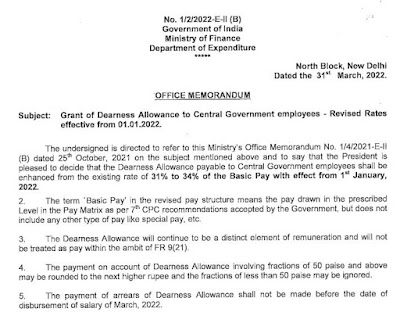
DA Jan 2022 - Grant of Dearness Allowance to Central Government employees - Revised Rates effective from 01.01.2022

 3% DA Hike - Revised Rates effective from 01.01.2022: DoE OM dated 31.03.2022 No. 1/2/2022-E-II (B) Government of India Ministry of Finance...