Monday, 29 June 2015

A concise introduction of pay commissions for Central Government Employees

A concise introduction of pay commissions for Central Government Employees.
Central Pay Commissions and Central Government Employees…
Generally, Central Government Employees who works in different ministries and departments under the Central Government, play major roles in the smooth functioning of the country. Employees under different departments work so hard to maintain law and order, stabilizing the economy, security to the people and defending our nation from enemies. Even though they are not large in numbers, their work during major crisis like natural calamities, earthquake and floods, stands apart. They are even asked to work 24 hours a day on all working days during emergencies. Our Defence Forces have done breathtaking efforts and marvellous work to evacuate Indian citizens from foreign countries which are under civil wars. They are bold enough to cross the border of our neighbouring country to fight against terrorists who had earlier ambushed and killed our security forces. Everyone must be proud of our defence forces for their bravery and skills.

Students after completing their tough academic career in different streams, keeps their first preference to get a government job. Though the pay packages are lower than multinational companies, they think that government jobs give more security to them.

As everyone knows that the pay and allowances for the central government employees are fixed by the central government as per the recommendations of Central Pay Commissions (CPCs). The central government constitutes Pay Commissions by appointing highly placed personalities as Chairman and Members. The commission then studies the economic conditions, day today difficulties of employees, their ideas etc., and give its recommendations to revise pay packages for the employees in every ten years. The commission submits its recommendations to the central government and the government in turn, takes final decision to implement the Pay Commission. Usually, the commission is given 18 months time to submit its report on the recommendations on pay revision:

PAY COMMISSIONS:

The First Pay Commission was appointed on May 1946, and it submitted its report in May 1947.
The Second CPC was appointed on August 1957, and it submitted its report in August 1959.
The Third CPC was appointed on April 1970, and it submitted its report in March 1973.
The Fourth CPC was appointed on June 1983, and three reports were submitted in June 1986, December 1986 and May 1987 respectively.
The Fifth CPC was appointed on April 1994, and submitted its report in January 1997.
The Sixth CPC was appointed on October 2004, and submitted its report in March 2008.

SEVENTH PAY COMMISSION:

The Seventh Central Pay Commission was constituted on the 28th of February 2014 under the Chairmanship of Justice Shri Ashok Kumar Mathur, Shri Vivek Rae as full time member and Smt. Meena Aggarwal as Secretary. The Commission has been given 18 months from the date of its constitution to make its recommendations.

From the date of its constitution, the commission travelled all over the country meeting different delegates, officers, trade union leaders, associations, employees etc., under different departments to take stock of the economic conditions faced by the employees and the impact of rising prices of essential commodities on them.

Finally, the Chairman of the 7th CPC in their final meeting with the National Council JCM, has said that Commission will submit its report to the central government in September 2015. Points regarding the implementation of the 7th CPC were discussed. The Chairman denied any proposal to implement the recommendations from 01.01.2014 and said that the revised pay structures and recommendations will be implemented from 01.01.2016.

Let us hope for the best!!!

Source: www.govtstaffnewsportal.in

AICPIN points for the month of May to be announced Tomorrow

AICPIN points for the month of May to be announced Tomorrow

“The Ministry of Labour will announce the ‘All India Consumer Price Index for Industrial Workers’ for the month of May, tomorrow; AICPIN indicates the rise and fall of prices of essential commodities across important towns and cities in the country”.

After significant changes in the Agricultural and Rural AICPIN points in the month of May, there is tremendous curiosity regarding the AICPIN points for the industrial workers. The index of Agricultural and Rural AICPIN had increased by 6 and 7 points to 811 and 816 respectively.

CPI (IW) BY 2001=100 points indicate the fluctuation of prices of essential commodities. If the CPI (IW) points increase, it leads to an increase in the percentage of additional Dearness Allowance for Central Government employees and Pensioners.

If the AICPIN for the month of May increases by 4 points, then the Dearness Allowance for July could be higher by 7%. In other words, from 113%, it could go up to 120%.

The AICPIN points of each month are calculated on the basis of the fluctuations in the prices of 24 commodities, including rice and wheat, in 78 selected cities and towns. The CPI (IW) BY 2001=100 of this month is released towards the end of the following month.

The present method of calculation was recommended by the 6th Central Pay Commission. From 01.01.2016 onwards, it will be calculated based on the recommendations of the 7th Central Pay Commission.

Source: www.cgstaffnews.in

Sunday, 28 June 2015

Tatkal booking likely to get easier – IRCTC

Tatkal booking likely to get easier – IRCTC

“Attempts are being made to simplify the extremely popular Tatkal reservation system.”

Tatkal booking is a blessing in disguise for train travelers who urgently need tickets, but the process of booking tickets on this system could be a constant source of irritation. Though plenty of reasons are attributed to it, the main grouse is the slow server connectivity and the IRCTC website’s inability to handle multiple user load.

Addressing this issue, Sandeep Dutta, the Chief Public Relation Officer of IRCTC, which is a sister concern of the Indian Railways, said, “All over the country, more than ten lakh tickets are reserved everyday, of which about 50% is booked through IRCTC.

“On the Tatkal system, between 10 AM and 12 PM, nearly 1.5 lakh tickets are booked everyday on the IRCTC website. In the beginning the website server was able to book only 7000 tickets per minute. Now, it has been raised to 14,000 e-tickets per minute.

“When users all over the country try to reserve tickets on Tatkal at the same time, the website crashes due to the overload. This has constantly been a huge challenge for IRCTC. Despite the fact that IRCTC has given a number of facilities, its reputation suffers due to this.

To tackle this problem, IRCTC decided to purchase five new world-class Singapore-based servers. These servers will be added to the main IRCTC server in another ten days. User capacity will increase from 14,000 to 24,000 per minute maximum. There will not be any website crash after that.

So, Tatkal reservation is going to become much more user-friendly.

Source: www.cgstaffnews.in

Saturday, 27 June 2015

Recognition of qualification acquired through distance learning mode from Indira Gandhi National Open University (IGNOU), New Delhi Diploma/Degrees -Acceptance for purpose of employment on the railways

Recognition of BCA degree acquired through distance learning mode of Indira Gandhi National Open University (IGNOU) for Junior Engineer Recruitment in Railways – RBE 67/2015

Railway Board has accepted the IGNOU diploma/degree for the purpose of employment in Railways.  Ministry Railways issue communication to all recruitment heads of Railways confirming Recognition of qualification acquired through distance learning mode from Indira Gandhi National Open University (IGNOU).

Government of India (Bharat Sarkar)
Ministry of Railways (Rail Mantralaya)
(Railway Board)
RBE No. 67/2015
No. E (NG)-11/201 0/RR-1 /17
New Delhi, dated: 16.06.2015
The General Manager (P),
All Zonal Railways/Production Units, CORE/Allahabad,
MTP/Kolkata, Chennai, Mumbai,
CAO (R), DMW/Patiala, COFMOW/New Delhi,
Director General, RDSO/Lucknow & NAIRNadodra,
Director, IRISET/Secundrabad, IRICEN/Pune, IRIEEN/Nasik &
IRIM&EE/Jamalpur and Chairmen/Railway Recruitment Boards.

Sub: Recognition of qualification acquired through distance learning mode from Indira Gandhi National Open University (IGNOU), New Delhi Diploma/Degrees -Acceptance for purpose of employment on the railways.

Ref: Letter No. 2002/AC-II(CC)/37/8 dated 17/11/2004 and No. 2002/ACII(CC)/37/8(Vol.l) dated 24/9/2012.
***
Minimum educational qualification for open market recruitment to the category of Junior Engineer (Information Technology), has been prescribed in terms of instructions referred to above.

An issue has been raised by one of Railway Recruitment Boards whether qualification of Bachelor in Computer Application (BCA) obtained from Indira Gandhi National Open University (IGNOU) New Delhi through distance learning mode is acceptable for employment on the railways, in lieu of qualification prescribed for the post of Junior Engineer (IT) vide letters ibid.

The issue has been examined in consultation with Accounts and C&IS Directorates of this Ministry. It has been decided by the Board that Qualification of BCA obtained through distance mode cannot be accepted in lieu of the minimum qualification prescribed for the post of Junior Engineer (II).
Please acknowledge receipt.

(This disposes of RRB/Kolkata’s letter No.RRB/KOL/JAA/SRC/ECRC/16/Pt.I. 19/12/2014)

-sd-
(Lily Pandeya)
Director Estt. (N)-11
Railway Board

Download Railway Board RBE No.67/2015 No. E (NG)-11/201 0/RR-1 /17 dated 16.06.2015

Stoppage of Fixed Medical Allowance to Central Government Employees under CS(MA) Rules who are working in remote areas

Stoppage of Fixed Medical Allowance to Central Government Employees under CS(MA) Rules who are working in remote areas

Ministry of Health and Family Welfare has issued an OM on Stoppage of Fixed Medical Allowance (FMA) being paid to the Central Government employees working in the interior/remote areas and their governance under CS(MA) Rules, 1944.
No.S.14025/09/2013-MS
Government of India
Ministry of Health and Family Welfare
Department of Health & Family Welfare
***********
Nirman Bhawan, NewDelhi
Dated 3rd June, 2015.
OFFICE MEMORANDUM

Subject: Stoppage of Fixed Medical Allowance (FMA) being paid to the Central Government employees working in the interior/remote areas and their governance under CS(MA) Rules, 1944.

Reference is invited to OMNo.S-1402011/88-MS dated 17.07.1990 in which fixed medical allowance to the tune of Rs.25/-per month was granted to employee working in the interior/remote areas where no Authorized Medical Attendant was available within a radius of 5 kms, which was subsequently revised to the tune of Rs.l00/- per month vide OMF.No.14025/33/98-MS dated 18.01.1999.

2. On receiving a proposal from Ministry of Defence on the issue of medical reimbursement to employees who are in receipt of Fixed Medical Allowance, the matter was examined in the Ministry in consultation with Department of Expenditure and Department of Personnel & Training.

3. It has now been decided to stop the above mentioned Fixed Medical Allowance.  Henceforth, the Central Government employees residing in interior/remote areas will be governed by the extant rules as laid down under CS(MA) Rules, 1944.

4. This O.M. will be effective from the date of issue. After issuance of this OM,the above mentioned OMs i.e.,O.M. No.S-1402011/88-MS dated 17.07.1990 and O.M F.No.14025/33/98-MS dated 18.01.1999. stand withdrawn.

5.This issues with the concurrence of the Department of Personnel &Training and Department of Expenditure.
(Bindu Tewari)
Director
Download Ministry of Health and Family Welfare OM No.S.14025/09/2013-MS 03.06.2015

DOPT: Government Stresses on Punctuality

DOPT: Government Stresses on Punctuality

Press release by Ministry of Personnel, Public Grievances & Pensions regarding observation of punctuality in attendance:-
Press Information Bureau
Government of India
Ministry of Personnel, Public Grievances & Pensions

25-June-2015
Govt Stresses on Punctuality
The Government has directed all Government servants to strictly observe punctuality in attendance. All Ministries and Departments besides Autonomous Bodies, CBI, Lok Sabha and Rajya Sabha Secretariats and the Union Territories Administrations have been asked to issue necessary directions to all employees at all levels to mark their attendance in the Biometric Attendance System (BAS) portal on regular basis.
In a recent Office Memorandum, it is reiterated that the BAS is only an enabling platform and there is no change in the instructions relating to Office Hours, late attendance etc.

Citing provisions under the CCS (Conduct) Rules, 1964 the Memorandum reiterates that habitual late attendance will be viewed as conduct unbecoming of a Government servant and disciplinary action may be taken against such offenders.

The Memorandum is available on the DoPT website with the following link:
http://ccis.nic.in/WriteReadData/CircularPortal/D2/D02est/11013_9_2014-Estt.A-III-22062015.pdf

PIB

PFRDA: ATAL PENSION YOJANA – BENEFITS AND FEATURES

Pension Fund Regulatory and Development Authority
First Floor, ICADR Building, Plot No 6, Institutional Area Phase II,
Vasant Kunj, New Delhi-110070
ATAL PENSION YOJANA – BENEFITS AND FEATURES
1. Anybody in the age group of 18-40 years can join !!
 
2. You can choose your pension plan from Rs 1,000/- to Rs 5,000/- per month.
 
3. Your contribution depends on your age and the pension plan you choose!
 
4. You can be a member of any existing PF/Pension scheme such as EPF/PPF/Govt. pension and still join APY!
 
5. You can be an Income tax payer and still join APY.
 
6. For (4) and (5) above, Govt. Co-contribution is not available but Govt. guarantee for pension will be available!
 
7. Govt. Co-contribution of 50% of subscribers’ contribution or Rs 1,000/- per annum, whichever is lower will be available for five years only to subscribers joining by 31st December 2015.
 
The monthly contribution chart for different age groups and pension amounts is given below:
 
 
Joining AgeYears of Contribution
Indicative Monthly Contribution under APY (Rs.)
Monthly pension of Rs. 1000. Indicative return of corpus Rs 1.70 lacsMonthly pension of Rs. 2000. Indicative return of corpus Rs3.40 lacsMonthly pension of Rs. 3000. Indicative return of corpus Rs 5.10 lacsMonthly pension of Rs. 4000. Indicative return of corpus Rs 6.80 lacsMonthly pension of Rs. 5000. Indicative return of corpus Rs 8.50 lacs
18424284126168210
19414692138183228
204050100150198248
213954108162215269
223859117177234292
233764127192254318
243670139208277346
253576151226301376
263482164246327409
273390178268356446
283297194292388485
2931106212318423529
3030116231347462577
3129126252379504630
3228138276414551689
3327151302453602752
3426165330495659824
3525181362543722902
3624198396594792990
37232184366548701,087
38222404807209571,196
39212645287921,0541,318
402029158287311641454
 

SUBMIT YOUR APPLICATION FORM AT YOUR BANK BRANCH
For more information, Please call on our APY Toll free No. 1800110069

Source: PFRDA

Friday, 26 June 2015

10th Bank Wage Settlement Stagnation Increment - Clarification

10th Bank Wage Settlement Stagnation Increment - Clarification

IBA  carries out amendment regarding stagnation increment in Clause 40 of Bank Wage Settlement dated 25.05.2015

IBA clarifies on Stagnation Increment under 10th Bank Wage Settlement for Bank Employees

Indian Bank’s Association
HR & Industrial Relations

No. CIR/HR&IR/XBPS/KU/919
June 16, 2015

Designation Officers of Banks which are parties to the 10th Bipartite Settlement/Workmen Union dated 25.5.2016

Dear Sir,

Stagnation Increment

Under the recently signed 10th Bipartite Settlement, it has been agreed that employees shall be eligible for 8th stagnation increment on 1st May, 2015 or two years after receiving stagnation increment, whichever is later.

It has been further agreed that the period of 3 years shall be reduced to 2 years for sanction of 6th stagnation increment.  Accordingly it has bee provided in the Settlement that an employee who has completed two years or more after receiving the fifth stagnation increment as on 1st November, 2012 shall receive the sixth stagnation increment as on 1st November, 2012.

In this connection, we advise that the financial benefit on account of this reduction of eligibility from 3 to 2 years for sanction of the 6th stagnation increment shall accrue on or after 1.5.2015 since the additional cost of such reduction in periodicity from 3 to 2 years has been adjusted at 50% of the actual cost and hence to be effective from 1.5.2015 (30 months out of 60 months of the period of the Settlement).
However under clause 40 of the settlement dated 25.5.2015 in ‘Implementation’ it has inadvertently mentioned as under:-

Stagnation Increment – 8th     1st May, 2015


In view of the adjustment of cost as 50% of the total cost towards improvements in stagnation increment/s this needs to be corrected and read as under:
3     Stagnation Increment improvements (5th to 6th & 7th to 8th Stagnation increment)     1st May, 2015
Member banks may kindly take a note of the above.
Yours faithfully,
K. Unnikrishnan
Dy. Chief Executive
Download IBA Circular No. No. CIR/HR&IR/XBPS/KU/919 dated 16.06.2015

Thursday, 25 June 2015

7th Pay Commission expected to submit its report to the Centre in September

7th Pay Commission expected to submit its report to the Centre in September
“The 7th Pay Commission’s status quo explanation on its report has created a huge buzz”
According to reliable sources of information, the 7th Pay Commission is expected to submit its final report including the revised pay and pension structure for Central Government employees and pensioners to the Central Government on in the first week of September.

As confirmation of the news, the 7th Pay Commission, on its official website had published an announcement yesterday. It said, “Pay and Pension proposals, expectations in facilities & benefits, and valuable suggestions were received from Central Government employee unions, associations, members of the Defence services and NC JCM Staff Side. All these will be considered. Personal interactions shall not be held anymore. All the demands and suggestions have been examined and the task of preparing the final recommendation report has almost ended. In addition to this, the report containing all the recommendations will be prepared within the stipulated time that was allocated.”

Everybody is pleased with the authorized news that the 7th Pay Commission report, which contains the new pay and perk structure that directly affects more than 40 lakh Central Government employee all over the country, will be ready on time.

There were rumours that the Commission might seek an extension of another six months. Many reasons were given for this claim and most of these were very convincing. It is a welcome move on the part of the 7th Pay Commission to voluntarily come forward and announce their current status.

If everything goes as planned, the 7th Pay Commission recommendations will come into effect from 01.01.2016 onwards.

Meanwhile, there is no doubt in the fact that employees are extremely curious to find out how much their salaries would increase if the new Pay Commission recommendations are implemented.

7CPC Finalization of the report is underway, no further meetings in future

7CPC Finalization of the report is underway, no further meetings in future

7th Pay Commission completes its task in the time frame given to it. The work of compilation and finalization of the report is underway.

The 7th Central Pay Commission has published the below message on its official portal today for all stake holders. It ensured that the pay commission report will be completed within the time frame and submit to the government very soon.

    “Further to the memoranda received from a variety of Organisations, Federations, Groups representing civil employees in the Government of India as also from the Defence Services, the Commission has had fruitful and wide ranging discussions on relevant issues with all stakeholders. Such interactions have now been concluded. Valuable inputs have been received and the work of compilation and finalization of the report is underway, so that the Commission completes its task in the time frame given to it. Accordingly, any future requests for meeting with the Commission will not be entertained”.

Source: http://7cpc.india.gov.in/

Flash News

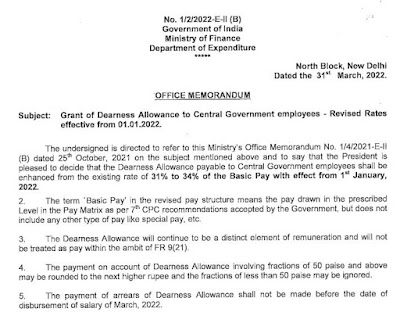
DA Jan 2022 - Grant of Dearness Allowance to Central Government employees - Revised Rates effective from 01.01.2022

 3% DA Hike - Revised Rates effective from 01.01.2022: DoE OM dated 31.03.2022 No. 1/2/2022-E-II (B) Government of India Ministry of Finance...