Saturday, 17 January 2015

7% Dearness Allowance increased to Kerala Government Employees

Dearness Allowance for Kerala Government Employees – 7% of DA/DR hiked

As per the media information, the State Government of Kerala has increased seven percent of Dearness allowance for its employees from July 2014. This benefit will also applicable for state pensioners and the total DA/DR is now increased to 80%.

The Finance Minister K.M.Mani said, the new Dearness allowance would have retrospective effect from July 2014 and also said that with the increase, the employees and pensioners in the state would get the same benefit as that of the Central Government employees and Pensioners.

The increased DA would be disbursed from March 2015. However, the arrears of employees from July 2014 to March 2015 would be merged with the Provident Fund.

Dearness Allowances: Issue taken as agenda by DPPW in the SCOVA meeting

Simultaneous issue of orders for the release of Dearness Allowances: Issue taken as agenda by DPPW in the SCOVA meeting

Ministry of Personnel, Public Grievances & Pensions published an order yesterday regarding the four new agenda items will be discussed in the meeting of Standing Committee of Voluntary Agencies (SCOCA) under the Chairmanship on 3.2.2015.

The four fresh agenda points are given below…

1. Simultaneous issue of orders for the release of Dearness Allowances:
Based on the rise in Consumer Price Index, Dearness Allowance and Dearness Relief are granted to serving employees and pensioners respectively with effect from 1st January and 1st July each year. The orders sanctioning DA are issued by the Finance Ministry and the orders sanctioning DR are issued by the Ministry of Personnel, Public Grievances and Pensions after the same. While serving employees get the increase in cash after a couple of days from the date of issue of Office Memorandum, the pensioners get it after some days since the issue of O.M, for DR needs to be further approved by Department of Expenditure and CAG. As the payment of DA and DR is being made from the Consolidated Fund of India, the issuance of separate orders for the grant of DA and DR could be unnecessary.

2. Co-authorisation of Family Pension of permanently disabled children/dependent parents and permanently disabled siblings
As a policy initiative of DoPPW, the CPAO vide its O.M no. CPAO/Tech/Simplification/2013-14/252 dated 06.02.2014 allowed co-authorisation
of family pension of permanently disabled’ children/dependent parents and permanently disabled siblings. A similar benefit may be considered by Department of Defence and Ministry of Railways to its pensioners.

3. Non-adherence of extant rules with regard to submission of life certificate
Despite clear instructions from the Ministry of Finance,vide CPAO/Tech/Grievances/2010-11/531 dated 30.06.2011, it has been reported that some’ banks branches are insisting on personal appearance of pensioners for submission of life certificates along with PPOs. The extant rules now exempt personal appearance and the prescribed form is to be signed by any of the persons specified therein.The pensioners thus got put to untoward hardship in addition to stress and strain which could have been avoided. As such, Department of Financial Services is requested to take necessary steps to get the instructions complied with strictly without fail.

4. Provision of CGHS facility for life time to dependent disabled/mentally retarded children of Central Government Employees/Pensioners

a) In the “Definition of Family” under CGH_S,furnished in Ministry of Health & FW O.M. No. 3T-1/2009-C&P/CGHS (P) dated 23-2-2011, daughter as indicated at 51 No.5(ii) can avail the benefits till she starts earning or gets married irrespective of the age-limit, where as son indicated at 51. No. 5(iii) of the list, suffering from any permanent Physical/Mental disability is entitled to avail the facility “irrespective of age- limit”, and son’s marital status may not result in denial of CGHS facility to him ,in as much as there is no mention of marital status in the definition, unlike the definition at 51.5 (i) On the other hand, daughter suffering from any permanent disability (physical disability or mental retardation) loses the facility if she gets married as per the definition at 51. (5)(ii). Hence, the case of a physically disabled/mentally retarded daughter needs to be considered for extension of CGHS facility “irrespective of age-limit, even after her marriage” .

b) Further under CCS (Pension) Rules, 1972, by an amendment to explanations 1 and 3 after Sub-rule 6 of Rule 54, as communicated vide Department of Pension & PW’O.M. No. 1/33/2012-P&PW(E) dated 16-1-2013, mentally /physically disabled children have been allowed to continue to draw family pension even after their marriage thereby removing the condition of marital status for continued drawal of family pension.

c) Thus on the analogy of pension rules, mentally/physically disabled children (both son and daughter) of Central Government Employees/Pensioners may be allowed to continue to avail CGHS facilities even after their marriage by removing the condition of marital status now existing in respect of daughters only. The “definition of family” under CGHS would need to modified suitably.

CCS (Conduct) Rules – Filing of annual Immovable Property Returns – Dopt Orders 2015

CCS (Conduct) Rules – Filing of annual Immovable Property Returns – Dopt Orders 2015

IMMEDIATE
F. No. 11013/3/2014-Estt.(A)
Government of India
Ministry of Personnel, Public Grievances & Pensions
Department of Personnel & Training
Establishment Division
North Block, New Delhi — 110001
Dated January 16 , 2015
OFFICE MEMORANDUM
Subject: Central Civil Services (Conduct) Rules, 1964 — Filing of annual Immovable Property Returns – regarding

The undersigned is directed to state that as per various notifications issued by this Department, relating to the Public Servants (Furnishing of Information and Annual Returns of Assets and Liabilities and the Limits for Exemption of Assets in Filing Returns) under the Lokpal and Lokayuktas Act, 2013, the public servant who has filed declaration, information and annual returns of property under the provision of the rules applicable to such public servant, should file the declaration, information and return indicating his/her assets and liabilities, as on 01.08.2014, to the competent authority on or before, 30.04.2015. The notifications are available on the Department’s website at http://persmin.gov.in/Lokpal HomePage From CCIS.asp.

2. The Central Civil Services (Conduct) Rules, 1964, are being amended to align them with the Lokpal and Lokayuktas Act, 2013. Presently, as per the Rule 18(1)(ii) of the Central Civil Services (Conduct) Rules, 1964, every Government servant belonging to any service or holding any post included in Group ‘A’ and Group ‘B’ is required to submit an annual return regarding the immovable property inherited/owned/ acquired/ held on lease or mortgage either in his own name or in the name of any family member or in the name of any other person.

3. It has, inter-alia, been clarified by this Department vide Office Memorandum No. 407/12/2014-AVD-IV(B) dated 13.01.2015 that the requirement of filing returns regarding assets and liabilities under the Lokpal Act is in addition to, and not in supersession of the requirement of filing similar returns under the existing Conduct Rules. In view of this, all Government Servants may be directed as follows:
(i) The annual Immovable Property Return, as on 31.12.2014, under the existing CCS(Conduct) Rules, 1964 is required to be filed on or before 31.01.2015;
(ii) The first return under the Lokpal Act (as on 01.08.2014) should be filed on or before 30.04.2015; and
(iii) The next annual return under the Lokpal Act, for the year ending 31.03.2015 should be filed on or before 31.07.2015.

4. It is, therefore, requested that all concerned may be suitably advised to file the Immovable Property Returns (IPRs) and the return under the Lokpal Act as per the dates indicated above, Further, in accordance with the instruction contained in this Department’s Office Memorandum No. 11013/3/2011-Estt.A dated 11.04.2011, IPRs (to be submitted by 31 st January of each year) shall be placed in public domain by 31 st March of that year. A compliance report in respect of the IPRs filed by Group ‘A’ Officers of the Central Civil Services, as on 31.01.2015, may please be furnished to this Department by 30.04.2015.

5. Similar action may kindly be taken by the authorities controlling services not covered by the Central Civil Services (Conduct) Rules, 1964.

6. Hindi version will follow.
sd/-
(J.A. Vaidyanathan)
Director (Establishment)
Telefax: 2309 3179
Source: www.persmin.gov.in

7CPC: 7th Pay Commission’s visit to Andaman & Nicobar Islands

7CPC: 7th Pay Commission’s visit to Andaman & Nicobar Islands

As per information available in the official website of 7thcpc.india.gov.in, the commission is proposed to visit Andaman & Nicobar Islands from 4th to 7th February, 2015.

The Commission, headed by its Chairman, Justice Shri A. K. Mathur, proposes to visit Andaman & Nicobar Islands from 4th to 7th February, 2015.

The Commission would like to invite various entities/associations/federations representing any/all categories of employees covered by the terms of reference of the Commission to present their views.

Your request for a meeting with the Commission may be sent through e-mail to the Secretary, 7th Central Pay Commission at secy-7cpc@nic.in. The memorandum already submitted by the requesting entity may also be sent as an attachment with this e-mail.

The last date for receiving request for meeting is 31st January 2015 (1700 hours).

DR Orders for CG Pensioners – Issue taken as agenda by DPPW

DR Orders for CG Pensioners – Issue taken as agenda by DPPW

Simultaneous issue of orders for the release of Dearness Allowances: Issue taken as agenda by DPPW in the SCOVA meeting

Ministry of Personnel, Public Grievances & Pensions published an order yesterday regarding the four new agenda items will be discussed in the meeting of Standing Committee of Voluntary Agencies (SCOCA) under the Chairmanship on 3.2.2015.

The four fresh agenda points are given below…

1. Simultaneous issue of orders for the release of Dearness Allowances:

Based on the rise in Consumer Price Index, Dearness Allowance and Dearness Relief are granted to serving employees and pensioners respectively with effect from 1st January and 1st July each year. The orders sanctioning DA are issued by the Finance Ministry and the orders sanctioning DR are issued by the Ministry of Personnel, Public Grievances and Pensions after the same. While serving employees get the increase in cash after a couple of days from the date of issue of Office Memorandum, the pensioners get it after some days since the issue of O.M, for DR needs to be further approved by Department of Expenditure and CAG. As the payment of DA and DR is being made from the Consolidated Fund of India, the issuance of separate orders for the grant of DA and DR could be unnecessary.

2. Co-authorisation of Family Pension of permanently disabled children/dependent parents and permanently disabled siblings

As a policy initiative of DoPPW, the CPAO vide its O.M no. CPAO/Tech/Simplification/2013-14/252 dated 06.02.2014 allowed co-authorisation
of family pension of permanently disabled’ children/dependent parents and permanently disabled siblings. A similar benefit may be considered by Department of Defence and Ministry of Railways to its pensioners.

3. Non-adherence of extant rules with regard to submission of life certificate

Despite clear instructions from the Ministry of Finance,vide CPAO/Tech/Grievances/2010-11/531 dated 30.06.2011, it has been reported that some’ banks branches are insisting on personal appearance of pensioners for submission of life certificates along with PPOs. The extant rules now exempt personal appearance and the prescribed form is to be signed by any of the persons specified therein.The pensioners thus got put to untoward hardship in addition to stress and strain which could have been avoided. As such, Department of Financial Services is requested to take necessary steps to get the instructions complied with strictly without fail.

4. Provision of CGHS facility for life time to dependent disabled/mentally retarded children of Central Government Employees/Pensioners

a) In the “Definition of Family” under CGH_S,furnished in Ministry of Health & FW O.M. No. 3T-1/2009-C&P/CGHS (P) dated 23-2-2011, daughter as indicated at 51 No.5(ii) can avail the benefits till she starts earning or gets married irrespective of the age-limit, where as son indicated at 51. No. 5(iii) of the list, suffering from any permanent Physical/Mental disability is entitled to avail the facility “irrespective of age- limit”, and son’s marital status may not result in denial of CGHS facility to him ,in as much as there is no mention of marital status in the definition, unlike the definition at

51.5 (i) On the other hand, daughter suffering from any permanent disability (physical disability or mental retardation) loses the facility if she gets married as per the definition at 51. (5)(ii). Hence, the case of a physically disabled/mentally retarded daughter needs to be considered for extension of CGHS facility “irrespective of age-limit, even after her marriage” .

b) Further under CCS (Pension) Rules, 1972, by an amendment to explanations 1 and 3 after Sub-rule 6 of Rule 54, as communicated vide Department of Pension & PW’O.M. No. 1/33/2012-P&PW(E) dated 16-1-2013, mentally /physically disabled children have been allowed to continue to draw family pension even after their marriage thereby removing the condition of marital status for continued drawal of family pension.

c) Thus on the analogy of pension rules, mentally/physically disabled children (both son and daughter) of Central Government Employees/Pensioners may be allowed to continue to avail CGHS facilities even after their marriage by removing the condition of marital status now existing in respect of daughters only. The “definition of family” under CGHS would need to modified suitably.

Retirement age: Government proposes raising retirement age of scientists from 60 to 65

Government proposes raising retirement age of scientists from 60 to 65: 

The government has proposed raising the retirement age of scientists working in all ministries, departments and autonomous institutions from 60 to 65 years.

In a draft cabinet note that has been circulated to all ministries, the science and technology ministry has argued that such a move will help attract scientific manpower and that all institutions would be able to harness the expertise of scientists for a longer duration.

“Most of the scientists at 60 would be leading productive research groups and are involved in mentoring students and young scientists. It is therefore necessary to make use of the productive age of the scientists beyond 60 years so that the effective scientific strength and correspondingly the scientific wealth of the country get enhanced,” the draft note said.

Read more at: Hindustan Times

Friday, 16 January 2015

7th Pay Commission : Highlights of the demands of Central Government Employees to 7CPC

7th Pay Commission : Highlights of the demands of Central Government Employees to 7CPC

1. Pay scales are calculated on the basis of pay drawn pay in pay band + GP + 100% DA by employee as on 01-01-2014.

2. 7th CPC report should be implemented w.e.f. 01-01-2014.

3. Scrap New Pension Scheme and cover all employees under Old Pension and Family Pension Scheme.

4. JCM has proposed minimum wage for MTS (Skilled) Rs.26,000 p.m.

5. Ratio of minimum and maximum wage should be 1:8.

6. General formula for determination of pay scale based on minimum living wage demanded for MTS is pay in PB+GP x 3.7.

7. Annual rate of increment @ 5% of the pay.

8. Fixation of pay on promotion = 2 increments and difference of pay between present and promotional posts (minimum Rs.3000).

9. The pay structure demanded is as under:-

Exiting Proposed (in Rs.)
PB-1 GP Rs.1800 – 26,000
PB-1 GP Rs.1900, PB-1 GP Rs.2000 – 33,000
PB-1 GP Rs. 2400, PB-1 GP Rs.2800 – 46,000
PB-2 GP Rs.4200 – 56,000
PB-2 GP Rs.4600, PB-2 GP Rs.4800 – 74,000
PB-2 GP Rs.5400 – 78,000

10. Dearness Allowances on the basis of 12 monthly average of CPI, Payment on 1st Jan and 1st July every year.

11. Overtime Allowances on the basis of total Pay+DA+Full TA.

12 Liabilities of all Government dues of persons died in harness be waived.

13. Transfer Policy : Group `C and `D Staff should not be transferred. DoPT should issue clear cut guideline as per 5th CPC recommendation. Govt. should from a Transfer Policy in each department for transferring on mutual basis on promotion. Any order issued in violation of policy framed be cancelled by head of department on representation.

14. Transport Allowance :
X Class Cities Y Class Cities
Pay up to Rs.75,000 Rs.7500 + DA Rs.3750 + DA
Pay above Rs.75,000 Rs.6500 + DA Rs.3500 + DA

13. Deputation Allowance double the rates and should be paid 10% of the pay at same station and 20% of the pay at outside station.

14. Classification of the post should be executive and non-executive instead of present Group A,B.C.

15. Special Pay which was replaced with SPL/Allowance by 4th CPC be bring back to curtail pay scales.

16. Scrap downsizing, outsourcing and contracting of govt. jobs.

17. Regularize all casual labour and count their entire service after first two year, as a regular service for pension and all other benefits. They should not be thrown out by engaging contractors workers.

18. The present MACPs Scheme be replaced by giving five promotion after completion of 8,15,21,26 and 30 year of service with benefits of stepping up of pay with junior.
19. PLB being bilateral agreement, it should be out of 7th CPC perview.

20. Housing facility:-
(a) To achieve 70% houses in Delhi and 40% in all other towns to take lease accommodation and allot to the govt. employees.
(b) Land and building acquired by it department may be used for constructing houses for govt. employees.

21. House Building Allowance :-
(a) Simplify the procedure of HBA
(b) Entitle to purchase second and used houses

22. Common Category – Equal Pay for similar nature of work be provided.

23. CP appointment – remove ceiling of 5% and give appointment within Three months.

24. Traveling Allowance:-
‘A1’ and ‘A’ Class Cities Other Cities
A. Executives Rs.5000+DA per day Rs.3500+DA per day
B. Non-Executives Rs.4000+DA per day Rs.2500+DA per day

25. Composite Transfer Grant :-
Executive Class 6000 kg by Goods Train/ Rate per km by road 8 Wheeler Wagon Rs.50+DA(Rs.1 per kg and single container per km)
Non-Executive Class 3000 kg – do – -do-

26. Children Education Allowance should be allowed up to Graduate, Post Graduate, and all Professional Courses. Allow any two children for Children Education Allowance.

27. Fixation of pay on promotion – two increments in feeder grade with minimum
benefit of Rs.3000.

28. House Rent Allowance
X Class Cities 60%
Other Classified Cities 40%
Unclassified Locations 20%

29. City Allowance
`X’ Class Cities `Y’ Class Cities
A. Pay up to Rs.50,000 10% 5%
B. Pay above Rs.50,000 6% minimum Rs 5000 3% minimum Rs.2500

30. Patient Care Allowance to all para-medical and staff working in hospitals.

31. All allowances to be increased by three times.

32. NE Region benefits – Payment of Special Duty Allowance @ 37.5 of pay.

33. Training:- Sufficient budget for in-service training.

34. Leave Entitlement

(i) Increase Casual Leave 08 to 12 days & 10 days to 15 days.
(ii) Declare May Day as National Holiday
(iii) In case of Hospital Leave, remove the ceiling of maximum 24 months leave and 120 days full payment and remaining half payment.
(iv) Allow accumulation of 400 days Earned Leave
(v) Allow encashment of 50% leave while in service at the credit after 20 years Qualifying Service.
(vi) National Holiday Allowance (NHA) – Minimum one day salary and eligibility criteria to be removed for all Non Executive Staff.
(vii) Permit encashment of Half Pay Leave.
(viii) Increase Maternity Leave to 240 days to female employees & increase 30 days Paternity Leave to male employees.

35. LTC
(a) Permission to travel by air within and outside the NE Region.
(b) To increase the periodicity once in a two year.
(c) One visit outside country in a lifetime

36. Income Tax:
(i) Allow 30% standard deduction to salaried employees.
(ii) Exempt all allowances.
(iii) Raise the ceiling limit as under:
(a) General – 2 Lakh to 5 Lakh
(b) Sr. Citizen – 2.5 Lakh to 7 Lakh
(c) Sr. Citizen above 80 years of age – 5 Lakh to 10 Lakh
(iv) No Income Tax on pension and family pension and Dearness Relief.

35. (a) Effective grievance handling machinery for all non-executive staff.
(b) Spot settlement
(c) Maintain schedule of three meetings in a year
(d) Department Council be revived at all levels
(e) Arbitration Award be implemented within six month, if not be discussed with Staff Side before rejection for finding out some modified form of agreement.

36. Appoint Arbitrator for shorting all pending anomalies of the 6th CPC.

37. Date of Increment – 1st January and 1st July every year. In case of employees retiring on 31st December and 30th June, they should be given one increment on last day of service, i.e. 31st December and 30th June, and their retirements benefits should be calculated by adding the same.

38. General Insurance: Active Insurance Scheme covering risk upto Rs. 7,50,000/- to Non Executive & Rs. 3,50,000/- to Skilled staff by monthly contribution of Rs. 750/- & Rs. 350/- respectively.

39. Point to point fixation of pay.

40. Extra benefits to Women employees 
 (i) 30% reservation for women.
(ii) Posting of husband and wife at same station.
(iii) One month special rest for chronic disease
(iv) Conversion of Child Care Leave into Family Care Leave
(v) Flexi time

41. Gratuity:
Existing ceiling of 16 ½ months be removed and Gratuity be paid @ half month salary for every year of qualifying service.
Remove ceiling limit of Rs.10 Lakh for Gratuity.

42. Pension:
(i) Pension @ 67% of Last Pay Drawn (LPD) instead of 50% presently.
(ii) Pension after 10 years of qualifying service in case of resignation
(iii) Increase pension age-based as under:
  65 years – 70% of LPD
  70 years – 75% of LPD
  75 years – 80% of LPD
  80 years – 85% of LPD
  85 years – 90% of LPD
  90 years – 100% of LPD

(iv) Parity of pension to retirees before 1.1.2006.
(v) Enhanced family pension should be same in case of death in harness and normal death.
(vi) After 10 years, family pension should be 50% of LPD.
(vii) Family pension to son upto the age of 28 years looking to the recruitment age.
(viii) Fixed Medical Allowance (FMA) @ Rs.2500/- per month.
(ix) Extend medical facilities to parents also.
(x) HRA to pensioners.
(xi) Improvement in ex-gratia pension to CPF/SRPF retirees up to 1/3rd of full pension.

7th Pay commission faces a thousand challenges

7th Pay commission faces a thousand challenges


Tapas Joshi, New Delhi writes an article about the 7th central pay commission and we reproduced the content for our blog viewers to easy understanding…

Jaitley, a ray of hope to the Central Government Employees
Seventh pay commission marching towards implication in January 2016, Finance Minister to play a vital role
Tapas Joshi, January 10
New Delhi. New Delhi.

 The work of the Seventh Pay commission is still in progress, but this has become a topic of curiosity amidst the Central Government Employees. The Pay commission established in February 2014 has completed a journey of almost one year. It is to be noted that the Seventh Pay commission was established for a period of 15 months, according to which the Pay commission should submit its report before September 2015.

Of all Pay Commissions established till date, the maximum have submitted their reports within a period of 3 years. In spite of the eminent delay in establishment of the Sixth Pay commission, they submitted their report within two years and the government accepted their recommendations without any delay. Technically, the report of the Sixth Pay is believed to be the best report submitted till date as it changed the conventional Pay scales to Pay Band and Grade Pay which was greatly appreciated.

Those who initially criticised the recommendations were also found happy at later stages. There were also a few flaws in the recommendations which still remain intact. The Sixth Pay commission had merged Pay scales to a large extent, this led to a lot of administrative difficulties regarding the performance of grade C employees as this mergence placed many juniors at par in their pay band and grade pay in comparison with their seniors which led to many in-disciplinary issues. This led to unhappiness for some Senior Employees.
Junior employees were happy for a while, but they were permanently deprived from the benefits of Promotion. Similarly, many discrepancies have been noticed in the Sixth Pay Commission and the Pay Commissions before it. The Seventh Pay commission also has a challenge to clear all these discrepancies.
If we consider the Sixth Pay Commission, to a very large extent it has prepared the base for the future Pay Commissions. The Seventh Pay commission practically should have no problem to till the ground given to them by the Sixth Pay Commission, provided they do not have any theoretical objections to the ruleset laid by the Sixth Pay Commission. If the Seventh Pay commission tries not to do anything new, and prepares the fresh Pay scales focusing on clearing the existing shortfalls based on the current inflation and economic norms, the Pay commission can surely prove to be successful to a large extent. If clearing the discrepancies is a Challenge to the Pay Commission, the submission of their Report on time is even a greater challenge.

Whenever it comes to the Seventh Pay commission, it is natural to mention about the Modi Government. In nearly seventh months of Office Holding, Finance Minister Arun Jaitley not only declared Income Tax Exemptions and received the appreciation of employees, but also stated that “If I had more, I would have granted more exemptions” which shows his sympathy towards the working Personnel. It is eminent that the Seventh Pay commission will submit its report by the end of this year.

Read more at : www.cgstaffnews.in

Thursday, 15 January 2015

7th Pay Commission: Four times increase in pay for Central Government Employees expected

7th Pay Commission: Four times increase in pay for Central Government Employees expected

Tapas Joshi, New Delhi writes an article about the 7th pay commission pay scale for Central Government employees. We reproduced the article and given under to our readers for easy understanding…
Seventh Pay Commission: Four times increase in pay for Central Government Employees expected.
New Delhi: Tapas Joshi

2016 is a year expected to bring unbound happiness to the Central Government Employees. This year will end a long wait of 10 years, because the recommendations of the Pay Commission will be implemented in January 2016.

The Pay commission was established during the Manmohan Singh Government in February 2014. The deadline for the Pay commission was set to be 15 months. This leads to an expectation for the release of the Pay Commission report by September 2015. If the Memorandum submitted by the Various Employee Organisations is considered, the Pay Commission should provision recommendation for a four-fold increase in the current pay. During its tenure, the Pay Commission will travel to various cities, in addition to meeting the staff of various Employee Organisations. Here it is essential to note that during the sixth pay commission it was recommended to increase the pay of the Central Government Employees three-fold of their current pay.

Primary considerations in Pay Judgement:

The Pay of the Central Government Employees are compared with the Public sector employees such as BHEL, ONGC, etc and also with the Private sector employees. The minimum pay scale of the International Labor Union (ILO) is also considered as a norm. Further, the price of the various daily utility objects is taken into consideration. In the sixth pay commission the Inflation rate as on 01.01.2006 was also considered before putting up recommendations for the fresh Pay scales.

Things to be kept in mind by the Pay commission:

If we talk about the sixth pay commission the ratio of the minimum and maximum Pay was worked around as 1:12 and the minimum pay was decided to be Rs 7100. If in Rs 7100 we include House Rent Allowance, Transport Allowance, Education Allowance etc the figure increases up to Rs 10000.

This time the Dearness Allowance has crossed the figure of 100 percent, and according the Indian Labor Ministry the minimum pay should be Rs 15000 per month. If the inflation and minimum pay are considered, on today’s date the minimum pay should be increased from Rs 7100 to Rs 30000. If in this we include House Rent Allowance, Transport Allowance, Education Allowance etc the figure increases up to Rs 45000.
Thus the Pay of the Central Government Employees is expected to have a four-fold rise. The Central Government Employees are impatiently waiting for 2016, and we are also waiting to see how much do the Pay Commission stand up to the Expectations of the Central Government Employees.

Source: CG Staff News

Clarification regarding Pay fixation on grant of Non-Functional Upgradation to the officers of Organized Group A Services

Clarification regarding Pay fixation on grant of Non-Functional Upgradation to the officers of Organized Group A Services

No. AB. 14017/25/2013-Estt.(RR)
Government of India
Ministry of Personnel, Public Grievances and Pensions
Department of Personnel and Training

New Delhi, the 12th January, 2015

OFFICE MEMORANDUM

Subject: Clarification regarding Pay fixation on grant of Non-Functional Upgradation to the officers of Organized Group A Services

The instructions for grant of NFU as per 6th CPC for officers of Organized Group ‘A’ services have been issued in DOPT OM dated 24.04.2009. The terms & conditions for grant of NFU as laid down in Clause-7 of the Annexure to the above said 0.M., prescribe that pay fixation on grant of NFU under these orders will be done as per the provisions of CCS (RP) Rules, 2008 i.e. officers will be granted one increment at the rate of 3% of basic pay and the difference of grade pay will be added to their basic pay. As for the officers posted under the Central Staffing Scheme, they will be granted one increment on account of NFU, but their grade pay will remain unchanged as they are holding a tenure post with a specific grade pay under Central Staffing Scheme.

2. The provisions of FR 22-(I)(a)(1) have been extended to promotions after 01.012006 vide Department of Expenditure O.M. F.No. 1/1/2008-IC dated 13th September, 2008(Clarification No.2). References have been received in this Department seeking clarification on whether the officers on grant of NFU will also be entitled to exercise option to get their pay fixed from the date of grant of NFU or from the date of the next increment.

3. The issue has been considered in consultation with the Department of Expenditure. It is clarified that the officers may be permitted the option for pay fixation as in the case of promotion with the condition that no re-fixation of pay would be allowed at the time of promotion. As per the terms and conditions for grant of NFU all the prescribed eligibility criteria and promotional norms including ‘benchmark’ for up-gradation to a particular grade pay would have to be met at the time of screening for grant of higher pay scale.

4. Hindi version will follow.
(Mukta Goel)
Director (E-I)
Source Document: www.persmin.gov.in

Flash News

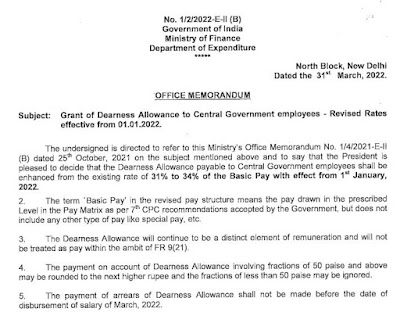
DA Jan 2022 - Grant of Dearness Allowance to Central Government employees - Revised Rates effective from 01.01.2022

 3% DA Hike - Revised Rates effective from 01.01.2022: DoE OM dated 31.03.2022 No. 1/2/2022-E-II (B) Government of India Ministry of Finance...