Tuesday, 7 May 2019

Tax benefits under NPS, the Government Subscribers can make an additional investment in their NPS Tier I account


Tax benefits under NPS, the Government Subscribers can make an additional investment in their NPS Tier I account

Voluntary Contribution in Tier I account by Govt. Sector Subscribers

In order to avail Tax benefits under NPS, the Government Subscribers can make an additional investment in their NPS Tier I account. An additional deduction for investment up to Rs. 50,000 in NPS (Tier I account) is available exclusively to NPS subscribers. This additional investment can be made by the Subscribers by either of the following ways:

A. Through associated Nodal Office
B. Through eNPS portal
C. Through NPS Mobile App
D. By logging into the CRA System
E. Through Point of Presence (PoP)

A. Voluntary Contribution through associated Nodal Office {Pay and Accounts Office (PAO)/ Cheque Drawing and Disbursement Offices (CDDOs)}

Govt. Subscribers may approach their associated Nodal Offices (PAOs/ CDDOs) for processing of Voluntary Contributions in their Tier I account. The Nodal Office is required to carry out the following activities:

Download necessary utilities for preparation of contribution file i.e. File Preparation Utility (FPU) and File Validation Utility (FVU). Kindly note, these are separate utilities through which only Tier-II and Tier I Voluntary contributions can be prepared and validated. The utilities are available on CRA website – www.npscra.nsdl.co.in at the following link:

https://npscra.nsdl.co.in/
Prepare voluntary contribution details by using the FPU. Ensure that contribution type is selected as “Voluntary Contribution”.

Validate voluntary contribution file prepared using the FVU.

Upload Subscriber Contribution File (SCF) in the NPSCAN application (www.npscancra.com) by logging with the User ID and Internet Password (IPIN) provided by NSDLCRA. The procedure of Contribution upload will be similar to the upload of regular contribution files in NPS.
Nodal Office shall upload the SCF in respect of the Subscribers for whom clear funds are available on daily basis. The Nodal Office is required to remit the funds to the Trustee Bank latest by T+1 day (T being the date of receipt of clear funds) post upload of contribution details in the CRA system.

B. Voluntary Contribution through eNPS portal

The Subscribers can also pay voluntary contributions under Tier I online through eNPS. In order to contribute through eNPS, the Subscribers need to follow the below mentioned steps:
Visit the eNPS portal (https://enps.nsdl.com).

Click on the “Contribution” option.

On the next screen, the Subscriber will have to provide PRAN, Date of Birth, enter Captcha details and click on the “Verify PRAN” option. On clicking the “Verify PRAN” option, system will prompt for a One Time Password (OTP) and the same will be sent on the registered mobile number of the Subscriber. System will display a message to the Subscriber about generation of OTP. The Subscriber will enter the OTP and click on submit OTP option.

After submission of OTP, on the next screen the Subscriber will select the Tier Type as “Tier I” and enter the amount in “Voluntary contribution amount” section, select the “Payment Gateway Option”, tick on the declarations and finally click on “Make Payment” option.

Upon successful processing of the contribution, the units will be credited to Subscribers’ NPS account and an SMS/ Email alert will be sent to the Subscribers’ registered Mobile Number/ Email ID.

C. Voluntary Contribution through NPS Mobile App

Voluntary contribution in Tier I account can also be made using the NPS Mobile App.
NPS Mobile App can be downloaded from Playstore for android phones and Appstore for IOS phones (iPhone).

In NPS Mobile App, Subscriber is required to click on the “Contribution” option available on the Home screen.

On the next screen, Subscriber needs to enter the PRAN, Date of Birth and the Captcha details and click on “Verify PRAN” option.

App will prompt for a One Time Password (OTP) and the same will be sent to the registered mobile number of the Subscriber. App will display a message to the Subscriber about generation of OTP. The Subscriber will enter the OTP and click on submit OTP option.

After submission of OTP, on the next screen the Subscriber will select the Tier Type as “Tier I” and enter the amount, select the “Payment Gateway Option”, tick on the declarations and finally click on “Confirm Payment” option.

Upon successful payment, a receipt will get generated confirming the payment details.

D. Voluntary contribution by logging into the CRA System
One more option for Subscribers to contribute voluntarily in Tier I account is by logging into the CRA System with the User ID (i.e. the PRAN) and the Internet Password (IPIN).
In the CRA system, at the Home page, the Subscriber needs to go to Menu – Contribute Online <<>> Sub-menu - Make Online Contribution.

System will re-direct the Subscriber to the eNPS portal.
Further, the Subscriber needs to follow the procedure as explained under Point C above.

E. Voluntary contribution through Point of Presence (PoP)/ Point of PresenceService Providers (PoP-SP)
Subscribers may also approach the PoP/ PoP-SPs for making Voluntary Contribution in their Tier I account.

The list of PoPs/ PoP-SPs is available on CRA website (www.npscra.nsdl.co.in).

What are the tax benefits of NPS?


1. What are the tax benefits of NPS?
Income Tax Act allows benefits under NPS as per the following sections:

On Employee’s contribution: Employee’s own contribution is eligible for tax deduction under sec 80 CCD (1) of Income Tax Act up to 10% of salary (Basic + DA). This is within the overall ceiling of Rs. 1.50 Lacs under Sec. 80 CCE of the Income Tax Act.

On Employer’s contribution: Up to 10% of Basic & DA (no monetary ceiling) under 80CCD (2). This rebate is over and above 80 CCE limit of Rs. 1.50 lacs.

Voluntary Contribution: Employee can voluntarily invest an additional amount of Rs. 50,000 (or more) to the NPS Tier I account and claim tax deduction on the same under section 80 CCD 1(B), subject to a maximum of Rs. 50,000.

2. Which document can a Subscriber use as investment proof in order to avail the tax benefit?
A copy of the Annual Transaction Statement (Tier I) can be used as investment proof in order to avail tax benefits.

3. Can a Subscriber get loan under NPS?
No. At present, a Subscriber cannot avail loan against NPS holdings.

4. Are NPS returns guaranteed?
There is no investment return guarantee. As per the present guidelines of Pension Fund Regulatory & Development Authority (PFRDA, the regulator for NPS), in case of government employees, contributions towards pension are invested by three Pension Fund Managers (PFMs), viz., LIC Pension Fund Limited, SBI Pension Funds Private Limited and UTI Retirement Solutions Limited as per the stipulated guidelines.

The returns under NPS are totally market based i.e. they are based on the NAV of the Pension Fund schemes. The benefits will entirely depend upon the amount contributed and the investment growth upto the point of exit from NPS.

Monday, 6 May 2019

ECHS Smart Card: DOCUMENTS REQUIRED AS PROOF OF INCOME TO CHECK ELIGIBILITY OF DEPENDANTS FOR ECHS MEMBERSHIP


ECHS Smart Card: DOCUMENTS REQUIRED AS PROOF OF INCOME TO CHECK ELIGIBILITY OF DEPENDANTS FOR ECHS MEMBERSHIP

Central Organisation ECHS
Adjutant General's Branch
Integrated Headquarters of MoD (Army),
Thimayya Marg, Near Gopinath Circle,
Delhi Cantt- 110 010

B/ 49711-NewSmartCard /AG/ ECHS
29 Apr 2019
IHQ of MoD (Air Force)
IHQ of MoD (Navy)
HQ South Comd (A/ ECHS)
HQ East Comd (A/ ECHS)
HQ West Comd (A/ ECHS)
HQ Central Comd (A/ ECHS)
Northern Comd (A/ ECHS)
South West Comd (A/ ECHS)
HQ ANC
Regional Centres ECHS

DOCUMENTS REQUIRED AS PROOF OF INCOME TO CHECK ELIGIBILITY OF DEPENDANTS FOR ECHS MEMBERSHIP

1. Refer to Central Organisation ECHS letter No B/ 49701-PR /AG/ ECHS/ 2017 dated 27 Sep 2017 and 8/49701-PR/ AG/ ECHS/ 2017 dt 16 Nov 2017(Not to all).

2. A policy on eligibility criteria for ECHS membership was promulgated vide letters under reference. The following documents are required to be produced by the ESM for all dependants above 18 years of age (except spouse) at the time of collection of their Cards:-

(a) Self attested copy of PAN Card.
(b) Self attested copy of Form 26AS for the last two financial years.

3. In case the documents given at Para 2(a) & (b) can not be produced by the ESM, then he will have to furnish a self attested certificate for dependant above 18 Years of age. Specimen proforma is attached as Appx 'A'.

4. In case of income of dependents above 18 years of age (except spouse) is more than Rs 9000/ - from all sources (excluding DA) per month, then the ECHS Cards for such dependants will not be handed over to the beneficiary/ ESM. Such Cards will be destroyed by a board of officers every month and record be maintained at the Station HQ's. Details of such destruction be forwarded to Regional Centre concerned, Central Organization, ECHS and M/ S Source Dot Com Private Limited. Cases will be intiated in such cases for cancellation of cards permanently.

5. It is further reiterated that the Cards of all dependants will be blocked automatically by the system on completion of one year. The ESM will have to submit an online self declaration certificate by using his login credentials. A specimen ECHS self attested certificate for dependant above 18 years of age is attached as Appx 'B'. The fields marked as 'A' will be auto populated and in the balance fields the beneficiary will have to upload the required certificate/ enter details. This renewal facility will be available one month in advance from completion of one year from the date of issue of Card/ last renewal.
(Rakesh Kakar)
Col Retd
Jt Dir (Stats & Automation)
for MD ECHS
Encls: (As above)

Copy to :-
The details of Cards destroyed by Regional Centres & fwd by Private Ltd board of officers should be blocked & removed from the system. However, data of such Cards should be maintained separately & fwd to Central Organization, ECHS on six monthly basis.

Internal
Medical Section
C & L Section
P & FC Section
S&A Section You are requested to upload the ECHS website and copy given to SourceDotcom.

Source: ECHS

General Departmental Competitive Examination - Reservation for "horizontal" categories including Persons with Benchmark Disabilities and Economically Weaker Sections (EWS) who are serving employees


General Departmental Competitive Examination - Reservation for "horizontal" categories including Persons with Benchmark Disabilities and Economically Weaker Sections (EWS) who are serving employees reg.
RBE No. 65
GOVERNMENT OF INDIA
MINISTRY OF RAILWAYS
(RAILWAY BOARD)
Ne. E(NG)I-2018/PM1/23
New Delhi, dated 23.04.2019
The General Managers,
All Zonal Railways &
Production Units.
(As per standard mailing list)

Sub: General Departmental Competitive Examination - Reservation for "horizontal" categories including Persons with Benchmark Disabilities and Economically Weaker Sections (EWS) who are serving employees reg.

Ref: (i) SECR's letter No. P-HQ/RUL/105/5/7073 dated 25.09.2018 & 04.02.2019.
(ii) ECoR's letter No. ECoR/Pers/GDCE/2019 dated 01.04.2019

Clarification has been sought by certain Railways regarding applicability of reservation for PwBD and Economically Weaker Sections (EWS) employees' under the scheme of General Departmental Competitive Examination (GDCE).

The matter has been examined in detail in Board’s office. It is clarified that horizontal reservation quota (including that for PwBD and EWS) that is applicable for Open Market recruitment will not apply for GDCE scheme.

This disposes of the above referred letters.
Sd/-
(S. Balachandra Iyer)
Executive Director Estt..(N)
All Railway Board
Source: Indian Railways

Concessions to Armed Forces Officers and Personnel Below Officer Ranks including Defence Civilians deployed Civilians deployed in CI Operation


Op Rhino- Concessions to Armed Forces Officers and Personnel Below Officer Ranks including Defence Civilians deployed Civilians deployed in CI Operation

No. 8(3)/9ID (Pay/Services)
Government of India
Ministry of Defence
New Delhi, dated 25th April, 2019
To
The Chief of the Army Staff
New Delhi

Subject: Op Rhino - Concessions to Armed Forces Officers and Personnel Below Officer Ranks including Defence Civilians deployed in CI Operation

Sir,
I am directed to refer to this Ministry's letter of even number dated 5th September, 2017 on the above subject and to convey the sanction of the competent authority to the grant of concessions mentioned in this Ministry's letter of even number dated 10th Jan 1992 read with this Ministry's letter No. 37269/ CI/AG/PS- 3(a)/121/ D(Pay/ Services) dated 14 Jan 1994, as amended, w.e.f. 15th Dec., 2017 to 30th June, 2019 or till the termination of Op Rhino, whichever is earlier.

This issues with the concurrence of Finance Division of this Ministry vide their I.D. No. 5(21)/ 2002-AG(RA)/ 110-PA dated 25/04/ 2019.
Yours faithfully,
( Arun Kumar )
Under Secretary to the Govt. of India
Source: MoD

NFIR's protest against Railway Board's proposal for making Detonators as part of personal safety equipment of Asst Loco Pilots


Registration No. : RTU/ Nnn/31/2012

NFIR

National Federation of Indian Railwaymen
3, CHELMSFORD ROAD, NEW DELHI - 110055
Affiliated to :
Indian National Trade Union Congress (INTUC)
International Transport Workers' Federation (ITF)
No. IV/RSAC/2018
Date: 03.05.2019.
The Secretary (E),
Railway Board,
New Delhi.

Dear Sir,

Subject: NFIR's protest against Railway Board's proposal for making Detonators as part of personal safety equipment of Asst. Loco Pilots - Reg.

Ref: Railway Board's Letter No. 2019/ Safety (A&R) /19/07 dated 18.04.2019.

Pursuant to the proposal of Northern Railway, the Railway Board have since sent communication to all the General Managers seeking views for making provision of Detonators as part of personal safety equipment of Asst.Loco Pilots vide Railway Board's letter dated 18.04.2019. While protesting against the arbitrary proposal of the Railway Board, the Federation places below valid points for review.
i) At present, the items/ tools being carried by ALP in his personal bag are:

Tri-colour Torch, Red and Green Flags, Working time table(s). Apart from ALP also required to carry one set of additional dress / uniform, night dress, bathroom slippers, water bottle, lunch box, trouble shooting directory etc.

Now, if detonator box is included in personal luggage, then weight of bag will increase and cause difficulty to carry while walking from crew lobby to running room and also in major yards.

(ii) Besides the above, the other complications which would arise if detonators are made part of personal equipments of Asst.Loco Pilots are furnished below:
a) As per G&SR 3.64.1 (b), the Railway Administration shall be responsible for the supply, renewal, periodical testing and safe custody of such detonators and for ensuring that their usage needs to be understood properly.

b) The detonators are explosive material, therefore to carry them in public places such as platforms circulating area etc., could be treated as violation of Anns and Explosive Act.

c) Most of the major stations are provided with metal detectors to ensure safety of public. If Assistant Loco Pilot carries detonators in his personal luggage, it would be objected by Security Personnel.

d) It will also be risky for Assistant Loco Pilots to keep detonators at their residence as it would be impossible for ALP to continuously guard detonator box during his HQ stay.

e) During Pilot/ Spare movement, ALP cannot keep detonators with him in view of the fact that carrying explosives in passenger trains is prohibited.
In view of the above, NFIR urges upon the Railway Board to kindly cancel the Railway Board's proposal dated 18.04.2019.
Yours faithfully,
(Dr.M.Raghavaiah)
General Secretary
Copy to the Executive Director (Safety), Railway Board, New Delhi
Copy to the Executive Director (IR), Railway Board, New Delhi
Copy to the General Secretaries of Zonal Unions of NFIR
Copy to the Media Centre/ NFIR.

Source: NFIR

Sunday, 5 May 2019

DoE - Recruitment to the post of Despatch Rider in the Ministry of Defence by Deputation and Absorption and Re-employment basis

DoE - Recruitment to the post of Despatch Rider in the Ministry of Defence by Deputation and Absorption and Re-employment basis

F.No.A-350 18/1/2018-D(Estt.l/Gp.II)
Government of India
Ministry of Defence
Room No. 320, 'B' Wing
Sena Bhawan, New Delhi-110105
Dated the 12th April, 2018
OFFICE MEMORANDUM

Subject: Recruitment to the post of Despatch Rider in the Ministry of Defence by Deputation and Absorption and Re-employment basis - regarding

The undersigned is directed to say that 10(ten) posts of Assistant(Excluded) in Level-7 of the Pay Matrix (Rs. 44,900- 1,42,400/-) is proposed to be filled up on deputation basis in the Ministry of Defence (Secretariat) initially for a minimum period of three years, from amongst the following:-
  • Assistant Section Officers (erstwhile Assistant) of the Central Secretariat Service (CSS) in Level-7 of the Pay Matrix (Rs. 44,900- 1,42,400/-), or
  • Senior Secretariat Assistants (erstwhile Upper Division Clerk) of the Central Secretariat Clerical Service in Level-4 of the Pay Matrix (Rs. 25,500-81,100/-) with ten years of regular service in the grade and who have undergone training in Cash and Accounts in the Institute of Secretariat Training and Management (ISTM) or equivalent training course conducted by any other training institution and possesses three years of experience in cash, accounts and budget work;
  • Senior Auditors of Defence Accounts Department in Level-6 of the Pay Matrix (Rs. 35,400- 1,12,400/-);
  • Auditors of the Defence Accounts Department in Level-5 of the Pay Matrix (Rs. 29,200- 92,300/-) with six years regular service in the grade;
2. In addition to the above, it may be noted that the period of deputation including period of deputation in another ex-cadre post held immediately preceding this appointment in the same or some other organisation/ Department of the Central Government shall ordinarily not exceed three years. The maximum age limit for appointment by deputation shall not exceed fifty six years as on the closing date of receipt of applications.

3. Applications in the attached proforma (Annexure-I) from willing and eligible officials and whose services can be spared, may be forwarded by the Employer/ Cadre Controlling Authority with duly filled-in certificate (Annexure-II) to this office within 45 days from the date of publication of the advertisement in Employment News along with attested photocopies of up-to-date APAR dossiers for the last five years. Application received after the due date or found incomplete will not be considered.

(DiPanankar Dutta)
Under Secretary to the Government of India
To:
  1. Ministries/ Departments of Government of India
  2. O/o CGDA, Ulan Batar Road, Palam, Delhi Cantt-10
  3. All Sections in Ministry of Defence including Finance Division
  4. D(IT/NIC), Ministry of Defence (with the request to place this vacancy OM on the website of MoD)
  5. Notice Board
  6. D(OL) for Hindi translation
Source: MoD

Saturday, 4 May 2019

IBA Orders on DA : Increase in DA Slabs of 34 - 64.50 % May to July 2019


IBA Orders on DA : Increase in DA Slabs of 34 - 64.50 % May to July 2019

Dearness Allowance for Workmen and Officer Employees in banks for the months of May, June & July 2019 under X BPS/ Joint Note dated 25.5.2015
Indian Banks’ Association

HR & Industrial Relations

No.CIR/HR&IR/76/D/2019-20/7217

May 2, 2019

All Members of the Association
(Designated Officers)

Dear Sir/Madam,

Dearness Allowance for Workmen and Officer Employees in banks for the months of May, June & July 2019 under X BPS/Joint Note dated 25.5.2015

The confirmed All India Average Consumer Price Index Numbers for Industrial Workers (Base 1960=140} for the quarter ended March 2019 are as follows:-

January 2019 - 7007.55
February 2019 - 7007.55
March 2019 - 7053.20

The average CPI of the above is 7023 and accordingly the number of DA slabs are 645 (7023-4440= 2583/4= 645 Slabs) The last quarterly Payment of DA was at 611 Slabs. Hence there is an increase in DA slabs of 34, i.e 645 Slabs for payment of DA for the quarter May. June & July, 2019

In terms of clause 7 of the 10th Bipartite Settlement dated 25.05.2015 and clause 3 of the Joint Note dated 25.05.2015, the rate of Dearness Allowance payable to workmen and officer employees for the months of May, June & July, 2019 shall be 64.50 % of ‘pay’. While arriving at dearness allowance payable, decimals from third place may please be ignored.

Yours faithfully,
sd/-
S K Kakkar
Senior Advisor (HR&IR)

JCM - Frequently asked questions on Joint Consultative Machinery

Frequently asked questions on Joint Consultative Machinery (JCM)

FREQUENTLY ASKED QUESTIONS (FAQ)

1. What is Joint Consultative Machinery?

The scheme of Joint Consultative Machinery is a platform for constructive dialogue between the representatives of the staff side and the official side for peaceful resolution of all disputes between the Government as employer and the employees. The scheme was introduced in 1966 with the objectives of promoting harmonious relations and securing the greatest measure of cooperation between the Central 1 Government as the employer and the employees in matters of common concern and with the object of further increasing the efficiency of the public service combined with the well being of those employed. The scheme is a non statutory one mutually agreed upon between the staff side and the official side.

2. What is the applicability of the JCM Scheme?

The scheme covers all regular civil employees of the Central Government, except:
(a)The Class -I services;
(b)The Class-II services, other than the Central Secretariat Services and the other comparable services in the headquarters organisation of the Government;
(c) Persons in industrial establishments employed mainly in managerial or administrative capacity, and those who being employed in supervisory capacity drawing salary going beyond grade pay of Rs.4200/- per month;
(d) Employees of the Union Territories; and
(e) Police personnel.

3. What is the structure of the Joint Councils under the JCM Scheme?

The scheme provides for setting up of Joint Councils at the National, Departmental and Regional / Office levels. The National Council, chaired by the Cabinet Secretary, is the apex body.

4. How are staff side members selected for various Joint Councils?

The representatives of the staff side for various Joint Councils are chosen / selected from members of the recognized service associations/ unions.

5. What is the time schedule for holding meetings of the National / Departmental Councils?

As per the JCM Scheme, ordinary meeting of the National Council/ Departmental Council may be held as often as necessary as but not less than once in four months.

6. How recognition is granted to the staff associations?

The Department of Personnel & Training being the nodal department for matters relating to Joint Consultative Machinery and Compulsory Arbitration, has notified Central Civil Services (Recognition of Associations) Rules, 1993 for the purpose of granting recognition to various service associations.Recognition is actually granted by the concerned Ministry/Department in accordance with the CCS (RSA) Rules, 1993.In case of any doubt or confusion, the matter is referred to the JCA Section of the Department of Personnel & Training for clarification/ advice.

7. What are the facilities available to recognised associations?

The recognized associations/ unions enjoy certain facilities like:
(a) Negotiations with the employer;
(b) Correspondence and meetings with the head of the administrative departments;
(c) Provision of accommodation for the associations subject to availability;
(d) Facility of special casual leave up to 20 days in a year to the office bearers of the associations.(e) Payment of T.A/ D.A for attending officially sponsored meetings; and
(f) Facility of seeking transfer of Chief Executive of the Union /association to the Headquarters of the appropriate head of administration.

8. What will happen if there is no agreement between thestaff and the official side?

If there is no agreement between the staff and the official side on an arbitrable issue, then the matter is to be referred to the Board of Arbitration if so desired by the staff side.

9. What are the issues on which arbitration is possible?

The arbitration is limited to the following issues:
(a) Pay and allowances;
(b)Weekly hours of work ; and
(c) Leave

10. Is the award given by the Board of Arbitration binding on the parties

The award given by the Board of Arbitration is binding on the Government as well as the staff side subject to the over riding authority of the Parliament. The award can be modified/rejected only with the approval of the Parliament through a formal resolution on grounds affecting national economy or social justice.

Rule 10 of Army Officers and Air Force Officers Pay Rules - MoD Orders


Rule 10 of Army Officers and Air Force Officers Pay Rules - MoD Orders

Rule 10 of Army Officers and Air Force Officers Pay Rules - MoD Orders
Date of next increment- Rule 10 of Army Officers and Air Force Officers Pay Rules, 2017; Regulation 10 of Navy Officers Pay Regulations, 2017; Rule 10 of Army, Air Force and Military Nursing Service Pay Rules, 2017; Regulation 10 of Navy Pay Regulations, 2017 and Rule 9 of the Non-Combatants (Enrolled) of Air Force Rules, 2017

No.PC-1(20)/2017-D(Pay/Services) Part-II
Government of India
Ministry of Defence

Sena Bhawarn, New Delhi
dated the 11th March, 2019

OFFICE MEMORANDUM

Subject: Date of next increment- Rule 10 of Army Officers and Air Force Officers Pay Rules, 2017; Regulation 10 of Navy Officers Pay Regulations, 2017; Rule 10 of Army, Air Force and Military Nursing Service Pay Rules, 2017; Regulation 10 of Navy Pay Regulations, 2017 and Rule 9 of the Non-Combatants (Enrolled) of Air Force Rules, 2017- regarding.

The undersigned is directed to invite attention to Rule 10 of Army Officers and Air Force Officers Pay Rules, 2017; Regulation 10 of Navy Officers Pay Regulations, 2017; Rule 10 of Army, Air Force and Military Nursing Service Pay Rules, 2017; Regulation 10 of Navy Pay Regulations, 2017 and Rule 9 of the Non-Combatants (Enrolled) of Air Force Rules, 2017 which provides, inter alia, that there shall be two dates for increment namely 1st January and 1st July of every year, instead of the provision of one date of increment on the 1st July during the 6th Pay Commission pay structure. The Rule/Regulation further provides that an employee shall be entitled to only one annual increment either on 1st January or 1st July depending on the date of appointment, promotion or grant of financial upgradation. The Sub-Rule/Regulation (2) thereof provides that increment in respect of an employee appointed or promoted or granted financial upgradation including upgradation under MACP during the period between the 2nd day of January and 1st day of July (both inclusive) shall be granted on 1st day of 4 January and the increment in respect Hof an employee appointed or promoted or granted financial upgradation including upgradation under MACP during the period between 2nd day of July and 1st day of January (both inclusive) shall be granted ork1st day of July.

2. The proviso to Sub-Rule/Regulation (2) of Rule 10 of Army Officers and Air Force Officers Pay Rules, 2017; Regulation 10 of Navy Officers Pay Regulations, 2017; Rule 10 of Army, Air Force and Military Nursing Service Pay Rules, 2017; Regulation 10 of Navy Pay Regulations, 2017 and Rule 9 of the Non-Combatants (Enrolled) of Air Force Rules, 2017, provides that the next increment after drawal of increment on 1st day of July 2016 shall accrue as on 1st day of July 2017.

3. During the regime of pay structure immediately prior to 01/01/2016, when the annual increment was admissible uniformly on 1st July every year; the increment was admissible on July, provided the condition of 6 months service was fulfilled. Thereafter, the next increment used to be given after a period of 12 months.

Accordingly, keeping in view the principle followed during the period before 1.1.2016 immediately prior to coming into force of the Army Officers and Air Force Officers Pay Rules, 2017; Navy Officers pay Regulations, 2017; Army, Air Force and Military Nursing Service pay Rules, 2017; Navy pay Regulations, 2017 and Non-Combatants (Enrolled) of Air Force Rules, 2017, which has been modified in the revised pay structure in ‘terms of Rule/Regulation 10 of the Army Officers and Air Force Officers Pay Rules, 2017; Navy Officers Pay Regulations, 2017; Army, Air Force and Military Nursing Service Pay Rules, 2017; Navy Pay Regulations, 2017 and Rule 9 of the Non- Combatants (Enrolled) of Air Force Rules, 2017 by way of 2 dates of
increment on 1st January and 1st July, it is clarified that in case an employee is promoted or granted financial upgradation including upgradation under the MACP scheme on January or 1st July, where the pay is fixed in the Level applicable to the post on which promotion is made in accordance with the Rule/Regulation 12 of the Army Officers and Air Force Officers pay Rules, 2017; Navy Officers pay Regulations, 2017; Army, Air Force and Military Nursing Service pay Rules, 2017; Navy pay Regulations, 2017 and Rule 11 of the Non-Combatants (Enrolled) of Air Force Rules, 2017 the first increment in the Level applicable to the post on which promotion is made shall accrue on the following 1st July Or January, as the case may be, provided a period of 6th months qualifying service is strictly fulfilled. The next increment thereafter shall, however, accrue only after completion of one year.

5. This issues with the concurrence of Defence (Finance) vide its ID No.1(3)/2018/P-III/AG-291/PA dated 28.02.2019.

sd/-
(Arun Kumar)
Under Secretary to the Government of India

To,
1. The Chief of Army Staff
2. The Chief of Naval Staff
3.The Chief of Air Staff

Flash News

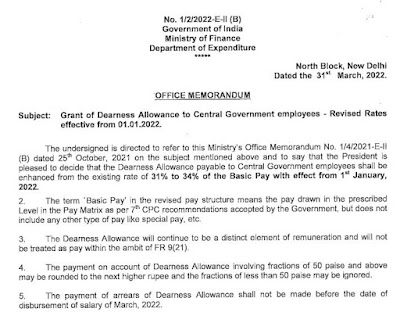
DA Jan 2022 - Grant of Dearness Allowance to Central Government employees - Revised Rates effective from 01.01.2022

 3% DA Hike - Revised Rates effective from 01.01.2022: DoE OM dated 31.03.2022 No. 1/2/2022-E-II (B) Government of India Ministry of Finance...