Showing posts with label person with disability. Show all posts

Monday, 19 August 2019

Railway Concessions, Reservation Quota and Other FACILITIES EXTENDED TO PERSONS WITH DISABILITY

Railway Concessions, Reservation Quota and Other FACILITIES EXTENDED TO PERSONS WITH DISABILITY

Facilities extended for the persons with disability by Ministry of Railways include:-

(A) Concessions:

Concessions in Rail fare have been extended to persons with disability, which are as under:

CONCESSION FOR PERSONS WITH DISABILITY

Category of persons with disability
1. Orthopedically handicapped/Paraplegic persons who cannot travel without escort - for any purpose. However, can book ticket with or without escort.
2. Mentally retarded persons who cannot travel without escort- for any purpose. However, can book ticket with or without escort.
3. Blind persons travelling alone or with an escort - for any purpose

Percentage of concession
  • 75% in 2nd, SL; 1st Class, 3AC, AC chair car
  • 50% in 1AC and 2AC,
  • 25% in 3AC & AC chair Car of Rajdhani/ Shatabdi trains
  • 50% in MST & QST
  • One escort is also eligible for same element of concession
4. Deaf & Dumb persons (both afflictions together in the same person) travelling alone or with an escort - for any purpose.
Percentage of concession
  • 50% in 2nd, SL and 1st Class
  • 50% in MST & QST
  • One escort is also eligible for same element of concession.
The procedure for availing concession is (a) Concession tickets are issued directly from Stations on production of copy of prescribed certificate from Govt. Doctor, (b) For Blind persons, certificates issued by RMPs and certain Institutions working of Blind persons (listed in Coaching Tariff) also are accepted. Concessions granted directly at stations on production of . a photocopy of the certificate. The Original certificate will have to be produced for inspection at the time of purchase of concessional ticket and during journey, if demanded. E-ticket are also issued on the basis of Unique ID issued by Indian railways to eligible persons with disability for concession in fare.

Concession is admissible in the basic fares of Mail/ Express/ Rajdhani/ Shatabdi group of trains all other charges like reservation fee, supplementary charges etc. are to be paid in full.

With a view to facilitate persons with disability to avail concessional tickets online, concessional tickets booking facility including online concessional ticket booking facility for the persons with disability using Photo identity card issue by the Railways has been introduced.

(B) Quota in Reservation:

(i) A reservation quota of four sleeper class berths & 2 berths in 3AC class has been earmarked in all trains running on non-suburban sections for persons with disability performing their journey on handicapped concessional ticket. The persons accompanying the persons with disability as escort is also allotted the berth out of this quota.

(ii) Instructions have also been issued that in the tickets issued through Computerized Passenger Reservation System, to extent feasible, one lower berth should be allotted to the person with disability and the person accompanying the persons with disability as. escort should be allotted middle/upper berths near the persons with disability subject to availability of accommodation.

(iii) After departure of the train, i'f there are vacant lower berths available in the train and if any person with disability booked on the authority of handicapped concessional ticket, who has been allotted upper/middle berth, approaches for allotment of vacant lower berths, the Conductor/Train Ticket Examiner (TTE) has been authorized to allot the vacant lower berth to them making necessary entries in the Chart.

(C) Other facilities:

(i) Specially designed coaches known as SLRD coaches with wider entrance doors to allow a wheel chair to enter, wider aisles and modified toilet with 4 berths, the lower two for persons with disability and upper berths for attendants have been attached in almost all Mail/Express trains except Rajdhani, Shatabdi, Jan Shatabdi Express Trains and Duronto Express Trains.

(ii) Instructions have been issued that in all Mail/Express Trains, the SLRD coaches should treated as unreserved coaches earmarked for exclusive use of persons with disability. In case of Garib Rath Express Trains which are fully reserved trains, these coaches are treated as reserved for booking by persons with disability travelling on the prescribed certificate on payment of full fare of 3 AC class of Garib Rath Express on first come first served basis.

(iii) Separate counters are earmarked to various Passenger Reservation System (PRS) centres for dealing with the reservation i,requisitions received from persons with disability, Senior Citizens, Ex. MPs, MLAs, accredited journalists and freedom fighters, if the average demand per shift not less than 120 tickets. In case there is no justification for earmarking of an exclusive counter for any of these categories of persons including persons with disability or senior citizens, one or two counters depending upon the total demand are earmarked for dealing with the reservation requests for all these categories of persons.

(iv) Zonal Railways have been authorised to introduce Battery Operated Vehicles (BOVs) at major Railway Stations for persons with disability, elderly and ailing passengers on 'first come first served' basis through sponsorship from individuals, NGOs, Trusts, Charitable institutions, Corporates and PSUs/Corporate Houses under their Corporate Social Responsibility with no charge to passenger or to the Railway. 80 BOVs have already been provided at 54 major railway stations. Further, instructions have also been issued to Zonal Railways to invite Expression of interest for providing the facility of Battery'' operated Car service on payment basis initially at all Al category stations keeping in view the financial sustainability of the service. This facility can be availed by passengers on 'first come first served' basis, however, preference shall be given to Sr. Citizens, persons with disability, pregnant women and medically sick passengers.

(v) Persons with disability friendly toilets, water fountains, ticket counters and earmarked parking facility is provided at all A-1, A and B category of stations.

(vi) In allotment of STD/PCO booths at Railway Stations, 25% booths have been reserved for persons with disability (including blind) with disability of 40% and above.

(vii) Zonal railways have also been instructed to provide one wheel chair per platform and in case of island platforms one wheel chair per two platforms at all A-1 and A category stations.

Yatri Mitra Sewa has a!So been introduced at major railway stations for enabling passengers to book wheel chairs services cum porter services free of cost through NGOs, Charitable trust, PSUs etc. under CSR and responsibility of providing this facility has been entrusted with IRCTC. In case of lack of response from NGOs, Charitable trust, PSUs etc. this service may be arranged on payment basis through a service provider or on its own.

Short term facilities as detailed below have been planned at all stations:
  • Standard ramp for barrier free entry.
  • Earmarking at least two parking lots.
  • Non-slippery walk-way from parking lot to building.
  • Signages of appropriate visibility. At least one toilet (on the ground floor).
  • At least one drinking water tap suitable for use by persons with disability. 'May I help you' Booth.
In addition, long term facilities as detailed below have been planned at 'A-1', 'A' & 'B' category stations:
  • Provision of facility for inter-platform transfer.
  • Engraving on edges of platform.
Source: Indian Railways

Monday, 6 May 2019

General Departmental Competitive Examination - Reservation for "horizontal" categories including Persons with Benchmark Disabilities and Economically Weaker Sections (EWS) who are serving employees


General Departmental Competitive Examination - Reservation for "horizontal" categories including Persons with Benchmark Disabilities and Economically Weaker Sections (EWS) who are serving employees reg.
RBE No. 65
GOVERNMENT OF INDIA
MINISTRY OF RAILWAYS
(RAILWAY BOARD)
Ne. E(NG)I-2018/PM1/23
New Delhi, dated 23.04.2019
The General Managers,
All Zonal Railways &
Production Units.
(As per standard mailing list)

Sub: General Departmental Competitive Examination - Reservation for "horizontal" categories including Persons with Benchmark Disabilities and Economically Weaker Sections (EWS) who are serving employees reg.

Ref: (i) SECR's letter No. P-HQ/RUL/105/5/7073 dated 25.09.2018 & 04.02.2019.
(ii) ECoR's letter No. ECoR/Pers/GDCE/2019 dated 01.04.2019

Clarification has been sought by certain Railways regarding applicability of reservation for PwBD and Economically Weaker Sections (EWS) employees' under the scheme of General Departmental Competitive Examination (GDCE).

The matter has been examined in detail in Board’s office. It is clarified that horizontal reservation quota (including that for PwBD and EWS) that is applicable for Open Market recruitment will not apply for GDCE scheme.

This disposes of the above referred letters.
Sd/-
(S. Balachandra Iyer)
Executive Director Estt..(N)
All Railway Board
Source: Indian Railways

Monday, 28 December 2015

Person With Disabilities in Central Government – 7th Pay Commission Recommendations

Person With Disabilities in Central Government – 7th Pay Commission Recommendations


PWDs in Central Government

The government provides three percent reservation in jobs for PWDs. Apart from this reservation at the entry stage, DoPT has issued instructions regarding identification of jobs, post-recruitment and pre-promotion training, providing aids/assistive devices, accessibility and barrier free environment at work place, preference in government accommodation, grievance redressal, and preference in transfer/posting for PWDs. In a recent notification, a provision has been made for ten years’ (fifteen years in case of SC/ST and thirteen years in case of OBC candidates) relaxation in the upper age limit for direct recruitment to civil posts/services under the Central Government.

Moreover, there are certain special entitlements as given below:

i. Special Allowance for Child Care for Women with Disabilities at the rate of Rs.1,500 pm;
ii. Transport Allowance at double the normal rate, subject to a minimum of Rs.1,000 pm;
iii. Constant Attendance Allowance for retired employees with 100 percent disablement at the rate of Rs. 4,500 per month;
iv. Special Casual Leave for four days in a calendar year for specific requirements relating to disabilities;
 v. Special Casual Leave for ten days in a calendar year for participation in Conferences/Seminars/Trainings/Workshops related to disability and development.

In case the disability is work related, the following additional provisions are available:

a. Special Disability Leave;
b. Disability Pension;
c. Educational Concession to children of Defence personnel who are disabled in action.

For employees with differently abled children, Children Education Allowance and Hostel Subsidy is granted at double rate.

Demands

Associations of employees with disabilities made the following demands before the Commission:
i. Suitable enhancement in the existing provisions
ii. Provision of Common Room in offices with suitable recreational facilities
iii. Additional rebate in House Building Advance and Automobile Advance
iv. Establishment of Welfare Committees in the ministries

Analysis and Recommendations

The National Policy for Persons with Disabilities, 2006, enunciates the measures that need to be taken by the government to ensure equal opportunities, protection of justifys and full participation in society for PWDs, in consonance with the principles enshrined in the Indian Constitution. India is also a signatory to the UN Convention on the justifys for Persons with Disabilities. Thus, provision of appropriate measures for employees with disabilities is the responsibility of the Union Government.

The Commission has made various recommendations regarding PWDs at different places in the report. They are consolidated here for ready reference:
i. In recognition of the singular responsibility faced by differently abled women in raising their children, the Special Allowance for Child Care for Women with Disabilities has been enhanced from the present rate of Rs.1,500 pm to Rs.3,000 pm

ii. Transport Allowance at double the normal rate has been retained, and the minimum amount has been increased from Rs.1,000 pm to Rs.2,250 pm

iii. Children Education Allowance and Hostel Subsidy have been kept at double rate for differently abled children

iv. Constant Attendance Allowance has been enhanced from Rs.4,500 pm to Rs.6,750 pm

v. Special Disability Leave has been subsumed in Work Related Illness and Injury Leave (WRIIL), with improved provisions

vi. Educational Concession, hitherto available only to the children of Defence personnel killed/missing/disabled in action, has been extended to similarly placed personnel of CAPFs, Indian Coast Guard, RPF and police forces of Union Territories mutatis mutandis.

Besides the above recommendations, there are a few suggestions that can go a long way in improving the working environment for these employees :
i. In our interactions, it has been highlighted that easy access, particularly to toilets, remains an issue of concern. Hence, it is suggested that Guidelines and Space Standard for Barrier Free Built Environment for Disabled and Elderly Persons, issued by CPWD, Ministry of Urban Affairs and Employment, should invariably be followed while designing new government premises. Their application in the existing offices may also be explored.

ii. Every ministry should have a Welfare Committee, with due representation of differently abled employees, to address their concerns.

iii. The grievance redressal machinery should be strengthened and made more effective

Monday, 23 November 2015

7th Pay Commission Report: Person with Disabilities

7th Pay Commission Report: Person with Disabilities

 Introduction
9.6.1 As per the Persons with Disabilities (Equal Opportunities, Protection of Rights and Full Participation) Act, 1995, a “person with disability” means a person suffering from not less than 40 percent of any disability as certified by a medical authority. “Disability” as defined in Section 2(i) of the Act means– (i) blindness (ii) low vision (iii) leprosy cured (iv) hearing impairment (v) locomotor disability (vi) mental retardation (vii) mental illness.
9.6.2 As per the Census of India, 2011, there are nearly 26.8 million Persons with Disabilities (PWDs) in the country, which is nearly 2.21 percent of the total population.


PWDs in Central Government
9.6.3 The government provides three percent reservation in jobs for PWDs. Apart from this reservation at the entry stage, DoPT has issued instructions regarding identification of jobs, post-recruitment and pre-promotion training, providing aids/ assistive devices, accessibility and barrier free environment at work place, preference in government accommodation, grievance redressal, and preference in transfer/posting for PWDs. In a recent notification, a provision has been made for ten years’ (fifteen years in case of SC/ST and thirteen years in case of OBC candidates) relaxation in the upper age limit for direct recruitment to civil posts/services under the Central Government.

9.6.4 Moreover, there are certain special entitlements as given below:
i. Special Allowance for Child Care for Women with Disabilities at the rate of Rs.1,500 pm;

ii. Transport Allowance at double the normal rate, subject to a minimum of Rs.1,000 pm; iii. Constant Attendance Allowance for retired employees with 100 percent disablement at the rate of Rs.4,500 per month;

iv. Special Casual Leave for four days in a calendar year for specific requirements relating to disabilities;

v. Special Casual Leave for ten days in a calendar year for participation in Conferences/ Seminars/Trainings/Workshops related to disability and development.

9.6.5 In case the disability is work related, the following additional provisions are available:
a. Special Disability Leave;

b. Disability Pension;

c. Educational Concession to children of Defence personnel who are disabled in action.

9.6.6 For employees with differently abled children, Children Education Allowance and Hostel Subsidy is granted at double rate.


Demands

9.6.7 Associations of employees with disabilities made the following demands before the Commission:
i. Suitable enhancement in the existing provisions

ii. Provision of Common Room in offices with suitable recreational facilities

iii. Additional rebate in House Building Advance and Automobile Advance
iv. Establishment of Welfare Committees in the ministries
Analysis and Recommendations

9.6.8 The National Policy for Persons with Disabilities, 2006, enunciates the measures that need to be taken by the government to ensure equal opportunities, protection of rights and full participation in society for PWDs, in consonance with the principles enshrined in the Indian Constitution. India is also a signatory to the UN Convention on the Rights for Persons with Disabilities. Thus, provision of appropriate measures for employees with disabilities is the responsibility of the Union Government.

9.6.9 The Commission has made various recommendations regarding PWDs at different places in the report. They are consolidated here for ready reference:
i. In recognition of the singular responsibility faced by differently abled women in raising their children, the Special Allowance for Child Care for Women with Disabilities has been enhanced from the present rate of Rs.1,500 pm to Rs.3,000 pm

ii. Transport Allowance at double the normal rate has been retained, and the minimum amount has been increased from Rs.1,000 pm to Rs.2,250 pm

iii. Children Education Allowance and Hostel Subsidy have been kept at double rate for differently abled children

iv. Constant Attendance Allowance has been enhanced from Rs.4,500 pm to Rs.6,750 pm

v. Special Disability Leave has been subsumed in Work Related Illness and Injury Leave (WRIIL), with improved provisions

vi. Educational Concession, hitherto available only to the children of Defence personnel killed/missing/disabled in action, has been extended to similarly placed personnel of CAPFs, Indian Coast Guard, RPF and police forces of Union Territories mutatis mutandis

9.6.10 Besides the above recommendations, there are a few suggestions that can go a long way in improving the working environment for these employees:
i. In our interactions, it has been highlighted that easy access, particularly to toilets, remains an issue of concern. Hence, it is suggested that Guidelines and Space Standard for Barrier Free Built Environment for Disabled and Elderly Persons, issued by CPWD, Ministry of Urban Affairs and Employment, should invariably be followed while designing new government premises. Their application in the existing offices may also be explored.

ii. Every ministry should have a Welfare Committee, with due representation of differently abled employees, to address their concerns.
iii. The grievance redressal machinery should be strengthened and made more effective.

Monday, 5 October 2015

Recruitment of Persons with Disabilities in Indian Railway from Open market

Recruitment of Persons with Disabilities from Open market- Employment Notices shall also get the uploaded on the websites of the Department of Empowerment of Persons with Disabilities, Department of Personnel and Training, Office of the Chief Commissioner for Persons with Disabilities: Railway Board Order

GOVERNMENT OF INDIA
MINISTRY OF RAILWAYS
(RAILWAY BOARD)
E(NG)-II/2015/RC-2/2
New Delhi, dated 16 .09.2015
The General Manager (P)
All Indian Railways/PUs,
Chairman/RRBs.
Sub: Recruitment of Persons with Disabilities from Open market- Employment Notices – reg.

As the Railways are aware, three percent of the vacancies in direct recruitment to non-Gazetted posts are to be reserved for persons with disabilities of which one percent each shall be reserved for persons suffering from (i) blindness or low vision, (ii) hearing impairment and (iii) locomotor disability or cerebral palsy in the posts identified suitable for each disability.  Further, in terms of Board’s instructions as contained in letter No. E(NG)-Il/98/RC-2/8 dated 17/9/1998, in addition to the Employment Notices being supplied to the Employment Exchanges, Special Employment Exchanges, Vocational Rehabilitation Centres & National level Rehabilitation institutes, such notices are also to be published in Employment News. It has now been decided that recruiting agencies whether RRBs/RRCs/ Railway Administrations shall also get the Employment Notices/Advertisements uploaded on the websites of the Department of Empowerment of Persons with Disabilities, Department of Personnel and Training, Office of the Chief Commissioner for Persons with Disabilities and any other Ministry/Department as deemed necessary through NIC or other means for information of all concerned. This will be in addition to, hoisting the same on the websites of the recruiting agencies concerned.

sd/-
(Neeraj Kumar)
Director Estt.(N)-II
Railway Board
 
Source: http://www.indianrailways.gov.in/railwayboard/uploads/directorate/establishment/ENG-II/2015/16_9_2015.pdf

Thursday, 6 August 2015

Facilities to Differently Abled at Government Offices

Facilities to Differently Abled at Government Offices
The Department of Personnel and Training has informed that as per information submitted on-line by 71 Departments/Ministries, as on 01.01.2013, there were 9341 number of persons with disabilities who were employed in the Departments/Ministries of the Central Government. State/UT-wise information is not compiled.
As per section 46 of the Persons with Disabilities (Equal Opportunities, Protection of justify and Full Participation) Act, 1995, the appropriate Governments and the local authorities are required to provide for-

(a) ramps in public buildings;
(b) adaptation of toilets for wheel chair users;
(c) braille symbols and auditory signals in elevators or lifts;
(d) ramps in hospitals, primary health centers and other medical care and rehabilitation institutions.
All the Ministries/Departments have been requested to comply with this provision. The Ministry of Railways provides concessional fare for various classes of persons with disabilities as under:
S.No. Category of Persons Percentage of Concession
1 Orthopaedically Handicapped/Paraplegic persons who cannot travel without escort –for any purpose 75% in 2nd, Sleeper, 1st Class, 3AC, AC chair Car50% in 1AC and 2AC
25% in 3AC & AC Chair Car of Rajdhani/Shatabdi trains
50% in Monthly Season Ticket & Quarterly Season Ticket
One escort is also eligible for same element of concession
2 Mentally retarded persons who cannot travel without escort- for any purpose.
3 Blind persons travelling alone or with an escort- for any purpose
4 Deaf & Dumb persons (both afflictions together in the same person) travelling alone or with an escort- for any purpose. 50% in 2nd , Sleeper and 1st Class50% in Monthly Season Ticket & Quarterly Season Ticket One escort is also eligible for same element of concession.

Similarly, State Governments have their own schemes for providing concessional fare for persons with disabilities while travelling by the buses owned by State transport undertakings.

As per Section 33 of the Persons with Disabilities (Equal Opportunities, Protection of justifys and Full Participation) Act, 1995, every appropriate Government are required to appoint in every establishment such percentage of vacancies not less than three per cent for persons or class of persons with disability of which one per cent each is reserved for persons suffering from blindness or low vision; (ii) hearing impairment; (iii) locomotor disability or cerebral palsy, in the posts identified for each disability.

This information was given by the Minister of State for Social Justice and Empowerment, Shri Krishan Pal Gurjar in a written reply to a question in Lok Sabha here today.
Source: PIB News

Tuesday, 30 June 2015

Uniform Age concession of 10 years to the Persons with Disabilities for direct recruitment to civil posts/services under the Central Government – Dopt Orders

Uniform Age concession of 10 years to the Persons with Disabilities for direct recruitment to civil posts/services under the Central Government – Dopt Orders

Grant of age concession to the Persons with Disabilities for direct recruitment to civil posts/services under the Central Government – Dopt Orders

G.I., Dept. of Per. & Trg., O.M.F.No15012/1/2003-Estt.(D), dated 29.6.2015

Subject: Grant of age concession to the Persons with Disabilities suffering from (a) blindness or ow vision, (b) hearing impairment and (c) locomotor disability or cerebral palsy for direct recruitment to civil posts/services under the Central Government.

The undersigned is directed to say that the following age concessions have been provided to physically handicapped persons for recruitment under the Central Government:

(i) Provision of ten years concession in upper age limit for Group C and D posts filled through employment exchanges issued vide O.M.No.15012/6/77-Estt.(D) dated 28.1.1978;

(ii) Provision of five years’ concession in upper age limit (10 years for SC/ST, 8 years for OBC) for recruitment to Group ‘A’ and ‘B’ posts otherwise than through Open Competitive Examination issued vide O.M.No.15012/5/92-Estt.(D) dated 27.7.1995; and

(iii) Provision of ten years concession in upper age limit (15 years for SC/ST, 13 years for OBC) for recruitment to Group A, B, C and D Civil Posts/Services filled through Open Competitive Examination issued vide O.M.No.43019/28/86-Estt.(D) dated 1.2.1999.

2. The question of prescribing uniform age-concession for direct recruitment to all Civil Posts/Services under the Central Government has since been examined and in supersession of the OMs referred to at (i), (ii) and (iii) above, the following has been decided:

Age relaxation of 10 years (15 years for SC/ST and 13 years for OBC candidates) in upper age limit shall be allowed to persons suffering from (a) blindness or low vision, (b) hearing impairment and (c) locomotor disability or cerebral palsy in case of direct recruitment to all civil posts/services under the Central Government identified suitable to be held by persons with such disabilities, subject to the condition that maximum age of the applicant on the crucial date shall not exceed 56 years.

(ii) The age concession to the persons with disabilities shall be admissible irrespective of the fact whether the post is reserved for person with disabilities or not, provided the post is identified suitable for the relevant category of disability. This provision will not apply to the Civil Services Examination, in respect of which the List of Services Identified suitable for Physically Disabled Category along with’ the Physical Requirements and Functional Classifications is notified separately.

(iii) Relaxation of age limit would be permissible to such persons who have a minimum of 40% disability.
(iv) The definitions of above categories of disabilities, for the purpose of age relaxation, will be same as given in this Department’s O.M. No. 36035/3/2004-Estt(Reservation) dated 29th December 2005.

(v) If a person with disability is entitled to age concession by virtue of being a Central Government employee, concession to him/her will be admissible either as a ‘person with disability’ or as a ‘Central Government employee’ whichever may be more beneficial to him/her. This provision will not apply to the Civil Services Examination, which is governed by the Civil Services Examination Rules, published annually.

(vi) Provisions of this O.M. will not be applicable to a post/service for which other specific provision regarding age relaxation is made by notification.

3. The Ministries/Departments are advised to ensure invariably that while sending the requisition to the UPSC/SSC and other recruitment agencies for direct recruitment posts by selection, they should clearly mention in the requisition the category of person(s) with disabilities suitable for the post(s) in question. No change or modification in identified post(s) for physically disabled persons with respect to an Examination, intimated after the Notification of that Examination, shall be acceptable.

4. These instructions come into effect from the date of their issue.

Click to view the original order

Authority : www.persmin.gov.in

Tuesday, 17 February 2015

Travelling Allowance in respect of Attendant/Escort for accompanying a Government Servant with Disabilities on travel during tour/training

Travelling Allowance in respect of Attendant/Escort for accompanying a Government Servant with Disabilities on travel during tour/training etc: Finance Ministry OM dated 17-02-2015

No. 19030/3/2013-E.IV
Government of India
Ministry of Finance
Department of Expenditure
North Block, New Delhi
Dated the 17th February, 2015.
OFFICE MEMORANDUM
Subject- Travelling Allowance in respect of Attendant/Escort for accompanying a Government Servant with Disabilities on travel during tour/training etc.
References have been received in the Ministry of Finance, Department of Expenditure seeking provision in the Rules/instructions regulating Travelling Allowance, in order to allow grant of Travelling Allowance to the Government servant with Disabilities in respect of an Attendant/Escort accompanying such a Government servant with Disabilities during travel while on tour/training, etc. At present there are no provisions in the Travelling Allowance rules which allows Government servants to claim Travelling Allowance in respect of Attendant/Escort accompanying them on tour/ training, etc. where such Government servants require the assistance of an Attendant/Escort for travel.
2. The matter has been considered and it has now been decided to allow Travelling Allowance in respect of the Attendant/Escort, for accompanying a Government servant with Disabilities during travel while on tour/training, etc., to be claimed by the Government servant with Disabilities. The admissibility of Travelling Allowance, in respect of the Attendant/Escort accompanying a Government servant with Disabilities, would be subject to the following conditions:-
(a) Ordinarily, the field offices/local administrative offices at the touring station, which the Government servant with Disabilities is required to visit on tour or training institutes where the Government servant with Disabilities is required to undergo training, would be required to provide an Attendant/Escort, from the existing pool of staff/persons employed, from the time the Government servant with Disabilities arrives at the destination and till such time the Government servant with Disabilities departs from that destination back to his headquarter station/place from where the Government servant with Disabilities had initially proceeded to that destination. During travel abroad, either on foreign tour/training, the Indian Missions/Posts (Embassy of India) at the country of visit would be required to.provide an Attendant/Escort, from the existing pool of staff/persons ,employed, during the period of stay of the Government servant with Disabilities in that country.

(b) Only when field offices/local administrative offices at the touring station or training institutes or Indian Missions/Posts at the country of visit, as the case may be, officially express their inability to provide an Attendant/Escort to the visiting Government servant with Disabilities, would the claim of Travelling Allowance in respect of Attendant/Escort accompanying the Government servant with Disabilities arise. In such cases, fare for travel of Attendant/Escort accompanying Government servant with Disabilities would be reimbursed. While for travel by air, Airlines-are expected to provide assistance to Government servant with Disabilities during travel as per Airlines policies, a Government servant with Disabilities however, can take along his personal Attendant/Escort for travel by Indian Railways for assistance during journey and boarding/de-boarding, even when an Attendant/Escort at destination station is provided officially.

(c) In all cases, Government servant with Disabilities are required to purchase travel tickets for self and Attendant/Escort at concessional rates, if any, offered by Railways/Airlines.

(d) The facility of Travelling Allowance for the Attendant/Escort would only be admissible to those Government servants with Disabilities, wherein it is certified by the competent Medical Authority that such a person compulsorily requires assistance of another person for travel. Under this clause, necessary certificate is to be obtained from the Head of Department of a Government Civil Hospital designated for the type/form of disability of the Government servant. Based on the certificate from competent Medical Authority, Heads of Departments would have to further satisfy the need for an Attendant/Escort during travel of the Government servant, before allowing the journey for the Attendant/Escort.

(e) Subject to clause (d) above, Travelling Allowance for the Attendant/Escort would be admissible to the Government servant with Disabilities while on tour (domestic or foreign). However, the authority deputing such a Government servant with Disabilities on tour would have to record in writing that the tour is considered necessary in the discharge of duties and responsibilities assigned to the Government servant with Disabilities.

(f) Subject to clause (d) above, Travelling Allowance for the Attendant/Escort would also be admissible to the Government servant with Disabilities when deputed on training provided it is recorded by the authority competent to depute such officials on training that such training is a mandatory training for career progression or induction training for probationers.

(g) Travelling Allowance consists of two parts; Mileage Allowance and Daily Allowance. No Daily Allowance would be admissible to the Attendant/Escort of the Government servant with Disabilities. Mileage Allowance would be admissible to the Attendant/Escort at the same rate and in the same class of accommodation, as the Government servant with Disabilities is entitled to under the Revised Travelling Allowance Rules, read with travel restrictions imposed under austerity measures/economy instructions, issued from time to time by the Government. However, in case of travel by any of the modes of conveyance by road, as prescribed under the Travelling Allowance rules, no separate mileage allowance would be admissible to the Government servant with Disabilities, in respect of the Attendant/Escort, except where the travel is by public bus.

(h) For commuting between residence to office and back, certain categories of Government servants with Disabilities are eligible for Transport Allowance at double the normal rates. As no Travelling Allowance is admissible to. Government servants for training at headquarter station, consequently, no claim of Travelling Allowance to the Attendant/Escort of the Government servant with Disabilities would be admissible for training at headquarter station.

3. In so far as persons serving in the Indian Audit and Accounts Department are concerned, these orders issue in consultation with the Comptroller & Auditor General of India.
sd/-
(Subhash Chand)
Director
Source: http://finmin.nic.in/the_ministry/dept_expenditure/notification/ta_ota/TA_Attendant_disabilities_tourtraining17022015.pdf

Flash News

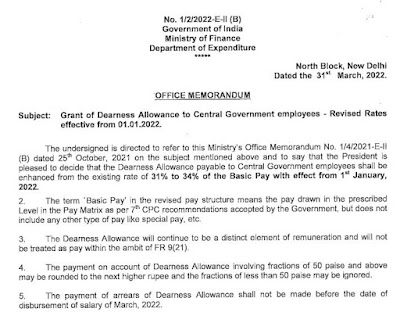
DA Jan 2022 - Grant of Dearness Allowance to Central Government employees - Revised Rates effective from 01.01.2022

 3% DA Hike - Revised Rates effective from 01.01.2022: DoE OM dated 31.03.2022 No. 1/2/2022-E-II (B) Government of India Ministry of Finance...