Tuesday, 2 January 2018

Grant of Special Casual Leave for the purpose of blood donation

Grant of Special Casual Leave for the purpose of blood donation

Special-Casual-Leave-blood-donation

No.13020/1/2017-Estt(L)
Government of India
Ministry of Personnel, Public Grievances and Pensions
Department of Personnel & Training
Old JNU Campus, New Delhi 110 067
Dated: 29.12.2017
Office Memorandum

Subject: Grant of Special Casual Leave for the purpose of blood donation - reg.

The undersigned is directed to refer to the provisions of this Department's O.M. dated 8.10.1956, which provides for grant of Special Casual Leave to a Government servant who donates blood on that day.

2. In this regard, it is noted that presently this rule applies only to whole blood donation and does not cover apheresis donation. It is felt that the rule should cover apheresis donation as well since it will have the added advantage of getting blood components like platelets, plasma etc.

3. In view of the above, it has now been decided that Special Casual Leave may be granted for blood donation or for apheresis (blood components such as cells, plasma, platelets etc.,)donation at licensed Blood Banks on a working day (for that day only) up to a maximum of 4 times in a year on submission of valid proof of donation.

sd/-
(Sandeep Saxena)
Under Secretary to the Government of India
Source: dopt.gov.in

Sanctioned strength and Employees in position in Central Government as on 01.03.2016

Sanctioned strength and Employees in position in Central Government as on 01.03.2016

DISTRIBUTION OF REGULAR CIVILIAN EMPLOYEES (GROUP- WISE) IN CENTRAL GOVERNMENT AND UNION TERRITORY ADMINISTRATIONS AS ON 01.03.2016

Pay-and-Allowance-report-CG-Employees-1

Erstwhile Group D posts have been categorised as Group C after implementation of recommendations of 6th Central Pay Commission (CPC).

GROUP-WISE NUMBER OF SANCTIONED POSTS AND EMPLOYEES IN POSITION, VACANCIES AND THEIR PERCENTAGE TO TOTAL SANCTIONED POSTS AS ON 01.03.2016
Pay-and-Allowance-report-CG-Employees


NUMBER OF SANCTIONED POSTS AND NUMBER OF EMPLOYEES IN POSITION IN CENTRAL POLICE FORCES
Pay-and-Allowance-report-CG-Employees

Annual Report on Pay & Allowances for Central Government Employees - Finance Ministry

Annual Report on Pay & Allowances for Central Government Employees - Finance Ministry

Pay Research Unit
Department of Expenditure
Ministry of Finance
New Delhi

ANNUAL REPORT ON PAY & ALLOWANCES FOR THE YEAR 2016-17

SALIENT FEATURES

1. The total expenditure on Pay and Allowances (excluding Productivity Linked Bonus/Ad-hoc Bonus, Honorarium, Encashment of Earned Leave and Travelling Allowance) for Regular Central Government Civilian employees including employees of the Union Territories was Rs.182513.25 crore in 2016-17 as compared to Rs.150028.57 crore in 2015-16. Thus, there is an increase in expenditure by Rs.32484.68 crore over previous year which in relative terms works out to around 21.65%.

2. The Total expenditure on pay and allowances as a percentage of Revenue Receipts and Revenue Expenditure of the Central Government during the financial year 2016-17 is 10.88% and 9.18% as compared 10.45% and 8.43% respectively during the financial year 2015-16.

3. Out of the total expenditure of Rs.182513.25 crore, the percentage expenditure on Pay, Dearness Allowance (DA), House Rent Allowance (HRA) and other allowances are 65.75%, 16.57%, 3.42% and 14.26% respectively.

4. Out of the total expenditure of Rs.6253.93 crore on HRA in 2016-17, the HRA expenditure for 'X' class cities is Rs.2817.83 crore which is around 45.06% of the total expenditure on HRA.

5. Almost 86% of the total expenditure was incurred by five major Ministries/Departments (Railways, Defence (Civil), Home Affairs, Posts and Revenue) during 2016-17.

6. Of the total expenditure on Pay and Allowances in 2016-17, the Ministry of Railways continues to have the largest share i.e 38.92% , marginally increased from 34.98% in 2015- 16. Share of Ministry of Home Affairs has decreased from 26.59% to 25.06% and department of Posts has been decreased from 7.74% to 5.55% . Share of Ministry of Defence (Civil) has decreased from the previous year i.e. from 12.11% to 12.04%.

7. The expenditure of UT administrations is Rs.3781.92 crore in 2016-17 as compared to Rs.3382.19 crore in 2015-16. Thus, there is an increase in expenditure by Rs.399.73. crore over previous year which in relative terms works out to around 11.82%.

8. The expenditure of Indian Missions/ Embassies abroad is Rs.1426.08 crore in 2016-17 as compared to Rs.1159.54 crore in 2015-16. Thus, there is an increase in expenditure by Rs.266.54 crore over previous year which in relative terms works out to around 22.98%.

9. As on 01.03.2016, the total number of Regular Central Government Civilian Employees in position was 32.21 lakh against the sanctioned strength of 36.34 lakh and approximately 11.36% of the posts were vacant.

10. Almost 92% of the total manpower is covered by five major Ministries/Departments viz, Railways, Defence (Civil) , Home Affairs, Posts and Revenue. Of the total strength of 32.21 lakh, the percentage share of the Railways is 41.33%, Home Affairs 29.44%, Defence (Civil) 12.37%, Posts 6.02 %, Revenue 3.11% and all other Ministries/ Departments 7.73%

11. Against the sanctioned strength of 9.57 lakh in Central Police Forces, 9.01 lakh employees were in position as on 01.03.2016. In Union Territories (UTs) 64910 employees were in position as on 01.03.2016.

12. DA based on All India Consumer Price Index.

Source: www.doe.gov.in

Applicability of CCS (RP) Rules, 2016 to persons re-employed Government Service and whose pay is debitable to civil estimates


Applicability of CCS (RP) Rules, 2016 to persons re-employed Government Service and whose pay is debitable to civil estimates -reg.

No. Conf/Re-emp.Ex-Sercice/2016-19
Dated - 01.01.2018
Shri Ajay Narayan Jha,
Secretary
Department of Expenditure
Ministry of Finance, Government of India
Room No.129-A, North Block
New Delhi - 110001

Sub: Applicability of CCS (RP) Rules, 2016 to persons re-employed Government Service and whose pay is debitable to civil estimates - reg.

Ref : DoPT O.M. No. F.No. 3/3/2016-Estt.(Pay-II) dated 18.10.2017.

Sir,
1. Confederation of Central Government Employees and Workers has received numerous complaints from re-employed ex-servicemen on the matter of their initial pay fixation in the re-employed posts. We have taken up this case in the Standing Committee meeting of JCM National Council as an agenda item. Minutes of the Standing Committee meeting circulated in DOP & T OM No.3/3/2016-JCA dated 08-08-2017 is reproduced below:

"S.No.36 - Removal of ambiguity in fixation of pay of re- employed ex-servicemen and grant of the same benefit extended to commissioned officers to Personal Below Officers Rank (PBOR) also.
Reply: Establishment Division in their comments dated 28-03-2017 had stated that -
(i) The first issue relates to pay fixation on re- employment in Civil Services and Public Sector Banks etc. Department of Financial Services (DoFS) is stated to have clarified that pay fixation of ex-servicemen would be through protection of pay plus DA drawn by them at the time of release from the Armed Forces. DoFS orders provide that in addition to the pay fixed on re-employment, pension and other retirement benefits would also be allowed.

(ii) Establishment Division of DOP&T has clarified to Department of Posts that initial pay on re-employment in case of ex-servicemen who had held posts below Commissioned Officers and Civilians below Group-A, shall be fixed as per the entry pay in the revised pay structure of the re-employed posts applicable to the case of direct recruits appointed on or after 01-01-2006.

(iii) Staff side says there is contradictions in the two clarifications and, as a result of the ambiguity, one section has benefited (Personnel who are covered under the instructions of DoFS) while others are not (Personnel who are covered under the instructions of DoPT). JS(E) stated that they had received a number of grievances and the Department of Welfare of Ex-Servicemen had also raised this issue. Presently there are two formulations for pay fixation of ex-servicemen - one for Group-A Posts and another for others - which is not an ideal situation. It was stated that the same is under active consideration and a decision is likely shortly."
We understand that it is in this background DOPT has circulated a revised draft proposal seeking opinion from other nodal Ministers. In that context, I would like to draw your kind attention to the succeeding facts and circumstances of the case.

History of Rules/ OMs Governing Pay-fixation on Re-Employment

2. Before delving into the above captioned subject, it would be prudent to retrace the evolution of statutory rules governing the initial fixation of pay of re-employed pensioners. The first comprehensive policy on the subject was issued by Department of Expenditure, MoF vide their O.M. No. 8(34)/Est. III/57 dated 25.11.1958 (Annexure-I) which when read in conjunction with Article 510-526 of Central Services Regulation (Annexure-II), inter-alia states that:-
(a) Re-employed pensioners should be allowed only the prescribed scales of pay, that is, no protected time scales such as those available to pre-1931 entrants should be extended to them.

(b) The initial pay, on re-employment should be fixed at the minimum stage of the scale of pay prescribed for the post in which an individual is re-employed. In cases where it is felt that the fixation of initial pay of the re-employed officer at the minimum of the prescribed pay scale will cause undue hardship, the pay may be fixed at a higher stage by allowing one increment for each year of service which the officer has rendered before retirement in a post not lower than that in which he is re-employed.

(c) In addition to (b) above the Government servant may be permitted to draw separately any pension sanctioned to him and to retain any other form of retirement benefit for which he is eligible e.g. Government's contribution to a Contributory Provident Fund, gratuity, commuted value of pension, etc.
3. The said policy was in vogue till 30.07.1986, with suitable amendments from time to time in so far as the amount of pension to be ignored while fixing the pay in the re-employed post is as given below :-

4. However, the subject was transferred to DoPT in 1986, therefore, all subsequent instructions were issued under the aegis of DoPT. One such impugned instruction is the CCS (Fixation of Pay of Re-employed Pensioners) Orders, 1986 issued vide DOPT OM No. 3/1/85-Estt. (Pay-II) dated 31.07.1986 (Annexure-VIII). The subject order has been subsequently amended by DOPT vide their O.M. No. 3/19/2009-Estt (Pay-II) dated 05.04.2010 (Annexure-XI), 08.11.2010 (Annexure-XII)and O.M. No. 3/3/2016-Estt (Pay II) dated 01.05.2017(Annexure-X). However, these orders have failed to incorporate 'Hardship Clause' for pay fixation in respect of PBORs which has resulted in lot of heartburn and anomalous situation of pay-fixation post 1986 order viz-a-viz pre-1986 retirees. The situation has worsened post implementation of the 6th CPC and the recent 7th CPC, causing large-scale upheaval among PBOR ex-servicemen and further resulting in unending litigation in various courts of law across the country. Confederation has submitted a representation in September 2015 addressed to Shri. Jithendra Singh, Minister for State, Department of Personnel explaining the above position and requested to review the DOP&T orders. The matter was taken up in JCM also as stated above. Under such circumstances, DoPT has now decided to formulate a new policy, for which they have sought comments of Department of Ex-servicemen Welfare, MoD, Department of Expenditure, MoF and Department of Pension and Pensioners Welfare. I would like to reiterate that unless there is a cogent reason, the policies affecting lives of millions of ex-servicemen should not be arbitrarily amended. This is especially evident from intentional/ unintentional omission of "hardship clause" from pay-fixation orders issued by DoPT which are at variance from the instructions issued by DoE till 1986.

5. It is also brought to the notice of Department of Expenditure that in view of large scale representation/litigation and discontent among re-employed ex-servicemen after issue of DoPT O.M.3/3/2016-Estt (Pay-II) dated 01.05.2017, Department of Ex-servicemen Welfare, MoD vide their O.M. No 28(11)2017/D (Res-I) dated 24.07.2017 (Annexure-XIII) had suggested DoPT to completely revive the provisions contained in DoE, MoF O.M. No. 8(34)/Est. III/57 dated 25.11.1958. But, the proposal of DESW stated in Para 6 of their above cited O. M. would only be beneficial only if status quo existed till 30.06.1986 is fully revived. In other words, any proposal to revive the 1958 Orders would be beneficial to re-employed ex-servicemen (PBOR) only if the entire pension is ignored for fixation of pay in the re-employed post, i.e. the pension is not to be taken into account while fixing the pay as per Ministry of Defence O.M. No. 2 (1)/83/D (Civ.I) dated 08.02.1983 and Ministry of Finance, Dept. of Expenditure No. F. 4 (3)-E. III (B)/82 dated 13.12.1983.

OPINION/ RECOMMENDATION OF THE CONFEDERATION

Computation of Pre-Retirement Pay for the purpose of Pay-Fixation

6. Similarly, the concept of pre-retirement pay (PRP) has undergone changes to the detriment of re-employed pensioners/ex- servicemen. It may be appreciated that Article 510 of Central Service Regulations, DoE O.M. 5(21)-Est. III(B)/64 dated 15.06.1964(Annexure XIV), DoPT O.M. No. 3/1/86-Estt (P.II) dated 31.07.1986 include all components of pay such as rank pay, increments of pay for length of service, Good Service Pay, Classification Pay and X-Group Pay as a part of PRP. However, the proposal sent by DoPT for comments only takes basic pay as PRP like Armed Forces Officers, while ignoring other components which are part of pension. It would be prudent to mention that PRP of Armed Forces Officer and Personnel Below Officer Rank (PBOR) has never been same and treating PRP of Armed Forces Officer as that of PBOR will not only create anomalous situation but also bring financial losses to PBOR.

Treatment of Military Service Pay.

7. It is submitted that as per Part I, Section-3 of Gazette Notification dated 30 August, 2008 (Annexure XV), Cabinet Resolution accepted Military Service Pay (Serial 2 of Annexure I-Part A) as part of pay in respect of all defence forces and is to be counted for pay fixation and pension in accordance with Para 2.3.12 of 6th CPC Recommendations(Annexure XVI). However, Defence Ministry arbitrarily overridden the above aspect through their O.M. dated 24.07.2009. Accordingly, DOPT has denied the benefit of MSP to all defence pensioners whereas the said O.M. of MoD was meant only for military officers on their re- employment within Armed Forces. In this context, I humbly refer to enclosed judgment of Hon'ble Supreme Court of India on Civil Appeal No 3744 of 2016 dated 08.12.2017(Annexure XVII) on admissibility of MACP on similar lines. In this judgment, Hon'ble Supreme Court has held that cabinet decisions cannot be overridden/ modified through the means of any executive order. Hence, Department of Expenditure may like to take cognizance of this ruling while forwarding its views to DoPT. It is imperative that the issue of MSP while fixing PRP is handled now in the spirit of above judgment which would go a long way in avoiding future litigation.

Methods of Pay Fixation

8. Since, DoPT has proposed to consolidate, rationalise and simplify existing orders on pay fixation of re-employed ex- servicemen (including reservists and ex-combatant clerks) in a single policy framework, we as representatives of employees including re-employed ex- servicemen, being a major stake holder in the matter would like to suggest that pay fixation policy envisaged from 25.11.1958 to 30.06.1986 may be revived. Accordingly, all re-employed ex-servicemen may be given two options to exercise, whichever may be beneficial to them and the subject option shall have a retrospective effect since 31.07.1986 at the discretion of affected ex-servicemen, as under :-
(a) Option I - The initial pay, on re-employment shall be fixed at the minimum of the scale of pay prescribed for the post in which the individual is re-employed. After fixing the pay as above, in case the initial pay is lesser than the last pay drawn (pre-retirement pay), such cases are to be treated as causing undue hardship, the pay is to be fixed at a higher stage by granting one increment for each year of service rendered by him, so as to bring the initial pay at par with the pre-retirement pay. The pay so fixed is to be treated as "minimum of the pay scale". In addition to the above, the government servant is permitted to draw pension and all other forms of retirement benefits including Dearness Relief on pension which he is eligible.

(b) Option II - The initial pay of a re-employed pensioner shall be fixed in the time scale of the re-employed post at a stage equivalent to the stage that would have been reached by putting in the Civil Posts, the number of completed years of service rendered in the posts in the Armed Forces. The pay so fixed will not be restricted to the 'pre- retirement pay'. The pension (including pension equivalent retirement benefit) may be reduced from the pay so fixed after ignoring an amount of Rs.15000/- as proposed by DOPT. In addition to the above, the government servant is permitted to draw pension and all other forms of retirement benefits including Dearness Relief on pension which he is eligible. (The amount of ignorable part of pension and PEG for pensioners re-employed prior to 01.01.2016 will remain at Rs.4000/-).
9. It is requested that the proposals of this Confederation may kindly be considered on merit while formulating DoE views for onward submission to DoPT. I am hopeful that appropriate policy would be formulated in consonance with the spirit of government orders in vogue till 1986.

Thanking You

Encl: As stated.
Yours faithfully,
(M. Krishnan,)
Member, Standing Committee,
National Council JCM &
Secretary General,
Confederation of Central Government Employees & Workers.
Mob: 09447068125, Email: mkrishnan6854@gmail.com

Source - confederationhq.blogspot.in

Monday, 1 January 2018

Revised rates of ECHS contribution and entitlement of Ward in Empanelled Hospitals/Medical Facilities

Revised rates of ECHS contribution and entitlement of Ward in Empanelled Hospitals/Medical Facilities.Dated 29.12.2017.
Government of India
Ministry of Defence
Department of Ex- Servicemen Welfare
Sena Bhavan, New Delhi
Dated 29th Dec., 2017
To,

The Chief of Army Staff
The Chief of Naval Staff
The Chief of Air Staff
Subject : Revised rates of ECHS contribution and entitlement of Ward in Empanelled Hospitals Medical Facilities.
Sir,

In supersession of the Government of India, Ministry of Defence letter No.22(16)/05/US/(WE)/D(Res) dated 19 July 2005 and dated August, 2011, I am directed to convey the sanction of the Government to revise rates of ECHS contribution to be paid by ESM and ward entitlement as under :

S.No. Category One time Contribution Ward Entitlement
(a)Recruit to Havs & equivalent in Navy

& AF
Rs.30,000/-General
(b)Nb Sub/Sub/Sub Maj or equivalent in Navy & AF

(including Hony Nb Sub/MACP Nb Sub and Hony Lt/Capt.
Rs.67,000/-Semi Private
(c)All

Officers
Rs.1,20,000/-Private

2. The revised order will be effective from the date of issue of this letter.

3. This issues with the concurrence of Ministry of Defence (Finance) vide their ID No.32(09)/2016/Fin/Pen dated 22-11-2017.Yours faithfully,
sd/-
(A.K.Karn)
Under Secretary to the Govt. of India
Authority: http://www.desw.gov.in/

Central Pension Accounting Office (CPAO) celebrated its 29th Foundation Day today in the service of the Central Civil Pensioners


Central Pension Accounting Office (CPAO) celebrated its 29th Foundation Day today in the service of the Central Civil Pensioners. 

The Central Pension Accounting Office (CPAO) celebrated  here today its 29th Foundation Day in the service of the Central (Civil) Pensioners. CPAO   (website www.cpao.nic.in) was established on 1st January, 1990; primarily to cater to the needs of central civil pensioners and other stakeholders in the Ministries/ Departments and Banks. The Central (Civil) pensions are authorized through Central Pension Accounting Office (CPAO) functioning under the Controller General of Accounts (CGA).

CPAO is administering the 'Scheme for Payment of Pensions to Central Government Civil Pensioners by Authorized Banks (both Public Sector and some Private sector Banks).  Its functions include, issue of Special Seal Authorisations (SSAs) for pension payments to Authorised Banks, preparation of budget for the Pension Grant and accounting thereof, reconciliation with and performance review of banks with respect to pension payments and disbursements & maintenance of the database of the Central Civil Pensioners etc.

CPAO was created with the primary objective of simplifying procedure and reducing the number of agencies for pension payment and to expedite the process of authorization, revision and transfer of pension through Authorized Banks.  The working of CPAO is fully computerized and it maintains a database of over 12 lakh Central (Civil) pensioners through Pension Authorisation, Retrieval and Accounting System (PARAS). These pensioners are being provided pension related services by the CPAO through more than 70,788 paying bank branches all over the country.

CPAO has Pension Tracking System to check the latest status of the pension processing and SMS facility is also being provided to the pensioners at each stage. CPAO has taken many steps under Digital India Mission like e-Scroll, e-SSA, e-PPO project etc. to reduce the paper movement and creation of digital record of the Special Seal Authorities (SSAs), PPO (Pension Payment Order) etc.  CPAO is also handling the grievances of the Central (Civil) Pensioners through its Grievance Redressal Mechanism which includes Web Responsive Pensioners Service (WRPS) facilitating information to pensioners on pension payments, facility to view and download latest orders and special seal authorities (SSAs) issued by CPAO among others.

 PIB

Government announced 8% GOI Savings (Taxable) Bonds


Government announced 8% GOI Savings (Taxable) Bonds

The Government of India (GoI) announced here today that 8% GOI Savings (Taxable) Bonds, 2003 shall cease for subscription with effect from the close of banking business on Tuesday, the 02nd January, 2018.

The Government of India (GoI) announced here today that 8% GOI Savings (Taxable) Bonds, 2003 shall cease for subscription with effect from the close of banking business on Tuesday, the 02nd January, 2018.

PIB

Direct Recruitment to Group C - Reservation Fixed on the basis of Population


Direct Recruitment to Group C - Reservation Fixed on the basis of Population
"In case of direct recruitment to Group C posts normally attracting candidates from a locality or a region, the percentage of reservation is generally fixed on the basis of proportion of their population in the respective States/Union Territories"
Reserve category representation
Article 16(4) of the Constitution enables provision of reservation to backward class of citizens, who are not adequately represented in the services under the State.

As per extant instructions, reservation is provided to Scheduled Castes, Scheduled Tribes and Other Backward Classes at the rate of 15%, 7.5% and 27% respectively in case of direct recruitment on all India basis by open competition. In case of direct recruitment on all India basis otherwise than by open competition, the percentage fixed is 16.66% for Scheduled Castes, 7.5% for Scheduled Tribes and 25.84% for Other Backward Classes.

In case of direct recruitment to Group C posts normally attracting candidates from a locality or a region, the percentage of reservation is generally fixed on the basis of proportion of their population in the respective States/Union Territories.

The services under the State come under the List II of the Seventh Schedule i.e. State List of the Constitution. The information on the state-wise provisions for reservation is not centrally maintained.
As per the 9 Judge Bench Constitutional judgment of the Supreme Court in Indira Sawhney case, total reservation cannot exceed the limit of 50%. In the same judgment, the Supreme Court has also observed that clause (4) of Article 16 of Constitution speaks of adequate representation and not proportionate representation.

This was stated by the Union Minister of State (Independent Charge) of the Ministry of Development of North Eastern Region (DoNER), MoS PMO, Personnel, Public Grievances & Pensions, Atomic Energy and Space, Dr Jitendra Singh in a written reply to question in the Lok Sabha today.

Sunday, 31 December 2017

Issuing of Aadhaar cards through post offices and banks

Issuing of Aadhaar cards through post offices and banks

GOVERNMENT OF INDIA
MINISTRY OF ELECTRONICS AND INFORMATION TECHNOLOGY
RAJYA SABHA
UNSTARRED QUESTION NO-900

ANSWERED ON-22.12.2017

Issuing of Aadhaar cards through post offices and banks
900 . Shri Dharmapuri Srinivas

Will the Minister of ELECTRONICS AND INFORMATION TECHNOLOGY be pleased to state:

(a) whether it is a fact that the Government is contemplating on handing over the work of issuing of Aadhaar Cards to Post Offices and Banks in the country; and

(b) if so, the details thereof

ANSWER

(a) and (b): Department of Post, as Registrar of UIDAI, has been mandated to set up Aadhaar enrolment and update facility in designated post offices throughout the country. In addition, banks have also been mandated under Regulation 12A of the Aadhaar (Enrolment and Update) (Second Amendment) Regulations, 2017 (No. 2 of 2017) and the Aadhaar (Enrolment and Update) (Third Amendment) (No. 3 of 2017) to set up Aadhaar enrolment and update facility in a minimum one out of every ten bank branches.

Restriction in conduct rules on investments by employees

GOVERNMENT OF INDIA
MINISTRY OF PERSONNEL,PUBLIC GRIEVANCES AND PENSIONS
RAJYA SABHA

UNSTARRED QUESTION NO-1223
ANSWERED ON-28.12.2017

Restriction in conduct rules on investments by employees

1223 . Shri Narayan Lal Panchariya
(a) whether there are any restrictions under relevant conduct rules on investments by Central Government employees in stock market/financial market instruments;
(b) if so, the details thereof and the reasons therefor;
(c) whether Government is considering any proposal for giving greater freedom to Central Government employees to invest in such instruments; and
(d) if so, the details thereof?

ANSWER
MINISTER OF STATE IN THE MINISTRY OF PERSONNEL, PUBLIC GRIEVANCES AND PENSIONS AND MINISTER OF STATE IN THE PRIME MINISTER’S OFFICE (DR. JITENDRA SINGH)

(a) & (b): Yes Sir. Rule 16 of the Central Civil Services (Conduct) Rules, 1964, is relevant for investment by Central Government employees in stock/ financial market instruments. The provisions of Rule 16 are reproduced as under:

"(1) No Government servant shall speculate in any stock, share or other investment: Provided that nothing in this sub-rule shall apply to occasional investments made through stock brokers or other persons duly authorised and licensed or who have obtained a certificate of registration under the relevant law. Explanation - Frequent purchase or sale or both, of shares, securities or other investments shall be deemed to be speculation within the meaning of this sub-rule."

(2) (i) No Government servant shall make, or permit any member of his family or any person acting on his behalf to make, any investment which is likely to embarrass or influence him in the discharge of his official duties. For this purpose, any purchase of shares out of the quotas reserved for Directors of Companies or their friends and associates shall be deemed to be an investment which is likely to embarrass the Government servant.

(ii) No Government servant who is involved in the decision making process of fixation of price of an Initial Public Offering or Follow-up Public Offering of shares of a Central Public Sector Enterprise shall apply, either himself or through any member of his family or through any other person acting on his behalf, for allotment of shares in the Initial Public Offerings or Follow-up Public Offerings of such Central Public Sector Enterprise.

(3) If any question arises whether any transaction is of the nature referred to in sub-rule (1) or sub-rule(2), the decision of the Government thereon shall be final.

(4) (i) No Government servant shall, save in the ordinary course of business with a bank or a public limited company, either himself or through any member of his family or any other person acting on his behalf,

(a) lend or borrow or deposit money, as a principal or an agent, to, or from or with, any person or firm or private limited company within the local limits of his authority or with whom he is likely to have official dealings or otherwise place himself under any pecuniary obligation to such person or firm or private limited company; or

(b) lend money to any person at interest or in a manner whereby return in money or in kind is charged or paid:
Provided that a Government servant may give to, or accept from, a relative or a personal friend a purely temporary loan of a small amount free of interest, or operate credit account with a bona fide tradesman or make an advance of pay to his private employee:

Provided further that nothing in this sub-rule shall apply in respect of any transaction entered into by a Government servant with the previous sanction of the Government.

(ii) When a Government servant is appointed or transferred to a post of such nature as would involve him in the breach of any of the provisions of sub-rule (2) or sub-rule (4), he shall forthwith report the circumstances to the prescribed authority and shall thereafter act in accordance with such order as may be made by such authority.

2. Further, vide O.M. No. 11013/6/91-Ests.(A) dated 8.04.1992 (copy enclosed), it was clarified that shares, securities, debentures etc. are treated as movable property for the purpose of Rule 18 (3) of the Central Civil Services (Conduct) Rules, 1964, which provides for intimation/ permission of an individual transaction, if the value of such transaction exceeds two months of basic pay of the Government servant.

(c) & (d): At present, there is no proposal under consideration of the Government for giving greater freedom to Central Government employees to invest in stock market/ financial market instruments.

Flash News

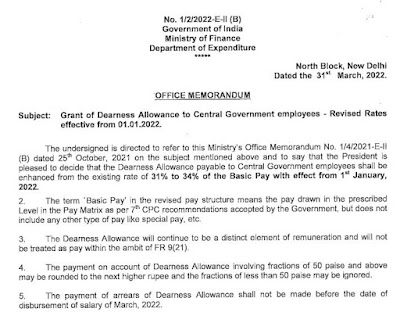
DA Jan 2022 - Grant of Dearness Allowance to Central Government employees - Revised Rates effective from 01.01.2022

 3% DA Hike - Revised Rates effective from 01.01.2022: DoE OM dated 31.03.2022 No. 1/2/2022-E-II (B) Government of India Ministry of Finance...