Showing posts with label Reservation for SC ST and OBC. Show all posts

Tuesday, 5 February 2019

Inclusion of Castes in OBC Lists


Ministry of Social Justice & Empowerment

Inclusion of Castes in OBC Lists

Inclusion of castes/communities in the Central List of OBCs is a continuous process. Proposals have been received from various States during the years 2016, 2017 and 2018 for inclusion of castes/communities in the Central List of OBCs. The State-wise and year-wise status is given below. At present, no proposal for inclusion of caste/community from State/UT is pending with the Government.

The National Commission for Backward Classes (NCBC) constituted w.e.f. 15.08.2018 by insertion of new article viz. article 338B in the Constitution, similar to article 338, applicable for National Commission for Scheduled Castes and article 338A applicable for National Commission for Scheduled Tribes, would have the powers and responsibilities that of NCSC for SCs and NCST for STs including power to advice on inclusion in the Central List of OBCs.

No such advice received from erstwhile National Commission for Backward Classes is pending with the Government. The Commission to Examine Sub-categorization of Other Backward Classes is mandated to submit its report by 31.05.2019.

Statement showing State-wise & year-wise status of processing of proposals for inclusion of castes/communities in the Central list of OBCs during the last three years.

StateNo. of  EntryStatus
2016
Andhra Pradesh09Included in the Central List of OBC
Bihar02Included in the Central List of OBC
Jharkhand05Included in the Central List of OBC
Jammu & Kashmir02Included in the Central List of OBC
Maharashtra01Included in the Central List of OBC
Madhya Pradesh11Included in the Central List of OBC
Uttarakhand02Included in the Central List of OBC
Telangana86Included in the Central List of OBC
2017 and 2018
No advice received from erstwhile NCBC on the proposals/requests is pending with the Government.
An 'entry' for this purpose includes caste, its synonyms and sub-castes

This information was given by Minister of State for Social Justice and Empowerment Shri Krishan Pal Gurjar in a written reply in Lok Sabha today.

Source: PIB

Friday, 6 April 2018

Representation of OBCs in the Central Government Services


Representation of OBCs in the Central Government Services

Press Information Bureau
Government of India
Ministry of Personnel, Public Grievances & Pensions
04-April-2018

Strength of Employees

As per information received from 77 Ministries/Departments including their attached/subordinate offices, the representation of SCs, STs and OBCs in the posts and services under the Central Government as on 01.01.2016 is 17.49%, 8.47% and 21.57% respectively.

Representation of OBCs in the Central Government services is less as compared to the percentage of reservation for them because reservation of OBC started in September, 1993.

As per available information, representation of OBCs as on 01.01.2012 was 16.55% which has now increased to 21.57% as on 01.01.2016. Therefore, there is an increasing trend in the representation of OBCs in the posts and services of Central Government.
Department of Personnel & Training has issued instructions to all Ministries/Departments to constitute an in-house Committee to identify backlog reserved vacancies, study of the root cause of backlog reserved vacancies, initiation of measures to remove such factors and to fill up such vacancies through Special Recruitment Drive.

This information was provided by the Union Minister of State (Independent Charge) Development of North-Eastern Region (DoNER), MoS PMO, Personnel, Public Grievances & Pensions, Atomic Energy and Space, Dr Jitendra Singh in written reply to a question in Lok Sabha today.

Tuesday, 13 March 2018

UGC Letter reg: Implementation of Reservation Policy of the Government of India


Implementation of Reservation Policy - UGC Order dt. 5.3.2018
UGC Letter reg: Implementation of Reservation Policy of the Government of India.

No.F.1-5/2006(SCT)
05 March, 2018
The Registrar(s)
All Central Universities
All State Universities receiving grant-in-aid
Deemed to be Universities receiving grant-in-aid by UGC/Government
Inter University Centres of UGC

Subject: Implementation of Resenation Policy of the Government of India - Reg.

Sir/Madam,
With reference to the above subject, I am to inform that for implementation of reservation policy of the Central Government. MHRD vide order No.6-30/2005-U5 dated 6th December, 2005 directed the UGC to ensure effective implementation of the reservation policy in the Central Universities and those of Institutions Deemed 10 Universities receiving aid from the public funds except in minority institutions under Article of the Constitution. Accordingly, UGC, vide letter No.1-5/2006(SCT) dated 25-08-2006, circulated new Guidelines for strict implementation of Reservation Policy of the Government. This has been further reiterated by MHRD O.M.No.12-60/2013-UI dated 25-6-2013.
The Ministry of Human Resource Development vide its letter No. 1- 7/2017-CU.V dated 06-09-2017 has directed the UGC to examine the issues mentioned in judgments (10 in number) quoted by the Hon'ble High Court Of Allahabad, in its order dated 07-04-2017 and submit its recommendations to MHRD for their consideration and appropriate decision.

Accordingly, UGC had constituted a Committee and submitted its recommendations to Ministry of Human Resource Development on 07-11-2017. Thereafter, in compliance of the judgement Of the Allahahad High Court upheld by the Hon'ble Supreme Court Of India and in view of tendered by the DOPT and recommendations Of the UGC, MHRD vide its O.M.No.1- 7/2017-CU.V dated 22.2.2018; has intimated that the department's O.M. No.12-60/2-13-UI dated 25-06-2013 stands amended to the extent mentioned below in the UGC guidelines 2006, in accordance with the recommendations of the UGC, which are as under:

"(i) Clause 6(c);
In case of reservation SC/ST, all the Universities, Deemed to be Universities, Colleges and other Grant-in-Aid institutions and Centres shall prepare the roster system keeping the Department Subject as a unit for an levels of teachers as applicable.

(ii) Clause 8(a)(v):
The roster, department-wise, shall be applied to the total number of posts in each of the categories [(e.g.) Professor, Associate Professor, Assistant Professor] within the Department/Subject".
The above decision may also be circulated to its constituent and affiliated colleges for immediate follow up action.

You requested to prepare fresh within month of receipt of this letter under intimation to UGC.
This issues with the approval of the Competent Authority.
Yours faithfully,
sd/-
(Dev Swarup)
Source: www.ugc.ac.in

Monday, 1 January 2018

Direct Recruitment to Group C - Reservation Fixed on the basis of Population


Direct Recruitment to Group C - Reservation Fixed on the basis of Population
"In case of direct recruitment to Group C posts normally attracting candidates from a locality or a region, the percentage of reservation is generally fixed on the basis of proportion of their population in the respective States/Union Territories"
Reserve category representation
Article 16(4) of the Constitution enables provision of reservation to backward class of citizens, who are not adequately represented in the services under the State.

As per extant instructions, reservation is provided to Scheduled Castes, Scheduled Tribes and Other Backward Classes at the rate of 15%, 7.5% and 27% respectively in case of direct recruitment on all India basis by open competition. In case of direct recruitment on all India basis otherwise than by open competition, the percentage fixed is 16.66% for Scheduled Castes, 7.5% for Scheduled Tribes and 25.84% for Other Backward Classes.

In case of direct recruitment to Group C posts normally attracting candidates from a locality or a region, the percentage of reservation is generally fixed on the basis of proportion of their population in the respective States/Union Territories.

The services under the State come under the List II of the Seventh Schedule i.e. State List of the Constitution. The information on the state-wise provisions for reservation is not centrally maintained.
As per the 9 Judge Bench Constitutional judgment of the Supreme Court in Indira Sawhney case, total reservation cannot exceed the limit of 50%. In the same judgment, the Supreme Court has also observed that clause (4) of Article 16 of Constitution speaks of adequate representation and not proportionate representation.

This was stated by the Union Minister of State (Independent Charge) of the Ministry of Development of North Eastern Region (DoNER), MoS PMO, Personnel, Public Grievances & Pensions, Atomic Energy and Space, Dr Jitendra Singh in a written reply to question in the Lok Sabha today.

Thursday, 18 February 2016

Amendment in SC/ST Act is need of hour –Gehlot

Amendment in SC/ST Act is need of hour –Gehlot

Union Minister of Social Justice & Empowerment Shri Thaawarchand Gehlot today said that amendment in SC/ST act is the need of the hour. Expressing concern in a meeting held here to review and amend the provisions in the Protection of Civil Rights {PCR} Act, 1955 and the Scheduled Castes and the Scheduled Tribes (Prevention of Atrocities) {PoA} Act, 1989, he said that objective behind this amendment is not only to identify more cases of atrocities which were left unreported earlier but also to increase the successful ending and conviction in this issue so that controlling these kind of small incidents will lead to a just and equal society.

The Minister said that despite the deterrent provisions made in the PoA Act, continuing atrocities against the members of Scheduled Castes (SCs) and Scheduled Tribes (STs) had been a cause of concern. High incidence of occurrences of offences against members of SCs and STs also indicated that the deterrent effect of the PoA Act was not adequately felt by the accused. It was, therefore, considered appropriate to strengthen the Act and make the relevant provisions of the Act more effective. Shri Gehlot added that based on the consultation process with all the stakeholders, amendments in the PoA Act were proposed to broadly cover five areas namely (i) Amendments to Chapter II (Offences of Atrocities) to include new definitions, new offences, to re -phrase existing sections and expand the scope of presumptions, (ii) Institutional Strengthening, (iii) Appeals (a new section), (iv) Establishing Rights of Victims and Witnesses (a new chapter) and (v) strengthening preventive measures. The objective of these amendments in the PoA Act is to deliver members of SCs and STs, a greater justice as well as be an enhanced deterrent to the offenders. The Scheduled Castes and the Scheduled Tribes (Prevention of Atrocities) Amendment Bill, 2015 to effect amendments in the PoA Act as passed by the Lok Sabha and Rajya Sabha on 04.08.2015 and 21.12.2015 respectively and assented to by the President on 31.12.2015, has been notified with effect from 26.01.2016.

Article 17 of the Constitution of India abolished ‘untouchability’, forbade its practice in any form and made enforcement of any disability arising out of untouchability as an offence punishable in accordance with the law. An Act of Parliament namely the Scheduled Castes and the Scheduled Tribes (Prevention of Atrocities) {PoA} Act, 1989, which falls within the provisions of Article 17 of the Constitution was enacted for preventing atrocities against members of Scheduled Castes and Scheduled Tribes, to provide for Special Courts for the trial of such offences as well as relief and rehabilitation of the victims of atrocities. The PoA Act extends to the whole of India except Jammu & Kashmir, and responsibility for its implementation rests with State Governments.

A Committee under the Chairpersonship of Union Minister for Social Justice and Empowerment with members from Ministries of Home Affairs, Tribal Affairs, Law and Justice, Department of Justice, National Commission for Scheduled Castes, National Commission for Scheduled Tribes and three non-official members( two amongst SCs and one amongst SC) , which was set up in the year 2006 on a recommendation of the Parliament Committee, to devise ways and means to curb offences of atrocities and ensure effective administration Acts of Parliament namely the Protection of Civil Rights{PCR} Act, 1955 and the Scheduled Castes and the Scheduled Tribes(Prevention of Atrocities){PoA} Act, 1989, was held meeting to review implementation status of PCR and PoA Acts in States and Union Territories.

The aforesaid meeting has a special significance in view of amendments made in the PoA Act as it has cast a greater responsibility on the concerned State Governments and Union Territory Administrations to augment the infrastructure and human resource for its implementation.

Representatives from various states and union territories presented their opinions and suggestions in terms of successful implementation and practice regarding these acts in their respective states. Shri Gehlot presided over the meeting. Minister of State Shri Krishan Pal Gurjar and Shri Vijay Sampla also addressed the august gathering.

Friday, 18 December 2015

Reservation in promotion – Minister replied in Rajya Sabha

Reservation in promotion – Minister replied in Rajya Sabha

The DoPT Minister replied in Parliament, while answering a question about the stand of Central Government on reservation in promotion cases involving Central Government employees as follows…
“The reservation in promotion is provided to Scheduled Castes (SCs) and Scheduled Tribes (STs) at the rate of 15% and 7.5% respectively in posts and services under the Central Government. As on 1.1.2013, the representation of SCs and STs was 17.55% and 7.72% respectively.
The Hon’ble Supreme Court, on 19.10.2006, in the matter of M. Nagaraj & Ors. V/s Union of India, while upholding the validity of the Constitutional Amendments made in favour of Scheduled Castes and Scheduled Tribes, inter-alia, observed that the State will have to collect quantifiable data of backwardness, inadequacy of representation before providing reservation in promotion.
In order to provide impediment free reservation in promotion to SCs and STs, the Constitutional (One Hundred and Seventeenth Amendment) Bill was introduced in the Rajya Sabha by the Government in September, 2012. The Bill was passed by the Rajya Sabha on 17.12.2012 and transmitted to the Lok Sabha for consideration and passing. The Bill could not be considered in the 15th Lok Sabha and lapsed on the dissolution of 15th Lok Sabha. The issues emanating from the Hon’ble Supreme Court’s judgment dated 19.10.2006 in M.Nagaraj case is under examination.”

Authority: Rajya Sabha Q&A

Flash News

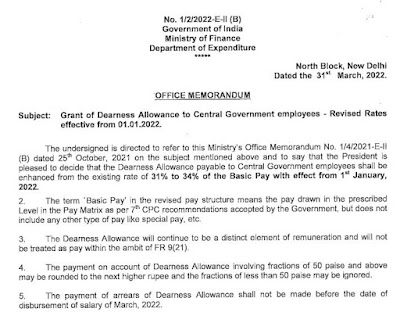
DA Jan 2022 - Grant of Dearness Allowance to Central Government employees - Revised Rates effective from 01.01.2022

 3% DA Hike - Revised Rates effective from 01.01.2022: DoE OM dated 31.03.2022 No. 1/2/2022-E-II (B) Government of India Ministry of Finance...