Tuesday, 8 March 2016

NJCA has decided to defer strike date to 11th July, 2016 due to elections in five states

NJCA has decided to defer strike date to 11th July, 2016 due to elections in five states

National Joint Council of Action
4, State Entry Road, New Delhi – 110055
No.NJC/2016/7th CPC
March 7, 2016
To
All Constituents of NJCA

Dear Comrade,
The NJCA met today and reviewed the discussion in the meeting of Empowered Committee of Secretaries presided by the Cabinet Secretary on 1st March 2016 where-in the Cabinet Secretary had requested for more time to arrive at conclusions on the charter of demands raised by the Staff Side.

The meeting also considered the situation in the aftermath of the coming into effect of the Code of Conduct with the declaration of election schedule in 5 State Assemblies and the fact that there will be polling on 11th April 2016 in West Bengal and Assam.

The meeting, therefore, came to the conclusion that it will not be feasible for us to stick to the date of strike as 11th April 2016. Considering the fact that as per section 22 of the Industrial Dispute Act, 1947 with regard to the validity of the strike notice which is not more than six weeks from the date of serving the strike notice, it was also felt that we may have to revisit the issue of serving the notice for strike afresh.
Considering all the above aspects, the meeting took the following decisions”
1. The indefinite strike shall commence from 6 am on 11th July 2016
2. The strike Notice would be served on 9th June 2016.
3. Massive demonstrations shall be held in all work place on 11th March 2016 in support of the charter of demands and strike decision.
4. The decision of the NJCA would be communicated to the Cabinet Secretary.
Detailed mobilization programmes would be given later on.
With greetings
Yours faithfully,
(Shiva Gopal Mishra)
Convener
Source: www.ncjcmstaffside.com

Schedule for the General Elections to the Legislative Assemblies of Assam, Kerala, Tamil Nadu, West Bengal and Puducherry

Schedule for the General Elections to the Legislative Assemblies of Assam, Kerala, Tamil Nadu, West Bengal and Puducherry - Regarding.

Election Commission
07-March, 2016

In continuation of Commission’s Press Note No. ECI/PN/16/2016 dated 4th March, 2016, it is informed that the Commission has provided on the National Voters’ Services Portal, first time the facilities to search the voters’ name in the electoral roll, to know the address of polling station to locate the polling station on the Google map, to know the contact details of the electoral staff and also to see the electoral roll of any particular polling station on the web portal. The same facility is also being made available through an integrated mobile App, in order to facilitate the voters in getting all the information of their electoral roll entry and polling station details.

Further, to ensure a continuous link of electors with the election machinery, Commission has decided to launch first-ever-Information Gateway on web portal, mobile App and through SMS, to keep the electors of the area informed of the relevant happenings during the entire election period. The key information conveyed would include the schedule of election for the constituency, details of the nominations received, final list of contesting candidates, reminder about the date of poll and the results on the counting date.

Further, the Commission has taken the initiative to provide e-voter information slip thorough web portal and also on mobile App to enable the voters’ to take a print out of their electoral roll entries without photograph, which along with the EPIC or any other alternate identification document, as decided by the Commission, may be used in locating the elector’s entry in marked copy of electoral roll to expedite the voting process at the polling station.

PIB

Admission in Kendriya Vidyalayas – Priority for Children of Central Government Employees

Admission in Kendriya Vidyalayas – Priority for Children of Central Government Employees

Priority in Admission in Kendriya Vidyalaya will be to Children of Central government employees and children of ex-servicemen, PSU, Autonomous bodies, State Govt Employees and Foreign Nationals
Kendriya Vidyalayas Admission Policy – Priority in Admission for Children of Central Government Employees, Defence Personnel and Ex-Servicemen – Admission guidelines
Kendriya Vidyalayas (KVs) were established to cater to the educational needs of the children of transferable Central Government employees including Defence and Para-military personnel by providing a common programme of education. As per the admission guidelines duly approved by the Board of Governors of Kendriya Vidyalaya Sangathan (KVS), following priorities are followed in granting admission to the KVs in Defence / Civil Sector:-

1. Children of transferable and non-transferable Central government employees and children of ex-servicemen. This will also include children of Foreign National officials, who come on deputation or transfer to India on invitation by Government of India.

2. Children of transferable and non-transferable employees of Autonomous Bodies / Public Sector Undertaking / Institute of Higher Learning of the Government of India.

3. Children of transferable and non-transferable State Government employees.

4. Children of transferable and non-transferable employees of Autonomous Bodies / Public Sector Undertakings / Institute of Higher Learning of the State Governments.

5. Children from any other category including the children of Foreign Nationals who are located in India due to their work or for any personal reasons. The children of Foreign Nationals would be considered only in case there are no children of Indian Nationals waitlisted for admission.

The Children of Defence personnel are considered as first priority category for admission in KVs. The Children admitted in a KV can automatically claim admission in another KV, if their parent is transferred from one station to another.

This information was given by the Union Human Resource Development Minister, Smt. Smriti Zubin Irani today in a written reply to a Rajya Sabha question.

Source : PIB

Age relaxation for widows for employment in Government and Central PSUs

Age relaxation for widows for employment in Government and Central PSUs

Ministry of Women and Child Development is considering taking up a proposal for age relaxation for widows for employment in Government and Central PSUs

Ministry of Women and Child Development has issued a press release

Age relaxation for widows
The Ministry of Women and Child Development is considering taking up a proposal for age relaxation for widows for employment in Government and Central PSUs. The Ministry is also considering moving a proposal for tax rebates for single women who are having children. These are at a preliminary stage and formal proposals have not yet been prepared.

This information was given by the Minister of Women and Child Development, Smt Maneka Sanjay Gandhi in reply to a question in the Rajya Sabha today.

Pib.nic.in

7th CPC News: Rs 70000 Crore Allocated For 7th Pay Commission in Budget 2016

Rs 70000 Crore Allocated For 7th Pay Commission in Budget 2016

7crores -allocated-7th-CPC


As much as Rs 70,000 crore has been provisioned in the Union Budget 2016-17 for implementation of Seventh Pay Commission for government employees, a top finance ministry official said.

While the Budget did not provide an explicit overall provision number, the government had said the Seventh Pay Commission hike has been built in as interim allocation for different ministries and Budget numbers were credible.

Implementation of the pay commission report in toto is to cost the government Rs 1.02 lakh crore.

“We have provisioned for around 60-70 per cent of the total burden that was talked about,” the official said adding about Rs 70,000 crore has been provided in the Budget.

“We will wait to see the report of the Committee of Secretaries on the Seventh Pay Commission and decide if we need further allocation,” he said.

The Budget document states that “the implementation of the Seventh Pay Commission due from January 1, 2016 is to be implemented during 2016-17 fiscal as also the revised One Rank One Pension (OROP)scheme for Defence services.”

The finance ministry has provisioned for this in the Demands for Grants for individual departments and ministries. It is built into and subsumed into those allocations.

“No one actually knows what will be the actual burden on the exchequer for the implementation of Pay commission recommendation. We have calculated internally and allocated to various ministries and departments accordingly,” the official said.

The government in January set up a high-powered panel headed by Cabinet Secretary P K Sinha to process the recommendations of the seventh Pay Commission which will have bearing on the remuneration of 47 lakh central government employees and 52 lakh pensioners.

The Empowered Committee of Secretaries will function as a Screening Committee to process the recommendations with regard to all relevant factors of the Commission in an expeditious detailed and holistic fashion.

The official further said the finance ministry has fully provided for OROP scheme for defence personnel.
Faced with the burden of Pay Commission recommendations, there were concerns on whether the government would be able to stick to the fiscal deficit target of 3.9 per cent for 2016-17.

However, in Budget Finance Minister Arun Jaitley dispelled doubts and promised to adhere to the fiscal consolidation roadmap and stick to 3.9 per cent deficit target.

PTI

Monday, 7 March 2016

Centre decides to withdraw tax on Provident Fund

Centre decides to withdraw tax on Provident Fund

News have surfaced that the Prime Minister has instructed the Finance Minister to put a hold on the proposed plan to impose taxes on PF withdrawals. Finance Minister Arun Jaitley is expected to make an official announcement in this regard shortly.

Employee unions all over the country have been vehemently opposing the proposed tax on the withdrawals made on the most important savings of a worker, from the moment the announcement was made. Most employees depend on their provident fund savings to meet some of the most important expenses of their lives, like medical, marriages, building a house, etc. The decision to impose tax on these withdrawals was condemned by all.

Jaitley had announced a tax on 60 percent of the Employee Provident Fund, and Public Provident Fund. The government has now said that they had planned to impose tax only on the PF Interest. But, there was strong opposition for this too. Demands were made to withdraw this tax.

According to information available, Jaitley had informed at the meeting of the MPs that the Prime Minister will have to decide on this. Meanwhile, the Prime Minister has recommended the Finance Minister to stop the tax on the PF withdrawals, and to conduct a thorough study on this. Arun Jaitley is expected to take the required action after consulting with the officials of his ministry. The Prime Minister’s intervention has restored the peace of mind of more than 60 lakh Government employees.

NFIR writes to PM to withdraw of Budget proposal to levy Income Tax on Provident Fund

NFIR writes to PM to withdraw of Budget proposal to levy Income Tax on Provident Fund

Serious resentment among employees against Budget proposal to levy Income Tax on withdrawal of 60% of provident Fund
NFIR
National Federation of Indian Railwaymen
3, CHELMSFORD ROAD, NEW DELHI – 110 055
Dated: 05/03/2016
Shri Narendra Modiji
Hon’ble Prime Minister of India,
152, South Block,
Raisina Hill
New Delhi – 110011

Sub: Serious resentment among employees against Budget proposal to levy Income Tax on withdrawal of 60% of provident Fund – reg.

The employees in general and Rail Workforce in particular are extremely unhappy over the Budget proposal presented by the Hon’ble Finance Minister to impose Income Tax on 60% of Provident Fund withdrawals. This proposal if enforced would cause harm to the workers at their fag end of service on superannuation.

Hon’ble Prime Minister may please appreciate that the employee withdraws his/her legitimate Provident Fund for meeting the requirements of Children Education, Construction of house or for the purpose of performing marriages of children. Levying Income Tax on these

withdrawals that too when the Provident Fund amount is recognized to be the property of the worker, would be unethical. The employees are deeply disappointed over the Budget proposal to impose Income Tax on P.F. withdrawal.

NFIR, therefore appeals to the Hon’ble Prime Minister to kindly intervene and see that the above proposal is reconsidered and withdrawn in the interest of industrial peace in the Country.
Yours sincerely,
sd/-
(Dr.M.Raghavaiah)
General Secretary
Source: NFIR

7th Pay Commission Latest News – Budget Allocation for 7th CPC Pay and Pension Hike is true says livemint

Livemint’s report says that 93% of expected additional outgo on account of implementation of 7th pay commission has been allocated in Budget 2016

7th Pay Commission Latest News – Budget Allocation for 7th CPC Pay and Pension Hike is true says livemint in response to Bloomberg’s report that Indian Government understates its expenditure towards Salary to an extent of US$ 15 billion to reduce budget deficit numbers


7th Pay Commission Latest News – What was initially seen as a scoop that exposed the attempt of Indian Budget 2016 to understate Deficit Numbers was later confirmed to be not true thanks to Livemint’s study on Budget Allocation for 7th Pay Commission recommended increase in pay and pension of Central Government Employees and Pensioners

Bloomberg business which is a TV and internet media had reported that an Amount equivalent to US$ 15 Billion which is to be paid to CG Employees and Pensioners as result of implementation of 7th Pay Commission report in the year 2016-17, has not been taken in to account in the Budget 2016-17.


Bloomberg reported this News with much hype and titled it as : “Missing: $15 billion lost somewhere in India’s 1,500-page budget” .


In response to this, Livemint has now come up with a comparison study on budget allocation for pay and allowances Central Government employees in 2015-16 and 2016-17

A Bloomberg report on Wednesday titled “Missing: $15 billion lost somewhere in India’s 1,500-page budget” raised a red flag on the Indian government’s balancing of its books in Budget 2016. It pointed out how the global financial data provider and other analysts were unable to locate the numbers allocated for implementing the recommendations of the Seventh Pay Commission (SPC), which doles out the once-in-10-years pay hike given to central government employees. The allusion was the government may have understated this payout—and, by extension, its deficit.

Livemint’s study on funds allocated for 7th pay commission pay hike is as follows

“We tried to locate those “missing” numbers in the same budget documents. First, we need to know how much it will cost the government to implement the SPC recommendations. The estimate for 2016-17 by the SPC is a 24% increase in payouts to government employees, or Rs.102,100 crore (around $15 billion).

The first place to look for is under non-plan expenditure, and a table titled “Estimated strength of establishment and provision thereof”. This details how many employees are there in 56 government departments (excluding defence) and how much the government has budgeted to pay their salaries: an increase ofRs.65,690 crore in 2016-17. Thus, we have accounted for around 65% of SPC’s impact.

The second place to look for is pensions, the details of which are again provided under non-plan expenditure. This shows the government has budgeted for an increase of Rs.37,066 crore.”

Thus, the total increase in salary and pension bill in 2016-17 is Rs.102,756 crore. However, there is one rider. The pension liabilities include increased outgo on account of implementing the One Rank One Pension (OROP) scheme.


Implementing OROP is estimated to cost the government Rs.7,500 crore. Deducting this amount means the government has budgeted Rs.95,256 crore to meet SPC recommendations. In other words, the net shortfall in budget estimates on account of implementing the SPC is Rs.6,844 crore.

What’s “missing” is $1 billion and not $15 billion.”

Soure: Livemint

Sunday, 6 March 2016

Allotment of Revised Pay Structure for Official Language Staff

Allotment of Revised Pay Structure for Official Language Staff

Railway Board letter to NFIR regarding Allotment of revised pay structure for Official Language Staff in Indian Railways

Ministry of Railways has sent a letter to Secretary regarding grant of revised pay structure for Official Language Staff in Indian Railways
GOVERNMENT OF INDIA
MINISTRY OF RAILWAYS
(RAILWAY BOARD)

No. PC-VI/2015/IR-N/1
New Delhi Dated: 18/02/2016
The General Secretary,
NFIR,
3, Chelmsford Road,
New Delhi – 110055

Sub: Allotment of revised pay structure for Official Language Staff on Indian Railways – reg.
Ref: NFIR’s letter No. IV/NFIR/Vlth CPC/Part 11 dated 02/02/2016.

Dear Sir,
    Undersigned is directed to refer to NFIR’ s letter under cited subject. In this context, copy of Ministry of Finance’s O.M  No.6(1)/E.III(B)/2011 dated 01.08.2012 is enclosed for ready reference.

DA:- As above
Yours faithfully,
For Secretary Railway Board

Download Railway Board letter No. PC-VI/2015/IR-N/1 dated 18.02.201


No.36(1)/E.III(B)/2011
Government of India
Ministry of Finance
Department of Expenditure

***
New Delhi, dated the lst August 2012

OFFICE MEMORANDUM

Subject : Allotment of revised pay structure for Official Language staff of Indian Railways.

The undersigned is directed to refer to Ministry of Railways, Railway Board’s OM No.PC Vl/2008/1/5/2 dated 26.04.2012 on the subject mentioned above,

2. The matter has been examined. It has been agreed to upgrade the Grade Pay of Rajbhasha Sahayak Gr.II .from Rs.28,.00 in PB-1 to that of Grade pay of Rs.4200 in PB-2· and its merger with Rajbhasha Sahayak Gr.I and bringing the Rajbhasha Staff of Zonal Railways at par with their counterpart in CSOLS subject to the following conditions:

i) The future recruitment in the grade of Rajbhasha Sahayak would be made through 100% by direct recruitment

ii) The educational qualification of the entry Grade (Rajbhasha Sahayak) may be kept as Master’s Degree at par with Jr. Hindi Translator of CSOLS.

iii) The necessary amendments may be made in-the RRs and all future recruitment would be done based on such amended RRs.

iv) The grade of Rajbhasha Sahayak Gr.II would be phased out by placing the existing incumbents who possess the prescribed educational qualification in the higher grade and for those who do not possess the requisite qualification be placed in the higher grade only on completion of 6 years of regular service in the lower grade.

v) The benefit may ,be extended on prospective basis.

vi) Ministry of Railways satisfying itself that this will not have repercussions on any other categories or personnel.

3. This issues with the approval of JS (Pers.).
(Sunita Bansal)
Under Secretary to the Government of India

Confusion on EPF due to bad phrasing in Budget speech: Union Revenue Secretary Hasmukh Adhia


Confusion on EPF due to bad phrasing in Budget speech: Union Revenue Secretary Hasmukh Adhia

Union Revenue Secretary Hasmukh Adhia today defended the proposal to tax Employee’s Provident Fund withdrawals, saying the intention was only to encourage investment in pension schemes, but the phrasing in the Budget speech caused the confusion.

“The entire thing happened not because of any illogicality in the step but due to the communication gap,” Adhia said at an interaction on Budget at the Ahmedabad Management Association here.

“In the budget we try to concise the speech by minimising the words. If it goes beyond 1 hour and 30 minutes it becomes boring. When we were reducing the number of words and when it came to this paragraph we chopped it off and that is how the problem occurred,” Adhia said.

“If we had paraphrased this paragraph differently then less confusion would have been created.”

The government has in fact continued with the policy of exempting EPF at all three stages (entry, during the scheme and exit), he argued.

“We have not said that we will be taxing remaining 60 per cent (of withdrawn EPF). The first 40 per cent is totally exempt. Regarding remaining 60 per cent the expectation is you should put it in some pension scheme….To encourage people to put their money in pension products we have said if you put the remaining 60 per cent in annuity scheme it will not be taxed….original corpus after your death will go to your heir and that will also be tax exempt,” he said.

“So in a way we have continued exempt, exempt, exempt scheme, but with a time period,” he said.

“We do not wish to get anything out of this, it is not a revenue mobilisation effort,” Adiha said.

“The Finance Minister has already said that he will make the announcement on it in a very short time (in Parliament)”, he noted.

The government could not raise the Income Tax exemption limit as when it was raised the last time from Rs 2 lakh to 2.5 lakh, it lost some 40 lakh tax payers, he said to another question.

PTI

Flash News

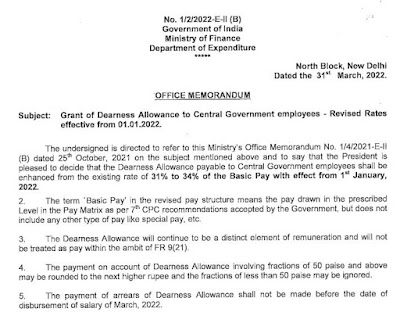
DA Jan 2022 - Grant of Dearness Allowance to Central Government employees - Revised Rates effective from 01.01.2022

 3% DA Hike - Revised Rates effective from 01.01.2022: DoE OM dated 31.03.2022 No. 1/2/2022-E-II (B) Government of India Ministry of Finance...