Monday, 21 September 2015

Grant of Night Duty Allowance on the basis of Actual Salary

Grant of Night Duty Allowance on the basis of Actual Salary – BPMS writes to OFB

BHARATIYA PRATIRAKSHA MAZDOOR SANGH
(AN ALL INDIA FEDERATION OF DEFENCE WORKERS)
(AN INDUSTRIAL UNIT OF B.M.S.)
(RECOGNISED BY MINISTRY OF DEFENCE, GOVT. OF INDIA)

REF: BPMS / OFB / NDA / 200 (8/2/L)
Dated: 14/09/2015
To,
The DDG (IR),
Ordnance Factory Board,
10 A, S.K.Bose Road,
Kolkata – 700001

Subject: Grant of Night Duty Allowance on the basis of Actual Salary

Reference: PC of A (Fys) Kolkata letter No. Pay/Tech-II/1206/2015/13, dated 09.09.2015

Respected Sir,
With due regards, it is submitted that the issue of payment of Night Duty Allowance based on actual salary, instead of notional pay of Rs.2200/- was resolved vide MOD ID No. 17(4)/2012/D(Civ-II), Dated 08.05.2015 in compliance of Contempt Petition (CP No. 200/2014 Shri Arvind Girija Singh & Ors versus UOI & Ors.) based on the CAT Jodhpur directions in CA No 34/2008 dated 5.11.2009 and subsequent ratifications by Hon’ble High Court and Supreme Court of India.

We are surprised to see the PC of A (Fys) letter cited under reference whereby ceiling for entitlement of Night Duty Allowance has been revised to Rs. 12380/- pay in Pay Band. We have strong objection on the issuance of this letter because PC of A (Fys) is not the competent authority to revise the ceiling of entitlement for NDA unilaterally as the original order has been issued by Ministry of Defence in consultation with Min of Finance, DoP&T, Def (Finance) and if there was any doubt regarding eligibility, PC of A (Fys) should have asked for clarification from the competent authorities through prescribed channels.

Further, all the court cases regarding revision of night duty allowance was related to the notional ceiling of Rs. 2200/- per month and this issue was resolved by ordering the NDA on the actual salary and nowhere court further fixed any real or notional ceiling. Even it has been already clarified in the earlier order which states that entitlement ceiling of Rs. 2200/- is not applicable to existing categories who are getting NDA. Prior to implementation of recommendations of 6th CPC, IEs / NIEs / NGOs upto Assistant Foreman (Technical) was entitled for Night Duty Allowance being a non-gazetted supervisory staff but now the post of Assistant Foreman is merged with JWM which is a gazetted supervisory post in OFB. Hence, all the Industrial / Non-Industrial & Non – Gazetted Supervisory staff are entitled for NDA on the basis of actual salary.

Therefore, you are requested to intervene into the matter so that all IEs/NIEs/NGOs may get the NDA as per actual salary in compliance with the court pronouncements in letter and spirit.

Thanking you.
Sincerely yours
sd/-
(M P SINGH)
General Secretary
Source: BPMS

Government pulls up ministries on pension delay issue, sets October 15 deadline for report

Government pulls up ministries on pension delay issue, sets October 15 deadline for report

NEW DELHI: The government has raised objections to delay in starting pensions to retiring officials because their respective departments fail to issue a certificate validating the service five years before they actually retire. All ministries have now been asked to study the case of each soon-to be retiring employee to avoid such an occurrence.

The PM-led ministry of personnel has written to all ministries on September 16 that they need to submit a report by October 15 in this regard and non-compliance with the statutory requirement of issuing the said certificate “may be viewed seriously”.

As per the existing rules, a certificate regarding ‘qualifying service’ is required to be issued by the Heads of Offices after completion of 18 years of service of an employee and again 5 years before the date of the person’s retirement. “It has been noticed that the certificates regarding qualifying service are not invariably issued to the government servant as required under the rules,” the letter stated.

“It has been observed by this department that processing of pension cases of the employees retiring quite often get delayed on account of the issues relating to verification of service. Although detailed instructions regarding verification of service have been issued by DoPT and by this department, these instructions are not meticulously adhered to resulting in delay in sanctioning of retirement benefit of the employees,” said the September 16 letter.

The letter specifies a format under which all ministries have to furnish a statement now by October 15 regarding the status of issue of service verification certificates. Each ministry has to specify the number of employees to whom the certificate has been issued after 18 years of their service and 5 years before their retirement, to whom the certificate is due and number of eligible employees in respect of whom the issue of certificates is in due process. The government is streamlining the system of pension issue, including introducing an Aadhaar-based online ‘annual life certificate’ submission system.

“It has been observed by this department that processing of pension cases of the employees retiring quite often get delayed on account of the issues relating to verification of service. Although detailed instructions regarding verification of service have been issued by DoPT and by this department, these instructions are not meticulously adhered to resulting in delay in sanctioning of retirement benefit of the employees,” said the September 16 letter.

The letter specifies a format under which all ministries have to furnish a statement now by October 15 regarding the status of issue of service verification certificates. Each ministry has to specify the number of employees to whom the certificate has been issued after 18 years of their service and 5 years before their retirement, to whom the certificate is due and number of eligible employees in respect of whom the issue of certificates is in due process. The government is streamlining the system of pension issue, including introducing an Aadhaar-based online ‘annual life certificate’ submission system.

Source:http://m.economictimes.com/

New Pension Scheme (NPS) v/s Old Pension Scheme

NPS is far beneficial than Government Pension – Comparison of New Pension Scheme (National Pension Scheme) and Central Government Pension 
 
The Central Government employees who have joined after 1/1/2004 and are put under National Pension Scheme (NPS) have been demanding abolition of NPS and have been persuading the Central Government to make the government pension scheme applicable to them.

This only exhibits their ignorance of the fact that the New Pension Scheme is highly lucrative and make the government employees who joined after 1/1/2004 far richer than the government employees who enjoy government pension scheme. By doing so they are in the process of ruining the great fortunes that lies in store under New Pension Scheme. Let me compare both the scheme:
Comparison of New Pension Scheme (National Pension Scheme) and Central Government Pension
 
Benefits under NPS
Let me take a case of Upper Division Clerk(UDC) who joins government service in 2014 at the age of 25 and renders 35 years of service till attaining 60 years of age. He / She gets 3% annual increment every year and gets one promotion every 10 year under M.A.C.P. Although he / she is likely to get 14 to 20% increase in D.A every year as per Consumer Price Index I just take 12%(assuming 6 + 6%) 2 times D.A in a year
* MACP / Promotion Years
(A) Therefore, the total pension wealth of a government servant who joined in 2014 and retiring under New Pension Scheme shall at the time of his retirement be Rs. 2,87,26,201/-

(B) 60% of the lump-sum pension wealth which he / she will be getting on retirement:
Rs.1,72,35.720

(C) 40% invested in an annuity scheme which he / she can receive before 70 years:
Rs.1,14,90,481

(D) Earned Leave Encashment: Rs. 215625 x 10 months : Rs. 21,56,250
TOTAL of (A) (B) (C) and (D) will be Rs. 3,08,82,451
Death Gratuity:
Although not entitled for retirement gratuity, but eligible for Death Gratuity If died during the service

Monthly Pension:
At the assumed Interest at the rate of 8.7% per annum on the other 40% of pension wealth of Rs.1,14,90,481 invested in annuity shall fetch  monthly pension of at least : Rs.83,306/ –
Not only this, before he / she attains the age of 70 he / she can withdraw the remaining 40% of his pension wealth of Rs. 1,14,90,481/- which if invested in Fixed Deposit of a nationalised bank can fetch interest and take care of not only of his wife and children but his descendants also for generations to come.

This is just a tip of the iceberg. If we consider the other 4 pay commission benefits that materialize on1/1/2016, 1/1/2026, 1/1/2036 and 1/1/2046 which a NPS pensioner who joins as UDC shall be getting before his retirement in 2049,his total pension wealth will be undoubtedly double the above amount which comes to more than Rs.5 crores. While a person who joins as U.D.C. gets this much, one will be rocked out of stupor to know what a Group A officer who renders 35 years of service may get – undoubtedly his total pension wealth will be more than Rs.10 crores.
 
Benefits under Central Government Pension Scheme

Now let us see what will be the retirement benefits of the above person if he / she is put in government pension scheme:

1.Gratuity for 16.5 months :
Rs.2,15,625 x 16.5 months = Rs.35,57,812/- Restricted to Rs.10,00,000
 
2. Earned Leave Encashment:
Rs. 215625 x 10 months : Rs.21,56,250
 
3. Pension Commutation:
Rs.17195 x 40% = Rs.6878 x 12 x 8.194 years Rs 6,76,300
Total Benefits under Central Government Pension Scheme: Rs.38,32,550 

4. GPF Balance:
As it is a general tendency of the government servants to withdraw from GPF frequently, there will be very little left at the time of retirement 

5. Monthly pension
i) Rs.34390 / 2 = Rs.17195 (basic pension being 50% of pay and grade pay Less 40% of basic pension towards commutation (Rs 6878) which will be restored after 15 years
Balance basic pension is Rs. 10317
ii) DA @ 527% of basic pension of Rs.17195 = Rs. 90617 (subject to increase in DA every 6 months based on consumer price index)
Total pension is Rs.1,00,934 per month.
After the death of government servant say after 67 years, spouse can take only 60% of the basic pension i.e.Rs.17195 x 60% = Rs.10317 plus D.A.at the prevailing rates. After spouse’s death children are unlikely to draw the pension as they would have already crossed the age limit. Thus, unlike the dependents of NPS pensioners, there will be nothing left for financial security of the dependents of the government pensioners .
Thus it is unwise on the part of government servants who have joined after 1/1/2004 to demand for abolition of NPS scheme and grant of government pension.

Mr.M.Dorai
Deputy Director
ESIC Model Hospital,
Bangalore (Ministry of Labour, Government of India) is the author of this Article

Sunday, 20 September 2015

7th Pay Commission: Employees’ delight, government's despair

7th Pay Commission: Employees’ delight, government's despair

New Delhi: The Seventh Pay Commission report is awaited, the new pay scales will be applicable to Central government employees with effect from January 2016.

50 lakh central government employees and 56 lakh pensioners including dependents hope to get this gift from April next year. The revised pay scales are likely to be implemented retrospectively starting 1 January 2016.

Many commentators say that the average increase in basic fair pay for all government employees will be in the region of 40-45%.

This is a very rough average because for senior level officers, like the Cabinet Secretary or officials at the secretary level, the payback could increase by more than 50%.

As the Pay Commission numbers come through there could be a 30-40 per cent increase for each central government employee.

An increase of salary and allowances would boost middle class central government employees to spend more time with their families for marketing.

The economy would get a major boost from a pickup in consumption, resulting from an increase in salaries but the flip side to the hike will be a spike in inflation.

The reports of Seventh Pay Commission will be implicated from April next year as Finance Minister Arun Jaitley said in the Parliament on February 27, “The Seventh Pay Commission impact may have to be absorbed in 2016-17.”

Finance Minister Arun Jaitley said above statement in his pre-budget speech. His statement indicates that the government may implement Seventh Pay Commission report from April 2016.

The strongest criticism of Pay Commission awards is that they play havoc with government finances. The pervious pay commissions’ rollout has been negative for fiscal balances.

The recommendations of the second pay commission were accompanied with a financial impact of about Rs 39 crore. The financial burden of the implementation of the third, fourth, fifth pay and sixth pay commission recommendations has been estimated at around Rs 144 crore, Rs 1,282 crore, Rs 17,000 crore and Rs 20,000 crore respectively.

Initial estimates suggest the seventh pay commission could add Rs 1,00,619 crore to the central government’s wage bill.

The central government pay and allowances amount to 1 per cent of GDP today. State wages amount to another 4 per cent, making for a total of 5 per cent of GDP.

The medium-term expenditure framework recently presented to Parliament by Finance Minister Jaitley, which looks at an increase in pay of 16 per cent for 2016-17 consequent to the Seventh Pay Commission award. That would amount to an increase of 0.8 per cent of GDP. This is a one-off impact.

One Rank One Pension is also a rider to enforcement of the seventh pay commission’s recommendation. The government is committed to OROP for the armed forces. This would impose an as yet undefined burden on Central government finances.
TST

NPS returns are market linked - Tax Benefit on NPS

NPS returns are market linked

An investor within the scheme has an option to choose funds based on her level of safety and risk in addition to choosing her own fund manager

The National Pension System (NPS) has been advertising a lot about the new tax deduction of Rs.50,000 for tax payers. I wanted to know more about the new deduction under section 80CCD(1)(b). Is this available only for people whose employers are investing in NPS on their behalf, or is this available for general public as well? How does the deduction work with respect to other tax benefits?
—Praveen Aggarwal

NPS is a voluntary pension scheme regulated by the Pension Fund Regulatory & Development Authority (PFRDA). It was introduced as an investment option to provide for the country’s growing working community to ensure that they have an option to save for their retirement needs. The purpose was to replace the existing system of defined benefit pension to a defined contribution-based pension system.
An investor within the scheme has an option to choose funds based on her level of safety and risk in addition to choosing her own fund manager. The returns are market-linked and, hence, do not give any form of guarantee.

NPS follows an EET (exempt-exempt-tax) model—exempt at the time of contribution or investment, exempt at the time of earnings and taxable at the time of withdrawals.

Section 80CCD under the Income-tax Act, 1961, provides the tax incentive at the first stage of investment—for getting the benefit of deduction for contributions made towards NPS.
This deduction is available to all individuals—salaried as well as non-salaried. This deduction was earlier restricted to Rs.1 lakh for each financial year under section 80CCD(1) and was subsequently increased to Rs.1.50 lakh.

To further boost savings, in Budget 2015, a new section, 80CCD 1B, was introduced, under which an additional deduction of up to Rs.50,000 was allowed for contribution made towards NPS. This made the total deduction under section 80CCD to Rs.2 lakh.

If we go through the provisions of section 80CCD, there is a lack of clarity whether the additional deduction of Rs.50,000 is after exhausting the limit of 10% of salary. Is the cap on deduction of up to 10% of salary (basic + dearness allowance) under section 80CCD (1) and within the overall ceiling of Rs.1.50 lakh or is it over and above the ceiling of Rs.1.50 lakh?

While this ambiguity remains, the intent was clarified in an example quoted by the finance minister in his budget speech this year, in which it was clarified that the assessee can claim additional deduction and the deduction of Rs.50,000 was over and above the ceiling of Rs.1.50 lakh.

Let’s take an example. If you have exhausted your Rs.1.50 lakh limit of deduction under section 80C by savings in Public Provident Fund (PPF), insurance premiums, repayment of housing loan, among other things, you can further increase your tax savings by contributing up to Rs.50,000 towards NPS.
You could open an NPS Tier I account, which is the first level, to claim the tax benefits.

Source: LiveMint

Full Pension on less than 30 years & more than 20 years of Qualifying Service for Pre-2006 pensioners

FULL PENSION FOR THOSE WITH LESS THAN 30 YEARS but MORE THAN 20 YEARS QS

In view of the fact that review Petition filed by UOI RP (C) NO. 2565/2015 in SLP (C) No. 6567/2015 UOI Vs M.O. Inasu dismissed by HSC on 28.8.2015, and Following file notings of DOPW (obtained under RTI) let us hope DOP&PW will now issue necessary instructions extending benefit of full min. pension to all pre 2006 pensioners irrespective of Q.S. rendered.

The extract from the File Noting obtained from DOP&PW under RTI ACT, on pro rata pension matter.

    Extract from File Noting of DOP&PW OM 30.7.2015 obtained under RTIA:

12. It may be mentioned that in its order dated 22.1.2013 and 16.8.2013 in OA No. 715/2012 and OA No. 1015/2012 respectively, Hon’ CAT Ernakulam Bench directed that the revised pension fixed in terms of para 4.2 of OM dt. 1.9.2008 would not be reduced pro rata in cases where the qualifying service of a pre 2006 pensioner was less than 33 yrs. This order of Hon CAT was challenged by D/o Revenue in the H.C. of Kerala in OP(CAT) No. 4/2012 and No. 8/2012. Hon’ H.C. of Kerala dismissed the Op(CAT) No. 4/2012 and No. 8/2012 vide order dt. 7.1.2014. The SLP filed by the Dept. of Revenue against the order dt. 7.1.2014 has also been dismissed by Hon’ S/C. in its order dated 20.2.2015. Learned ASG, Sjri P.S.Narsimha has advised to file a Review Petition. The concerned file is presently with MOL(CA Section) and Ms. Rekha Pandey, Adv. is drafting the RP.

13. As already mentioned above, in the order dt. 29.4.2013 of Hon HC of Delhi in WP No. 1535/2012, it was observed that the only issue which survived was, with ref. to para 9 of OM dt. 28.1.2013 which makes it applicable from 24.9.2012 instead of 1.1.2006. In view of this observation of the Hon H.C. of Delhi, we may issue orders for giving effect to the OM dated 28.1.2013 w.e.f. 1.1.2006 instead of 24.9.2012. The question whether or not the revised pension in terms of OM 28.1.2013 would be reduced proportionally would be examined once the order of the Hon S.C. in the RP to be filed against dismissal of SLP 21044/2014 is available ( para 12 above)
( emphasis added)

Sd.
S.K. Makkar US
17.4.2015

   Noting of Secy(P)

6. Thus the court ruling has become law of the land

7. Given the fact the review/curative petition in the same matter has once been dismissed by Hon. Apex Court, as also the fact that Civil Appeal of Ministry of Defence with which the SLPs in question got tagged, has also failed, there is no chance that a review petition may yield a different result. On the other hand this will not only engage the govt. machinery in uncessary litigation but will also result in attendant avoidable expenditure. ( emphasis added)

Sd.
Alok Rawat Secy/ Pension
22.4.2015

Hon MOS(PP)
Sd.
7.5.2015

Source: BPS

Saturday, 19 September 2015

REGARDING FAMILY PENSION IN NPS

FAMILY PENSION IN NPS

Family Pension for NPS Employees – A report states that between April 1994 and April 2004, more than 50 lakh youths joined Government Services. However, the same dropped to around 33 Lakhs after April 2004. Experts blame the Governments’ decision to abolish pension for this, which forced the youths to move towards the corporate sector.

The 33 lakh Central and State Government employees who have joined after 2004, may soon have a reason to rejoice. The Government is seriously considering to offer Family Pension for NPS Employees who have joined after 2004. Reliable sources have said that the 7th Pay Commission has recommended the same. The State Governments’ have been asked to submit their reports by the end of December, and after due approval it is expected that the Pension Scheme will come into effect by 1, January 2016.

We already know that the Employees who joined in Government Services after 2004 come under contributory pension scheme. Under which an employee will be deducted 10 per cent of his basic salary, and the same per cent would be contributed by the Government through out his/her service. After retirement, 70 per cent of the pension would be given in lump sum and the rest of the 30 per cent would be used for component to be paid every month till his/her life time.

However the employees who joined in service before 2004, are eligible for family pension, and they are not deducted any amount from the salary in the name of pension. Such employees afterretirement, become eligible for 50 per cent of the last drawn salary as their pension.

Sources confirm, the 7th Pay Commission may include recommendations for NPS revisions, and it is expected to be converted to family pension. Mr.KKN Kutty, Secretary General, Confederation of CGEs and workers expressed his happiness and said, if the Central Government accepts the proposal, a large number of Government employees would be benefited.

Mr.K.S.Sharma, former Chief Secretary, Madha Pradesh said, “The family pension scheme was abolished from April 2004. It was a bad move by the Government. It is pension, that attracts the youths to join the Government Services, because their future is secured. If the Government accepts the recommendations of the 7th Pay Commission, the youths would be motivated to join the Government Services”.

A report states that between April 1994 and April 2004, more than 50 lakh youths joined Government Services. However, the same dropped to around 33 Lakhs after April 2004. Experts blame the Governments’ decision to abolish pension for this, which forced the youths to move towards the corporate sector.

Mr.Jayanth Malaiya, Finance Minister, Madhya Pradesh assured, “If the recommendations were accepted by the central government, he will definitely consider implementing the same in MP”.

Source: Dainik Bhaskar

Non compliance of instructions for payment of Defence Pension

Non compliance of instructions for payment of Defence Pension

    O/o the Principal Controller of Defence Accounts (Pensions)
    Draupadi Ghat Allahabad-211014
Circular No.180
No. AT/Tech/256-V
    Dt. 14.08.2015
To
The CMD
All Public Sector Bank
(Including three Private Sector Banks viz Axis Bank, ICICI Bank & HDFC Bank)

Sub: Non compliance of instructions for payment of Defence Pension.

Guidelines/instructions for payment of Defence Pension are provided in “Scheme for payment of pension of Defence Pensioners by Public Sector Banks”. This scheme helps the banks in discharging their duties of payment to defence pensioner especially with respect to obtaining necessary certificates from pensioners/ family pensioners before continuing payment after due date as well as maintenance of pension account and submission of paid scrolls along with necessary enclosures/certificates to this office. Besides this, circulars on pensionary matter are also issued by this office from time to time.

2. However, it is observed that Banks are not adhering to above said guidelines/instructions resulting in increase in complaints from pensioners due to incorrect / under payment and also loss to exchequer due to over payment. In this regard, two major irregularities noticed where banks failed to comply with the guidelines/instructions stated in para 1 above are elaborated below:-

(i) In a particular case, after the death of pensioner on 10.12.2001 which was intimated to the pension paying bank by the son of pensioner. However, the bank continuously credited the pension in pensioner’s account till 2007.The account of pensioner was having a balance of Rs 6,17,628 as on 15.04.2015.

3. Thus, in this case the bank failed to adhere to the following guidelines:-
(a) Bank failed to comply with the provisions of para 8.4 of “Scheme for Payment of Pension of Defence Pensioners by Public Sector Banks” which states that where pensioner ceases to draw pension due to death, disqualification, expiry of award, transfer to another Pension Disbursing Agency, the details of such pensioner will be extracted monthly by the bank and forwarded to this office on the format prescribed in Annexure D-I & D-II by 10th of the following month under the Registered Cover Superscribed as “Annexure D-I, & D-II”.

(b) Bank has failed to take action, as per Para 29 of Annexure-H of “Scheme for payment of pension of Defence Pensioners by Public Sector Banks” for stoppage/discontinuance of the payment immediately after receipt of intimation of demise of pensioner.

(c) Bank has further failed to take action for stoppage/discontinuance of pension after 31.10.2002 i.e. in the month of November, as after death of pensioner, life certificate / identification could not be obtained/carried out. Clear instruction for obtaining life certificate and identification is laid down in Para 12 of “Scheme for Payment of Pension of Defence Pensioners by Public Sector Banks” and Para 4 of Annexure-H of “Scheme for Payment of Pension of Defence Pensioners by Public Sector Banks”.

(d) Bank has failed even to follow their own guidelines to close the account if no transaction took place for six months.

(ii) In another case, a pensioner was granted basic pension amounting Rs 8000/- pm. However, bank credited his account @ Rs 80,000/- of basic pension plus dearness relief. Here bank has overlooked the upper ceiling of pension of Rs 45,000/- as stated vide Para 9 of this office circular No. 397 dt-18.l 1.2008.

4. Such incorrect payments have been viewed seriously by Ministry of Defence and directed to establish the mechanism to stop the payment of such nature.

In view of the above, it is requested that all paying branches/CPPC under your jurisdictions dealing with defence pension may be instructed to adhere strictly to the guidelines/instructions specifically with respect to showing the causalities affecting the entitlement or admissibility of pension/family pension in change statement and enclosing the various certificates with Bank Scrolls. A copy of Annexure D-I, & D-II is enclosed for providing the details concerned in digital mode with the e-scrolls, as this office is moving ahead with e-auditing.

In addition, the banks are required to introduce the “Range Check” in all the categories of Pension so as to ensure that the amount of pension does not fall below the minimum range and does not go beyond the maximum range introduced in the system.
    (Vivek Umap)
Addl.CDA
Download Principal Controller of Defence Accounts Circular No. 180 dated 14.08.2015

Friday, 18 September 2015

Verification of qualifying service after 18 years service and 5 years before retirement

Verification of qualifying service after 18 years service and 5 years before retirement


G.I., Dept. of Per. & Trg., O.M.No.1/19/2013-P&PW(E), dated 16-9-2015

Sub: Verification of qualifying service after 18 years service and 5 years before retirement.

It has been observed by this Department that processing of pension cases of the employees retiring from the government service quite often get delayed on account of the issues relating to verification of service from time to time by the concerned authorities during the service of the concerned employee. Although detailed instructions regarding verification of service have been issued by Department of Personnel & Training and by this Department, these instructions are not meticulously adhered to resulting in delay in sanctioning of retirement benefit of the employees.

2. Rule 32 of the CCS (Pension) rules, which existed prior to December, 2012 provided for issuing of a certificate in Form 24 by the Head of Office in consultation with by the Account Officer regarding completion of qualifying service of 25 years. These rules have been amended subsequently and as per the existing provisions, a certificate regarding qualifying service is required to be issued by the HOO after completion of 18 years of service and again 5 years before the date of retirement of an employee. Rule further provide that verification done under that rule shall be treated as final and shall not be reopened except when necessitated by a subsequent – change in the rules and orders governing the conditions under which the service qualifies for pension.

3. It has been noticed that the certificates regarding qualifying service are not invariably issued to the government servant as required under the rules. All Ministries/Departments etc. are therefore requested to bring these provisions to the notice of Heads of Offices and PAOs for strict compliance. Non-compliance of this statutory requirements may be viewed seriously.

4. In order to review status regarding compliance of these rules, all Ministries/Departments are requested that the information may be collected from all establishments / office under them and the same may be compiled and sent to this Department by 15th October, 2015 in the enclosed proforma.

Source: www.pensionersportal.gov.in

Separate counters to women passengers for buying train tickets

Separate counters to women passengers for buying train tickets

Facilities for Women Passengers for buying Train Tickets at Reservation Counters

Ministry of Railways has been providing special facilities to women passengers for conveniently buying tickets at railway reservation counters. The Ministry has further elaborated facilities as follows: –

(a) At computerized reservation office, a separate reservation counter should be earmarked for ladies if the average demand per shift is not less than 120 tickets.

(b) In case, there is no justification for earmarking of exclusive counter for ladies, the requests received from ladies should be dealt with along with the reservation requests of the specific categories viz. senior citizen, physically handicapped, ex. MPs, MLAs, accredited journalists, freedom fighters etc.

(c) At those reservation offices where separate reservation counters have not been earmarked for ladies and also those locations which have not been computerized, ladies/female passengers should not be compelled to join the general queues and be attended to separately at the same counter as for general passengers. A suitable notice board about the availability of this facility should also be displayed near the reservation counter. This facility will however be available only from 11:30 hours to avoid misuse of this facility by unscrupulous elements to block accommodation during opening hours of general and Tatkal reservation.

(d) Ladies may be allowed to purchase tickets from these reservation counters irrespective of persons for whom the reservation is being sought. However, no other persons will be allowed to purchase ticket for them from these counters.

(e) As far as earmarking of separate unreserved ticket counters for ladies, zonal Railways have been asked to assess the demand and do the needful based on the same.

Source: PIB News

Flash News

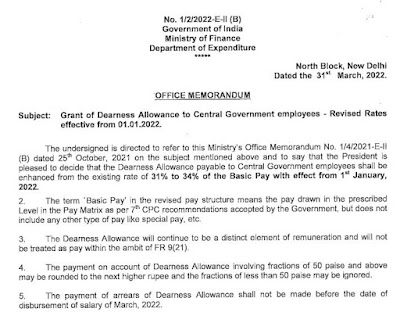
DA Jan 2022 - Grant of Dearness Allowance to Central Government employees - Revised Rates effective from 01.01.2022

 3% DA Hike - Revised Rates effective from 01.01.2022: DoE OM dated 31.03.2022 No. 1/2/2022-E-II (B) Government of India Ministry of Finance...