Wednesday, 19 August 2015

Display CGEWHO’S Housing Scheme in all Central Ministry’s web site through NIC

Display details of the vacant dwelling units/unsold dwelling units in CGEWHO’S Housing Scheme in all Central Ministry’s web site through NIC: MHUPA Instructions

F. No. I-19011/6/2015-AA/FTS-13680
Government of India
Ministry of Housing & Urban Poverty Alleviation
(A.A. Section)

Nirman Bhawan, New Delhi
Dated: 18 August, 2015

Sub: Display CGEWHO’S Housing Scheme in all Central Ministry’s web site through NIC -Reg.
Based on the deliberation in the Executive Committee Meeting of Central Government Employees Welfare Housing Organization (CGEWHO), a decision has been taken to web publish details of the vacant dwelling units/unsold dwelling units in CGEWHO’S Housing Schemes in official website of different Ministries. 
Accordingly, CGEWHO has sent detailed web-link of its housing schemes where vacancies exist. A copy of the same is enclosed for appropriate action.
Encl. As above.
(A.N. Jha)
Under Secretary to the Govt. of India

CGEWHO
Source: http://mhupa.gov.in/office%20order/Office_Order_18_08_2015.pdf

Demand of One Rank One Pension by Defence, Railway, CG Employees vs New Pension Scheme: Opinion on LiveMint

Demand of One Rank One Pension by Defence, Railway, CG Employees vs New Pension Scheme: Opinion on LiveMint

How we should think about the One Rank One Pension issue
One parity we should be discussing is parity with central government employees who have been moved to a defined contribution scheme from defined benefit since 2004

how+we+should+think+about+the+one+rank+one+pension+issue
Each of us has some link at a family level, direct or indirect, with the armed forces. A parent, a brother, an uncle, a cousin, a son, or a nephew. At a personal level, we know the first-hand stories of a wife not knowing if an ‘exercise’ will end in a dead husband. Of a father not knowing if the next landmine will have his son’s name on it. At a societal level, we can’t forget the border battles, and much closer home, the comforting presence of the army trucks and the green helmets as they rolled in after the 1984 riots to calm fires in West Delhi residential clusters. Can’t forget that when everything else fails in civic life, the army is called in to restore order. The army is called in not just to maintain order, but even for things like making that foot over-bridge that kept collapsing before the Commonwealth Games. And we have to only look over to our immediate northwest to see what damage an army can do to a nation.
How can the nation then say no to the one demand that the men in uniform are making—give us enough when we remove the uniform and lead civilian lives? The heart says it should be done. So why the delay? It could be that the answer is not always that simple. The One Rank One Pension (OROP) issue that seeks to index old pensioners to benefits that current ones get, has got all the ingredients of a perfect bomb: an emotive issue, kicked around by cynical politics of an outgoing government promising something it knew it would not be responsible for, an aspiring change maker who did not understand the multi-dimensional issue that OROP is and making a promise to implement it. And now a public stand-off between the veterans and the government.
Why is the issue so difficult to deal with? Why not just give the armed forces what they want? The issue is complicated on two counts (there are many other issues, of course, but I think these two are key). One, the country does not have the money over time to fund a rising bill of defined benefit (DB) pensions. DB pensions give the person retiring a certain percentage of his last salary, keeping in mind the number of years worked. DB schemes are ultimately un-fundable since declining populations find fewer people funding larger and larger numbers of the retired. Many countries across the world are in the process of moving away from DB plans. Two, and even more disastrously, OROP will open the doors for similar demands from other groups. Do Central Reserve Police Force soldiers deserve any less? What about the Indo-Tibetan Border Police? And the police? The first off the block has been the railway unions demanding OROP. “Railwaymen are performing dedicated service for the nation. Railway is the lifeline of the country. Employees are working round the clock across the country,” the general secretary of All India Railwaymen’s Federation was quoted as saying in a newspaper report. Other unions are waiting and watching, and once OROP is announced, expect a deluge of protests and court cases for parity.
The one parity we should be discussing today is parity with central government employees who have been moved to a defined contribution (DC) scheme from a DB since 2004. DC schemes put control of the future in the hands of the individual and what the state needs to do is design an efficient system that is fair to the social security seeker. India has a state of the art DC vehicle in the National Pension System (NPS). The costs are wafer-thin, the products are few so as to not freeze choice, and there is no fund manager risk since equity investing is restricted to index funds. For those unwilling or unable to choose the right fund, there is a default lifecycle fund that reduces equity as the person ages and moves into safer debt. The government should use the current focus on pensions to negotiate the move from DB to NPS for all categories of pensioners—those already on a DB, but, as was done with the civil services, from a given date, all new employees move to the NPS.
The armed forces have almost seven decades of goodwill banked, but an uncompromising demand irrespective of the consequences may change this equation. Unhappily for us, there are no recent academic studies that show what state pensions cost the nation. There is a 2006 paper that has some estimates (which are scary) and can be read here: http://mintne.ws/1J0DNWx . Even this old study clearly showed that DB pensions are unsustainable. Now to open the door for OROP for all categories of government employees will be a fiscal disaster for India. A more middle-of-the-road solution may be the only one that is sustainable without derailing the future of the country. No person who has defended the country against the dushman will want to see the country ship out gold one more time because OROP has opened the doors to a future that is unsustainable. If a middle-of-the-road solution is not acceptable, we only need to look west once again. This time, a little further than our immediate neighbour, to Greece, and see what runaway benefit bills can do to a nation. And because of the colour coding rules of the world, India should not expect the global multilateral agencies to expend the same kid gloves that Greece has been dealt with.
Monika Halan works in the area of financial literacy and financial intermediation policy and is a certified financial planner. She is editor, Mint Money, Yale World Fellow 2011 and on the board of FPSB India. She can be reached at expenseaccount@livemint.com

7TH CPC Will Increase Central Government Pay Only By 15% – Should We Accept?

7TH CPC Will Increase Central Government Pay Only By 15% – Should We Accept?

Big Expectations from 7th CPC and Low possibilities projected by Union Finance Minister!

Honourable Finance Minister Shri.Arun Jaitely had spoken about the possible impact of 7th CPC recommedations in Parliament.

The Speech is critically reviewed by Comrade Elangovan of DREU.

I am reproducting the comments of Comrade Elangovan for the consideration of our members:

7TH CPC WILL INCREASE CENTRAL GOVERNMENT PAY ONLY BY 15% - SHOULD WE ACCEPT?
R.ELANGOVAN,
WORKING PRESIDENT, DREU

1. The Medium Term Expenditure Framework statement has not yet been uploaded in Finance Ministry’s website.However I have taken the figures provided by print media including The Hindu.As per their statement the expenditure on salaries will rise by 9.56% in the fiscal 2015-16 as a result of 7th CPC implementation over the normal estimated expenditure in the 2015-16 budget to Rs.100619 crores. This means that the expenditure projected was Rs.91,839cr which if increased by 9.56% becomes Rs.100619 crores.

2. While going through the earlier framework statements I have come to the conclusion that the ‘salaries’ shown is pay with normal increments plus DA projected.

3. As per the estimated strength and provision there of statement laid as part of finance budget,the normal projection as PAY was Rs.60731 cr and so DA is Rs 31,108 as deducted from Rs 91 839 cr.The budget document does not give the DA expenditure separately. It gives the total expenditure on all allowances. I have therefore arrived at the figure based on calculations. However I have sought the expenditure on DA, HRA, and Transport Allowance separately through RTI.

4. The increase proposed is Rs.100619 cr from Rs.91,839 cr which means that there will be an increase of Rs.8780 cr. There won’t be any DA after 1-1-2016 up to 31-3-2016 in the fiscal 2015-16.Therefore the whole increase is on basic pay in this fiscal.

5. As we have already seen that the basic pay is Rs.60731 cr. the increase of Rs.8780 cr. is over this Rs.60731.This increase is 14.45% only.The expenditure projected for 2016-17 is Rs.1,12,000cr which is Rs.11,400 more over 2015-16 which works out to 11.32%. This is due to Increment, DA,HRA, TRA etc.The projection for 2017-18 is 1,16,000 cr.

6. If 40% of Basic Pay is to be given,the increase of expenditure in the fiscal 2015-16 must be Rs. 24000 cr as against the Rs. 8780 cr. The demand of JCM Staff side is that there must be an increase of 371% of basic pay as on 1-1-2016. With the 119% DA we would be drawing 219% already. The real increase demanded is 152% of Basic Pay. So not the 152% or 40% of 5th and 6th CPC is intended to be given to us. Only around 15% is going to be given. As The Terms Of Reference of 7TH CPC directs them to recommend only what is ‘FEASIBLE AND DESIRABLE’ to the Government.Now the Government In Parliament states only 15% is FEASIBLE AND DESIRABLE. ARE WE TO ACCEPT IT.? Some PSUs got 15%. But that is for 5 years. But for Central Government Employees it is for Ten Years. Are We To Accept?

7. Pension expenditure for civilian pensioners was estimated to be Rs.27,145cr and defence pension Rs.54,500 cr. The total is Rs.81645 cr. This is expected to go up to Rs.88521 cr, which is an increase of Rs.6876 cr.As there will be no Dearness Relief for the fiscal 2015-16 the increase is to be accounted only to Basic Pension.

8. I have sought the expenditure break up for dearness relief under RTI. However the rough calculation shows a near increase of same 15% in Pension.

9. The impact of 6th CPC on expenditure as per estimated strength of establishment and provision there of in respect of Central Government civilian employees was as follows:

ARREARS Rs 26084 cr. For three years mostly on Pay and DA regular PAY Increase per annum: Rs 8685 cr. These are actual figures.The 219% ofRs. 8685 cris Rs.19000 cr. EVEN THIS IS NOT GIVEN.

10.We must issue a warning to the government afresh demanding acceptance of our demand.I recall my earlier note where in I had quoted Bibek Debroy’s report that the 7th CPC will not be that destabilising to the Government as that of 6th CPC. GOVERNMENT PROVES THAT.

Source: http://postalpensioners.blogspot.in/

Tuesday, 18 August 2015

Real wage hike the CG employee is expecting is more than 80% wage hike – Karnataka COC

Real wage hike the CG employee is expecting is more than 80% wage hike – Karnataka COC

The General Secretary of Karnataka COC Shri P.S.Prasad said in the article published in his official blog on 14.8.2015 that the real wage hike the Central Government employee is expecting is more than 80% wage hike. We reproduced full content of the article and given below for your ready reference.

Central Government Employees Salary Expenditurer

Comrades,
There are various reports of wage hike from 15.79 % to 40% in news papers/social media / web sites. It is once again clarified that none of these are correct. If we go through the statement of the Finance Minister in Parliament which says the salary outgo of central government employees will go up by 9.56 per cent to Rs 1,00,619 crore in current fiscal. The pace will increase further in 2016-17 at 15.79 per cent to Rs 1.16 lakh crore with the likely implementation of the 7th Pay Commission award, the outgo towards salary will further rise in 2017-18 to over Rs 1.28 lakh crore.

The budget 2015-2016 : if go through the budget of 2015 -16 http://indiabudget.nic.in/ub2015-16/rec/tr.pdf expected tax revenue is 14,49,490.56 (In crores of rupees).

The Central Government employees wage bill is around Rs 1,00,000 crore . The actual wage bill is now at just 8.5 % of the revenue collection please see . http://finmin.nic.in/pru/BROCHURE/brochure2012-13.pdf.
The budget allocation at just 9.56 % as projected is not the real wage increase by the 7th CPC the Central Government employee is expecting, may be the 7th CPC may give higher wage increase than the budget allocation. If we go through the budget expenditure of 2008-09 when the 6th CPC was implemented the 16% of the total revenue was spent as wages.

The Government being model employer should pay its employees the real wages. The real wage hike the Central Government employee is expecting is more than 80% wage hike. Due to following factors. even the 5th CPC the wage increase was about 40% and 6th CPC recommendations the wage increase was about 40% even after merger of DA in 2004, hence the wage increase during from 2004 & 2006 together was more than 60%. Now we should hope for better wage hike from the 7th CPC.

a) The actual price rise in last decade is more than 250% , DA we got is just 119% as on 1/7/15.

b) The DA merger has not taken place as on 1/1/14 which would have given a wage hike of 25%.

c) All Government agencies such as Banks, Public sector undertakings, LIC, State Governments etc are having wage revision in 5 years, we are having only wage revision of 10 years, the price rise is eroding the wage hike in just a few years.

Let us fight for the real wage hike.
Comradely yours
(P.S.Prasad)
General Secretary
Source: http://karnatakacoc.blogspot.in/

Success of the Strike 2nd Sep 2015 can Lead to Financial Benefits from 7th CPC

Success of the Strike 2nd Sep 2015 can Lead to Financial Benefits from 7th CPC
“7th CPC report release has been postponed, now let us to utilise the postponement period and put additional pressure on the 7th CPC and the Government of India to accept our justified demand’s of Central Government Employees such as minimum wage of Rs 26,000/- with effect from Jan 2014, fitment formula of 3.72 , five promotion scheme , date of effect of the 7th CPC from 1/1/2014 etc.”
 
7th CPC Report & 2nd September 2015 Strike
To
All Affiliates
COC Karnataka

Comrade,
The latest information is that the 7th CPC report will be submitted only in last week of September, we should not be too worried about this as the 7th CPC report was expected to submit its report in first week of September , the delay is only by few days only and that too the 7th CPC period is upto end of September 2015 as the 7th CPC was constituted on 28th Feb 2014 and allowed 18 months time the 7th CPC has started functioning only in April 2014 onwards.
 
The COC Karnataka meeting held on 4th August 2015 at RMS office has decided to participate in the 2nd September 2015 strike program as per the directions of the Confederation of CG Employees New Delhi. Now due to many reasons the 7th CPC report release has been postponed, now let us to utilise the postponement period and put additional pressure on the 7th CPC and the Government of India to accept our justified demand’s of Central Government Employees such as minimum wage of Rs 26,000/- with effect from Jan 2014, fitment formula of 3.72 , five promotion scheme , date of effect of the 7th CPC from 1/1/2014 etc.
Comrades if the 2nd September 2015 strike by the Central Government Employees is asuccess, then we can get more financial benefits from the 7th CPC and the Government of India apart from other important issues of unwanted labour reforms will be solved.
 
I request all comrades to prepare and educate the grass root leaders and employees on our demands. Conduct gate meetings / general body meetings from 11th August onwards.
Comradely yours
(P.S.Prasad)
General Secretary
Source-http://karnatakacoc.blogspot.in/

Revision of pension/family pension of pre-2006 pensioners of All India Services – Dopt order

Revision of pension/family pension of pre-2006 pensioners of All India Services – Dopt order

G.I., Dept. of Per. & Trg., O.M.No.25014/1/2013-AIS-II, dated 17.08.2015

Subject: Revision of pension/family pension of pre-2006 pensioners of All India Services.

Sir,
I am directed to refer to the above mention subject and to say that in compliance to the judicial pronouncement, the Department of Pension & Pensioners vide its O.M. No. 38/37/08-P&PW(A) dated 30/07/2015 has decided that the pension/family pension of all pre-2006 pensioners/family pensioners may be revised in accordance with their Department’s O.M. NO. 38/37/08/-P&PW(A) dated 28/1/2013 w.e.f. 01.01.2006 instead of 24.9.2012.

The applicability of the provisions of the aforesaid O.M. dated 30/07/2015 to All India Services pensioners of pre-2006 has been considered by this Department and it is decided that provisions of the aforesaid O.M. of Department of Pension & Pensioners Welfare shall be applicable miutatis-mutandis to All India Service pensioners of pre- 2006.

Authority : www.persmin.gov.in

Monday, 17 August 2015

7th Pay Commission rumors – Recommendations on Holidays and Leave

7th Pay Commission rumors – Recommendations on Holidays and Leave
‘Rumours regarding the 7th Pay Commission are ablaze like wildfire among Central Government employees.’
The hot topic of discussion among Central Government employees these days revolves around the holidays and their accumulation of EL. There is plenty of news to mull over.

During their entire service period, Central Government employees can accumulate 300 days of earned leave.These unutilized earned leave can be surrendered for encashment at the time of retirement.

According to unconfirmed reports, the 7th Pay Commission is keen on reducing the accumulation of 300 days earned leave limit. Rumours fix the number to most likely be either 120, 150, or 180 days.

Accumulation of 300 days earned leave is not a simple task to accomplish. At 10 earned leave days per year, one must put in 30 years of service to earn 300 days earned leave. It is worth mentioning here that National Council JCM Staff Side had to fight a long battle to earn the privilege.

Unconfirmed reports also claim that the number of leave days too is likely to be reduced. Some even say that the 7th Pay Commission is giving serious thoughts about abolishing the gazette-leave holidays and suggest to the Government that only three national holidays be given henceforth.

There is also a flood of information about issues like salary hike and retirement age. Unfortunately, nobody is in a position to either completely trust or dismiss these bits and pieces of information.

Source: www.cgstaffportal.in

Change the name of posts of LDC, UDC and Assistants – Dopt seeks suggestion

Change the name of posts of LDC, UDC and Assistants – Dopt seeks suggestion

DoPT seeks suggestions on the proposal under consideration to change the name of posts of LDC, UDC and Assistants of CSCS / CSS.

G.I., Dept. of Per. & Trg., O.M.F.No.21/12/2010-CS.I(P), dated the 17.08.2015
Subject: Proposal to change nomenclature of posts of CSCS/CSS

The undersigned is directed to say that this Department is considering a proposal to change nomenclature of posts of Central Secretariat Clerical Service (CSCS) and Central Secretariat Service (CSS), as under:

S.No. Existing Designation Service Proposed Designation
 (i) Assistant  css Assistant Section Officer (ASO)
(ii) UDC cscs  Senior Secretariat Assistant (SSA)
(iii) LDC cscs Junior Secretariat Assistant (JSA)

2. All concerned may give their inputs/suggestions on the proposal latest by 18th September, 2015 at the e-mail id given below.
sd/-
(Parminder Singh)
Under Secretary to the Government of India
Tele:24642705
e-mail :
parminder.edu@nic.in
Authority: www.persmin.gov.in
Click to view the order

Finance ministry braces for 7th Pay Commission recommendations

Finance ministry braces for 7th Pay Commission recommendations: LiveMint Article
 
Salary, pension costs set to grow 15.8% and 16%, respectively, in FY17, leaving govt less money to build capital assets 
 
New Delhi: The finance ministry is apprehensive about the recommendations of the Seventh Pay Commission, expected this month, significantly increasing the revenue expenditure of the government in the next fiscal, leaving it less money to spend on building capital assets.
 
finance+ministry+braces+7th+cpc
In the medium-term expenditure framework statement laid before Parliament on Wednesday, the finance ministry said salary and pension expenditure is expected to rise by 15.8% and 16%, respectively, in 2016-17, which may leave capital expenditure room to grow by no more than 8% during the year.
 
Total revenue expenditure is expected to jump 8.1% to Rs.16.6 trillion in 2016-17 against a budgeted growth of 3.1% in 2015-16. During the same period, growth in capital expenditure is expected to slow to 8%, at Rs.2.6 trillion, from a budgeted growth of 25.4%.
 
The finance ministry said award of the Seventh Pay Commission’s suggestions, with their consequent impact on government finances, “poses a risk”.
 
The government appointed the Seventh Pay Commission on 28 February 2014 under chairman, Justice Ashok Kumar Mathur, with a time frame of 18 months to make its recommendations.
 
“The pay commission impact may have to be absorbed in 2016-17. The phase of consolidation, extended by one year, will also be spanning out in this period. Thus, in the medium-term framework, the fiscal position will continue to be stressed,” the finance ministry said in the 2015-16 budget presented in February.
 
The Union budget cut the plan expenditure for the first time in many years by Rs.2,657 crore to Rs.4.7 trillion in 2015-16 from the revised estimate of 2014-15, as the centre shared an additional Rs.1.86 trillion with states.
 
The Finance Commission has raised the united share of states in net central taxes to 42% from 32%.
 
The tight fiscal situation forced the government to revise its fiscal consolidation road map and set a less ambitious fiscal deficit target of 3.9% of the gross domestic product (GDP) for 2015-16 against the earlier target of 3.6% set in last year’s budget.
 
The Sixth Pay Commission, which was constituted in October 2006, had submitted its report in March 2008.
 
As a result of the recommendations of the Sixth Pay Commission, pay and allowances of Union government employees more than doubled between 2007-08 and 2011-12—from Rs.74,647 crore to Rs.166,792 crore, according to the Fourteenth Finance Commission (FFC) estimates.
 
“As a ratio of GDP, it jumped from a little over 0.9% in 2007-08 to 1.2% in 2008-09 and about 1.4% in 2009-10 on account of both pay revision and payment of arrears. However, it moderated to a little over 1% in 2012-13,” the Finance Commission said.
 
The recommendations of the Sixth Pay Commission were implemented by states with a delay mainly between 2009-10 and 2011-12, with “significant expenditure outgo”, FFC said.
 
FFC had said that while the finance ministry projects an increase in pension payments by 8.7% in 2015-16, a 30% increase is expected in 2016-17 on account of the impact of the Seventh Pay Commission, followed by an annual growth rate of 8% in subsequent years.
 
Read at: Live Mint

Railway employees also demand One Rank One Pension

Railway employees also demand One Rank One Pension

New Delhi,: Now, Railway employees too have raised the demand for One Rank One Pension, saying that they should not be ignored as like the defence personnel they also have dedicated their services to the nation.

The issue of OROP for railway employees was discussed in the Seventh Pay Commission and we will raise the issue again, Shiv Gopal Mishra, General Secretary of All-India Railwaymen’s Federation told PTI.
Currently there are 13.26 lakh employees working in the Railways.

“Railwaymen are performing dedicated service for the nation. Railway is the lifeline of the country. Employees are working round the clock across the country,” Mishra said.

He, however, said servicemen in defence forces should get OROP but the same principle should also be applicable to Railways.

“Our brothers in defence should get it as soon as possible. But at the same time we should also not be ignored,” AIRF leader said.

Expressing disappointment over Prime Minister Narendra Modi’s Red Fort speech, Mishra said “PM should have offered something concrete on the OROP issue. Though there were expectations for an announcement on the issue, nothing happened.”

PM, in his Independence day speech, said in-principle the government has accepted the demand for OROP but it is a long pending issues, and discussions are underway and in the last stages.

Taking on lawmakers, he said, “MPs are increasing their salaries whenever they want to increase. They even get full pension irrespective of their term or attendance.
PTI

Flash News

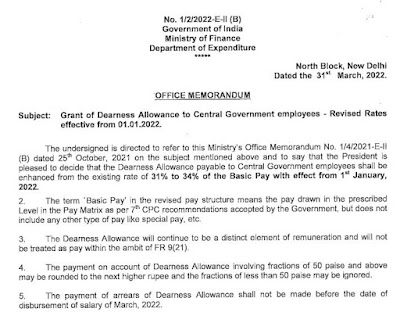
DA Jan 2022 - Grant of Dearness Allowance to Central Government employees - Revised Rates effective from 01.01.2022

 3% DA Hike - Revised Rates effective from 01.01.2022: DoE OM dated 31.03.2022 No. 1/2/2022-E-II (B) Government of India Ministry of Finance...