Tuesday, 24 February 2015

Implementation of One Rank One Pension Scheme – Defence Minister replied in Parliament

Implementation of One Rank One Pension Scheme – Defence Minister replied in Parliament

Implementation of One Rank One Pension Scheme

The principle of One Rank One Pension for the Armed Forces has been accepted by the Government. The modalities for implementation have been discussed with various stakeholders and are presently under consideration of the Government. It will be implemented once the modalities are approved by the Government.

This information was given by Minister of State for Defence Shri Rao Inderjit Singh in a written reply to Shri Avinash Rai Khannain Rajya Sabha today.

New Pension Scheme in Railways may be scrapped

New Pension Scheme in Railways may be scrapped, It is expected that Railway Minister may announce this during his budget speech. If this happens this will be a great news for young railway employees who have been appointed after 01.01.2004. Please read this news paper report published in dainik jagran:-

new pension scheme

Source: http://www.govemployees.in

MoU Signed Between Indian Army and State Bank of India

Press Information Bureau
Government of India
Ministry of Defence
23-February-2015
MoU Signed Between Indian Army and State Bank of India
A Memorandum of Understanding (MoU) was signed between the Indian Army and State Bank of India (SBI) on the Defence Salary Package on 23 Feb 2015. The signing in ceremony was chaired by the Adjutant General, Lt Gen Rakesh Sharma and was attended by top dignitaries of SBI Bank, headed by Dr Vaidyan MG, Dy MD (Retail Strategy).

The first MoU between SBI and the Indian Army was signed in 2011 and was valid for a period of three years. The revised MoU is tailor-made to suit the requirements of serving soldiers, pensioners and families. A number of additional facilities have been incorporated in the revised MoU after concerted efforts spanning over a year.

The basic features of the MoU include a number of free / concessional services like free drafts, free cheque books, free funds transfers to any bank in India through RTGS / NEFT, free ATM cards etc. The provision also includes the Nepal Express Remittance Scheme which enables instant fund transfers to Nepal for the benefit of the Nepali Domicile Gorkha Soldiers serving in the Indian Army.

Additional improved features are linking of the Personal Accident Insurance (PAI) to the Savings account instead of the debit card, enhancement of the PAI amounts, enhancement of the exemption percentage of margin money for house and car loans and waiving off of the processing charges on the loans. The revised MoU will benefit almost 19.5 lakh pensioners and 10 lakh serving personnel who hold Pay or Pension accounts with SBI and also provide them an opportunity to access modern banking facilities.

Col Rohan Anand, SM
PRO (Army)
PIB

IBA Official Minutes of meeting dated 23.02.2015 for 10th Bipartite Wage Revision – Bank Wage Revision from 01.11.2012

Indian Banks’ Association
Minutes of the discussions held on 23rd February 2015 between IBA representing 
Management of banks which are parties to the Bipartite settlement and 
Workmen Unions and Officers Associations on wage revision
Discussions were held between the Indian Banks’Association representing Managements of banks and the authorized representatives of Workmen Unions and Officers Associations on wage revision for officers in banks. After holding several rounds of discussions, the parties have mutually agreed as under:
  1. The wage revision will be effective from 1.11.2012
  2. The annual wage increase in salary and allowances @ 15% which works out to Rs.4725 crores on salary slip components.
  3. The new scales will be constructed after merging dearness allowance corresponding 4440 points as on November 2011, which works out to 60.15% and adding a load factor of 2% on Basic pay plus Dearness Allowance as on 31st March 2012 amounting to around Rs.597 crores.
  4. Distribution of annual wage increase between workmen unions and Officers Associations will be worked separately based on breakup of establishment expenses as on 31-3-2012.
  5. Every second and fourth Saturday of the month will be a holiday and the other Saturdays will be full working days.
  6. All other issues of the Managements and Unions/Associations discussed during the process of negotiation will be settled to the mutual satisfaction.
  7. The parties will meet on mutually convenient dated to draw out a detailed Bipartite Settlement/Joint Note on the various issues on which consensus positions have been reached. The parties will endeavour to finalise the Bipartite Settlement/Joint Note within a period of ninety days from the date of this minutes.
Signed at Mumbai on 23rd February 2015

FOR MANAGEMENT FOR OFFICER’S ASSOCIATIONS/ WORKMEN UNIONS


T M Bhasin All India Bank Officer’s Confederation


V R Iyer All India bank Officers Association


Arundhati Bhattacharya Indian National Bank Officers Congress


Rajeev Rishi National Organisation of Bank Officers

Source Image by http://banknewskumar.blogspot.in/

Second and fourth Saturdays will henceforth be holidays for banks. The remaining Saturdays in a month will be full working days.

Second and fourth Saturdays will henceforth be holidays for banks. The remaining Saturdays in a month will be full working days.

This was one of the agreements arrived at the meeting of the Indian Banks’ Association with associations of bank employees and staff in Mumbai on Monday.

The agreement, primarily settling the long pending negotiations over the wage revision, led to the United Forum of Banking Unions (UFBU) deferring its four day strike plan later this month.

“It is a balancing act,” UFBU (Andhra Pradesh and Telangana) Convenor VVSR Sarma told The Hindu about the agreement on the additional holidays. The influential body of the bank staffers was insisting that all Saturdays should be holidays.

By limiting it to two Saturdays and making other Saturdays full working day, the banks have ensured that the impact on the customers due to the additional holidays is less.

On the key wage revision component, Mr.Sarma said 15 per cent increase is what the IBA has agreed. The negotiations had hit a stalemate after the banks struck to 13 per cent, while the UFBU demanded 19 per cent. According to Mr.Sarma, the cost for the banks due to the 15 per cent hike that has been agreed works out to Rs.4,725 crore.
The agreement on the wage revision would be implemented with effect from November 1, 2012, he added.

Read at: The Hindu

Prime Minister says Budget session of Parliament important as people look at it with lot of hopes

Prime Minister says Budget session of Parliament important as people look at it with lot of hopes

Says it is collective responsibility of all parties to ensure effective functioning of Parliament
PM assures leaders of several parties all their concerns will be discussed
Shri M.Venkaiah Naidu says broad consensus on Ordinances; Land concerns can be discussed
Several parties call for smooth functioning of Parliament at All Party Meet on Budget session
Leaders welcome Prime Minister’s statement on religious freedom

Prime Minister Shri Narendra Modi has stressed on the importance of the Budget sesson of Parliament beginning February 23, 2015 saying that the people of the country look at the session with lot of hopes and expectations. He addressed the leaders of various parties in both the Houses of Parliament at a meeting convened by the Government for mutual consultations on the Budget session today.

Prime Minister said that it is the collective responsibility of all parties and leaders to enable the people fulfill their hopes and aspirations through proper functioning of both the Houses of Parliament. Shri Modi assured the leaders that all the issues and concerned raised by them will be discussed in an appropriate manner keeping in view their importance and priority. He expressed the hope that there would be a collective effort during the Budget session in the interest of the common man.

Prime Minister has attended the leaders’ meeting for over an hour and later had lunch along with all the leades.

In his opening remarks, Minister of Parliamentary Affairs gave detailes of the 44-item agenda of the Government for the Budget session including financial, legislative and non-legislative business. He said that of the six Ordinances to be converted into Acts of Parliament by April 5, 2015, there has been a broad consensus on five of them relating to Citizenship for Overseas Indians, Introduction of e-rikshaws, allocation of coal blocks and non-coal mines through open bidding. On the Insurance Ordinance, he said that further to the suggestion of opposition parties, a Select Committee of Rajya Sabha has been set up and the same had submitted its report which amounts to a broad view of the House and there is no reason for two views in the matter.

Shri Venkaiah Naidu said that the Government is willing to address concerns if any, on the Land Acquistion Ordinance. He noted : “Several state governments cutting across partyline have expressed difficulties in land acquisiton for development projects under the Act of 2013 and sought modifications. Subsequently, the central government sought to facilitate land acquistion for notified puposes like infrastructure and affordable housing projects etc., in an easy manner without compromising on the remuneration to be paid to farmers and rehabilitation measures to be taken up for displaced persons. The Government is ready to address apprehensions, if any in this regard’.

Shri Naidu further said at the all party meet : “I would like to assure you all that the government is always willing to sit with opposition to resolve any differences on any issue. I don’t think there is any issue that can’t be resolved if approached with open mind. What is required is the spirit of mutual cooperation in the true spirit of Parliamentary democracy. Let us collectively strive to build a conducive environment for effective functioning of Parliament during the Budget session’.

Over thirty leaders from both the Houses of Parliament expressed their views with most of them highlighting the need for smooth functioning of Parliament to enable discussion on all issues of concern both for the Government and the Opposition.

Several leaders have welcomed Prime Minister’s recent statement on religious freedom and justify to promote one’s religion and his call for respecting all religions.

Congress leader in the Lok Sabha Shri Mallikarjuna Kharge said, “Parliamentary democracy is all about deciding on issues through discusssion. Different parties will convey their views on Ordinances and other issues whenever taken up’.

Leader of Nationalist Congress Party Shri Sharad Pawar said, “Budget session is important and we need to ensure smooth functioning of Parliament.”

BJD leader Shri Bhartruhari Mahtab noted :”There has been undue focus on the Ordinaces in the media in general while it should have been on the Budget and economic issues. We need to focus on budget issues. We want both the Houses to function smoothly and decide on major issues. Efforts shall be made to move forward on important issues throgh rapproachment’.

Leaders of different parties from Tamil Nadu suggested that during the forthcoming visit of the Prime Minister to Sri Lanka, a conducive atmosphere may be created for protecting the justifys of Tamil fishermen and Tamils in Sri Lanka.

People’s representatives from Andhra Pradesh sought necessary action for fulfilling the assurances given to the state in the Andhra Pradesh Reorganisation Act including the Special Status and Special Package for the state. TRS leaders also spoke of the need for doing the needful for the state of Telangana.

Leaders from North-East suggested that they be given sufficient time in both the Houses putting aside the principle of time allocation based on numerical strength.

Issues suggested for discussion during the ensuing Budget session by leaders of different parties include: agrarian crisis, safety and security of women, espionage issue, communal harmony, free academic environment, passing on the benefit of declining international oil prices to public, Swine flu outbreak, Election reforms, price rise, natual calamities, development of North-East, reservation for women in legislatures etc.
Parliamentary Affairs Minister Shri M.Venkaiah Naidu later said that the all pary meet concluded on a very positive note and thanked the leaders for their views and suggestions.

Source: PIB News

Monday, 23 February 2015

Confederation of Central Government Employees request for early implementation of seventh pay commission

Confederation of Central Government Employees request for early implementation of seventh pay commission
 
M. Duraipandian, State general secretary of the Confederation of Central Government Employees and Workers sought the implementation of the seventh pay commission at the earliest.
 
While talking to the newsmen here on Saturday, he said it was a prerequisite that the employees should be provided with interim relief along with 50 percent merger of dearness allowance in salaries prior to approving any pay commission.
 
But even after a long period, the pay commission that was announced earlier by the central government has not yet been implemented.
 
Besides, Gramin Dak Sevaks numbering 2,65,000 across India should be brought under the much awaited seventh pay commission.
 
He said they had been working for almost 30 years for a meagre payment.
 
Moreover, the new and existing pension scheme should be scrapped and replaced with the old pension scheme. Since the launch of the new pension scheme, fund managers had not been appointed and the employees had been raising their doubts whether they could be entitled to avail such monetary benefits after their service period.
 
March to Parliament
 
To draw the government’s attention to fulfil these demands, the confederation members would stage a demonstration in front all district headquarter offices on March 2 and as the next step the confederation would stage a massive march towards the parliament in New Delhi on April 28, he said.
 
If these demands were not met, the employees would go on indefinite strike, which would be announced in July, he added.

Clarification by Railway Board: Reckoning of 30% pay element for the purpose of payment towards leave encashment upto 10 days to running staff

Clarification by Railway Board: Reckoning of 30% pay element for the purpose of payment towards leave encashment upto 10 days to running staff

GOVERNMENT OF INDIA
MINISTRY OF RAILWAYS
(RAILWAY BOARD)
RBE No. 10 /2015.
No.E(P&A)II-2011/RS-20
New Delhi, dated 12.02.2015
The General Managers,
All Indian Railways & Prod. Units etc.
(As per mailing lists No.I&II).
Sub: Reckoning of 30% pay element for the purpose of payment towards leave encashment upto 10 days to running staff.
Board have issued instructions vide letter No. F(E)III/2008/LE-I/I dated 29-10-2008 on encashment of leave while in service.

2. Some of the Zonal Railways had sought clarification whether 30% pay element is to be reckoned for the purpose of leave encashment upto 10 days of LAP to the running staff.

3. The matter has been considered by the Board and it is clarified that in the case of Running Staff, the calculation of leave encashment upto 10 days wil be done in the same manner as in the case of leave salary in terms of Rule 25(i)(k) of “The Rules for the payment of Running and other Allowances to the Running staff on Railways, 1981″

4. An illustration of the above is shown below:
(i) Basic Pay in general = Basic in Pay Band + Grade Pay = BP
(ii) Basic Pay of running staff = 130% of BP = (A)
(iii) DA rate in general = DA%
(iv) DA for running staff = DA% of (A) =(B)
(v) Leave encashment for 1 day = (A + B)/30
5. Other terms and conditions on encashment of leave will remain the same.

6. This issues with the concurrence of the Finance Directorate of the Ministry of Railways.

7. Please acknowledge receipt.
sd/-
(K.Shankar)
Director/E(P&A)
Railway Board
Source: www.airfindia.com
[http://www.airfindia.com/Orders%202015/RBE%20No.10%20of%202015%20of%20Ministry%20of%20Railways.pdf]

Revision of rates for various treatment procedures under ECHS

Revision of rates for various treatment procedures under ECHS
Central Organisation, ECHS
Adjutant General’s Branch
integrated Headquarters
Ministry of Qefence (Army)
Maude Line’s
Delhi Cantt-110010
B/49773/AG/ECHS/Rates/Policy
10 Feb 2015
REVISION OF RATES FOR VARIOUS TREATMENT
PROCEDURES UNDER ECHS
1. Ref this office letter No B/49773/AG/ECHS/Rates/Policy dt 07 Oct 2014 and B/49773/AG/ECHS/Rates/Policy dt 19 Nov 2014

2. CGHS has revised the rates for various treatment procedures vide their OM No S-11011/48/2014-CGHS (HEC) dt 18 Feb 2015. The rates of under mentioned treatment procedures alongwith their CGHS code are as under:-

Sr. No. CGHS Code Treatment Procedure Current Rate Revised Rates
Non-NABH NABH Non-NABH NABH
Gynae & Obst
1 648 RVF Repair 140000 16100 18975 21821
2 1590 USG for Obstetrics –Anomalies scan 323 380 770 887
Nephrology & Urology
1 793 Epididymectomy 8000 9200 15938 18750
2 888 Lithotripsy Extra corporeal shock wave 19000 21850 19550 22483
3 746 Ureteric Catheterization 690 794 8278 10950
4 807 Kidney transplant (Related) 3500 4025 200000 230000
5 808 Kidney transplant (Unrelated including immunosuppressant therapy) 143000 164450 300000 345000
General Surgery
1 372 Secondary suture of wounds 290 334 3400 4000
2 390 Haemorrhoidectomy 2500 2875 20720 24375
3 391 Stappler Haemorrhoidectomy 4025 4629 38000 43700
4 393 Varicose vein surgery; Trendelenburg operation with suturing or ligation. 8625 9919 10000 11500
5 18 Catheterization 83 95 425 500
6 477 Fissure in Ano-Fissurectomy 5750 6613 13800 15870
7 506 Laparoscopic Paraumblical Hernia Repair 12580 14800 17500 20125
Ophthalmology
1 32 Pterygium Surgery 86 99 5500 6325
2 34 Conjunctival wound repair or exploration following blunt trauma 115 132 3300 3795
Imaging Investigations
1 150 CT-orbit and brain 173 199 1600 1840
2 991 Foramen magnum decompression for Chari Malformation 1100 1265 93750 107813
Cardiology
1 534 DVR 53000 60950 155422 178735

2. Reimbursement to beneficiaries/ empanelled hospitals shall be limited to ceiling rate or as per actuals, whichever is lower. The other terms and conditions as regards to CGHS package rates remain unchanged.

3. The revised rates shall come into force for ECHS from the date of issue and shall be in force till further orders and are applicable in all cities.
(Vijay Anand)
Col
Dir (Med)
for MD ECHS
Source: http://echs.gov.in/images/pdf/med/med128.pdf

Income Tax Expectations: Here’s What India Wants

Income Tax Expectations: Here’s What India Wants

A survey carried out by industry body Assocham has found that a majority of salaried employees want Finance Minister Arun Jaitley to increase the income tax exemption in the forthcoming Budget.

A hike in income tax exemption from Rs. 2.5 lakh to Rs. 3 lakh will lead to savings of up to Rs. 5,000 for those who fall in the Rs. 2.5 lakh to Rs. 5 lakh tax bracket. Those in the Rs. 5 lakh to Rs. 10 lakh tax bracket will save up to Rs. 10,000, while those in the highest tax bracket can save up to Rs. 15,000.

Any increase in exemption in income tax would leave more money in the hands of people and will increase their purchasing power, Assocham said.

If Mr Jaitley hikes income tax exemption limit, it will be for the second time in two years that salaried employees will get a relief on taxes.

The other big expectation is about exemption on housing loans. 78 per cent of those surveyed want interest exemption on home loans to go up to Rs. 5 lakh from Rs. 2 lakh.

Property prices in the country have gone up sharply over the years and many individuals have to pay large amounts as interest for home loans. Exemption on interest on home loan was hiked by Rs. 50,000 to Rs. 2 lakh in the previous Budget.

A large number of respondents in the survey also voted for hiking exemption limit under section 80C of the Income Tax Act; the section makes investments worth Rs. 1.5 lakh on saving instruments such as fixed deposits, national saving certificates and public provident funds exempt from taxes.

“Hike in exemption limits will boost the savings rate in the Indian economy to 35 per cent of GDP from below 30 per cent currently,” said Assocham secretary general D S Rawat.

88 per cent of respondents want the government to reduce the record-high duty on gold import. Import duty on gold was hiked to 10 per cent in 2013 when the economy was struggling with a high current account deficit and volatile rupee.

Nearly 82 per cent of the salaried class expects a separate deduction of Rs. 50,000 for the payment towards annuity or pension plans. Deduction of the amount paid towards annuity plans u/s 80CCC and NPS u/s 80CCD come under the threshold limit of section 80C currently.

Around 55 per cent of the survey respondents were between 25 and 29 year-old; 26 per cent fell between 30 and 39 years; 16 per cent were between 40 and 49 years. The survey was carried out among employees from 18 broad sectors, with maximum share contributed by employees from IT/ITes sector (17 per cent). It was conducted across Delhi, Mumbai, Kolkata, Chennai, Ahmedabad, Hyderabad, Pune, Chandigarh, Dehradun, etc. About 500 salaried employees from the different sectors were covered by the survey from each city on an average.

Flash News

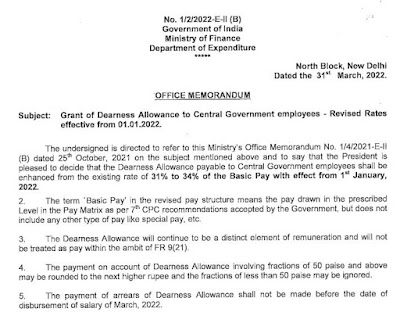
DA Jan 2022 - Grant of Dearness Allowance to Central Government employees - Revised Rates effective from 01.01.2022

 3% DA Hike - Revised Rates effective from 01.01.2022: DoE OM dated 31.03.2022 No. 1/2/2022-E-II (B) Government of India Ministry of Finance...