Friday, 14 November 2014

Comparison of New Pension Scheme (National Pension Scheme) and Central Government Pension


Comparison of New Pension Scheme (National Pension Scheme) and Central Government Pension

Comparison of New Pension Scheme (National Pension Scheme) and Central Government Pension

The Central Government employees who have joined after 1/1/2004 and are put under National Pension Scheme(NPS)  have been demanding abolition of NPS and have been persuading the Central Government to make the government pension scheme applicable to them.

This only exhibits their ignorance of the fact that the New Pension Scheme is highly lucrative and make the government employees who joined after 1/1/2004 far richer than the government employees who enjoy government pension scheme.  By doing so they are in the process of ruining the great fortunes that lies in store under New Pension Scheme. Let me compare both the scheme:

Benefits under NPS

Let me take a case of Upper Division Clerk(UDC) who joins government service in 2014 at the age of 25  and renders 35 years  of service till attaining 60 years of age. He / She gets 3% annual increment every year and gets one promotion every 10 year under M.A.C.P.  Although he / she is likely to get 14 to 20% increase in D.A every year as per Consumer Price Index I just take 12%(assuming 6 + 6%) 2 times D.A in a year

YEAR D.A. assumed @12% Per
annum
PAY + GRADEPAY with 3% annual increment D.A TOTAL TotalMonthly Subscription
(employee and Govt)
AnnualSubscription Annual Appreciationof Investments @8.7% Only TOTALPENSION WEALTH
2014
107%
9910
10604
20514
4102
49224
2320
51,544
2015
119%
10210
12150
22360
4471
53652
7012
1,12,208
2016
131%
10520
13781
24301
4860
58320
 12511
 183039
2017
143%
10840
15501
26341
5268
63216
 18903
 265158
2018
155%
11170
17314
28484
5696
68352
 26290
 359800
2019
167%
11510
19222
30732
6146
73752
 34779
 468331
2020
179%
11860
21229
33089
6618
79416
 44487
 592234
2021
191%
12220
23340
35560
7112
85344
 55546
 733124
2022
203%
12590
25558
38148
7630
91560
 68097
 892781
2023
215%
12970
27886
40856
8172
98064
 82293
 1073138
2024*
227%
14130
32075
46205
9240
110880
 98589
 1282607
2025
239%
14560
34798
49358
9872
118464
 117170
 1518241
2026
251%
15000
37650
52650
10530
126360
 138041
 1782642
2027
263%
15450
40634
56084
11216
134592
 161433
 2078667
2028
275%
15920
43780
59700
11940
143280
 187596
 2409543
2029
287%
16400
47068
63468
12694
152328
 216809
 2778680
2030
299%
16900
50531
67431
13486
161832
 249371
 3189883
2031
311%
17410
54145
71555
14312
171744
 285614
 3647241
2032
323%
17940
57946
75886
15178
182136
 325893
 4155270
2033
335%
18480
61908
80388
16078
192936
 370601
 4718807
2034*
347%
21060
73078
94138
18828
225936
 421184
 5365927
2035
359%
21700
77903
99603
19920
239040
 478101
 6083068
2036
371%
22360
82956
105316
21064
252768
 541139
 6876975
2037
383%
23030
88205
111235
22248
266976
 610878
 7754829
2038
395%
23730
93734
117464
23492
281904
 687954
 8724687
2039
407%
24450
99512
123962
24792
297504
 773068
 9795259
2040
419%
25190
105546
130736
26148
313776
 866975
 10976010
2041
431%
25950
111845
137795
27560
330720
 970498
 12277228
2042
443%
26730
118414
145144
29028
348336
 1084535
 13710099
2043
455%
27540
125307
152847
30570
366840
 1210066
 15287005
2044*
467%
29640
138419
168059
33612
403344
 1348977
 17039326
2045
479%
30530
146239
176769
35354
424248
 1501283
 18940857
2046
491%
31450
154420
185870
37174
446088
 1668876
 21055821
2047
503%
32400
162972
195372
39074
468888
 1853953
 23378662
2048
515%
33380
171907
205287
41058
492696
 2057162
 25928520
2049
527%
34390
181235
215625
43126
517512
 2280169

 28726201

* MACP / Promotion Years
(A) Therefore, the total pension wealth of a government servant who joined in 2014 and retiring under New Pension Scheme shall at the time of his retirement be Rs. 2,87,26,201/-

(B) 60% of the lump-sum pension wealth which he / she will be  getting on retirement:
Rs.1,72,35.720

(C) 40%   invested in an annuity scheme  which he / she can receive before 70 years:
Rs.1,14,90,481

(D) Earned Leave Encashment:  Rs. 215625 x 10 months        : Rs.   21,56,250

TOTAL of (A) (B) (C) and (D) will be            Rs. 3,08,82,451

Death Gratuity:

Although not entitled for retirement gratuity, but eligible for Death Gratuity  If died during the service

Monthly Pension:

At the assumed Interest at the rate of 8.7% per annum on  the other 40%  of pension wealth of Rs.1,14,90,481  invested in annuity shall fetch
monthly pension of  at least  :            Rs.83,306/ –

Not only this, before he / she attains the age of 70 he / she can withdraw the remaining  40% of his pension wealth of Rs. 1,14,90,481/- which if invested in Fixed Deposit of a nationalised bank can fetch interest and take care of not only of his wife and children but his descendants also for generations to come.
This is just a tip of the iceberg. If we consider the other  4 pay commission benefits that materialize on 1/1/2016, 1/1/2026, 1/1/2036 and 1/1/2046 which a NPS pensioner who joins as UDC shall be getting  before his retirement in 2049,his total pension wealth will be undoubtedly double the above amount which comes to more than Rs.5 crores. While a person who joins as U.D.C. gets this much, one will be rocked out of stupor to know what a Group A officer who renders 35 years of service may get – undoubtedly his total pensionwealth will be more than Rs.10 crores.

Benefits under Central Government Pension Scheme

Now let us see what will be the retirement benefits of the above person if he / she is put in government pension scheme:

1.Gratuity for 16.5 months :

Rs.2,15,625 x 16.5 months = Rs.35,57,812/- Restricted to  Rs.10,00,000

2. Earned Leave Encashment:

Rs. 215625 x 10 months :     Rs.21,56,250

3. Pension Commutation:

Rs.17195 x 40% = Rs.6878 x 12 x  8.194 years   Rs  6,76,300

Total Benefits under Central Government Pension Scheme:         Rs.38,32,550

4. GPF Balance:

As it is a general tendency of the government servants to withdraw from GPF frequently, there will be very little left at the time of retirement

5. Monthly pension

i) Rs.34390 / 2    =  Rs.17195 (basic pension being 50% of pay and grade pay Less 40% of basic pension towards commutation (Rs 6878) which will be restored after 15 years

Balance basic pension       is Rs. 10317

ii) DA @ 527% of basic pension of Rs.17195  = Rs. 90617 (subject to increase in DA every 6 months based on consumer price index)

Total pension                        is Rs.1,00,934 per month.

After the death of government servant  say after 67 years, spouse can take only 60% of the basic pension i.e.Rs.17195 x 60% = Rs.10317 plus D.A.at the prevailing rates. After spouse’s death children are unlikely to draw the pension as they would have already crossed the age limit.  Thus, unlike the dependents of NPS pensioners, there will be nothing left for financial security  of the dependents of the government pensioners .
Thus it is unwise on the part of government servants who have joined after 1/1/2004 to demand for abolition of NPS scheme and grant of government pension.

Mr.M.Dorai
Deputy Director
ESIC Model Hospital,
Bangalore (Ministry of Labour, Government of India) is the author of this Article.

Source: http://www.gconnect.in

Thursday, 13 November 2014

Meetings held by 7th Pay Commission (as on 12.11.2014)

Meetings held by 7th Pay Commission (as on 12.11.2014)

DateMeeting with
09.11.2014At Mumbai: IPS Association, Maharashtra; Assistant Audit Officers’ Association; Competent Authority – SAFEMA/NDPSA; Indian Revenue Service Promotee Officers’ Association; Indian Revenue Service Association, Mumbai; Films Division Cameramen; Indian
Naval Armament Service Association; Directorate of Marketing and Inspection Employees’ Association
08.11.2014At Mumbai: All India Defence Pharmacist Association; Orthotics and Prosthetics Association of India; All India CGHS Employees’ Association; All India Association of Statistical Investigators; National Railway Mazdoor Union; All India Naval Technical Supervisory
Staff Association; Ordnance Factories Group B Gazetted Officers; National Defence Non-Gazetted Staff Association; All India Association of Non-Gazetted Officers; The Naval Employees’ Union
07.11.2014At Mumbai: ISRO Pensioners’ Association; Directorate of Purchase and Stores Employees’ Association; Atomic Energy Workers and Staff Union; National Federation of Atomic Energy Employees; Atomic Energy Workers and Staff Union; BARC Employees’
Association, Tarapur; All India Association of Inspectors and Assistant Superintendents; All India Savings Bank Control Employees’ Union; All India Central Labour Welfare Organization Staff Association; Central Government Pensioners’ Welfare Association
06.11.2014At Mumbai: Central Railway Promotee Officers’ Association; Central Railway Mazdoor Sangh; All India Train Controllers’ Association; Central Railway Engineers’ Association; Bhartiya Pratiraksha Mazdoor Sangh; All India Loco Running Staff Association; Western
Railway Motormen’s Association; Indian Railways Radiographers’ Association; All India Loco Inspectors’ Welfare Association; Rashtriya Bhartiya Khani Vibhag Karmchari Sangh; Indian Bureau of Mines Employees’ Association; Central Water and Power Research
Station; Indian Forest Service Association, Maharashtra
30.10.2014S30 Retired Pensioners’ Association; PFRDA
29.10.2014Director General and Other officers of Defence Estate
13.10.2014At Leh: Personnel of Indian Army, Indian Air Force, Defence Institute of High Altitude Research, DRDO, BRO, ITBP, MES, All Ladakh Central Government Employees Association
09.10.2014At Dehradun: Non-Gazetted Officers’ Association, LBSNAA; National Institute for the Visually Handicapped Employees’ Union; Ministerial Staff Association, Survey of India; Topographical Staff Association, Survey of India; Class III Service Association, Survey of
India; Central Government Library Association; Faculty, Indira Gandhi National Forest Academy; Indira Gandhi National Forest Academy Staff Association; Faculty, Indian Council of Forestry Research and Education
08.10.2014At Dehradun: National Defence Medical Laboratory Technical Staff Association; All India Association of Clerical Employees of Ordnance Factories; Employees Union Ordnance Factory, Dehradun; All India Association of Non-Gazetted Officers of Ordnance &
Equipment Factories and Quality Assurance Organization; Staff Association, Rashtriya Indian Military College; All India DGQA Engineers Association; Wildlife Institute of India
24.09.2014Indian Ex-servicemen Movement
23.09.2014CRPF Officers
22.09.2014BSF Officers; Forum of retired CAPF officers
17.09.2014Aviation Research Centre
16.09.2014RPF Group ‘A’ Officers, IIM Bangalore
15.09.2014Disabled War Veterans (DISWAVE) Association, DG Bureau of Police Research and Development
26.08.2014At Bangalore: IAS Officers’ Association, IPS Officers’ Association, IFS Officers’ Association
25.08.2014At Bangalore: IIM Bangalore, ISRO
24.08.2014At Bangalore: Army Base Workshop (EME) Diploma Holders Association, Bangalore, Air Force Store Keepers Association, All India NCC Defence Civilian Employees Association, Confederation of Central Government Employees and Workers – Karnataka State,
Atomic Energy Employees Federation, All India Central Excise Inspectors Association, The Indian Hospital Pharmacist Association, Indian Railway Loco Runningmen Organisation, South Western Railways Engineers Association, Railway Wheel Factory, South Western
Railway Employees Sangh, All India DRDO Personal Staff Association, DoS Pensioners Forum, Central Government Pensioners Association, Indian Institute of Horticulture Research Employees’ Association, NIMHANS, Veterans Association, All India Loco Running Staff
Association
21.08.2014Physiotherapy Forum; Indian Ordnance Factories Group’B’ Gazetted Officers Association
20.08.2014Commissioner, Kendriya Vidyalaya Sangathan; Commissioner, Navodaya Vidyalaya Sangathan
24.07.2014Confederation of Central Government Gazetted Officers Association; National Ex-Servicemen Co-ordination Committee; Indian Ex-Services League
23.07.2014Bharat Central Pensioners Federation; Bharat Pensioners Samaj; Group ‘B’ Indian Information Service Association; Indian Postal Service Officers Association; DANICS Officers Association; Group ‘B’ Indian Ordnance Gazetted Officers Association
22.07.2014Police Commissioner, Delhi; DG Coast Guard; IOFS Officers Association
21.07.2014Director, IB; Director, CBI; Director, RAW
19.06.2014Indian Economic Service Officers Association; Indian Statistical Service Officers Association; IFS Officers Association; DGs of CAPFs (BSF+ITBP+Assam Rifles+Sashastra Seema Suraksha Bal); DGs of CAPFs (CISF+CRPF+NSC)
18.06.2014IFS Officers Association; PFRDA; Officers of Department of Financial Services, MOF; Officers of Department of Pension & Pensioners Welfare; P&T Finance Accounts Gr.A Officers Association; IRAS Officers Association; Central Health Service
Association
17.06.2014IAS Officers’ Association; Central Engineering Services Officers’ Association (Water+Power+Architecture); Central Engineering Services Officers’ Association (Civil+Electrical+Mechanical+Road Transport+Telecom); Income Tax Officers’ Association; Custom
Officers Association; Central Excise Officers Association
16.06.2014IPS Officers’ Association; Representative of Pay Commission cells of Army, Navy and Airforce; Indian Audit and Accounts Service Association; Cost Accounts Association; Civil Accounts Association; Federation of Railway Officers

Source : http://7cpc.india.gov.in/meetings.html

New List of CGHS Hospitals comes into effect from October 2014

New List of CGHS Hospitals comes into effect from October 2014

CGHS (Central Government Health System is the complete medical treatment facility provided for Central Government Employees, Retired employees, and their dependents. CGHS provides service through following categories of Allopathic, Homeopathic, Ayurveda, Unani, Yoga, Sidha Systems. Instructions on these various matters have been issued from time to time for the guidance of this scheme by the Department of Health and Family Welfare.

After a long gap, the list of hospitals under CGHS was released recently. According to the order issued by the Health Ministry, the list of hospitals for Delhi and NCR (National Capital region) will come into effect from 01.10.2014 onwards.

In addition to the hospitals under CGHS, an updated version of package rates of all kind of treatment too has been released. Click here for the complete order issued by the Health Ministry, including the rules and regulations for the treatment.

The list of CGHS hospitals for the rest of the country, excluding Delhi and the NCR, will soon be released.
On 27th June 2014, an order has been issued by the office of the Additional Director, CGHS regarding the extension of the period of empanelment of hospitals under CGHS Chennai. Nearly 19 hospitals(Miot, Agarwal, Vasan, Udhi, Parvathy, Med Fort, N.B., metropolis, CSI Kalyani, Sugam, Soundarapandian, Global, Noble, Anderson, Bharat, Frontier, Sridevi, M.N.Eye and Roentgen) including eye and dignostic centres indicated in that order.

Source: 7thpaycommissionnews.in

Wednesday, 12 November 2014

7th Pay Commission visit to Hyderabad from 18th to 20th November, 2014

7th Pay Commission visit to Hyderabad from 18th to 20th November, 2014
    Commission’s visit to Hyderabad
The Commission, headed by its Chairman, Justice Shri A. K. Mathur, proposes to visit Hyderabad from 18th to 20th November, 2014. The Commission would like to invite various entities/associations/federations representing any/all categories of employees covered by the terms of reference of the Commission to present their views.

Your request for a meeting with the Commission may be sent through e-mail to the Secretary, 7th Central Pay Commission at secy-7cpc@nic.in. The memorandum already submitted by the requesting entity may also be sent as an attachment with this e-mail.

The last date for receiving request for meeting is 17th Nov. 2014 (1700 hours).

Source: http://7cpc.india.gov.in/news06.html

Parity between Assistant, SO of Ordnance Factory and CSS/CSSS Pay Scale: Judgement by HC citing "Equal pay for Equal Work"

Parity between Assistant, SO of Ordnance Factory and CSS/CSSS Pay Scale: Landmark Judgement by HC citing "Equal pay for Equal Work".  Text of Hindustan Times News reproduced below:-
  New pay scale benefits for ordnance staff too: HC

UNIFORMITY Citing ‘equal pay for equal work’ principle, Delhi High Court tells Centre to grant pay parity to ordnance factory employees

Employees at Ordnance Factories (OF) – who have been contesting their omission from the benefits of the sixth pay commission for over seven years have finally more than one reason to rejoice.

Reining in the principle of ‘equal pay for equal work’ at public offices, the Delhi High Court has directed the Centre to grant pay parity to employees in the OF with that of identically ranked official in the Central Secretariat Service (CSS) and Central Secretariat Stenographer’s Service (CSSS).

The direction will be applied retrospectively from 2006 — when the sixth CPC was implemented. Not only this, the HC order will come in handy for the employees of the OF when the seventh central pay commission is implemented.

The HC order came in response to a petition filed by Ordnance Factory Employees Association challenging the decision of the finance ministry declining their request for the assistants working in the OF Board to be given same pay scale as was given to similarly placed officials in CSS, CSSS, Ar my Headquarters, UPSC and other services.

The starting point of discrimination against the employees of the OF Board came soon before the acceptance of recommendation of the sixth CPC when a pay upgradation of employees of CSS and CSSS was made in September 2006.

While the OFs and Armed Forces Head Quarters (AFHQs) — both non-secretariat organization — were excluded from the pay upgradation, the latter took the matter to the Central Administrative Tribunal (CAT) and got an order in its favour.

In the case of OF Board, the central government took the view that since it was a nonattached office working outside the Secretariat, there cannot be parity of pay scales. The OF Board was denied benefit of upgradation and the replacement scales given by the sixth CPC. The CAT, too, took a similar stand and denied any relief to the OF Board.

The matter finally reached the Delhi HC last year and after over a year of deliberation a bench of Justice S Ravindra Bhat and Justice Vipin Sanghi termed the discrimination meted out to the OF Board as “over-classification.”

The HC said the discrimination was illogical and artificial. It also took note that the cadre structure of CSS and CSSS is identical to that of the OF. In all the above organisations, the cadre of upper divisional clerks (UDCs) is filled by the feeder of the cadre of the lower divisional clerks (LDCs).

The cadre of assistants on the OF Board is filled by promotion from the feeder cadre of UDCs with at least five years of experience on regular basis.

“The OF Board was treated historically as equals to CSS/CSSS employees and enjoyed equal pay and all benefits flowing from equal pay,” the high court noted adding, “This was based on the previous four instances of determinations by successive pay commissions that they performed equal work.”

Source Image provided by http://aiamshq.blogspot.in/2014/11/blog-post.html

Source: http://lobis.nic.in/dhc/SRB/judgement/14-10-2014/SRB14102014CW46062013.pdf

Memorandum to the 7th Pay Commission by the Comptroller & Auditor General of India

Memorandum to the 7th Pay Commission by the Comptroller & Auditor General of India

Memorandum to the Seventh Pay Commission – Comptroller & Auditor General of India Group ‘B’ and ‘C’ cadres

Comptroller & Auditor General of India (CAG) submitted memorandum to 7th Pay Commission

The Comptroller & Auditor General of India (CAG) is a constitutional authority appointed by the President of India under Article 148 of the Constitution of India. The duties & powers of the CAG are prescribed in the Articles 149-151 of the Constitution of India. The Parliament under Article 149 of the Constitution has enacted the Comptroller & Auditor General’s (Duties, Power and Condition of Service) (CAG’s DPC Act) Act, 1971 replacing the earlier Government of India (Audit & Accounts) Order 1936.

Click to read memorandum

Central Civil Services (Classification, Control and Appeal) (Second Amendment) Rules, 2014

Central Civil Services (Classification, Control and Appeal) (Second Amendment) Rules, 2014

THE GAZETTE OF INDIA EXTRAORDINARY
[PART II—Sec 3(i)]
MINISTRY OF PERSONNEL, PUBLIC GRIEVANCES AND PENSIONS
(Department of Personnel and Training)

NOTIFICATION

New Delhi, the 31st October, 2014

G.S.R. 769(E).- In exercise of the powers conferred by the proviso co article 309 and clause (5) of article 148 of the Constitution, and after consultation with the Comptroller und Auditor General of India in relation to persons serving in the Indian Audit and Accounts Department, the President hereby makes the following rules further to amend the Central Civil Services (Classification, Control and Appel) rules 1965 namely—

1. (I) These rules may be called the Central Civil Services (Classification, Control and Appeal) (SecondAmendment) Rules, 2014.
(2) They shall come into force on the date of their publication in the Official Gazette.

2. In the Central Civil Services (Classification. Control and Appeal) Rules, 1965 (hereinafter referred to as the said rules)
(a) In rule I5, for sub-rules 2A, 3 and 4, the following sub-rules shall be substituted, namely: —

3) (a) In every case where it ta necessary to consult the Commission, the Disciplinary Authority shall forward or cause to be forwarded to the Commission for its advice:
(i) a copy of the report of the Inquiring Authority together with its own tentative reasons for disagreement, if any, with the findings of Inquiring Authority on any article of charge; and
(ii) comments of Disciplinary Authority on the representation of the Government servant on the Inquiry report and disagreement note, if any and all the cue records of the inquiry proceedings
(b) The Disciplinary Authority shah forward or cause to be forwarded a copy of the advice of the Commission received under clause (a) to the Government savant, who shall be required to submit, if he so desires, his written representation or submission to the Disciplinary Authority within fifteen days, on the advice of the Commission

(4) The Disciplinary Authority shall consider the representation under sub-rule (2) and/ or clause (b) of sub-rule (3), if any, submitted by the Government servant and record its findings before proceeding further in the matter as specified in sub-rules (5) and (6).

(5) If the Disciplinary Authority having regard to its findings on all or any of the articles of charge is of the opinion the any of the penalties specified in clauses (I) to (iv) of rule 11 should be imposed on the Government servant, it shall, notwithstanding anything contained in rule 16, make an order imposing such penalty.

(6) If the Disciplinary Authority having regard to its findings on ail or any of the articles of charge and on the basis of the evidence adduced during the inquiry Is of the opinion that any of the penalties specified in clauses (V) to (ix) of rule 11 should be imposed on the Government servant, it shall make an order imposing such penalty and it shall not be necessary to give the Government savant any opportunity of making representation on the penalty proponed to be imposed.”;
(b) In rule 16,—
(i) in sub-rule (I),-
(A) for the words, brackets and figure “sub-rule (3)”, the words, brackets and figure ‘sub-rule (5)” shall be substituted;
(B) for clauses (d) and (e), the following clauses shah be substituted; namely: —
“(d) Consulting the Commission where such consultation is necessary. The Disciplinary Authority shall forward or cause to be forwarded a copy of the advice of the Commission to the Government servant, who shall be required to submit, if he so desires, his written representation or submission on the advice of the Commission, to the Disciplinary Authority within fifteen days; and
(e) recording a finding on each imputation or misconduct or misbehavior.”
(ii) in sub-rule (2) for clauses (vi) and (vii), the following clauses shall be substituted,
“(vi) representation, if any, of the Government servant on the advice of the Commission:
(vii) the findings on each imputation of misconduct or misbehavior; and
(viii) the orders on the case together with the reasons therefor.;
(C) In rule 17, the words “and also a copy of the advice, if any, given by the Commission,” shall be deleted;

(d) In rule 19, in the second proviso, after the words “where such consultation ta necessary”, the words “and the Government servant has been given an opportunity of representing against the advice of the Commission.” shall be added;.

(e) In rule 27, in sub-rule (2), in the proviso, in clause (i) alter the words “where such consultation is necessary” the words “and the government servant has been given an opportunity of representing against the advice of the Commission,” shall be added:

(f) In rule 29, in sub-ruIe (1) in the first proviso, after the words “where such consultation is necessary”. the words“ and the Government servant has been given an opportunity of representing against the advice of the Commission shall be added:

(g) In rule 29-A, in the proviso, after the words “where such consultation is necessary”, the words “and the Government servant has been given an opportunity of representing against the advice of the Commission.” shall be added;

(h) In rule 32 shall be omitted.

[F. No. 11012/8/2011-Estt.(A)]
MAMTA KUNDRA, Jt. Secy.
Source: www.persmin.gov.in

Central Government employee opts for a surrogate child – What says CCS (Leave) Rules..?

Central Government Employee opts for a surrogate child – What says CCS (Leave) Rules..?

Can Central Govt Female Employees Opting for Surrogate Pregnancy Claim Maternity Leave?

Parenthood is a gift of god. Thanks to the development in medical sciences, childless couples can now opt for surrogate pregnancies. If women employees of Central Government organizations opt for surrogate pregnancies, can they claim maternity leave?

Women employees of Central Government establishments are given Maternity leave for a period of 180 days and male employees are given Paternity Leave for a period of 15 days if they choose to adopt babies. At present, there is no leave entitlements for parents of the surrogate child.

Let’s see what the Indian medical Research Council has to say about couples who choose to have babies through surrogate mothers.


Surrogacy: General Considerations

A child born through surrogacy must be adopted by the genetic (biological) parents unless they can establish through genetic (DNA) fingerprinting (of which the records will be maintained in the clinic) that the child is theirs.Guidelines for ART Clinics in India ICMR/NAMS

Surrogacy by assisted conception should normally be considered only for patients for whom it would be physically or medically impossible/undesirable to carry a baby to term.

Payments to surrogate mothers should cover all genuine expenses associated with the pregnancy. Documentary evidence of the financial arrangement for surrogacy must be available. The ART centre should not be involved in this monetary aspect.

Advertisements regarding surrogacy should not be made by the ART clinic. The responsibility of finding a surrogate mother, through advertisement or otherwise, should rest with the couple, or a semen bank.

A surrogate mother should not be over 45 years of age. Before accepting a woman as a possible surrogate for a particular couple’s child, the ART clinic must ensure (and put on record) that the woman satisfies all the testable criteria to go through a successful full-term pregnancy.

A relative, a known person, as well as a person unknown to the couple may act as a surrogate mother for the couple. In the case of a relative acting as a surrogate, the relative should belong to the same generation as the women desiring the surrogate.

A prospective surrogate mother must be tested for HIV and shown to be seronegative for this virus just before embryo transfer. She must also provide a written certificate that (a) she has not had a drug intravenously administered into her through a shared syringe, (b) she has not undergone blood transfusion; and (c) she and her husband (to the best of her/his knowledge) has had no extramarital relationship in the last six months.

(This is to ensure that the person would not come up with symptoms of HIV infection during the period of surrogacy.) The prospective surrogate mother must also declare that she will not use drugs intravenously, and not undergo blood transfusion excepting of blood obtained through a certified blood bank.

No woman may act as a surrogate more then thrice in her lifetime

Monday, 10 November 2014

CGHS EMPLOYEES ASSOCIATION MEETS 7TH PAY COMMISSION

CGHS EMPLOYEES ASSOCIATION MEETS 7TH PAY COMMISSION

All India CGHS Employees Association had a meeting with the 7th Pay Commission on 8th November 2014. During this meeting the delegation led by Shri Francis Ellis Secretary General raised the common issues of Administrative Staff viz. Upgradation of Grade pay of LDC to Rs 2800, Granting of MACP on Promotional Hierarchy etc.

All other Associations, inviting to meet the 7th Pay Commission are requested to please bring the Grade Pay issue of LDC/UDC and MACP issue before the Pay Commission in its own importance.

The photo of CGHS delegation with Pay Commission is placed below:

Source: http://aiamshq.blogspot.in/2014/11/cghs-employeesassociation-meets-7-th.html

All India Naval Technical Supervisory Staff Association meeting with 7th CPC and presentation i.r.o. technical Supervisory Cadre

All India Naval Technical Supervisory Staff Association meeting with 7th CPC and presentation i.r.o. technical Supervisory Cadre

The All India Naval Technical Supervisory Staff Association had an interaction with the complete team of 7th Central Pay Commission under Chairmanship of Justice Shri. Ashok Kumar Mathur at Naval Dockyard Mumbai on 08th Nov 2014. They handed over a memorandum to the 7th CPC and a presentation (scroll below) was organized in respect of the technical supervisory cadre.

Following office bearers were present during the detail interaction:

1. Shri. BB Mohanty   – President
2. Shri. AL Mhatre    – General Secretary
3. Shri. KM Nair      – Vice President
4. Shri. AS Raza      – Secretary
5. Shri. RK Pandey    – Treasurer
6. Shri. Navin Kumar  – Org. Secretary
7. Shri. T  Vargese   – Jt. Secretary
8. Shri. RG Pandey    – Jt. Secretary
9. Shri. Tarun Sarkar – Jt. Secretary
10.Shri. T Singh      – Jt. Secretary
11.Shri. JR Johnson   – Jt. Secretary
Regards,
Avinash Mhatre,
General Secretary
AINTSSA

Presentation to Seventh Central Pay Commission
By
All India Naval Technical Supervisory Staff Association
PAY  DETERMINATION
  • Reasonable ratio between maximum and minimum salary shall be 8: 1.
  • Proposed common and uniform multiple factor for revision of pay in respect of existing pay is 3.96 (as per % rise of NNP on constant prices).
  • Determination of minimum salary based on inflation (50% DA shall be treated as DP).
  • Rate of increment in each grade may please be granted @ 5% per annum.
  • Reduction of nos. of grade pays of Rs. 4800 & Rs. 5400/- in PB-2 need to merged and upgraded to GP Rs. 5400/- in PB-3 as doctrine of equal pay for equal work.
CONSISTENT ANAMOLY :  DISTURBANCE  OF VERTICLE RELATIVITY BETWEEN CHARGEMAN AND MASTER CRAFTSMAN 
Pay Commission Pay Scales Brief on improvements given in violation of vertical relativity & Pay Commission recommendations
Fourth CPC Sr. Chargeman Rs.1400-2300
Master Craftsman, Rs. 1400-2300
HSK-I, Rs. 1320-1560
Identical Pay scales of Sr. Chargeman, and MCM resulted in hierarchal confusion and attracted many court cases.
Fifth CPC Chargeman-II Rs. 5000-8000
Only three grades
Master Craftsman, Rs.4500-7000
HSK Rs. Rs.4000-6000
Skilled , Rs.3050-4590
Concept of four grades (Skilled, HSK Gr-II, HSK Gr-I and MCM) restored with MCM placed in the scale of Rs.5000-8000 equal to the Chargeman-II who supervises MCM.
2005 The post of MCM has been made as regular by Govt. Of India and accordingly benefit of pay fixation has been permitted, and stated that the work of Master Craftsman in grade Rs.5000-8000 will be supervised by Chargeman-II scale Rs.5000-8000.
Sixth CPC Chargeman Grade Pay Rs.4200, PB-2, Only three grades Skilled (GP Rs.1900), Highly Skilled (GP Rs.2400) and MCM (GP Rs.2800) were recommended in PB-1, maintaining the hierarchal order and the principle of higher post given the higher Grade Pay Para 3.8.27 of SCPC report. Concept of four grades (Skilled , HSK Gr-II, HSK Gr-I and MCM) restored with Sr. Technician placed in the GP of Rs.4200.

Sixth Pay Commission recommendation vide para 2.2.11 “Grade pay being progressively higher for successive higher posts, the employees on promotion will get monetary benefit on promotion in the form of the increased grade pay apart from the benefit of one additional increment” got violated.
MACP  Scheme
  • The scheme shall be unique effect between Defence service and civilian personnel, since there was a disparity earlier, service personnel are getting MACP scheme after 8, 16, 24 years whereas civilian are  getting  after  10, 20 & 30 years.
  • Proposed for five MACPs (after 6, 12, 18, 24 & 30 years).
  • Grant of MACP scheme on Promotional hierarchy.
  • Shift-over from one pay band (PB-2 to PB-3) to the next one on effect of MACPs.
  • Uniform MACP scheme for all central government departments including defence services.
INTRODUCTION OF  TIME  BOUND PROMOTIONS
Existing hierarchy of posts Existing Grade Pay Proposed hierarchy of posts after proposed cadre restructuring Proposed revised Grade Pay after proposed cadre restructuring Provision of time bound promotion instead of MACPS which shall compensate the losses due to MACPS
Chargeman Rs.4200 (PB-2) Junior Engineer 4800, PB-2 Entry grade For entry level post of JE (GP-4600)
Foreman Rs.4600 (PB-2) Assistant Engineer 5400, PB-3 1st Functional / non functional promotion to GP-5400 (PB-3) after completion of 6 years in GP-4800
Proposed Merger of
Technical Assistant and
Junior Technical Officer
Rs.4800 (PB-2)
And
Rs.5400 (PB-3)
Executive Engineer 6600, PB-3 2nd Functional / non functional promotion to GP-6600 (PB-3) after completion of 4 years in GP-5400
Technical Officer Rs. 6600 (PB-3) Superintendent Engineer 7600, PB-3 3rd Functional / non functional promotion to GP-7600 (PB-3) after completion of 4 years in GP-6600
Senior Technical Officer Rs. 7600 (PB-3) Chief Engineer 8700, PB-4 4th Functional / non functional promotion to GP-8700 (PB-4) after completion of 4 years in GP-7600, PB-3
Chief Technical Officer Rs. 8700 (PB-3) Principal Engineer 8900, PB-4 5th Functional / non functional promotion to GP-8900 (PB-4) after completion of 4 years in GP-8700 (PB-4)
CONDITIONS  OF  SERVICE
  • Hours  of  work  for  Non-Industrial Cadre = 40 hours.
  • Grant of Restricted Holidays to Technical Supervisors of Indian Navy.
  • Five days week for industrial establishments of Navy.
  • Leave facilities – Maximum accumulation of leaves.
  • Medical Facilities – Introduction of Assured healthcare  services to the technical supervisors working in Naval Units at remote and underdeveloped areas like Karwar, Azhimala etc.
More news on :  karnmk.blogspot.in

Flash News

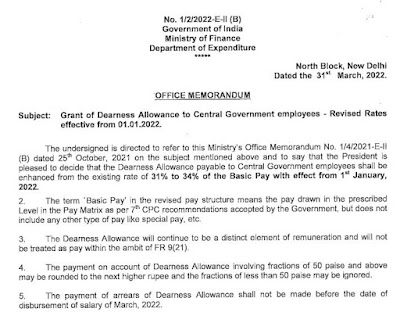
DA Jan 2022 - Grant of Dearness Allowance to Central Government employees - Revised Rates effective from 01.01.2022

 3% DA Hike - Revised Rates effective from 01.01.2022: DoE OM dated 31.03.2022 No. 1/2/2022-E-II (B) Government of India Ministry of Finance...