Wednesday, 19 December 2018

Senior Citizen Entitlement of Employees

Ministry of Personnel, Public Grievances & Pensions
Senior Citizen Entitlement of Employees
19 DEC 2018
Department of Social Justice & Empowerment has informed that there is at present no proposal in that Department for lowering the age of senior citizen. Government employees become entitle to pension on retirement. There is also no proposal to increase or decrease the age of retirement of Central Government Employees.

The salient features of the pension entitlements of employees retiring from the Central Government are as under:
  • A Government servant retiring in accordance with the rules, after completing a qualifying service of not less than 10 years, is entitled to a pension @ 50% of his last pay or 50% of average emoluments for the last 10 months, whichever is more beneficial to him/her.
  • After completion of 80 years of age or above, additional pension @ 20% to 100% is payable to the retired Government servant.
  • A retired/retiring Government servant is entitled to, at his/her option, a lump sum payment, by commutation of a maximum of 40% of his/her pension.
  • On retirement, a Government employee is entitled to a retirement gratuity based on his/her emoluments and length of qualifying service.
  • On death of a Central Government pensioner, the family is entitled to a family pension the amount of which is 50% of the last pay for a period of seven years, or for a period up to the date on which the retired deceased Government servant would have attained the age of 67 years had he/she survived, whichever is earlier. Thereafter, the amount of family pension is 30% of his last pay.  The amount of family pension is also increased by 20% to 100% after the family pensioner attains the age of 80 years and above.
  • The family of a Government servant, who dies while in service after having rendered not less than seven years’ continuous service, is entitled to a family pension 50% of the last pay for a period of ten years. Thereafter, the amount of family pension is 30% of his/her last pay.
This was stated by the Minister of State in the Ministry of Personnel, Public Grievances and Pensions and Minister of State in the Prime Minister's Office, Dr. Jitendra Singh in a written reply to a question in the Lok Sabha today.

PIB

Redresasal of Public Grievances & CPGRAMS

Redresasal of Public Grievances & CPGRAMS

Ministry of Personnel, Public Grievances & Pensions
Redresasal of Public Grievances
19 DEC 2018
As per the data available on the online Centralized Public Grievance Redress and Monitoring System (CPGRAMS), the year-wise number of grievances received and disposed off during the period from 1.1.2014 to 13.12.2018 in respect of Ministries/Departments of Government of India is as under:

There has been about fivefold increase in the number of grievances received in CPGRAMS from 2014 to 2017.  The rate of disposal has also kept pace with the number of grievances received during the period.  High rate of disposal has been achieved since the Government has taken every possible step to put in place a strong Grievance Redress Mechanism.

Government has taken several steps to make the Grievance Redressal Mechanism effective for quick disposal of public grievances which are as under:
(i)    Review of Grievances of identified Ministry/Department is undertaken every month during meetings conducted on PRAGATI (Pro-Active Governance and Timely Implementation) platform.

(ii)   For effective monitoring of grievances at Secretary level, an electronic Dashboard has been created showing the consolidated status of grievances disposed and pending, on CPGRAMS. Weekly reminders through SMS are also being sent for pending grievances.

(iii)  A Grievance Analysis Study in respect of  top 20 grievance receiving Ministries/ Departments/ Organizations listed on CPGRAMS for identifying grievance prone areas, their root cause analysis and suggested systemic reforms for reducing such grievances, has been carried out by Department of Administrative Reforms and Public Grievances. Several suggested systemic reforms have been implemented by the concerned Ministries/Departments.  Some of these reforms are: automatic refunds on cancellation of Railway Tickets, Single Window Pension through disbursing Banks, intensive mechanized cleaning of coaches, e-verification of Income Tax Returns, expeditious Income Tax Returns upto Rs.50,000/-,  etc.

(iv) In continuation of the Grievance Analysis Study in respect of top 20 Ministries/ Departments receiving maximum grievances on CPGRAMS, another Grievance Analysis Study for next 20 Ministries/ Departments receiving bulk of the grievances has also been carried out by Department of Administrative Reforms and Public Grievances.

(v)    A Public Grievances Call Centre has been set up for reminding the concerned officials of top 40 Ministries/Departments/Organizations for expeditious disposal of grievances pending for more than 2 months.

(vi)   An Award Scheme has been launched for recognising outstanding performance with respect to disposal of grievances on CPGRAMS on a quarterly basis through issue of Certificate of Appreciation.

(vii)  Review meetings are being taken on regular basis with the representatives of Central   Ministries/ Departments for monitoring pendency of public grievances.

(viii) Training on CPGRAMS is conducted on regular basis.     

(ix)  A new Mobile App which is more user-friendly for lodging of public grievances has been developed.  The Grievance Action Status can also be viewed on the mobile itself.  This has been integrated with Unified Mobile Application for New-age Governance (UMANG).  This initiative also facilitates lodging of grievance anywhere anytime.
This was stated by the Minister of State in the Ministry of Personnel, Public Grievances and Pensions and Minister of State in the Prime Minister’s Office Dr. Jitendra Singh in a written reply to a question in the Lok Sabha today.

PIB

Promotion on Public Rating


Ministry of Personnel, Public Grievances & Pensions
Promotion on Public Rating
19 DEC 2018
The Government has no proposal under consideration to promote the Government officials based on public rating/feedback.

Department of Pension & Pensioners' Welfare has informed that an “Aadhar-based Digital Life Certificate (DLC)" for pensioners was launched on 10th November, 2014.

Aadhaar is used for authentication of pensioners.  As a result of this facility the pensioner is not required to present himself before his pension disbursing agency or produce other documents that he is alive.

After generation of the DLC, the pension disbursing agencies integrated with the system will get access to the submitted DLC for processing and release of pension there after.

Unique Identification Authority of India (UIDAI) has informed that it has a well-designed, multi-layered robust security system in place to maintain the highest level of data security and integrity in accordance with the Aadhaar Act, 2016 and the Regulations notified under the Act. Some of the security measures include provision of secure channel, implementation of Aadhaar Data Vault, Hardware Security Module, Registered Devices, Virtual ID-UID Token, biometric locking etc.

This was stated by the Minister of State in the Ministry of Personnel, Public Grievances & Pensions and Minister of State in the Prime Minister’s Office Dr. Jitendra Singh in a written reply to a question in the Lok Sabha today.

PIB

LTC for New Joining Central Government Employees - FAQ


LTC for New Joining Central Government Employees - FAQ
FAQ - LTC FOR NEW JOINING CENTRAL GOVERNMENT EMPLOYEES

Frequently Asked Questions on LTC entitlements of Fresh Recruit

Frequently Asked Questions (FAQs) on Leave Travel Concession entitlements of Fresh Recruit
The 6th CPC had recommended that "Fresh Recruits" to the Central Government may be allowed to travel to their Home Town along with their families on three occasions in a block of four years and to any place in India on the fourth occasion. This was accepted by the Government and orders were issued vide DoPT O.M. No. 31011/4/2008-Estt.(A) dated 23rd September, 2008.

This Department receives a number of references seeking clarifications from various Ministry/ Departments about the year wise LTC entitlements of Fresh Recruits. Based on the same, a set of frequently asked questions have been answered as under:

Question 1. What are the LTC entitlements of a Fresh Recruit?
Answer: Fresh recruits to the Central Government are allowed to travel to their home town along with their families on three occasions in a block of four years and to any place in India on the fourth occasion. This facility shall be available to the fresh recruits only for the first two blocks of four years applicable after joining the Government for the first time.
Question 2. How are the two blocks of four years applied to the Fresh Recruit?
Answer: The first two blocks of four years shall apply with reference to the initial date of joining the Government service even though the Govt. servant may change the job within the Government subsequently. However, as per Rule 7 of CCS (LTC) Rules, 1988, the LTC entitlement of a fresh recruit will be calculated calendar year wise with effect from the date of completion of one year of regular service.
Question 3. Are the LTC blocks of four years in respect of Fresh Recruits same as the regular blocks like 2010-13, 2014-17?
Answer: No. The first two blocks of four years of fresh recruits will be personal to them. On completion of eight year of LTC, they will be treated at par with other regular LTC beneficiaries as per the prescribed blocks like 2014-17, 2018-21 etc.
Question 4. If a fresh recruit does not avail LTC facility in a particular year, can he/she avail it in the next year?
Answer: No. Carryover of LTC to the next year is not allowed in case of a fresh recruit as he is already entitled to every year LTC. Hence, if a fresh recruit does not avail of the LTC facility in any year, his LTC will deem to have lapsed with the end of that year.
Question 5. How will the LTC entitlements of a Fresh Recruit be exercised after the completion of eight years of service?
Answer: (a) After the completion of eight years of service, when the next LTC cycle of fresh recruit coincides with the beginning of the second two year block (eg. 2016-17) of the running four year block (2014-17), he will be eligible only for ‘Home Town’ LTC if he/she has availed ‘Any Place in India’ LTC in the eighth year. Cases, where the new LTC cycle of fresh recruit coincides with the second year of the running two year block (ex. 2017 of 2016-2017), he will not be eligible for LTC in that year. Refer illustrations 1 & 3 for further explanation. (b) At the end of the eighth year of LTC, when the new LTC cycle of a fresh recruit coincides with the beginning of a regular four year block, his entitlement in the regular block will be exercised as per the usual LTC Rules. Refer illustration 2.
Question 6. How will the LTC entitlement computed in case of a fresh recruit joining the service on 31st December of any year?
Answer: A fresh recruit who joins the Government service on 31st December of any year, will be eligible for LTC w.e.f. 31st December of next year. Since, 31st December is the last date of a calendar year, his first occasion of LTC ends with that year. Hence, he may avail his first Home Town LTC on the last day of that year. From next year onwards he would be eligible for the remaining seven LTCs. Refer illustration 3.
Question 7. How will the entitlements of a fresh recruit be computed who has joined the Govt. service before 01.09.2008?
Answer: A fresh recruit who has joined Government service before 01.09.2008 (i.e before the introduction of this scheme) and has not completed his first eight years of service as on 01.09.2008 will be eligible for this concession for the remaining time-period till the completion of first eight years of his/ her service. Refer illustration 4.
Question 8. Can a fresh recruit whose Home Town and Headquarters are same, avail LTC to Home Town?
Answer: No. A fresh recruit whose Home Town and Headquarters are same, cannot avail LTC to Home Town. He may avail LTC to any place in India on the fourth and eighth occasion only. As per Rule 8 of CCS (LTC) Rules, 1988, LTC to Home Town shall be admissible irrespective of the distance between the Headquarters of the Govt. servant and his Home Town which implies that Headquarters and Home Town should be at different places.

Illustration

Illustration 1:
An employee joins the Government service on 1st September, 2008. As per the CCS (LTC) Rules, he will become eligible for LTC with effect from 1st September, 2009 (i.e. after the completion of one year of regular service). His entitlement for Home Town / All India would be as under:
Year of LTCType of LTCLTC Occasion
01.09.2008 – 31.08.2009Nil-
01.09.2009 – 31.12.2009Home Town1st
01.01.2010 – 31.12.2010Home Town2nd
01.01.2011 – 31.12.2011Home Town3rd
01.01.2012 – 31.12.2012Any Place in India4th
01.01.2013 – 31.12.2013Home Town5th
01.01.2014 – 31.12.2014Home Town6th
01.01.2015 – 31.12.2015Home Town7th
01.01.2016 – 31.12.2016Any Place in India8th
01.01.2017 – 31.12.2017Nil-
01.01.2018 – 31.12.2021New LTC Block
Explanation
1.After the completion of the first eight years, when the fresh recruit gets into the middle of the running regular block of four calendar years (ex. 2014-2017) where the new LTC cycle of fresh recruit coincides with the second year of the running two year block (ex. 2017 of 2016-2017), he will not be eligible for LTC in that year (i.e. 2017).
2.It can be seen from above that LTC entitlement for a fresh recruit is calculated calendar year wise with effect from the date of completion of one year of regular service.

Illustration 2:

An employee joins the Government service on 1st January, 2009. As per the CCS (LTC) Rules, he will become eligible for LTC with effect from 1st January, 2010 (i.e. after the completion of one year of regular service). His entitlement for Home Town / All India LTC would be as under:
Year of LTCType of LTCLTC Occasion
01.01.2009 – 31.12.2009Nil
01.01.2010 – 31.12.2010Home Town1st
01.01.2011 – 31.12.2011Home Town2nd
01.01.2012 – 31.12.2012Home Town3rd
01.01.2013 – 31.12.2013Any Place in India4th
01.01.2014 – 31.12.2014Home Town5th
01.01.2015 – 31.12.2015Home Town6th
01.01.2016 – 31.12.2016Home Town7th
01.01.2017 – 31.12.2017Any Place in India8th
01.01.2018 – 31.12.2021New LTC Block
Explanations:
1.A the end of the eighth year of LTC, when the new LTC cycle of a fresh recruit coincides with the beginning of a regular four year block, his entitlement in the regular block will be exercised as per the usual LTC Rules.Explanations:
Illustration 3:
An employee joins the Government service on 31st December, 2011. As per the CCS (LTC) Rules, he will become eligible for LTC with effect from 31st December, 2012 (i.e. after completion of one year of regular service). His entitlement for Home Town / All India LTC would be as under:
Year of LTCType of LTCLTC Occasion
31.01.2011 – 30.12.2012Nil
31.12.2012Home Town1st
01.01.2013 – 31.12.2013Home Town2nd
01.01.2014 – 31.12.2014Home Town3rd
01.01.2015 – 31.12.2015Any Place in India4th
01.01.2016 – 31.12.2016Home Town5th
01.01.2017 – 31.12.2017Home Town6th
01.01.2018 – 31.12.2018Home Town7th
01.01.2019 – 31.12.2019Any Place in India8th
01.01.2020 – 31.12.2021Home Town
01.01.2022 – 31.12.2025New LTC Block
Explanations:
i. A fresh recruit who joins on 31st December of any year, will be eligible for LTC w.e.f. 31st December of next year. Since, 31st December is the last date of that calendar year, his first occasion of LTC ends with that year. Hence, he may avail his first home town LTC on that day only (eg. 31st December, 2012). From next year onwards he will be eligible for the remaining seven LTCs.
ii. After the completion of eight years of service, when the next LTC cycle of fresh recruit coincides with the beginning of the second two year block (eg. 2020-21) of the running four year block (2018-21), he will be eligible only for the ‘Home Town’ LTC in that block if he has availed of ‘Any Place in India’ LTC in the eighth year. In case, the fresh recruit forgoes his eighth year LTC, then he has a choice to avail either ‘Any Place in India’ or ‘Home Town’ LTC in the following two year block (i.e. in 2020-21).
Illustration 4:
An employee joins the Government service on 10th May, 2006. As per the CCS (LTC) Rules, he will become eligible for LTC with effect from 10th May, 2007 (i.e. after the completion of one year of regular service). His entitlement for Home Town / All India LTC would be as under:
YEAR OF LTCTYPE OF LTCLTC OCCASION
10.05.2006 – 09.05.2007Nil
10.05.2007 – 31.12.2007Home Town/ Any Place in India1st
01.01.2008 – 31.12.2008Home Town2nd
01.01.2009 – 31.12.2009Home Town3rd
01.01.2010 – 31.12.2010Any Place in India4th
01.01.2011 – 31.12.2011Home Town5th
01.01.2012 – 31.12.2012Home Town6th
01.01.2013 – 31.12.2013Home Town7th
01.01.2014 – 31.12.2014Any Place in India8th
01.01.2015 – 31.12.2015Nil
01.01.2016 – 31.12.2017Home Town
Explanations:
A fresh recruit who has joined the Government service before 01.09.2008 (i.e. before the introduction of this scheme) and has not completed his first eight years of service as on 01.09.2008 will be eligible for this concession for the remaining time-period till the completion of first eight years of his/ her service. ,

Revision in the room rent of the ISTM Hostel


Revised Room Rent Rates of ISTM Hostel

Revision in the room rent of the ISTM Hostel

F.No.D-2109/17/2018-Hostel
GOVERNMENT OF INDIA
INSTITUTE OF SECRETARIAT TRAINING & MANAGEMENT

Date 15th October, 2018
ORDER Subject: Revision in the room rent of the ISTM Hostel The revised room rent for ISTM Hostel Accommodation is as per the following rates:-


Room Rent of ISTM Hostel Room
S.NO.NATURE OF OCCUPANCY (PER HEAD)ROOM RENT (RS.)LICENSE FEE
1.Triple Sharing20010
2.Twin Sharing49010
3.Single (Guest)68020
4.Private Guest (With Approval of Director96040
5.Guest Rooms at Ground Floor (Newly Developed)112080

This issues with the approval of Director ISTM.
sd/-
(H.Govind)
Deputy Director (Admin.)

https://istm.gov.in/

Tuesday, 18 December 2018

GDS: Implementation of recommendations of One-Man Committee on introduction of Voluntary Discharge scheme for all categories of Gramin Dak Sevaks


GDS: Implementation of recommendations of One-Man Committee on introduction of Voluntary Discharge scheme for all categories of Gramin Dak Sevaks
No.17-31/2016-GDS
Government of India
Ministry of Communications
Department of Posts
(GDS Section)
Dak Bhawan, Sansad Marg,
New Delhi - 110 001
Dated: 14 December 2018
Office Memorandum
Sub: Implementation of recommendations of One-Man Committee on introduction of Voluntary Discharge scheme for all categories of Gramin Dak Sevaks (GDS)

The undersigned is directed to convey the approval of the Competent Authority on recommendations of One-Man committee on introduction of Voluntary Discharge Scheme for all Categories of GDS, who are engaged on regular basis after due engagement formalities as prescribed in Gramin Dak Sevak (conduct & Engagement) Rules, 2011 and amended from time to time as per instruction of Directorate.

2. Keeping in view the above, it has been decided to issue consolidated instructions in supersession of all earlier OMs on the subject of Voluntary Discharge Scheme for all categories of Gramin Dak Sevaks as under:

2.1 SCHEME-1: ON COMPLETION OF 20 YEARS OF ENGAGEMENT PERIOD:-

(a) Scope: Intended for those who wish to quit prematurely without citing any specific reason.

(b) Conditions:
i. Minimum qualifying engagement period - 20 years

ii. No age restriction.

iii. By giving notice of not less than three months, in writing to the Divisional Head in prescribed proforma as shown in Annexure-I

iv. In computing the notice period of three months, the date of notice for voluntary discharge and date of its expiry to be excluded from the notice period.

v. In case the Divisional head does not refuse to grant the permission for retirement before the expiry of the period specified in the said notice, the discharge shall become effective from the date of expiry of the said period For example, if the date of notice is 05.02.2019 the discharge shall become effective from 04.05.2019.

vi. The divisional head shall issue orders before the date of expiry of notice either accepting or rejecting the voluntary discharge otherwise GDS shall be deemed to have been discharged voluntarily from engagement at the end of the period of notice of three months.

vii. Request can be withdrawn prior to acceptance of notice, with the approval of the accepting Authority i.e. Divisional Head.

viii. the scheme is purely voluntary and there will be no compulsion on any GDS to quit under this scheme.

ix. The scheme will not be available for GDS who are under put off duty, or against whom any disciplinary action, police case or court case, is pending.

x. All GDS who are engaged on regular basis on the date of notification of the scheme and who fulfill all other conditions will be eligible to opt for this scheme.

xi. The divisional Head will be the competent authority to accept and approve the voluntary discharge for all categories of GDS.

xii. Compassionate engagement will not be available for the dependents of the GDS to be discharged voluntarily. A declaration in prescribed application proforma as shown in Annexure-I will be taken from the GDS willing to seek the benefits of Voluntary Discharge scheme that she/he will not claim compassionate engagement for any of her/his dependents once voluntary discharge request is accepted.
(c) Entitlements :- Normal discharge benefits proportionate to the period of engagement rendered. In case the GDS quits engagement before completion of 20 years of engagement period, he/she will not be entitled to get any monetary benefits under the scheme.

2.2 SCHEME - 2: ON MEDICAL GROUND:

(a) Scope: Intended for those who suffer on account of any bodily or mental infirmity, which permanently incapacitates him/her for engagement and wishes to quit prematurely.

(b) Conditions:
i. Minimum engagement period 10 years

ii. No age restriction.

iii. An application in prescribed proforma as shown in Annexure-II to be submitted by the GDS.

iv. The Medical Authority (Civil Surgeon) should certify that the applicant is not fit to continue in engagement. For this purpose the Divisional Head shall direct the GDS for appearing before the appropriate Medical Authority i.e. Medical Board of a Government Hospital.

v. The GDS to be directed to appear before the appropriate Medical Authority.

vi. A certificate so obtained from the Medical Authority without the prior approval of the Department will not be valid.

vii. Date of effect will be the date of acceptance of the request.

viii. The scheme is purely voluntary and there will be no compulsion on any GDS to quit under this scheme.

ix. The scheme will not be available for GDS under put off duty, or against whom any Department disciplinary action, police case or court case is pending.

x. The Divisional Head will be the competent authority to accept and approve the voluntary discharge for all categories of GDS.

xi. All GDS who are engaged on regular basis on the date of notification of the scheme and who fulfill all other conditions will be eligible to opt for this scheme.

xii. Compassionate engagement will not be available for the dependents of the GDS to be discharged voluntarily. a declaration in prescribed application proforma as shown in Annexure-II will be taken from the GDS willing to seek the benefits of Voluntary Discharge scheme that she/he will not claim compassionate engagement for any of her/his dependents once voluntary discharge request on medical ground is accepted.


(c) Entitlements: Normal discharge benefits proportionate to the period of engagement rendered In case the GDS quits engagement before completion of 10 years of engagement period, she/he will not be entitled to get any monetary benefits.

3. The above instructions will come into effect from the date of issue of this O.M.

4. Hindi version will follow.
(S.B.Vyavahare)
Assistant Director General (GDS/PCC)
Source: nugdsap.blogspot.com

Proposal for alternative pension scheme in lieu of the existing CPF Scheme: NVS


Proposal for alternative pension scheme in lieu of the existing CPF Scheme: NVS

Navodaya Vidyalaya Samiti
Ministry of Human Resource Development
Government of India
(Department of School Education Literacy)
B-15. Institutional Area, Sector-62, Noida,
Gautam Budh Nagar, Uttar Pradesh 201309
URL: www.navodaya.gov.in

F.No.03-01-2018-NVS(Admin.) 4523.
Dated: 06/12/2018
To

The Deputy Commissioner
Navodaya Vidyalaya Samiti
All Regional Offices

Sub: Proposal for alternative pension scheme in lieu of the existing CPF Scheme

Sir,

Proposal for alternative pension scheme in lieu of existing CPF scheme is under consideration of the Ministry. It has been intimated by the Ministry that in the context of the feasibility of extending the benefits of the GPF-cum-Pension Scheme, 1972 not being there, one of the options would be to explore the possibility of having an annuity based alternative pension scheme in lieu of the existing CPF scheme. It has been desired that a comprehensive proposal based on willingness of the eligible employee to opt for the alternative scheme is annuity based pensionary benefits in lieu of existing scheme may be submitted.

Accordingly, you are requested to submit the consent of employees on shifting form existing scheme to annuity based pensionary scheme.

In this regard, you are, therefore, requested to kindly obtain willingness of the eligible employees who have joined the services before 1.1.2004 (including those who have retired) to opt for the alternative scheme in lieu of the existing CPF scheme.

The consolidated data in respect of RO and JNVs may be submitted to this office latest by 30.12.2018.

This may kindly be treated as most urgent.

This has the approval of Commissioner, NVS.

Yours faithful

(Dr. Honnareddy N)
Joint Commissioner (Admn.)

proposal-for-alternative-pension-scheme-nvs

Railways : Committee to examine the demand for consideration of Ticket Checking Staff as Running Staff

Railways : Committee to examine the demand for consideration of Ticket Checking Staff as Running Staff -

Government of India
Ministry of Railways
Railway Board
No.ERB-I/2018/23/48
New Delhi, dated 28.11.2018
ORDER

Ministry of Railways (Railway Board) have decided to constitute a Committee to examine the demand for consideration of Ticket Checking Staff as Running Staff. The Committee will consist of the following:-

i. AM/Commercial, Railway Board - Convener
ii. AM/Staff, Railway Board Member - Member
iii.PED/Finance, Railway Board Member - Member
2. The Terms of Reference of the Committee will be as under:‑
a. Grant of Running allowance to Ticket Checking staff on the lines of Loco-Pilots and Guards.
b.  Creation of posts of Ticket Checking Staff in the same manner as that of Running Staff.
3. The Committee should submit its report within three months from the date of its constitution.

4. The Headquarters of the Committee will be at Railway Board, New Delhi.

5. TG-V branch, Railway Board will be the Nodal branch for functioning of the Committee. Therefore, submission of report of the Committee for consideration of Railway Board, implementation of its recommendations and all related issues including Parl. Questions, RTI cases and other formalities with regard to the Committee, shall be dealt with by TG-V branch of Railway Board.

6. The Convener and Members of the Committee Will draw TA/DA as per extant rules.
(Vijay Kumar)
Under Secretary (Estt)-I
Railway Board

7CPC: Fixation of Pay on Non-Functional Upgradation - Some Illutrations

7CPC: Fixation of Pay on Non-Functional Upgradation - Some Illutrations

Fixation of pay on Non-Functional Upgradation from Level-8 to Level-10 with effect from 08.03.2018 and thereafter with effect from 1st January and 1st July of subsequent years (applicable for Non-Accounts Department Officers)

1.Level in the revised pay structure : Level 8
2.Basic Pay in Level-8 : 55200
3.Granted Non-Functional Upgradation in Level - 10
4.Pay after giving one increment in Level 8 : 56900
5.Pay in the upgraded Level i.e. Level 10 : 57800 (either equal to or next higher to 56900 in Level - 10)
Pay Band9300-3480015600-39100
Grade Pay480054005400
Levels8910
1476005310056100
2490005470057800
3505005630059500
4520005800061300
5536005970063100
6552006150065000
7569006330067000
8586006520069000

Fixation of pay on Non-Functional Upgradation from Level-9 to Level-10 with effect from 08.03.2018 and thereafter with effect from 1st January and 1st July of subsequent years (applicable for Non-Accounts Department Officers)

1.Level in the revised pay structure : Level 9
2.Basic Pay in Level- 9 : 59700
3.Granted Non-Functional Upgradation in Level – 10
4.Pay after giving one increment in Level 9 : 61500
5.Pay in the upgraded Level i.e. Level 10 : 63100 (either equal to or next higher to 61500 in Level - 10)
Pay Band9300-3480015600-39100
Grade Pay480054005400
Levels8910
1476005310056100
2490005470057800
3505005630059500
4520005800061300
5536005970063100
6552006150065000
7569006330067000
8586006520069000

Fixation of pay on Non-Functional Upgradation from Level-8 to Level-10 in respect of Officials officiating in Sr.Scale (Level-11) prior to Grant of NFU : Representative Illustrations
No.DetailsDatePay fixed in the Scale / LevelGP / Level
1Date of promotion to group ‘B’08.03.201425730GP – 4800
2Pay as on 01.01.16 (in 6th CPC)01.01.201627310GP – 4800
3Pay on fixation in 7th CPC01.01.201672100Level 8
4Date of promotion to adhoc Sr. Scale*09.03.201778500Level 11
5Notional pay as on 01.01.2018 had the officer not been promoted to adhoc Sr. Scale & continued in Level – 801.01.201876500Level 8
6Pay due to grant of NFU in Level – 10 on 08.03.2018 based on (5) above (Actual Pay)08.03.201880000Level 10
7Pay on refixation in Sr. Scale (in Level – 11) after grant of NFU w.e.f 08.03.201808.03.201880900Level 11

*While fixing the pay in Senior Scale promotional benefit has been as admissible.

** On grant of NFU w.e.f.08.03.2018, pay of the employees shall notionally be fixed in Level-10 at Rs.80000, thereafter the pay in Level-11 will be fixed at 80,900 in Level-11. The provisions of FR 22 (I)(a)(i) ie.Rule 1313(I)(a)(i) of IREC Vol.II would continue to be applicable on grant of NFU.

** In respect of Accounts Department Officers, similar procedure may be followed for fixation of Pay on grant of Non functional Upgradation from Level-9 to Level-10 in respect of officials officiating in Sr.Scale (Level-11) prior to grant of NFU.

*** If the employee in this illustrations is drawing more pay than that computed due to fixation at Rs.80900, the higher pay of that employee in such circumstances shall be protected as "Personal Pay" till the date it is adjusted by the next increment.

Monday, 17 December 2018

Minimum Pension - Employees Pension Scheme - for the pensioners under Employees Pension Scheme (EPS), 1995.


Ministry of Labour & Employment
Minimum Pension
17 DEC 2018
As regards Employees Pension Scheme (EPS), 1995, a minimum pension of Rs. 1,000/- per month has been prescribed with effect from 01.09.2014 for the pensioners under Employees Pension Scheme (EPS), 1995.

In the case of Atal Pension Yojana (APY), depending upon the pension plan selected, each subscriber under APY shall receive a guaranteed minimum pension of Rs. 1000 per month or Rs. 2000 per month or Rs. 3000 per month or Rs. 4000 per month or Rs. 5000 per month, after the age of 60 years until his/her death. If the actual returns during the accumulation phase are higher than the assumed returns for minimum guaranteed pension, such excess will be passed on to the subscriber. As such, the minimum pension depending upon the pension plan selected by the subscriber is fixed under the APY. Under National Pension System (NPS), there is no ceiling fixed for minimum pension.
Further, a High-Empowered Monitoring Committee has been constituted for complete evaluation and review of the EPS, 1995.

There is no provision for Dearness Allowance in EPS, 1995, as it is a self-funded scheme with fixed contributions. Further, Dearness Allowance is not applicable under NPS and APY as the pension under both depends upon the accumulated corpus at the time of exit which is market linked.
This information was given by Shri Santosh Kumar Gangwar Union Minister of State (I/C) for Labour and Employment in written reply to a question in Lok Sabha today.

PIB

Flash News

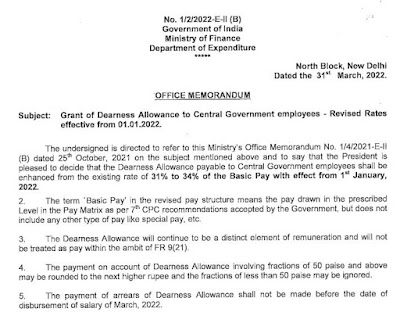
DA Jan 2022 - Grant of Dearness Allowance to Central Government employees - Revised Rates effective from 01.01.2022

 3% DA Hike - Revised Rates effective from 01.01.2022: DoE OM dated 31.03.2022 No. 1/2/2022-E-II (B) Government of India Ministry of Finance...