Tuesday, 11 December 2018

Restricted Holiday List 2019: Occasion of Birthday of Guru Gobind Singh in place of Lohri to be observed on 13/01/2019 - DoPT OM

Restricted Holiday List 2019: Occasion of Birthday of Guru Gobind Singh in place of Lohri to be observed on 13/01/2019 - DoPT OM

F. No. 12/2/2018-JCA-2
Ministry of Personnel, Public Grievances and Pensions
Department of Personnel & Training
Establishment (JCA) Section
North Block, New Delhi
Dated the December, 11 2018
Corrigendum

Subject: Restricted Holiday List 2019: Occasion of Birthday of Guru Gobind Singh in place of Lohri to be observed on 13/01/2019 - DoPT OM

In the list of holidays to be observed in Central Government Offices during the year 2019, circulated vide communication of even no. dated 11.07.2018, in the list of list of Restricted Holidays contained in Annexure-II, the entry 2 may be read as under:

S.No.HolidayDateSaka DateDay
1940 SAKA ERA
2.Guru Gobind Singh's Birthday in place of Lohri13.01.2019Pausha 23Sunday
2. Hindi version will follow.
(Jugal Singh)
Deputy Secretary to the Govt. of India
PH: 23093074
To
1. All Ministries/ Departments of Government of India.
2. UPSC/CVC/C&AG/PMO/Lok Sabha Secretariat/Rajya Sabha Secretariat / President’s Secretariat Vice-President’s Secretariat/Supreme Court / High Court / Central Administrative Tribunal / Election Commission of India / Minorities Commission National Human Rights Commission / Central Information Commission
3. All attached and subordinate offices of Ministry of Personnel, P.G. & Pensions.
4. Secretary, Staff Side, National Council (JCM), 13-C, Ferozeshah Road, New Delhi.
5. All Staff Side Members of the National Council (JCM).
6. All Staff Side Members of the Departmental Council (JCM), Ministry of Personnel, PG. and Pensions.
7. Chairman / Secretaries, Central Government Employees Welfare Coordination Committees (As per updated list from Welfare Section).
8. National Commission for Scheduled Castes /National Commission for Scheduled Tribes/ National Commission for Backward Classes.
9. PS to Cabinet Secretary.
10. Deputy Secretary (Coordination), Delhi Govt. Secretariat, I.G. Stadium, l.T.O., New Delhi.
11. The Manager (Store), Government of India, Forms Store, 166, Lenin Sarai, Kolkata (with 10 spare
copies).
12. The Chief Secretaries to all the State Governments / Union Territories.
13. Directorate of Advertising and Visual Publicity, PTI Building, New Delhi (with 5 spare copies)
14. Deputy Director (Bills), Dte. Of Printing, B-Wing, Nirman Bhavan, New Delhi (with 5 spare copies)
15. Positional Astronomy Centre, Block-AD, Plot No.8 Sector-V, Salt lake, Manish Bathan, Kolkata - 700091
16. Facilitation Centre, DOP&T (20 copies)

Source: DoPT

Central Government Employees Group Insurance Scheme-1980 - Table of Benefits for the savings fund for the period from 01.10.2018 to 31.12.2018


Central Government Employees Group Insurance Scheme-1980 - Table of Benefits for the savings fund for the period from 01.10.2018 to 31.12.2018

Central-Government-Employees-Group-Insurance-Scheme-1980

CGEGIS Table for 4th Quarter 2018 (from 01.10.2018 to 31.12.2018) of Benefits for the saving fund

No. 7(2)/EV/2016
Government of India
Ministry of Finance
Department of Expenditure
New Delhi, the 10 December, 2018

OFFICE MEMORANDUM

Sub: Central Government Employees Group Insurance Scheme-1980 - Table of Benefits for the savings fund for the period from 01.10.2018 to 31.12.2018.

The Tables of Benefits for Savings Fund to the beneficiaries under the Central Government Employees Group Insurance Scheme-1980, which are being issued on a quarterly basis from 01.01.2017 onwards, as brought out in this Ministry's OM of even number dated 17.03.2017, for the quarter from 01.10.2018 to 31.12.2018, as worked out by IRDA based on the interest rate or 8% per annum (compounded quarterly) as notified by the Department or Economic Affairs as per their Resolution No. 5(1)-B(PD)/2018 dated 04.10.2018, are enclosed.

2. The Tables enclosed are of two categories as per the existing practice. As hitherto the first Table of Benefits for the saving fund of the scheme is based on the subscription or Rs.10 p.m. from 1.1.1982 to 31.12.1989 and Rs 15 p.m. w.e.f.. 1.1.1990 onwards. The second Table or Benefits for savings fund is based on a subscription of Rs.10 p.m. for those employees who hod opted out or the revised rate or subscription w.e.f. 1.1.1990.

3. While these orders are in respect of Table or Benefits for the period from 01.10.2018 to 31.12.2018, the Tables already issued for the first quarter, second quarter and third quarter i.e. for the period 01.01.2018 to 30.09.2018 are also reproduced for the sake convenience and consolidation.

4 In their application to the employees of Indian Audit and Accounts Department , these orders are issued after consultation with the Comptroller & Auditor General of India.

5 Hindi version of these orders is attached.
Sd/-
(Amar Nath Singh)
Director
Source: doe.gov.in

TDS deduction under section 194A of the Income-tax Act, 1961 in case of Senior Citizens


TDS deduction under section 194A of the Income-tax Act, 1961 in case of Senior Citizens

F. No. Pr. DGIT(S)/CPC(TDS)/Notification/2018-19

Government of India
Ministry of Finance
Central Board of Direct Taxes
Directorate of Income-tax (Systems)
New Delhi
Notification No. 06 /2018
New Delhi, 06th December, 2018

Subject: - TDS deduction under section 194A of the Income-tax Act, 1961 in case of Senior Citizens - reg.

It has been brought to the notice of CBDT that in case of Senior Citizens, some TDS deductors/Banks are making TDS deductions even when the amount of income does not exceed fifty thousand rupees. The same is not in accordance with the law as the Income-tax Act provides that no tax deduction at source under section 194A shall be made in the case of Senior Citizens where the amount of such income or, the aggregate of the amounts of such income credited or paid during the financial year does not exceed fifty thousand rupees. (Please refer to the third proviso to sub-section 3 of section 194A)

2. Under sub-rule (5) of Rule 31A of the Income-tax Rules, 1962, the Director General of Income-tax (Systems) is authorized to specify the procedures, formats and standards for the purposes of furnishing and verification of the statements or claim for refund in Form 26B and shall be responsible for the day-to-day administration in relation to furnishing and verification of the statements or claim for refund in Form 26B in the manner so specified.

3. In exercise of the powers delegated by the Central Board of Direct Taxes (Board) under sub-rule (5) of Rule 31A of the Income-tax Rules, 1962, the Principal Director General of Income-tax (Systems) hereby clarifies that no tax deduction at source under section 194A shall be made in the case of Senior Citizens where the amount of such income or, the aggregate of the amounts of such income credited or paid during the financial year does not exceed fifty thousand rupees.
Sd/-
(Dewangi Marthak)
Asstt. Commissioner of Income-tax(CPC-TDS)
O/o the Pr. Director of Income-tax (Systems)
New Delhi
Source: incometaxindia.gov.in

Career progression of the staff working in GP Rs.1800


Career progression of the staff working in GP Rs.1800

All India Railwaymen's Federation
4, State Entry Road, New Delhi-110055
No.AIRF/24(C)
Dated: December 8, 2018
The Chairman,
Railway Board,
New Delhi

Sub: Career progression of the staff working in GP Rs.1800

Dear Sir,
As I have discussed this issue personally with your goodself and tried to get resolved the issue regarding career progression of the staff working in GP Rs.1800; because in many departments; the employees working in GP Rs.1800 are stagnating in GP Rs.1800 for 15 years and even 20 years, and these are the staff those who are working in GP Rs.1800 are virtually doing the job of skilled nature, in almost all the departments, including Technical and Non-Technical.

It would be in all fairness if 50% posts of GP Rs.1800 should be upgraded to GP Rs.1900, which will resolve the problems of the Railway Industry as well as the employees.

In this connection, it is worth-mentioning that, we have also requested your goodself for reduction in the Direct Recruitment Quota, and the employees having qualification of RRB should be given benefit for their selection against those vacancies through "LDCE open to all" policy, to facilitate the highly educated staff available over the Indian Railways.

We sincerely hope that, you will kindly consider it favourably and do the needful.
Yours faithfully,
sd/-
(Shiva Gopal Mishra)
General Secretary
Source: AIRF

Approximately 18 lakh central government employees covered under NPS would be benefitted from the streamlining of the National Pension System

National Pension System-NPS-Central-Government-Employees

Ministry of Finance

Streamlining of National Pension System (NPS)

Posted On: 10 DEC 2018 3:01PM by PIB Delhi
Decision
The Union Cabinet in its Meeting on 6th December, 2018 has approved the following proposal for streamlining the National Pension System (NPS).
  • Enhancement of the mandatory contribution by the Central Government for its employees covered under NPS Tier-I from the existing 10% to 14%.
  • Providing freedom of choice for selection of Pension Funds and pattern of investment to central government employees.
  • Payment of compensation for non-deposit or delayed deposit of NPS contributions during 2004-2012.
  • Tax exemption limit for lump sum withdrawal on exit has been enhanced to 60%. With this, the entire withdrawal will now be exempt from income tax. (At present, 40% of the total accumulated corpus utilized for purchase of annuity is already tax exempted. Out of 60% of the accumulated corpus withdrawn by the NPS subscriber at the time of retirement, 40% is tax exempt and balance 20% is taxable.)
  • Contribution by the Government employees under Tier-II of NPS will now be covered under Section 80 C for deduction up to Rs. 1.50 lakh for the purpose of income tax at par with the other schemes such as General Provident Fund, Contributory Provident Fund, Employees Provident Fund and Public Provident Fund provided that there is a lock-in period of 3 years.
Background
The new entrants to the central government service on or after 01.01.2004 are covered under the National Pension System (NPS). The Seventh Pay Commission (7th CPC), during its deliberations, examined certain concerns regarding NPS and made recommendations in the year 2015. The 7th CPC recommended for setting up of a Committee of Secretaries in this regard. Accordingly, a Committee of Secretaries was constituted by the Government to suggest measures for streamlining the implementation of NPS in the year 2016. The Committee submitted its report in the year 2018. Accordingly, based on the recommendations of the Committee, draft Cabinet Note was placed before the Cabinet for its approval.

Implementation strategy and targets
The proposed changes to NPS would be made applicable immediately once time critical decisions are taken in consultation with the other concerned Ministries / Departments.
Major impact
  • Increase in the eventual accumulated corpus of all central government employees covered under NPS.
  • Greater pension payouts after retirement without any additional burden on the employee.
  • Freedom of choice for selection of Pension Funds and investment pattern to central government employees.
  • Benefit to approximately 18 lakh central government employees covered under NPS.
  • Augmenting old-age security in a time of rising life expectancy.
  • By making NPS more attractive, government will be facilitated in attracting and retaining the best talent.
Expenditure involved
The impact on the exchequer on this account is estimated to be to the tune of around Rs. 2840 crores for the financial year 2019-20, and will be in the nature of a recurring expenditure. The financial implications on account of provisions regarding payment of compensation for non-deposit or delayed deposit of NPS contributions during 2004-2012, would be in addition to the amount indicated above.

No. of beneficiaries
Approximately 18 lakh central government employees covered under NPS would be benefitted from the streamlining of the National Pension System.
States/districts covered
Pan India.

Details and progress of scheme if already running
Presently, the new entrants to the central government service on or after 01.01.2004 are covered under the NPS. NPS is being implemented and regulated by Pension Fund Regulatory and Development Authority in the country.

PIB

DoPT: Procedure for booking of air-tickets on LTC- compliance of instructions


DoPT: Procedure for booking of air-tickets on LTC- compliance of instructions regarding.

DoPT-AIRTICKET-LTC

No. 31011/2/2018-Estt (A.IV)
Government of India
Ministry of Personnel, Public Grievances and Pensions
Department of Personnel and Training
Establishment A-IV Desk
North Block, New Delhi-10001
Dated: December 10, 2018
OFFICE MEMORANDUM

Subject:- Procedure for booking of air-tickets on LTC - compliance of instructions regarding.

The undersigned is directed to refer to this Department's O.M. No. 31011/5/2014-Estt.A-IV dated 24.09.2014, 23.09.2015 and 21.08.2017 on the procedure for booking of air tickets on LTC and to say that as per the extant instructions, whenever a Government servant claims LTC by air, he/she is required to book the air tickets directly from the airlines (Booking counters, website of airlines) or by utilizing the services of the authorized travel agents viz. 'M/s Balmer Lawrie & Company', 'M/s Ashok Travels & Tours' and 'IRCTC' (to the extent IRCTC is authorized as per DoPT O.M. No. 31011/6/2002-Est(A) dated 02.12.2009) while undertaking LTC journey(s).

2. In this regard, it is observed that despite reiterating the above instructions from time to time, this Department still continues to receive numerous references from various Ministries/Departments and individuals seeking relaxation for booking of air tickets for the purpose of LTC through private travel agents. In most of the cases, the common reasons cited by the Government employees are lack of awareness of the rules and work exigencies.

3. Therefore, all the Ministries/Departments are advised to ensure wide circulation and strict compliance of the guidelines stated in para 1 of this OM. This point may also be emphasized by the Administration whenever any advance is sought or intention to avail LTC is conveyed by the Government servant. It is stated that henceforth only those cases, where it is established that bonafide mistake has occured and the Administrative Ministry/Department is satisfied that undue hardship is being caused to the Government servant, shall be considered by this Department for relaxation provided that the information is received in the Proforma enclosed along with supporting documents.
End.: As above
(Surya Na ayan Jha)
Under Secretary to the Government of India
To
The Secretaries
All Ministries/Departments of Government of India
(As per the standard list)

Source: DoPT

Appointment on Compassionate Grounds - Railways


Appointment on Compassionate Grounds - Railways
Railways-Compassionate-Grounds


GOVERNMENT OF INDIA
MINISTRY OF RAILWAYS
(RAILWAY BOARD)
RBE No. 181/2018
New Delhi, dated 27.11.2018
No. E(NG)II/2018/RC-1/44 pt
The General Manager(P)
All Indian Railways & PUs

Sub: Appointment on Compassionate Grounds - Priority No. 1 case- reg.

Attention is invited to this office letter para 10 (i) and 10 (c) of Board's letter No. E(NG)II/90/RC-1/117 dated 12.12.1990 wherein it had been laid down regarding order of priority in offering appointment on compassionate grounds.

Priority No. 10 (i) - Dependents of employees who die or are permanently crippled in the course of duty and 10 (c) - a time limit of one month should be observed within which appointment should be given and Para 6 of Board's letter No. E(NG)II/91/RR-1120 dated 03.12.1991 wherein it had been laid down that Compassionate appointment in the clerical categories should be avoided to the extent possible. For any such appointment, General Manager should be personally satisfied that, the same is unavoidable, and offered as a last resort.

It has been decided by the Board that for the dependents of employees who die or are permanently crippled in the course of duty (Priority No.1), there should be no restriction on offering him/her clerical post and this power is hereby delegated to DRMs/CWMs solely for the dependents of employees who die or permanently crippled in the course of duty.
(Neeraj Kumar)
Director Estt. (N)II,
Railway Board.

Brief of the meeting held on 07.12.2018 with Hon'ble Minister for Railways


Brief of the meeting held on 07.12.2018 with Hon'ble Minister for Railways

All India Railwaymen's Federation
4, State Entry Road, New Delhi - 110055
No.AIRF/24(C)
Dated: December 8, 2018
The General Secretaries,
All Affiliated Unions,

Sub: Brief of the meeting held on 07.12.2018 with Hon'ble Minister for Railways

Dear Comrades,
Yesterday I met Hon'ble Minister for Railways and shown our anguish against the inordinate delay in resolving the problems of the Railwaymen at an earliest. We have also mentioned about the discussions held with the Railway Board on 4-5 December, 2018 and our decision of "Work To Rule".

He had given positive response and called the Member Staff and Financial Commissioner(Railways), Railway Board, telling them to resolve the problems of the Railwaymen at an earliest, including implementation of four grade structure, in the ratio of 10:20:20:50, in case of Trackmen/Track Maintainers, revision of the rates of Running Allowance and other allowances related to Running Staff, Restructuring of the IT Cadre, etc. etc. The meeting was held in a very cordial atmosphere and Hon’ble MR had appreciated the sentiments of the Railwaymen organized under AIRF.
This is for your information.
Yours faithfully,
sd/-
(Shiva Gopal Mishra)
General Secretary
Pending burning issues of the Railwaymen

The undernoted burning issues have been time and again brought to your kind notice for early redressal thereof because non-redressal of these issue is causing serious deep sense of discontentment among the Railway Staff……

1.Implementation of four grade structure in the ratio of 10:20:20:50 in case of Trackmen/Track Maintainers - As you are very well aware that, the Joint Committee on Package and Career Progression of Trackmen had, unanimously recommended to grant four grade structure to the category of Trackmen/Track Maintainers in the ratio of 10:20:20:50 with a view to facilitate advancement prospects to this ever neglected category of the staff who are directly involved in safe train operation by maintaining railway track. Despite assurance given by the Railway Board, during the course of discussions in Railway Board PNM with AIRF, that, orders would be issued within a couple of days to implement the said four grade structure, final outcome is still awaited, due to which serious resentment is brewing among the Trackmen/Track Maintainers.

2.Revision of the rates of Running Allowance and other allowances related to Running Staff - This issue has also been deliberated at length at several occasions, but unfortunately, Railway Board’s instructions to this effect are yet to be issued. The Running Staff, both Loco & Traffic, are seriously concerned due to inordinate delay in revision of the rates of Running Allowance and other allowances related to Running Staff because on previous occasions the revision used to be done just after implementation of recommendations of the successive Central Pay Commissions.

I would, therefore, seek your personal intervene, so that, revision of the rates of the aforesaid allowances is done without any further delay.

3.Restructuring of the IT Cadre - Information Technology has gained paramount importance in all walks of the life. While IT Cadre was formed in the Indian Railways more than a decade ago, but there is still some confusion in regard to dysfunction and Human Resource Management. Railway Board had issued instructions for Cadre Restructuring of IT Cadre (Ref.No.2016/AC-II(CC)/37/9 dated 18.04.2017(RBA No.45/2017), No.2017/AC-II(CC)/37/7 dated 29.06.2017 and No.2017/AC-II/37/9 dated 29.12.2017), but unfortunately, an impracticable condition was imposed to surrender all the vacant posts in the cadre, whereas, in Cadre Restructuring of other categories, only number of posts of Matching Money Value were surrendered and not the entire vacant posts. We have been regularly pursuing this issue, and the present Financial Commissioner, Railway Board, also assured to take necessary action in the matter, but final outcome is still awaited.

I would, therefore, request that, this issue should also be looked into on priority and revised orders issued early.

I sincerely hope that, the above issues would definitely be given due attention and necessary instructions shall be issued without any further delay, keeping in view the discontentment brewing among these vulnerable categories of the Railwaymen.

Source: AIRF

Sunday, 9 December 2018

NPS to OPS: New Pension Scheme Demand To Scrap it

NPS to OPS: New Pension Scheme Demand To Scrap it

New Pension Scheme Demand To Scrap it

New-Pension-Scheme-Scrap-NPS-OPS


NEW PENSION SCHEME (NPS): The New Pension Scheme is made compulsory for Government employees was brought into effect 2004, this has effected them a lot, lot of agitations are being carried out on scrapping the New Pension Scheme, this agitations has forced many State Governments such as Karnataka, Kerala, Andhra Pradesh, Delhi State Governments to reconsider this New Pension Scheme and formed an expert committee to review this New Pension Scheme. This New Pension Scheme was not implemented by West Bengal State Government. In this angle an analysis is made all about New Pension Scheme and ways to scarp or modify the New Pension Scheme to benefit the Government employees at large is suggested.

Need for Pension : The Pension System thus started in India was finalized by the Indian Pension Act of 1871. It appears that the British Government had the conception of providing its pensioners increase in their pensions to neutralize the effect of inflation.

Pension is a reward for past service. It is undoubtedly a condition of service but not an incentive to attract new entrants, the Pension is paid for past satisfactory service rendered, and to avoid destitution in old age as well as a social welfare or socio-economic justice measure, the fact that the cost of living has shot up and correspondingly the possibility of savings has gone down and consequently the drop in wages on retirement.

That pension is neither a bounty nor a matter of grace depending upon the sweet will of the employer and that it creates a vested right subject to 1972 rules which are statutory in character because they are enacted in exercise of powers conferred by the proviso to Art. 309 and clause (5) of Art. 148 of the Constitution; (ii) that the pension is not an ex-gratia payment but it is a payment for the past service rendered; and (iii) it is a social welfare measure rendering socio-economic justice to those who in the hey-day of their life ceaselessly toiled for the employer on an assurance that in their old age they would not be left in lurch.

As on 01-01-2018 there were 51.96 lakh pensioners in the country, including from Central Civil Services, Railways, and Post, Defence and Defence civilians.

EVOLUTION OF NEW PENSION SCHEME (NPS) IN INDIA:

In 1991 Government of India as introduced diverse economic reforms to pull the country out of economic crisis and to accelerate the rate of growth. These reforms are often described as the New economic policy (NEP) or policy of LPG where L for liberalisation; P for privatisation; G for globalisation. The Congress Government under the Prime Ministership of Hon’ble Prime Minister Shri P. V. Narasimha Rao, the signed an agreement with the International Monetary Fund (IMF) to get the IMF loan in which the IMF had imposed various conditions to get the soft loan which includes pension reforms , which the Indian Government Congress Government had accepted it to reform in a 10 years period .

On the basis of the decision taken in the Eleventh Conference of State Finance Secretaries held in the Reserve Bank of India (RBI) during January 2003, a Group was constituted by the RBI in February 2003 to study the pension liabilities of the State Governments and make suitable recommendations.
The "Pension Fund" to be created under the proposed revised schemes should be kept completely outside the States' Consolidated Fund and the Public Account

The pension systems, both for Civil Servants and other citizens, as evolved over the years have begun to show signs of financial stress in many countries, including India. Since the pension benefits of Government employees are usually paid from the general revenue of the Governments, the steep rise in such liabilities adversely affect the fiscal soundness of the Government entities. In India too, the increasing pension liabilities of the Central and State Governments have emerged as a major area of concern, especially in the wake of fiscal deterioration in recent years. About 20% of the state Government funds are spent on pension.

During the Hon'ble Prime Minister Shri Atal Bihari Vajpayee of NDA was in power from 1998 to 2004 which implemented this agreement of IMF on pension reforms . The NDA Government constituted two committees namely B.K.Bhattacharya committee headed by Shri B.K.Bhattacharya, Former Chief Secretary, Government of Karnataka as chairman and under the Chairmanship of Shri Biju Patnaik, Chief Minister of Orissa , both these committees recommended introduction of New Pension Scheme (NPS) & Hon'ble Prime Minister Shri Manmohan Singh of Congress (UPA) was in power from 2004 to 2014 continued to accept these pension reforms.
The New Pension Scheme (NPS) was announced on December 22, 2003 by the NDA Government, for all new government employees excepting those in the Armed Forces. This brand new system replaces the defined benefit system of pension and this includes GPF. Contributory pension scheme is for entrants who joined after 1st January 2004.

While the NPS is mandatory for the Central government employees, it has potentially a much wider reach. As of March 2007, 19 states which have decided to introduce similar schemes, mandating newly recruited civil servants to mandatorily join the NPS‐type scheme.

The NPS started with the decision of the Government of India to stop defined benefit pensions for all its employees who joined after 1 January 2004. While the scheme was initially designed for government employees only, it was opened up for all citizens of India in 2009. Over 15 lakhs Government employees are currently registered in NPS scheme.

The Department of Economic Affairs (DEA) at the Ministry of Finance, notified a new pensions regulator in August 2003, before the NPS commenced operations in January 2004. The PFRDA bill was presented in 2005, and was finally passed in Parliament in 2013.
Let us analyse why Government is adopting the pension reforms:

Sl. noIndian Government ViewEmployees view
1The ratio of retirees to workers is on continuous rise and further by 2030 the 25% of the population (200 million pensioners) will be above 60 years of age.The large number of employees are effected by the New Pension reforms, hence Government should keep it in mind the interest of the large chunk   of employees
2The Pension system shall put enormous financial pressure on the Government and take away funds meant for social cause spending, this will cause a drain on the state of economy.About 80 % of employees are Group "C" workers, the pension amount is ultimately spent by them for their daily needs and money flows into the market and economy will not be effected , secondly Government is a model employer and it has social responsibility towards its employees.
After a decade of existence, there is need to examine the existing NPS and compare the performance of this system to the goals with which it was created.

*One of the key bottlenecks has been the lack of a sound regulatory framework, put in place by an empowered and independent regulator. The PFRDA Bill that had been pending since 2002 was finally passed in 2013. This enables the formal institutionalisation of the PFRDA as the regulator of the NPS. The PFRDA can now take on the task of both the relatively short term agenda of closing the gap between the current NPS and the original design.
*Central government employees can invest in these assets only through their Tier II account which get higher returns on longer period.
  • After the enactment of the Pension Fund Regulatory and Development Act, 2013, it is not the exclusive liability of the government to pay the pension."
    The Ministry of Finance will oversee and supervise the Pension Funds through a new and independent Pension Fund Regulatory and Development Authority.”
WHAT IS THE NATIONAL PENSION SCHEME?
Each Government employee contributes 10 % of his salary (Basic Pay + DA + DP) to the pension account , which is then matched by a Government contribution of an equal amount .
National Pension Scheme or New Pension scheme is a pension plan offered by the government. Investment in this scheme is via debt and equity market. The invested amount is locked until retirement. At retirement age, you can withdraw 60% of the maturity amount while the balance40% must be invested in annuity. The maturity amount is taxable. The NPS is regulated by the PFRDA and fund management is by designated fund managers from the private and public sector. NPS has the lowest charges.

From our salaries and daily allowance, 10 per cent is cut towards pension and an equal amount is given by the government. This amount is invested into the share markets under the new scheme.
An NPS subscriber can withdraw 25% of his contribution to the corpus for emergencies before retirement. Instead of withdrawing the entire amount at retirement, you can withdraw Rs 25,000, or 25% of your contribution, earlier, without any tax incidence. The remaining Rs 1.75 lakh is withdrawn on retirement.

New Pension Scheme extension of benefits of Retirement Gratuity and Death Gratuity to the Central Government employees covered by New Defined Contribution Pension System (National Pension System)-regarding. All these condition would be equally applicable for grant of gratuity to employees covered under New Pension Scheme.

An individual can claim tax deduction of upto 10 percent of the salary contributed towards NPS under Section 80 C. For those contributing through the corporate scheme, an employee can claim tax deduction on contribution made by the employer, not exceeding 10 percent of his basic salary plus dearness allowance (if any) Under Section 80 CCD (2). This is above the overall limit of Rs.1 lakh offered under Section 80C.

How New Pension Scheme (NPS) is affecting the Government employees.

The New Pension Scheme is highly disadvantageous to the Government employees under the present situation the pension amount is invested into the share markets under the new scheme. If the markets are doing well, the employees will get a good pension if the share market fails no pension is available to them. Under the old system, employees would get a fixed amount as pension that was 50 per cent of their last basic salary. When the salary was hiked, the pension amount too would be revised. Under the present NPS system, there is no security as pensions depend on market conditions. Secondly the NPS is highly disadvantageous if the length of the Government service is less if a employee serves for 20 years, he draws a pension of about Rs 3,000/- to Rs 5,000/ only. If he completes 33 years of service he draws about Rs 12,000/- to Rs 15,000/- compared to Rs 15,000/- to Rs 20,000/- in the old pension system, this new pension system needs a deep study and its minimum pension should be at least 50% of the last pay drawn. It is upto the Government how and where the money is invested, but a minimum guarantee of 50% of the last pay drawn should be assured by the Government to the employee.

Under New Pension Scheme is in reality much steeper than what the quantum of pension would indicate the differential treatment for those retiring under Old Pension scheme and New Pension Scheme, would be according differential treatment to pensioners who form a class irrespective of the type of retirement and, therefore, would be violate of Art. 14. It was also contended that classification based on fortuitous circumstance of retirement in old or New Pension Scheme, fixing of which is not shown to be related to any rational principle, would be equally violate of Art. 14.

Pension Scheme around the Globe : The USA, Canada, United Kingdom, China , Germany etc. Governments have a scheme of a Defined Benefit (DB) pension is where you receive a specific amount of pay out that is guaranteed by employer, regardless of how their pension investment performs. Your defined benefit amount depends on how much is paid into the plan and your years of service with that employer.

CONCLUSION:The Indian Government should also have a similar Defined Benefit (DB) pension scheme like other major countries in the world have, as many state Governments are re thinking on the New Pension Scheme, hence this New Pension Scheme should be remodelled to suit the Government employees. The Government should take up more social responsibilities of protecting its employees.
We request the government to reintroduce the old pension system. For this a greater movement should take place amongst the New Pension Scheme employees forcing Central Government to rethink the new pension policy adopted after 2004.
P.S.Prasad
Working President
COC Karnataka
Source: http://karnatakacoc.blogspot.com/
New Pension Scheme, NPS, Old Pension Scheme, OPS, Central Government Employees News, Pension System ,

Grant of Non Functional Grade Pay Rs. 5400 to Inspectors under ACP/MACP Scheme - CBDT Orders dated on 6.12.2018


Grant of Non Functional Grade Pay Rs. 5400 to Inspectors under ACP/MACP Scheme - CBDT Orders dated on 6.12.2018

OA No.1707/2016 filed by Shri R.K.Tripathi & Ors. Vs. UOI & Ors. before Hobble CAT PB, New Delhi - for grant of non-functional Grade Pay of Rs.5400/- in PB-2 to those Inspectors who were granted Grade Pay of Rs.4800/- due to ACP / MACP Scheme
Most Immediate
Court Matter
By FAX/Speed post
F.No.A-23011/62/2016-Ad.IIA
Government of India
Ministry of Finance
Department of Revenue
Central Board of Indirect Taxes and Customs
North Block,New Delhi.
Dated 6th December,2018
To,
Director General
Directorate of Human Resource Development(HRM),
Customs & Central Excise,507,Deep Shikha,
Rajendra Place,New Delhi-110 008

Subject: OA No. 1707/2016 filed by Shri R.K. Tripathi & Ors before Hon'ble CAT PB,New Delhi for grant of non-functional Grade pay of Rs. 5400/- in PB-2 to those Inspectors who were granted Grade Pay of Rs. 4800/-due to ACP/MACP Scheme

Sir,

I am directed to say that as per extant instructions,non functional Grade pay of Rs.5400 in PB-2 (per-revised) is granted to those Superintendents/ Appraisers who have completed 4 years who was granted Grade pay of Rs. 4800/- Shri M.Subramaniam,the then Inspector who was granted Grade pay of Rs. 4800/-due to ACP scheme, got favorable judgment from the Hon'ble Supreme Court.Review Petition in the said case was also dismissed by the Hon'ble Supreme Court.

2.Consequent upon dismissal of Civil Appeal No.8883/2011 and Review Petition in Civil Appeal filed by UOI by Hon’ble Supreme Court,the judgement of Hon'ble High Court of Madras in M. Subramaniam has been implemented in consulation with D/o Expenditure.

3.Keeping in view a number of similar court cases in different Benches of CAT/Court being decided by CAT/High Court, in favour of petitioners,the matter was examined in the Board and a proposal was referred to D/o Expenditure tp consider extension of the direction of the Hon'ble Court in M.Subramaniam,to all similarly placed officers.Deptt.Of Expenditure vide note dated 12.11.2018 examined the matterand sought following clarifications:-

(i) How many individuals of which posts have been allowed the benefit so far?
(ii) How many similarly placed persons are to be covered in the benefit?
(iii) Whether the similarly placed persons are holder of the same post which was held by the individuals covered in the SLP?
(iv) The financial implications on the befit already allowed and the estimated financial implication on the similarly placed employees?

4.The details sought by D/o Expenditure vide note dated 12.11.2108 needs to be compiled from the Zonal Commissionerates. You are requested to kindly obtain the details/information on the points mentioned above from Zonal Commissionerate, compile it and furnish the same to the Board for taking up the matter with D/o Expenditure. Since a number of court cases are pending in CAT/High Court, it is requested to expedite this exercise and detail/information be made available to the Board, by 20.12.2018.
Yours faithfully,
sd/-
(M.K.Gupta)
Under Secretary to the Government of India
Source: Confederation

Flash News

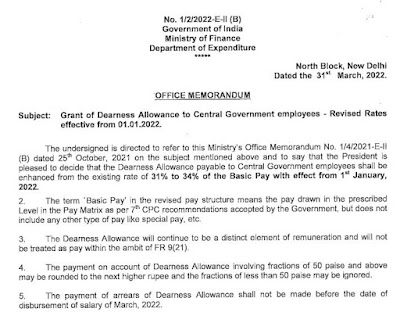
DA Jan 2022 - Grant of Dearness Allowance to Central Government employees - Revised Rates effective from 01.01.2022

 3% DA Hike - Revised Rates effective from 01.01.2022: DoE OM dated 31.03.2022 No. 1/2/2022-E-II (B) Government of India Ministry of Finance...